


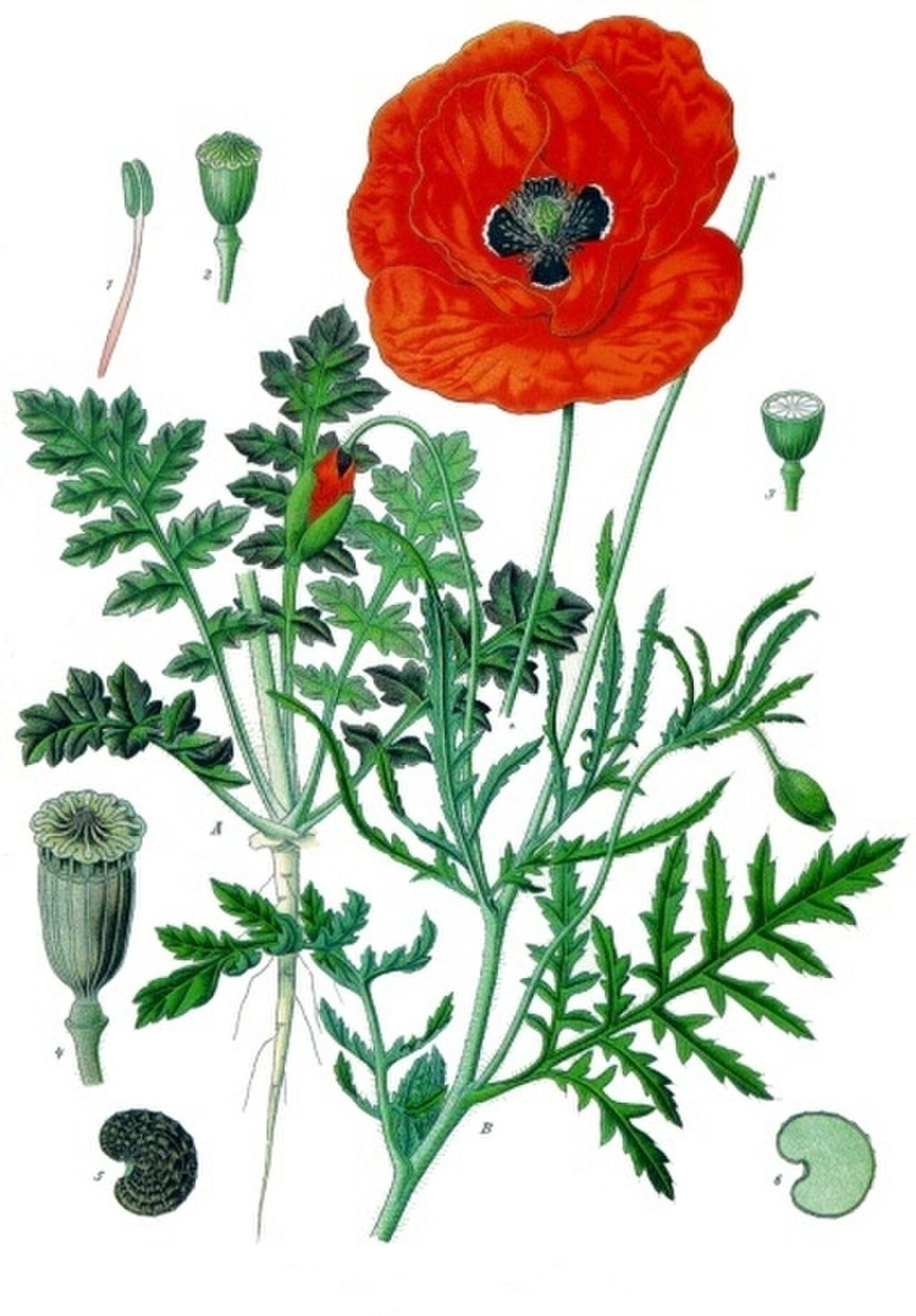
 by Tom Gurney
Tom Gurney BSc (Hons) is an art history expert with over 20 years experience
Page Created on September 22, 2026 / Page Updated on September 22, 2026
Email: tomgurney1@gmail.com / Phone: +44 7429 011000
Introduction
Georgia O’Keeffe’s Red Poppy is both smaller and more complicated than its fame suggests. The painting measures only 7 by 9 inches (17.8 by 22.9 centimetres). Within that intimate horizontal canvas, one orange-red bloom expands almost from edge to edge. A black centre anchors its folds, a trace of green stem appears below, and an unmodulated pale field isolates the flower.[1]
Made in 1927, it is oil on canvas and catalogue raisonné number 594. Its present owner is identified only as a private collection.[1] The work should not be confused with O’Keeffe’s two-flower Oriental Poppies of the same year or with several much larger single poppies dated 1928.[4][5][6] CR 594 moved from a private gift to museum retrospectives and then into millions of everyday journeys.
In 1996 the United States Postal Service reproduced it on a 32-cent commemorative stamp honouring O’Keeffe. The stamp turned a tiny canvas into an even smaller printed image, but multiplied its audience across a national postal network.[16] In 2026, the Georgia O’Keeffe Museum returned to that transformation with the stamp’s designer, making reproduction history part of the painting’s current reception.[19]
At a Glance
- ArtistGeorgia O’Keeffe
- ArtworkRed Poppy
- Artistic contextAmerican modernism
Contents
- Object identity
- A miniature made monumental
- Colour and material limits
- Date evidence and title confusion
- Botanical identity
- The 1928 debut
- Museum history and recovered exhibitions
- Daniel Catton Rich, gift and retrospectives
- Later provenance
- Stamp, anniversary and public afterlife
- Sexualised reception and O’Keeffe’s response
- Multilingual and transcultural reception
- Limits of the record
- Close looking
- Why the painting matters
Object identity
- Maker: Georgia O’Keeffe (1887–1986)
- Title: Red Poppy
- Date: 1927, with a 1928 date on the backing
- Medium: oil on canvas
- Dimensions: 7 × 9 inches (17.8 × 22.9 cm)
- Catalogue raisonné: CR 594
- Collection: private collection
- First documented exhibition: O’Keeffe exhibition, Intimate Gallery, New York, January–February 1928[1][2]
The scale must travel with every account. Reproductions often place the picture on a full page or screen, making it seem physically comparable to O’Keeffe’s thirty- and forty-inch flowers. CR 594 creates enlargement inside an object barely wider than a hand.
A miniature made monumental
The flower stretches laterally. Its upper petals rise and fold around a dark centre; broad lower petals descend towards the bottom edge. Orange and scarlet move into deeper red near overlaps. The centre is black but not perfectly circular, and its uneven edge makes it feel embedded among petals rather than pasted onto them.[1] Only a slim green stem survives beneath the bloom.
That small vertical mark carries disproportionate importance: it identifies support and growth while showing how much of the plant O’Keeffe has removed. Leaves, soil, vase and surrounding garden disappear. The pale ground is similarly active. It occupies small wedges above and beside the flower, establishing the contour by contrast. Because it offers neither horizon nor cast shadow, the flower does not sit in ordinary three-dimensional space.
It appears displayed, suspended or pressed towards the viewer. The picture is often described as a close-up. That term usefully names proximity, but it should not imply a mechanically photographed crop. O’Keeffe redistributed curves, selected which petals crossed, opened the centre and retained just enough stem to keep the form botanical. O’Keeffe’s flower strategy is frequently reduced to making small things large.
Red Poppy proves that actual dimensions and depicted scale are separate. The bloom seems large because its contour almost exceeds the field; the painting remains only 63 square inches. This contradiction controls viewing distance. A large canvas can address the whole body across a gallery. CR 594 asks the spectator to approach. At close range, the petal curves occupy much of vision despite the object’s portability. Intimacy produces pressure. The white border-like field intensifies that pressure. There is no atmospheric recession into which the flower can retreat. Its edges meet a flat light zone, making the red advance.
The crop feels expansive because the surrounding information is so scarce. The later postage stamp would repeat this logic at another scale. A miniature reproduction still allowed the bloom to fill its rectangle. What changed was the object’s function and circulation, not the basic relation between flower and boundary.[16]
Colour and material limits
“Red” in the title is an economical label. The painting itself moves through orange, scarlet, warm vermilion-like passages, deep crimson and near-black. The colour changes with petal direction: broad zones carry light, while overlaps darken and curve inward. The centre does more than provide contrast. Black gathers the composition and makes adjacent orange appear more luminous. Pale ground performs the opposite operation, sharpening the outer contour. The flower sits between two extremes of value. Green is small but decisive. The stem introduces a complementary contrast and connects the bloom to a plant outside the crop. Its restraint keeps the composition from becoming a conventional red-and-green floral arrangement.
These descriptions name visible colour, not pigment chemistry. No public object-specific scientific analysis identifies the reds, black, green, ground or varnish of CR 594.[1] A digital image cannot securely supply that information. Oil on canvas is unusual in effect at this small scale because the support carries the status of a portable study while the controlled transitions feel resolved. The medium lets O’Keeffe build saturated colour and soften boundaries without the absorbency and exposed paper typical of watercolour.
The backing supplies crucial evidence. It bears the words “Red Poppy – 1928 / Georgia O’Keeffe” in black ink.[1] Stretcher and verso are recorded as inaccessible. That means the public catalogue offers a partial physical archive rather than a complete examination. Technical studies of other O’Keeffe paintings can identify paint layers, supports, underdrawing, surface protrusions and conservation interventions.[23]
Those findings cannot be imported into CR 594. The correct technical conclusion is modest: oil on canvas, observed visual modulation, a recorded backing inscription and no published object-specific treatment or analytical report. The painting’s private ownership further limits current evidence. Condition may have been assessed for loans or sale, but no such report is public. A manuscript should not describe craquelure, fading, restoration or original frame without documentation.
Date evidence and title confusion
The backing appears to offer a direct date, yet the catalogue assigns 1927. The Whitney Archive says “Painted 1927”, the Abiquiú Notebooks record 1927, and the work appeared in the O’Keeffe exhibition that opened in January 1928.[1] That chronology makes late 1927 plausible. The backing may record the year of exhibition, inscription or later handling rather than execution. The evidence does not establish exactly when or why the discrepancy arose. Catalogue practice weighs multiple sources rather than obeying the most visible numeral. In this case, archive agreement and the early exhibition favour 1927, while the material inscription remains part of the object’s history. Both should be published.
The older O’Keeffe Museum database supplies additional specificity: the 1928 checklist placed it at number 33.[2] Its record also once located the private collection in New York in 1979. The current Access record removes that location, so present ownership should remain simply “private collection”.[1][2] CR 594 is the 7-by-9-inch single flower dated 1927.
The adjacent catalogue number, CR 595, is Oriental Poppies, also 1927: two red-orange blossoms fill a canvas about 30 by 40 inches, now at the Frederick R. Weisman Art Museum.[4] In 1928 O’Keeffe produced more large single-flower canvases. CR 637, Red Poppy, measures 36¼ by 30 inches and has circulated under Red Poppy No. VI. Its documented provenance runs from the Downtown Gallery through John H. Hauberg, Reed College, auction and Gerald Peters Gallery.[6]
CR 638 is another Red Poppy, 30 by 36 inches, now at the Museum of Fine Arts, St Petersburg. Its alternate titles include Red Poppy No. V and Poppy. The catalogue dates it 1928, while its owner has used 1927.[5] These are not enlarged copies of the small picture. Number, orientation, petal arrangement, field and dimensions differ.
A caption containing only “Red Poppy” and “1927” is still vulnerable to error because owner records have assigned 1927 to CR 638. The catalogue number and measurements lock identity. The distinctions also revise the idea of a single iconic poppy. O’Keeffe tested the motif across intimate and monumental supports, single and paired blossoms, pale and saturated grounds. Repetition was a method of comparison.
Botanical identity
The painting’s common title does not provide a Latin name. A red poppy with a dark centre could suggest several species or garden hybrids. Because O’Keeffe removes leaves, bud, seed capsule and most of the stem, diagnostic evidence is weak. The closely related CR 595 is titled Oriental Poppies, making Papaver orientale an important context.
Kew describes that species as a perennial native from eastern Türkiye to northern Iran, with large red or orange flowers and bristly leaves; it entered western European gardens in the early eighteenth century and exists in many cultivated forms.[20] The Royal Horticultural Society describes large, short-lived, bowl-shaped flowers with dark basal blotches and four petals.[21] Those traits illuminate the painted contrast between red petal and black centre.
They do not prove that CR 594 records P. orientale rather than another poppy. Botanical caution matters because titles within a group can migrate. “Oriental” belongs securely to CR 595’s catalogue name. Applying it automatically to CR 594 would turn proximity into taxonomy. The painting offers an intensely selected flower, not a herbarium specimen.
The 1928 debut
Red Poppy first appeared in O’Keeffe’s exhibition at the Intimate Gallery, opened by Alfred Stieglitz in January 1928. The checklist title agrees with the backing and major archives, even though the year does not.[1] The work entered public view beside recent city pictures, flowers and abstractions. Its tiny format would have affected that encounter. On a wall with larger canvases, scale could become a sequence rather than a single signature effect. The Intimate Gallery was both exhibition space and commercial structure. Stieglitz promoted O’Keeffe, while she increasingly handled installation and practical gallery matters during the later 1920s.
The show should therefore not be described as something done to a passive artist.[22] The first title was already plain: Red Poppy. Unlike titles that encode location or numbering, it provides colour and plant only. The economy helps the image remain memorable, but later made confusion among different canvases easier.
Museum history and recovered exhibitions
In 1932–33 the painting entered American Painting and Sculpture, 1862–1932. A MoMA flower checklist from the period places O’Keeffe’s Red Poppy and Jack-in-the-Pulpit, No. 2 among floral works by artists including Manet, Matisse, Monet, Kuniyoshi and Redon.[7] That context reframed the work. At the Intimate Gallery it belonged to one artist’s current production; in a thematic museum display, it entered a longer and transatlantic history of flower imagery.
Its severe crop and small support could be measured against vase paintings, gardens and symbolist blooms. The exhibition history then records the 1934 International Exhibition of Paintings in Pittsburgh and a 1938 O’Keeffe presentation at William & Mary.[1] Movement among New York, Pittsburgh and Williamsburg broadened the work’s institutional geography before its gift to Daniel Catton Rich. In 1998 researchers found a handwritten Stieglitz list of eight paintings loaned from An American Place to William & Mary.
That discovery enabled a 2001 reconstruction of the short exhibition, which Access O’Keeffe dates to 4–9 May 1938.[13] The reconstruction appeared first at the Muscarelle Museum and then at the Georgia O’Keeffe Museum.[13][14] It restored a little-known southern exhibition to the record and demonstrated how one surviving checklist can change the visible career of an object. William & Mary’s current archive guide calls this the earliest known local exhibition but gives 4–9 May 1935, while also placing O’Keeffe’s honorary degree in 1938.[15]
Access O’Keeffe says 1938 and explains the recovered Stieglitz document. Until the underlying archive is reconciled, the catalogue date should control and the institutional disagreement should remain explicit. The event is historically notable because the work spent only five days in that setting. Exhibition importance cannot be measured by duration alone; documentary loss had nearly removed it from the public chronology altogether.
Daniel Catton Rich, gift and retrospectives
O’Keeffe gave Red Poppy to Daniel Catton Rich in 1943.[1] Rich was then director of the Art Institute of Chicago and had organised her exhibition there that year, the museum’s first solo retrospective devoted to a woman artist.[10] Their friendship began after meeting in 1929 and developed through exhibitions and institutional work. After Stieglitz died in 1946, O’Keeffe consulted Rich while sorting and distributing the enormous Stieglitz collection among public institutions.[10][11]
The retrospective did not arrive as a neutral institutional arrangement. All sixty-one works came through An American Place, so the survey was extensive but excluded paintings O’Keeffe had already sold.[26] She then spent three days installing it and insisted that the largest of the three galleries be repainted. The final sequence of two white rooms and one greenish-grey room made wall colour part of her presentation. These decisions establish O’Keeffe as an active author of the exhibition environment, alongside Rich’s curatorial and critical work.
Her hanging made CR 594’s scale explicit. Archival installation photographs show the 7-by-9-inch Red Poppy beside East River from the 30th Story of Shelton Hotel, a 30-by-48-inch city canvas, with the large Abstraction and From the Lake No. 3 nearby.[26] Subjects, dates and sizes were allowed to resonate rather than being segregated into flowers, cities and non-objective work. The miniature flower therefore operated as a deliberate interruption within a wall of large forms, demonstrating that intensity and physical dimensions were separate questions for O’Keeffe herself.
The gift can therefore be documented as part of a sustained professional relationship. The Museum’s exhibition study judges that O’Keeffe likely gave Rich Red Poppy to thank him personally, but marks that purpose as an inference rather than a documented statement.[26] It would still be speculative to call the picture payment or attach it to a specific service without correspondence. Rich helped expand museum commitments to modern and photographic art, conservation and education. O’Keeffe later wrote a eulogy for him after his death in 1976.[12]
The friendship places CR 594 within the interpersonal labour through which modern American art entered museums. The Art Institute’s 1943 exhibition preceded the gift and listed Red Poppy as number 26.[1][2] It presented O’Keeffe’s career at a major encyclopaedic museum and led to the institution’s purchase of Black Cross, New Mexico, its first O’Keeffe.[10] Three years later CR 594 appeared as number 30 in the Museum of Modern Art retrospective.[2]
MoMA now identifies that exhibition as its first retrospective devoted to a woman artist. It was organised chronologically and combined flowers with early abstractions and New Mexico landscapes.[8] O’Keeffe participated closely in preparations. MoMA’s press material foregrounded her account of finding colour and shape capable of saying what words could not.[8][9] That statement is broader than Red Poppy, but it helps explain why hue and form should be examined before symbolic claims are imposed.
The retrospective was not the endpoint of recognition. The painting later entered the 1966 Amon Carter survey, the 1970–71 Whitney retrospective and the 1987–89 multi-museum retrospective.[1] Repeated inclusion made this very small privately held canvas part of the institutional canon. The 1966 exhibition travelled from the Amon Carter Museum to the Museum of Fine Arts, Houston. The 1970–71 retrospective moved from the Whitney Museum to the Art Institute of Chicago and San Francisco Museum of Modern Art.
The 1987–89 survey travelled still more widely, through the National Gallery of Art, Art Institute, Dallas Museum of Art, Metropolitan Museum of Art and Los Angeles County Museum of Art.[1] Each itinerary enlarged the number of viewers able to meet an object otherwise inaccessible in a private collection. Its inclusion also affected the category “major work”. Museums repeatedly borrowed a picture with neither monumental dimensions nor a permanent public home. Canonical status emerged from loans, catalogues and comparison rather than from sheer size or one institution’s continuous display.
Later provenance
Daniel Catton Rich retained the work until his death. It passed by bequest to Michael Rich in Chicago in 1979 and appeared at Sotheby Parke Bernet on 19 April that year as lot 177.[1] The older museum database then recorded a private collection in New York.[2] The current catalogue says only “Private Collection” and does not publish subsequent owners, sales or transfers.[1]
That is a limit, not an invitation to fill the gap from unsourced market sites. Private ownership did not prevent loans. The exhibition history reaches through major surveys and the O’Keeffe Museum’s inaugural exhibition in 1997–98, followed by the Williamsburg reconstruction in 2001.[1] Custody and visibility therefore followed different paths. The inaugural display had particular symbolic force.
A work given to a museum director, later dispersed at auction and still privately held helped open the institution devoted to O’Keeffe in Santa Fe. It briefly acquired a public setting close to the artist’s long-term New Mexico home without changing ownership. The Smithsonian inventory independently identifies the work and catalogue literature, but it is an inventory record rather than a current-owner statement.[3] Access O’Keeffe controls present metadata while the Smithsonian provides corroboration.
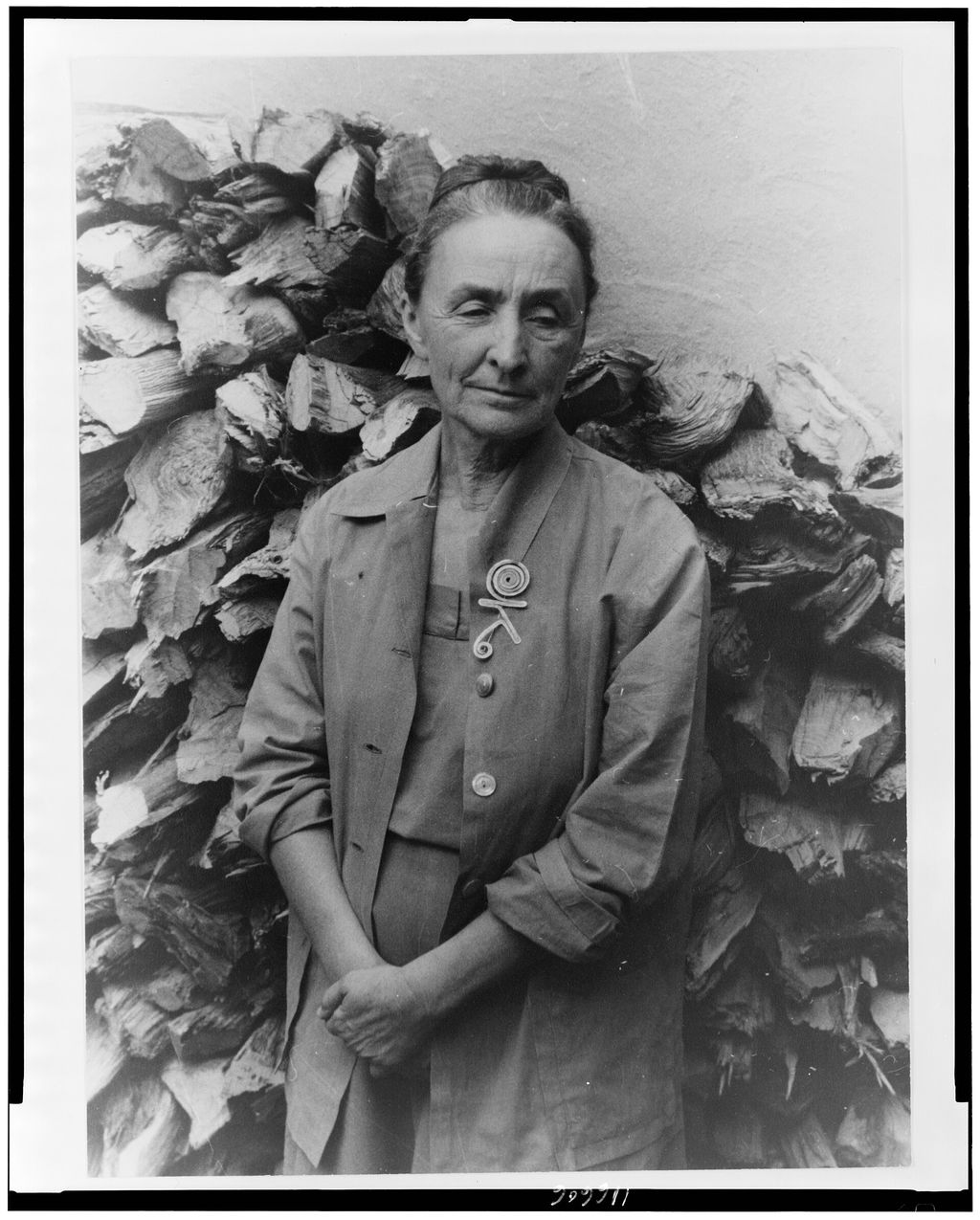
Stamp, anniversary and public afterlife
The United States Postal Service issued a 32-cent O’Keeffe commemorative on 23 May 1996 in Santa Fe, with nationwide sale beginning the following day. Margaret Bauer designed it; Stamp Venturers printed it by gravure; a pane combined fifteen flower stamps with a photograph of O’Keeffe.[16] The choice of CR 594 was especially apt for reduction. Its simple horizontal field, strong centre and broad colour zones survive at stamp scale. Yet the transformation was not neutral.
The canvas ratio had to enter a designed pane with denomination, national lettering and artist commemoration. The stamp detached the image from private ownership and museum loan schedules. Anyone could buy, handle, cancel and send it. The flower became simultaneously artwork reproduction, federal currency-like instrument and travelling memorial. Gravure translated oil into tiny coloured dots and mechanically repeatable layers.
Perforation gave the image a serrated physical edge foreign to the canvas, while cancellation could mark the flower during use. The postal object was not a neutral miniature painting; it was designed to be separated, affixed, processed and often discarded. The pane’s photograph of O’Keeffe joined artwork and artist persona. A private collection’s object thereby became the emblem selected to represent an entire career.
That choice reinforced the popular association between O’Keeffe and flowers even though the postal record also described her abstractions, landscapes, city views, bones and shells.[16] USPS’s Women on Stamps publication identified the image and placed O’Keeffe in a broader representational history.[17] The O’Keeffe Museum archive preserves first-day ceremony material, covers and one hundred sheets of fifteen stamps.[18] Ephemera that once circulated now forms an institutional collection.
In May 2026 the Georgia O’Keeffe Museum marked thirty years since the stamp with a recorded conversation featuring Bauer. The designer discussed collaboration with USPS, research and the route to the final iteration.[19] This programme adds a living design perspective unavailable in the 1996 object record. The stamp should not be treated as an automatic photograph pasted into a template.
It was a graphic project involving scale, printing, layout, institutional approval and reproduction rights. The anniversary also shows that the stamp has become part of O’Keeffe scholarship. A derivative object can acquire its own makers, archive, technical vocabulary and reception history. CR 594’s cultural reach now includes both the painting and an enormous dispersed edition after it.
Sexualised reception and O’Keeffe’s response
The red folds and dark centre can invite bodily association, and sexual interpretations of O’Keeffe’s flowers form a long history of reception. That history should be stated as reception, not converted into proof of the artist’s intent. O’Keeffe objected that viewers applied their associations to her flowers and wrote as though she shared them.[22] Her response does not ban interpretation. It requires precise grammar: a viewer may perceive an erotic analogy; the archival evidence does not establish that CR 594 was designed as a coded genital image. The tiny support further complicates habitual language about overwhelming femininity. The bloom expands within its rectangle, but the object remains intimate.
Formal pressure, botanical recognition, chromatic pleasure and gendered reading can coexist if their evidential statuses remain distinct. The stamp introduced another layer. A work long sexualised by criticism was selected for national commemoration and everyday mail. That choice neither confirms nor erases earlier readings; it documents public domestication and mass familiarity.
Multilingual and transcultural reception
Chinese-language museum scholarship has used Red Poppy as a comparative point for floral imagery by Taiwanese artist Hsu Wu-yung, focusing on close detail, curves, gradients and bodily association.[24] This does not make O’Keeffe the origin of another artist’s work. It records a later interpretive encounter across different artistic and cultural histories. A National Taiwan University medical-humanities essay discusses O’Keeffe through changing vision and reproduces the Chinese title 紅罌粟花, while also noting the 1996 stamp.[25] The medical frame shifts attention from sexuality alone towards sight, ageing and artistic persistence. These sources have different purposes from the catalogue raisonné. They do not control the object’s date or provenance.
Their value lies in reception: the image travels through translation, comparison, medicine and art education as well as through American museums. Translation also exposes ambiguity in “red poppy”. A common plant phrase can suggest several species and cultural associations. The English catalogue title must remain the metadata anchor, with botanical and symbolic claims separately supported.
Limits of the record
Public evidence does not identify the precise flower specimen, species, garden, date of execution within 1927 or reason for the conflicting backing year. It does not publish preparatory drawings, pigments, underpainting, conservation treatment, original frame or current detailed provenance. Nor does it document O’Keeffe’s exact words about giving the work to Rich. Their long relationship and the timing of the gift support the Museum scholar’s cautious inference of personal thanks, not a definitive private explanation.[26]
The 1996 stamp records institutional selection without proving that CR 594 was O’Keeffe’s own preferred poppy. These gaps should remain visible. The catalogue record, whose core fields were updated and verified in 2026, still stops at the 1979 sale; its silence is therefore a current limit rather than merely an old summary.[1] A long manuscript becomes more reliable by marking the end of evidence, not by supplying plausible detail as fact.
Close looking
Begin by imagining the actual 7-by-9-inch support. Let the painting remain small long enough to understand how close you must come. Then notice how the flower nearly cancels that smallness by reaching towards every edge. Follow colour from orange outer light into deep red folds and black centre. Look for the point where one petal passes another; those overlaps produce depth without a landscape setting.
Find the green stem. Its thinness changes the whole image from free abstraction to a cropped plant, even as the pale field refuses ordinary botanical space. Finally compare the painting with the stamp, if available. Ask what gravure, lettering, perforation and pane layout do to the colour image. Reproduction is another act of design.
Why the painting matters
Red Poppy proves that O’Keeffe did not require a monumental canvas to make a flower feel expansive. Crop, isolation and saturated contrast allow a 7-by-9-inch object to hold concentrated visual force. The surviving stem keeps the bloom tied to the world while the pale field moves it towards abstraction. Its history expands the object further.
A disputed date reveals catalogue method; similar titles demand precise identification; a gift to Daniel Catton Rich opens institutional networks; retrospectives canonised the work; a postage stamp turned private property into a mass public image. The painting continues to gather meanings through Chinese and other translations, botanical comparison, gendered criticism and design history. None replaces close looking. Their coexistence shows how one small red flower became a durable vehicle for arguments about scale, seeing, reproduction and cultural memory.
Discussion
Which piece of evidence most changes the way you read Red Poppy?
Reader Insights
Which visible detail most changes your reading of Red Poppy?
How do medium, setting and documented history shape the encounter?
What remains uncertain when documented fact is separated from interpretation?
Join the Conversation
Share your reading of Red Poppy below.
References
- Access O’Keeffe, Red Poppy, 1927, CR 594. View Source
- Georgia O’Keeffe Museum legacy collection record for CR 594. View Source
- Smithsonian American Art Inventories, Red Poppy. View Source
- Access O’Keeffe, Oriental Poppies, 1927, CR 595. View Source
- Access O’Keeffe, Red Poppy, 1928, CR 638. View Source
- Christie’s, Red Poppy, 1928, CR 637. View Source
- Museum of Modern Art, Flowers exhibition master checklist, 1932–33. View Source
- Museum of Modern Art, Georgia O’Keeffe, 14 May–25 August 1946. View Source
- Museum of Modern Art, 1946 retrospective press release. View Source
- Art Institute of Chicago, “Window on the West,” O’Keeffe and Daniel Catton Rich. View Source
- Art Institute of Chicago, “The Alfred Stieglitz Collection.” View Source
- Art Institute of Chicago, One Hundred Years at the Art Institute. View Source
- Access O’Keeffe, Georgia O’Keeffe in Williamsburg: A Re-Creation of the Artist’s First Exhibition in the South. View Source
- Muscarelle Museum of Art, Georgia O’Keeffe in Williamsburg. View Source
- William & Mary Special Collections, “Georgia O’Keeffe.” View Source
- Smithsonian National Postal Museum, “32c Georgia O’Keeffe single.” View Source
- US Government Publishing Office and United States Postal Service, Women on Stamps. View Source
- Georgia O’Keeffe Museum Archives, United States Postal Service Stamps Related to Georgia O’Keeffe. View Source
- Georgia O’Keeffe Museum, “Celebrating O’Keeffe’s ‘Red Poppy’ Commemorative Stamp,” 2026. View Source
- Royal Botanic Gardens, Kew, Papaver orientale. View Source
- Royal Horticultural Society, Papaver orientale. View Source
- Access O’Keeffe, “Georgia O’Keeffe In Her Own Words.” View Source
- National Gallery of Art, technical record for Jack-in-the-Pulpit No. IV. View Source
- Tainan Art Museum, Chinese-language research publication comparing Hsu Wu-yung and O’Keeffe, 2018. View Source
- National Taiwan University, “O’Keeffe and Vision,” medical-humanities publication. View Source
- Georgia O’Keeffe Museum, Exhibiting O’Keeffe: The Making of an American Modernist, especially Sarah Kelly Oehler, “Art Institute of Chicago, 1943.” View Source