


 by Tom Gurney
Tom Gurney BSc (Hons) is an art history expert with over 20 years experience
Page Created on September 22, 2026 / Page Updated on September 22, 2026
Email: tomgurney1@gmail.com / Phone: +44 7429 011000
Introduction
Georgia O’Keeffe’s Jimson Weed of 1932 presents one white flower so close that its flaring rim nearly fills a canvas four feet high. Four green leaves spread around it. Blue survives in the corners and narrow intervals, less like a distant sky than a colour pressed behind the plant. The work is oil on canvas, 48 by 40 inches (121.9 by 101.6 centimetres), catalogue raisonné number 815, and belongs to Crystal Bridges Museum of American Art.[1][2]
Its names carry a history. Access O’Keeffe prefers Jimson Weed, lists White Flower No. 1 as an alternate, and records the present owner’s compound title, Jimson Weed/White Flower No. 1.[1] The alternatives are not interchangeable decoration. They disclose changes among exhibition lists, studio records, owners and cataloguers, as well as uncertainty within O’Keeffe’s larger group of white Datura paintings. The picture also attracts a persistent factual error.
It was not the painting commissioned for Elizabeth Arden’s New York salon. That is a separate work made in 1936, on linen, with four blossoms and much larger dimensions.[7][8] Keeping those objects apart opens a richer story: one about a flower painted in 1932, renamed and repeatedly exhibited, inherited by O’Keeffe’s sister, borrowed by the White House, sold for a historic sum, and finally placed in an American museum.
At a Glance
- ArtistGeorgia O’Keeffe
- ArtworkJimson Weed / White Flower No. 1
- Artistic contextAmerican modernism
Contents
- Object identity
- A flower beyond the field
- Description, abstraction and surface
- Title and date contradictions
- Botanical identity and cultural meanings
- The jimson-weed sequence
- The separate Elizabeth Arden commission
- Related paintings and design
- Debut and early circulation
- Provenance and museum collection
- White House loan
- The 2014 sale
- O’Keeffe’s recollection
- Sexual readings and resistance
- International titles and reception
- Uncertainties
- Close looking
- Why the painting matters
Object identity
- Artist: Georgia O’Keeffe (1887–1986)
- Catalogue title: Jimson Weed
- Alternate and current-owner title: White Flower No. 1; Jimson Weed/White Flower No. 1
- Date: 1932
- Medium: oil on canvas
- Unframed dimensions: 48 × 40 inches (121.9 × 101.6 cm)
- Catalogue raisonné: CR 815
- Current collection: Crystal Bridges Museum of American Art, Bentonville, Arkansas
- Accession: 2014.35
- First documented exhibition: Paintings—New & Some Old by Georgia O’Keeffe, An American Place, New York, 1933[1][2]
Crystal Bridges also publishes dimensions of 53 by 44¾ by 2½ inches. Those are best understood as the framed object; they do not supersede the catalogue’s measurements of the painted canvas.[1][2] The museum’s Spanish record repeats the object identity and makes its present interpretation available to another readership.[3] Stating both measurements prevents a frame from becoming a false variant of the composition.
A flower beyond the field
The bloom is frontal without being mechanically centred. Its white corolla opens towards the spectator, but the throat shifts slightly and the petal edges expand unevenly. One lobe rises towards the top edge; another broad curve moves right; a lower fold bends into the mouth of the flower. O’Keeffe makes a stable emblem out of an asymmetrical living structure.
The white is built through differences. Cool grey, blue and violet turn the inner folds; warmer cream and pale green carry the rim; the deepest recess is neither a black hole nor a flat outline. White therefore acts as a range of colour relationships. It receives the imagined light while producing its own internal rhythm.
Four leaves establish a counter-motion. Their pointed, darker forms push diagonally towards the corners, and their veins direct the eye back to the flower. Blue wedges appear between them. The flower opens; the leaves brace and rotate. The rectangular support holds a composition of radial pressure rather than an isolated specimen laid on a neutral ground.[1][2]
Cropping makes the flower appear larger than a thing that could be picked. Several edges approach or pass beyond the boundary, so the spectator cannot measure the plant against pot, stem, hand or landscape. Yet the canvas itself is already substantial. Unlike O’Keeffe’s small flower pictures that acquire magnitude mainly through framing, CR 815 combines depicted enlargement with bodily scale.
Description, abstraction and surface
The painting remains recognisably botanical: trumpet, throat, five-part flare, leaves and veins are legible. At the same time, recognition does not exhaust it. The white corolla can be followed as nested curves; the dark throat can become an oval interval; the leaves divide the blue into irregular shapes. The viewer moves between flower and arrangement without needing to decide which is the “real” subject. That oscillation is central to O’Keeffe’s modernism.
She did not turn nature into geometry by removing every identifying feature. She made observed things carry abstract force through scale, crop, contour and colour. The image can therefore be precise and invented at once. Its precision lies in the attentive organisation of a bloom, not in the botanical completeness of a scientific plate. The missing context matters.
A botanical illustration typically supplies stems, leaves from several angles, scale, fruit or other diagnostic evidence. O’Keeffe removes most of these. She asks what happens when the flower occupies nearly the entire visual encounter. The result is concentration rather than documentation. Photography offers a relevant visual context.
A close lens, enlarged print and sharply isolated detail had become important instruments of modern seeing, and later European retrospectives have linked the large flower paintings to straight photography.[21] But “photographic” cannot explain the picture by itself. Paint distributes white through many slow transitions, reshapes the leaves and constructs a relation between flower and rectangular edge. No surviving source establishes a photographic model for this canvas.
Oil paint permits O’Keeffe to grade the corolla from opaque light to cooler shadow without surrendering the firmness of its outline. The smooth visual continuity can conceal the labour involved: boundaries had to remain controlled across a large area, pale passages had to retain clarity beside dark green, and the interior had to deepen without breaking into a separate object. Public records identify oil and canvas but do not publish an object-specific pigment analysis, X-radiograph, infrared image or treatment history for CR 815.[1][2]
It would therefore be unsafe to name a white, blue or green pigment from a screen reproduction. Colour names here describe appearance, not chemistry. Technical study of other O’Keeffe pictures demonstrates the sort of evidence conservation can recover—ground structure, paint sequence, canvas weave, underdrawing and later intervention—but those results belong to the objects examined.[24] They cannot be transferred to Jimson Weed.
Comparative evidence sets a question; it does not answer it. An earlier related picture, Jimson Weed 3 of 1931, retains a historic conservation label naming a copolymer coating of iso- and n-butyl methacrylate.[6] That record is valuable for the conservation history of CR 785. It is not evidence that CR 815 received the same coating. The difference illustrates why paintings that look like a series must still be treated as separate material objects.
Title and date contradictions
Access O’Keeffe derives the preferred title Jimson Weed from major archival records, while preserving White Flower No. 1 and other historical forms.[1] The compound title now widely used allows audiences to connect two traditions, but it should not create the impression that every early document used both phrases. The Whitney Archive records that the painting was examined at An American Place in March 1946. It was unsigned, and O’Keeffe then called it Jimson Weed.[1]
That direct naming carries weight. At the same time, Whitney and Abiquiú records associated it with White Flower No. 2 and with number 10 in the 1933 exhibition. The catalogue raisonné notes that number 10 was actually a different work, CR 816.[1] The reverse introduces another discrepancy. Backing inscriptions give 1931, whereas archive evidence and the chronology of the 1933 exhibition support 1932.
The catalogue adopts 1932 after weighing the exhibition and correspondence evidence.[1][25] A responsible caption should use 1932 while retaining the inscription problem in a fuller account. The painting also appeared under Morning Glory in the September 1938 issue of Woman’s Home Companion.[1] That title changes the plant family and demonstrates the risk of identifying an O’Keeffe flower from a reproduced image or popular caption alone. Catalogue numbers, dimensions and provenance are necessary controls.
Botanical identity and cultural meanings
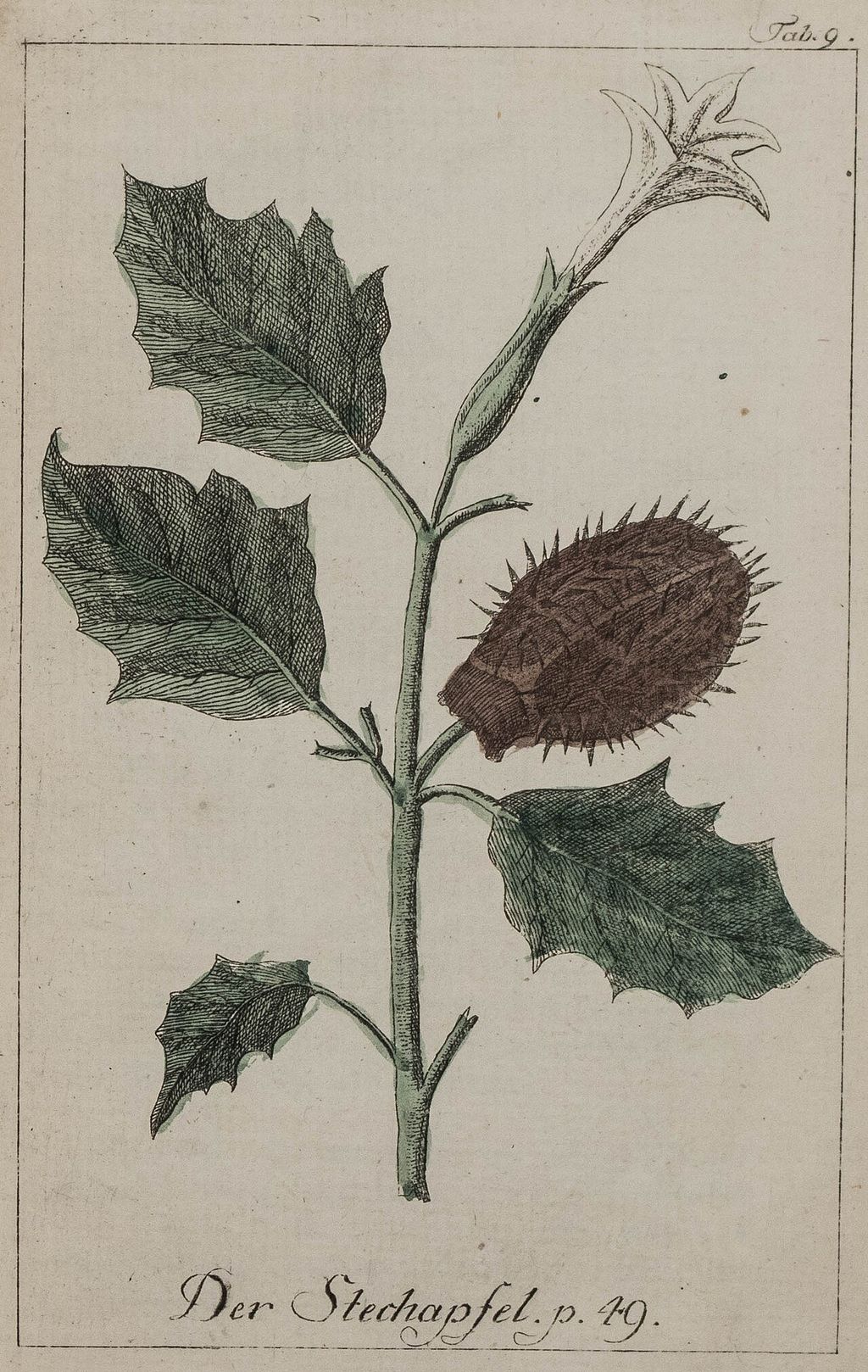
“Jimson weed” does not provide a secure Latin identification. The name is commonly associated with Datura, a genus in the nightshade family, but regional usage and historical taxonomy vary. In the American Southwest, Datura wrightii bears large white trumpet-shaped flowers, often 15 to 23 centimetres long, which open around evening and attract moth pollinators.[15][16] Natural-history sources also record Datura meteloides as an older synonym applied in this context, while common names include sacred datura and thorn apple.[17] O’Keeffe’s earlier Jimson Weed 3 has itself circulated under Datura Stramonium.[6]
Datura stramonium and D. wrightii are distinct taxa, so a historical title should not be converted silently into a modern botanical determination. CR 815 shows the flower and several leaves, but the transformed scale, selective contours and missing fruit make species diagnosis precarious. Neither Access O’Keeffe nor Crystal Bridges assigns a scientific name.[1][2] The sound conclusion is that the painting represents the form O’Keeffe and her records called jimson weed; D. wrightii supplies plausible Southwestern botanical context without becoming a definitive label. The plant’s behaviour helps the eye.
Evening opening explains why the white corolla functions as a conspicuous target in low light, and moth pollination gives the trumpet a role beyond human beauty.[15][16] The flower generally lasts briefly. O’Keeffe’s enlargement extends sustained attention to a form whose fullest opening is temporary. Every part of the plant is highly toxic.[15][16] Its chemical danger complicates the pristine appearance of the white bloom.
The picture need not encode poison symbolically, but viewers should avoid sentimentalising the plant as harmless purity. Some Datura species have ceremonial and medicinal histories among Indigenous peoples of the Americas. Those histories are specific to communities, places and protocols. A broad label such as “sacred flower of the Southwest” erases difference and may turn living knowledge into an exotic prop. No source tied to CR 815 establishes that O’Keeffe meant to represent a particular Pueblo, Diné, Paiute or other Indigenous use.
The painting’s New Mexico context does not authorise that attribution. Botanical ecology and documented local presence may be discussed; cultural meaning requires community-specific evidence. This caution changes interpretation. The image emerged from a region with histories that exceed an artist’s private encounter, but acknowledging that fact does not permit the manuscript to assign borrowed symbolism. The archive records title, exhibition and ownership more securely than ritual intention.
Later photographs extend the botanical record without settling the 1932 identification. Between 1964 and 1968 O’Keeffe photographed close views of white jimson-weed flowers among dark leaves; the archive catalogues them as Datura stramonium.[26][27] The images show her returning to the plant through another medium and preserving pistil, stamen, shadows and bent petal edges omitted or transformed in the painting. Their archival species label belongs to the later photographs and cannot be projected backwards as proof of CR 815’s exact specimen.
Todd Webb’s 1960 photograph Jimson Weed in Roofless Room, Abiquiu places a flowering plant within O’Keeffe’s domestic architecture.[28] Made twenty-eight years after CR 815, it is evidence of the motif’s continuing presence around her rather than a preparatory source. Together, Webb’s environmental view and O’Keeffe’s closer photographs complicate a simple painting-versus-photography opposition. Photography could document location, botanical detail and later attention, while the painted image established its own scale and spatial compression decades earlier.
The jimson-weed sequence
O’Keeffe had already painted the plant by 1931. Jimson Weed 3, CR 785, is a 40-by-30-inch canvas with the flower set among leaves and blue space. Its alternate titles—Datura Stramonium, The White Flower and numbered versions of Jimson Weed—show that instability was present from the beginning.[6] CR 815 enlarges and simplifies the encounter. The 48-by-40-inch field gives the single bloom more room, while the leaves become four broad directional supports.
The comparison reveals development rather than a repeated formula: O’Keeffe adjusted scale, the amount of blue, the flower’s rotation and the pressure at the edge. The word “series” can obscure these decisions if it implies minor variations on one design. O’Keeffe used a motif to test different relations among botanical recognition, bodily scale and painted boundary. Numbering helped distinguish works administratively, but the numbers themselves shifted in records.
The separate Elizabeth Arden commission
In 1936 the cosmetics entrepreneur Elizabeth Arden commissioned O’Keeffe to make a large work for the exercise room of her Fifth Avenue salon. The result is CR 886, also titled Jimson Weed: four white flowers across a field of green leaves and blue, painted on linen and measuring about 70 by 83½ inches. It now belongs to the Indianapolis Museum of Art at Newfields.[7][8] The distinction is visible and documentary.
CR 815 has one dominant flower, dates from 1932, measures 48 by 40 inches and is at Crystal Bridges. CR 886 has four blossoms, dates from 1936, is horizontal and considerably larger, and is at Newfields. The later picture’s owner identifies its support as linen, correcting the generic “canvas” sometimes repeated in older sources.[7][8] Correspondence resolves its date. Archive records once proposed 1935, 1937 or 1938, but letters and a January 1937 newspaper reference support 1936.
Access O’Keeffe further corrects the claim that the commission was shown at An American Place: it went directly to Arden.[7] Newfields traces it through the salon, which Eli Lilly acquired in 1971, and his 1997 gift to the museum.[8] O’Keeffe wrote that she obtained the large flower order herself, a small but pointed statement of professional agency.[9] The Georgia O’Keeffe Museum dates the $10,000 commission to the latter part of 1936.[10]
These facts belong to CR 886. They should not be attached to the 1932 Crystal Bridges canvas merely because both are called Jimson Weed. The commission nevertheless affects how CR 815 is understood. Four years after the single-flower canvas, O’Keeffe could translate the motif into a site-specific, horizontal, decorative-scale work for a fashionable commercial interior. The plant moved from gallery painting to commissioned environment without losing its formal structure.
Two Jimson Weeds with Green Leaves and Blue Sky of 1938, catalogue number 949, is another distinct oil on canvas measuring 48 by 40 inches and now in a private collection.[11] A white label printed by O’Keeffe supplies the unusually descriptive title. The work is absent from the Whitney, Downtown Gallery and Abiquiú records, making that label especially important. Two white flowers occupy opposing parts of the composition: one lower right and one upper left.
Yellow centres punctuate them; dark green leaves cross the field with yellow-green veins; blue remains as sharply shaped negative space.[11] Where CR 815 builds a frontal encounter around one bloom, CR 949 makes the eye travel diagonally between two. Repetition creates interval, and interval makes the blue more active. The title names “blue sky”, apparently settling what CR 815 leaves spatially ambiguous. Yet the blue still functions as a compressed painted field rather than deep landscape.
Leaves and flowers crowd it, so sky becomes pattern as well as atmosphere. Its provenance is documented through a series of art-world custodians: Doris Bry, Harold Diamond by 1977, Elaine Horwitch Gallery, private ownership, Helene Wasserman Fine Art, and the Sid Deutsch and Owings-Dewey galleries in 1986.[11] The catalogue also records that it was received in exchange for CR 556 and CR 865, although the public record should not be expanded into an undocumented account of who negotiated the exchange.
The work was shown in 1977 and 1984 and appeared in exhibitions in 2003–04 and 2011–12.[11] That later visibility makes it part of the motif’s reception beyond the celebrated auction history of CR 815. It demonstrates that the jimson-weed project was neither a single masterpiece nor one salon commission, but a sustained set of formal decisions across the 1930s.
In 1938 O’Keeffe also made Design for a Glass Plate, CR 947, a graphite drawing connected by correspondence to William Einstein and to a commissioned Steuben object.[12] The design was translated into a circular glass bowl about fourteen inches in diameter.[13] Glass changes the flower’s terms. A canvas offers an opaque rectangular field; the bowl is transparent, reflective and round. Its botanical line must accommodate curvature, manufacture and use.
The motif becomes something light passes through and hands may circle. This movement between media argues against treating the large flower as a single optical trick. O’Keeffe could revise the form for oil, paper and manufactured glass. Each support reorganised scale and boundary. The Steuben work later appeared with CR 815 when the painting returned from its White House loan, allowing visitors to compare the motif’s material transformations.[13][14]
Debut and early circulation
CR 815 was first documented in the 1933 An American Place exhibition Paintings—New & Some Old by Georgia O’Keeffe.[1] Installation evidence and catalogue comparison help correct the later archive confusion over whether it was number 10 and whether the title contained “No. 2”. The catalogue raisonné uses these records alongside correspondence to establish the object’s identity and date. The painting returned to O’Keeffe exhibitions in 1937 and appeared in a 1941 presentation associated with the Metropolitan Museum of Art and Rockefeller Center.
Digitised installation photographs now make part of that first setting visible. The Georgia O’Keeffe Foundation photograph collection identifies views in which Jimson Weed hangs with a large cross painting and barns, as well as wider rooms combining flowers, landscape and architecture.[26] These images replace an imagined white-cube isolation with a documented visual argument. The flower’s radial white form was encountered beside subjects associated with New Mexico and Lake George, allowing scale, darkness and simplified structure to operate across motifs rather than within a botanical category alone.
It entered the Museum of Modern Art’s 1946 retrospective, then the major 1970–71 retrospective organised by the Whitney Museum and travelling to Chicago and San Francisco.[1] Later exhibitions carried it outside a narrowly American story. It appeared at the Hayward Gallery, Mexico City and Yokohama in 1993–94; in the Georgia O’Keeffe Museum’s inaugural exhibition in 1997; and in The Poetry of Things in 1999–2000.
It was included in Modern Nature in 2013–14, the Tate/Vienna/Art Gallery of Ontario retrospective of 2016–17, The Beyond in 2018–19, and the Thyssen/Pompidou/Beyeler retrospective of 2021–22.[1][18][19][21][22] This itinerary repeatedly changed the painting’s neighbours. In a 1933 dealer exhibition it belonged to a current body of work; in 1946 and 1970 it helped construct retrospective development; in twenty-first-century European museums it represented American modernism for audiences with limited access to O’Keeffe originals.
Provenance and museum collection
By 1966 the painting belonged to O’Keeffe’s sister Anita O’Keeffe Young. It passed through her estate and the Robert R. Young Foundation in 1985, then appeared at Sotheby’s in New York on 3 December 1987 as lot 7. Gerald and Kathleen Peters owned it before another Sotheby’s sale on 1 December 1994, lot 83.[1] It then moved through a private Santa Fe collection and Gerald Peters Gallery to the Burnett Foundation.
The foundation gave it to the Georgia O’Keeffe Museum in 1996, in time for the museum’s opening. The 2014 sale by the museum supported its acquisitions fund, and Crystal Bridges bought the work.[1][4] This history complicates a simple opposition between private market and public museum. Family custody, charitable foundation, commercial gallery, auction house and two museums all shaped the object’s availability.
The sale removed a major picture from one museum collection while enabling other acquisitions; purchase placed it in another museum. The chain also explains why records change. Each transfer creates cataloguing, photography, condition review and legal documentation. Access O’Keeffe states that its data represent current understanding rather than authentication and records current-owner verification.[1][25] Provenance should therefore be treated as researched evidence with revision dates, not a timeless caption.
White House loan
The Georgia O’Keeffe Museum lent CR 815 to the White House in 2002. It returned to Santa Fe in 2009 and was displayed with the Steuben bowl derived from O’Keeffe’s 1938 design.[14] The loan added a national ceremonial setting to a picture already prominent in museums and reproductions. The White House episode should not be inflated into presidential endorsement of a specific interpretation.
Its documented significance lies in institutional circulation: a privately accessible executive residence borrowed a museum object for seven years, after which the museum publicly marked its return. Pairing canvas and glass created a more useful encounter than prestige alone. The installation could show how one flower idea altered when rectangle became circle, opaque paint became transparent material, and unique painting met manufactured design.
The 2014 sale
At Sotheby’s on 20 November 2014, Jimson Weed/White Flower No. 1 sold for $44,405,000 against an estimate of $10–15 million.[4] The price was then an auction record for any work by a woman artist. It brought unusual public attention to the gendered structure of market value and to O’Keeffe’s position within it. That record is historical, not current. In 2025 Frida Kahlo’s El Sueño (La Cama) sold for $54.7 million and surpassed it.[5]
Accurate writing should therefore say that O’Keeffe’s canvas held the record from 2014 until 2025. Repeating “the most expensive work by a woman” in the present tense turns a dated press claim into error. The sale price is evidence of market reception, not a measure of artistic quality. It reflects rarity, scale, provenance, institutional visibility, competition among bidders and the symbolic force of a record.
It does not prove that CR 815 is O’Keeffe’s best flower painting, or that paintings by women had suddenly achieved market equality. The auction catalogue linked the painting’s unusually large scale to O’Keeffe’s contemporaneous thinking about a Radio City Music Hall mural.[4] The chronology makes that a suggestive context, but no cited preparatory document proves that CR 815 was a mural study. It is safer to speak of parallel questions of enlargement than direct function.
O’Keeffe’s recollection
In a recollection published decades later, O’Keeffe described the jimson weed as an evening-opening trumpet with strong veins, pale green and violet in its centre, conspicuous fragrance and a life curtailed by daytime heat. She remembered counting 125 blossoms near her house.[4] The account gives sensory and lived context to a motif she knew over time. Retrospective memory must still be dated as retrospective. It cannot prove the exact place, day or specimen behind CR 815.
Its value lies in confirming prolonged familiarity: she observed abundance, temporal opening, colour within apparent white and the flower’s changing state. That memory redirects attention from a static emblem to duration. The painting fixes one open phase, but its curved throat and spreading rim belong to a plant that opens, attracts, wilts and returns through new blooms. Monumental scale slows the viewer before a short-lived event.
Sexual readings and resistance
O’Keeffe’s flowers were sexualised early in her career. The open throat and folded white forms of CR 815 have often been read through bodily analogy. Such a response is part of the work’s reception and cannot simply be erased, especially because criticism around O’Keeffe was already shaped by gender and by Alfred Stieglitz’s photographs of her. It is equally wrong to present that reading as the artist’s disclosed programme.
O’Keeffe objected that people projected their own associations onto her flowers and then wrote as though she had put those ideas there.[23] Her objection does not dictate what later viewers may see, but it changes the status of a sexual interpretation from intention to reception. Formal and ecological readings widen the field. The central opening can be understood as a spatial structure; the pale corolla as a night-visible signal to pollinators; the green leaves as a counter-rotation; the crop as a modern pictorial device.[15][20]
None has to become the exclusive answer. The discipline is attribution. “The painting is a sexual symbol” claims an essence. “Some viewers have experienced its folds bodily” identifies a history of response. O’Keeffe’s resistance belongs beside that history rather than being used to close it down.
International titles and reception
The 2021 Museo Nacional Thyssen-Bornemisza exhibition translated the title into Spanish as Estramonio. Flor blanca nº 1.[18] “Estramonio” places the plant explicitly within Datura vocabulary, while retaining the numbered white-flower alternative. Translation here interprets as well as labels. At the Centre Pompidou the work appeared in the 2021 retrospective, and a French essay approached O’Keeffe’s flowers from the imagined scale and urgency of pollinating creatures rather than only through Freudian symbolism.[19][20]
That argument does not establish what O’Keeffe intended in 1932. It documents a later ecological reception that shifts the question from what the flower resembles to whom a flower matters. Fondation Beyeler’s 2022 presentation connected O’Keeffe’s large flowers to straight photography and emphasised the coexistence of abstraction and observable nature.[21] The German-language press material made the same connection for a Swiss public.
These institutional framings show how CR 815 operates as a portable example of O’Keeffe’s methods, even while each exhibition selects a different emphasis. The international itinerary also exposes the limits of reproduction. Screen colour alters white, blue and green; photographs flatten the framed depth; publication scale can shrink a four-foot canvas to a postcard. Dimensions and owner links are essential parts of any text-led presentation.
Uncertainties
The public record does not establish the precise species, the exact plant used, the place and duration of painting, or the chemical identities of the pigments. It does not publish a complete condition or treatment history. It does not explain every historic title change or conclusively identify the source of the 1931 inscription. There is also no reason to assume that the background depicts literal sky merely because a later related title uses those words.
In CR 815, blue may evoke sky while functioning as compressed pictorial space. Nor does the painting’s 2014 price determine which interpretation matters most. These limits are productive. They distinguish material fact from visual inference and keep the painting open without making it vague. One can describe exactly how the forms behave while refusing unsupported biography or symbolism.
Close looking
First register the real scale. Stand far enough away to see the white bloom and four leaves as a radial design. Notice how the rectangle contains an almost circular expansion and how blue is divided into corner-like remnants. Move closer and stop calling the flower simply white. Follow grey, violet, green and cream through the petals.
Watch the throat deepen without a hard boundary. Then trace each leaf vein back towards the bloom and see how the surrounding darks make the pale form advance. Compare symmetry with difference. The flower feels emblematic, yet no two lobes match. The leaves distribute weight unevenly.
The centre sits within a system that appears inevitable only because O’Keeffe balanced its irregularities so carefully. Finally compare records. Keep CR 815 beside CR 886 and CR 949. One flower of 1932, four commissioned flowers of 1936 and two diagonally paired flowers of 1938 make different paintings. Names repeat; objects do not.
Why the painting matters
Jimson Weed concentrates O’Keeffe’s ability to make sustained looking public. A brief evening bloom becomes a four-foot encounter. Botanical form remains visible while scale and crop release curves, intervals and colour from ordinary measurement. White becomes chromatic, blue becomes spatially uncertain, and leaves become structural forces. Its history is equally instructive.
Conflicting titles and dates reveal archival work; comparison with the Arden commission corrects a durable myth; botanical research disciplines species claims; provenance connects family, galleries, foundations, auctions and museums; international exhibitions generate new languages of interpretation. The 2014 price made the painting a market landmark for eleven years. Its deeper importance lies in surviving that headline. CR 815 rewards the slower work of distinguishing object from reproduction, history from publicity, and documented meaning from projection. The flower becomes more compelling when its uncertainties are made exact.
Discussion
Which piece of evidence most changes the way you read Jimson Weed / White Flower No. 1?
Reader Insights
Which visible detail most changes your reading of Jimson Weed / White Flower No. 1?
How do medium, setting and documented history shape the encounter?
What remains uncertain when documented fact is separated from interpretation?
Join the Conversation
Share your reading of Jimson Weed / White Flower No. 1 below.
References
- Access O’Keeffe, Jimson Weed, 1932, CR 815. View Source
- Crystal Bridges Museum of American Art, Jimson Weed/White Flower No. 1, accession 2014.35. View Source
- Crystal Bridges Museum of American Art, Spanish object record. View Source
- Sotheby’s, Jimson Weed/White Flower No. 1, American Art, 20 November 2014, lot 11. View Source
- Sotheby’s, “The 10 Most Exhilarating Auction Records Set in 2025.” View Source
- Access O’Keeffe, Jimson Weed 3, 1931, CR 785. View Source
- Access O’Keeffe, Jimson Weed, 1936, CR 886. View Source
- Indianapolis Museum of Art at Newfields, Jimson Weed, 1936, accession 1997.131. View Source
- Library of Congress, Georgia O’Keeffe timeline. View Source
- Georgia O’Keeffe Museum, Timeline. View Source
- Access O’Keeffe, Two Jimson Weeds with Green Leaves and Blue Sky, 1938, CR 949. View Source
- Access O’Keeffe, Design for a Glass Plate, 1938, CR 947. View Source
- Access O’Keeffe, Steuben glass bowl after Design for a Glass Plate. View Source
- Access O’Keeffe, “Jimson Weed Returns from White House.” View Source
- National Park Service, Montezuma Castle National Monument, “Wildflowers.” View Source
- National Park Service, Arches National Park, Datura wrightii. View Source
- Arizona-Sonora Desert Museum, “Nightshade Family (Solanaceae).” View Source
- Museo Nacional Thyssen-Bornemisza, Georgia O’Keeffe, works in the exhibition. View Source
- Centre Pompidou, “Georgia O’Keeffe: The Pioneer Spirit.” View Source
- Centre Pompidou, “Chez Georgia O’Keeffe, le vivant à hauteur de colibri.” View Source
- Fondation Beyeler, Georgia O’Keeffe press kit, 2022. View Source
- Tate Modern, Georgia O’Keeffe, 2016. View Source
- Access O’Keeffe, “Georgia O’Keeffe In Her Own Words.” View Source
- National Gallery of Art, technical record for Jack-in-the-Pulpit No. IV. View Source
- Access O’Keeffe, “Information for Researchers.” View Source
- Access O’Keeffe, Georgia O’Keeffe Foundation Photographs, 1894–c.1992. View Source
- Access O’Keeffe, O’Keeffe photograph, Jimsonweed (Datura stramonium), 1964–68. View Source
- Smithsonian American Art Museum, Todd Webb, Jimson Weed in Roofless Room, Abiquiu, 1960. View Source