


 by Tom Gurney
Tom Gurney BSc (Hons) is an art history expert with over 20 years experience
Page Created on September 22, 2026 / Page Updated on September 22, 2026
Email: tomgurney1@gmail.com / Phone: +44 7429 011000
Introduction
Georgia O’Keeffe’s Light Iris presents a white flower so close that it exceeds the canvas. Broad upper petals fold around a cool recess; below them, turquoise, pink and green structures gather around three flashes of yellow. The bloom is recognisable, yet its scale makes recognition only the beginning. Petals become planes, openings become intervals, and white divides into a spectrum of pale colour.
The painting is now catalogued as White Iris and dated 1930. Light Iris is a genuine historic alternate title, not a modern invention, while an older 1924 date preserved on a lost backing conflicts with stronger archival and exhibition evidence. The work therefore offers two histories at once: O’Keeffe’s transformation of a flower and the later reconstruction of the object’s identity.[1][2]
At a Glance
- ArtistGeorgia O’Keeffe
- ArtworkLight Iris
- Artistic contextAmerican modernism
Contents
- Object record and disputed date
- Inside the iris
- Botanical language and identification
- Colour, light and spatial structure
- Enlargement, photography and erotic interpretation
- The painting’s 1930 context
- Debut, examination and material evidence
- Conservation and the limits of inference
- Provenance and collection history
- Exhibitions and changing critical frames
- Scale, title and museum encounter
- International circulation
- Modernist and contemporary dialogues
- A scientific afterlife
- Unresolved questions and continuing force
Object record and disputed date
- Artist: Georgia O’Keeffe (1887–1986)
- Current title: White Iris
- Historic alternate title: Light Iris
- Date: 1930
- Medium: oil on canvas
- Catalogue raisonné: CR 721
- Dimensions: 101.6 × 76.2 centimetres (40 × 30 inches)
- Collection: Virginia Museum of Fine Arts, Richmond
- Accession: 85.1534
- Credit: Gift of Mr and Mrs Bruce C. Gottwald[1][2][3]
The fixed page title, Light Iris, follows the Downtown Gallery Archive. The catalogue raisonné’s preferred White Iris is supported by the Whitney Archive, O’Keeffe’s Abiquiú Notebooks and the checklist for the painting’s 1931 debut at An American Place. Both names belong to the work’s history, but current institutional identification should not be hidden.[1] Photocopies in the museum files preserve three inscriptions from a lost backing.
Two give Light Iris and a date of 1924 or 1924 with a question mark; another, in Alfred Stieglitz’s hand, says “For Philadelphia Museum”. Andrew Droth of An American Place also transcribed the 1924 title and date.[1] Other evidence points to 1930. The Whitney Archive records that date, as do the Downtown Gallery Archive and Abiquiú Notebooks. Most decisively, the painting appeared in O’Keeffe’s January 1931 exhibition of recent work and is visible in Stieglitz’s installation photograph.
The catalogue raisonné therefore dates CR 721 to 1930.[1][9] The conflict should not be solved by pretending the backing never existed. A lost backing can preserve early information, later annotation or error; without the original, handwriting, sequence and physical relation cannot be re-examined. The 1924 date remains part of the record, while the converging 1930 documentation carries greater weight.
Inside the iris
The iris touches or crosses every edge. A white mass fills the upper third; side petals leave the canvas at left and right; lower forms continue beyond the bottom. No stem, leaf, vase or surrounding room establishes ordinary scale. This absence creates immersion. The viewer cannot stand back and survey a complete specimen.
Instead, the eye moves through a field whose boundaries belong to the canvas rather than to the flower. Cropping also makes the background unstable. Pink-lavender and blue-grey passages around the upper petals can be read as atmosphere, shadow or further floral depth. At several edges, flower and ground approach the same value, so separation depends on temperature and contour rather than dark outline. Three large pale forms dominate the top.
The central one descends like a broad hood, overlapping a left-hand fold and meeting a narrower white curve at right. Beneath them lies an irregular blue-grey opening that recedes towards the flower’s centre. The lower half expands rather than contracts. A turquoise fall rises at left; a pale green and white form projects forwards in the middle; another green-white fall turns down at right.
Pink, lilac and cool grey fold between them. The composition suggests bilateral balance without mirror symmetry. Yellow accents recur across the lower width, yet the central beard is larger and more frontal. A dark green cleft on the right has no exact counterpart on the left. The flower feels ordered and organic because repetition is continually varied.
Botanical language and identification
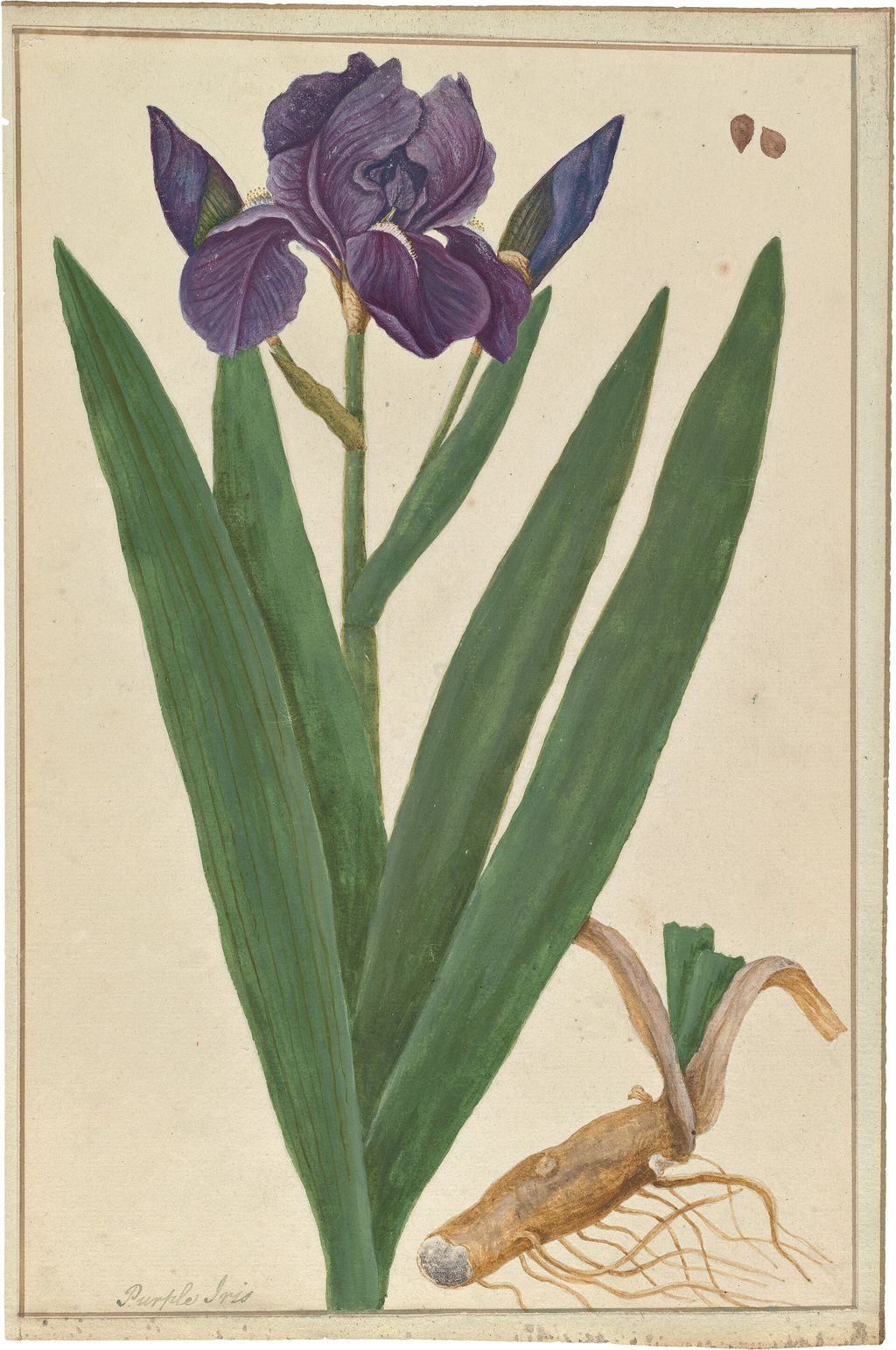
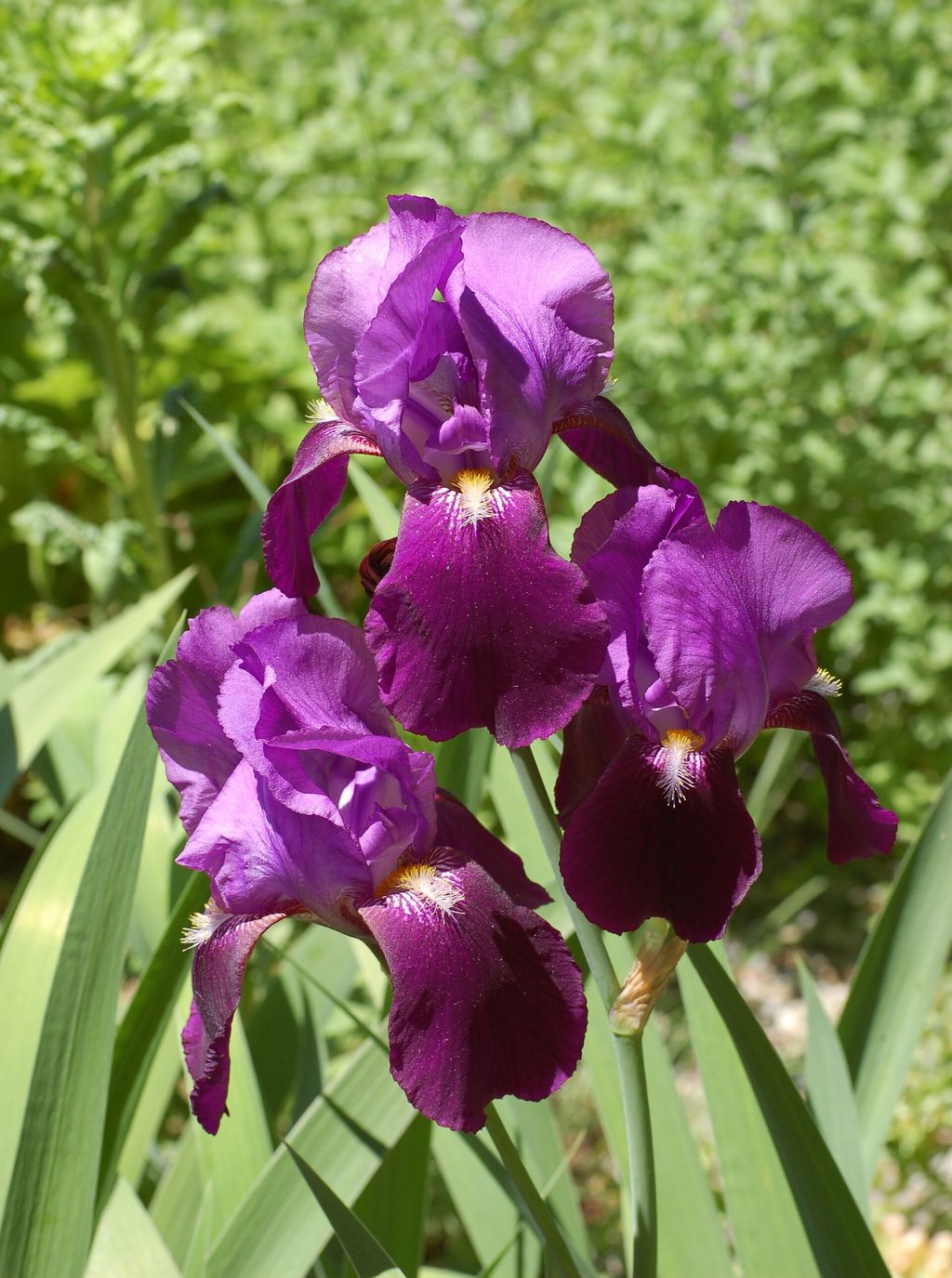
An iris flower has six petal-like segments. Three inner tepals generally rise and are called standards; three outer tepals turn outward or downward and are called falls. In bearded irises, a dense line of hairs runs along the middle of each fall.[6][7][8] That structure helps decode O’Keeffe’s enlargement. The great upper folds correspond broadly to standards.
The lower projecting forms behave as falls, and the yellow-orange brushes mark their beards. Two side beards are partly cropped, while the central one points directly towards the viewer. Botanical vocabulary clarifies without turning the painting into a diagram. Overlap hides attachments, petaloid style branches complicate the centre, and pictorial colour does not map every organ literally.
O’Keeffe preserves enough anatomy to sustain recognition while reorganising it into a spatial drama. The visible beard and large ruffled forms make a cultivated bearded iris the most plausible broad description. Modern bearded cultivars exist in extensive colour and size ranges, with upright standards and pendant or flaring falls.[7][8] No authoritative object source names a species, cultivar or garden provenance.
It would therefore be unsafe to identify Iris germanica or any named hybrid from appearance alone. O’Keeffe may also have altered colour, scale and relation as she composed. The manuscript retains “white iris” as the documented subject and “cultivated bearded iris” as a morphological category. Anything more precise awaits horticultural or archival evidence.
Colour, light and spatial structure
The title White Iris describes the flower but not a single pigment. Upper petals carry blue-grey shadows and faint cream transitions. Pink suffuses edges and inner folds. Turquoise and pale green define lower planes, while yellow concentrates at the beards. White functions through proximity: a near-white passage becomes cool beside pink, warm beside blue, brilliant beside grey and muted beside yellow. The flower’s apparent purity is an optical sum of differences. This matters because a reproduction can flatten the work into pastel prettiness. At full scale, coloured intervals articulate depth.
Blue-grey withdraws, yellow advances, and green establishes a living interior beneath the pale display. The central beard is a short vertical brush of yellow and orange strokes. Its granular-looking hairs project over a pale fall. Smaller yellow-tipped structures at the lower corners repeat the motif near the canvas edges. These accents do botanical and compositional work.
They identify the flower as a bearded iris, establish three-part organisation and prevent the lower half from becoming an undifferentiated expanse of white and green. Their saturation also measures depth. The central yellow appears nearest, while the side beards curve away and are cut by the frame. A small anatomical feature becomes a set of coordinates for an enormous image.
Enlargement, photography and erotic interpretation
In her 1939 statement “About Myself”, O’Keeffe wrote that flowers were small and that people rarely took time to see them. She explained that painting them large could make busy New Yorkers attend to what she saw.[4] CR 721 fulfils that argument without merely enlarging detail. Its scale destabilises quick recognition. Viewers can name an iris immediately, then spend much longer determining how its folds connect.
Enlargement also changes bodily relation. The forty-inch canvas approaches torso scale. The viewer confronts rather than holds the flower, and the central fall seems to move out from the surface. Close cropping and radical magnification have long invited comparison with modern photography. O’Keeffe lived among photographers, and the 2015–16 French exhibition explicitly placed her work with photographic friends.
The 2021–22 retrospective title, The Painter’s Lens, renewed that discussion.[14][18][24] No located photograph is a direct source for White Iris. Paint allows O’Keeffe to alter scale, suppress context, intensify colour and combine observations made over time. The canvas is not an enlarged exposure. Photography remains useful as a history of looking.
A close-up lens taught modern viewers that a fragment could fill a field and become abstract without ceasing to record an object. O’Keeffe transformed that visual condition through hand-built colour and oil paint. The iris’s central opening, folds and bodily scale have often been read sexually. Such readings form an important part of the painting’s reception, shaped by Stieglitz’s photographs, psychoanalytic criticism and later feminist debates.[21][23]
O’Keeffe resisted claims that critics had uncovered her unconscious intention. Her 1939 statement argued that spectators attached personal associations to the flowers, then attributed those thoughts back to her; later interviews repeated that objection.[4] Viewers may experience the image as sensuous or erotic, and historians can study why that response became dominant, but they should not convert reception into proof of a concealed symbol. Flower anatomy, abstract organisation and erotic association can coexist. The yellow beards, falls and standards keep the subject botanically legible, while the canvas also operates as interlocking fields of white, turquoise, pink, green and grey.
O’Keeffe repeatedly challenged the division between objective and abstract art. A recognisable flower still requires line, colour, proportion and interval to work as a painting.[4] In CR 721, abstraction is not a stage reached after the iris disappears. It is the organisation that lets the iris appear with unusual force. Recognition and formal autonomy develop together.
The painting’s 1930 context
During 1930 O’Keeffe also made six paintings of jack-in-the-pulpits found near Lake George. Across that sequence, the plant is progressively enlarged and simplified until the final canvas reduces it to a dark field and a white linear form.[10] The comparison shows that botanical subjects could become laboratories for serial transformation. White Iris retains more descriptive detail than the last jack-in-the-pulpit, yet its cropping and colour already press against abstraction.
There is no evidence that CR 721 belonged to a comparably numbered iris sequence. The analogy concerns method and year, not a claim of shared series structure. O’Keeffe’s first extended New Mexico season in 1929 changed her subjects, but it did not replace the eastern environments of New York and Lake George. The title of her 1931 exhibition—Recent Paintings, New Mexico, New York, Etc.—announced geographical plurality.[5][9]
The iris entered public view in that mixed field. Its cultivated flower could stand beside desert, city and lake subjects rather than represent an isolated “flower period”. This context corrects a familiar simplification in which O’Keeffe moves cleanly from flowers to New Mexico. She continued to use different places and objects as parallel resources.
Debut, examination and material evidence
Alfred Stieglitz organised the exhibition at An American Place from 1 January to 1 February 1931. The painting appears in his installation photograph, providing evidence stronger than a later recollection.[1][9] That photograph helps settle the date and confirms the work’s physical presence in the gallery. It can also reveal relative scale and neighbours when examined at sufficient resolution.
It cannot fully recover the original surface or visitor experience. Black-and-white installation photography suppresses the painting’s pink, turquoise and yellow relations, the very differences through which its white flower takes shape. The Whitney Archive states that the work was examined at An American Place in March 1946. This was a period when records for O’Keeffe’s oeuvre were being consolidated through gallery documents, physical inspection and her participation.[1]
The examination links the 1931 display to later cataloguing. It also reminds us that the current title and date are critical conclusions assembled from several records, not words visibly fixed on the painted face. No public account specifies the examiner, condition observed in 1946 or whether the now-lost backing was still attached. Those remain documentary gaps.
Conservation and the limits of inference
A typed note by Doris Bry says, simply, that the painting “has been varnished”. The note establishes a coating in the work’s historical record without identifying its material, date or maker.[1] Varnish can saturate colour and alter gloss, but it can also age or be changed during treatment. No public technical report states whether the recorded coating survives unchanged or has been removed or replaced.
The current image should therefore be discussed as the museum presents it, while avoiding assumptions that its surface sheen reproduces O’Keeffe’s original intention exactly. VMFA conservator Josh Summer reported in 2023 that the canvas is unlined, securely attached and taut on a stable four-member stretcher. Stretcher-bar marks appear around all sides, and a shallow draw affects the viewer’s upper-right corner. Canvas slubs make small bulges under the paint.[1]
These facts return physical irregularity to an image often encountered as seamless reproduction. The flower’s soft fields lie on woven fabric with knots, tension and edge pressure. The unlined state is significant because the original canvas remains free of a secondary fabric lining. The report does not state that every attachment or stretcher component is original, so originality should not be inferred automatically.
The 2023 report describes the ground and paint layers as secure, with fine cracks in many areas. An old scratch or gouge is visible under magnification in the blue area above the flower’s centre. Colours remain bright; only a few tiny accretions interrupt an otherwise clean surface.[1] The scratch is visually minor but interpretively useful.
It distinguishes the material painting from the ideal image. A vulnerable surface has passed through studios, galleries, private collections, transport and exhibitions. Fine cracking is not evidence of neglect by itself. It belongs to the ageing behaviour of layered paint and support, while the conservator’s overall judgement is that the work is in good condition. Wax now covers the stretcher mitres and keys, immobilising them.
A corrugated acid-free backing board closes the reverse, and a Tycore insert projects into the stretcher cavity to reduce vibration and buffer changes in relative humidity.[1] These additions are invisible from the gallery. They show conservation acting through environmental moderation rather than cosmetic alteration. They also complicate the lost-backing history. The present protective backing is modern conservation equipment, not the historic backing from which the 1924 inscriptions were copied.
Provenance and collection history
The current provenance begins with Doris Bry in New York, followed by Andrew Crispo Gallery. Baron Heinrich Thyssen-Bornemisza owned the painting in Lugano by 1974. It then passed through Kennedy Galleries to Bruce and Martha Gottwald in Richmond in 1977.[1] The chain places CR 721 within several networks: O’Keeffe’s long-serving assistant and agent, the New York market, a major European collector, another American dealer and a Virginia family collection.
Public data do not specify how Bry acquired it, the dates of the first dealer transfer or the terms of later sales. A list of names is not a complete transaction history, and those gaps should remain visible. The Gottwalds gave White Iris to the Virginia Museum of Fine Arts on 20 December 1985. Its accession number, 85.1534, records that year of entry.[1][2][3]
The gift converted a widely travelled private object into a public collection work. VMFA later described it in board records as an icon of its American galleries, a status that affected lending decisions.[16] Current collection information was verified with VMFA in March 2026. That verification updates ownership and condition fields without erasing the earlier catalogue history.[1]
Exhibitions and changing critical frames
The painting appeared in a 1955 Georgia O’Keeffe exhibition at the University of Nebraska Art Galleries. The venue is significant because it carried O’Keeffe’s work beyond the New York commercial-gallery system during a period when abstraction was often narrated through younger post-war painters.[11] An iris made a quarter-century earlier could now be seen retrospectively. What had entered An American Place as recent work became evidence of sustained modern experimentation before large-scale abstraction dominated American criticism. The public exhibition record establishes inclusion but not the exact checklist number, lender or hanging relationship.
The separate completeness search did not recover the checklist number, lender or installation details from the surviving Nebraska catalogue or institutional files. In 1985 CR 721 joined Georgia O’Keeffe: Works from Southern Collections at the Columbus Museum in Georgia. At that point the painting belonged to the Gottwalds in Richmond and had not yet entered VMFA.[12] The exhibition treated private and public ownership across the American South as a curatorial resource. It also placed the work near the end of its private history: the Gottwald gift to VMFA followed on 20 December that year.
The sequence does not prove that the exhibition caused the donation. It does show that the canvas was publicly active immediately before accession and that its regional visibility preceded permanent museum ownership. From 2003 the painting was included in Debating American Modernism: Stieglitz, Duchamp, and the New York Avant-Garde at the Muskegon Museum of Art. The long-term display placed O’Keeffe within rival and overlapping accounts of American experimentation rather than presenting her only through flowers or biography.[13]
The title’s juxtaposition of Stieglitz and Duchamp raises productive questions. O’Keeffe’s art developed within the Stieglitz circle, but her enlarged iris also tests the boundary between observed object and autonomous design. It belongs to modernism through formal invention as well as affiliation. The exhibition category remains an argument, not a neutral container. It highlights avant-garde networks and may understate botanical knowledge, material handling or the gendered reception that made O’Keeffe’s flowers culturally distinctive.
Scale, title and museum encounter
At forty by thirty inches, White Iris is larger than a natural bloom but smaller than many later museum-scale canvases. Reproduction tends to erase that middle register: on a screen it may look like a small study, while in a poster it can become architectural. Physical viewing restores the relation between support and body. The painting is tall enough to command a standing viewer, yet its brushwork and fine surface changes still require proximity. Moving nearer reveals cracks, weave and colour modulation; stepping back allows the flower’s three-part structure to cohere.
This oscillation explains why enlargement is not only a compositional device: it choreographs distance. The viewer must alternate between anatomical recognition and abstract field, between whole and fragment. Light Iris and White Iris do more than label the same object. “White” directs attention to the flower’s nominal colour, while “Light” can suggest pallor, illumination or reduced visual weight. The first sounds botanical and the second experiential. Neither title fully describes the canvas. Its most saturated passages are yellow and green, while pink and turquoise occupy substantial areas. The title establishes a dominant perception that close looking then complicates.
O’Keeffe’s record-keeping and gallery circulation allowed titles to shift across archives. Preserving the alternate form reveals that art-historical identity is sometimes plural even when the physical object is singular. The composition repeatedly sends the eye inward and back out. Upper petals curve towards the blue-grey recess, but their white surfaces expand to the top and sides. The central green opening draws attention downwards, where the foremost fall pushes back towards the viewer.
No single perspective governs these movements. Some edges imply soft flesh folding in space; other colour boundaries behave like flat bands. The flower alternates between cavity and screen. That tension keeps the image from settling into illustration. Botanical depth is continually converted into pictorial rhythm, then restored when a beard or fold becomes legible again.
International circulation
VMFA approved the painting for a 2015–16 exhibition at the Musée de Grenoble; an intended Nantes venue was later removed. Access O’Keeffe records the show as Georgia O’Keeffe: Et Ses Amis Photographes.[14][25] The photographic frame made the close-up question explicit for French audiences. It placed O’Keeffe within a network rather than treating her cropped flowers as a solitary invention.
The changed venue schedule illustrates why exhibition histories require institutional records: announced and realised itineraries are not always identical. The international retrospective opened at Tate Modern in London and continued to Vienna and Toronto. VMFA approved White Iris for Tate but declined the later venues, explaining that the picture had recently returned from France and should be available to its own visitors.[15][16] The database lists the work under the tour as a whole, while the lender’s minutes refine its movement. CR 721 participated in London, not every stop. A tour-level record can imply continuous travel unless venue-specific loan decisions are checked.
Modernist and contemporary dialogues
From 2018 to 2019, The Beyond: Georgia O’Keeffe and Contemporary Art travelled from Crystal Bridges to the North Carolina Museum of Art and New Britain Museum of American Art.[17] The exhibition asked how later artists engaged O’Keeffe’s forms, scale, gendered reception and public persona. Within that setting, the iris became both a 1930 painting and an active source in contemporary practice. Such reception resists the claim that canonical flower pictures have become exhausted through reproduction.
New juxtapositions can expose their strangeness, material scale and unresolved cultural meanings. VMFA approved the painting for Georgia O’Keeffe: The Painter’s Lens, presented in Madrid, Paris and at Fondation Beyeler in 2021–22. The Spanish checklist names it Lirio blanco and gives the VMFA credit.[18][19][20] The multilingual title demonstrates that “white” travelled as the preferred identifier. The exhibition’s lens metaphor invited comparison between painting and photography without reducing one medium to the other.
Its movement across three European institutions also confirms that the canvas’s modern reception is international. Each venue placed an American flower painting within a different museum culture and history of modernism. At Fondation Beyeler it appeared as number 5 in room 4. The English gallery guide stressed how tightly the delicate flower is cropped, how little it separates from the background, and how O’Keeffe’s single-bloom enlargement differs from conventional bouquets, flowerbeds and wild-flower groupings.[26]
That interpretation is valuable because it treats monumentality as a method of inquiry. The painting enlarges formal qualities, surface and colour rather than merely making a small subject spectacular. In 1997 VMFA acquired a small painted Iris by Frank Vincent DuMond, who had taught O’Keeffe at the Art Students League in 1907–08. The museum’s curator David Park Curry described DuMond’s lifelike blossom as a precedent for O’Keeffe’s much looser, enlarged flower imagery.[27] The comparison should not become a direct source claim.
More than two decades separate O’Keeffe’s student years from CR 721, and no document says she copied DuMond’s painting. Their difference is more revealing: his flower remains a small specimen available to be visually plucked, while hers removes stem and scale and enters the bloom. Bringing both works into one public collection allows teaching history to be examined materially. Influence need not mean resemblance alone; it can also be measured by how radically a former student transformed a shared subject.
The work joined O’Keeffe and Moore, which travelled through San Diego, Albuquerque, Montréal and Boston from 2023 to January 2025.[22] The pairing shifted attention from flower iconography alone to shared acts of collecting, enlarging and abstracting natural forms. Moore’s bones, stones and shells provided a sculptural counterpoint to O’Keeffe’s petals and desert objects. For White Iris, the comparison makes volume newly important. The folds do not only form a coloured surface; they curl, overlap and project as though the bloom were monumental sculpture.
A scientific afterlife
In 2011 Light Iris appeared in the stimulus set for a peer-reviewed NeuroImage study of responses to art. Eight participants viewed fifty paintings or drawings and fifty ordinary photographs matched for depicted content while making animate-or-inanimate judgements. The authors reported aggregate activation in reward-related regions for art images compared with non-art controls.[28] CR 721 was one item in a deliberately varied set spanning periods and styles, so the experiment cannot establish a distinctive neural response to O’Keeffe’s iris or explain any individual viewer’s interpretation.
The study nevertheless documents a different kind of reception: the painting moved from museum and exhibition history into experimental neuroscience as a recognised example of art. Its appendix called the image Light Iris and dated it 1924, reproducing the older metadata rather than the catalogue raisonné’s 1930 conclusion.[28] That discrepancy shows why object research matters beyond art history. Once titles and dates enter scientific datasets, educational resources or image banks, superseded information can acquire the appearance of neutral fact and circulate independently of the evidence that later corrected it.
Unresolved questions and continuing force
No public source located in the separate completeness pass identifies the iris cultivar, source garden, place or month of execution, preparatory study or direct photographic model. The original lost backing cannot be re-examined. The 2023 condition report does not publish pigment analysis, X-radiography, infrared imaging, ground composition, varnish identification, treatment chronology or original frame evidence. Dealer transaction documents are also incomplete. These absences set research targets rather than invitations to speculate.
The painting’s documented complexity is sufficient without converting possibility into fact. The painting joins botanical structure to abstract scale. Three falls and beards remain legible, yet they become an immersive arrangement of colour, pressure and opening. White proves to be an event made from pink, blue, green, yellow and grey. Its title and date history show scholarship at work.
Light Iris preserves a valid archival name; White Iris reflects broader documentary agreement. The 1924 inscription is recorded, tested and outweighed rather than suppressed. Its physical history adds another form of seeing. Cracks, canvas slubs, a small scratch, varnish and preventive backing locate the famous image in material time. To look closely is to encounter a flower, a painting and an object whose identity has been repeatedly examined.
Discussion
Which piece of evidence most changes the way you read Light Iris?
Reader Insights
Which visible detail most changes your reading of Light Iris?
How do medium, setting and documented history shape the encounter?
What remains uncertain when documented fact is separated from interpretation?
Join the Conversation
Share your reading of Light Iris below.
References
- Access O’Keeffe, “White Iris, 1930,” CR 721, Georgia O’Keeffe Museum, accessed 20 September 2026, View Source.
- Virginia Museum of Fine Arts, collection record for Georgia O’Keeffe, White Iris, 85.1534, accessed 20 September 2026, View Source.
- Smithsonian Institution Research Information System, “White Iris, (painting),” accessed 20 September 2026, View Source.
- Access O’Keeffe, “In Her Words,” especially O’Keeffe’s 1939 “About Myself” statement, accessed 20 September 2026, View Source.
- Access O’Keeffe, “Chronology,” 1929–31, accessed 20 September 2026, View Source.
- Royal Botanic Gardens, Kew, “Iris afghanica Wendelbo,” Plants of the World Online, morphology section, accessed 20 September 2026, View Source.
- Missouri Botanical Garden, “Iris,” horticultural factsheet, View Source.
- Missouri Botanical Garden, “Iris ‘Beverly Sills’,” Plant Finder, accessed 20 September 2026, View Source.
- Access O’Keeffe, “Georgia O’Keeffe: Recent Paintings, New Mexico, New York, Etc.,” An American Place, 1 January–1 February 1931, View Source.
- National Gallery of Art, “Georgia O’Keeffe, Jack-in-the-Pulpit No. VI, 1930,” accessed 20 September 2026, View Source.
- Access O’Keeffe, “Georgia O’Keeffe,” University of Nebraska Art Galleries, 1955, View Source.
- Access O’Keeffe, “Georgia O’Keeffe: Works from Southern Collections,” 1985, View Source.
- Access O’Keeffe, “Debating American Modernism: Stieglitz, Duchamp, and the New York Avant-Garde,” View Source.
- Access O’Keeffe, “Georgia O’Keeffe: Et Ses Amis Photographes,” View Source.
- Access O’Keeffe, “Georgia O’Keeffe,” 2016–17 touring exhibition, View Source.
- Virginia Museum of Fine Arts, Board of Trustees meeting minutes, 16 March 2016, View Source.
- Access O’Keeffe, “The Beyond: Georgia O’Keeffe and Contemporary Art,” 2018–19, View Source.
- Access O’Keeffe, “Georgia O’Keeffe: The Painter’s Lens,” 2021–22, View Source.
- Virginia Museum of Fine Arts, Board of Trustees meeting minutes, 17 September 2020, View Source.
- Museo Nacional Thyssen-Bornemisza, Georgia O’Keeffe, Spanish exhibition checklist, 2021, View Source.
- Museo Nacional Thyssen-Bornemisza, “Georgia O’Keeffe, White Iris No. 7,” accessed 20 September 2026, View Source.
- Access O’Keeffe, “O’Keeffe and Moore,” 2023–25, View Source.
- Georgia O’Keeffe Museum, “Examining New Dimensions through the Retrospective,” accessed 20 September 2026, View Source.
- Museo Nacional Thyssen-Bornemisza, Georgia O’Keeffe, press dossier, 2021, View Source.
- Virginia Museum of Fine Arts, Art Acquisitions Subcommittee meeting minutes, 18 March and 15 September 2015, View Source.
- Fondation Beyeler, Georgia O’Keeffe, English gallery guide, 2022, room 4, no. 5, View Source.
- Virginia Museum of Fine Arts, “Virginia Museum Acquires ‘Iris’ Painting by Frank DuMond, Who Taught O’Keeffe,” 1997, archived by Traditional Fine Arts Organization, View Source.
- Simon Lacey et al., “Art for Reward’s Sake: Visual Art Recruits the Ventral Striatum,” NeuroImage 55 (2011): 420–433, doi:10.1016/j.neuroimage.2010.11.027, View Source.