


 by Tom Gurney
Tom Gurney BSc (Hons) is an art history expert with over 20 years experience
Published on June 19, 2020 / Updated on August 9, 2026
Email: tomgurney1@gmail.com / Phone: +44 7429 011000
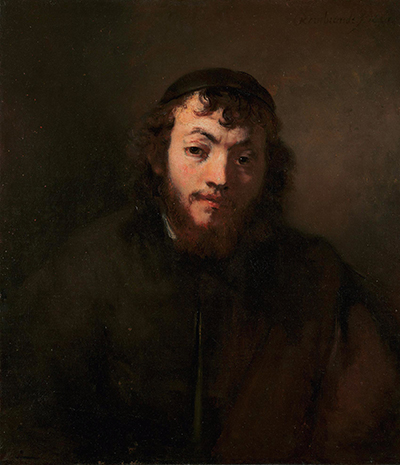
Bust of a Young Jew is a late Rembrandt tronie in the Kimbell Art Museum
The Kimbell Art Museum in Fort Worth, Texas, USA holds this small portrait that measures 65.8cm tall and 57.5cm wide. The background is simple and deliberately avoids during one's attention, whilst the figure is darkened himself, other than his face.
A closer inspection of the facial features, beautifully drawn out by the artist's legendary mastering of light, reveals a finely detailed area of the canvas, where the artist would invest the most time and care. Models with more distinguishing features, such as aged skin or other imperfections, would offer more interest and opportunty to the artist.
The majority of Rembrandt's paintings remain in Europe and so it is a good opportunity for those in Texas to see this particular work without having to go far. The high profile of this artist also means that his original work comes up for sale only very rarely.
The Kimbell insititution was set up as recently as 1972 and, as such, their collection is considered relatively small at around 350 artworks. That said, the level of quality is highly impressive, as is the list of some of the artists featured here. For example, you can enjoy original paintings by the likes of Velázquez, Poussin, Piet Mondrian, Georges Braque, Claude Monet and Pablo Picasso. The highest profile work would be The Torment of Saint Anthony, Michelangelo's very first known painting.
Object Notes and Research Context
The Kimbell Art Museum titles the painting Bust of a Young Jew and dates it to 1663. It is an oil on canvas, 65.8 by 57.5 cm, accession AP 1977.04. The museum's interpretation is useful because it treats the work as a tronie or character study rather than a commissioned portrait of a named sitter.
That category changes the way the picture should be read. Rembrandt focuses on a live model, a modest skullcap, curly hair and a full beard, but the point is not documentary identity alone. The dramatic light isolates the head and turns the face into a study of temperament. The rough late manner, limited earth palette and economical strokes should link this page to the style-and-technique hub.
The Kimbell also cautions that the skullcap was not worn only by Jews in Rembrandt's day. The sitter should not be reduced to a simple ethnic label, even though Amsterdam Jewish subjects and models have been important in the painting's reception.
The Kimbell's tronie framing should lead the page away from biography and towards pictorial experiment. A tronie could use a live sitter, but it was not necessarily sold or understood as a personal portrait. The face, beard, skullcap and robe become ingredients for studying age, character, costume and light.
This is also a good page for caution around terminology. The title Bust of a Young Jew has a long reception history, but the museum notes that a skullcap alone does not prove Jewish identity in seventeenth-century Amsterdam. A careful article can still discuss Rembrandt's Jewish subjects and neighbourhood context while avoiding a flat identification based only on costume.
The late date also matters. In 1663 Rembrandt's brushwork was broad, economical and often visibly textured. A concise technique note can explain that the loose surface is not carelessness; it is part of the late style that makes the sitter's face appear to gather out of warm darkness.
For interpretation, the safest headline is not identity but category. The painting can teach readers what a tronie is, why Rembrandt used character heads, and how late brushwork can make a sitter feel both observed and partly imagined.
The Kimbell provenance record also supports a concise collection-history note.
Further Rembrandt Context
This shorter legacy page remains part of the Rembrandt archive. For fuller context, use the refreshed Rembrandt pages below, which explain the artist's biography, media, technique, attribution issues and major works in greater depth.
For secure object data, attribution and collection history, compare Bust of a Bearded Young Man with a Skullcap with the relevant museum or catalogue record before treating older page text as final.

 Rembrandt.jpg)
Discussion
What feels most useful when looking at Bust of a Bearded Young Man with a Skullcap: the subject, the handling of light, the medium, the attribution history, or its place within Rembrandt's wider painting output?
Reader Insights
Set this page beside the refreshed Rembrandt hubs before relying on older summaries alone.
Rembrandt pages often need museum records, catalogue history and attribution caution, especially where older sources use broader labels.
Which detail would you most want clarified next: date, medium, collection, attribution, subject, condition or comparison with another Rembrandt work?
Join the Conversation
Have a thought or observation about Bust of a Bearded Young Man with a Skullcap? Share it below. Thoughtful responses may be added as the Rembrandt archive continues to be reviewed.