


 by Tom Gurney
Tom Gurney BSc (Hons) is an art history expert with over 20 years experience
Published on June 19, 2020 / Updated on November 19, 2026
Email: tomgurney1@gmail.com / Phone: +44 7429 011000
Introduction
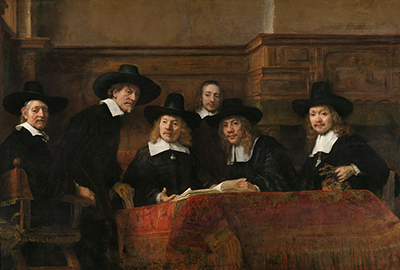
A man at the left of the table has shifted forward in his chair. At the centre, a hand is still raised beside an open book. The men around him are looking out of the painting, their attention drawn towards someone on our side of the table. Rembrandt gives us enough to feel that we have arrived in the middle of something. The book stays open, the hand stays raised, and the man by the chair could be getting up or sitting down.
Rembrandt van Rijn painted The Syndics of the Drapers’ Guild in 1662. The Rijksmuseum calls it The Sampling Officials of the Amsterdam Drapers’ Guild, Known as ‘The Syndics’. In Dutch it is known as De Staalmeesters, after the officials who inspected cloth. The painting is oil on canvas, measures 191.5 by 279 centimetres and is catalogued as SK-C-6. It hangs in the Rijksmuseum’s Gallery of Honour on loan from the City of Amsterdam. The five wardens commissioned it for the Staalhof, the Drapers’ Guild hall on Staalstraat. Their attendant appears with them, standing behind the table. [1]
The scale matters. The red carpet falls almost to the bottom of the picture, and the broad black hats belong to figures large enough to register as people across a room. Above them stretches a wall of brown panelling and bare plaster. There is space for their eyes, collars and hands to make small differences felt. Of the six men, only one leans so far forward that he appears caught in motion. The others can turn the room’s attention towards us with a shift of the head.
At a Glance
- Date1662
- MediumPainting
- CollectionRijksmuseum, Amsterdam
- SittersOfficials who assessed dyed woollen cloth
What the sampling officials did
The five staalmeesters, also called waardijns or wardens, were responsible for assessing the quality of dyed woollen cloth. The cloth in question was laken, a woven wool textile whose manufacture involved finishing and dyeing. Sampling gave the wardens a basis for comparing the material submitted to them against a standard. The results mattered to people making and selling cloth and to buyers who depended on the reliability of an inspection. A trade involving many hands, from manufacture to sale, gave a small group of experienced men a consequential job. [1] [2]
The wardens’ office had a municipal basis. As the art historian Henri van de Waal pointed out in his study of the painting, Amsterdam’s burgomasters appointed the board, and the wardens answered to them. The familiar English term syndics can suggest that these men governed the whole guild or administered its funds. Their responsibility here was more specific. The portrait commemorates the exercise of judgement over a material whose appearance and quality could be examined. That distinction also matters when we try to work out what business the men might be conducting around the table. [3]
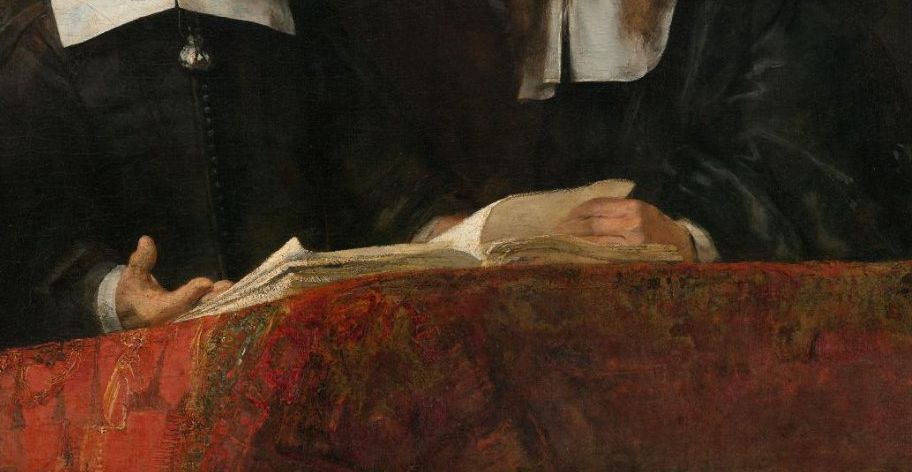
The Rijksmuseum identifies the open volume as a sample book. Its pale pages occupy a narrow strip along the top of the carpet. The leaf rises slightly where a hand meets it, and the book’s light edge makes it stand out even at a distance. An accounts ledger has also figured in interpretations of the scene, particularly those in which the wardens are imagined reporting to fellow guild members. The visible pages leave their contents indistinct. The museum’s identification fits the board’s documented duties, while van de Waal’s account of the institution weakens the idea that the board is presenting guild accounts. The book can establish a connection with the work of the office even though the painting leaves the precise business of the day open. [1] [3]
The carpet belongs to the setting of that work. The Rijksmuseum identifies it as Persian. Its scale and use distinguish it from the dyed woollen cloth the officials were charged with examining. The carpet covers the table and gives the gathering a rich foreground, while the sample book brings the narrower business of inspection into the picture. The occupation also makes the care with which Rembrandt differentiates materials particularly apt. The eye moves from the patterned carpet to the paper and then to the dark cloth of the coats. Each of these surfaces catches and holds the light differently.
The six men, from left to right
The Rijksmuseum places the figures in the following order across the canvas: Jacob van Loon, Volckert Jansz, Willem van Doeyenburg, Frans Hendricksz Bel, Aernout van der Mye and Jochem de Neve. Bel, the fourth figure in that sequence, was the board’s attendant. The five men wearing broad-brimmed hats are the officials. Archival research has connected the group with the board probably in office in 1661–62. Historian I. H. van Eeghen’s account also gives a sense of the limits of the surviving evidence. She identified the men eligible to appear in the portrait through records of the office, and her proposed placement of the two right-hand wardens differed from the order now given by the Rijksmuseum. Bel’s identity could be established with greater confidence. [1] [4]
Jacob van Loon sits at the far left, beyond the book and most of the carpet. His chair is conspicuously near the front. Its turned upright, warm in colour, rises against his dark clothing. His body belongs to the gathering around the table, and his head angles out towards us. Van Loon was born in 1595, making him the eldest of the wardens named by the museum. Rembrandt gives his face a narrow band of light between the underside of the hat and the white of his collar. This is the figure for whom a separate seated study survives in Amsterdam. [1] [5]
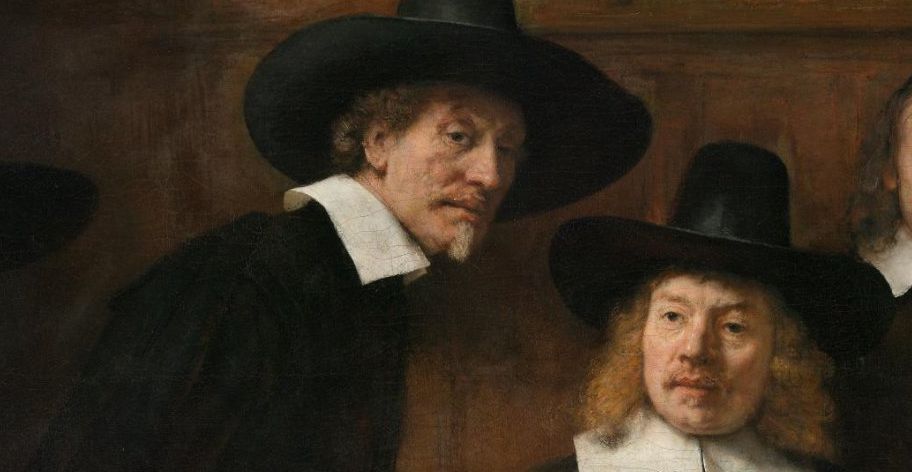
Volckert Jansz is second from the left. His head sits higher than those of the seated officials, and his body makes a slant from the brim of his hat down towards the chair and table. One hand is low, near the chair, and his coat hangs down in a broad dark shape. Of all five wardens he seems most ready to change position. His bent stance supplies the visual basis for the familiar impression of an interruption. The direction of the movement remains open. The tilt would make sense as a man leaning forward to rise or as one lowering himself towards his seat. [1] [5]
Willem van Doeyenburg, identified in the historical literature as the chairman, sits just left of the centre. His white collar spreads wide below his face, and his right hand emerges near the open volume, with fingers lifted in a small gesture. His position gives him a clear relation to the board’s work and to the encounter with the viewer. The hand could belong to someone making a point or pausing in the course of one. Rembrandt leaves space around it so that its movement remains legible against the book and the much larger plane of the carpet. [1] [3] [4]
Frans Hendricksz Bel stands behind the others, between Van Doeyenburg and Van der Mye. His head is bare, and the slim white of his collar has none of the breadth of the white shapes worn by the seated wardens. Van Eeghen found that he had been appointed to his post about a decade before the painting. He also owned an establishment for rinsing dyed cloth and was credited with improvements to that work. His connection to the trade thus extended beyond attending the board. In the painting his position denotes his place in the institution, and the clear light on his uncovered forehead makes him an indispensable part of the group. [1] [4]
Aernout van der Mye sits at the right of the open book. His darker hat and slightly inclined head draw the eye back in towards its pages. One hand lies across the near edge of the volume, bringing the light on his knuckles close to the light paper. There is a useful difference between his gesture and the chairman’s. Van der Mye’s hand has a point of contact and appears to hold the place. Van Doeyenburg’s fingers are freer, as if his gesture has begun to carry the discussion away from the page. [1]
Jochem de Neve is the official at the far right. His hat is a little apart from the others, his collar falls in a broad white shape, and his hand and the object it holds lie close to the front of his dark coat. He appears seated behind the right-hand end of the table. The diagonal of the carpet at that end opens a little space between his silhouette and the edge of the painting. Across the room, Van Loon’s chair helps define the left boundary of the gathering. De Neve’s pale hand and collar give the far right a comparable weight. The two men have very different surroundings, so the painting can balance their positions without making them match. [1]
Why we look up across the table
The most telling sign of the low viewpoint is the table itself. Its near face, covered by a deep fall of red carpet, takes up much of the lower right of the canvas. The tabletop is nearly hidden from view. What we can see clearly is the raised silhouette of the open book and the hands just behind the edge. At the right, a diagonal indicates the table’s recession into the room. The arrangement gives us an unusually close view of the vertical surface of the carpet and places the men’s faces above our apparent eye level.
One explanation concerns the position of the canvas in the real guild hall. A picture hung high can seem to continue the room if its painted forms are seen from below. In his study of the painting’s X-rays, the Rijksmuseum curator Arthur van Schendel proposed a high position, perhaps above panelling or a fireplace. Van de Waal likewise associated this kind of perspective with high display and pointed to a civic guard portrait by Bartholomeus van der Helst in which figures are seen from below even though the floor is visible. The Rijksmuseum provenance establishes the Staalhof as the intended destination. The exact wall and height are matters of reconstruction. The fireplace represented at the right of Rembrandt’s painting belongs to the pictured room and offers no direct evidence for the wall on which the canvas hung. [1] [3] [6]
Another explanation puts the difference in height inside the depicted room. In an influential nineteenth-century account associated with Théophile Thoré, known as Thoré-Bürger, the officials were imagined on a raised platform, before an audience of guild members to whom they had rendered an account. An interruption from those assembled supposedly prompts their response. Here the viewer takes the position of one of the people facing the board. Van de Waal challenged the story on institutional grounds and treated the low viewpoint as a feature of this kind of portrait. The painting gives us little floor from which to reconstruct a platform. The dais and the formal reporting session remain parts of a proposed narrative. [3]
A third question concerns the experience the viewpoint creates, at whatever height the picture was originally hung. From where Rembrandt puts us, the edge of the table is high enough to keep its business partly hidden and low enough for the men to look across it. Someone arriving in the room could produce just such an exchange of attention. The Rijksmuseum describes the wardens as looking up as if our arrival has interrupted them. That reading accounts for the combination of outward faces and hands still engaged with their work. The visual effect leaves the newcomer’s identity and reason for being there to the imagination. [1]
The gestures make this encounter less predictable than a line of frontal portraits would be. Van Loon turns at the far left. Jansz brings his body with him, so far that his black coat creates a diagonal across the woodwork. Van Doeyenburg’s position beside the book allows us to imagine that he has been addressing someone. Van der Mye stays close to the page even as his face lifts. The men are oriented towards much the same space, and their varying postures give that space the breadth of a place where someone could actually stand.
Annotated Details from The Syndics of the Drapers’ Guild
Compare the men’s directions of attention and the way the table establishes the viewpoint.
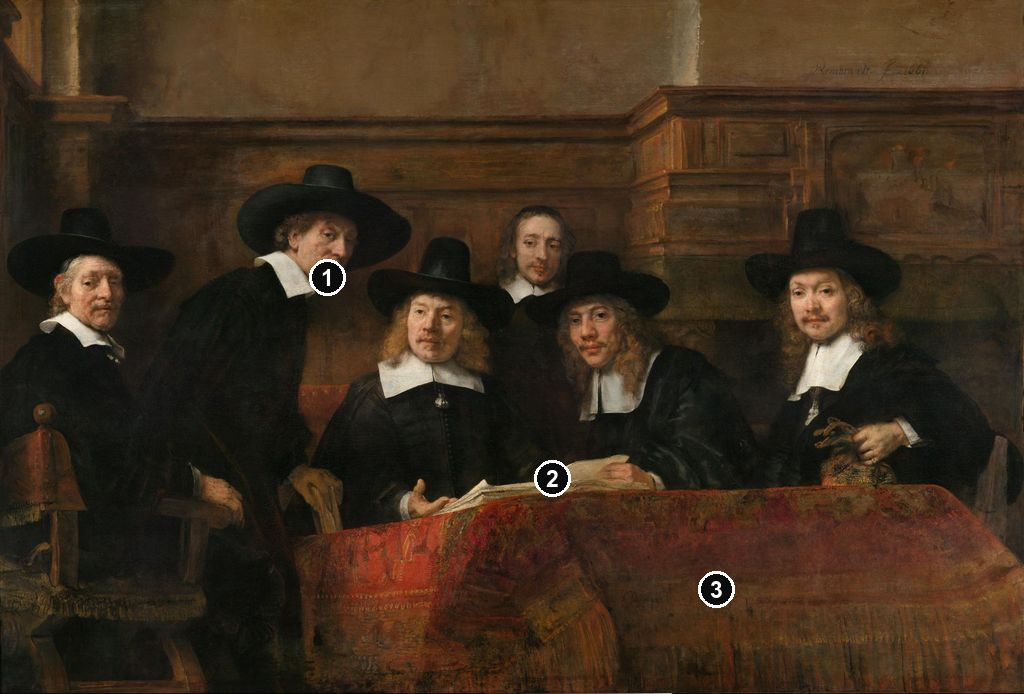
Details from THE SYNDICS OF THE DRAPERS’ GUILD
Open a detail to inspect it at a larger size.
The rising figure
One man appears to lean forward as he turns from the table to look out.
The open book
The central hands and the edge of the open book interrupt the line of the table.
The carpet
The broad red carpet marks the distance between the officials and the viewer.
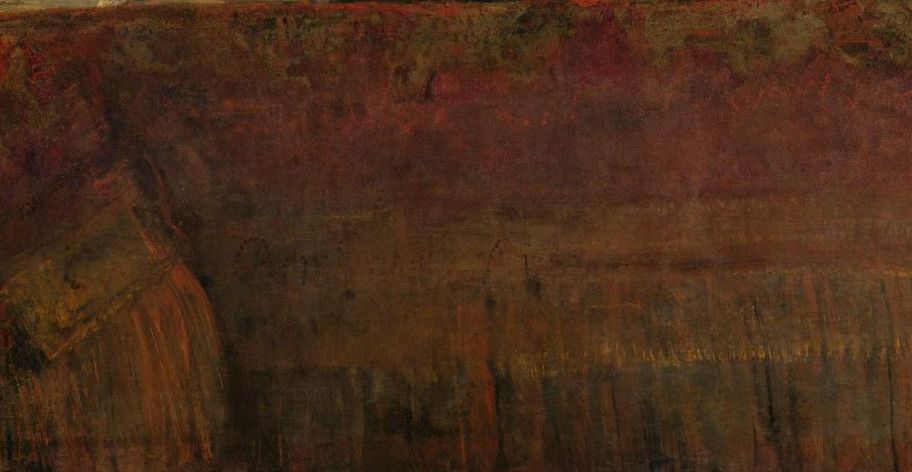
Rijksmuseum reproduction. The annotated image adds markers, and the details are cropped. Photograph source · Rijksmuseum public domain
Watch: Rembrandt’s life and work
Explore Rembrandt’s early career, etchings and paintings, and see his work alongside that of other Baroque artists.
Rembrandt | A Life of Art
Curators introduce Rembrandt’s early career and trace how he developed his handling of light and shade.
Watch on YouTubeThe carpet, the light and the room
Rembrandt gives the table two conspicuous colours. A warm red takes in the broad front surface, and an illuminated edge near the book picks out the change of plane. The ornament is visible enough to follow, with bands and irregular accents appearing in red, brown, gold and muted green. It grows harder to separate into individual motifs lower down, where the hanging carpet darkens. Along the opposite edge, the paper provides a short, much paler accent. The carpet establishes how close the table is, and the book tells us how much of the table remains beyond our sight.
The dark garments have a similar variety. Jansz’s coat reads at first as a large black mass, although its edge can be followed where it meets the chair and where it crosses the panelling. The lit collars help define the different turns of the men’s shoulders. Van Doeyenburg’s collar has a broad spread. Van der Mye’s appears in two narrower areas, and De Neve’s pale linen comes to a more emphatic point against his coat. Some whites turn grey or warm where they recede from the light. The differences give the men a shared formality of dress and a particular posture apiece.
The panelling establishes the room’s dimensions with a few strong lines. A horizontal moulding runs behind the hats, and the projecting architectural section to the right breaks it. The relatively open plaster above leaves room for the lift of Jansz’s body to register. Farther right, the museum identifies a small painting above the hearth as an image of a burning beacon. It takes time to pick out in the dark. Its size and subdued tones leave the faces and book as the main points of interest, while its presence gives the wall some of the furnished character of a room used by an institution. [1]
The light makes the depth between the people easy to read. Bel stands farther back, and substantial areas of his clothing merge with the shadow. A patch of light holds his forehead and cheek in view. The stronger whites in front of him bring the wardens’ collars nearer, while the light on the hands brings the eye down towards the book. There is a particularly long interval between the face of Jansz and his lowered hand. That interval allows his whole figure, including the dark length of his coat, to carry the movement. At the middle of the painting, where the men sit close, small changes in the light do more of the work.
Three drawings and a changing composition
Three surviving drawings are associated with the development of The Syndics. The Rijksmuseum’s feature Who’s who? introduces the studies as evidence of how Rembrandt worked out the group. The individual sheets are in Amsterdam and Rotterdam, and the group study is in Berlin. Their differences from the painting let us follow particular decisions. Their precise relationship to the stages of painting remains a matter of interpretation. Peter Schatborn’s catalogue entry for the Amsterdam sheet notes that drawings related to Rembrandt’s paintings could be made as he considered changes to a composition already under way. [5] [7]
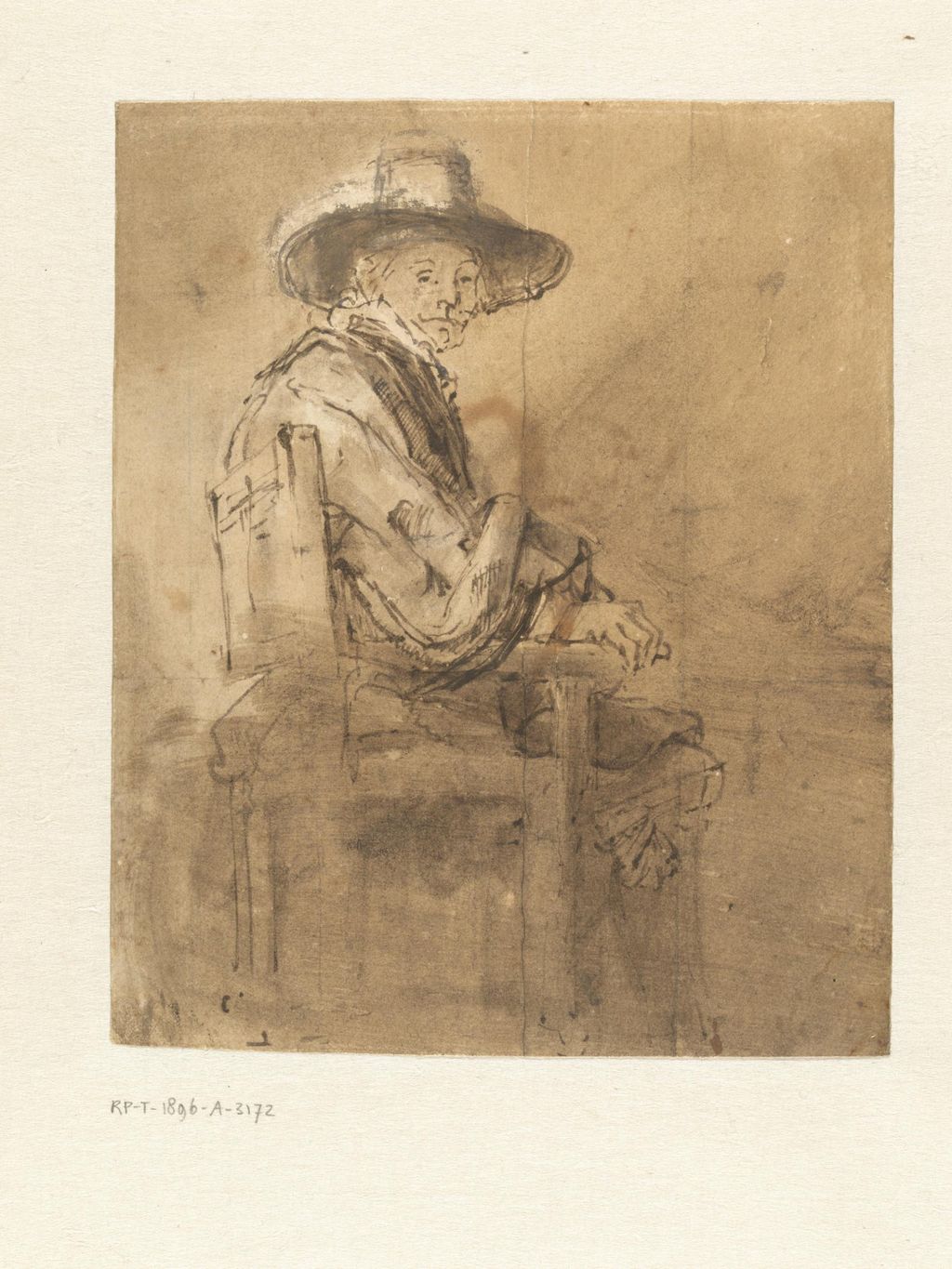
The Rijksmuseum sheet shows Jacob van Loon seated. His body and chair are indicated with broad areas of brown wash, and a few pen strokes establish the face and hands. Pale corrections and accents open up areas within the wash. Schatborn notes that these white touches would once have been stronger. The chair is simpler than the one in the painting, where the upright close to the left edge becomes such a conspicuous detail. The figure already poses a problem that carries through to the canvas. Rembrandt needs to show a man seated in relation to his colleagues while leaving his face available to the person in front of the group. [5]
The Rotterdam drawing, Study for One of the Syndics, Volkert Jansz., is in Museum Boijmans Van Beuningen, inventory R 133 (PK). Here Jansz stands more upright. Broad strokes of reed pen and brush give weight to his body and establish enough of the surroundings to situate him. Schatborn points out that Rembrandt left an opening at the lower left for Van Loon’s chair. Even in a study mainly concerned with one body, the place of the next man was already in play. Both individual studies were made on paper from an account book. That fact concerns the material Rembrandt drew on. The painted volume on the table is a separate object within the scene. [5] [8]
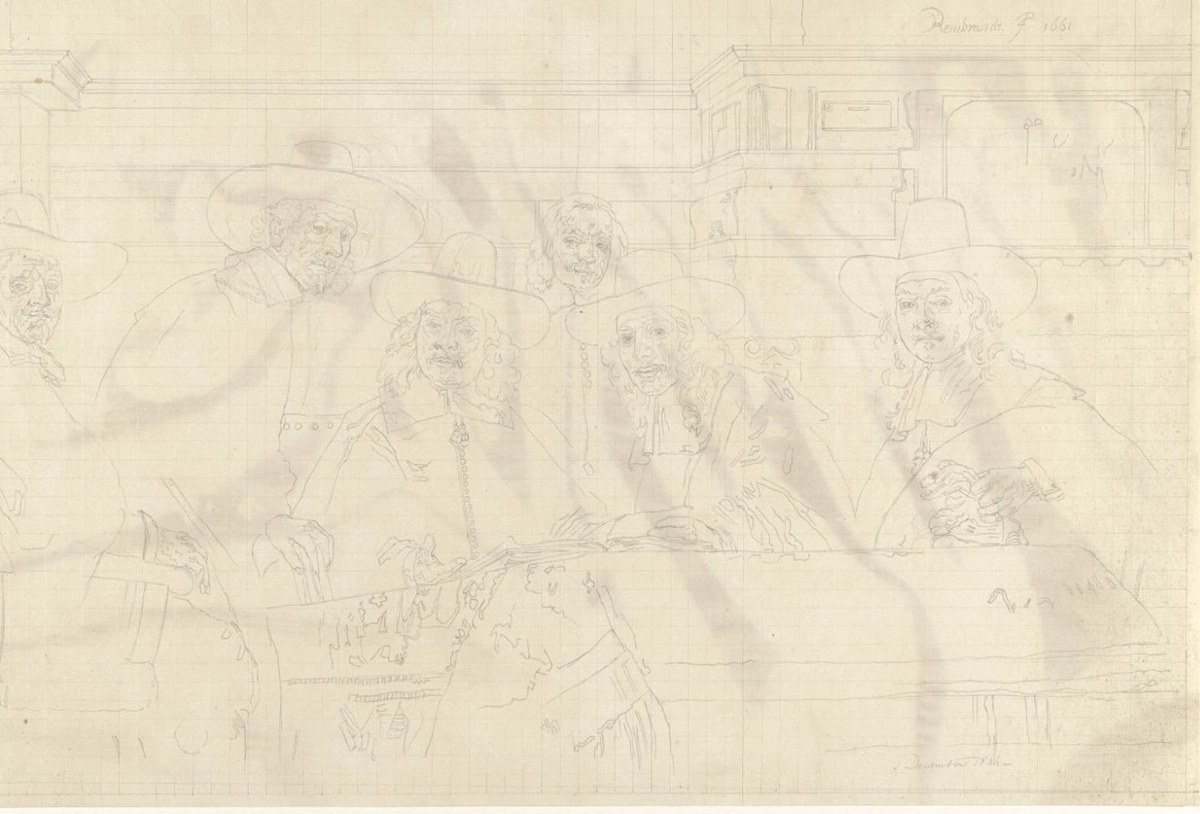
The drawing in the Berlin Kupferstichkabinett, KdZ 5270, brings together the three officials at the left. Its present arched format was imposed at some point, and a trace of another hat brim at the right suggests that the sheet once extended farther. Within the surviving group, Jansz stands straighter and more frontally than in the painting. The figures can be read as more directly engaged with one another. Schatborn identifies a quickly added head in the approximate position Bel would occupy in the finished composition. Van Schendel, looking at the same mark, read it as a sculpted head associated with the fireplace. The small form is easy to understand in either context, since the drawing gives the surroundings in abbreviated strokes. [5] [6] [9]
The drawings record different scales of activity. The individual studies work out how someone sits or stands, down to the space a chair will need. The Berlin sheet allows Rembrandt to test what happens when bodies and faces are read together. The later inclination of Jansz is a modest alteration in the angle of one figure, with consequences for the whole left side. It gives the seated Van Loon room to remain distinct and carries the eye towards the chairman and the book. It also gives the finished portrait its most persuasive suggestion of movement.
What the X-rays reveal beneath the paint
Van Schendel published a study of The Syndics in 1956 drawing on radiographs made during a period of conservation examination. A radiograph records differences in how materials absorb X-rays. Certain passages of earlier paint can therefore register beneath the visible surface. In an extensively revised area, several positions can appear in one image. Identifying the forms is one task. Deciding which one came first and what the painter intended at each stage calls for interpretation. The Rembrandt Database also presents a digitally assembled overall radiograph, which allows the local changes to be seen across the full composition. [6] [9]
Around Van Doeyenburg, the radiographs show several placements of the head and hand. The Rembrandt Database identifies three, with the rising official first positioned farther left than he appears now. Van Schendel also found substantial changes beneath the open book. Together these traces show how much of the central action was settled on the canvas. When Rembrandt moved a head or changed the level of a hand, he had to reconsider how that hand met the pale pages and how much room remained for the man next to it. The delicately spaced gestures in the finished group are the result of decisions at the scale of the whole picture. [6] [9]
Bel’s position changed repeatedly. The radiographs suggest attempts to put him at the extreme right and between the two wardens on the right. In the final arrangement he occupies the quieter gap just behind the centre, where his bare head rises between two hat brims. The placement brings the attendant into the same field of attention as the chairman and the book, while his distance behind them remains visible. A figure with a subordinate role supplied Rembrandt with one of the most important elements in arranging the six heads. [5] [6]
The examination also established something about the canvas under all that paint. Van Schendel described two horizontal widths of linen joined a little above the middle, the seam passing through the region of several heads. The canvas has a herringbone twill that can be seen in the radiographs and at parts of the turned edges. He regarded it as an uncommon support in Dutch painting and documented it in other works, including Rembrandt’s Conspiracy of Claudius Civilis, painted for Amsterdam’s Town Hall. The herringbone is the weave of the actual support. The ornament of the Persian carpet is painted on top of it. Between those two textiles lie the preparations and successive revisions that the X-rays help make visible. [6]
From the Staalhof to the Gallery of Honour
The wardens commissioned the work for a room associated with their office. Men who knew the Staalhof could have brought quite specific knowledge to the picture, recognising faces and connecting the volume on the table with an institution they dealt with. The commission came after Rembrandt’s financial difficulties in the 1650s and his move to a rented house on the Rozengracht. A canvas almost three metres wide, made to represent a board of officials in its own hall, shows him still entrusted with a prominent Amsterdam commission at this stage of his career. [1]
Two inscriptions have contributed to the painting’s history. The Rijksmuseum records the signature and date on the carpet as ‘Rembrandt f. 1662’. It catalogues the other inscription, ‘Rembrandt. f. 1661.’, as false. The distinction is between two inscriptions on a painting the museum attributes to Rembrandt. The likely term of office of the group, spanning 1661 and 1662, is a separate question from the date Rembrandt signed on the carpet. [1] [4] [6]
The painting went from the Staalhof to the Konstkamer, or art room, in Amsterdam’s Town Hall on 27 November 1771, a date the Rijksmuseum records on the evidence of a former label on the reverse. The city lent the work to the museum on 15 August 1808. Its passage through these settings changed the audiences that stood in front of the table. At the guild hall it commemorated particular officeholders within their working institution. In the civic collection and later the museum, it could be encountered by viewers whose knowledge of the men began with the painting itself. [1]
Reproductive prints took the group into other settings. The Rijksmuseum holds a 1799 etching by Johannes Pieter de Frey after Rembrandt, RP-P-1885-A-9800, with an inscription giving the year 1661 in its title. The museum also holds De Frey’s proof impression, RP-P-OB-52.254. These are separately catalogued impressions on paper. Both reverse the painting’s arrangement, placing De Neve at the left and Van Loon at the right. The reversal also moves the little beacon picture to the left. The date printed on the lettered impression belongs to that print’s inscription, and the orientation of the original is the one given by the painting SK-C-6. [10] [11]
How Rembrandt’s other groups direct our attention
In The Anatomy Lesson of Dr Nicolaes Tulp, painted in 1632 and now in the Mauritshuis, the illuminated body of Adriaen Adriaensz, known as Aris Kindt, lies along the foreground. Tulp lifts the dissected forearm with forceps, and his free hand demonstrates a movement. The other surgeons direct their eyes towards different points. Their positions give a viewer several ways into the demonstration. In The Syndics, a book takes up a small fraction of the area occupied by the body in the earlier work. It can hold the attention of one hand while the men’s faces draw ours. Both paintings give a group of professionals something specific to gather around, and the object in each governs how their attention can move. [12]
In The Night Watch, dated 1642 and catalogued by the Rijksmuseum as SK-C-5, Captain Frans Banninck Cocq stretches his hand forward as the company prepares to move. The gesture carries across a crowd in which weapons, bodies and costume details intersect at different heights. Van Doeyenburg’s raised fingers in The Syndics occupy a much smaller space, close to the tabletop. Rembrandt had twenty years earlier used the captain’s projection towards the viewer to set a whole group in motion. Here a hand can suggest a passing word while a few glances carry as much consequence as a step. Both paintings give public office a physical form through the way people stand, look and act in relation to one another. [13]
Vincent van Gogh singled out The Syndics in a letter to Theo written on or about 10 October 1885, after visiting the Rijksmuseum. He called it Rembrandt’s finest painting and went on to praise the intimacy and sympathetic handling of The Jewish Bride, a separate late painting also in the Rijksmuseum. In a letter to Émile Bernard in 1888, he recalled admiring hands in both works for their vitality, at a time when he was thinking about what painters meant by finish. His observation sends the eye back to the different things hands do in The Syndics. One stays low beside a chair, another holds the edge of a book, and the chairman’s fingers remain poised above the carpet. The small distance between those fingers and the page holds open the question of what he was about to say. [14] [15]
Rembrandt artworks
Different impressions of the same print can appear as separate records.
| Name | Date | Medium |
|---|---|---|
| The Night Watch | 1642 | Painting |
| The Return of the Prodigal Son | 1660s | Painting |
| The Anatomy Lesson of Dr Nicolaes Tulp | 1632 | Painting |
| The Jewish Bride | c. 1665–69 | Painting |
| Self-Portrait with Two Circles | c. 1665 | Painting |
| Christ in the Storm on the Sea of Galilee | 1633 | Painting |
| Bathsheba at Her Bath | 1654 | Painting |
| The Hundred Guilder Print | c. 1648–49 | |
| The Three Trees | 1643 | |
| Aristotle with a Bust of Homer | 1653 | Painting |
| The Abduction of Ganymede | 1635 | Painting |
| Ahasuerus and Haman at the Feast of Esther | 1660 | Painting |
| The Anatomy Lesson of Dr Jan Deijman | 1656 | Painting |
| Judith at the Banquet of Holofernes | 1634 | Painting |
| Artist in His Studio | c. 1628 | Painting |
| The Artist’s Mother, Head and Bust, Three-Quarters Right | 1628 | |
| The Artist’s Mother, Head Only, Full Face | 1628 | |
| Balaam and the Ass | 1626 | Painting |
| The Baptism of the Eunuch | 1626 | Painting |
| Beggar in a High Cap, Standing and Leaning on a Stick | c. 1629 | |
| Beggar with a Clenched Hand, Leaning on a Stick | c. 1629 | |
| Belshazzar’s Feast | c. 1636–38 | Painting |
| The Blinding of Samson | 1636 | Painting |
| Bust of a Bearded Young Man with a Skullcap | 1663 | Painting |
| Christ Presented to the People | 1655 | |
| The Circumcision | c. 1625 | |
| The Conspiracy of Claudius Civilis | c. 1661–62 | Painting |
| Danaë | Begun 1636 and later revised | Painting |
| The Descent from the Cross | 1632–33 | Painting |
| Descent from the Cross by Torchlight | 1654 | |
| The Descent from the Cross, Second Plate | 1633 | |
| Diana Bathing with Her Nymphs, with Actaeon and Callisto | 1634 | Painting |
| Ephraim Bueno, Jewish Physician | 1647 | |
| Portrait of Frederick Rihel on Horseback | c. 1663 | Painting |
| Flora | 1634 | Painting |
| The Goldweigher’s Field | 1651 | |
| Head of Christ | 1645–50 | Painting |
| The Holy Family with Angels | 1645 | Painting |
| Homer Dictating His Verses | 1663 | Painting |
| Jacob Blessing the Sons of Joseph | 1656 | Painting |
| Jacob Wrestling with the Angel | 1659–60 | Painting |
| Joseph and Potiphar’s Wife | 1655 | Painting |
| Juno | c. 1662–65 | Painting |
| Landscape with a Stone Bridge | c. 1638 | Painting |
| Head of an Old Man with Curly Hair | 1659 | Painting |
| A Man in Armour | Possibly 1655 | Painting |
| Minerva in Her Study | 1635 | Painting |
| Moses with the Tablets of the Law | 1659 | Painting |
| Old Man with a Gold Chain | c. 1631 | Painting |
| Peter and John at the Gate of the Temple | c. 1629 | |
| Philosopher in Meditation | 1632 | Painting |
| The Polish Rider | c. 1655 | Painting |
| Portrait of a Woman with a Lapdog | c. 1665 | Painting |
| Portrait of Gerard de Lairesse | 1665–67 | Painting |
| Portrait of Jan Six | c. 1654 | Painting |
| Portrait of Maerten Soolmans | 1634 | Painting |
| Portrait of a Woman, Probably Maria Trip | 1639 | Painting |
| Portrait of Oopjen Coppit | 1634 | Painting |
| Portrait of Titus | c. 1662 | Painting |
| Rembrandt and Saskia in the Parable of the Prodigal Son | c. 1635 | Painting |
| The Raising of Lazarus | c. 1630–32 | Painting |
| The Rest on the Flight into Egypt | c. 1626 | |
| Self-Portrait as the Apostle Paul | 1661 | Painting |
| Self-Portrait (Cologne) | c. 1668 | Painting |
| Rembrandt’s Self-Portrait, Frowning | 1630 | |
| Self-Portrait in a Cap, Wide-Eyed and Open-Mouthed | 1630 | |
| Self-Portrait in a Fur Cap | 1630 | |
| Self-Portrait in a Fur Cap, in an Oval Border | c. 1629 | |
| Self-Portrait in a Soft Hat and Embroidered Cloak | 1631 | |
| Self-Portrait, Bending Forward | c. 1628 | |
| Self-Portrait with a Broad Nose | c. 1628 | |
| Self-Portrait with Beret and Turned-Up Collar | 1659 | Painting |
| Self-Portrait with Plumed Cap and Lowered Sabre | 1634 | |
| The Shipbuilder and His Wife | 1633 | Painting |
| Simeon’s Hymn of Praise | c. 1640 | |
| Simeon in the Temple | c. 1669 | Painting |
| St Jerome Kneeling | c. 1628–29 | |
| Saint Matthew and the Angel | 1661 | Painting |
| The Stoning of Saint Stephen | 1625 | Painting |
| A Stout Man in a Large Cloak | c. 1629 | |
| The Supper at Emmaus | 1648 | Painting |
| Susanna and the Elders | 1647 | Painting |
| The Syndics of the Drapers’ Guild | 1662 | Painting |
| The Mill | 1645/1648 | Painting |
| The Woman Taken in Adultery | 1644 | Painting |
| Lucretia (1664) | 1664 | Painting |
| Lucretia (1666) | 1666 | Painting |
| Anatomische les van Dr. Jan Deijman (fragment) | 1656 | Painting |
| Isaac and Rebecca, Known as ‘The Jewish Bride’ | c. 1665 - c. 1669 | Painting |
| Johannes Wtenbogaert | 1633 | Painting |
| Man in Oriental Dress | 1635 | Painting |
| Musical Company | 1626 | Painting |
| Portrait of Ephraim Bueno | 1645 - 1647 | Painting |
| Portrait of Haesje Jacobsdr van Cleyburg | 1634 | Painting |
| Portrait of Oopjen Coppit | 1634 | Painting |
| Self-portrait | c. 1628 | Painting |
| Still Life with Peacocks | c. 1639 | Painting |
| Tobit and Anna with the Kid | 1626 | Painting |
| Young Woman in Fantasy Costume | 1633 | Painting |
| A Polish Nobleman | 1637 | Painting |
| A Woman Holding a Pink | 1656 | Painting |
| A Young Man Seated at a Table (possibly Govaert Flinck) | c. 1660 | Painting |
| Man with a Sheet of Music | 1633 | Painting |
| Philemon and Baucis | 1658 | Painting |
| Portrait of a Gentleman with a Tall Hat and Gloves | c. 1656/1658 | Painting |
| Portrait of a Lady with an Ostrich-Feather Fan | c. 1656/1658 | Painting |
| Portrait of a Man in a Tall Hat | c. 1663 | Painting |
| Saskia van Uylenburgh, the Wife of the Artist | probably begun 1634/1635 and completed 1638/1640 | Painting |
| The Circumcision | 1661 | Painting |
| Bellona | 1633 | Painting |
| Flora | ca. 1654 | Painting |
| Hendrickje Stoffels (1626–1663) | mid-1650s | Painting |
| Herman Doomer (ca. 1595–1650) | 1640 | Painting |
| Man in a Turban | 1632 | Painting |
| Man with a Magnifying Glass | early 1660s | Painting |
| Portrait of a Man | 1632 | Painting |
| Portrait of a Man Holding Gloves | 1648 | Painting |
| Portrait of a Man, probably a Member of the Van Beresteyn Family | 1632 | Painting |
| Portrait of a Woman | 1633 | Painting |
| Portrait of a Woman, probably a Member of the Van Beresteyn Family | 1632 | Painting |
| Portrait of a Young Woman with a Fan | 1633 | Painting |
| The Standard Bearer (probably Floris Soop, 1604–1657) | 1654 | Painting |
| The Toilet of Bathsheba | 1643 | Painting |
| Woman with a Pink | early 1660s | Painting |
| Lieven Willemsz van Coppenol (born about 1599, died 1671 or later) | Painting | |
| Portrait of a Man | ca. 1655–60 | Painting |
| Self-Portrait | 1660 | Painting |
| A Cap | c. 1629 - c. 1630 | Drawing |
| A Cow in a Shed | c. 1640 | Drawing |
| A Syndic of the Drapers’ Guild, Jacob van Loon, Seated | c. 1661 - c. 1662 | Drawing |
| Abraham Casting Out Hagar and Ishmael | c. 1650 | Drawing |
| Actor in the Role of Pantalone Engaged in Conservation | c. 1634 - c. 1636 | Drawing |
| Bedroom with Saskia in a Canopy Bed | c. 1638 | Drawing |
| Beheading of John the Baptist | c. 1640 - c. 1641 | Drawing |
| Boaz and Ruth | c. 1645 | Drawing |
| Boy Walking with a Stick | c. 1635 - c. 1640 | Drawing |
| Christ Appearing to Mary Magdalene as a Gardener (Noli me tangere) | c. 1645 | Drawing |
| Christ Healing a Leper | c. 1650 - c. 1655 | Drawing |
| Christ Washing the Disciples’ Feet | c. 1640 - c. 1650 | Drawing |
| Cottage with White Paling among Trees | c. 1648 | Drawing |
| Daniel in the Lions’ Den | c. 1650 | Drawing |
| David Hearing the News of Uriah’s Death | c. 1650 | Drawing |
| Five Studies of Haman’s Head | c. 1655 - c. 1660 | Drawing |
| Four Men Standing, Wearing Hats | c. 1650 | Drawing |
| Indian Archer | c. 1656 - c. 1658 | Drawing |
| Inn on the Amstelveenseweg | c. 1652 | Drawing |
| Jacob and his Sons | c. 1641 | Drawing |
| Jael Killing Sisera | c. 1658 - c. 1659 | Drawing |
| Jahangir | c. 1656 - c. 1658 | Drawing |
| Joseph in Prison Interpreting the Dreams of the Butler and the Baker | c. 1650 - c. 1655 | Drawing |
| Longhouse Farmstead with a Haystack in a Polder Landscape | c. 1652 | Drawing |
| Man Helping a Rider to Mount a Horse | c. 1640 - c. 1641 | Drawing |
| Nude Woman Lying on a Pillow | c. 1661 - c. 1662 | Drawing |
| Nude Woman Seated by a Stove | c. 1661 - c. 1662 | Drawing |
| One of the Three Kings Adoring the Virgin and Child | c. 1635 - c. 1640 | Drawing |
| Recumbent Lion | c. 1660 | Drawing |
| Saskia in Bed | c. 1635 | Drawing |
| Seated Actor in the Role of Capitano | c. 1634 - c. 1636 | Drawing |
| Self-portrait with Tousled Hair | c. 1628 - c. 1629 | Drawing |
| Shah Jahan | c. 1656 - c. 1658 | Drawing |
| Shah Jahan and his Son | c. 1656 - c. 1658 | Drawing |
| Small Study of the Head of the Sick Woman | c. 1647 - c. 1648 | Drawing |
| Standing Man with a Pouch | c. 1629 - c. 1630 | Drawing |
| Standing Man with a Stick, Facing Left | c. 1629 - c. 1630 | Drawing |
| Standing Man with a Stick, Facing Right | c. 1629 - c. 1630 | Drawing |
| Standing Man with Outstretched Arm | c. 1636 - c. 1641 | Drawing |
| Studies for the Sick Woman in the ‘Hundred Guilder Print’ | c. 1648 | Drawing |
| Studies of the Mourning Magdalen and the Virgin | c. 1635 - c. 1636 | Drawing |
| Study of a Man, Seen from Behind | c. 1629 - c. 1630 | Drawing |
| Study of a Woman’s Legs | c. 1628 - c. 1629 | Drawing |
| Susanna and the Elders | c. 1650 - c. 1655 | Drawing |
| The Actor Willem Bartholsz Ruyter as a Peasant | c. 1638 | Drawing |
| The Actor Willem Bartholsz Ruyter as King Ahasuerus on his Throne | c. 1635 - c. 1640 | Drawing |
| The Angel Appearing to Joseph in his Dream | c. 1650 | Drawing |
| The Annunciation to the Shepherds | c. 1650 | Drawing |
| The Entombment, over a Sketch of an Executioner | c. 1640 - c. 1641 | Drawing |
| The Pancake Woman | c. 1635 | Drawing |
| The Swijgh Utrecht Tower in Amsterdam | c. 1650 - c. 1655 | Drawing |
| Three Orientals Conversing | c. 1645 | Drawing |
| Three Scribes | c. 1628 - c. 1629 | Drawing |
| Three Women and a Child by a Door | c. 1645 | Drawing |
| Tobias and the Angel Taking Leave of Raguel | c. 1650 - c. 1655 | Drawing |
| Two Horses at a Halting-place | c. 1637 | Drawing |
| View of the Amstel from the Blauwbrug | c. 1645 - c. 1650 | Drawing |
| View of the Amstelveenseweg outside Amsterdam | c. 1660 - c. 1662 | Drawing |
| View of the Nieuwezijds Voorburgwal | c. 1647 | Drawing |
| Walking Man with a High Cap | c. 1655 - c. 1660 | Drawing |
| Winter View with a Waterway, Cottages and Two Boats | c. 1650 | Drawing |
| Woman with a Urinating Child | c. 1658 - c. 1660 | Drawing |
| Young Woman Seated by a Window (Saskia?) | c. 1638 | Drawing |
| A Landscape with Farm Buildings among Trees | c. 1650/1655 | Drawing |
| Beggar Man and Woman | c. 1630/1631 | Drawing |
| Beggar Woman Leaning on a Stick | 1628/1630 | Drawing |
| Bust of an Elderly Man in a Flat Cap | 1635/1637 | Drawing |
| Cottages and Barn beside a Road | c. 1650 | Drawing |
| Esther before Ahasuerus | 1655/1660 | Drawing |
| Figures on the Anthoniesdijk Entering Houtewael [verso] | c. 1650 | Drawing |
| God the Father Supported by Angels | 1655/1660 | Drawing |
| Head of an Old Man (recto) | c. 1631 | Drawing |
| Jan Cornelisz Sylvius, the Preacher | 1644/1645 | Drawing |
| Joseph Recounting His Dreams | early 1640s | Drawing |
| Seated Old Man | 1630 | Drawing |
| Self-Portrait | c. 1637 | Drawing |
| View of Diemen | c. 1655 | Drawing |
| View of Houtewael near the Sint Anthoniespoort [recto] | c. 1650 | Drawing |
| View over the Amstel from the Rampart | c. 1646/1650 | Drawing |
| Woman Seated on the Ground with Two Children | 1635/1640 | Drawing |
| Cottage among Trees | ca. 1650 | Drawing |
| Cottage near the Entrance to a Wood | 1644 | Drawing |
| Elsje Christiaens Hanging on a Gibbet | 1664 | Drawing |
| Group of Farm Buildings | ca. 1648–52 | Drawing |
| Houses by the Water | ca. 1652 | Drawing |
| Nathan Admonishing David | 1650–55 | Drawing |
| Old Man in Profile | 1620–69 | Drawing |
| Old Man Leaning on a Stick | 1632–35 | Drawing |
| Potiphar's Wife Accusing Joseph Before her Husband | 1620–69 | Drawing |
| Satire on Art Criticism | 1644 | Drawing |
| Seated Man Wearing a Flat Cap | 1635–40 | Drawing |
| St. Peter and St John Healing the Paralytic | 1606–69 | Drawing |
| Study Sheet with Three Women and a Boy | ca. 1638–39 | Drawing |
| The Last Supper, after Leonardo da Vinci | 1634–35 | Drawing |
| The Wedding Night of Tobias and Sarah | 1640–49 | Drawing |
| Two Cottages | ca. 1636 | Drawing |
| Two Studies of a Woman Reading | 1635–40 | Drawing |
| Woman Reading | 1606–69 | Drawing |
| The Annunciation to the Shepherds | c. 1655 | Drawing |
| Elsje Christiaens Hanging on a Gibbet | 1664 | Drawing |
| A blind hurdy-gurdy player and family receiving alms | 1648 | Print impression |
| A cavalry fight | 1629 | Print impression |
| A Polander with a Stick | c. 1631 | Print impression |
| A scholar in his study | c. 1652 | Print impression |
| A Scholar in his Study (‘Faust’) | c. 1652 | Print impression |
| A standing hurdy-gurdy player | c. 1631 | Print impression |
| Aanbidding der herders: nachtstuk | 1650 - 1654 | Print impression |
| Abraham Francen | c. 1657 | Print impression |
| Abraham Francen, apothecary | c. 1657 | Print impression |
| Arnout Tholinx | c. 1656 | Print impression |
| Bald headed man in profile right: the artist's father (?) | 1630 | Print impression |
| Bald man with open mouth, looking down: bust | c. 1631 | Print impression |
| Bald Old Man with a Short Beard | c. 1635 | Print impression |
| Bearded man with short wavy hair: bust | c. 1631 | Print impression |
| Bearded Old Man with High Forehead | c. 1629 | Print impression |
| Bedelaar met een houten been | 1628 - 1632 | Print impression |
| Bedelaar met een stok | 1631 | Print impression |
| Beggar in a high cap, standing and leaning on a stick | c. 1629 | Print impression |
| Beggar in a High Hat, Leaning on a Stick | c. 1629 | Print impression |
| Beggar leaning on a stick, facing left | c. 1630 | Print impression |
| Beggar Man and Woman | c. 1629 | Print impression |
| Beggar Man and Woman behind a Bank | c. 1630 | Print impression |
| Beggar seated warming his hands at a chafing dish | c. 1630 | Print impression |
| Beggar Warming his Hands | c. 1630 | Print impression |
| Beggar with a clenched hand, leaning on a stick | c. 1629 | Print impression |
| Beggar with a Cottage and Two Figures in the Background | c. 1629 | Print impression |
| Beggar with a Crippled Hand, Leaning on a Stick | c. 1629 | Print impression |
| Beggar with a Wooden Leg | c. 1630 | Print impression |
| Beggar Woman with a Gourd | c. 1629 | Print impression |
| Beggar, Seated in an Armchair | c. 1629 | Print impression |
| Bust of an old man with a fur cap and flowing beard, nearly full face | c. 1631 | Print impression |
| Bust of an old man with flowing beard and white sleeve | c. 1630 | Print impression |
| Christ and the woman of Samaria among ruins | 1634 | Print impression |
| Christ before Pilate: large plate | 1635 | Print impression |
| Christ Crucified between the Two Thieves | c. 1641 | Print impression |
| Christ Crucified between the two Thieves: 'The Three Crosses' | 1653 | Print impression |
| Christ crucified between the two thieves: an oval plate | c. 1641 | Print impression |
| Christ Disputing with the Doctors | 1630 | Print impression |
| Christ disputing with the Doctors: small plate | 1630 | Print impression |
| Christ Healing the Sick (‘Hundred Guilder Print’) | c. 1648 | Print impression |
| Christ Preaching | c. 1657 | Print impression |
| Christ preaching ('La Petite Tombe') | c. 1657 | Print impression |
| Christ Preaching, known as La petite tombe | c. 1657 | Print impression |
| Christ Presented to the People (Ecce Homo) | 1655 | Print impression |
| Christ presented to the people: oblong plate | 1655 | Print impression |
| Christus en de schriftgeleerden: kleine plaat | 1630 | Print impression |
| Clump of trees with a vista | 1652 | Print impression |
| Cottage and Boundary Post on the Spaarndammerdijk | c. 1650 | Print impression |
| Cottage and boundary post on the Spaarndammerdijk ('L'Obelisque') | c. 1650 | Print impression |
| Cottage and Farm Buildings with a Man Sketching | c. 1641 | Print impression |
| Cottage beside a canal with a view of Ouderkerk | c. 1641 | Print impression |
| Cottages beside a Canal: View of Ouderkerk aan de Amstel | c. 1641 | Print impression |
| David in gebed | 1652 | Print impression |
| Diana at the bath | c. 1631 | Print impression |
| Driekoningen: een nachtstuk | 1649 - 1653 | Print impression |
| Een student aan tafel bij kaarslicht | c. 1642 | Print impression |
| Farmhouse among Trees | 1652 | Print impression |
| Geleerde in zijn werkkamer (Faust) | 1650 - 1807 | Print impression |
| Girl with a basket | c. 1642 | Print impression |
| Goudsmid | 1655 | Print impression |
| Grotesque profile: man in a high cap | c. 1629 | Print impression |
| Head of a Man in a Fur Cap, Crying Out | c. 1629 | Print impression |
| Head of a man in a high cap | c. 1629 | Print impression |
| Head of a Man in a High Hat | c. 1629 | Print impression |
| Head of an Old Man in a High Fur Hat | c. 1629 | Print impression |
| Hieronymus geknield in gebed, de blik naar beneden gericht | 1635 | Print impression |
| Honderd Gulden prent | 1753 - 1810 | Print impression |
| Jacob's ladder | 1655 | Print impression |
| Jan Antonides van der Linden | 1665 | Print impression |
| Jan Asselijn, painter | 1645 - 1649 | Print impression |
| Jan Lutma, goldsmith | 1656 | Print impression |
| Jan Six | 1647 | Print impression |
| Johannes Lutma | 1656 | Print impression |
| Johannes Wtenbogaert | 1635 | Print impression |
| Jongeman, zittend en staand | 1644 - 1648 | Print impression |
| Jozef vertelt zijn dromen | 1638 | Print impression |
| Kruisiging: kleine plaat | 1633 - 1637 | Print impression |
| Landscape with a cow drinking | c. 1650 | Print impression |
| Landscape with a farm building and the 'house with the tower' | c. 1650 | Print impression |
| Landscape with a farmhouse along a road beside a canal | c. 1652 | Print impression |
| Landscape with a Fisherman (‘The Milkman’) | c. 1650 | Print impression |
| Landscape with sportsman and dogs | c. 1648 | Print impression |
| Landscape with Sportsman and Dogs (‘Het jagertje’) | c. 1648 | Print impression |
| Landschap met drinkende koe | 1648 - 1652 | Print impression |
| Lieven Willemsz van Coppenol | c. 1658 | Print impression |
| Lieven Willemsz. van Coppenol, writing master: the larger plate | c. 1658 | Print impression |
| Lieven Willemsz. van Coppenol, writing master: the smaller plate | c. 1658 | Print impression |
| Loflied van Simeon | 1637 - 1641 | Print impression |
| Male nude, seated and standing | c. 1646 | Print impression |
| Man Crying Out | c. 1629 | Print impression |
| Man drawing from a cast | c. 1641 | Print impression |
| Man Drawing from a Plaster Cast | c. 1641 | Print impression |
| Man in a Close Cap | 1630 | Print impression |
| Man in a Square Cap, in Profile to the Right | c. 1629 | Print impression |
| Man in cap bound around his chin | c. 1631 | Print impression |
| Man with square beard and curly hair: bust | c. 1631 | Print impression |
| Man, tekenend naar een gipsmodel | 1639 - 1643 | Print impression |
| Medea: or the marriage of Jason and Creusa | 1648 | Print impression |
| Naked woman on a mound | c. 1631 | Print impression |
| Old Bearded Man, with Mouth Half Open | c. 1629 | Print impression |
| Old beggar woman with a gourd | c. 1629 | Print impression |
| Old Man in a Fur Coat and Tall Hat | c. 1629 | Print impression |
| Old man in meditation, leaning on a book | c. 1645 | Print impression |
| Old Man Lost in Meditation, Leaning on a Book | c. 1645 | Print impression |
| Old Man Shading his Eyes with his Hand | c. 1639 | Print impression |
| Old Man with a Flowing Beard and White Sleeve | c. 1630 | Print impression |
| Old Man with a Fur Cap and Flowing Beard | c. 1631 | Print impression |
| Old Man, Seen from Behind | c. 1629 | Print impression |
| Old Woman Seated in a Cottage, with a String of Onions | c. 1629 | Print impression |
| Old woman seated in a cottage, with a string of onions on the wall | c. 1629 | Print impression |
| Old Woman Sleeping | c. 1636 | Print impression |
| Oude bedelares met kalebas | 1628 - 1632 | Print impression |
| Peasant family on the tramp | c. 1652 | Print impression |
| Pieter Haaringh: hands and hat | 1655 | Print impression |
| Polander leaning on a stick | c. 1631 | Print impression |
| Portrait of Abraham Francen | c. 1657 | Print impression |
| Portrait of Lieven Willemsz van Coppenol, known as ‘The Smaller Plate’ | c. 1658 | Print impression |
| Portret van de apotheker Abraham Francen | 1655 - 1807 | Print impression |
| Portret van de schrijfmeester Lieven Willemsz. van Coppenol: grote plaat | 1658 | Print impression |
| Portret van predikant Cornelis Claesz. Anslo | 1641 | Print impression |
| Portret van Rembrandt | 1638 | Print impression |
| Profile of a Man in a High Hat | c. 1629 | Print impression |
| Ragged Peasant with his Hands behind him | c. 1630 | Print impression |
| Ragged peasant with his hands behind him, holding a stick | c. 1630 | Print impression |
| Rembrandt’s Mother | 1628 | Print impression |
| Rest on the Flight into Egypt at Night | 1642 - 1646 | Print impression |
| Rest on the flight into Egypt: a night piece | c. 1644 | Print impression |
| Rondtrekkende boerenfamilie | 1650 - 1654 | Print impression |
| Saint Jerome Reading in an Italianate Landscape | c. 1653 | Print impression |
| Schatpenning | 1633 - 1637 | Print impression |
| Self-portrait Bare-headed | c. 1629 | Print impression |
| Self-portrait etching at a window | 1648 | Print impression |
| Self-portrait in a cap and dark cloak: bust | c. 1631 | Print impression |
| Self-portrait in a cap and scarf with the face dark: bust | 1633 | Print impression |
| Self-portrait in a Fur Cap | c. 1629 | Print impression |
| Self-portrait in a Soft Cap | c. 1634 | Print impression |
| Self-portrait in a soft hat and a patterned cloak | 1631 | Print impression |
| Self-portrait in a Soft Hat and Patterned Cloak | 1631 | Print impression |
| Self-portrait in a velvet cap with plume | 1638 | Print impression |
| Self-portrait leaning forward: bust | c. 1629 | Print impression |
| Self-portrait wearing a soft cap: full face, head only | c. 1634 | Print impression |
| Self-portrait with a Broad Nose | c. 1628 | Print impression |
| Self-portrait with bushy hair: bust | c. 1631 | Print impression |
| Self-portrait with cap pulled forward | c. 1630 | Print impression |
| Self-portrait with long bushy hair: head only | c. 1631 | Print impression |
| Self-portrait with Long, Bushy Hair | c. 1631 | Print impression |
| Self-portrait, Bending Forward | c. 1628 | Print impression |
| Self-portrait, frowning: bust | 1630 | Print impression |
| Self-portrait, Leaning Forward | c. 1629 | Print impression |
| Sheet of Slight Studies, One of Two Peasants | c. 1651 | Print impression |
| Sheet of studies of men's head: old man in fur coat and high cap | c. 1629 | Print impression |
| Sheet of studies of men's heads: man crying out, three quarters left: bust | c. 1629 | Print impression |
| Sheet of studies of men's heads: old bearded man nearly in profile to right: mouth half open | c. 1629 | Print impression |
| Sheet of studies of men's heads: old man seen from behind, profile right: half-figure | c. 1629 | Print impression |
| Sheet of Studies with a Tree and the Upper Part of Rembrandt’s Head in a Velvet Cap | c. 1644 | Print impression |
| Sheet of Studies, with a Self-portrait, a Beggar Couple, and Heads of an Old Man and Old Woman | 1632 | Print impression |
| Sheet of Studies, with a Woman Lying Ill in Bed | c. 1639 | Print impression |
| Sheet of studies, with a woman lying ill in bed: busts of two male figures | c. 1639 | Print impression |
| Sheet of studies: head of the artist | 1632 | Print impression |
| Sheet of studies: head of the artist, a beggar couple, heads of an old man and old woman, etc. | 1632 | Print impression |
| Sick woman with a large white headdress (Saskia) | c. 1645 | Print impression |
| Sick Woman with a White Headdress (Saskia) | c. 1645 | Print impression |
| Sleeping Puppy | c. 1640 | Print impression |
| Small Grey Landscape | c. 1640 | Print impression |
| St Jerome beside a pollard willow | 1648 | Print impression |
| St Jerome Kneeling | c. 1628 | Print impression |
| St Jerome kneeling in prayer, looking down | 1635 | Print impression |
| St Jerome reading in an Italian landscape | c. 1653 | Print impression |
| St Peter and St John at the gate of the temple: roughly etched | c. 1629 | Print impression |
| Star of the Kings | c. 1651 | Print impression |
| Straatmuzikanten | 1632 - 1637 | Print impression |
| Strolling Musicians | c. 1635 | Print impression |
| Study of the Head of a Woman | c. 1635 | Print impression |
| The Adoration of the Shepherds | c. 1657 | Print impression |
| The adoration of the shepherds: a night piece | c. 1657 | Print impression |
| The Adoration of the Shepherds: Nocturne | c. 1657 | Print impression |
| The Artist Drawing from a Model | c. 1639 | Print impression |
| The artist drawing from the model | c. 1639 | Print impression |
| The artist's mother seated at a table, looking right: three quarter length | c. 1631 | Print impression |
| The Baby Walker | c. 1646 | Print impression |
| The beheading of St John the Baptist | c. 1631 | Print impression |
| The Blindness of Tobit | c. 1629 | Print impression |
| The blindness of Tobit: a sketch | c. 1629 | Print impression |
| The circumcision | c. 1625 | Print impression |
| The circumcision: small plate | c. 1630 | Print impression |
| The Entombment | c. 1654 | Print impression |
| The Flight into Egypt | c. 1628 | Print impression |
| The Flight into Egypt, on a Plate by Segers | c. 1653 | Print impression |
| The flight into Egypt: a sketch: St Joseph | c. 1628 | Print impression |
| The flight into Egypt: altered plate from Seghers | c. 1653 | Print impression |
| The good Samaritan | 1633 | Print impression |
| The great Jewish bride | 1635 | Print impression |
| The Hundred Guilder Print | c. 1648 | Print impression |
| The Hundred Guilder Print: the ass, the camel and the wheelbarrow | c. 1648 | Print impression |
| The Hundred Guilder Print: the central piece with Christ preaching | c. 1648 | Print impression |
| The Hundred Guilder Print: the central piece with Christ preaching, the plate arched | c. 1648 | Print impression |
| The Hundred Guilder Print: the figures leaning on the wall in the centre left | c. 1648 | Print impression |
| The Hundred Guilder Print: the man seen on the back in the lower left corner | c. 1648 | Print impression |
| The Hurdy-gurdy Player | c. 1631 | Print impression |
| The monk in the cornfield | c. 1646 | Print impression |
| The Presentation in the Temple | c. 1654 | Print impression |
| The presentation in the temple in the dark manner | c. 1654 | Print impression |
| The presentation in the temple: oblong print | c. 1640 | Print impression |
| The Rest on the Flight into Egypt | c. 1644 | Print impression |
| The Skater | c. 1639 | Print impression |
| The sleeping herdsman | c. 1644 | Print impression |
| The small lion hunt (with two lions) | c. 1629 | Print impression |
| The Small Lion Hunt, with One Lion | c. 1629 | Print impression |
| The Spanish gypsy 'Preciosa' | c. 1642 | Print impression |
| The Star of the Kings: a night piece | c. 1651 | Print impression |
| The Three Crosses | 1653 | Print impression |
| The Tribute Money | c. 1634 | Print impression |
| The Triumph of Mordecai | c. 1641 | Print impression |
| The Virgin with the Instruments of the Passion | c. 1642 | Print impression |
| Thomas Haaringh | c. 1655 | Print impression |
| Thomas Haringh (‘Old Haring’) | c. 1655 | Print impression |
| Three heads of women, one lightly etched | c. 1637 | Print impression |
| Three oriental figures (Jacob and Laban?) | 1641 | Print impression |
| Three Studies of Old Men’s Heads | c. 1630 | Print impression |
| Titus | c. 1656 | Print impression |
| Two Beggars | c. 1629 | Print impression |
| Two tramps, a man and a woman | c. 1634 | Print impression |
| View of Amsterdam from the Kadijk | c. 1641 | Print impression |
| View of the Diemerdijk with a milkman and cottages | c. 1650 | Print impression |
| View of the Huis Te Vraag Inn on the Sloterweg | c. 1652 | Print impression |
| Vlucht naar Egypte: nachtstuk | 1651 | Print impression |
| Vrouw in een deuropening, pratend met een man met kinderen | 1641 | Print impression |
| Woman bathing her feet at a brook | 1658 | Print impression |
| Woman in a Fur-trimmed Cloak | 1631 | Print impression |
| Woman with a High Headdress | c. 1630 | Print impression |
| Woman with a high headdress wrapped around the chin: bust | c. 1630 | Print impression |
| Zelfportret met gepluimde fluwelen baret | 1638 | Print impression |
| A Bald Man in Profile (The Artist's Father?) | 1630 | Print impression |
| A Peasant Calling Out: "tis vinnich kout" (It's biting cold) | 1634 | Print impression |
| A Peasant in a High Cap, Standing Leaning on a Stick | 1639 | Print impression |
| A Peasant Replying: "Dats niet" (That's nothing) | 1634 | Print impression |
| Abraham and Isaac | 1645 | Print impression |
| Abraham Caressing Isaac | c. 1637 | Print impression |
| Abraham Casting Out Hagar and Ishmael | 1637 | Print impression |
| Abraham Entertaining the Angels | 1656 | Print impression |
| Abraham's Sacrifice | 1655 | Print impression |
| Adam and Eve | 1638 | Print impression |
| Bald Old Man with a Short Beard in Profile | c. 1635 | Print impression |
| Bearded Man in a Velvet Cap with a Jewel Clasp | 1637 | Print impression |
| Bearded Man, in a Furred Oriental Cap and Robe: the Artist's Father | 1631 | Print impression |
| Beggar Man and Beggar Woman Conversing | 1630 | Print impression |
| Beggar Seated on a Bank | 1630 | Print impression |
| Beggar with His Left Hand Extended | 1631 | Print impression |
| Beggar Woman Leaning on a Stick | 1646 | Print impression |
| Beggars Receiving Alms at the Door of a House | 1648 | Print impression |
| Bust of a Man Wearing a High Cap, Three-Quarters Right (The Artist's Father?) | 1630 | Print impression |
| Bust of an African Woman | c. 1630 | Print impression |
| Bust of an Old Bearded Man, Looking Down, Three Quarters Right | 1631 | Print impression |
| Canal with a Large Boat and Bridge | 1650 | Print impression |
| Canal with an Angler and Two Swans | 1650 | Print impression |
| Christ and the Woman of Samaria: an Arched Print | 1658 | Print impression |
| Christ Appearing to the Apostles | 1656 | Print impression |
| Christ at Emmaus: the Larger Plate | 1654 | Print impression |
| Christ at Emmaus: the Smaller Plate | 1634 | Print impression |
| Christ Carried to the Tomb | c. 1645 | Print impression |
| Christ Disputing with the Doctors: a Sketch | 1652 | Print impression |
| Christ Driving the Money Changers from the Temple | 1635 | Print impression |
| Christ Preaching (The Hundred Guilder Print) | c. 1649 | Print impression |
| Christ Returning from the Temple with His Parents | 1654 | Print impression |
| Christ Seated Disputing with the Doctors | 1654 | Print impression |
| Clement de Jonghe | 1651 | Print impression |
| Cornelis Claesz Anslo | 1641 | Print impression |
| Cottage beside a Canal | c. 1645 | Print impression |
| Cottage with a White Paling | 1648 | Print impression |
| Cottages and Farm Buildings with a Man Sketching | c. 1645 | Print impression |
| David and Goliath | 1655 | Print impression |
| David in Prayer | 1652 | Print impression |
| Death Appearing to a Wedded Couple from an Open Grave | 1639 | Print impression |
| Ephraim Bonus | 1647 | Print impression |
| Faust | c. 1652 | Print impression |
| Jacob Haaringh ('Young Haaringh') (Pieter Haaringh) | 1655 | Print impression |
| Jan Asselijn | c. 1647 | Print impression |
| Jan Cornelisz. Sylvius | 1633 | Print impression |
| Jan Lutma | 1656 | Print impression |
| Jan Uytenbogaert | 1635 | Print impression |
| Jews in the Synagogue | 1648 | Print impression |
| Joseph Telling His Dreams | 1638 | Print impression |
| Joseph's Coat Brought to Jacob | c. 1633 | Print impression |
| Landscape with a Cottage and a Large Tree | 1641 | Print impression |
| Landscape with a Cottage and Hay Barn: Oblong | 1641 | Print impression |
| Landscape with a Cow | c. 1650 | Print impression |
| Landscape with a Hay Barn and a Flock of Sheep | 1652 | Print impression |
| Landscape with a Milkman | c. 1650 | Print impression |
| Landscape with a Road beside a Canal | c. 1652 | Print impression |
| Landscape with a Square Tower | 1650 | Print impression |
| Landscape with a View toward Haarlem (The Goldweigher's Field) | 1651 | Print impression |
| Landscape with an Obelisk | c. 1650 | Print impression |
| Landscape with Sportsman and Dog | c. 1653 | Print impression |
| Landscape with Three Gabled Cottages beside a Road | 1650 | Print impression |
| Landscape with Trees, Farm Buildings and a Tower | c. 1651 | Print impression |
| Lieven Willemsz van Coppenol: the Larger Plate | 1658 | Print impression |
| Lieven Willemsz van Coppenol: the Smaller Plate | c. 1658 | Print impression |
| Man at a Desk Wearing a Cross and Chain | 1641 | Print impression |
| Man Crying Out, Three-Quarters Left | c. 1630/1631 | Print impression |
| Man in a Broad-Brimmed Hat | possibly 1638 | Print impression |
| Man in a Coat and Fur Cap Leaning against a Bank | c. 1630 | Print impression |
| Man in an Arbor | 1642 | Print impression |
| Nude Man Seated and Nude Man Standing, with a Woman and Baby in the Background | c. 1646 | Print impression |
| Nude Man Seated before a Curtain | 1646 | Print impression |
| Nude Man Seated on the Ground with One Leg Extended | 1646 | Print impression |
| Nude Seated on a Bench with a Pillow (Woman Bathing Her Feet at a Brook) | 1658 | Print impression |
| Old Bearded Man in a High Fur Cap, with Eyes Closed | c. 1635 | Print impression |
| Old Man Seen from Behind, Profile to Right | c. 1631 | Print impression |
| Old Man with a Divided Fur Cap | 1640 | Print impression |
| Old Man with Beard, Fur Cap, and Velvet Cloak | c. 1632 | Print impression |
| Peasant with His Hands behind His Back | 1631 | Print impression |
| Peter and John Healing the Cripple at the Gate of the Temple | 1659 | Print impression |
| Portrait of a Boy in Profile | 1641 | Print impression |
| Reclining Female Nude | 1658 | Print impression |
| Return of the Prodigal Son | 1636 | Print impression |
| Saint Francis beneath a Tree Praying | 1657 | Print impression |
| Saint Jerome beside a Pollard Willow | 1648 | Print impression |
| Saint Jerome in a Dark Chamber | 1642 | Print impression |
| Saint Jerome Reading in an Italian Landscape | c. 1653 | Print impression |
| Saint Peter in Penitence | 1645 | Print impression |
| Samuel Menasseh ben Israel | 1636 | Print impression |
| Saskia with Pearls in Her Hair | 1634 | Print impression |
| Self-Portrait (?) with Plumed Cap and Lowered Sabre | 1634 | Print impression |
| Self-Portrait in a Cap and Scarf with the Face Dark | 1633 | Print impression |
| Self-Portrait in a Cap, Open-Mouthed | 1630 | Print impression |
| Self-Portrait in a Cap: Laughing | 1630 | Print impression |
| Self-Portrait in a Flat Cap and Embroidered Dress | c. 1642 | Print impression |
| Self-Portrait in a Heavy Fur Cap | 1631 | Print impression |
| Self-Portrait Leaning on a Stone Sill | 1639 | Print impression |
| Self-Portrait with Raised Sabre | 1634 | Print impression |
| Self-Portrait with Saskia | 1636 | Print impression |
| Self-Portrait, Frowning | 1630 | Print impression |
| Sheet of Studies including a Woman Lying Ill in Bed | c. 1641/1642 | Print impression |
| Sheet of Studies including Head of the Artist, a Beggar Couple, Heads of an Old Man and Old Woman | c. 1632 | Print impression |
| Sheet of Studies with the Head of the Artist, a Beggar Man, and Woman and Child | 1651 | Print impression |
| Sheet with Two Studies: a Tree, and the Upper Part of a Head of the Artist Wearing a Velvet Cap | c. 1642 | Print impression |
| Six's Bridge | 1645 | Print impression |
| Small Gray Landscape: a House and Trees beside a Pool | c. 1640 | Print impression |
| Student at a Table by Candlelight | c. 1642 | Print impression |
| Studies of the Head of Saskia and Others | 1636 | Print impression |
| The Adoration of the Shepherds: with the Lamp | c. 1654 | Print impression |
| The Agony in the Garden | c. 1657 | Print impression |
| The Angel Appearing to the Shepherds | 1634 | Print impression |
| The Angel Departing from the Family of Tobias | 1641 | Print impression |
| The Artist's Mother in a Cloth Headdress, Looking Down | 1633 | Print impression |
| The Artist's Mother Seated at a Table, Looking Right | c. 1631 | Print impression |
| The Artist's Mother Seated, in an Oriental Headdress | 1631 | Print impression |
| The Artist's Mother with Her Hand on Her Chest | 1631 | Print impression |
| The Artist's Mother, Head and Bust | 1628 | Print impression |
| The Baptism of the Eunuch | 1641 | Print impression |
| The Bathers | 1651 | Print impression |
| The Blind Fiddler | 1631 | Print impression |
| The Blindness of Tobit: the Larger Plate | 1651 | Print impression |
| The Card Player | 1641 | Print impression |
| The Circumcision in the Stable | 1654 | Print impression |
| The Crucifixion: Small Plate | c. 1635 | Print impression |
| The Death of the Virgin | 1639 | Print impression |
| The Descent from the Cross by Torchlight | 1654 | Print impression |
| The Descent from the Cross: a Sketch | 1642 | Print impression |
| The Flight into Egypt: a Night Piece | 1651 | Print impression |
| The Flight into Egypt: Altered from Seghers | c. 1653 | Print impression |
| The Flight into Egypt: Crossing a Brook | 1654 | Print impression |
| The Flight into Egypt: Small | 1633 | Print impression |
| The Goldsmith | 1655 | Print impression |
| The Golf Player | 1654 | Print impression |
| The Hog | 1643 | Print impression |
| The Holy Family | c. 1632 | Print impression |
| The Image Seen by Nebuchadnezzar | 1655 | Print impression |
| The Large Lion Hunt | 1641 | Print impression |
| The Little Jewish Bride (Saskia as Saint Catherine) | 1638 | Print impression |
| The Omval | 1645 | Print impression |
| The Pancake Woman | 1635 | Print impression |
| The Persian | 1632 | Print impression |
| The Phoenix or the Statue Overthrown | 1658 | Print impression |
| The Presentation in the Temple with the Angel: Small Plate | 1630 | Print impression |
| The Quacksalver | 1635 | Print impression |
| The Raising of Lazarus: Small Plate | 1642 | Print impression |
| The Rest on the Flight: Lightly Etched | 1645 | Print impression |
| The Shepherd and His Family | 1644 | Print impression |
| The Ship of Fortune | 1633 | Print impression |
| The Stoning of Saint Stephen | 1635 | Print impression |
| The Three Trees | 1643 | Print impression |
| The Virgin and Child with the Cat and Snake | 1654 | Print impression |
| The Windmill | 1641 | Print impression |
| Thomas Haaringh (Old Haaringh) | c. 1655 | Print impression |
| Three Heads of Women, One Asleep | 1637 | Print impression |
| Turbaned Soldier on Horseback | c. 1632 | Print impression |
| View of Amsterdam from the Northwest | c. 1640 | Print impression |
| Virgin and Child in the Clouds | 1641 | Print impression |
| Woman at a Door Hatch Talking to a Man and Children (The Schoolmaster) | 1641 | Print impression |
| Woman at the Bath with a Hat beside Her | 1658 | Print impression |
| Woman Reading | 1634 | Print impression |
| Woman Sitting Half Dressed beside a Stove | 1658 | Print impression |
| Woman with the Arrow | 1661 | Print impression |
| Young Man in a Velvet Cap (Petrus Sylvius?) | 1637 | Print impression |
| Jan Uytenbogaert, "The Goldweigher" | Print impression | |
| A Man Making Water | 1630 | Print impression |
| A Peasant Calling Out: "T is vinnich kout" | 1634 | Print impression |
| A Peasant Replying: "Dats niet" | 1634 | Print impression |
| Bust of an Old Man with a Flowing Beard: the Head Bowed Forward: Left Shoulder Unshaded | 1630 | Print impression |
| Bust of an Old Man with Flowing Beard: the Head Inclined Three-Quarters Right | 1630 | Print impression |
| Canal with a Large Boat and a Bridge | 1650 | Print impression |
| Christ Before Pilate: the large plate | 1636 | Print impression |
| Christ between his Parents, Returning from the Temple | 1654 | Print impression |
| Christ Crucified Between Two Thieves; oval plate | ca. 1641 | Print impression |
| Christ Preaching, called La Petite Tombe | ca. 1657 | Print impression |
| Christ Presented to the People | 1655 | Print impression |
| Clement de Jonghe, Printseller | 1651 | Print impression |
| Cornelis Claesz Anslo, Mennonite Preacher | 1641 | Print impression |
| Cottage Beside a Canal with a View of Ouderkerk (counterproof) | ca. 1641 | Print impression |
| Cottages and a Hay Barn on the Diemerdijk with a Flock of Sheep | 1652 | Print impression |
| Descent from the Cross | 1633 | Print impression |
| Ephraim Bueno, Jewish Physician | 1647 | Print impression |
| Flight into Egypt: Altered from Tobias and the Angel by Hercules Segers | ca. 1653 | Print impression |
| Jan Asselijn, Painter (Krabbetje) | ca. 1647 | Print impression |
| Jan Cornelis Sylvius | 1633 | Print impression |
| Jan Cornelisz. Sylvius, preacher | 1646 | Print impression |
| Jews in a Synagogue | 1648 | Print impression |
| Landscape with a Cottage and a Haybarn | 1641 | Print impression |
| Landscape with a shepherd and a dog | ca. 1653 | Print impression |
| Lieven Willemsz van Coppenol with his Grandson | ca. 1658 | Print impression |
| Man at Desk, Wearing Cross and Chain | 1641 | Print impression |
| Man Crying Out, Three-Quarters Left: Bust | ca. 1629 | Print impression |
| Man in a Cloak and Fur Cap, Leaning against a Bank | ca. 1630 | Print impression |
| Nude Man Seated and Another Standing, with a Woman and a Baby Lightly Etched in Background | ca. 1646 | Print impression |
| Old Man with Divided Fur Cap | 1640 | Print impression |
| Panorama near Bloemendael Showing the Saxenburg Estate | 1651 | Print impression |
| Pieter Haaringh ('Young Haaringh') | 1655 | Print impression |
| Polander Standing with Arms Folded | 1630–40 | Print impression |
| Portrait of Lieven Willemsz van Coppenol, Writing Master (the larger plate) | 1658 | Print impression |
| Rembrandt with Raised Sabre | 1634 | Print impression |
| Rembrandt's Wife and Five Other Heads | 1636 | Print impression |
| Ruth and Naomi, or a scene from Cervantes's "La Gitanilla" | ca. 1642 | Print impression |
| Self-Portrait, Leaning on a Stone Wall | 1639 | Print impression |
| Sheet of Studies with a Woman Lying Ill in Bed, etc. | ca. 1641/42 | Print impression |
| Sheet with Two Studies: A Tree and the Upper Part of a Head of Rembrandt Wearing a Velvet Cap | ca. 1642 | Print impression |
| St. Jerome in a Dark Chamber | 1642 | Print impression |
| St. Jerome in Prayer | 1635 | Print impression |
| St. Jerome Reading | 1634 | Print impression |
| Studies of the Heads of Saskia and Others | 1636 | Print impression |
| Study from the Nude: Man Seated on Ground, with One Leg Extended | 1646 | Print impression |
| The Artist's Mother: Head and Bust Three Quarters Right | 1628 | Print impression |
| The Flute Player | 1642 | Print impression |
| The Fourth Oriental Head | ca. 1635 | Print impression |
| The Raising of Lazarus: The Larger Plate | ca. 1632 | Print impression |
| The Remonstrant Preacher Johannes Uytenbogaert | 1635 | Print impression |
| The Rest on the Flight into Egypt; lightly etched | 1645 | Print impression |
| The Star of Kings: A Night Piece | ca. 1651 | Print impression |
| The Stoning of St. Stephen | 1635 | Print impression |
| The Supper at Emmaus | 1654 | Print impression |
| The Synagogue | 1648 | Print impression |
| View of the Diemerdijk with a Milkman and Cottages ('Het Melkboertje') | ca. 1650 | Print impression |
| Young Man in a Velvet Cap (Ferdinand Bol) | 1637 | Print impression |
| Cornelis Claesz Anslo, Preacher | Print impression | |
| Ephraim Bonus, Jewish Physician | Print impression | |
| The Beheading of John the Baptist | Print impression | |
| The Presentation in the Temple: Oblong Plate | Print impression | |
| A Cavalry Fight | 1629 | Print impression |
| A scholar in his study | c. 1652 | Print impression |
| A standing hurdy-gurdy player | c. 1631 | Print impression |
| Abraham Francen, apothecary | c. 1657 | Print impression |
| Bald man with open mouth, looking down: bust | c. 1631 | Print impression |
| Bedelaar met een houten been | c. 1630 | Print impression |
| Bedelaar met een stok | 1631 | Print impression |
| Beggar in a high cap, standing and leaning on a stick | c. 1629 | Print impression |
| Beggar seated warming his hands at a chafing dish | c. 1630 | Print impression |
| Beggar with a clenched hand, leaning on a stick | c. 1629 | Print impression |
| Christ before Pilate: large plate | 1635 | Print impression |
| Christ crucified between the two thieves: an oval plate | c. 1641 | Print impression |
| Christ disputing with the doctors: small plate | 1819 | Print impression |
| Christ Healing the Sick (‘Hundred Guilder Print’) | c. 1648 | Print impression |
| Christ preaching ('La Petite Tombe') | c. 1657 | Print impression |
| Christ Presented to the People (Ecce Homo) | 1655 | Print impression |
| Christ presented to the people: oblong plate | 1655 | Print impression |
| Girl with a Basket | c. 1642 | Print impression |
| Grotesque profile: man in a high cap | c. 1629 | Print impression |
| Head of a man in a fur cap, crying out | c. 1629 | Print impression |
| Head of a man in a high cap | c. 1629 | Print impression |
| Jan Antonides van der Linden | 1665 | Print impression |
| Johannes Lutma | 1656 | Print impression |
| Landscape with a cow drinking | c. 1650 | Print impression |
| Landscape with a farm building and the 'house with the tower' | c. 1650 | Print impression |
| Landscape with sportsman and dogs | c. 1648 | Print impression |
| Lieven Willemsz van Coppenol | c. 1658 | Print impression |
| Lieven Willemsz. van Coppenol, writing master: the larger plate | c. 1658 | Print impression |
| Lieven Willemsz. van Coppenol, writing master: the smaller plate | c. 1658 | Print impression |
| Male nude, seated and standing | c. 1646 | Print impression |
| Man drawing from a cast | c. 1641 | Print impression |
| Medea: or the marriage of Jason and Creusa | 1648 | Print impression |
| Naked woman on a mound | c. 1631 | Print impression |
| Old man shading his eyes with his hand | c. 1639 | Print impression |
| Old woman sleeping | c. 1636 | Print impression |
| Peasant family on the tramp | c. 1652 | Print impression |
| Polander leaning on a stick | c. 1631 | Print impression |
| Ragged peasant with his hands behind him, holding a stick | c. 1630 | Print impression |
| Self-portrait in a cap and dark cloak: bust | c. 1631 | Print impression |
| Self-portrait in a soft hat and a patterned cloak | 1631 | Print impression |
| Self-portrait leaning forward: bust | c. 1629 | Print impression |
| Self-portrait wearing a soft cap: full face, head only | c. 1634 | Print impression |
| Self-portrait with cap pulled forward | c. 1630 | Print impression |
| Self-portrait with long bushy hair: head only | c. 1631 | Print impression |
| Self-portrait, frowning: bust | 1630 | Print impression |
| Sheet of studies of men's head: old man in fur coat and high cap | c. 1629 | Print impression |
| Sheet of studies of men's heads: man crying out, three quarters left: bust | c. 1629 | Print impression |
| Sheet of studies of men's heads: old man seen from behind, profile right: half-figure | c. 1629 | Print impression |
| Sheet of studies, with a woman lying ill in bed | c. 1639 | Print impression |
| Sick woman with a large white headdress (Saskia) | c. 1645 | Print impression |
| St Jerome Reading in an Italian Landscape | c. 1653 | Print impression |
| The Adoration of the Shepherds | c. 1657 | Print impression |
| The adoration of the shepherds: a night piece | c. 1657 | Print impression |
| The Adoration of the Shepherds: Nocturne | c. 1657 | Print impression |
| The artist drawing from the model | c. 1639 | Print impression |
| The beheading of St John the Baptist | c. 1631 | Print impression |
| The blindness of Tobit: a sketch | c. 1629 | Print impression |
| The circumcision: small plate | c. 1630 | Print impression |
| The Entombment | c. 1654 | Print impression |
| The flight into Egypt: a sketch: St Joseph | c. 1628 | Print impression |
| The flight into Egypt: altered plate from Seghers | c. 1653 | Print impression |
| The good Samaritan | 1633 | Print impression |
| The Hundred Guilder Print | c. 1648 | Print impression |
| The Hundred Guilder Print: the central piece with Christ preaching, the plate arched | c. 1648 | Print impression |
| The Hundred Guilder Print: the figures leaning on the wall in the centre left | 1753 - 1810 | Print impression |
| The Hundred Guilder Print: the man seen on the back in the lower left corner | 1753 - 1810 | Print impression |
| The Monk in the Cornfield | c. 1646 | Print impression |
| The presentation in the temple in the dark manner | c. 1654 | Print impression |
| The presentation in the temple: oblong print | c. 1640 | Print impression |
| The Rest on the Flight into Egypt | c. 1626 | Print impression |
| The rest on the flight into Egypt: a night piece | c. 1644 | Print impression |
| The sleeping herdsman | c. 1644 | Print impression |
| The Small Lion Hunt, with Two Lions | c. 1629 | Print impression |
| The Spanish Gypsy Preciosa | c. 1642 | Print impression |
| The Star of the Kings: a night piece | c. 1651 | Print impression |
| The strolling musicians | c. 1635 | Print impression |
| The Three Crosses | 1653 | Print impression |
| The tribute money | c. 1634 | Print impression |
| The triumph of Mordecai | c. 1641 | Print impression |
| Thomas Haaringh | c. 1655 | Print impression |
| Two Tramps, a Man and a Woman | c. 1634 | Print impression |
| View of Amsterdam from the Kadijk | c. 1641 | Print impression |
| View of the Diemerdijk with a milkman and cottages | c. 1650 | Print impression |
| Woman with a high headdress wrapped around the chin: bust | c. 1630 | Print impression |
| Zelfportret met gepluimde fluwelen baret | 1638 | Print impression |
| Abraham Entertaining the Angels | 1656 | Print impression |
| Abraham Francen | c. 1657 | Print impression |
| Bald Old Man with a Short Beard in Profile | c. 1635 | Print impression |
| Beggar Leaning on a Stick, Facing Left | c. 1630 | Print impression |
| Beggar Man and Woman behind a Bank | c. 1630 | Print impression |
| Beggar with a Wooden Leg | c. 1630 | Print impression |
| Beggars Receiving Alms at the Door of a House | 1648 | Print impression |
| Bust of a Man Wearing a High Cap, Three-Quarters Right (The Artist's Father?) | 1630 | Print impression |
| Bust of an Old Man with Flowing Beard and White Sleeve | c. 1630 | Print impression |
| Christ and the Woman of Samaria Among Ruins | 1634 | Print impression |
| Christ at Emmaus: the Larger Plate | 1654 | Print impression |
| Christ Crucified between the Two Thieves (The Three Crosses) | 1653 | Print impression |
| Christ Disputing with the Doctors: a Sketch | 1652 | Print impression |
| Christ Driving the Money Changers from the Temple | 1635 | Print impression |
| Christ Preaching (The Hundred Guilder Print) | c. 1643/1649 | Print impression |
| Clement de Jonghe | 1651 | Print impression |
| Clump of Trees with a Vista | 1652 | Print impression |
| Cornelis Claesz Anslo | 1641 | Print impression |
| Cottage with a White Paling | 1648 | Print impression |
| Diana at the Bath | c. 1631 | Print impression |
| Ephraim Bonus | 1647 | Print impression |
| Faust | c. 1652 | Print impression |
| Jacob Haaringh (Young Haaringh) (Pieter Haaringh) | 1655 | Print impression |
| Jacob's Ladder | 1655 | Print impression |
| Jan Asselijn | c. 1647 | Print impression |
| Jan Cornelisz. Sylvius | 1646 | Print impression |
| Jan Lutma | 1656 | Print impression |
| Jan Six | 1647 | Print impression |
| Jews in the Synagogue | 1648 | Print impression |
| Landscape with a Cottage and a Large Tree | 1641 | Print impression |
| Landscape with a Cottage and Hay Barn: Oblong | 1641 | Print impression |
| Landscape with a Hay Barn and a Flock of Sheep | 1652 | Print impression |
| Landscape with a Milkman | c. 1650 | Print impression |
| Landscape with a View toward Haarlem (The Goldweigher's Field) | 1651 | Print impression |
| Landscape with Trees, Farm Buildings and a Tower | c. 1651 | Print impression |
| Lieven Willemsz van Coppenol: the Larger Plate | 1658 | Print impression |
| Lieven Willemsz van Coppenol: the Smaller Plate | c. 1658 | Print impression |
| Nude Seated on a Bench with a Pillow (Woman Bathing Her Feet at a Brook) | 1658 | Print impression |
| Old Beggar Woman with a Gourd | c. 1630 | Print impression |
| Old Man in Meditation, Leaning on a Book | c. 1645 | Print impression |
| Old Man with Beard, Fur Cap, and Velvet Cloak | c. 1632 | Print impression |
| Peter and John Healing the Cripple at the Gate of the Temple | 1659 | Print impression |
| Reclining Female Nude | 1658 | Print impression |
| Return of the Prodigal Son | 1636 | Print impression |
| Saint Jerome in a Dark Chamber | 1642 | Print impression |
| Self-Portrait (?) with Plumed Cap and Lowered Sabre | 1634 | Print impression |
| Self-Portrait Etching at a Window | 1648 | Print impression |
| Self-Portrait in a Fur Cap | 1630 | Print impression |
| Self-Portrait in a Velvet Cap with Plume | 1638 | Print impression |
| Self-Portrait Leaning on a Stone Sill | 1639 | Print impression |
| Self-Portrait, Frowning | 1630 | Print impression |
| Sleeping Puppy | c. 1640 | Print impression |
| The Adoration of the Shepherds: with the Lamp | c. 1654 | Print impression |
| The Artist's Mother Seated at a Table, Looking Right | c. 1631 | Print impression |
| The Artist's Mother Seated, in an Oriental Headdress | 1631 | Print impression |
| The Artist's Mother with Her Hand on Her Chest | 1631 | Print impression |
| The Blind Fiddler | 1631 | Print impression |
| The Circumcision in the Stable | 1654 | Print impression |
| The Descent from the Cross: a Sketch | 1642 | Print impression |
| The Flight into Egypt | 1651 | Print impression |
| The Flight into Egypt: a Night Piece | 1651 | Print impression |
| The Great Jewish Bride | 1635 | Print impression |
| The Holy Family | c. 1632 | Print impression |
| The Raising of Lazarus: Small Plate | 1642 | Print impression |
| The Ship of Fortune | 1633 | Print impression |
| The Skater | c. 1639 | Print impression |
| The Small Lion Hunt (with One Lion) | c. 1629 | Print impression |
| The Stoning of Saint Stephen | 1635 | Print impression |
| The Three Trees | 1643 | Print impression |
| The Virgin and Child with the Cat and Snake | 1654 | Print impression |
| The Windmill | 1641 | Print impression |
| Three Heads of Women, One Lightly Etched | c. 1637 | Print impression |
| Three Oriental Figures (Jacob and Laban?) | 1641 | Print impression |
| Virgin and Child in the Clouds | 1641 | Print impression |
| Young Man in a Velvet Cap (Petrus Sylvius?) | 1637 | Print impression |
| A Peasant in a High Cap, Standing Leaning on a Stick | 1639 | Print impression |
| A Scholar in His Study ('Faust') | ca. 1652 | Print impression |
| Abraham and Isaac | 1645 | Print impression |
| Abraham Casting out Hagar and Ishmael | 1637 | Print impression |
| Abraham's Sacrifice | 1655 | Print impression |
| Bearded Man in a Velvet Cap with a Jewel Clasp | 1637 | Print impression |
| Beggar Man and Beggar Woman Conversing | 1630 | Print impression |
| Bust of an Old Bearded Man Looking Down, Three-Quarters Right | 1631 | Print impression |
| Canal with an Angler and Two Swans | 1650 | Print impression |
| Christ and the Woman of Samaria: an Arched Print | 1658 | Print impression |
| Christ Appearing to the Apostles | 1656 | Print impression |
| Christ at Emmaus: The Smaller Plate | 1634 | Print impression |
| Christ Carried to the Tomb | ca. 1645 | Print impression |
| Christ Presented to the People | 1655 | Print impression |
| Christ Returning from the Temple with His Parents | 1654 | Print impression |
| Christ Seated Disputing with the Doctors | 1654 | Print impression |
| Clement de Jonghe, printseller | 1651 | Print impression |
| Cottage and Boundary Post on the Spaarndammerdijk ('L'Obelisque') | ca. 1650 | Print impression |
| Cottage beside a Canal with a View of Ouderkerk | ca. 1641 | Print impression |
| Cottages and Farm Buildings with a Man Sketching | ca. 1645 | Print impression |
| David and Goliath | 1655 | Print impression |
| David in Prayer | 1652 | Print impression |
| Death Appearing to a Wedded Couple from an Open Grave | 1639 | Print impression |
| Descent from the Cross by Torchlight | 1654 | Print impression |
| Ephraim Bueno, Jewish Physician | 1647 | Print impression |
| Jan Asselijn, Painter (Krabbetje) | ca. 1646 | Print impression |
| Jan Lutma, goldsmith | 1656 | Print impression |
| Jan Uytenbogaert (The Gold Weigher) | 1639 | Print impression |
| Joseph Telling His Dreams | 1638 | Print impression |
| Joseph's Coat Brought to Jacob | ca. 1633 | Print impression |
| Landscape with a Farmhouse Along a Road Beside a Canal | ca. 1652 | Print impression |
| Landscape with a Square Tower | 1650 | Print impression |
| Landscape with Three Gabled Cottages Beside a Road | 1650 | Print impression |
| Man at a Desk Wearing a Cross and Chain | 1641 | Print impression |
| Man in a Coat and Fur Cap Leaning against a Bank | ca. 1630 | Print impression |
| Nude Man Seated before a Curtain | 1646 | Print impression |
| Old Man with a Divided Fur Cap | 1640 | Print impression |
| Portrait of a Boy, in Profile | 1641 | Print impression |
| Saint Francis beneath a Tree, Praying | 1657 | Print impression |
| Saskia with Pearls in Her Hair | 1634 | Print impression |
| Self-Portrait in a Flat Cap and Embroidered Dress | ca. 1642 | Print impression |
| Self-Portrait with Saskia | 1636 | Print impression |
| St. Jerome beside a Pollard Willow | 1648 | Print impression |
| Student at a Table by Candlelight | ca. 1642 | Print impression |
| Studies of the Head of Saskia and Others | 1636 | Print impression |
| The Agony in the Garden | ca. 1652 | Print impression |
| The Angel Appearing to the Shepherds | 1634 | Print impression |
| The Artist's Mother Seated at a Table Looking Right: Three-Quarter Length | ca. 1631 | Print impression |
| The Artist's Mother: Head and Bust, Three-Quarters Right | 1628 | Print impression |
| The Baptism of The Eunuch | 1641 | Print impression |
| The Blindness of Tobit | 1651 | Print impression |
| The Blindness of Tobit: The Larger Plate | 1651 | Print impression |
| The Circumcision | ca. 1625 | Print impression |
| The Crucifixion: Small Plate | ca. 1635 | Print impression |
| The Death of the Virgin | 1639 | Print impression |
| The Flight into Egypt: Crossing a Brook | 1654 | Print impression |
| The Goldsmith | 1655 | Print impression |
| The Golf-Player | 1654 | Print impression |
| The Image Seen by Nebuchadnezzar | 1655 | Print impression |
| The Old Bearded Man in a High Fur Cap, with Eyes Closed | ca. 1635 | Print impression |
| The Omval | 1645 | Print impression |
| The Pancake Woman | 1635 | Print impression |
| The Persian | 1632 | Print impression |
| The Raising of Lazarus: The Larger Plate | ca. 1632 | Print impression |
| The Stoning of St. Stephen | 1635 | Print impression |
| Thomas Haaringh (Old Haaringh) | ca. 1655 | Print impression |
| Turbaned Soldier on Horseback | ca. 1629 | Print impression |
| View of Amsterdam from the Northwest | ca. 1640 | Print impression |
| Woman at the Bath with a Hat beside Her | 1658 | Print impression |
| Woman Bathing Her Feet at a Brook | 1658 | Print impression |
| Woman Sitting Half-Dressed beside a Stove | 1658 | Print impression |
| Young Man in a Velvet Cap (Ferdinand Bol) | 1637 | Print impression |
| Jan Uytenbogaert | Print impression | |
| A cavalry fight | 1629 | Print impression |
| A scholar in his study | c. 1652 | Print impression |
| Abraham Francen, apothecary | c. 1657 | Print impression |
| Bald man with open mouth, looking down: bust | c. 1631 | Print impression |
| Bedelaar met een stok | 1631 | Print impression |
| Christ before Pilate: large plate | 1635 | Print impression |
| Christ preaching ('La Petite Tombe') | c. 1657 | Print impression |
| Christ presented to the people: oblong plate | 1655 | Print impression |
| Girl with a basket | c. 1642 | Print impression |
| Head of a man in a fur cap, crying out | c. 1629 | Print impression |
| Jan Antonides van der Linden | 1665 | Print impression |
| Landscape with a Cow Drinking | c. 1650 | Print impression |
| Landscape with a farm building and the 'house with the tower' | c. 1650 | Print impression |
| Landscape with sportsman and dogs | c. 1648 | Print impression |
| Lieven Willemsz. van Coppenol, writing master: the larger plate | c. 1658 | Print impression |
| Lieven Willemsz. van Coppenol, writing master: the smaller plate | c. 1658 | Print impression |
| Male nude, seated and standing | c. 1646 | Print impression |
| Man drawing from a cast | c. 1641 | Print impression |
| Medea: or the marriage of Jason and Creusa | 1648 | Print impression |
| Naked Woman on a Mound | c. 1631 | Print impression |
| Old man shading his eyes with his hand | c. 1639 | Print impression |
| Peasant family on the tramp | c. 1652 | Print impression |
| Polander leaning on a stick | c. 1631 | Print impression |
| Ragged peasant with his hands behind him, holding a stick | c. 1630 | Print impression |
| Self-portrait in a cap and dark cloak: bust | c. 1631 | Print impression |
| Self-portrait in a soft hat and a patterned cloak | 1631 | Print impression |
| Self-portrait with cap pulled forward | c. 1630 | Print impression |
| Self-portrait with long bushy hair: head only | c. 1631 | Print impression |
| Sheet of studies of men's heads: man crying out, three quarters left: bust | c. 1629 | Print impression |
| The Adoration of the Shepherds | c. 1657 | Print impression |
| The adoration of the shepherds: a night piece | c. 1657 | Print impression |
| The Adoration of the Shepherds: Nocturne | c. 1657 | Print impression |
| The artist drawing from the model | c. 1639 | Print impression |
| The beheading of St John the Baptist | c. 1631 | Print impression |
| The circumcision: small plate | c. 1630 | Print impression |
| The Entombment | c. 1654 | Print impression |
| The flight into Egypt: a sketch: St Joseph | c. 1628 | Print impression |
| The flight into Egypt: altered plate from Seghers | c. 1653 | Print impression |
| The good Samaritan | 1633 | Print impression |
| The Hundred Guilder Print | c. 1648 | Print impression |
| The presentation in the temple: oblong print | c. 1640 | Print impression |
| The rest on the flight into Egypt: a night piece | c. 1644 | Print impression |
| The Sleeping Herdsman | c. 1644 | Print impression |
| The Star of the Kings: a night piece | c. 1651 | Print impression |
| The strolling musicians | c. 1635 | Print impression |
| The Three Crosses | 1653 | Print impression |
| The tribute money | c. 1634 | Print impression |
| The triumph of Mordecai | c. 1641 | Print impression |
| View of Amsterdam from the Kadijk | c. 1641 | Print impression |
| View of the Diemerdijk with a milkman and cottages | c. 1650 | Print impression |
| Woman with a high headdress wrapped around the chin: bust | c. 1630 | Print impression |
| Abraham Francen | c. 1657 | Print impression |
| Beggar in a High Cap, Standing and Leaning on a Stick | c. 1630 | Print impression |
| Beggar Seated Warming His Hands at a Chafing Dish | c. 1630 | Print impression |
| Christ and the Woman of Samaria Among Ruins | 1634 | Print impression |
| Christ at Emmaus: the Larger Plate | 1654 | Print impression |
| Christ Crucified between the Two Thieves (The Three Crosses) | 1653 | Print impression |
| Christ Driving the Money Changers from the Temple | 1635 | Print impression |
| Clement de Jonghe | 1651 | Print impression |
| Diana at the Bath | c. 1631 | Print impression |
| Faust | c. 1652 | Print impression |
| Jacob Haaringh (Young Haaringh) (Pieter Haaringh) | 1655 | Print impression |
| Jacob's Ladder | 1655 | Print impression |
| Jan Asselijn | c. 1647 | Print impression |
| Jan Lutma | 1656 | Print impression |
| Jan Six | 1647 | Print impression |
| Landscape with a Cottage and a Large Tree | 1641 | Print impression |
| Landscape with a View toward Haarlem (The Goldweigher's Field) | 1651 | Print impression |
| Landscape with Trees, Farm Buildings and a Tower | c. 1651 | Print impression |
| Nude Seated on a Bench with a Pillow (Woman Bathing Her Feet at a Brook) | 1658 | Print impression |
| Old Woman Sleeping | c. 1635/1637 | Print impression |
| Self-Portrait (?) with Plumed Cap and Lowered Sabre | 1634 | Print impression |
| Self-Portrait Etching at a Window | 1648 | Print impression |
| Self-Portrait Wearing a Soft Cap: Full Face, Head Only | c. 1634 | Print impression |
| Sick Woman with a Large White Headdress (Saskia) | c. 1641/1642 | Print impression |
| The Adoration of the Shepherds: with the Lamp | c. 1654 | Print impression |
| The Blindness of Tobit: a Sketch | c. 1629 | Print impression |
| The Great Jewish Bride | 1635 | Print impression |
| The Presentation in the Temple in the Dark Manner | c. 1654 | Print impression |
| The Return of the Prodigal Son | 1636 | Print impression |
| The Small Lion Hunt (with Two Lions) | c. 1632 | Print impression |
| The Spanish Gypsy "Preciosa" | c. 1642 | Print impression |
| The Three Trees | 1643 | Print impression |
Frequently Asked Questions
He painted it in 1662. The Rijksmuseum holds the canvas, which it titles The Sampling Officials of the Amsterdam Drapers’ Guild. [1]
The wardens assessed the quality of dyed woollen cloth. That work explains why cloth samples and the official book belong in their group portrait. [1]
The five officials are joined by an attendant. The Rijksmuseum identifies the men and gives their order across the canvas. [1]
The viewpoint is low, and a broad fall of red carpet occupies the front of the table. The arrangement lets the men look outward and down towards the viewer.
Yes. Three surviving drawings are associated with the painting. They help show how Rembrandt developed and changed the arrangement. [5]
The wardens commissioned it for a room connected with their office at the Staalhof. Viewers familiar with the room could recognise the people and their work. [1]
Discussion
Look across the table at the book and the man leaning forward.
Reader Insights
How does the low viewpoint shape the group’s presence?
What changes between the preparatory drawing and final figure?
Join the Conversation
Share a detail, comparison or question about The Syndics of the Drapers’ Guild below.
References
- Rijksmuseum, The Sampling Officials of the Amsterdam Drapers’ Guild, Known as ‘The Syndics’, SK-C-6. View source.
- Rijksmuseum, Snapshot, on the officials and the inspection of dyed cloth. View source.
- Henri van de Waal, De Staalmeesters en hun legende, Oud Holland 71, 1956. View source.
- I. H. van Eeghen, The Syndics of the Cloth Hall, Oud Holland 73, 1958. View source.
- Peter Schatborn, Rijksmuseum, catalogue entry for One of the Syndics, Jacob van Loon, Seated, 2017. View source.
- Arthur van Schendel, De schimmen van de Staalmeesters, Oud Holland 71, 1956, pp. 1–23. View source.
- Rijksmuseum, Who’s who?, on the drawings for The Syndics. View source.
- Museum Boijmans Van Beuningen, Study for One of the Syndics, Volkert Jansz., R 133 (PK). View source.
- The Rembrandt Database, The Painter at Work, with the assembled radiograph of SK-C-6 and the Berlin group study. View source.
- Rijksmuseum, Johannes Pieter de Frey, De Staalmeesters, lettered etching, RP-P-1885-A-9800. View source.
- Rijksmuseum, Johannes Pieter de Frey, De Staalmeesters, proof impression, RP-P-OB-52.254. View source.
- Mauritshuis, Rembrandt, The Anatomy Lesson of Dr Nicolaes Tulp, inventory 146. View source.
- Rijksmuseum, Rembrandt, The Night Watch, SK-C-5. View source.
- Vincent van Gogh, letter 534 to Theo van Gogh, Nuenen, on or about 10 October 1885. View source.
- Oskar Bätschmann, Van Gogh Chooses Rembrandt and Delacroix, exhibition catalogue essay, 2007. View source.
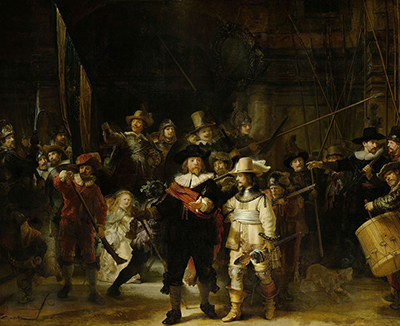
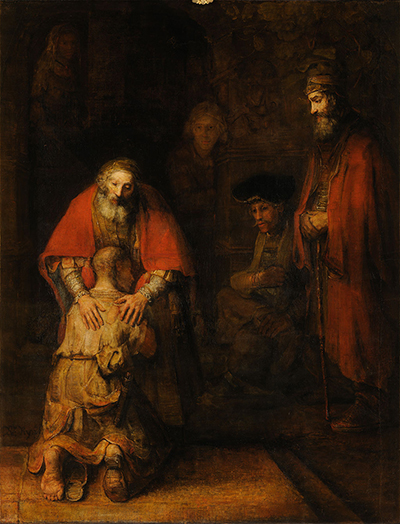
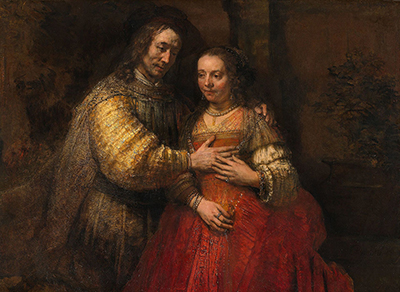
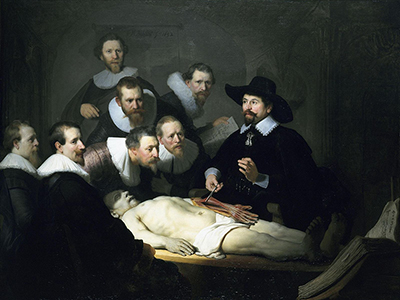
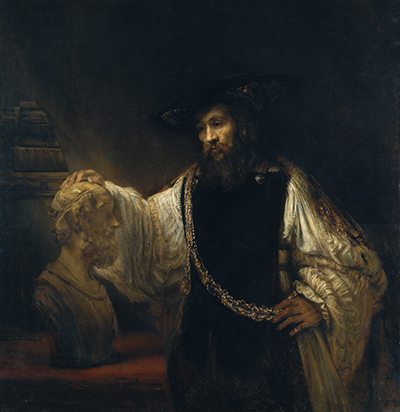
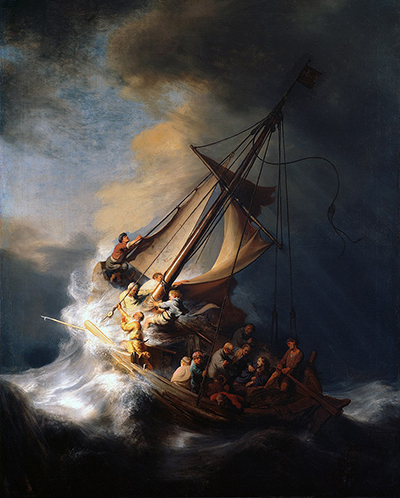
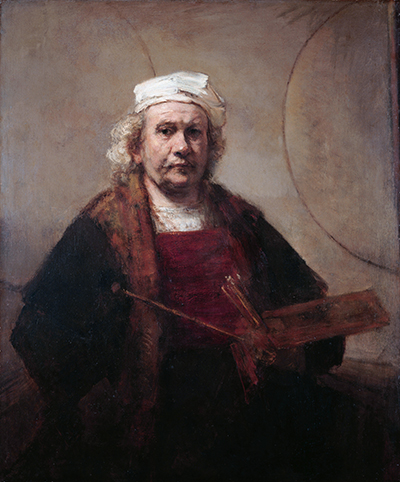
 Rembrandt.jpg)