


 by Tom Gurney
Tom Gurney BSc (Hons) is an art history expert with over 20 years experience
Published on June 19, 2020 / Updated on August 9, 2026
Email: tomgurney1@gmail.com / Phone: +44 7429 011000
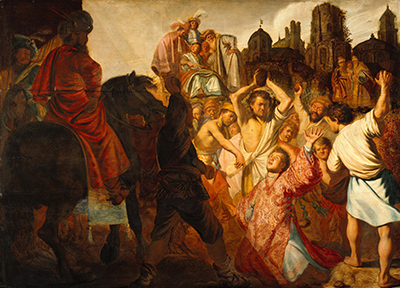
The Stoning of Saint Stephen is Rembrandt's earliest signed and dated painting
This oil on oak panel measures 89 cm × 123 cm (35 in × 48 in) and can now be found at the Musée des Beaux-Arts de Lyon in France. Most of the artist's work was to be oil on canvas but perhaps he was forced into cheaper alternatives at this early stage in his career.
Stephen was to be stoned outside of the city by a collection of up to 20 figures. This story is from Acts 7. Prior to his passing, Stephen would give his last words to Christ before the sky would open and release a storm. It is believed that some of the faces found in this composition are actually self-portraits of the artist himself, probably three in total.
The theme of martyrdom is frequent throughout the teachings of Christianity, as well as most other major religions. The idea of personal sacrifice for the benefit of others is a good lesson for life, whether you are religious or not. Indeed, this powerful theme can be found in the work of countless other artists from the Renaissance and Baroque periods.
Diego Velazquez produced the most famous self-portrait in history, certainly when incorporating into a wider composition. His Las Meninas masterpiece still ranks as one of the finest and most imaginative paintings in the history of art.
Rembrandt uses abrupt lighting in this piece which separates the composition in two. The eye is drawn to the right hand side where the main focus of the composition is placed. As the persecutors pummel the martyr with stones, a horseman looks on from the shadows of the opposing side of the wooden panel painting.
Object Notes and Research Context
The Musee des Beaux-Arts de Lyon records La Lapidation de Saint Etienne as a 1625 oil on wood by Rembrandt, measuring 89 by 123 cm and acquired in 1844. Its importance rests on chronology as much as subject: the museum presents it as the earliest known painting signed and dated by Rembrandt.
The work also has a useful attribution history for readers. Lyon notes that the painting was doubted after its acquisition but reattributed in 1962, when Hans Gerson identified the signature and date. The current museum route therefore supports Rembrandt authorship, while the article can still explain why early Rembrandt paintings sometimes carry a documented history of challenge, rediscovery and technical review.
The subject comes from Acts 7, where Stephen, one of the first deacons of the Christian community in Jerusalem, is condemned after false testimony and stoned outside the city. Rembrandt makes the saint's kneeling body the point of light within a violent crowd, and the museum notes possible inserted likenesses of Rembrandt and Jan Lievens. That makes the page a natural bridge to the early-life biography, the Leiden circle and early history painting.
The Lyon painting is also useful for explaining Rembrandt's relationship with Jan Lievens. Both artists were young Leiden history painters in the 1620s, and their closeness makes possible likenesses inside the composition especially intriguing. Those identifications are not certain portraits, but they explain why scholars look closely at faces within early Rembrandt crowd scenes.
As a martyrdom scene, the picture anticipates later Rembrandt interests: extreme emotion, biblical violence, crowd psychology and concentrated light. Stephen's gaze and kneeling pose make him the still point within a chaotic execution. That gives the page strong links to early-life, Leiden, history painting and technique pages without needing to inflate the work beyond the evidence.
The work's early date also makes it useful for explaining ambition. Rembrandt chose a violent, multi-figure martyrdom subject before he had fully settled into the Amsterdam career that made him famous. That boldness helps the article connect early Leiden practice to later biblical drama.
Further Rembrandt Context
This shorter legacy page remains part of the Rembrandt archive. For fuller context, use the refreshed Rembrandt pages below, which explain the artist's biography, media, technique, attribution issues and major works in greater depth.
For secure object data, attribution and collection history, compare The Stoning of Saint Stephen with the relevant museum or catalogue record before treating older page text as final.
 Rembrandt.jpg)
Discussion
What feels most useful when looking at The Stoning of Saint Stephen: the subject, the handling of light, the medium, the attribution history, or its place within Rembrandt's wider painting output?
Reader Insights
Set this page beside the refreshed Rembrandt hubs before relying on older summaries alone.
Rembrandt pages often need museum records, catalogue history and attribution caution, especially where older sources use broader labels.
Which detail would you most want clarified next: date, medium, collection, attribution, subject, condition or comparison with another Rembrandt work?
Join the Conversation
Have a thought or observation about The Stoning of Saint Stephen? Share it below. Thoughtful responses may be added as the Rembrandt archive continues to be reviewed.