


 by Tom Gurney
Tom Gurney BSc (Hons) is an art history expert with over 20 years experience
Published on June 19, 2020 / Updated on November 19, 2026
Email: tomgurney1@gmail.com / Phone: +44 7429 011000
Introduction
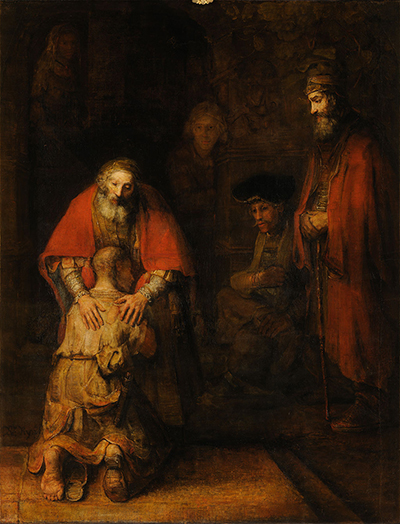
In The Return of the Prodigal Son, a kneeling man presents the soles of his feet to anyone standing before the canvas. One foot is bare, the other still partly shod. His father bends over him and lays both hands on his back. The richest red in the painting gathers around the old man’s shoulders, then appears again at the right in the robe of a witness who keeps his distance. Rembrandt gives the embrace an audience within the picture. He also gives it a position well to the left of centre, leaving room for the different ways in which the people around it receive what they see. [1]
Rembrandt had pictured the same parable in an etching dated 1636. In the Metropolitan Museum of Art’s impression, the encounter takes place amid more legible architectural detail, and the little lines that describe the figures also carry the eye across the setting. In the Hermitage canvas, the figures are larger than life and darkness absorbs much of their surroundings. The date of the painting has been variously proposed within Rembrandt’s later career. The etching, with its own date and physical history, gives us another treatment of the subject, separated from the canvas by decades. The comparison brings out a choice that runs through Rembrandt’s paintings. How much of the world around a figure does the viewer need to see for a gesture to make sense? [1] [2]
That question takes a different form in a Leiden panel, a portrait made for an Amsterdam household and a canvas commissioned for a civic hall. A raised hand might summon Lazarus, demonstrate the mechanics of a forearm or give a company its marching orders. A painted face might record a particular person, explore an expression or give a character from an ancient story a presence in the room. The size and surface of the painting matter to each effect. So does what has happened to the object since it left the studio.
At a Glance
- MediaOil on panel and canvas
- SubjectsPortraits, history paintings and landscapes
- ExamplesThe Anatomy Lesson of Dr Nicolaes Tulp and The Return of the Prodigal Son
Leiden and the invention of a scene
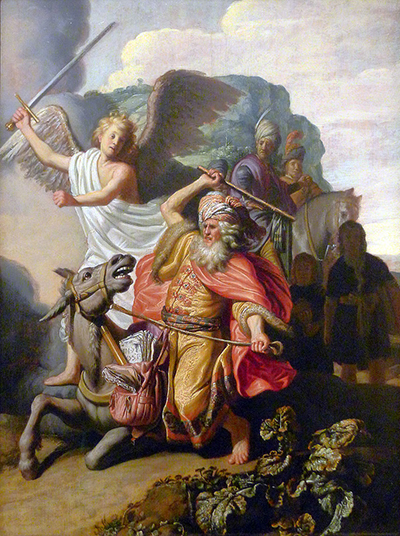
History painting in Rembrandt’s time embraced stories from scripture, antiquity and mythology. It carried high prestige because a painter had to choose a moment in a story, arrange figures in space and make their actions intelligible. Pieter Lastman, with whom Rembrandt studied in Amsterdam before establishing himself in Leiden, gave him a model for doing this through costume, gesture and the grouping of witnesses. Rembrandt’s Balaam and the Ass of 1626 takes up a story Lastman had painted in 1622. The shared subject offers a measure of the younger painter’s independence. He could work with a familiar cast and incident while deciding anew how surprise should register across the scene. [3]
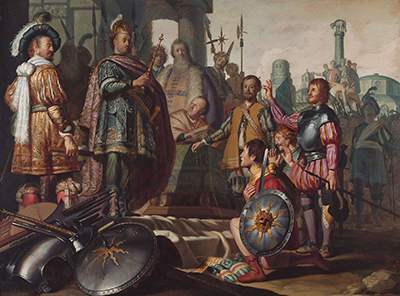
A large early panel in Museum De Lakenhal, dated 1626, shows how much of a story can remain evident when its precise identity has become obscure. The museum calls it History Painting with a Self-Portrait of the Painter. An elaborately dressed group occupies a stepped setting, and differences of posture and height establish a hierarchy before any figure is named. Faces peer past shoulders, with one young face identified by the museum as Rembrandt’s own. The title preserves that identification while leaving the larger episode open. Seventeenth-century costume could bring distant events to life for a contemporary viewer. Its richness also leaves room for several plausible readings when the original context of a picture has been lost. [4]
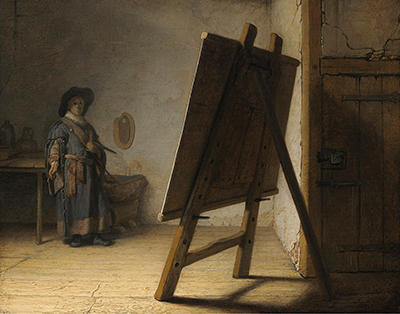
Scale gives the figures a very different relationship to their surroundings in Artist in His Studio, painted about 1628 and now in Boston. The easel rises in the foreground, its dark reverse turned towards us. The painter has stepped far enough back to appear small, with a stretch of bare floor between him and the work. The picture withholds the face of the canvas or panel on the easel, so our view follows the painter’s act of looking. The wall, the uneven floor and the light that picks out the easel’s edge are enough to give the interval a physical weight. In a painting small enough to examine at close quarters, Rembrandt found a way to make distance itself the subject. [5]
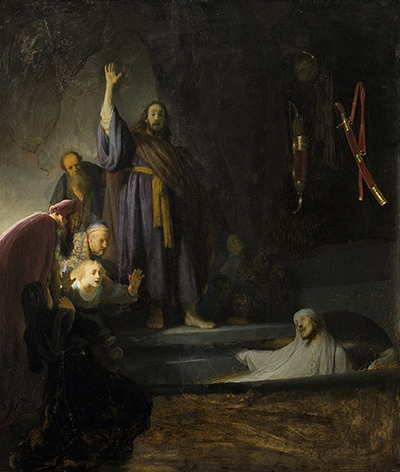
The wooden panel of The Raising of Lazarus, dated about 1630–32 by the Los Angeles County Museum of Art, approaches a metre in height. Christ’s raised arm stands out against the gloom of the burial place, and Lazarus appears low in the image, at the edge of the tomb. The people around them register the miracle through different movements of the head and hands. The darkness gives these reactions their sequence. It also leaves room for touches of colour in the costumes and glints on objects hanging at the right. Rembrandt returned to Lazarus in drawings and etchings. The Los Angeles object is his known painting of the miracle, with its own arrangement of bodies, colour and light on wood. The date range places it across the transition from Leiden to Amsterdam. [6]
A different scale of experiment survives in the Getty’s Rembrandt Laughing, about 1628. The face is tilted and the mouth open, with a short flare of light across the throat and metal collar. Oil on copper allows the painter to work on a smooth, rigid surface, here about twenty-two centimetres high. The face is recognisable as his own, and the momentary expression and costume bring the painting close to a tronie, a study of a type, appearance or expression. That overlap matters. A painter’s own features could serve as readily available material for an experiment and as the subject of an image someone might wish to own. [7]
Amsterdam portraits and the places they occupied
Portrait commissions in Amsterdam gave Rembrandt opportunities to work at several scales at once. A likeness might have to carry across a room or reward close inspection. It might have to stand beside a companion picture, fit among other family portraits or represent a person in the middle of a recognisable occupation. The sitter’s place in the composition follows from these practical demands as much as from the expression on the face. The near-contemporary portraits of a shipbuilder and his wife, and of the young couple Marten Soolmans and Oopjen Coppit, make the variety of those demands particularly clear. [8] [9] [10]
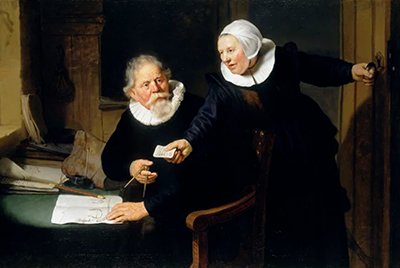
In the Royal Collection’s The Shipbuilder and his Wife of 1633, Jan Rijcksen sits at his work, with drawing instruments and paper before him. Griet Jans enters beside him with a letter. Its delivery explains his turn and her forward movement, giving both sitters a reason to occupy the same frame. Their hands tell us who has just arrived, who has been working and where the business of the picture is about to move. The implements matter because they make the interruption specific. Rijcksen’s profession is visible in the occupation from which his wife calls him away. There is time in the picture for a task to be resumed and for the letter to change it. [8]
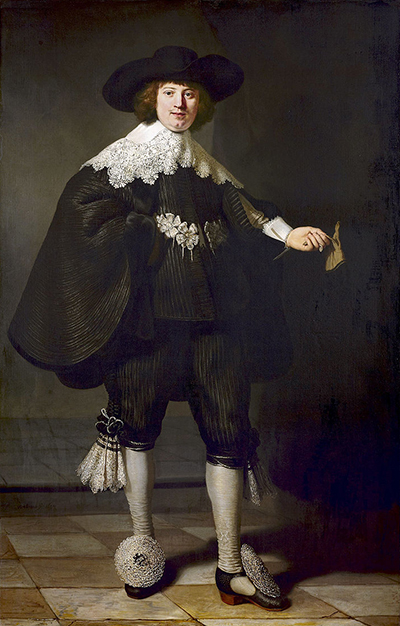
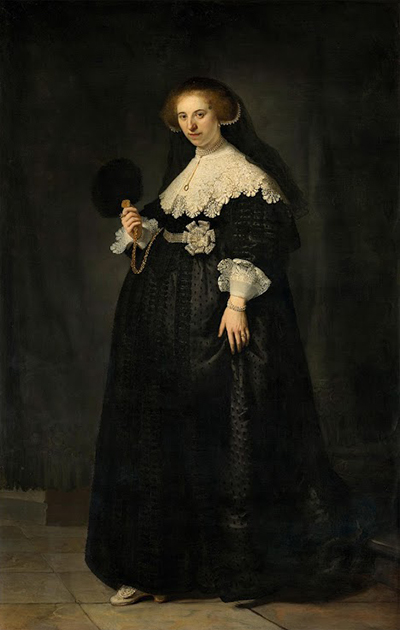
Soolmans and Coppit, painted in 1634, each have a canvas just over two metres tall. The portraits are pendants, conceived to be seen as companions, and were painted a year after the couple’s marriage. Soolmans’s great white shoe rosettes and the white at his neck mark the ends of a tall expanse of black. Coppit’s pale collar and cuffs and the ornament of her dress catch the light in a different rhythm. Full-length presentation makes the fall of the clothes and the placement of the feet as consequential as the faces. The pair can now be read through both the Rijksmuseum and Louvre records, which document the joint acquisition and preserve variations in the spelling of Marten’s name. The two records describe two canvases with a shared history. [9] [10]
The couple’s black clothes also show what a misleading shorthand it can be to call Rembrandt a painter of darkness. Black in these portraits contains seams, folds, changes of sheen and passages where the outline separates only slightly from the background. Those distinctions give the costly fabrics their substance. They establish how the figures stand before the eye reaches the brilliance of lace or jewellery. A reproduction that closes up the dark tones can make the costumes seem like plain silhouettes. It can also hide the amount of work these portraits devote to the relationship between a body and the fabric that covers it. [9] [10]
How a group portrait becomes an event
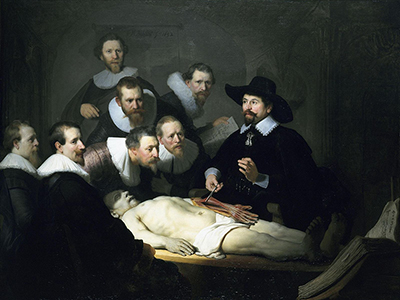
In The Anatomy Lesson of Dr Nicolaes Tulp of 1632, the task was to portray members of Amsterdam’s surgeons’ guild. The Mauritshuis records the commission in connection with Tulp’s January anatomy lesson and identifies the dead man as Adriaen Adriaensz, known as Aris Kindt, whose body was made available after his execution. Tulp holds up structures exposed in the forearm and demonstrates an action with his free hand. The surgeons cluster and lean, their various lines of sight leading towards the body, the demonstration and points beyond them. The corpse’s pale diagonal holds the seated and standing figures together. Guild members, their teacher and the man on the table occupy different positions in the institution the painting represents. [11]
The painted sheet held by one of the men has a history of its own. It bore an anatomical drawing before later overpainting introduced a list identifying the sitters by number. Conservation removed the overpaint on the sheet, revealing the drawing of an arm again, while the identifying numbers beside the sitters were retained. The distinction is worth making when looking at the work today. Its surface preserves both an aspect of Rembrandt’s original demonstration and evidence of a later wish to make the group easier to identify. The commission gave the painting a documentary purpose from the outset. Successive owners and viewers also found documentary uses for what they saw. [11]
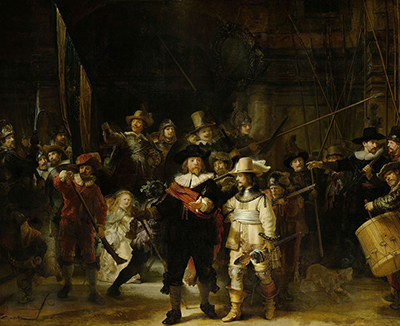
In The Night Watch of 1642, Rembrandt disperses attention across a much wider field. The Rijksmuseum identifies the company as the militia of District II under Captain Frans Banninck Cocq. At the front, his extended hand projects towards the viewer while Lieutenant Willem van Ruytenburch’s light costume makes him conspicuous among the overlapping figures. Pikes and muskets break up the space overhead. A brightly lit girl is visible deeper in the group, with a fowl hanging from her waist. Amid the activity, a succession of lit passages gives the eye bearings. The two officers appear to have room to advance even while the men behind them seem to have scarcely enough room to turn. [12]
The broad canvas was made for the hall of the Amsterdam musketeers’ headquarters, where it hung with other militia pictures. Its present edges belong to a later setting. When it was moved to the town hall in 1715, it was cut down, with the greatest loss at the left. The National Gallery in London holds an early painted copy by Gerrit Lundens that shows two men and a child beyond that edge and more of the drummer on the right. Lundens’s copy records a wider arrangement in which the officers were less centrally placed. The small picture therefore has particular value as evidence about a large one. Its brushwork, scale and authorship belong to Lundens. [12] [13]
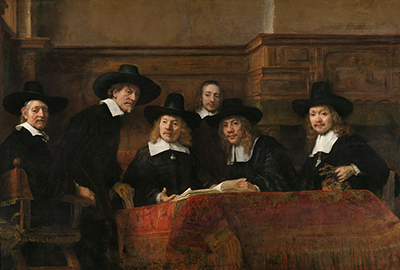
Twenty years after the militia commission, The Sampling Officials of the Amsterdam Drapers’ Guild, known as The Syndics, organises attention around a table. The officials supervised standards in the cloth trade. Rembrandt brings their faces close to a shared level while allowing one of the men to appear in the act of rising. The open book and the hands resting beside it establish the business in progress. The servant behind the officials, distinguishable by his uncovered head, occupies a different place in the social order. The low viewpoint and the turn of several heads make it easy to imagine an arrival in the room, although the particular cause of their attention is left open. [14]
The difference between these civic pictures is especially clear in the distribution of light. In the anatomy lesson it travels across a body available for inspection and picks out the faces of those authorised to gather around it. In the militia picture it singles out incidents at different depths and makes command visible amid a crowd. In The Syndics, relatively even light across the officials’ faces permits an exchange of looks with the spectator. The commission from the cloth guild also shows that Rembrandt could still secure an important civic assignment in the 1660s, after the financial difficulties of the previous decade. [11] [12] [14]
Revelation, violence and deliberation in history painting
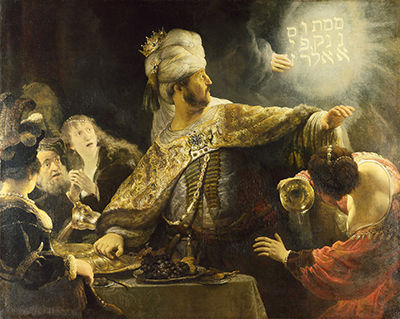
In Belshazzar’s Feast, which the National Gallery dates to about 1636–38, the story turns on a message whose meaning the king cannot yet grasp. The letters take up one area of the composition, the king’s recoiling body another. Vessels tip in the foreground and a sleeve presses forward as if the nearest diner were about to spill out of the picture. Daniel’s interpretation still lies in the future. The unusual vertical arrangement of the Hebrew lettering has been connected with an interpretation published by the Amsterdam scholar Menasseh ben Israel. The form of the inscription helps explain the puzzle within the story, and the gold of the letters competes on the canvas with the gold and jewels of the king’s dress. [15]
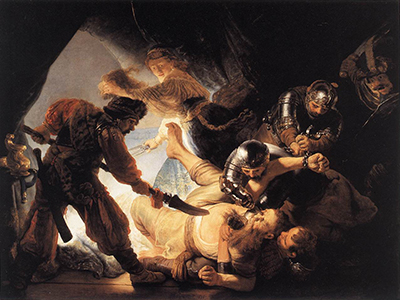
At over three metres wide, The Blinding of Samson, dated 1636 and held by the Städel Museum, has the scale to make a tangle of bodies immediately legible. Samson’s foreshortened leg and clenched toes bring a physical reaction close to the viewer. The struggle is bunched low in the canvas, and Delilah looks back from the light with the severed hair. Her position joins the violence we see to the action that made it possible. Samson’s own sight is being destroyed as the painter opens a clear view of the attack. The force of the scene depends on how much information the light delivers at once. In Belshazzar’s Feast there is an interval between seeing the writing and understanding it. Here, understanding arrives with the spectacle. [15] [16]
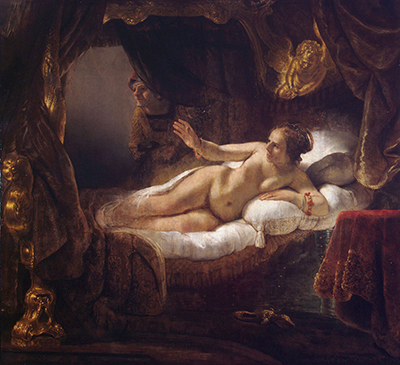
The Hermitage’s Danaë offers an unusually close material connection with Samson. The Hermitage catalogue reports the proposal, made in the Corpus, that the weave of the original linen in the two paintings is so similar that the canvases probably came from the same roll. Danaë is associated with 1636, though the damaged remnants of its date were lost following the 1985 attack, and study of the painting has established substantial reworking. The reclining woman extends her hand towards a presence suggested by light. Changes to the figure and the likelihood that the canvas was once larger complicate any reconstruction of how that entrance looked at first. The attack, which damaged paint and cut the canvas, introduced an entirely different set of changes. The Hermitage’s restoration continued until 1997. [1] [16]
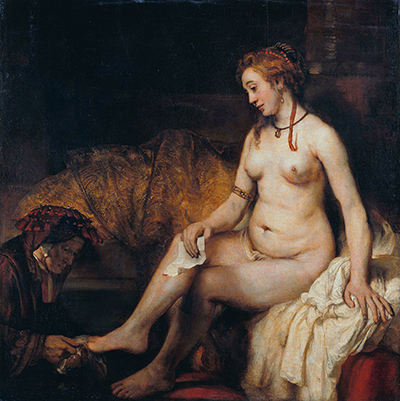
In the Louvre’s Bathsheba at Her Bath, signed and dated 1654, a letter supplies the immediate reason for a woman’s preoccupation. Bathsheba sits with her head inclined while an attendant works at her feet. Her hand holds the letter where the viewer can see it, and her lowered eyes leave the duration and outcome of her deliberation open. The summons from David comes from the biblical story. The king himself has no place in the visible scene. The Louvre records a reduction of the canvas and discusses evidence from radiography, which makes the finished composition one part of the painting’s history. The present placement of the figure and the space around her should be read with that material history in mind. [17]
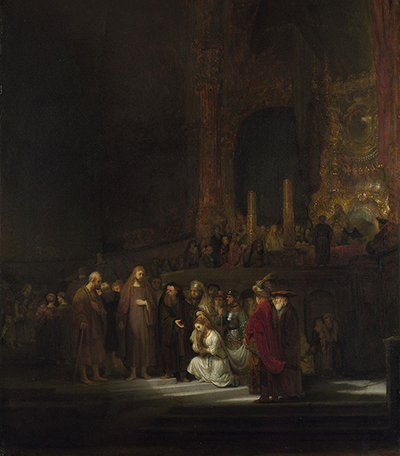
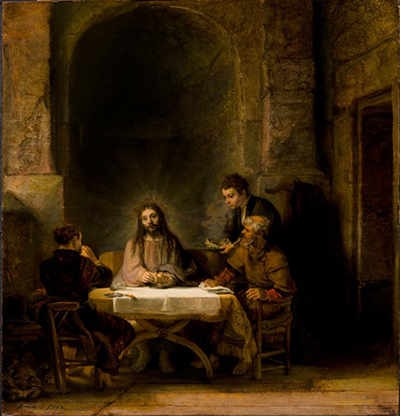
The 1648 Supper at Emmaus in the Louvre and the 1644 Woman taken in Adultery in London show how much narrative Rembrandt could keep in reserve even when several people are present. In Emmaus, the low gathering around a table occupies only part of a high, shadowed interior. The breaking of bread is the action around which recognition forms. In the London painting, the brightly lit woman kneels within a much larger architectural space, with Christ upright near her and surrounding figures distributed between light and shadow. Here a crowd has assembled to judge, and the gesture and position of Christ redirect attention towards the accused woman. Both are oil paintings on wood. The Louvre picture also carries a retraced signature, an example of how a dated inscription and its present physical appearance can have different histories. [18] [19]
Watch: Rembrandt’s life and work
Explore Rembrandt’s early career, etchings and paintings, and see his work alongside that of other Baroque artists.
Rembrandt | A Life of Art
Curators introduce Rembrandt’s early career and trace how he developed his handling of light and shade.
Watch on YouTubeLate paintings of touch and recognition
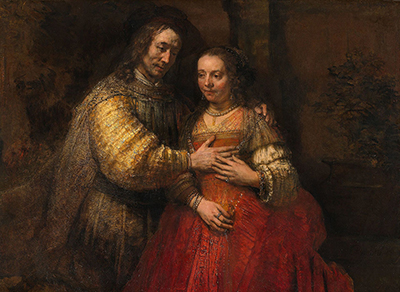
The Rijksmuseum’s Isaac and Rebecca, Known as ‘The Jewish Bride’, dated about 1665–69, makes a meeting of hands the centre of a large canvas. His hand lies across her breast. Hers comes up to meet it, the fingers set lightly over his. Their faces tilt towards the space between them without meeting each other’s gaze directly. The scale and weight of the sleeve give the eye a physical path down to the contact. Paint rises in ridges and catches light on the clothing, while the touch itself is measured and precise. The stillness of the figures leaves the worked surface unusually free to register. [20]
The full museum title retains a distinction between its biblical reading and the nickname by which generations of viewers came to know the picture. In Genesis, Isaac passes Rebecca off as his sister and their intimacy gives them away to King Abimelech. The painting can be understood as a couple represented in the guise of the biblical figures. The familiar nickname belongs to the picture’s later reception. Its survival alongside Isaac and Rebecca’s names records how readily an image of two people in richly worked clothes can suggest a marriage portrait even when the identity of the people in the painting remains unresolved. [20]
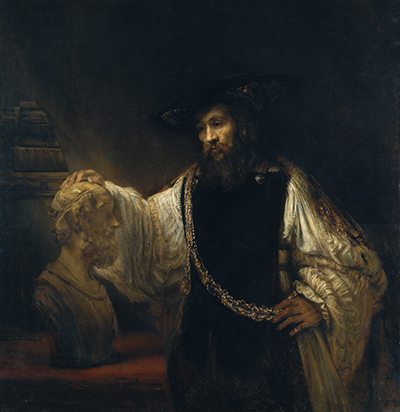
The hand that rests on the bust in Aristotle with a Bust of Homer of 1653 is also a point of contact between different kinds of presence. Aristotle’s sleeve falls heavily as he lays his fingers across the ancient poet’s head. The gold chain and medallion pass diagonally across his body and bring another figure, traditionally identified as Alexander, into the picture at a much smaller scale. The Metropolitan Museum of Art reads the work as a possible reflection on worldly honour and literary fame. The different substances give that reading a visible basis. A living hand rests on stone, while a likeness in metal hangs from the philosopher’s clothing. The painting was made for Antonio Ruffo in Sicily, evidence of a market for such learned subjects well beyond Amsterdam. [21]
The hands in The Return of the Prodigal Son bring the discussion back to the body on which they rest. The father’s beard and cloak retain lines worked through paint, while the son’s worn clothing and exposed heel receive enough light to be examined as closely as the faces. The Hermitage catalogue records the horizontal seam in the canvas, additions to the support and old retouching, especially low in the painting. It also identifies the inscription near the son’s feet as a false signature. The attribution and the dating therefore rest on a wider body of evidence. Van de Wetering’s final Corpus places the work about 1660–65, while the Hermitage catalogue also records later datings, including 1666–69 in a more recent scholarly catalogue. The sense of culmination many viewers find in the painting can coexist with that uncertainty about its year. [1]
Self-portraits and the uses of a familiar face
The contrast in scale between Rembrandt Laughing and the National Gallery’s Self Portrait at the Age of 34 is immediately apparent. In the London canvas of 1640, the painter rests an arm on a parapet and takes up enough space for the sleeve and shoulder to give his posture a deliberate breadth. The National Gallery relates the pose to Renaissance portraiture, including Titian and Raphael. Costume, bearing and placement make the figure a public image of a painter conversant with prestigious precedents. The features that animated a small expression study in the late 1620s now anchor an elaborate statement of artistic standing. [7] [22]
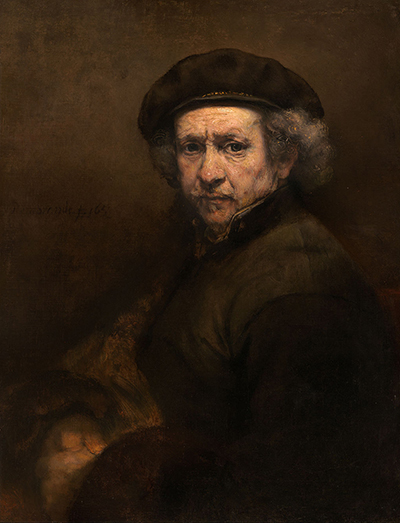
The Washington Self-Portrait of 1659 uses a turn of the body and a steady gaze to establish presence within a quieter range of colours. The face occupies a relatively small part of the area of paint, and the beret, shoulders and joined hands give the figure stability. It was painted after the sale of Rembrandt’s house and possessions, a documented circumstance that has encouraged viewers to look for personal adversity in the expression. The particular light on the forehead, the way the mouth is set and the heavily worked flesh are visible decisions. The painting leaves room for different readings of the state of mind they express. [23]
In London’s Self Portrait at the Age of 63, dated 1669, the face is built with small changes in the relief and direction of the paint. Scratches pick out details in and around the eyebrows and on the tip of the nose. These catch the light differently from the surrounding ridges, and places that might look like very small touches of pale paint in a photograph can depend on a tool drawn through a wet layer. Imaging has also revealed that the headwear was changed during painting. Even in this image made in the last year of his life, Rembrandt worked out how his head should appear as he went. Features that can feel utterly familiar were arrived at through specific revisions. [24] [25]
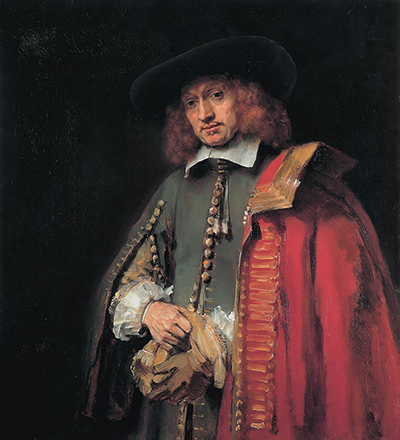
The painter’s likeness occurs in etchings and drawings as well as oils. Counting painted self-portraits involves deciding which likenesses are independent pictures by Rembrandt, which belong to character studies that use his features and which are versions painted by another hand. The distinction is easier to grasp through portraits of another sitter. Jan Six appears in a painting of about 1654 in the Six Collection, drawing on a glove, and in a print of 1647, reading beside a window. At the Morgan Library & Museum, one impression of the print is catalogued as etching, engraving and drypoint on Japanese paper. The sheet, its paper and the state of the plate describe that individual impression. The painted canvas has its own dimensions, handling and provenance. [26] [27]
Landscapes and the effects of age
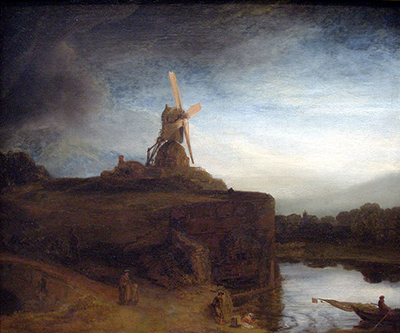
In The Mill, now in Washington, a windmill stands above a bank on a promontory. The uneven horizon drops away to water, and the sails have a stark clarity against an unsettled sky. The foreground figures and boat are small enough to make the height of the structure felt. In a painted career often approached through faces, this landscape gives comparable weight to the position of a building and the direction of the light. The National Gallery of Art dates the canvas to 1645–48 and treats the idea that Rembrandt drew on the appearance of his father’s mill in Leiden as a possibility. The composition leaves its particular site open. [28]
The landscape also offers a striking instance of the way a painting’s condition can affect how people explain it. Nineteenth-century admirers knew The Mill under layers of discoloured varnish. The warm darkness encouraged a view of the landscape as almost entirely storm-laden and lent itself to accounts that tied the mood to a period of financial distress. Treatment in 1977–79 removed old varnish and disclosed cooler greys and blues in the sky. The shape of the windmill and its place at the edge of the bank had been visible all along. The atmosphere in which viewers had learnt to place them changed considerably. [28]
Rembrandt’s etched Windmill gives the landscape reader another useful point of reference. The National Gallery of Art owns an impression in which the side of a mill, the low buildings and the open ground are described through black lines on paper. The distribution of light follows the balance between inked line and exposed sheet. In the Washington oil painting, the sky is an active field of colour and tone behind the sails, so the silhouette depends on colour relationships as well as contour. The two Washington records identify separate works. Their titles and shared motif make the comparison easy, and their materials explain why the two views unfold so differently. [28] [29]
Wood, copper, canvas and the layers of paint
Support is the term for the material that carries the paint. Rembrandt used wood, canvas and, on a smaller number of works, copper. There is a relationship between size and support, and it has exceptions worth noticing. Rembrandt Laughing is a small oil on copper. The fairly large Raising of Lazarus is on wood. Rembrandt was still working on wood in 1644, when he painted The Woman taken in Adultery on oak identified as Baltic or Polish, and in 1648, when he made the Louvre Supper at Emmaus. The great civic paintings on canvas were made at scales that required a different approach to preparing, stretching and moving the support. [6] [7] [12] [18] [19]
A ground is the prepared layer or series of layers under the image. Its colour can help set the middle tone of the painting, and it can affect the way subsequent paint handles and looks. When examined in a cross-section, under a microscope, a tiny sample can show the order and thickness of layers at the point where it was taken. Imaging can then help place that sample in the context of the whole picture. A thin brown passage may preserve a first painted indication of a form. An opaque light may have been laid over several layers, and a line that looks drawn may be an incision that exposes or displaces one of them. [25]
Operation Night Watch has supplied unusually detailed evidence for different stages of preparation on a single canvas. Rijksmuseum researchers reported a lead-rich impregnation in the fabric beneath the first ground, interpreted as a precaution against moisture. Elemental mapping also revealed a calcium-rich preparatory sketch, consistent with a chalk-containing paint. The sketch belongs to the stage at which the arrangement was being laid out. The lead-rich material belongs to the treatment of the canvas before that arrangement was painted. A map of an element registers its distribution, and researchers use its location and evidence from samples and imaging to work out which layer or material contributes to the signal. [30] [31]
The texture on top of the paint can be just as informative. Impasto is a buildup of paint pronounced enough to leave a physical relief. A raised stroke can catch falling light as well as depict a highlight. A thin transparent layer can modify the colour underneath it, while a broken drag of lighter paint across a darker passage can let the lower tone show between marks. In Isaac and Rebecca, the folds of a sleeve and the small accents of jewellery ask the painter for different kinds of mark within the same lit area. The hand emerging from that sleeve is given edges and transitions appropriate to flesh. Differences in handling hold the picture together at viewing distance. [20] [25]
Scratching is particularly revealing because the position of a mark can tell us when it was made. In the late London self-portrait, Melanie Gifford’s technical discussion identifies incisions in the upper paint. She also describes scratches used much earlier in the making of a composition, in the first painted layout of the Louvre’s Landscape with a Castle. Some marks have a profile compatible with a squared or split tool, complicating a common assumption that Rembrandt simply turned his brush around whenever he scratched. A similar mark in another painter’s work can reflect close attention to Rembrandt’s effects. Its shape, the layer into which it was made and its job in the picture give a better basis for comparison than the mere presence of a scratch. [25]
How the catalogue of Rembrandt’s paintings changes
A count of Rembrandt’s paintings refers to a body of works accepted at a particular time under particular criteria. It can take account of paintings executed wholly by Rembrandt, or it can also admit pictures in which scholars detect his participation alongside another painter’s. The Rembrandt Research Project began in the late 1960s to examine paintings repeatedly attributed to him. Volume I of A Corpus of Rembrandt Paintings, covering 1625–31, recorded close comparisons and technical observations, with entries grouped according to the authors’ judgments about authenticity. The entries preserve the reasoning of that stage of the project, including evidence that could later be read differently. [32]
The concluding sixth volume, Ernst van de Wetering’s Rembrandt’s Paintings Revisited, is a chronological reassessment covering the career. It restores works excluded by earlier scholarship and revises conclusions reached in previous volumes. Its publisher describes the survey as covering 336 paintings. That figure has a defined source, and a count made from its entries depends on how one treats related works, versions and different degrees of participation. The broad question of how many paintings Rembrandt made in his lifetime also includes works that are lost or cannot securely be identified with an object today. A catalogue number identifies an entry in a particular scholarly scheme. It remains meaningful when read alongside the museum’s current title, attribution and inventory number. [33]
Workshop practice helps explain why attribution can be so difficult. Pupils learnt to paint by making copies and by adopting the studio’s conventions of pose, costume, lighting and handling. Paintings associated with a master could involve more than one hand, particularly where a busy portrait practice supported a studio. In its account of attribution, the National Gallery of Art describes the importance of considering the character of the brushwork alongside documentation, materials and knowledge of workshop practice. A compatible support or pigment establishes that the maker could have worked in the same place and period. The attribution still turns on what that evidence can explain when considered with the design, the handling and the object’s history. [34]
The Portrait of Rembrandt with a Gorget in the Mauritshuis makes those distinctions concrete. The museum formerly regarded its painting as the original and the related Nuremberg picture as a copy. Examination brought to light an extensive underdrawing in the Hague version. The two paintings were reassessed, and the Mauritshuis now identifies its picture as a studio copy and the one in the Germanisches Nationalmuseum as Rembrandt’s original. The face in both is Rembrandt’s. The painter of the Hague version remains unidentified. Here the distinction between a version and an original depends on comparison between two objects, with the preparatory design adding evidence about how one version was made. [35]
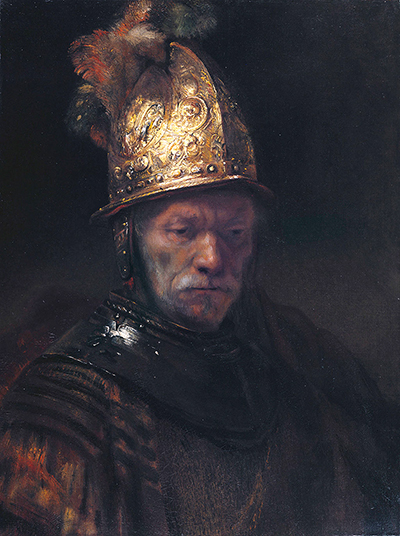
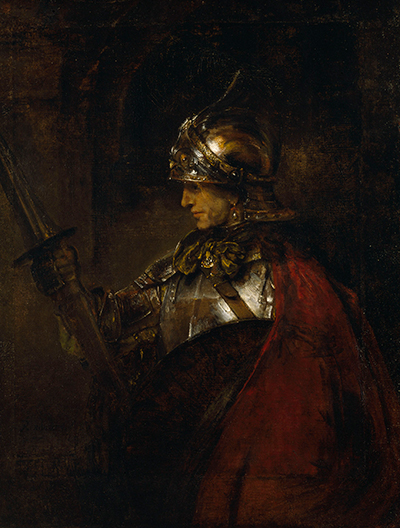
Berlin’s Man with the Golden Helmet had long been celebrated as a Rembrandt. The Gemäldegalerie now catalogues it in his circle, citing the combination of artistic and technical evidence and the recurrence of a model in work associated with the studio. The enormous visual emphasis on the helmet is easy to see. The paintwork on its elaborate raised decoration catches the eye long before the shadowed face. Glasgow’s A Man in Armour, dated about 1655, is a separate canvas that Glasgow Museums presents as by Rembrandt. The museum proposes Alexander the Great as the possible subject and describes the helmet as an invention combining elements from different sources. Berlin’s classification addresses authorship. In Glasgow, one of the questions concerns the identity of the figure represented. [36] [37]
Evidence can also return a painting to the accepted body of work. In 2026 the Rijksmuseum announced its conclusion that Vision of Zacharias in the Temple, dated 1633, was painted by Rembrandt. The picture had been excluded from his oeuvre in 1960 and remained out of public view after its sale the following year. The museum’s case draws on the compatibility of the panel and paint with the date, the examination of the signature, the buildup of the layers and changes made during painting. These findings came from direct study and comparison with securely attributed pictures of the period. In the scene itself, light from the upper right and Zacharias’s reaction make the unseen angel’s arrival legible. The narrative choice invites comparison with the early paintings even as the technical evidence addresses who made this particular object. [38]
When two records give the same subject, the inventory numbers are a useful place to begin. The date, dimensions and support can establish whether a reference leads to a canvas, a panel, another version or a sheet from a printed edition. The Rembrandt Database brings together documentation, literature and technical evidence across collections, so that a museum’s present description can be read alongside earlier examinations. The object itself can then come back into focus. In the Hermitage’s Prodigal Son, a later inscription, a sewn support and uncertainty over the year belong to the history of a particular canvas. So do the ridges of red on the father’s cloak and the open space across which the standing witness watches him fold his hands around his son. [1] [39]
List of Famous Rembrandt Paintings
Rembrandt artworks
Different impressions of the same print can appear as separate records.
| Name | Date | Medium |
|---|---|---|
| The Night Watch | 1642 | Painting |
| The Return of the Prodigal Son | 1660s | Painting |
| The Anatomy Lesson of Dr Nicolaes Tulp | 1632 | Painting |
| The Jewish Bride | c. 1665–69 | Painting |
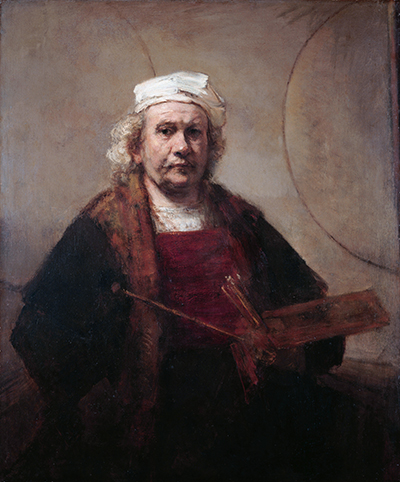
| Self-Portrait with Two Circles | c. 1665 | Painting |
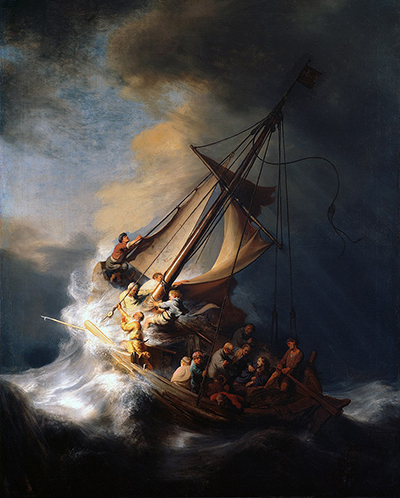
| Christ in the Storm on the Sea of Galilee | 1633 | Painting |
| Bathsheba at Her Bath | 1654 | Painting |
| The Hundred Guilder Print | c. 1648–49 | |
| The Three Trees | 1643 | |
| Aristotle with a Bust of Homer | 1653 | Painting |
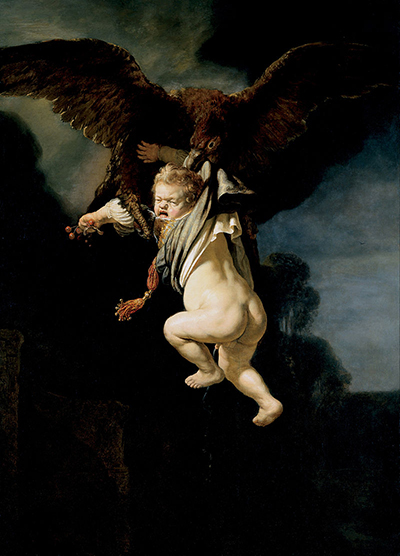
| The Abduction of Ganymede | 1635 | Painting |
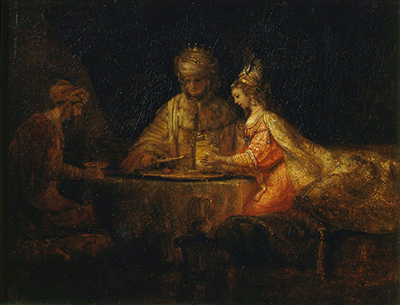
| Ahasuerus and Haman at the Feast of Esther | 1660 | Painting |
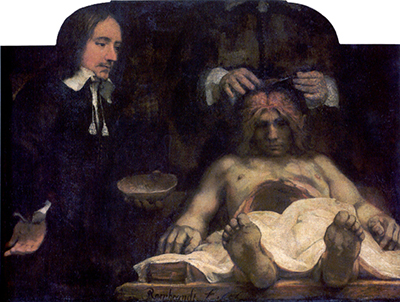
| The Anatomy Lesson of Dr Jan Deijman | 1656 | Painting |
| Judith at the Banquet of Holofernes | 1634 | Painting |
| Artist in His Studio | c. 1628 | Painting |
| The Artist’s Mother, Head and Bust, Three-Quarters Right | 1628 | |
| The Artist’s Mother, Head Only, Full Face | 1628 | |
| Balaam and the Ass | 1626 | Painting |
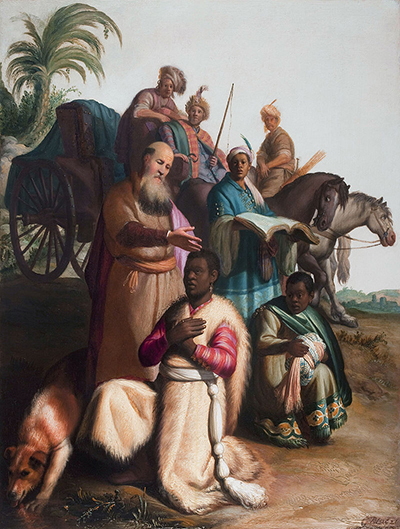
| The Baptism of the Eunuch | 1626 | Painting |
| Beggar in a High Cap, Standing and Leaning on a Stick | c. 1629 | |
| Beggar with a Clenched Hand, Leaning on a Stick | c. 1629 | |
| Belshazzar’s Feast | c. 1636–38 | Painting |
| The Blinding of Samson | 1636 | Painting |
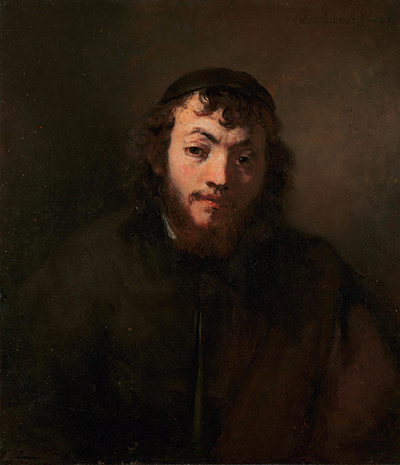
| Bust of a Bearded Young Man with a Skullcap | 1663 | Painting |
| Christ Presented to the People | 1655 | |
| The Circumcision | c. 1625 | |
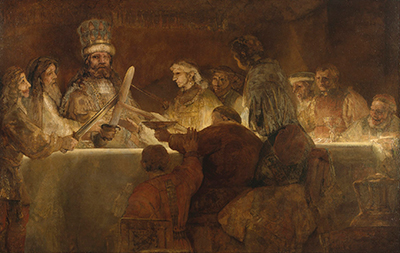
| The Conspiracy of Claudius Civilis | c. 1661–62 | Painting |
| Danaë | Begun 1636 and later revised | Painting |
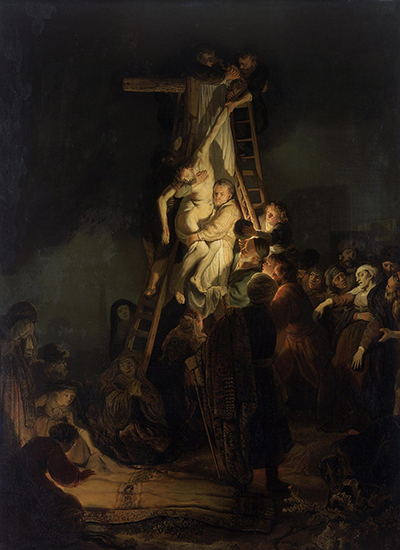
| The Descent from the Cross | 1632–33 | Painting |
| Descent from the Cross by Torchlight | 1654 | |
| The Descent from the Cross, Second Plate | 1633 | |
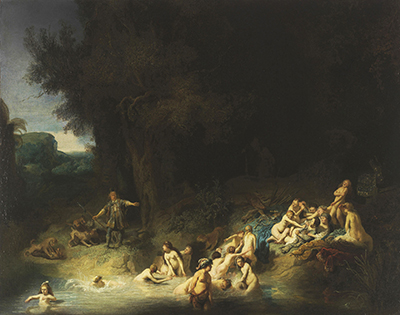
| Diana Bathing with Her Nymphs, with Actaeon and Callisto | 1634 | Painting |
| Ephraim Bueno, Jewish Physician | 1647 | |
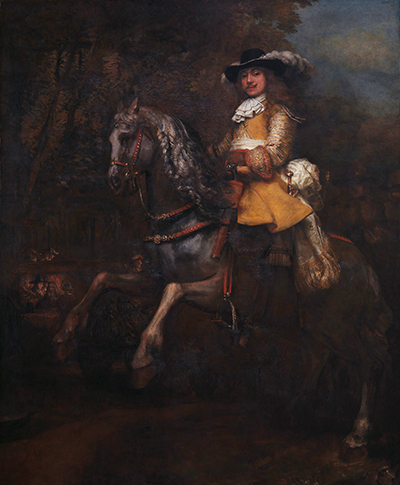
| Portrait of Frederick Rihel on Horseback | c. 1663 | Painting |
| Flora | 1634 | Painting |
| The Goldweigher’s Field | 1651 | |
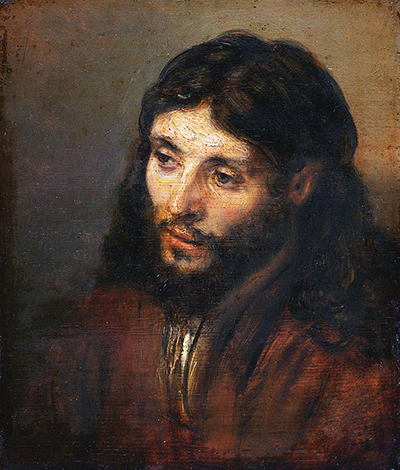
| Head of Christ | 1645–50 | Painting |
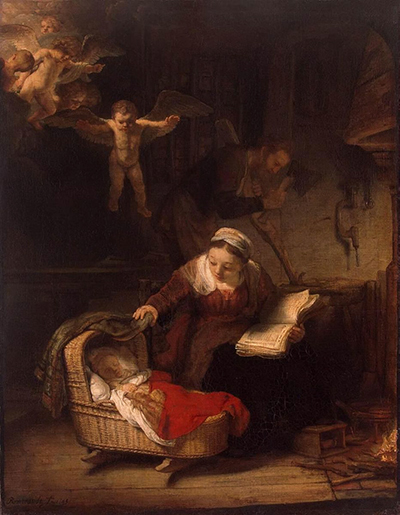
| The Holy Family with Angels | 1645 | Painting |
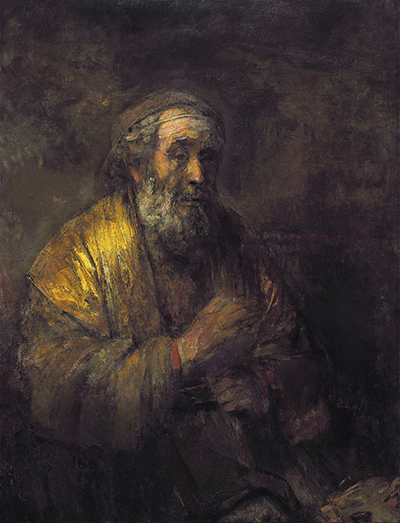
| Homer Dictating His Verses | 1663 | Painting |
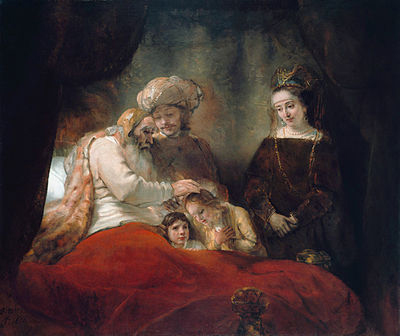
| Jacob Blessing the Sons of Joseph | 1656 | Painting |
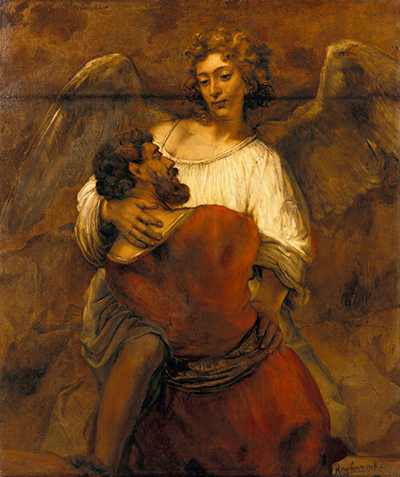
| Jacob Wrestling with the Angel | 1659–60 | Painting |
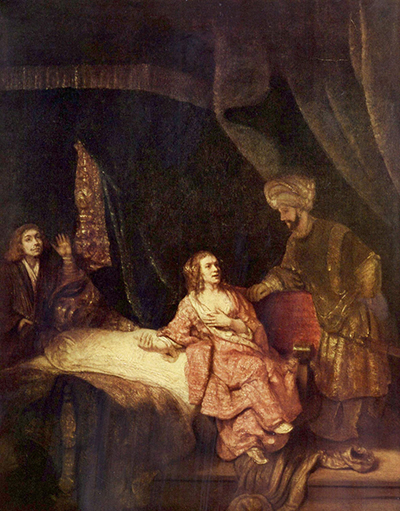
| Joseph and Potiphar’s Wife | 1655 | Painting |
| Juno | c. 1662–65 | Painting |
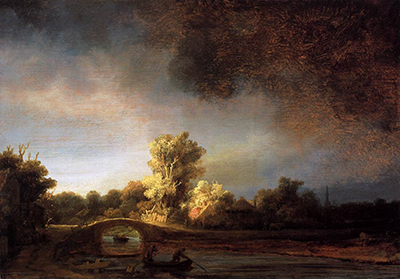
| Landscape with a Stone Bridge | c. 1638 | Painting |
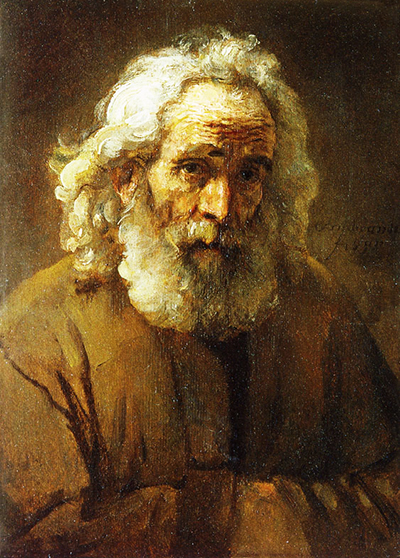
| Head of an Old Man with Curly Hair | 1659 | Painting |
| A Man in Armour | Possibly 1655 | Painting |
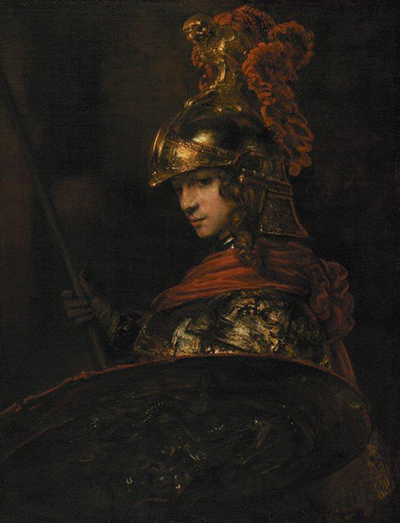
| Minerva in Her Study | 1635 | Painting |
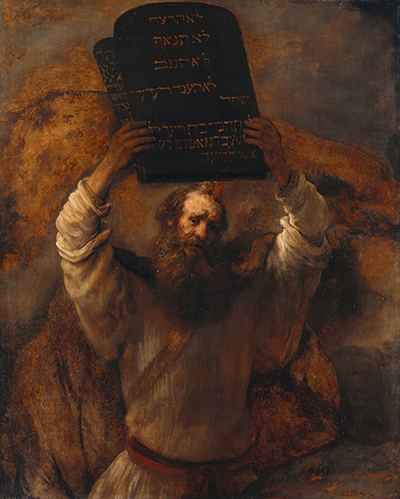
| Moses with the Tablets of the Law | 1659 | Painting |
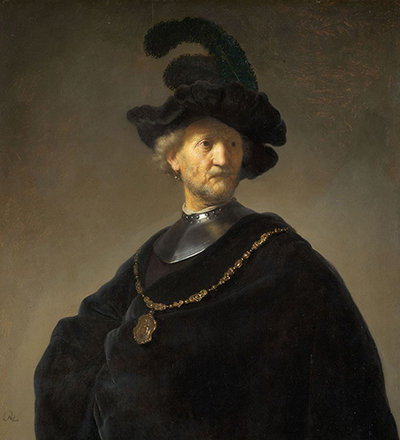
| Old Man with a Gold Chain | c. 1631 | Painting |
| Peter and John at the Gate of the Temple | c. 1629 | |
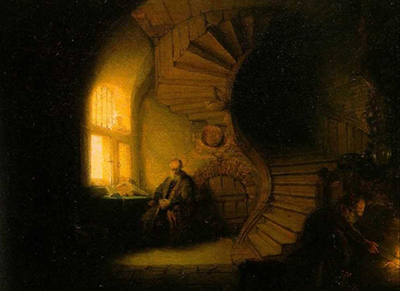
| Philosopher in Meditation | 1632 | Painting |
| The Polish Rider | c. 1655 | Painting |
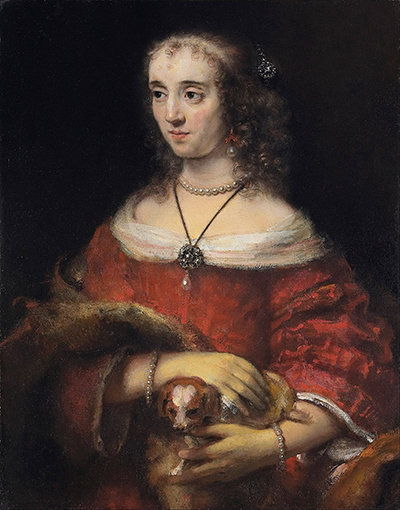
| Portrait of a Woman with a Lapdog | c. 1665 | Painting |
| Portrait of Gerard de Lairesse | 1665–67 | Painting |
| Portrait of Jan Six | c. 1654 | Painting |
| Portrait of Maerten Soolmans | 1634 | Painting |
| Portrait of a Woman, Probably Maria Trip | 1639 | Painting |
| Portrait of Oopjen Coppit | 1634 | Painting |
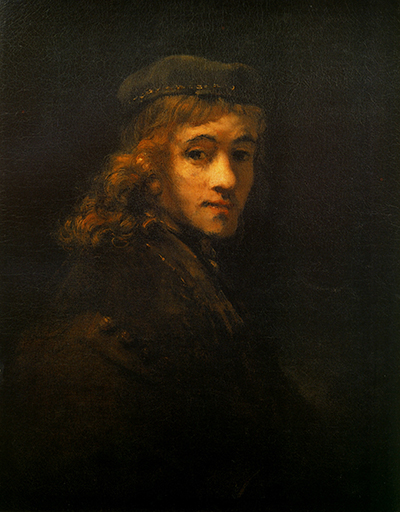
| Portrait of Titus | c. 1662 | Painting |
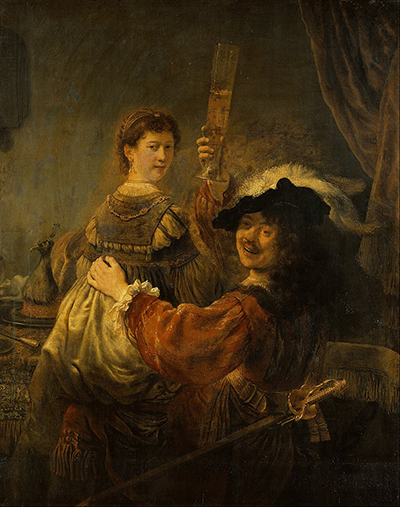
| Rembrandt and Saskia in the Parable of the Prodigal Son | c. 1635 | Painting |
| The Raising of Lazarus | c. 1630–32 | Painting |
| The Rest on the Flight into Egypt | c. 1626 | |
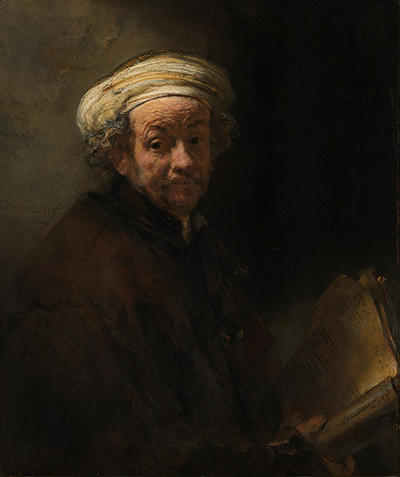
| Self-Portrait as the Apostle Paul | 1661 | Painting |
| Self-Portrait (Cologne) | c. 1668 | Painting |
| Rembrandt’s Self-Portrait, Frowning | 1630 | |
| Self-Portrait in a Cap, Wide-Eyed and Open-Mouthed | 1630 | |
| Self-Portrait in a Fur Cap | 1630 | |
| Self-Portrait in a Fur Cap, in an Oval Border | c. 1629 | |
| Self-Portrait in a Soft Hat and Embroidered Cloak | 1631 | |
| Self-Portrait, Bending Forward | c. 1628 | |
| Self-Portrait with a Broad Nose | c. 1628 | |
| Self-Portrait with Beret and Turned-Up Collar | 1659 | Painting |
| Self-Portrait with Plumed Cap and Lowered Sabre | 1634 | |
| The Shipbuilder and His Wife | 1633 | Painting |
| Simeon’s Hymn of Praise | c. 1640 | |
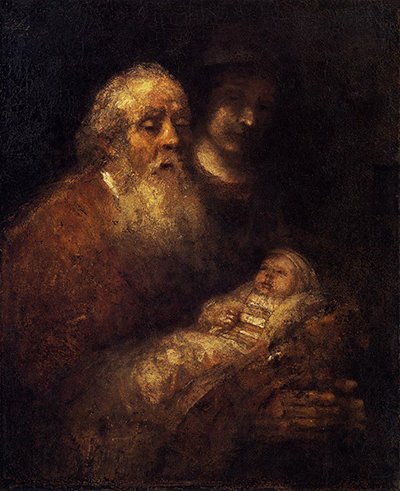
| Simeon in the Temple | c. 1669 | Painting |
| St Jerome Kneeling | c. 1628–29 | |
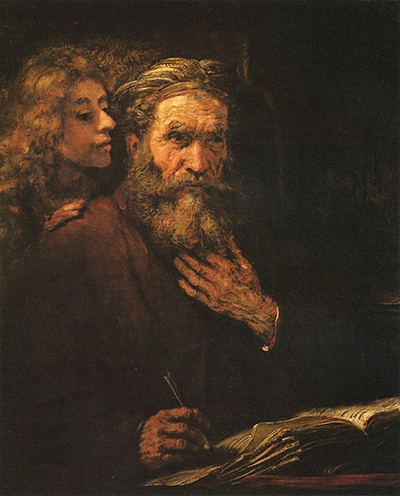
| Saint Matthew and the Angel | 1661 | Painting |
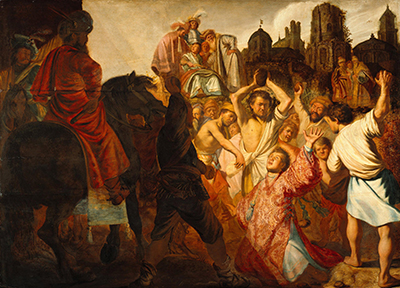
| The Stoning of Saint Stephen | 1625 | Painting |
| A Stout Man in a Large Cloak | c. 1629 | |
| The Supper at Emmaus | 1648 | Painting |
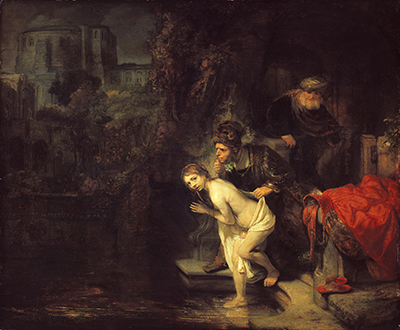
| Susanna and the Elders | 1647 | Painting |
| The Syndics of the Drapers’ Guild | 1662 | Painting |
| The Mill | 1645/1648 | Painting |
| The Woman Taken in Adultery | 1644 | Painting |
| Lucretia (1664) | 1664 | Painting |
| Lucretia (1666) | 1666 | Painting |
| Anatomische les van Dr. Jan Deijman (fragment) | 1656 | Painting |
| Isaac and Rebecca, Known as ‘The Jewish Bride’ | c. 1665 - c. 1669 | Painting |
| Johannes Wtenbogaert | 1633 | Painting |
| Man in Oriental Dress | 1635 | Painting |
| Musical Company | 1626 | Painting |
| Portrait of Ephraim Bueno | 1645 - 1647 | Painting |
| Portrait of Haesje Jacobsdr van Cleyburg | 1634 | Painting |
| Portrait of Oopjen Coppit | 1634 | Painting |
| Self-portrait | c. 1628 | Painting |
| Still Life with Peacocks | c. 1639 | Painting |
| Tobit and Anna with the Kid | 1626 | Painting |
| Young Woman in Fantasy Costume | 1633 | Painting |
| A Polish Nobleman | 1637 | Painting |
| A Woman Holding a Pink | 1656 | Painting |
| A Young Man Seated at a Table (possibly Govaert Flinck) | c. 1660 | Painting |
| Man with a Sheet of Music | 1633 | Painting |
| Philemon and Baucis | 1658 | Painting |
| Portrait of a Gentleman with a Tall Hat and Gloves | c. 1656/1658 | Painting |
| Portrait of a Lady with an Ostrich-Feather Fan | c. 1656/1658 | Painting |
| Portrait of a Man in a Tall Hat | c. 1663 | Painting |
| Saskia van Uylenburgh, the Wife of the Artist | probably begun 1634/1635 and completed 1638/1640 | Painting |
| The Circumcision | 1661 | Painting |
| Bellona | 1633 | Painting |
| Flora | ca. 1654 | Painting |
| Hendrickje Stoffels (1626–1663) | mid-1650s | Painting |
| Herman Doomer (ca. 1595–1650) | 1640 | Painting |
| Man in a Turban | 1632 | Painting |
| Man with a Magnifying Glass | early 1660s | Painting |
| Portrait of a Man | 1632 | Painting |
| Portrait of a Man Holding Gloves | 1648 | Painting |
| Portrait of a Man, probably a Member of the Van Beresteyn Family | 1632 | Painting |
| Portrait of a Woman | 1633 | Painting |
| Portrait of a Woman, probably a Member of the Van Beresteyn Family | 1632 | Painting |
| Portrait of a Young Woman with a Fan | 1633 | Painting |
| The Standard Bearer (probably Floris Soop, 1604–1657) | 1654 | Painting |
| The Toilet of Bathsheba | 1643 | Painting |
| Woman with a Pink | early 1660s | Painting |
| Lieven Willemsz van Coppenol (born about 1599, died 1671 or later) | Painting | |
| Portrait of a Man | ca. 1655–60 | Painting |
| Self-Portrait | 1660 | Painting |
| A Cap | c. 1629 - c. 1630 | Drawing |
| A Cow in a Shed | c. 1640 | Drawing |
| A Syndic of the Drapers’ Guild, Jacob van Loon, Seated | c. 1661 - c. 1662 | Drawing |
| Abraham Casting Out Hagar and Ishmael | c. 1650 | Drawing |
| Actor in the Role of Pantalone Engaged in Conservation | c. 1634 - c. 1636 | Drawing |
| Bedroom with Saskia in a Canopy Bed | c. 1638 | Drawing |
| Beheading of John the Baptist | c. 1640 - c. 1641 | Drawing |
| Boaz and Ruth | c. 1645 | Drawing |
| Boy Walking with a Stick | c. 1635 - c. 1640 | Drawing |
| Christ Appearing to Mary Magdalene as a Gardener (Noli me tangere) | c. 1645 | Drawing |
| Christ Healing a Leper | c. 1650 - c. 1655 | Drawing |
| Christ Washing the Disciples’ Feet | c. 1640 - c. 1650 | Drawing |
| Cottage with White Paling among Trees | c. 1648 | Drawing |
| Daniel in the Lions’ Den | c. 1650 | Drawing |
| David Hearing the News of Uriah’s Death | c. 1650 | Drawing |
| Five Studies of Haman’s Head | c. 1655 - c. 1660 | Drawing |
| Four Men Standing, Wearing Hats | c. 1650 | Drawing |
| Indian Archer | c. 1656 - c. 1658 | Drawing |
| Inn on the Amstelveenseweg | c. 1652 | Drawing |
| Jacob and his Sons | c. 1641 | Drawing |
| Jael Killing Sisera | c. 1658 - c. 1659 | Drawing |
| Jahangir | c. 1656 - c. 1658 | Drawing |
| Joseph in Prison Interpreting the Dreams of the Butler and the Baker | c. 1650 - c. 1655 | Drawing |
| Longhouse Farmstead with a Haystack in a Polder Landscape | c. 1652 | Drawing |
| Man Helping a Rider to Mount a Horse | c. 1640 - c. 1641 | Drawing |
| Nude Woman Lying on a Pillow | c. 1661 - c. 1662 | Drawing |
| Nude Woman Seated by a Stove | c. 1661 - c. 1662 | Drawing |
| One of the Three Kings Adoring the Virgin and Child | c. 1635 - c. 1640 | Drawing |
| Recumbent Lion | c. 1660 | Drawing |
| Saskia in Bed | c. 1635 | Drawing |
| Seated Actor in the Role of Capitano | c. 1634 - c. 1636 | Drawing |
| Self-portrait with Tousled Hair | c. 1628 - c. 1629 | Drawing |
| Shah Jahan | c. 1656 - c. 1658 | Drawing |
| Shah Jahan and his Son | c. 1656 - c. 1658 | Drawing |
| Small Study of the Head of the Sick Woman | c. 1647 - c. 1648 | Drawing |
| Standing Man with a Pouch | c. 1629 - c. 1630 | Drawing |
| Standing Man with a Stick, Facing Left | c. 1629 - c. 1630 | Drawing |
| Standing Man with a Stick, Facing Right | c. 1629 - c. 1630 | Drawing |
| Standing Man with Outstretched Arm | c. 1636 - c. 1641 | Drawing |
| Studies for the Sick Woman in the ‘Hundred Guilder Print’ | c. 1648 | Drawing |
| Studies of the Mourning Magdalen and the Virgin | c. 1635 - c. 1636 | Drawing |
| Study of a Man, Seen from Behind | c. 1629 - c. 1630 | Drawing |
| Study of a Woman’s Legs | c. 1628 - c. 1629 | Drawing |
| Susanna and the Elders | c. 1650 - c. 1655 | Drawing |
| The Actor Willem Bartholsz Ruyter as a Peasant | c. 1638 | Drawing |
| The Actor Willem Bartholsz Ruyter as King Ahasuerus on his Throne | c. 1635 - c. 1640 | Drawing |
| The Angel Appearing to Joseph in his Dream | c. 1650 | Drawing |
| The Annunciation to the Shepherds | c. 1650 | Drawing |
| The Entombment, over a Sketch of an Executioner | c. 1640 - c. 1641 | Drawing |
| The Pancake Woman | c. 1635 | Drawing |
| The Swijgh Utrecht Tower in Amsterdam | c. 1650 - c. 1655 | Drawing |
| Three Orientals Conversing | c. 1645 | Drawing |
| Three Scribes | c. 1628 - c. 1629 | Drawing |
| Three Women and a Child by a Door | c. 1645 | Drawing |
| Tobias and the Angel Taking Leave of Raguel | c. 1650 - c. 1655 | Drawing |
| Two Horses at a Halting-place | c. 1637 | Drawing |
| View of the Amstel from the Blauwbrug | c. 1645 - c. 1650 | Drawing |
| View of the Amstelveenseweg outside Amsterdam | c. 1660 - c. 1662 | Drawing |
| View of the Nieuwezijds Voorburgwal | c. 1647 | Drawing |
| Walking Man with a High Cap | c. 1655 - c. 1660 | Drawing |
| Winter View with a Waterway, Cottages and Two Boats | c. 1650 | Drawing |
| Woman with a Urinating Child | c. 1658 - c. 1660 | Drawing |
| Young Woman Seated by a Window (Saskia?) | c. 1638 | Drawing |
| A Landscape with Farm Buildings among Trees | c. 1650/1655 | Drawing |
| Beggar Man and Woman | c. 1630/1631 | Drawing |
| Beggar Woman Leaning on a Stick | 1628/1630 | Drawing |
| Bust of an Elderly Man in a Flat Cap | 1635/1637 | Drawing |
| Cottages and Barn beside a Road | c. 1650 | Drawing |
| Esther before Ahasuerus | 1655/1660 | Drawing |
| Figures on the Anthoniesdijk Entering Houtewael [verso] | c. 1650 | Drawing |
| God the Father Supported by Angels | 1655/1660 | Drawing |
| Head of an Old Man (recto) | c. 1631 | Drawing |
| Jan Cornelisz Sylvius, the Preacher | 1644/1645 | Drawing |
| Joseph Recounting His Dreams | early 1640s | Drawing |
| Seated Old Man | 1630 | Drawing |
| Self-Portrait | c. 1637 | Drawing |
| View of Diemen | c. 1655 | Drawing |
| View of Houtewael near the Sint Anthoniespoort [recto] | c. 1650 | Drawing |
| View over the Amstel from the Rampart | c. 1646/1650 | Drawing |
| Woman Seated on the Ground with Two Children | 1635/1640 | Drawing |
| Cottage among Trees | ca. 1650 | Drawing |
| Cottage near the Entrance to a Wood | 1644 | Drawing |
| Elsje Christiaens Hanging on a Gibbet | 1664 | Drawing |
| Group of Farm Buildings | ca. 1648–52 | Drawing |
| Houses by the Water | ca. 1652 | Drawing |
| Nathan Admonishing David | 1650–55 | Drawing |
| Old Man in Profile | 1620–69 | Drawing |
| Old Man Leaning on a Stick | 1632–35 | Drawing |
| Potiphar's Wife Accusing Joseph Before her Husband | 1620–69 | Drawing |
| Satire on Art Criticism | 1644 | Drawing |
| Seated Man Wearing a Flat Cap | 1635–40 | Drawing |
| St. Peter and St John Healing the Paralytic | 1606–69 | Drawing |
| Study Sheet with Three Women and a Boy | ca. 1638–39 | Drawing |
| The Last Supper, after Leonardo da Vinci | 1634–35 | Drawing |
| The Wedding Night of Tobias and Sarah | 1640–49 | Drawing |
| Two Cottages | ca. 1636 | Drawing |
| Two Studies of a Woman Reading | 1635–40 | Drawing |
| Woman Reading | 1606–69 | Drawing |
| The Annunciation to the Shepherds | c. 1655 | Drawing |
| Elsje Christiaens Hanging on a Gibbet | 1664 | Drawing |
| A blind hurdy-gurdy player and family receiving alms | 1648 | Print impression |
| A cavalry fight | 1629 | Print impression |
| A Polander with a Stick | c. 1631 | Print impression |
| A scholar in his study | c. 1652 | Print impression |
| A Scholar in his Study (‘Faust’) | c. 1652 | Print impression |
| A standing hurdy-gurdy player | c. 1631 | Print impression |
| Aanbidding der herders: nachtstuk | 1650 - 1654 | Print impression |
| Abraham Francen | c. 1657 | Print impression |
| Abraham Francen, apothecary | c. 1657 | Print impression |
| Arnout Tholinx | c. 1656 | Print impression |
| Bald headed man in profile right: the artist's father (?) | 1630 | Print impression |
| Bald man with open mouth, looking down: bust | c. 1631 | Print impression |
| Bald Old Man with a Short Beard | c. 1635 | Print impression |
| Bearded man with short wavy hair: bust | c. 1631 | Print impression |
| Bearded Old Man with High Forehead | c. 1629 | Print impression |
| Bedelaar met een houten been | 1628 - 1632 | Print impression |
| Bedelaar met een stok | 1631 | Print impression |
| Beggar in a high cap, standing and leaning on a stick | c. 1629 | Print impression |
| Beggar in a High Hat, Leaning on a Stick | c. 1629 | Print impression |
| Beggar leaning on a stick, facing left | c. 1630 | Print impression |
| Beggar Man and Woman | c. 1629 | Print impression |
| Beggar Man and Woman behind a Bank | c. 1630 | Print impression |
| Beggar seated warming his hands at a chafing dish | c. 1630 | Print impression |
| Beggar Warming his Hands | c. 1630 | Print impression |
| Beggar with a clenched hand, leaning on a stick | c. 1629 | Print impression |
| Beggar with a Cottage and Two Figures in the Background | c. 1629 | Print impression |
| Beggar with a Crippled Hand, Leaning on a Stick | c. 1629 | Print impression |
| Beggar with a Wooden Leg | c. 1630 | Print impression |
| Beggar Woman with a Gourd | c. 1629 | Print impression |
| Beggar, Seated in an Armchair | c. 1629 | Print impression |
| Bust of an old man with a fur cap and flowing beard, nearly full face | c. 1631 | Print impression |
| Bust of an old man with flowing beard and white sleeve | c. 1630 | Print impression |
| Christ and the woman of Samaria among ruins | 1634 | Print impression |
| Christ before Pilate: large plate | 1635 | Print impression |
| Christ Crucified between the Two Thieves | c. 1641 | Print impression |
| Christ Crucified between the two Thieves: 'The Three Crosses' | 1653 | Print impression |
| Christ crucified between the two thieves: an oval plate | c. 1641 | Print impression |
| Christ Disputing with the Doctors | 1630 | Print impression |
| Christ disputing with the Doctors: small plate | 1630 | Print impression |
| Christ Healing the Sick (‘Hundred Guilder Print’) | c. 1648 | Print impression |
| Christ Preaching | c. 1657 | Print impression |
| Christ preaching ('La Petite Tombe') | c. 1657 | Print impression |
| Christ Preaching, known as La petite tombe | c. 1657 | Print impression |
| Christ Presented to the People (Ecce Homo) | 1655 | Print impression |
| Christ presented to the people: oblong plate | 1655 | Print impression |
| Christus en de schriftgeleerden: kleine plaat | 1630 | Print impression |
| Clump of trees with a vista | 1652 | Print impression |
| Cottage and Boundary Post on the Spaarndammerdijk | c. 1650 | Print impression |
| Cottage and boundary post on the Spaarndammerdijk ('L'Obelisque') | c. 1650 | Print impression |
| Cottage and Farm Buildings with a Man Sketching | c. 1641 | Print impression |
| Cottage beside a canal with a view of Ouderkerk | c. 1641 | Print impression |
| Cottages beside a Canal: View of Ouderkerk aan de Amstel | c. 1641 | Print impression |
| David in gebed | 1652 | Print impression |
| Diana at the bath | c. 1631 | Print impression |
| Driekoningen: een nachtstuk | 1649 - 1653 | Print impression |
| Een student aan tafel bij kaarslicht | c. 1642 | Print impression |
| Farmhouse among Trees | 1652 | Print impression |
| Geleerde in zijn werkkamer (Faust) | 1650 - 1807 | Print impression |
| Girl with a basket | c. 1642 | Print impression |
| Goudsmid | 1655 | Print impression |
| Grotesque profile: man in a high cap | c. 1629 | Print impression |
| Head of a Man in a Fur Cap, Crying Out | c. 1629 | Print impression |
| Head of a man in a high cap | c. 1629 | Print impression |
| Head of a Man in a High Hat | c. 1629 | Print impression |
| Head of an Old Man in a High Fur Hat | c. 1629 | Print impression |
| Hieronymus geknield in gebed, de blik naar beneden gericht | 1635 | Print impression |
| Honderd Gulden prent | 1753 - 1810 | Print impression |
| Jacob's ladder | 1655 | Print impression |
| Jan Antonides van der Linden | 1665 | Print impression |
| Jan Asselijn, painter | 1645 - 1649 | Print impression |
| Jan Lutma, goldsmith | 1656 | Print impression |
| Jan Six | 1647 | Print impression |
| Johannes Lutma | 1656 | Print impression |
| Johannes Wtenbogaert | 1635 | Print impression |
| Jongeman, zittend en staand | 1644 - 1648 | Print impression |
| Jozef vertelt zijn dromen | 1638 | Print impression |
| Kruisiging: kleine plaat | 1633 - 1637 | Print impression |
| Landscape with a cow drinking | c. 1650 | Print impression |
| Landscape with a farm building and the 'house with the tower' | c. 1650 | Print impression |
| Landscape with a farmhouse along a road beside a canal | c. 1652 | Print impression |
| Landscape with a Fisherman (‘The Milkman’) | c. 1650 | Print impression |
| Landscape with sportsman and dogs | c. 1648 | Print impression |
| Landscape with Sportsman and Dogs (‘Het jagertje’) | c. 1648 | Print impression |
| Landschap met drinkende koe | 1648 - 1652 | Print impression |
| Lieven Willemsz van Coppenol | c. 1658 | Print impression |
| Lieven Willemsz. van Coppenol, writing master: the larger plate | c. 1658 | Print impression |
| Lieven Willemsz. van Coppenol, writing master: the smaller plate | c. 1658 | Print impression |
| Loflied van Simeon | 1637 - 1641 | Print impression |
| Male nude, seated and standing | c. 1646 | Print impression |
| Man Crying Out | c. 1629 | Print impression |
| Man drawing from a cast | c. 1641 | Print impression |
| Man Drawing from a Plaster Cast | c. 1641 | Print impression |
| Man in a Close Cap | 1630 | Print impression |
| Man in a Square Cap, in Profile to the Right | c. 1629 | Print impression |
| Man in cap bound around his chin | c. 1631 | Print impression |
| Man with square beard and curly hair: bust | c. 1631 | Print impression |
| Man, tekenend naar een gipsmodel | 1639 - 1643 | Print impression |
| Medea: or the marriage of Jason and Creusa | 1648 | Print impression |
| Naked woman on a mound | c. 1631 | Print impression |
| Old Bearded Man, with Mouth Half Open | c. 1629 | Print impression |
| Old beggar woman with a gourd | c. 1629 | Print impression |
| Old Man in a Fur Coat and Tall Hat | c. 1629 | Print impression |
| Old man in meditation, leaning on a book | c. 1645 | Print impression |
| Old Man Lost in Meditation, Leaning on a Book | c. 1645 | Print impression |
| Old Man Shading his Eyes with his Hand | c. 1639 | Print impression |
| Old Man with a Flowing Beard and White Sleeve | c. 1630 | Print impression |
| Old Man with a Fur Cap and Flowing Beard | c. 1631 | Print impression |
| Old Man, Seen from Behind | c. 1629 | Print impression |
| Old Woman Seated in a Cottage, with a String of Onions | c. 1629 | Print impression |
| Old woman seated in a cottage, with a string of onions on the wall | c. 1629 | Print impression |
| Old Woman Sleeping | c. 1636 | Print impression |
| Oude bedelares met kalebas | 1628 - 1632 | Print impression |
| Peasant family on the tramp | c. 1652 | Print impression |
| Pieter Haaringh: hands and hat | 1655 | Print impression |
| Polander leaning on a stick | c. 1631 | Print impression |
| Portrait of Abraham Francen | c. 1657 | Print impression |
| Portrait of Lieven Willemsz van Coppenol, known as ‘The Smaller Plate’ | c. 1658 | Print impression |
| Portret van de apotheker Abraham Francen | 1655 - 1807 | Print impression |
| Portret van de schrijfmeester Lieven Willemsz. van Coppenol: grote plaat | 1658 | Print impression |
| Portret van predikant Cornelis Claesz. Anslo | 1641 | Print impression |
| Portret van Rembrandt | 1638 | Print impression |
| Profile of a Man in a High Hat | c. 1629 | Print impression |
| Ragged Peasant with his Hands behind him | c. 1630 | Print impression |
| Ragged peasant with his hands behind him, holding a stick | c. 1630 | Print impression |
| Rembrandt’s Mother | 1628 | Print impression |
| Rest on the Flight into Egypt at Night | 1642 - 1646 | Print impression |
| Rest on the flight into Egypt: a night piece | c. 1644 | Print impression |
| Rondtrekkende boerenfamilie | 1650 - 1654 | Print impression |
| Saint Jerome Reading in an Italianate Landscape | c. 1653 | Print impression |
| Schatpenning | 1633 - 1637 | Print impression |
| Self-portrait Bare-headed | c. 1629 | Print impression |
| Self-portrait etching at a window | 1648 | Print impression |
| Self-portrait in a cap and dark cloak: bust | c. 1631 | Print impression |
| Self-portrait in a cap and scarf with the face dark: bust | 1633 | Print impression |
| Self-portrait in a Fur Cap | c. 1629 | Print impression |
| Self-portrait in a Soft Cap | c. 1634 | Print impression |
| Self-portrait in a soft hat and a patterned cloak | 1631 | Print impression |
| Self-portrait in a Soft Hat and Patterned Cloak | 1631 | Print impression |
| Self-portrait in a velvet cap with plume | 1638 | Print impression |
| Self-portrait leaning forward: bust | c. 1629 | Print impression |
| Self-portrait wearing a soft cap: full face, head only | c. 1634 | Print impression |
| Self-portrait with a Broad Nose | c. 1628 | Print impression |
| Self-portrait with bushy hair: bust | c. 1631 | Print impression |
| Self-portrait with cap pulled forward | c. 1630 | Print impression |
| Self-portrait with long bushy hair: head only | c. 1631 | Print impression |
| Self-portrait with Long, Bushy Hair | c. 1631 | Print impression |
| Self-portrait, Bending Forward | c. 1628 | Print impression |
| Self-portrait, frowning: bust | 1630 | Print impression |
| Self-portrait, Leaning Forward | c. 1629 | Print impression |
| Sheet of Slight Studies, One of Two Peasants | c. 1651 | Print impression |
| Sheet of studies of men's head: old man in fur coat and high cap | c. 1629 | Print impression |
| Sheet of studies of men's heads: man crying out, three quarters left: bust | c. 1629 | Print impression |
| Sheet of studies of men's heads: old bearded man nearly in profile to right: mouth half open | c. 1629 | Print impression |
| Sheet of studies of men's heads: old man seen from behind, profile right: half-figure | c. 1629 | Print impression |
| Sheet of Studies with a Tree and the Upper Part of Rembrandt’s Head in a Velvet Cap | c. 1644 | Print impression |
| Sheet of Studies, with a Self-portrait, a Beggar Couple, and Heads of an Old Man and Old Woman | 1632 | Print impression |
| Sheet of Studies, with a Woman Lying Ill in Bed | c. 1639 | Print impression |
| Sheet of studies, with a woman lying ill in bed: busts of two male figures | c. 1639 | Print impression |
| Sheet of studies: head of the artist | 1632 | Print impression |
| Sheet of studies: head of the artist, a beggar couple, heads of an old man and old woman, etc. | 1632 | Print impression |
| Sick woman with a large white headdress (Saskia) | c. 1645 | Print impression |
| Sick Woman with a White Headdress (Saskia) | c. 1645 | Print impression |
| Sleeping Puppy | c. 1640 | Print impression |
| Small Grey Landscape | c. 1640 | Print impression |
| St Jerome beside a pollard willow | 1648 | Print impression |
| St Jerome Kneeling | c. 1628 | Print impression |
| St Jerome kneeling in prayer, looking down | 1635 | Print impression |
| St Jerome reading in an Italian landscape | c. 1653 | Print impression |
| St Peter and St John at the gate of the temple: roughly etched | c. 1629 | Print impression |
| Star of the Kings | c. 1651 | Print impression |
| Straatmuzikanten | 1632 - 1637 | Print impression |
| Strolling Musicians | c. 1635 | Print impression |
| Study of the Head of a Woman | c. 1635 | Print impression |
| The Adoration of the Shepherds | c. 1657 | Print impression |
| The adoration of the shepherds: a night piece | c. 1657 | Print impression |
| The Adoration of the Shepherds: Nocturne | c. 1657 | Print impression |
| The Artist Drawing from a Model | c. 1639 | Print impression |
| The artist drawing from the model | c. 1639 | Print impression |
| The artist's mother seated at a table, looking right: three quarter length | c. 1631 | Print impression |
| The Baby Walker | c. 1646 | Print impression |
| The beheading of St John the Baptist | c. 1631 | Print impression |
| The Blindness of Tobit | c. 1629 | Print impression |
| The blindness of Tobit: a sketch | c. 1629 | Print impression |
| The circumcision | c. 1625 | Print impression |
| The circumcision: small plate | c. 1630 | Print impression |
| The Entombment | c. 1654 | Print impression |
| The Flight into Egypt | c. 1628 | Print impression |
| The Flight into Egypt, on a Plate by Segers | c. 1653 | Print impression |
| The flight into Egypt: a sketch: St Joseph | c. 1628 | Print impression |
| The flight into Egypt: altered plate from Seghers | c. 1653 | Print impression |
| The good Samaritan | 1633 | Print impression |
| The great Jewish bride | 1635 | Print impression |
| The Hundred Guilder Print | c. 1648 | Print impression |
| The Hundred Guilder Print: the ass, the camel and the wheelbarrow | c. 1648 | Print impression |
| The Hundred Guilder Print: the central piece with Christ preaching | c. 1648 | Print impression |
| The Hundred Guilder Print: the central piece with Christ preaching, the plate arched | c. 1648 | Print impression |
| The Hundred Guilder Print: the figures leaning on the wall in the centre left | c. 1648 | Print impression |
| The Hundred Guilder Print: the man seen on the back in the lower left corner | c. 1648 | Print impression |
| The Hurdy-gurdy Player | c. 1631 | Print impression |
| The monk in the cornfield | c. 1646 | Print impression |
| The Presentation in the Temple | c. 1654 | Print impression |
| The presentation in the temple in the dark manner | c. 1654 | Print impression |
| The presentation in the temple: oblong print | c. 1640 | Print impression |
| The Rest on the Flight into Egypt | c. 1644 | Print impression |
| The Skater | c. 1639 | Print impression |
| The sleeping herdsman | c. 1644 | Print impression |
| The small lion hunt (with two lions) | c. 1629 | Print impression |
| The Small Lion Hunt, with One Lion | c. 1629 | Print impression |
| The Spanish gypsy 'Preciosa' | c. 1642 | Print impression |
| The Star of the Kings: a night piece | c. 1651 | Print impression |
| The Three Crosses | 1653 | Print impression |
| The Tribute Money | c. 1634 | Print impression |
| The Triumph of Mordecai | c. 1641 | Print impression |
| The Virgin with the Instruments of the Passion | c. 1642 | Print impression |
| Thomas Haaringh | c. 1655 | Print impression |
| Thomas Haringh (‘Old Haring’) | c. 1655 | Print impression |
| Three heads of women, one lightly etched | c. 1637 | Print impression |
| Three oriental figures (Jacob and Laban?) | 1641 | Print impression |
| Three Studies of Old Men’s Heads | c. 1630 | Print impression |
| Titus | c. 1656 | Print impression |
| Two Beggars | c. 1629 | Print impression |
| Two tramps, a man and a woman | c. 1634 | Print impression |
| View of Amsterdam from the Kadijk | c. 1641 | Print impression |
| View of the Diemerdijk with a milkman and cottages | c. 1650 | Print impression |
| View of the Huis Te Vraag Inn on the Sloterweg | c. 1652 | Print impression |
| Vlucht naar Egypte: nachtstuk | 1651 | Print impression |
| Vrouw in een deuropening, pratend met een man met kinderen | 1641 | Print impression |
| Woman bathing her feet at a brook | 1658 | Print impression |
| Woman in a Fur-trimmed Cloak | 1631 | Print impression |
| Woman with a High Headdress | c. 1630 | Print impression |
| Woman with a high headdress wrapped around the chin: bust | c. 1630 | Print impression |
| Zelfportret met gepluimde fluwelen baret | 1638 | Print impression |
| A Bald Man in Profile (The Artist's Father?) | 1630 | Print impression |
| A Peasant Calling Out: "tis vinnich kout" (It's biting cold) | 1634 | Print impression |
| A Peasant in a High Cap, Standing Leaning on a Stick | 1639 | Print impression |
| A Peasant Replying: "Dats niet" (That's nothing) | 1634 | Print impression |
| Abraham and Isaac | 1645 | Print impression |
| Abraham Caressing Isaac | c. 1637 | Print impression |
| Abraham Casting Out Hagar and Ishmael | 1637 | Print impression |
| Abraham Entertaining the Angels | 1656 | Print impression |
| Abraham's Sacrifice | 1655 | Print impression |
| Adam and Eve | 1638 | Print impression |
| Bald Old Man with a Short Beard in Profile | c. 1635 | Print impression |
| Bearded Man in a Velvet Cap with a Jewel Clasp | 1637 | Print impression |
| Bearded Man, in a Furred Oriental Cap and Robe: the Artist's Father | 1631 | Print impression |
| Beggar Man and Beggar Woman Conversing | 1630 | Print impression |
| Beggar Seated on a Bank | 1630 | Print impression |
| Beggar with His Left Hand Extended | 1631 | Print impression |
| Beggar Woman Leaning on a Stick | 1646 | Print impression |
| Beggars Receiving Alms at the Door of a House | 1648 | Print impression |
| Bust of a Man Wearing a High Cap, Three-Quarters Right (The Artist's Father?) | 1630 | Print impression |
| Bust of an African Woman | c. 1630 | Print impression |
| Bust of an Old Bearded Man, Looking Down, Three Quarters Right | 1631 | Print impression |
| Canal with a Large Boat and Bridge | 1650 | Print impression |
| Canal with an Angler and Two Swans | 1650 | Print impression |
| Christ and the Woman of Samaria: an Arched Print | 1658 | Print impression |
| Christ Appearing to the Apostles | 1656 | Print impression |
| Christ at Emmaus: the Larger Plate | 1654 | Print impression |
| Christ at Emmaus: the Smaller Plate | 1634 | Print impression |
| Christ Carried to the Tomb | c. 1645 | Print impression |
| Christ Disputing with the Doctors: a Sketch | 1652 | Print impression |
| Christ Driving the Money Changers from the Temple | 1635 | Print impression |
| Christ Preaching (The Hundred Guilder Print) | c. 1649 | Print impression |
| Christ Returning from the Temple with His Parents | 1654 | Print impression |
| Christ Seated Disputing with the Doctors | 1654 | Print impression |
| Clement de Jonghe | 1651 | Print impression |
| Cornelis Claesz Anslo | 1641 | Print impression |
| Cottage beside a Canal | c. 1645 | Print impression |
| Cottage with a White Paling | 1648 | Print impression |
| Cottages and Farm Buildings with a Man Sketching | c. 1645 | Print impression |
| David and Goliath | 1655 | Print impression |
| David in Prayer | 1652 | Print impression |
| Death Appearing to a Wedded Couple from an Open Grave | 1639 | Print impression |
| Ephraim Bonus | 1647 | Print impression |
| Faust | c. 1652 | Print impression |
| Jacob Haaringh ('Young Haaringh') (Pieter Haaringh) | 1655 | Print impression |
| Jan Asselijn | c. 1647 | Print impression |
| Jan Cornelisz. Sylvius | 1633 | Print impression |
| Jan Lutma | 1656 | Print impression |
| Jan Uytenbogaert | 1635 | Print impression |
| Jews in the Synagogue | 1648 | Print impression |
| Joseph Telling His Dreams | 1638 | Print impression |
| Joseph's Coat Brought to Jacob | c. 1633 | Print impression |
| Landscape with a Cottage and a Large Tree | 1641 | Print impression |
| Landscape with a Cottage and Hay Barn: Oblong | 1641 | Print impression |
| Landscape with a Cow | c. 1650 | Print impression |
| Landscape with a Hay Barn and a Flock of Sheep | 1652 | Print impression |
| Landscape with a Milkman | c. 1650 | Print impression |
| Landscape with a Road beside a Canal | c. 1652 | Print impression |
| Landscape with a Square Tower | 1650 | Print impression |
| Landscape with a View toward Haarlem (The Goldweigher's Field) | 1651 | Print impression |
| Landscape with an Obelisk | c. 1650 | Print impression |
| Landscape with Sportsman and Dog | c. 1653 | Print impression |
| Landscape with Three Gabled Cottages beside a Road | 1650 | Print impression |
| Landscape with Trees, Farm Buildings and a Tower | c. 1651 | Print impression |
| Lieven Willemsz van Coppenol: the Larger Plate | 1658 | Print impression |
| Lieven Willemsz van Coppenol: the Smaller Plate | c. 1658 | Print impression |
| Man at a Desk Wearing a Cross and Chain | 1641 | Print impression |
| Man Crying Out, Three-Quarters Left | c. 1630/1631 | Print impression |
| Man in a Broad-Brimmed Hat | possibly 1638 | Print impression |
| Man in a Coat and Fur Cap Leaning against a Bank | c. 1630 | Print impression |
| Man in an Arbor | 1642 | Print impression |
| Nude Man Seated and Nude Man Standing, with a Woman and Baby in the Background | c. 1646 | Print impression |
| Nude Man Seated before a Curtain | 1646 | Print impression |
| Nude Man Seated on the Ground with One Leg Extended | 1646 | Print impression |
| Nude Seated on a Bench with a Pillow (Woman Bathing Her Feet at a Brook) | 1658 | Print impression |
| Old Bearded Man in a High Fur Cap, with Eyes Closed | c. 1635 | Print impression |
| Old Man Seen from Behind, Profile to Right | c. 1631 | Print impression |
| Old Man with a Divided Fur Cap | 1640 | Print impression |
| Old Man with Beard, Fur Cap, and Velvet Cloak | c. 1632 | Print impression |
| Peasant with His Hands behind His Back | 1631 | Print impression |
| Peter and John Healing the Cripple at the Gate of the Temple | 1659 | Print impression |
| Portrait of a Boy in Profile | 1641 | Print impression |
| Reclining Female Nude | 1658 | Print impression |
| Return of the Prodigal Son | 1636 | Print impression |
| Saint Francis beneath a Tree Praying | 1657 | Print impression |
| Saint Jerome beside a Pollard Willow | 1648 | Print impression |
| Saint Jerome in a Dark Chamber | 1642 | Print impression |
| Saint Jerome Reading in an Italian Landscape | c. 1653 | Print impression |
| Saint Peter in Penitence | 1645 | Print impression |
| Samuel Menasseh ben Israel | 1636 | Print impression |
| Saskia with Pearls in Her Hair | 1634 | Print impression |
| Self-Portrait (?) with Plumed Cap and Lowered Sabre | 1634 | Print impression |
| Self-Portrait in a Cap and Scarf with the Face Dark | 1633 | Print impression |
| Self-Portrait in a Cap, Open-Mouthed | 1630 | Print impression |
| Self-Portrait in a Cap: Laughing | 1630 | Print impression |
| Self-Portrait in a Flat Cap and Embroidered Dress | c. 1642 | Print impression |
| Self-Portrait in a Heavy Fur Cap | 1631 | Print impression |
| Self-Portrait Leaning on a Stone Sill | 1639 | Print impression |
| Self-Portrait with Raised Sabre | 1634 | Print impression |
| Self-Portrait with Saskia | 1636 | Print impression |
| Self-Portrait, Frowning | 1630 | Print impression |
| Sheet of Studies including a Woman Lying Ill in Bed | c. 1641/1642 | Print impression |
| Sheet of Studies including Head of the Artist, a Beggar Couple, Heads of an Old Man and Old Woman | c. 1632 | Print impression |
| Sheet of Studies with the Head of the Artist, a Beggar Man, and Woman and Child | 1651 | Print impression |
| Sheet with Two Studies: a Tree, and the Upper Part of a Head of the Artist Wearing a Velvet Cap | c. 1642 | Print impression |
| Six's Bridge | 1645 | Print impression |
| Small Gray Landscape: a House and Trees beside a Pool | c. 1640 | Print impression |
| Student at a Table by Candlelight | c. 1642 | Print impression |
| Studies of the Head of Saskia and Others | 1636 | Print impression |
| The Adoration of the Shepherds: with the Lamp | c. 1654 | Print impression |
| The Agony in the Garden | c. 1657 | Print impression |
| The Angel Appearing to the Shepherds | 1634 | Print impression |
| The Angel Departing from the Family of Tobias | 1641 | Print impression |
| The Artist's Mother in a Cloth Headdress, Looking Down | 1633 | Print impression |
| The Artist's Mother Seated at a Table, Looking Right | c. 1631 | Print impression |
| The Artist's Mother Seated, in an Oriental Headdress | 1631 | Print impression |
| The Artist's Mother with Her Hand on Her Chest | 1631 | Print impression |
| The Artist's Mother, Head and Bust | 1628 | Print impression |
| The Baptism of the Eunuch | 1641 | Print impression |
| The Bathers | 1651 | Print impression |
| The Blind Fiddler | 1631 | Print impression |
| The Blindness of Tobit: the Larger Plate | 1651 | Print impression |
| The Card Player | 1641 | Print impression |
| The Circumcision in the Stable | 1654 | Print impression |
| The Crucifixion: Small Plate | c. 1635 | Print impression |
| The Death of the Virgin | 1639 | Print impression |
| The Descent from the Cross by Torchlight | 1654 | Print impression |
| The Descent from the Cross: a Sketch | 1642 | Print impression |
| The Flight into Egypt: a Night Piece | 1651 | Print impression |
| The Flight into Egypt: Altered from Seghers | c. 1653 | Print impression |
| The Flight into Egypt: Crossing a Brook | 1654 | Print impression |
| The Flight into Egypt: Small | 1633 | Print impression |
| The Goldsmith | 1655 | Print impression |
| The Golf Player | 1654 | Print impression |
| The Hog | 1643 | Print impression |
| The Holy Family | c. 1632 | Print impression |
| The Image Seen by Nebuchadnezzar | 1655 | Print impression |
| The Large Lion Hunt | 1641 | Print impression |
| The Little Jewish Bride (Saskia as Saint Catherine) | 1638 | Print impression |
| The Omval | 1645 | Print impression |
| The Pancake Woman | 1635 | Print impression |
| The Persian | 1632 | Print impression |
| The Phoenix or the Statue Overthrown | 1658 | Print impression |
| The Presentation in the Temple with the Angel: Small Plate | 1630 | Print impression |
| The Quacksalver | 1635 | Print impression |
| The Raising of Lazarus: Small Plate | 1642 | Print impression |
| The Rest on the Flight: Lightly Etched | 1645 | Print impression |
| The Shepherd and His Family | 1644 | Print impression |
| The Ship of Fortune | 1633 | Print impression |
| The Stoning of Saint Stephen | 1635 | Print impression |
| The Three Trees | 1643 | Print impression |
| The Virgin and Child with the Cat and Snake | 1654 | Print impression |
| The Windmill | 1641 | Print impression |
| Thomas Haaringh (Old Haaringh) | c. 1655 | Print impression |
| Three Heads of Women, One Asleep | 1637 | Print impression |
| Turbaned Soldier on Horseback | c. 1632 | Print impression |
| View of Amsterdam from the Northwest | c. 1640 | Print impression |
| Virgin and Child in the Clouds | 1641 | Print impression |
| Woman at a Door Hatch Talking to a Man and Children (The Schoolmaster) | 1641 | Print impression |
| Woman at the Bath with a Hat beside Her | 1658 | Print impression |
| Woman Reading | 1634 | Print impression |
| Woman Sitting Half Dressed beside a Stove | 1658 | Print impression |
| Woman with the Arrow | 1661 | Print impression |
| Young Man in a Velvet Cap (Petrus Sylvius?) | 1637 | Print impression |
| Jan Uytenbogaert, "The Goldweigher" | Print impression | |
| A Man Making Water | 1630 | Print impression |
| A Peasant Calling Out: "T is vinnich kout" | 1634 | Print impression |
| A Peasant Replying: "Dats niet" | 1634 | Print impression |
| Bust of an Old Man with a Flowing Beard: the Head Bowed Forward: Left Shoulder Unshaded | 1630 | Print impression |
| Bust of an Old Man with Flowing Beard: the Head Inclined Three-Quarters Right | 1630 | Print impression |
| Canal with a Large Boat and a Bridge | 1650 | Print impression |
| Christ Before Pilate: the large plate | 1636 | Print impression |
| Christ between his Parents, Returning from the Temple | 1654 | Print impression |
| Christ Crucified Between Two Thieves; oval plate | ca. 1641 | Print impression |
| Christ Preaching, called La Petite Tombe | ca. 1657 | Print impression |
| Christ Presented to the People | 1655 | Print impression |
| Clement de Jonghe, Printseller | 1651 | Print impression |
| Cornelis Claesz Anslo, Mennonite Preacher | 1641 | Print impression |
| Cottage Beside a Canal with a View of Ouderkerk (counterproof) | ca. 1641 | Print impression |
| Cottages and a Hay Barn on the Diemerdijk with a Flock of Sheep | 1652 | Print impression |
| Descent from the Cross | 1633 | Print impression |
| Ephraim Bueno, Jewish Physician | 1647 | Print impression |
| Flight into Egypt: Altered from Tobias and the Angel by Hercules Segers | ca. 1653 | Print impression |
| Jan Asselijn, Painter (Krabbetje) | ca. 1647 | Print impression |
| Jan Cornelis Sylvius | 1633 | Print impression |
| Jan Cornelisz. Sylvius, preacher | 1646 | Print impression |
| Jews in a Synagogue | 1648 | Print impression |
| Landscape with a Cottage and a Haybarn | 1641 | Print impression |
| Landscape with a shepherd and a dog | ca. 1653 | Print impression |
| Lieven Willemsz van Coppenol with his Grandson | ca. 1658 | Print impression |
| Man at Desk, Wearing Cross and Chain | 1641 | Print impression |
| Man Crying Out, Three-Quarters Left: Bust | ca. 1629 | Print impression |
| Man in a Cloak and Fur Cap, Leaning against a Bank | ca. 1630 | Print impression |
| Nude Man Seated and Another Standing, with a Woman and a Baby Lightly Etched in Background | ca. 1646 | Print impression |
| Old Man with Divided Fur Cap | 1640 | Print impression |
| Panorama near Bloemendael Showing the Saxenburg Estate | 1651 | Print impression |
| Pieter Haaringh ('Young Haaringh') | 1655 | Print impression |
| Polander Standing with Arms Folded | 1630–40 | Print impression |
| Portrait of Lieven Willemsz van Coppenol, Writing Master (the larger plate) | 1658 | Print impression |
| Rembrandt with Raised Sabre | 1634 | Print impression |
| Rembrandt's Wife and Five Other Heads | 1636 | Print impression |
| Ruth and Naomi, or a scene from Cervantes's "La Gitanilla" | ca. 1642 | Print impression |
| Self-Portrait, Leaning on a Stone Wall | 1639 | Print impression |
| Sheet of Studies with a Woman Lying Ill in Bed, etc. | ca. 1641/42 | Print impression |
| Sheet with Two Studies: A Tree and the Upper Part of a Head of Rembrandt Wearing a Velvet Cap | ca. 1642 | Print impression |
| St. Jerome in a Dark Chamber | 1642 | Print impression |
| St. Jerome in Prayer | 1635 | Print impression |
| St. Jerome Reading | 1634 | Print impression |
| Studies of the Heads of Saskia and Others | 1636 | Print impression |
| Study from the Nude: Man Seated on Ground, with One Leg Extended | 1646 | Print impression |
| The Artist's Mother: Head and Bust Three Quarters Right | 1628 | Print impression |
| The Flute Player | 1642 | Print impression |
| The Fourth Oriental Head | ca. 1635 | Print impression |
| The Raising of Lazarus: The Larger Plate | ca. 1632 | Print impression |
| The Remonstrant Preacher Johannes Uytenbogaert | 1635 | Print impression |
| The Rest on the Flight into Egypt; lightly etched | 1645 | Print impression |
| The Star of Kings: A Night Piece | ca. 1651 | Print impression |
| The Stoning of St. Stephen | 1635 | Print impression |
| The Supper at Emmaus | 1654 | Print impression |
| The Synagogue | 1648 | Print impression |
| View of the Diemerdijk with a Milkman and Cottages ('Het Melkboertje') | ca. 1650 | Print impression |
| Young Man in a Velvet Cap (Ferdinand Bol) | 1637 | Print impression |
| Cornelis Claesz Anslo, Preacher | Print impression | |
| Ephraim Bonus, Jewish Physician | Print impression | |
| The Beheading of John the Baptist | Print impression | |
| The Presentation in the Temple: Oblong Plate | Print impression | |
| A Cavalry Fight | 1629 | Print impression |
| A scholar in his study | c. 1652 | Print impression |
| A standing hurdy-gurdy player | c. 1631 | Print impression |
| Abraham Francen, apothecary | c. 1657 | Print impression |
| Bald man with open mouth, looking down: bust | c. 1631 | Print impression |
| Bedelaar met een houten been | c. 1630 | Print impression |
| Bedelaar met een stok | 1631 | Print impression |
| Beggar in a high cap, standing and leaning on a stick | c. 1629 | Print impression |
| Beggar seated warming his hands at a chafing dish | c. 1630 | Print impression |
| Beggar with a clenched hand, leaning on a stick | c. 1629 | Print impression |
| Christ before Pilate: large plate | 1635 | Print impression |
| Christ crucified between the two thieves: an oval plate | c. 1641 | Print impression |
| Christ disputing with the doctors: small plate | 1819 | Print impression |
| Christ Healing the Sick (‘Hundred Guilder Print’) | c. 1648 | Print impression |
| Christ preaching ('La Petite Tombe') | c. 1657 | Print impression |
| Christ Presented to the People (Ecce Homo) | 1655 | Print impression |
| Christ presented to the people: oblong plate | 1655 | Print impression |
| Girl with a Basket | c. 1642 | Print impression |
| Grotesque profile: man in a high cap | c. 1629 | Print impression |
| Head of a man in a fur cap, crying out | c. 1629 | Print impression |
| Head of a man in a high cap | c. 1629 | Print impression |
| Jan Antonides van der Linden | 1665 | Print impression |
| Johannes Lutma | 1656 | Print impression |
| Landscape with a cow drinking | c. 1650 | Print impression |
| Landscape with a farm building and the 'house with the tower' | c. 1650 | Print impression |
| Landscape with sportsman and dogs | c. 1648 | Print impression |
| Lieven Willemsz van Coppenol | c. 1658 | Print impression |
| Lieven Willemsz. van Coppenol, writing master: the larger plate | c. 1658 | Print impression |
| Lieven Willemsz. van Coppenol, writing master: the smaller plate | c. 1658 | Print impression |
| Male nude, seated and standing | c. 1646 | Print impression |
| Man drawing from a cast | c. 1641 | Print impression |
| Medea: or the marriage of Jason and Creusa | 1648 | Print impression |
| Naked woman on a mound | c. 1631 | Print impression |
| Old man shading his eyes with his hand | c. 1639 | Print impression |
| Old woman sleeping | c. 1636 | Print impression |
| Peasant family on the tramp | c. 1652 | Print impression |
| Polander leaning on a stick | c. 1631 | Print impression |
| Ragged peasant with his hands behind him, holding a stick | c. 1630 | Print impression |
| Self-portrait in a cap and dark cloak: bust | c. 1631 | Print impression |
| Self-portrait in a soft hat and a patterned cloak | 1631 | Print impression |
| Self-portrait leaning forward: bust | c. 1629 | Print impression |
| Self-portrait wearing a soft cap: full face, head only | c. 1634 | Print impression |
| Self-portrait with cap pulled forward | c. 1630 | Print impression |
| Self-portrait with long bushy hair: head only | c. 1631 | Print impression |
| Self-portrait, frowning: bust | 1630 | Print impression |
| Sheet of studies of men's head: old man in fur coat and high cap | c. 1629 | Print impression |
| Sheet of studies of men's heads: man crying out, three quarters left: bust | c. 1629 | Print impression |
| Sheet of studies of men's heads: old man seen from behind, profile right: half-figure | c. 1629 | Print impression |
| Sheet of studies, with a woman lying ill in bed | c. 1639 | Print impression |
| Sick woman with a large white headdress (Saskia) | c. 1645 | Print impression |
| St Jerome Reading in an Italian Landscape | c. 1653 | Print impression |
| The Adoration of the Shepherds | c. 1657 | Print impression |
| The adoration of the shepherds: a night piece | c. 1657 | Print impression |
| The Adoration of the Shepherds: Nocturne | c. 1657 | Print impression |
| The artist drawing from the model | c. 1639 | Print impression |
| The beheading of St John the Baptist | c. 1631 | Print impression |
| The blindness of Tobit: a sketch | c. 1629 | Print impression |
| The circumcision: small plate | c. 1630 | Print impression |
| The Entombment | c. 1654 | Print impression |
| The flight into Egypt: a sketch: St Joseph | c. 1628 | Print impression |
| The flight into Egypt: altered plate from Seghers | c. 1653 | Print impression |
| The good Samaritan | 1633 | Print impression |
| The Hundred Guilder Print | c. 1648 | Print impression |
| The Hundred Guilder Print: the central piece with Christ preaching, the plate arched | c. 1648 | Print impression |
| The Hundred Guilder Print: the figures leaning on the wall in the centre left | 1753 - 1810 | Print impression |
| The Hundred Guilder Print: the man seen on the back in the lower left corner | 1753 - 1810 | Print impression |
| The Monk in the Cornfield | c. 1646 | Print impression |
| The presentation in the temple in the dark manner | c. 1654 | Print impression |
| The presentation in the temple: oblong print | c. 1640 | Print impression |
| The Rest on the Flight into Egypt | c. 1626 | Print impression |
| The rest on the flight into Egypt: a night piece | c. 1644 | Print impression |
| The sleeping herdsman | c. 1644 | Print impression |
| The Small Lion Hunt, with Two Lions | c. 1629 | Print impression |
| The Spanish Gypsy Preciosa | c. 1642 | Print impression |
| The Star of the Kings: a night piece | c. 1651 | Print impression |
| The strolling musicians | c. 1635 | Print impression |
| The Three Crosses | 1653 | Print impression |
| The tribute money | c. 1634 | Print impression |
| The triumph of Mordecai | c. 1641 | Print impression |
| Thomas Haaringh | c. 1655 | Print impression |
| Two Tramps, a Man and a Woman | c. 1634 | Print impression |
| View of Amsterdam from the Kadijk | c. 1641 | Print impression |
| View of the Diemerdijk with a milkman and cottages | c. 1650 | Print impression |
| Woman with a high headdress wrapped around the chin: bust | c. 1630 | Print impression |
| Zelfportret met gepluimde fluwelen baret | 1638 | Print impression |
| Abraham Entertaining the Angels | 1656 | Print impression |
| Abraham Francen | c. 1657 | Print impression |
| Bald Old Man with a Short Beard in Profile | c. 1635 | Print impression |
| Beggar Leaning on a Stick, Facing Left | c. 1630 | Print impression |
| Beggar Man and Woman behind a Bank | c. 1630 | Print impression |
| Beggar with a Wooden Leg | c. 1630 | Print impression |
| Beggars Receiving Alms at the Door of a House | 1648 | Print impression |
| Bust of a Man Wearing a High Cap, Three-Quarters Right (The Artist's Father?) | 1630 | Print impression |
| Bust of an Old Man with Flowing Beard and White Sleeve | c. 1630 | Print impression |
| Christ and the Woman of Samaria Among Ruins | 1634 | Print impression |
| Christ at Emmaus: the Larger Plate | 1654 | Print impression |
| Christ Crucified between the Two Thieves (The Three Crosses) | 1653 | Print impression |
| Christ Disputing with the Doctors: a Sketch | 1652 | Print impression |
| Christ Driving the Money Changers from the Temple | 1635 | Print impression |
| Christ Preaching (The Hundred Guilder Print) | c. 1643/1649 | Print impression |
| Clement de Jonghe | 1651 | Print impression |
| Clump of Trees with a Vista | 1652 | Print impression |
| Cornelis Claesz Anslo | 1641 | Print impression |
| Cottage with a White Paling | 1648 | Print impression |
| Diana at the Bath | c. 1631 | Print impression |
| Ephraim Bonus | 1647 | Print impression |
| Faust | c. 1652 | Print impression |
| Jacob Haaringh (Young Haaringh) (Pieter Haaringh) | 1655 | Print impression |
| Jacob's Ladder | 1655 | Print impression |
| Jan Asselijn | c. 1647 | Print impression |
| Jan Cornelisz. Sylvius | 1646 | Print impression |
| Jan Lutma | 1656 | Print impression |
| Jan Six | 1647 | Print impression |
| Jews in the Synagogue | 1648 | Print impression |
| Landscape with a Cottage and a Large Tree | 1641 | Print impression |
| Landscape with a Cottage and Hay Barn: Oblong | 1641 | Print impression |
| Landscape with a Hay Barn and a Flock of Sheep | 1652 | Print impression |
| Landscape with a Milkman | c. 1650 | Print impression |
| Landscape with a View toward Haarlem (The Goldweigher's Field) | 1651 | Print impression |
| Landscape with Trees, Farm Buildings and a Tower | c. 1651 | Print impression |
| Lieven Willemsz van Coppenol: the Larger Plate | 1658 | Print impression |
| Lieven Willemsz van Coppenol: the Smaller Plate | c. 1658 | Print impression |
| Nude Seated on a Bench with a Pillow (Woman Bathing Her Feet at a Brook) | 1658 | Print impression |
| Old Beggar Woman with a Gourd | c. 1630 | Print impression |
| Old Man in Meditation, Leaning on a Book | c. 1645 | Print impression |
| Old Man with Beard, Fur Cap, and Velvet Cloak | c. 1632 | Print impression |
| Peter and John Healing the Cripple at the Gate of the Temple | 1659 | Print impression |
| Reclining Female Nude | 1658 | Print impression |
| Return of the Prodigal Son | 1636 | Print impression |
| Saint Jerome in a Dark Chamber | 1642 | Print impression |
| Self-Portrait (?) with Plumed Cap and Lowered Sabre | 1634 | Print impression |
| Self-Portrait Etching at a Window | 1648 | Print impression |
| Self-Portrait in a Fur Cap | 1630 | Print impression |
| Self-Portrait in a Velvet Cap with Plume | 1638 | Print impression |
| Self-Portrait Leaning on a Stone Sill | 1639 | Print impression |
| Self-Portrait, Frowning | 1630 | Print impression |
| Sleeping Puppy | c. 1640 | Print impression |
| The Adoration of the Shepherds: with the Lamp | c. 1654 | Print impression |
| The Artist's Mother Seated at a Table, Looking Right | c. 1631 | Print impression |
| The Artist's Mother Seated, in an Oriental Headdress | 1631 | Print impression |
| The Artist's Mother with Her Hand on Her Chest | 1631 | Print impression |
| The Blind Fiddler | 1631 | Print impression |
| The Circumcision in the Stable | 1654 | Print impression |
| The Descent from the Cross: a Sketch | 1642 | Print impression |
| The Flight into Egypt | 1651 | Print impression |
| The Flight into Egypt: a Night Piece | 1651 | Print impression |
| The Great Jewish Bride | 1635 | Print impression |
| The Holy Family | c. 1632 | Print impression |
| The Raising of Lazarus: Small Plate | 1642 | Print impression |
| The Ship of Fortune | 1633 | Print impression |
| The Skater | c. 1639 | Print impression |
| The Small Lion Hunt (with One Lion) | c. 1629 | Print impression |
| The Stoning of Saint Stephen | 1635 | Print impression |
| The Three Trees | 1643 | Print impression |
| The Virgin and Child with the Cat and Snake | 1654 | Print impression |
| The Windmill | 1641 | Print impression |
| Three Heads of Women, One Lightly Etched | c. 1637 | Print impression |
| Three Oriental Figures (Jacob and Laban?) | 1641 | Print impression |
| Virgin and Child in the Clouds | 1641 | Print impression |
| Young Man in a Velvet Cap (Petrus Sylvius?) | 1637 | Print impression |
| A Peasant in a High Cap, Standing Leaning on a Stick | 1639 | Print impression |
| A Scholar in His Study ('Faust') | ca. 1652 | Print impression |
| Abraham and Isaac | 1645 | Print impression |
| Abraham Casting out Hagar and Ishmael | 1637 | Print impression |
| Abraham's Sacrifice | 1655 | Print impression |
| Bearded Man in a Velvet Cap with a Jewel Clasp | 1637 | Print impression |
| Beggar Man and Beggar Woman Conversing | 1630 | Print impression |
| Bust of an Old Bearded Man Looking Down, Three-Quarters Right | 1631 | Print impression |
| Canal with an Angler and Two Swans | 1650 | Print impression |
| Christ and the Woman of Samaria: an Arched Print | 1658 | Print impression |
| Christ Appearing to the Apostles | 1656 | Print impression |
| Christ at Emmaus: The Smaller Plate | 1634 | Print impression |
| Christ Carried to the Tomb | ca. 1645 | Print impression |
| Christ Presented to the People | 1655 | Print impression |
| Christ Returning from the Temple with His Parents | 1654 | Print impression |
| Christ Seated Disputing with the Doctors | 1654 | Print impression |
| Clement de Jonghe, printseller | 1651 | Print impression |
| Cottage and Boundary Post on the Spaarndammerdijk ('L'Obelisque') | ca. 1650 | Print impression |
| Cottage beside a Canal with a View of Ouderkerk | ca. 1641 | Print impression |
| Cottages and Farm Buildings with a Man Sketching | ca. 1645 | Print impression |
| David and Goliath | 1655 | Print impression |
| David in Prayer | 1652 | Print impression |
| Death Appearing to a Wedded Couple from an Open Grave | 1639 | Print impression |
| Descent from the Cross by Torchlight | 1654 | Print impression |
| Ephraim Bueno, Jewish Physician | 1647 | Print impression |
| Jan Asselijn, Painter (Krabbetje) | ca. 1646 | Print impression |
| Jan Lutma, goldsmith | 1656 | Print impression |
| Jan Uytenbogaert (The Gold Weigher) | 1639 | Print impression |
| Joseph Telling His Dreams | 1638 | Print impression |
| Joseph's Coat Brought to Jacob | ca. 1633 | Print impression |
| Landscape with a Farmhouse Along a Road Beside a Canal | ca. 1652 | Print impression |
| Landscape with a Square Tower | 1650 | Print impression |
| Landscape with Three Gabled Cottages Beside a Road | 1650 | Print impression |
| Man at a Desk Wearing a Cross and Chain | 1641 | Print impression |
| Man in a Coat and Fur Cap Leaning against a Bank | ca. 1630 | Print impression |
| Nude Man Seated before a Curtain | 1646 | Print impression |
| Old Man with a Divided Fur Cap | 1640 | Print impression |
| Portrait of a Boy, in Profile | 1641 | Print impression |
| Saint Francis beneath a Tree, Praying | 1657 | Print impression |
| Saskia with Pearls in Her Hair | 1634 | Print impression |
| Self-Portrait in a Flat Cap and Embroidered Dress | ca. 1642 | Print impression |
| Self-Portrait with Saskia | 1636 | Print impression |
| St. Jerome beside a Pollard Willow | 1648 | Print impression |
| Student at a Table by Candlelight | ca. 1642 | Print impression |
| Studies of the Head of Saskia and Others | 1636 | Print impression |
| The Agony in the Garden | ca. 1652 | Print impression |
| The Angel Appearing to the Shepherds | 1634 | Print impression |
| The Artist's Mother Seated at a Table Looking Right: Three-Quarter Length | ca. 1631 | Print impression |
| The Artist's Mother: Head and Bust, Three-Quarters Right | 1628 | Print impression |
| The Baptism of The Eunuch | 1641 | Print impression |
| The Blindness of Tobit | 1651 | Print impression |
| The Blindness of Tobit: The Larger Plate | 1651 | Print impression |
| The Circumcision | ca. 1625 | Print impression |
| The Crucifixion: Small Plate | ca. 1635 | Print impression |
| The Death of the Virgin | 1639 | Print impression |
| The Flight into Egypt: Crossing a Brook | 1654 | Print impression |
| The Goldsmith | 1655 | Print impression |
| The Golf-Player | 1654 | Print impression |
| The Image Seen by Nebuchadnezzar | 1655 | Print impression |
| The Old Bearded Man in a High Fur Cap, with Eyes Closed | ca. 1635 | Print impression |
| The Omval | 1645 | Print impression |
| The Pancake Woman | 1635 | Print impression |
| The Persian | 1632 | Print impression |
| The Raising of Lazarus: The Larger Plate | ca. 1632 | Print impression |
| The Stoning of St. Stephen | 1635 | Print impression |
| Thomas Haaringh (Old Haaringh) | ca. 1655 | Print impression |
| Turbaned Soldier on Horseback | ca. 1629 | Print impression |
| View of Amsterdam from the Northwest | ca. 1640 | Print impression |
| Woman at the Bath with a Hat beside Her | 1658 | Print impression |
| Woman Bathing Her Feet at a Brook | 1658 | Print impression |
| Woman Sitting Half-Dressed beside a Stove | 1658 | Print impression |
| Young Man in a Velvet Cap (Ferdinand Bol) | 1637 | Print impression |
| Jan Uytenbogaert | Print impression | |
| A cavalry fight | 1629 | Print impression |
| A scholar in his study | c. 1652 | Print impression |
| Abraham Francen, apothecary | c. 1657 | Print impression |
| Bald man with open mouth, looking down: bust | c. 1631 | Print impression |
| Bedelaar met een stok | 1631 | Print impression |
| Christ before Pilate: large plate | 1635 | Print impression |
| Christ preaching ('La Petite Tombe') | c. 1657 | Print impression |
| Christ presented to the people: oblong plate | 1655 | Print impression |
| Girl with a basket | c. 1642 | Print impression |
| Head of a man in a fur cap, crying out | c. 1629 | Print impression |
| Jan Antonides van der Linden | 1665 | Print impression |
| Landscape with a Cow Drinking | c. 1650 | Print impression |
| Landscape with a farm building and the 'house with the tower' | c. 1650 | Print impression |
| Landscape with sportsman and dogs | c. 1648 | Print impression |
| Lieven Willemsz. van Coppenol, writing master: the larger plate | c. 1658 | Print impression |
| Lieven Willemsz. van Coppenol, writing master: the smaller plate | c. 1658 | Print impression |
| Male nude, seated and standing | c. 1646 | Print impression |
| Man drawing from a cast | c. 1641 | Print impression |
| Medea: or the marriage of Jason and Creusa | 1648 | Print impression |
| Naked Woman on a Mound | c. 1631 | Print impression |
| Old man shading his eyes with his hand | c. 1639 | Print impression |
| Peasant family on the tramp | c. 1652 | Print impression |
| Polander leaning on a stick | c. 1631 | Print impression |
| Ragged peasant with his hands behind him, holding a stick | c. 1630 | Print impression |
| Self-portrait in a cap and dark cloak: bust | c. 1631 | Print impression |
| Self-portrait in a soft hat and a patterned cloak | 1631 | Print impression |
| Self-portrait with cap pulled forward | c. 1630 | Print impression |
| Self-portrait with long bushy hair: head only | c. 1631 | Print impression |
| Sheet of studies of men's heads: man crying out, three quarters left: bust | c. 1629 | Print impression |
| The Adoration of the Shepherds | c. 1657 | Print impression |
| The adoration of the shepherds: a night piece | c. 1657 | Print impression |
| The Adoration of the Shepherds: Nocturne | c. 1657 | Print impression |
| The artist drawing from the model | c. 1639 | Print impression |
| The beheading of St John the Baptist | c. 1631 | Print impression |
| The circumcision: small plate | c. 1630 | Print impression |
| The Entombment | c. 1654 | Print impression |
| The flight into Egypt: a sketch: St Joseph | c. 1628 | Print impression |
| The flight into Egypt: altered plate from Seghers | c. 1653 | Print impression |
| The good Samaritan | 1633 | Print impression |
| The Hundred Guilder Print | c. 1648 | Print impression |
| The presentation in the temple: oblong print | c. 1640 | Print impression |
| The rest on the flight into Egypt: a night piece | c. 1644 | Print impression |
| The Sleeping Herdsman | c. 1644 | Print impression |
| The Star of the Kings: a night piece | c. 1651 | Print impression |
| The strolling musicians | c. 1635 | Print impression |
| The Three Crosses | 1653 | Print impression |
| The tribute money | c. 1634 | Print impression |
| The triumph of Mordecai | c. 1641 | Print impression |
| View of Amsterdam from the Kadijk | c. 1641 | Print impression |
| View of the Diemerdijk with a milkman and cottages | c. 1650 | Print impression |
| Woman with a high headdress wrapped around the chin: bust | c. 1630 | Print impression |
| Abraham Francen | c. 1657 | Print impression |
| Beggar in a High Cap, Standing and Leaning on a Stick | c. 1630 | Print impression |
| Beggar Seated Warming His Hands at a Chafing Dish | c. 1630 | Print impression |
| Christ and the Woman of Samaria Among Ruins | 1634 | Print impression |
| Christ at Emmaus: the Larger Plate | 1654 | Print impression |
| Christ Crucified between the Two Thieves (The Three Crosses) | 1653 | Print impression |
| Christ Driving the Money Changers from the Temple | 1635 | Print impression |
| Clement de Jonghe | 1651 | Print impression |
| Diana at the Bath | c. 1631 | Print impression |
| Faust | c. 1652 | Print impression |
| Jacob Haaringh (Young Haaringh) (Pieter Haaringh) | 1655 | Print impression |
| Jacob's Ladder | 1655 | Print impression |
| Jan Asselijn | c. 1647 | Print impression |
| Jan Lutma | 1656 | Print impression |
| Jan Six | 1647 | Print impression |
| Landscape with a Cottage and a Large Tree | 1641 | Print impression |
| Landscape with a View toward Haarlem (The Goldweigher's Field) | 1651 | Print impression |
| Landscape with Trees, Farm Buildings and a Tower | c. 1651 | Print impression |
| Nude Seated on a Bench with a Pillow (Woman Bathing Her Feet at a Brook) | 1658 | Print impression |
| Old Woman Sleeping | c. 1635/1637 | Print impression |
| Self-Portrait (?) with Plumed Cap and Lowered Sabre | 1634 | Print impression |
| Self-Portrait Etching at a Window | 1648 | Print impression |
| Self-Portrait Wearing a Soft Cap: Full Face, Head Only | c. 1634 | Print impression |
| Sick Woman with a Large White Headdress (Saskia) | c. 1641/1642 | Print impression |
| The Adoration of the Shepherds: with the Lamp | c. 1654 | Print impression |
| The Blindness of Tobit: a Sketch | c. 1629 | Print impression |
| The Great Jewish Bride | 1635 | Print impression |
| The Presentation in the Temple in the Dark Manner | c. 1654 | Print impression |
| The Return of the Prodigal Son | 1636 | Print impression |
| The Small Lion Hunt (with Two Lions) | c. 1632 | Print impression |
| The Spanish Gypsy "Preciosa" | c. 1642 | Print impression |
| The Three Trees | 1643 | Print impression |
Frequently Asked Questions
He treated episodes from scripture, antiquity and myth, often building the scene around a moment of recognition, action or choice. [3]
They had to show several people and often the work of an institution. The 1632 anatomy lesson uses a demonstration to organise the surgeons around one action. [11]
The Jewish Bride in the Rijksmuseum builds its scene around the meeting of the couple’s hands. Their gesture is central to how the subject is understood. [20]
Yes. The small Rembrandt Laughing and the much larger 1640 Self Portrait at the Age of 34 make an especially clear comparison. [7]
He used canvas, wooden panels and, for a smaller number of works, copper. Each support presents a different surface for the first layers of paint. [6]
A total depends on the works accepted under the catalogue’s criteria at a particular time. Research can clarify whether a work is autograph or associated with his workshop or circle. [32]
Discussion
Choose two works from different periods and compare what Rembrandt asks the figures to do.
Reader Insights
How does the support make a difference to the surface?
Which painting changes most after you read its museum record?
Join the Conversation
Share a detail, comparison or question about Rembrandt’s Paintings below.
References
- State Hermitage Museum, Dutch Painting of the 17th and 18th Centuries. Catalogue of the Collection, Vol. 4, Rembrandt–Holsteyn (2023), entries 1007 and 1022. View source.
- Metropolitan Museum of Art, The Return of the Prodigal Son, 1636, etching, 66.521.49. View source.
- Arthur K. Wheelock Jr., Rembrandt and The Leiden Collection, The Leiden Collection. View source.
- Museum De Lakenhal, History Painting with a Self-Portrait of the Painter, B 564. View source.
- Museum of Fine Arts, Boston, Artist in His Studio, 38.1838. View source.
- Los Angeles County Museum of Art, The Raising of Lazarus, M.72.67.2. View source.
- J. Paul Getty Museum, Getty’s Newly Acquired Rembrandt Laughing Now on View, on painting 2013.60. View source.
- Royal Collection Trust, The Shipbuilder and his Wife, RCIN 405533. View source.
- Rijksmuseum, Portrait of Marten Soolmans, SK-A-5033. View source.
- Musée du Louvre, Portrait de Oopjen Coppit en costume à la française. View source.
- Mauritshuis, The Anatomy Lesson of Dr Nicolaes Tulp, 146. View source.
- Rijksmuseum, The Night Watch, SK-C-5. View source.
- National Gallery, London, Gerrit Lundens after Rembrandt, The Company of Captain Banning Cocq (‘The Nightwatch’), NG289. View source.
- Rijksmuseum, The Sampling Officials of the Amsterdam Drapers’ Guild, Known as ‘The Syndics’, SK-C-6. View source.
- National Gallery, London, Belshazzar’s Feast, NG6350. View source.
- Städel Museum, The Blinding of Samson, 1383. View source.
- Musée du Louvre, Bethsabée au bain tenant la lettre du roi David, MI 957. View source.
- Musée du Louvre, Les Pèlerins d’Emmaüs, INV 1739. View source.
- National Gallery, London, The Woman taken in Adultery, NG45. View source.
- Rijksmuseum, Isaac and Rebecca, Known as ‘The Jewish Bride’, SK-C-216. View source.
- Metropolitan Museum of Art, Aristotle with a Bust of Homer, 61.198. View source.
- National Gallery, London, Self Portrait at the Age of 34, NG672. View source.
- National Gallery of Art, Washington, Self-Portrait, 1659, 1937.1.72. View source.
- National Gallery, London, Self Portrait at the Age of 63, NG221. View source.
- National Gallery, London, Rembrandt Now. Technical Practice, Conservation and Research, conference proceedings, including studies by Rachel Billinge and E. Melanie Gifford. View source.
- National Gallery, London, Rembrandt: The Late Works, provenance and literature supplement, Portrait of Jan Six. View source.
- Morgan Library & Museum, Jan Six, 1647, impression on Japanese paper. View source.
- National Gallery of Art, Washington, The Mill, 1942.9.62. View source.
- National Gallery of Art, Washington, The Windmill, etching. View source.
- Rijksmuseum, Rembrandt Used a Lead-Containing Layer to Protect The Night Watch from Moisture. View source.
- Rijksmuseum, Preparatory Sketch Discovered beneath The Night Watch. View source.
- Rembrandt Research Project, A Corpus of Rembrandt Paintings, Vol. I, 1625–1631. View source.
- Ernst van de Wetering, A Corpus of Rembrandt Paintings VI. Rembrandt’s Paintings Revisited: A Complete Survey. View source.
- National Gallery of Art, Washington, Issues of Attribution in the Rembrandt Workshop. View source.
- Mauritshuis, Rembrandt? Three Paintings Examined, including Portrait of Rembrandt with a Gorget. View source.
- Staatliche Museen zu Berlin, Gemäldegalerie, Der Mann mit dem Goldhelm. View source.
- Glasgow Museums, A Man in Armour. View source.
- Rijksmuseum, Rijksmuseum Researchers Discover New Painting by Rembrandt van Rijn, on Vision of Zacharias in the Temple, 2 March 2026. View source.
- The Rembrandt Database, Mission and Scope. View source.
 Rembrandt.jpg)