


 by Tom Gurney
Tom Gurney BSc (Hons) is an art history expert with over 20 years experience
Published on June 19, 2020 / Updated on August 9, 2026
Email: tomgurney1@gmail.com / Phone: +44 7429 011000
Portrait of Maria Trip by Rembrandt: Introduction
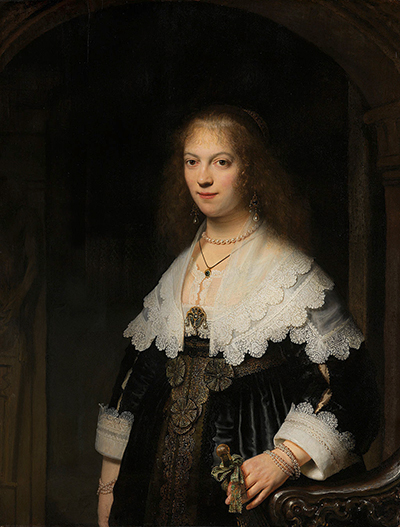
Rembrandt's portrait traditionally known as Portrait of Maria Trip is one of his most brilliant images of Amsterdam wealth. The Rijksmuseum's current title is more careful: Portrait of a Woman, Probably Maria Trip (1619-1683). That caution matters. The painting has long been connected with Maria Trip, but the public title should leave room for the museum's current wording, which treats the identification as likely rather than absolute.
Painted in 1639, the portrait shows a young woman richly dressed in black, lace, pearls, earrings, a brooch and a rare folding fan. It is not a full-length performance like Rembrandt's portraits of Marten Soolmans and Oopjen Coppit, but it speaks the same language of costly self-presentation. The sitter appears half-length, turned to the left, with her left arm resting on a stair rail and a fan in her hand. Rembrandt makes her jewellery, lace and accessories into a social announcement, yet he keeps the person from disappearing inside the display.
Contents
- Introduction
- What the Painting Is
- Who Was Maria Trip?
- Lace, Pearls and a Rare Fan
- Rembrandt's Amsterdam Portrait Practice
- The Problem of the Name
- A Related Drawing
- How to Look at the Portrait
- Why the Portrait Matters
What the Painting Is
The Rijksmuseum identifies the painting as a 1639 work by Rembrandt van Rijn. Its object number is SK-C-597. It is an oil painting on panel, measuring 107 cm high by 82 cm wide, and the museum records the signature and date as Rembrandt f. 1639. The current Rijksmuseum record places it on display in room 2.8 and gives the credit line as a loan from the Familie Van Weede Stichting.
Those facts are important because the painting's traditional short title can make it sound simpler than it is. The object is not merely a portrait with a name attached. It is a signed and dated Rembrandt portrait from the late 1630s, preserved in a major Dutch museum, with a sitter identification that should be handled carefully.
The Rijksmuseum's identification data includes title variants such as Portrait of a woman, possibly Maria Trip and Portrait of a Woman, Probably Maria Trip (1619-1683). The older and shorter name, Portrait of Maria Trip, remains useful for readers because it is the familiar search title, but the painting is best introduced with the museum's caution in view.
Who Was Maria Trip?
The Rijksmuseum says the sitter is likely the 20-year-old Maria Trip. It describes her as coming from an extremely wealthy family involved in the arms trade. Its fuller object description identifies Maria Trip as the sister of Jacobus Trip and later the wife of Balthasar Coymans.
That is enough to place the portrait in a very specific world. Maria Trip belonged to the Dutch Republic's upper mercantile elite, where family wealth, marriage prospects, imported goods and household display could all become visible in portraiture. The painting does not need a coat of arms or an elaborate interior to say this. The clues are carried by clothing, jewels, lace, pearls and the fan.
The Trip family context also matters for Rembrandt's portrait practice. By the late 1630s he had become a leading Amsterdam painter for patrons who wanted more than a plain likeness. He could make sitters look socially legible: wealthy, fashionable, controlled and alive. In this portrait, the sitter's identity is attached to the Trip name with caution, but the social register is unmistakable.
Lace, Pearls and a Rare Fan
The portrait's most visible language is dress. The Rijksmuseum describes the sitter as wearing a collar of the finest lace, a brooch with matching earrings and a fortune in pearls. These details are not decorative filler. They are the painting's statement about wealth.
Black clothing can mislead modern viewers. It may look restrained at first, even severe, but in seventeenth-century elite portraiture black fabric could be expensive and highly fashionable. Rembrandt uses the dark dress as a stage for light. The pale lace collar rises around the face. The pearls catch attention across the neck and bodice. The earrings and brooch add smaller points of glitter and finish.
The fan is especially important. The Rijksmuseum notes that the Chinese folding fan in the sitter's left hand was still rare and precious in 1639. Its story page adds that the fan ribbon was laced with pure gold. This is a small detail with large social force. It places the sitter in a world of costly imported objects and fashionable display.
Rembrandt gives these materials different kinds of life. Lace is delicate and light-catching. Pearls glow in small repeated units. The fan is both object and gesture. The stair rail gives the left arm a place to rest, making the pose feel arranged but not frozen. The portrait's luxury is clear, but it is also carefully organized.
Rembrandt's Amsterdam Portrait Practice
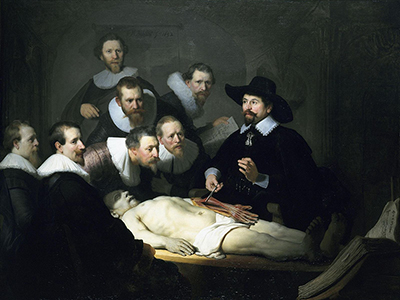
By 1639, Rembrandt had already proved himself in Amsterdam portraiture. The 1632 Anatomy Lesson of Dr Nicolaes Tulp had shown that he could turn a group portrait into an event. The 1634 portraits of Marten Soolmans and Oopjen Coppit had shown that he could handle elite display on a spectacular full-length scale. The Maria Trip portrait belongs to the same broader achievement, though it uses a more compact format.
This painting is not as physically imposing as the Marten and Oopjen portraits. It does not show the sitter from head to toe, and it does not depend on a matching pendant structure in the same way. Its ambition is concentrated. Rembrandt uses the half-length format to bring the viewer close to the face, collar, jewels and hand.
The comparison with Oopjen Coppit is useful because both portraits show wealthy young women in black dress, lace and expensive accessories. But the mood is different. Oopjen stands in monumental, full-length dignity. The woman probably Maria Trip is nearer, more compressed and more immediately focused around the upper body. Her wealth is still on display, but the painting asks us to look at the relationship between face, adornment and hand rather than at the full social architecture of the body.
Rembrandt's strength lies in making that display feel inhabited. He does not strip away status to find the sitter. He works through status: through clothing, jewellery and the polished code of appearance. The portrait is a social document because it shows how a young elite woman could be presented to the world. It is a work of art because Rembrandt turns that presentation into a living arrangement of light, surface and gaze.
The Problem of the Name
The title issue should not be treated as a nuisance. It is part of how responsible looking works. A portrait can be famous under a familiar name while a museum uses more cautious wording. In this case, the Rijksmuseum's title tells readers to hold two thoughts together: the painting is associated with Maria Trip, and the identification is not presented as beyond doubt.
That caution does not weaken the page. It makes the portrait more interesting. Seventeenth-century portraits often reached modern viewers through family tradition, collection history, inventories, old catalogues and later scholarship. Names can become firmer, softer or more complicated as evidence is reviewed.
The National Gallery, London, in its catalogue discussion of Trip family portraits, notes Rembrandt's earlier contact with the Trip family and refers to the portrait of Maria Trip as signed and dated 1639, on loan to the Rijksmuseum from the van Weede Family Foundation. That kind of contextual evidence supports the traditional association, but it still sits beside the Rijksmuseum's current public caution.
For readers, the best practice is simple: call the painting Portrait of Maria Trip when using the familiar title, but remember that the current museum title is Portrait of a Woman, Probably Maria Trip. The sitter is probably Maria Trip, not a nameless emblem of luxury and not a securely identified figure beyond all qualification.
A Related Drawing
There is also a related study in the British Museum. The museum describes it as a study for the portrait of Maria Trip, made by Rembrandt around 1639 in pen and brown iron-gall ink, with brown wash and white heightening. Its museum number is 1891,0713.9.
The drawing is useful because it shows that the painted portrait was not only a matter of surface finish. Rembrandt worked out pose, costume and presentation in another medium. The British Museum notes that the drawing relates to the painted portrait now on loan to the Rijksmuseum and that there are differences between the study and the finished painting, including details of collar, cuffs, rosettes and head angle.
Those differences are important. They remind us that a portrait could be adjusted as it moved from study to panel. The final painting's elegant display was made through choices, not simply copied from a fixed arrangement. Rembrandt could refine the collar, adjust the sitter's angle and intensify the costume language as he moved toward the finished image.
The drawing also connects this page with Rembrandt's wider practice across media. He was not only a painter of finished portraits. He was a draughtsman who could use line, wash and heightening to explore a sitter's pose before translating it into oil.
How to Look at the Portrait
Begin with the title, because it shapes the whole encounter. You are looking at a portrait probably of Maria Trip, painted by Rembrandt in 1639. The name is important, but the caution is important too.
Then look at the face and collar together. The lace collar does not merely frame the head; it amplifies it. Its pale, intricate surface catches the light and sets off the sitter's skin. The portrait makes social display and bodily presence inseparable.
Move next to the jewellery. The pearls, brooch and earrings tell us about money, taste and family position. They also give the surface rhythm. Rembrandt lets small highlights guide the eye across the upper body without turning the portrait into a jewellery inventory.
After that, look at the left hand and fan. The hand rests near the stair rail, holding an object that was rare and precious in 1639. The fan is a sign of access to expensive goods, but it is also a compositional anchor. It gives the lower part of the portrait a point of interest and keeps the sitter's body from becoming a static column of black.
Finally, compare the painting mentally with Rembrandt's other portraits of Amsterdam elites. Jan Six, Marten Soolmans and Oopjen Coppit all show different ways of making status visible. The Maria Trip portrait is quieter in scale than the Soolmans-Coppit pair and less informal than Jan Six, but it belongs to the same world of portraiture as social performance.
Why the Portrait Matters
Portrait of Maria Trip matters because it shows Rembrandt working at the intersection of likeness, luxury and urban status. The painting is not a moral lesson about wealth, and it is not a private confession. It is a portrait of a probable sitter from a very rich family, made by a painter who understood how social identity could be built through visible things.
The lace, pearls, brooch, earrings and fan are central to the portrait's meaning. They show that Rembrandt could paint luxury without letting luxury flatten the person. The sitter appears through her display rather than behind it.
The painting also helps connect Rembrandt's portrait practice across the 1630s and 1650s. Beside Marten Soolmans and Oopjen Coppit, it shows the language of elite dress and expensive accessories. Beside Jan Six, it shows another kind of Amsterdam presence, less mobile and conversational, more carefully staged around objects of wealth.
Most of all, the portrait rewards careful wording and careful looking. The sitter is probably Maria Trip. The wealth is unmistakable. The painting is signed and dated 1639. Between those firm and cautious facts, Rembrandt creates a compelling image of a young woman whose name, family world and material splendour still shape how the portrait is seen.
Frequently Asked Questions About Portrait of Maria Trip
The Rijksmuseum's current title is Portrait of a Woman, Probably Maria Trip (1619-1683), and it also uses a possibly Maria Trip title variant. The safest wording is that the sitter is probably or possibly Maria Trip.
It is an oil painting on panel. The Rijksmuseum records its dimensions as 107 cm high by 82 cm wide.
The painting is in the Rijksmuseum, Amsterdam, on loan from the Familie Van Weede Stichting. The current Rijksmuseum record places it on display in room 2.8.
They are signs of wealth and status. The Rijksmuseum notes the sitter's fine lace, brooch, matching earrings, pearls and rare Chinese folding fan. Its story page adds that the fan ribbon was laced with pure gold.
It belongs to Rembrandt's Amsterdam portrait practice in the late 1630s, when he was painting wealthy sitters with great attention to dress, gesture, surface and social presence.
Discussion
What feels most important in Portrait of Maria Trip: Rembrandt's light, the figure's expression, the material surface, the historical source, or the way the work sits beside his other paintings and prints?
Reader Insights
Begin with one detail in Portrait of Maria Trip, then move outward to light, gesture, surface and the surrounding space.
Connect the work to Rembrandt's biography, workshop, medium and the museum record rather than reading it as an isolated image.
Which detail changes the interpretation most once you know the date, subject, attribution history or present collection?
Join the Conversation
Have a thought or observation about Portrait of Maria Trip? Share it below. Thoughtful responses may be added to this section as the Rembrandt pages develop.
References
- Rijksmuseum, Portrait of a Woman, Probably Maria Trip (1619-1683), object SK-C-597: https://www.rijksmuseum.nl/en/collection/object/Portrait-of-a-Woman%2C-Probably-Maria-Trip-%281619-1683%29--6f7272f48fb3fbb02ceecf7aa897f1a7
- Rijksmuseum, Portrait of a Woman, Possibly Maria Trip: https://www.rijksmuseum.nl/en/stories/themes/rembrandt/story/portrait-woman-maria-trip
- British Museum, A study for the portrait of Maria Trip, museum number 1891,0713.9: https://www.britishmuseum.org/collection/object/P_1891-0713-9
- National Gallery, London, catalogue entry for Portrait of Jacob Trip: https://www.nationalgallery.org.uk/paintings/catalogues/maclaren-and-brown-1991/portrait-of-jacob-trip
- Rijksmuseum, Rembrandt collection set: https://www.rijksmuseum.nl/en/collection/set/Rembrandt--98fe3b7b-608d-4366-3514-08dd024ac890
 Rembrandt.jpg)