

 by Tom Gurney
Tom Gurney BSc (Hons) is an art history expert with over 20 years experience
Published on June 19, 2020 / Updated on August 9, 2026
Email: tomgurney1@gmail.com / Phone: +44 7429 011000
Rembrandt Prints: Introduction
Rembrandt's prints changed how his art moved through the world. A painting could remain with one owner, in one room, for years. A print could travel. It could be bought, exchanged, studied, pasted into an album, compared with another impression and carried far beyond Amsterdam. For many seventeenth-century viewers and later collectors, Rembrandt was not only a painter of faces, biblical scenes and dramatic light. He was a maker of printed sheets.
This matters because a Rembrandt print is not a black-and-white copy of a painting. It is an original work made through a plate, ink, paper and pressure. Many of his most important prints have no painted equivalent. Others take subjects he explored in paint or drawing and rethink them through line, tone and the physical act of printing.
The word prints is broader than etchings. Rembrandt is famous above all as an etcher, and the guide to Rembrandt's etchings explains the technique in greater depth. This article takes the wider view: what prints are, how impressions differ, why states and papers matter, how collectors understood them, and why works such as The Hundred Guilder Print, The Three Trees and Christ Presented to the People remain central to Rembrandt's reputation.
Contents
- Introduction
- What Counts as a Rembrandt Print?
- Why Prints Made Rembrandt Famous
- Plate, State, Impression and Sheet
- Paper, Plate Tone and the Look of an Impression
- The Major Print Examples
- Prints, Copies and Later Reprints
- Collectors, Catalogues and Value
- How Prints Connect to Paintings and Drawings
- How to Look at a Rembrandt Print
What Counts as a Rembrandt Print?
A print begins with a matrix, usually a plate in Rembrandt's case. The artist works the plate, the plate is inked and wiped, damp paper is pressed against it, and an impression is pulled. The printed sheet is the object a museum or collector holds.
Most original Rembrandt prints are etchings, often combined with drypoint and sometimes with engraving or burin work. In etching, acid bites the lines into a prepared metal plate. In drypoint, the artist scratches directly into the copper; the raised burr along the line can hold ink and print as a soft, rich dark. Engraving or burin work cuts a cleaner line into the plate. Museum records for major Rembrandt prints often name these techniques together because Rembrandt mixed them to get different visual effects.
That is why print language has to be precise. The plate is the worked metal surface. A state is a stage in that plate's development. An impression is one individual sheet printed from the plate. The sheet has its own paper, condition, dimensions, ink character and collecting history. A print may be famous as an image, but every surviving impression is also a particular object.
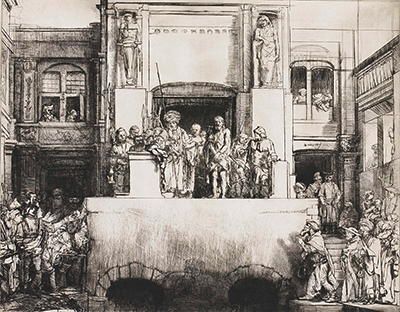
The same title can therefore cover more than one kind of evidence. The Met's second-state impression of Christ Presented to the People, the Rijksmuseum's third-state impression and the Met's eighth-state impression belong to one plate history, but they are not interchangeable. The title gathers them. The object records distinguish them.
Why Prints Made Rembrandt Famous
Prints helped Rembrandt reach an audience that paintings could not. Paintings were costly, relatively immobile and usually tied to a patron, collector or household. Printed sheets were more portable. They could circulate through dealers, collectors, albums and artistic networks. They could be seen by people who would never stand in front of a specific painting in Amsterdam.
Museum Boijmans Van Beuningen is especially useful on this point because its Rembrandt print holdings include landscapes, portraits, self-portraits, biblical scenes and classical subjects. Its collection account stresses that prints helped spread Rembrandt's fame during his lifetime because they reached a larger and wider audience than paintings or drawings. That statement should not make the prints seem merely popularizing. Their circulation was part of their power.
The Museum Rembrandthuis also helps place prints inside Rembrandt's working world. Its collection includes etchings, etching plates and drawings, and its science portal points to major print catalogues and research. The house context is a reminder that printmaking was not detached from the studio. Plates, paper, pupils, buyers, collectors and experiments belonged to the same creative economy as paintings and drawings.
Prints made Rembrandt visible in another way too: through self-fashioning. His etched self-portraits allowed his face, costumes, expressions and artistic persona to travel as repeatable images. A painted self-portrait might be rare and fixed. An etched self-portrait could appear in many collections and make Rembrandt's image part of the market for his art.
Plate, State, Impression and Sheet
The most important printmaking words are simple, but they change how the work is seen.
The plate is the copper surface that received the design. It could be etched with acid, scratched with drypoint, strengthened with burin work, reworked, worn down, cut up or printed long after the first impressions were made. The plate is not visible in most museum displays, yet it is the hidden physical source of the image.
A state is a stage of the plate. If Rembrandt altered the plate in a visible way, impressions pulled after that change belong to a different state. Christ Presented to the People is a strong example because major museum records identify several states. State history shows that the work was not frozen at the first act of invention. Rembrandt could return to the copper and rethink the image.
An impression is an individual sheet printed from the plate. Two impressions from the same state may still differ. One may be warmer because it was printed on Japanese paper. Another may be sharper on laid paper. One may show rich drypoint burr; another may show a plate after more wear. One may have more plate tone because of the way the surface was wiped before printing.
The sheet is the physical paper object. It can be trimmed, mounted, stained, repaired, marked by a watermark or preserved in a particular collection. Measurements in museum records often describe the plate, image or sheet, so small differences between records are not necessarily contradictions. They often mean that each institution is describing its own object.
For readers, this is liberating rather than fussy. It means a Rembrandt print is not one fixed picture repeated without change. It is an image with a material life.
Paper, Plate Tone and the Look of an Impression
Paper is part of the meaning of many Rembrandt prints. Japanese paper appears in records for major impressions of The Hundred Guilder Print and Christ Presented to the People. It can give a sheet warmth, softness and absorbency. Laid paper, with its visible structure from the papermaking process, appears in other records, including impressions of The Three Trees.
Watermarks can also matter. The National Gallery of Art records a Strasbourg lily watermark on its impression of The Three Trees. CODART's account of the WIRE project and the Journal of Historians of Netherlandish Art study on watermark decision trees show why such details are important. Watermarks and related paper evidence can help scholars compare sheets, identify paper relationships, date impressions, narrow the timing of changes to a plate and distinguish lifetime from later impressions.
Plate tone is another key idea. It is ink left on the surface of the plate after wiping. Instead of printing only from the lines, the sheet may carry a thin film of tone that changes atmosphere, warmth and shadow. In The Three Trees, the Rijksmuseum records light plate tone, a detail that helps explain the print's weather and air. In Christ Presented to the People, plate tone can affect the emotional weight of the civic space around Christ and the crowd.
These details do not replace subject matter. They deepen it. A biblical scene printed on Japanese paper may feel different from one on another support. A landscape with plate tone may feel stormier or more atmospheric than a cleaner impression. Rembrandt's art lives in the choices that connect image, plate, ink and paper.
The Major Print Examples
The Hundred Guilder Print is one of Rembrandt's most celebrated works on paper. Also known as Christ Healing the Sick, it gathers several Gospel moments around Christ: healing, teaching, children brought forward, questioners and the rich young man. The Met records its impression as etching, engraving and drypoint, second state of two. The Rijksmuseum records an impression on Japanese paper. The Art Institute of Chicago holds a CC0 impression on tan Japanese paper, and the British Museum first-state route helps explain earlier plate history. The famous title points to value and collecting memory, but the work's force comes from the way Rembrandt made mercy, poverty, wealth and spiritual attention visible through printed line.
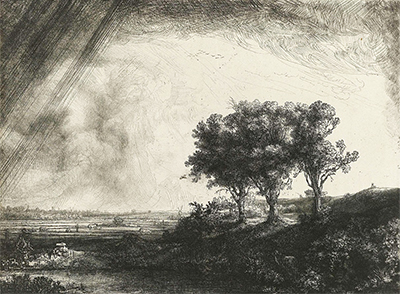
The Three Trees shows another side of Rembrandt's printmaking. It is a landscape from 1643, described by the Rijksmuseum as etching, drypoint and burin with light plate tone. The Met, Art Institute of Chicago and National Gallery of Art records add further impressions and paper details. The subject is not a famous event but weather itself: storm, rain, clearing light, open land and three dark trees holding the scene together. It shows how a printed sheet can create atmosphere without color.
Christ Presented to the People, or Ecce Homo, is one of Rembrandt's great drypoints. The Met records a second-state impression on Japanese paper, the Rijksmuseum records a third-state impression with plate tone on Japanese paper, and the Met also records an eighth-state impression. The work is important because it makes state history visible to ordinary looking. The subject is Christ displayed before the crowd, but the plate's changes also ask the viewer to watch an image becoming and changing over time.
These three works sit naturally beside the etchings guide. They also justify a wider prints article because each carries more than technique. The Hundred Guilder Print opens questions of value and reputation. The Three Trees opens landscape and atmosphere. Christ Presented to the People opens state comparison, drypoint scale and public judgement.
Prints, Copies and Later Reprints
Not every printed image associated with Rembrandt has the same status. This is one of the most important cautions in studying his prints.
A lifetime impression is usually understood as an impression printed during Rembrandt's lifetime, though the exact circumstances still need evidence. A posthumous impression was printed after his death, often from a surviving plate. A later reprint may show the plate at a different point in its life. A copy is a new version made by another hand. A reproduction is a later image that repeats or disseminates the design without being an original Rembrandt print.
Boijmans is valuable because it names this range in its holdings: lifetime impressions, posthumous prints, later reprints, copies and reproductions. That breadth can teach readers how Rembrandt's printmaking survived, spread and was imitated. It also prevents a lazy habit of treating every old-looking Rembrandt-related print as the same kind of object.
Copies and reproductions are not useless. They can show how popular an image became, how it entered teaching collections, how later artists learned from it and how collectors built Rembrandt albums. But they do not carry the same evidence as an impression from a plate worked by Rembrandt. A good print record tells the viewer which kind of encounter is taking place.
Collectors, Catalogues and Value
Rembrandt prints have always attracted collectors because they combine artistic intensity with material variety. Collectors compare states, papers, impressions, burr, tone, margins, condition, provenance and rarity. The same title can lead to several very different sheets, and those differences can affect both scholarship and value.
The Hundred Guilder Print makes this obvious because its traditional title points to price and reputation. The name should be used carefully, but it reminds us that Rembrandt's prints were prized objects, not casual studio leftovers. A print could be small enough to hold and still famous enough to become legendary.
Catalogues bring order to this complexity. Bartsch, Hollstein, White and Boon, New Hollstein, Erik Hinterding and Jaco Rutgers all belong to the scholarly tradition around Rembrandt's prints. Museum records often cite these systems when naming states or identifying impressions. Catalogue numbers may look dry at first glance, but they help protect the viewer from vague claims.
Collectors also shaped how prints were seen. Albums, sales, old titles, rare states and unusual papers all influenced reception. A museum sheet today may carry that history in its provenance and description. The print is therefore both Rembrandt's work and a record of later looking.
How Prints Connect to Paintings and Drawings
Rembrandt did not think in isolated boxes. A subject could move across painting, drawing and print, but each medium changed the result.
Drawings help explain the liveliness of his etched line. A quick pose, a rough face, a bank of cloud or a small landscape structure could be studied on paper and then reimagined through a plate. Etching offered a way to combine drawing-like freedom with repeatable impressions.
Paintings help explain his interest in light, but prints show that he did not need color or thick paint to create drama. In a print, light can be the untouched paper. Darkness can be bitten line, drypoint burr, engraving, plate tone or dense reworking. The result is not a lesser painting. It is a different kind of invention.
Portraits show the connection especially clearly. Rembrandt's painted portrait of Jan Six belongs to one history, while his etched Jan Six belongs to another. The etched portrait is not a substitute for the painting; it shows how identity, status and artistic intimacy could be carried by printed line.
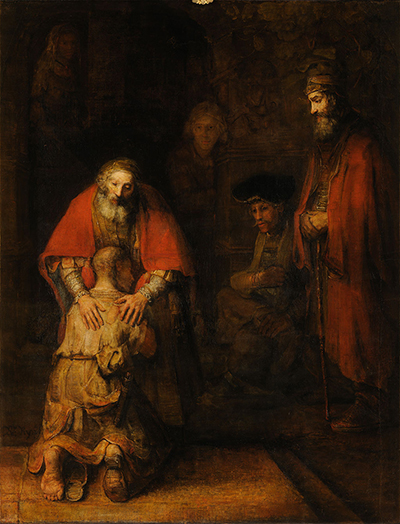
Biblical subjects also move across media. The Hundred Guilder Print, Christ Presented to the People and other religious prints belong near paintings such as The Return of the Prodigal Son or The Raising of Lazarus, but they solve spiritual drama with different means: crowding, open paper, line, state, pressure and the rhythm of black ink.
How to Look at a Rembrandt Print
Start with the title, but do not stop there. Ask which impression you are seeing. A museum record will often tell you the state, paper, plate size, sheet size, technique and collection history.
Look at the medium line. Does it say etching, drypoint, engraving, burin or a combination? If drypoint is named, look for rich dark passages where burr may have held ink. If plate tone is named, look for atmosphere that seems to come from ink on the plate surface rather than only from lines.
Read the state information. A second state of two and a third state of eight are not decorative labels. They place the sheet inside the plate's history. When another museum holds a different state, compare it carefully rather than treating it as another photograph of the same object.
Notice the paper. Japanese paper, laid paper and watermarks can change appearance and evidence. Paper may affect warmth, softness, dating and relationships between impressions.
Finally, look for what Rembrandt leaves open. In prints, the untouched sheet can become light, air, silence or distance. Some of Rembrandt's greatest printed effects come from what he decided not to mark.
Frequently Asked Questions About Rembrandt Prints
The Hundred Guilder Print is often treated as Rembrandt's most famous print. The Three Trees and Christ Presented to the People are also among his most important works on paper.
An impression is an individual printed sheet pulled from a plate. Impressions from the same plate can differ because of state, paper, inking, wiping, plate tone, wear, trimming and condition.
A state is a stage in the plate's development. If Rembrandt or a later hand changed the plate in visible ways, impressions printed after that change may belong to a new state.
Yes. Major museum records identify important Rembrandt impressions on Japanese paper, including examples of The Hundred Guilder Print and Christ Presented to the People. The paper can affect warmth, softness and surface character.
Not necessarily. A later impression may not carry the same evidence as a lifetime impression with fresh plate work, but it can still teach us about the plate's afterlife, collecting history, later taste and the survival of Rembrandt's images.
Selected Rembrandt Prints
 Rembrandt.jpg)
Discussion
What is the best way into Rembrandt Prints: materials, workshop practice, subject matter, collecting history, or comparison with one closely studied work?
Reader Insights
Use Rembrandt Prints to notice how Rembrandt changed his effects when the medium changed.
Set one famous work beside a quieter example and ask whether the same habits of light, touch and observation remain visible.
Which technical choice makes the page feel most alive: line, paint handling, paper, surface, revision or light?
Join the Conversation
Have a thought or observation about Rembrandt Prints? Share it below. Thoughtful responses may be added to this section as the Rembrandt pages develop.
References
- Museum Rembrandthuis, collection overview: https://www.rembrandthuis.nl/en/find-out-more/collection/
- Museum Rembrandthuis, science portal: https://www.rembrandthuis.nl/en/find-out-more/science-portal/
- Museum Boijmans Van Beuningen, Rembrandt etchings from the museum's collection: https://www.boijmans.nl/en/collection/research/rembrandt-etchings-from-the-museum-s-collection
- Rijksmuseum, The Hundred Guilder Print, object RP-P-OB-602: https://www.rijksmuseum.nl/en/collection/RP-P-OB-602
- The Metropolitan Museum of Art, The Hundred Guilder Print, object 29.107.35: https://www.metmuseum.org/art/collection/search/371732
- British Museum, The Hundred Guilder print, museum no. F,4.154: https://www.britishmuseum.org/collection/object/P_F-4-154
- Art Institute of Chicago, The Hundred Guilder Print, reference no. 1924.617: https://www.artic.edu/artworks/13094/the-hundred-guilder-print
- Rijksmuseum, The Three Trees, object RP-P-OB-444: https://www.rijksmuseum.nl/en/collection/object/De%2Bdrie%2Bbomen--4c0c780d82c4055bfd186ad2c117239e
- The Metropolitan Museum of Art, The Three Trees, object 29.107.31: https://www.metmuseum.org/art/collection/search/354633
- National Gallery of Art, The Three Trees, accession 1955.6.10: https://www.nga.gov/artworks/43418-three-trees
- Art Institute of Chicago, The Three Trees, reference no. 1938.1811: https://www.artic.edu/artworks/29271/the-three-trees
- Rijksmuseum, Christ Presented to the People (Ecce Homo), object RP-P-1975-1: https://www.rijksmuseum.nl/en/collection/object/Christ-Presented-to-the-People-Ecce-Homo--cb3a54189cf597446fe26248d57bb9d2
- The Metropolitan Museum of Art, Christ Presented to the People, second state, object 41.1.34: https://www.metmuseum.org/art/collection/search/343142
- The Metropolitan Museum of Art, Christ Presented to the People, eighth state, object 41.1.36: https://www.metmuseum.org/art/collection/search/356476
- CODART, The Watermark Identification in Rembrandt's Etchings (WIRE) Project: https://www.codart.nl/feature/curators-project/the-watermark-identification-in-rembrandts-etchings-wire-project/
- Journal of Historians of Netherlandish Art, Decision Trees for Watermark Identification in Rembrandt's Etchings: https://jhna.org/articles/decision-trees-for-watermark-identification-in-rembrandts-etchings/
- Frick Collection, The WIRE Project at Cornell: https://www.frick.org/interact/wire_project_cornell
- Art Institute of Chicago, Self-Portrait Etching at a Window: https://www.artic.edu/artworks/181616/self-portrait-etching-at-a-window