

 Rembrandt.jpg)
 by Tom Gurney
Tom Gurney BSc (Hons) is an art history expert with over 20 years experience
Published on June 19, 2020 / Updated on August 9, 2026
Email: tomgurney1@gmail.com / Phone: +44 7429 011000
The Hundred Guilder Print: Introduction
The Hundred Guilder Print is one of Rembrandt's most famous works on paper. It is also one of the easiest to misunderstand if it is treated like a single painting with one fixed surface. The work is a print: a composition made on a copper plate and known through surviving impressions, states, papers, inks and collection histories. One museum sheet can tell us a great deal, but it is not the whole work by itself.
The print is often called The Hundred Guilder Print because of its celebrated value in the early collecting world. It is also known as Christ Healing the Sick, a title that points more directly to the subject. Both names are useful, but neither is complete. The famous market title records the print's reputation. The subject title helps the viewer find Christ among the sick, the poor, the questioning, the watchful and the devout.
Rembrandt made the work around 1648. Major museum records describe it through a mixed intaglio technique: etching, drypoint and engraving or burin work. The Met records its impression as the second state of two, with a plate size of 28 x 39.3 cm. The Rijksmuseum records its impression as c. 1648, etching, drypoint and engraving on Japanese paper, 280 x 394 mm. The Art Institute of Chicago holds an impression on tan Japanese paper. The British Museum preserves important first-state evidence. These records are not competing versions of a simple fact. They show how carefully this print has to be described.
What makes The Hundred Guilder Print extraordinary is that all this material precision serves a deeply human scene. Christ stands at the centre of a crowd, not as a distant emblem but as a living focus. Around him are the sick and poor, a child brought forward, elders and questioners, figures in shadow, and a young man whose wealth separates him from the spiritual demand of the moment. The print gathers several Gospel ideas into one visual field. It is not just an illustration of one sentence. It is a meditation on what it means to come near Christ.
Contents
- Introduction
- Why the Title Matters
- A Print Known Through Impressions
- What the Subject Shows
- Christ at the Centre
- Reading the Crowd
- How Rembrandt Made the Print
- Etching, Drypoint and Engraving
- State, Paper and Impression
- Value, Rarity and Reputation
Annotated Details from The Hundred Guilder Print
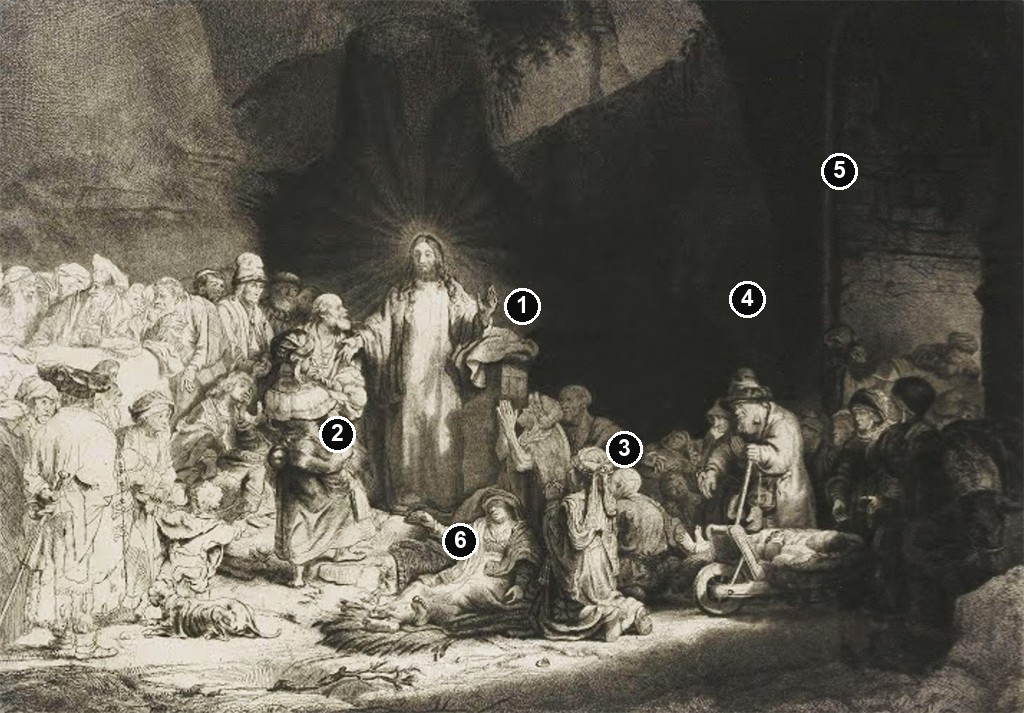
These annotated details follow the print's crowded Gospel world, where healing, teaching, wealth, poverty and dispute are compressed into one extraordinary etching.
Details from THE HUNDRED GUILDER PRINT
Close looking shows how Rembrandt uses line, light and grouping to combine several Gospel moments in one print.
Christ at the centre
Christ anchors the print without overwhelming it. Light and attention gather around him as different groups approach.
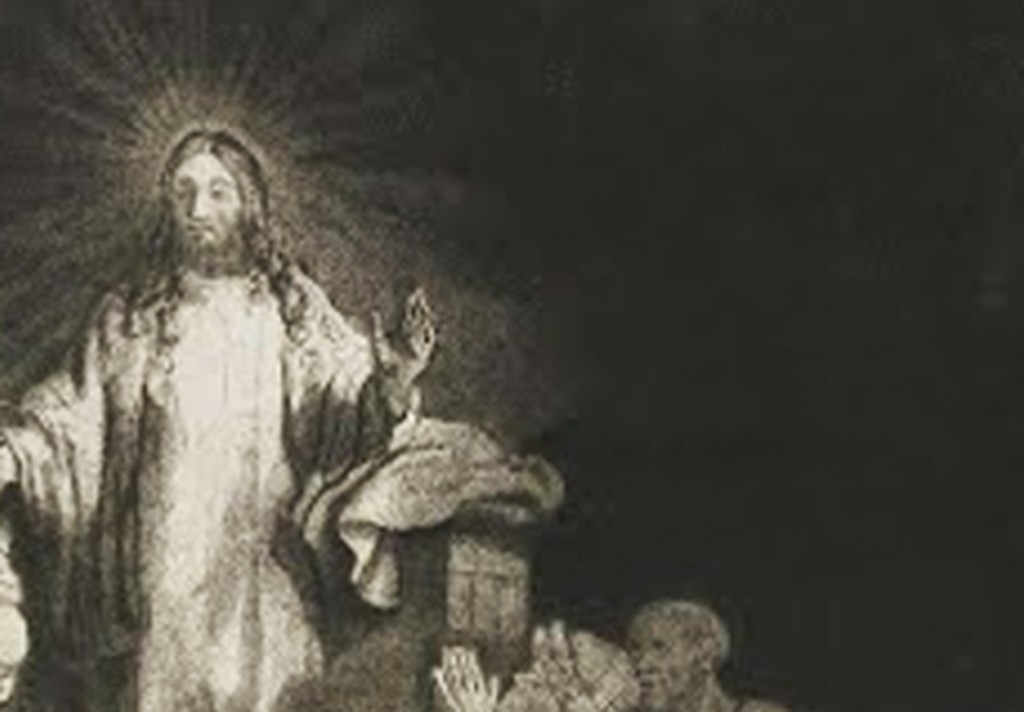
The sick and poor
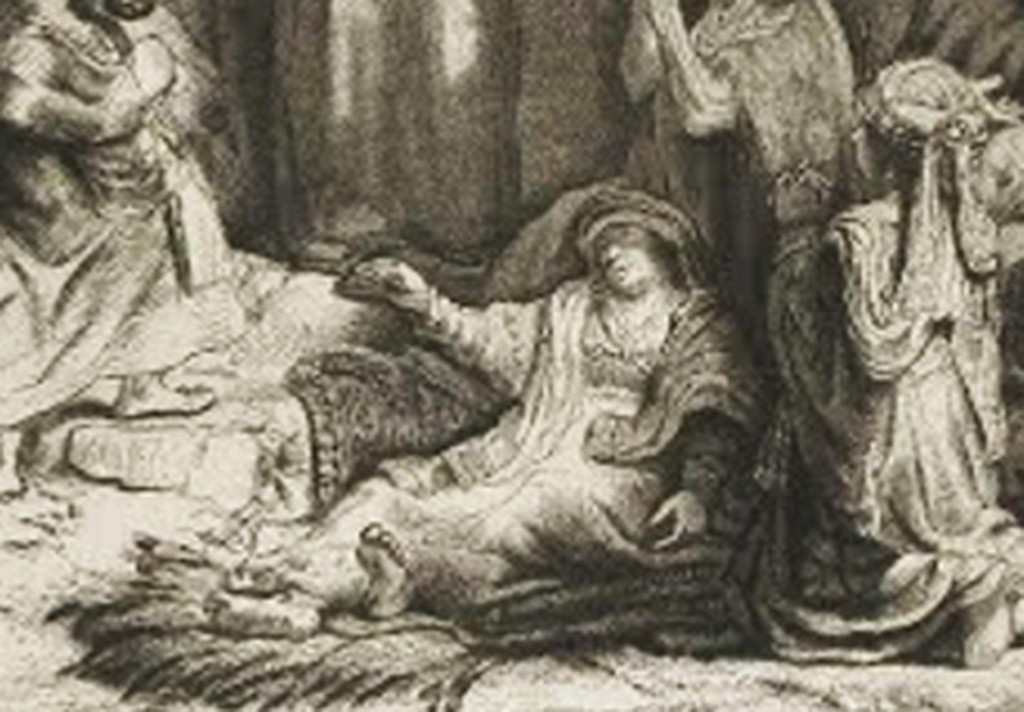
The figures seeking help give the print its human urgency. Rembrandt makes need visible through varied bodies and postures.
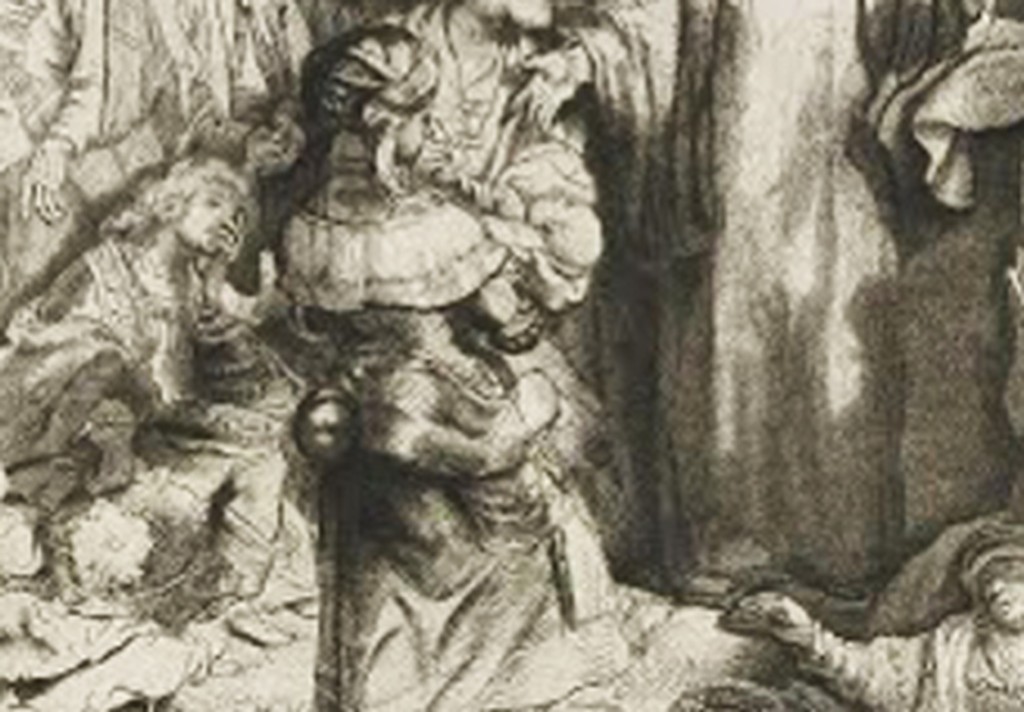
Children and approach
Children and followers complicate the scene. The print is about who may approach Christ and under what terms.
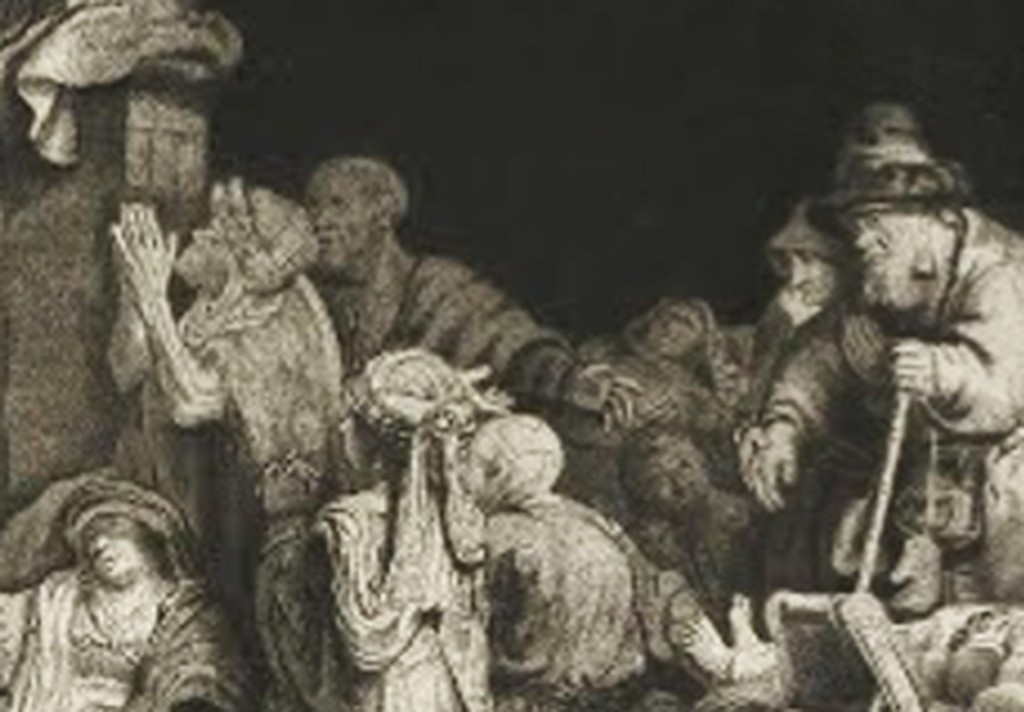
Questioners and dispute
The right-side figures bring argument and testing into the image. Compassion is balanced by debate.
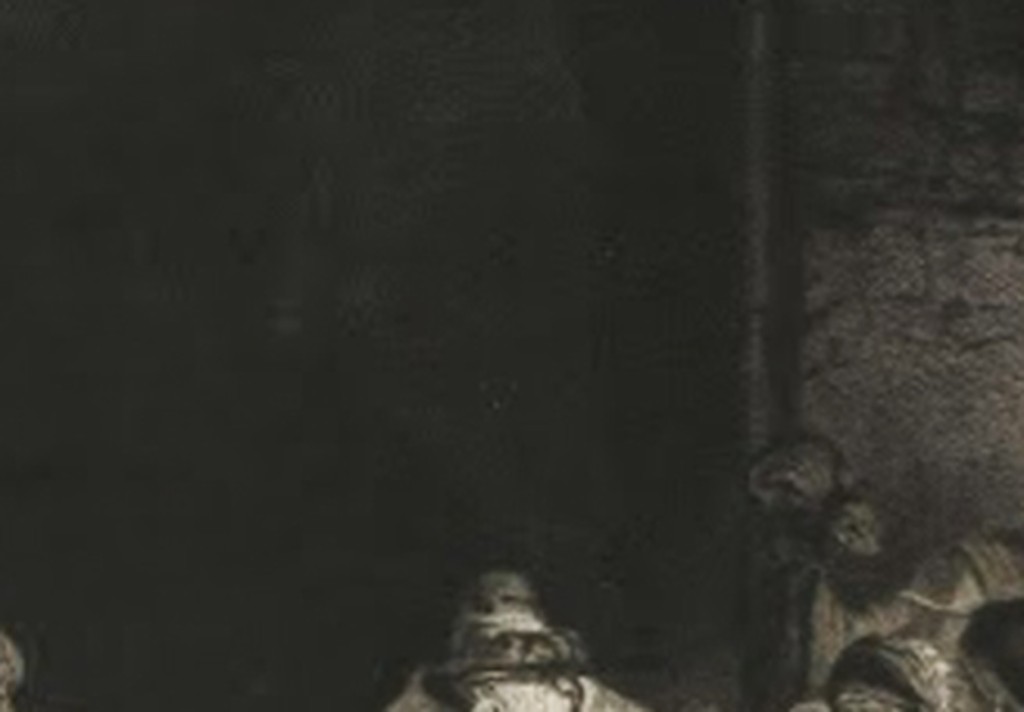
Architecture and shadow
Architecture frames the scene and deepens the tonal contrast. Etched darkness helps organize the crowded space.
Line, wiping and tone
Fine line and plate tone make impressions of the print feel alive. The surface is not neutral reproduction; it is part of the meaning.
Why the Title Matters
The title The Hundred Guilder Print is part of the work's fame. A guilder was a Dutch currency unit, and the name points to the print's exceptional value in the seventeenth-century collecting imagination. It suggests that this was not an ordinary sheet passing cheaply through the print market. It was prized, discussed and remembered as something unusually valuable.
That title should still be used because it is the name by which the work is best known. It appears in major museum records and in the history of Rembrandt print collecting. But it needs careful framing. It is not a title that explains the subject in the way The Anatomy Lesson of Dr Nicolaes Tulp or The Three Trees does. It names a reputation.
The subject-based title, Christ Healing the Sick, is clearer but also narrower. Healing is central to the work. The left and lower portions of the scene bring the viewer close to bodies marked by need: the ill, the lame, the poor and those who carry or guide them. Yet the print also includes teaching, blessing, questioning and testing. The subject complex is usually connected with the nineteenth chapter of Matthew, where Christ receives children, heals, answers the Pharisees and confronts the spiritual danger of riches.
This is why the work can also be discussed through longer descriptive titles, including Christ Preaching or Christ Receiving the Children. Those titles are not random alternatives. They arise because Rembrandt joined several related Gospel moments in one composition. The scene is about Christ's power to heal, but also about who is allowed to approach him, who resists him, and what kind of wealth or status becomes an obstacle.
The market title and the subject titles therefore pull in different directions. One remembers value. One remembers mercy. One remembers teaching. The best reading keeps all of them in view. The Hundred Guilder Print is famous partly because it was rare and prized, but its lasting force comes from the way Rembrandt made spiritual attention visible through line, darkness and paper.
A Print Known Through Impressions
The first rule for looking at The Hundred Guilder Print is simple: do not imagine one single object. There was a copper plate. Rembrandt worked that plate. Impressions were printed from it. Surviving sheets differ because they belong to particular states, papers, inking decisions and histories.
A state is a stage in the development of the plate. If visible changes are made to the plate, impressions printed after those changes belong to a new state. The Met records its impression as the second state of two. The British Museum first-state impression is valuable because it helps show the earlier condition of the plate and gives scholars a way to compare later changes.
An impression is an individual printed sheet. Two impressions of the same print may share the same image but still look different. Paper can be warmer or cooler. Ink can be denser or more transparent. Wiping can leave more or less tone on the surface of the plate. Drypoint burr may be fresher or more worn. Edges may be trimmed. Condition, mounting and collecting history can all affect how the sheet appears now.
The Art Institute of Chicago's tan Japanese paper impression is a good reminder of this. Japanese paper can affect the warmth, softness and absorbency of a printed sheet. That does not mean every Hundred Guilder Print looks like that Art Institute impression. It means that the Art Institute impression gives one important example of how the work could live on a particular support.
The Rijksmuseum record also matters for this reason. Its object number, RP-P-OB-602, identifies a particular impression, not the abstract idea of the print. The Met object 29.107.35 is another particular sheet. The British Museum sheet F,4.154 is another. Each museum record gives a way into the work, but none should be used as if it describes every surviving example in every detail.
This precision does not make the print less approachable. It makes it richer. The viewer can ask not only "What is the subject?" but also "Which sheet am I seeing?" A Rembrandt print is an image, an object and a history of decisions.
What the Subject Shows
The Hundred Guilder Print is usually connected with Matthew 19. That chapter brings together several episodes: Christ heals the sick, receives children, is tested by the Pharisees, and speaks to a rich young man about the demands of eternal life. Rembrandt does not place these moments in separate compartments. He brings them into one dense scene around Christ.
At the centre stands Christ, turned toward the crowd with a calm that holds the whole composition together. He is not isolated by architecture or a throne. He is surrounded. People press toward him from one side, observe him from another, question him, need him, and hesitate before him. The crowd is not decorative. It is the meaning of the print.
On the left and lower left, figures associated with sickness and need come forward. Some are close to the ground. Some depend on others. Their bodies make the spiritual claim of the print visible: those who suffer have a place before Christ. Rembrandt does not smooth them into symbols. He lets weight, posture, fatigue and hope remain visible.
Children are also part of the subject. In Matthew, Christ rebukes those who would keep children away, saying that the kingdom of heaven belongs to such as these. Rembrandt's scene includes the tenderness and vulnerability of that episode without turning it into a sentimental vignette. The child is part of a larger movement of approach.
The Pharisees and other questioners belong to the opposite pressure in the scene. They bring argument, status and testing. Their presence matters because Christ is not only healing bodies. He is answering the moral and religious structures around him. The print balances compassion with challenge.
The rich young man appears at the right, often read as the beautifully dressed figure whose presence contrasts with the poverty and need elsewhere. He is important because wealth is not simply an accessory in the print. In Matthew, riches become a spiritual problem when they prevent surrender. Rembrandt sets that problem inside a crowd where poverty, suffering and openness press toward Christ.
The result is not a tidy illustration. It is a theological crowd scene. Healing, blessing, teaching and judgment all happen in the same space. Rembrandt's achievement is to keep that complexity legible without reducing it to a diagram.
Christ at the Centre
Christ is the visual and spiritual centre of The Hundred Guilder Print, but Rembrandt does not make him dominant through grand theatrical display. He stands in light, but the light is delicate. It is the whiteness of paper and the restraint of line as much as any dramatic spotlight.
The surrounding figures help create that focus. Dense passages of line and shadow gather around Christ and make his relative clarity more powerful. In a painting, Rembrandt might build light with layers of pigment. In this print, light comes from what is drawn, what is bitten into the plate, what is scratched directly, what is darkened, and what is left open.
Christ's gesture matters because it joins authority and compassion. He is not passive in the crowd. He receives, addresses and blesses. The bodies around him create different forms of approach: pleading, listening, arguing, carrying, watching, resisting. Christ's stillness is not emptiness. It is the point against which every other motion is measured.
Rembrandt also avoids making the sacred centre too easy. Christ is luminous, but the space around him is crowded and uneven. The viewer has to look through layers of human presence. That is part of the print's moral intelligence. Grace is not separated from difficulty. It is found among bodies, voices and competing claims.
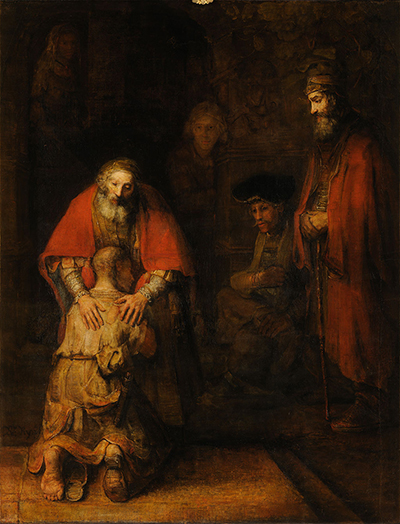
This is one reason The Hundred Guilder Print belongs with Rembrandt's broader biblical art. In paintings such as The Return of the Prodigal Son, spiritual meaning is carried by touch, posture and silence. In The Hundred Guilder Print, the same seriousness is carried by printmaking: pressure, line, contrast, paper and the distribution of bodies around a centre.
The print's power depends on restraint as much as richness. Christ does not need to be over-described. The surrounding darkness, the broken lines and the open paper allow him to remain both visible and mysterious. Rembrandt gives the viewer enough to recognize the scene, then asks the viewer to keep looking.
Reading the Crowd
The crowd in The Hundred Guilder Print is not a background mass. It is a field of spiritual responses.
Some figures approach because they need healing. Their bodies are low, bent or dependent. They bring the physical urgency of the scene into the foreground. Rembrandt's line gives them gravity without turning them into spectacle. The viewer sees need, but also dignity.
Other figures listen. They stand or sit near Christ with the stillness of attention. Their role is quieter, but essential. They make the print a scene of teaching as well as healing. The word of Christ is not visible, yet the arrangement of faces and bodies suggests that speech is taking place.
Some figures question or judge. Their presence prevents the scene from becoming only tender. The Gospel setting includes testing and dispute, and Rembrandt gives that tension a social form. These figures are not simply villains. They represent the pressure of law, status and interpretation.
The rich young man gives the right side of the print a different emotional temperature. Elegance, self-possession and possession itself become part of the drama. His clothing and bearing separate him from the poverty elsewhere, but they do not make him free. The spiritual question is whether he can give up what binds him.
The animals and peripheral figures deepen the everyday world of the print. A biblical scene in Rembrandt often feels close because sacred history enters a recognizably human environment. The setting is not archaeological reconstruction. It is a place where need, argument, fatigue and hope can be felt.
The crowd also creates a rhythm of looking. The eye moves from shadow into light, from groups to individuals, from the poor to the wealthy, from listeners to doubters, from bodies to faces. The print rewards slow viewing because its meaning is distributed. No single figure explains it all.
That is why The Hundred Guilder Print can feel both crowded and unified. Christ holds the centre, but the crowd gives the centre its meaning. The scene asks who comes near, who keeps distance, who understands and who cannot yet let go.
How Rembrandt Made the Print
The Hundred Guilder Print is a masterpiece of mixed printmaking. Major records describe it as etching, drypoint and engraving or burin work. Those terms name different ways of marking a copper plate.
In etching, the plate is covered with an acid-resistant ground. The artist draws through that ground with a needle, exposing the copper. Acid then bites those exposed lines into the plate. The result can preserve the freedom of drawing while creating lines that hold ink for printing.
Drypoint is more direct. The artist scratches into the copper with a hard point. The action raises a fragile ridge of metal called burr. When ink catches in that burr, the printed line can look rich, soft and dark. Burr is delicate and can wear down as impressions are pulled, which is one reason strong early drypoint effects are valued.
Engraving or burin work involves cutting into the plate with a tool that creates a cleaner, more deliberate line. Rembrandt is usually thought of above all as an etcher, but museum records for his major prints often acknowledge combinations of techniques. In The Hundred Guilder Print, the mixture matters because the sheet contains many kinds of line: delicate contours, shadowy clusters, decisive accents and passages of velvety dark.
The Met notes that Rembrandt continued repositioning details after first etching the plate, with visible traces around Christ's eyes, hands and feet. That observation is especially valuable because it counters the illusion of instant perfection. The print was worked and revised. Even the central figure bears evidence of adjustment.
The plate also had a later history. British Museum notes are important for distinguishing Rembrandt's own plate history from later reworking associated with Captain William Baillie, who acquired, reworked and cut the plate in the eighteenth century. That later story belongs to the afterlife of the print, not to the original making of Rembrandt's composition.
The key point is that The Hundred Guilder Print is not only a beautiful religious image. It is a record of decisions made in copper. Its compassion is inseparable from its method.
Etching, Drypoint and Engraving
The mix of etching, drypoint and engraving helps explain the print's visual range.
Etched lines can be fine, quick and descriptive. They give Rembrandt a way to draw through the plate. In a crowd scene, this matters because different bodies require different speeds of description. A head, a shoulder, a hand, a fold of cloth or the outline of an animal can be found with a few lines, then absorbed into a larger field.
Drypoint gives the print another register. It can deepen shadow and soften certain dark passages. Because burr catches ink around the scratched line, drypoint can feel less sharp than etched line and more atmospheric. In a scene about bodily need and spiritual pressure, that richness is not merely decorative. It helps create depth, weight and intensity.
Engraving or burin work can strengthen and clarify. It brings a more cut quality to selected marks. Used with restraint, it can help hold a complicated composition together. The viewer may not separate each technique consciously, but the eye feels the difference between wiry line, soft dark and decisive cut.
Rembrandt's genius lies in making these processes feel natural. The print does not announce itself as a technical exercise. It breathes through technique. The same plate can contain delicacy, density, correction, open paper and deep shadow without losing the human scene.
The open paper is especially important. In a print, light often exists where ink is absent. Christ's presence depends partly on Rembrandt's refusal to overwork him. Surrounding marks create pressure, but the central clarity remains. That is a printmaker's kind of luminosity.
The technique also controls time. Some figures seem to pause in still attention. Others press forward or lean back. Dense line can slow the eye. Open passages can release it. Rembrandt turns the act of looking into a moral experience: the viewer must move through need, argument and hesitation before arriving fully at Christ.
State, Paper and Impression
The state and paper history of The Hundred Guilder Print is not a specialist afterthought. It is central to the work.
The Met identifies its impression as the second state of two. The British Museum first-state impression helps show an earlier stage in the plate's development. These distinctions matter because the plate was changed. A first-state impression and a second-state impression are related, but they are not identical evidence.
Paper matters too. The Rijksmuseum and Art Institute of Chicago records show the work on Japanese paper. Japanese paper was valued for qualities that could change the look of an impression: warmth, softness, surface and absorbency. Such paper can give dark passages a different presence and open passages a different glow.
Inking and wiping also matter. LACMA discusses Rembrandt's experimentation with inking and paper types, and that point helps explain why impressions can vary beyond state alone. The same plate can yield different visual effects depending on how it is inked, wiped and printed. Plate tone, where ink remains on the plate surface, can create warmth or shadow. A cleaner wipe can make the sheet sharper and brighter.
This is why comparisons between impressions can be so rewarding. One sheet may feel more atmospheric. Another may reveal line more clearly. One may preserve richer drypoint effects. Another may show a different paper character. The question is not which one is the real Hundred Guilder Print. The question is what each impression tells us about Rembrandt's plate and the history of its printing.
Museum dimensions should also be read with care. The Met gives a plate size of 28 x 39.3 cm. The Rijksmuseum record gives 280 x 394 mm. The Art Institute sheet is described in relation to the platemark. These measurements align around the same large horizontal print, but each record describes its own sheet or plate information.
For the reader, the practical lesson is straightforward: always read the object record. The title identifies the famous work, but the record tells you which impression you are seeing.
Value, Rarity and Reputation
The Hundred Guilder Print has long been tied to value. That is built into its name. But value should be handled carefully, because a famous price story can easily become legend if it is repeated without evidence.
The safest way to understand the title is as a sign of early collecting reputation. The print was exceptional enough to be remembered through a monetary name. It circulated in a world where Rembrandt's prints were collected, compared and catalogued, and where certain impressions could become prized for state, paper, condition, rarity or beauty.
British Museum material is especially useful because it preserves a route into the print's early value history and later plate history. The 1654 Jan Meyssens letter evidence noted in the research record is important because it helps connect the work's reputation to the seventeenth century rather than only to later romantic storytelling. Even so, public discussion should avoid turning the title into a simplistic anecdote.
The later Baillie episode also shows how famous prints can acquire complicated afterlives. In the eighteenth century, Captain William Baillie acquired the plate, reworked it and cut it into pieces. That act belongs to a later collecting and print market history. It is not part of Rembrandt's original intention, but it shaped the survival and reception of the plate.
Rarity in Rembrandt prints is never just a matter of how many images exist online today. It involves states, impressions, paper, plate wear, later reworking and provenance. An impression can be prized because of its state, its paper, the freshness of drypoint, its condition, or its place in a known collection history.
The title therefore opens a useful door, but it should not be allowed to dominate the work. The print is not great because it was expensive. It was expensive, remembered and collected because it was recognized as extraordinary.
The Plate's Later Life
The later life of the plate helps explain why The Hundred Guilder Print has to be handled with unusual care. A painting can be restored, damaged, moved or reframed, but it usually remains one physical artwork. A print plate can keep producing impressions, can be altered by later hands, and can become part of a collecting story long after the artist is dead.
The British Museum record is especially valuable here because it helps separate Rembrandt's first-state plate from later intervention. In the eighteenth century, Captain William Baillie acquired the plate, reworked it and cut it into sections. Those later sheets belong to the reception and afterlife of the image, but they should not be confused with impressions made from Rembrandt's original work on the plate.
That distinction protects the viewer from a common mistake. The title may remain the same, and the central subject may still be recognizable, but the historical status of a sheet can differ sharply. A lifetime impression, a first-state impression, a second-state impression, a later reworked impression and a fragment from a cut plate do not all carry the same evidence.
The later plate history also shows how deeply collectors valued Rembrandt's printmaking. Baillie's treatment of the plate may now seem severe, but it belongs to a world in which Rembrandt's plates and impressions were active objects in the market. They could be owned, altered, admired, sold and reinterpreted. That history is not a reason to turn away from the work. It is a reason to ask better questions of every sheet.
When a museum record identifies state, paper, object number and later history, it is not burdening the viewer with trivia. It is giving the viewer the means to know what kind of encounter is taking place. The Hundred Guilder Print survives not as a single untouched thing, but as a great image with a complicated material life.
The Print Among Rembrandt's Biblical Works
Rembrandt returned again and again to biblical subjects. He did so in paintings, drawings and prints, and he often approached scripture through human nearness rather than spectacle alone.
The Hundred Guilder Print belongs with that larger habit. It shares with The Return of the Prodigal Son a concern for mercy, touch and spiritual approach. It shares with Rembrandt's many scenes of Christ a desire to make sacred presence feel humanly available. It shares with Christ Presented to the People a deep interest in crowds, judgment and the public body around Christ.
But the print solves those problems in its own medium. A painting can use color, thickness and scale. A drawing can use speed and open line. The Hundred Guilder Print uses the resources of the printed sheet: etched line, drypoint richness, cut accents, paper tone, open reserve and the pressure of many figures in a limited space.
The work also belongs near Rembrandt's printmaking achievements such as The Three Trees and Christ Presented to the People. The Three Trees shows how he could make weather and landscape through line and tone. Christ Presented to the People shows drypoint, plate state and public judgment on a large scale. The Hundred Guilder Print brings similar technical seriousness to a scene of healing and teaching.
It is tempting to call The Hundred Guilder Print painterly, and there is truth in that if the word means richness, atmosphere and depth. But the work should not be valued because it seems to imitate painting. Its greatness is specifically graphic. It makes spiritual drama from the things only a print can do.
That is why it remains central to Rembrandt's reputation. It shows him as a maker who could turn copper, ink and paper into a world of mercy, argument and attention.
How to Look at The Hundred Guilder Print
Begin with the whole composition. Notice that Christ is central, but not isolated. The print is organized around approach: the sick, the poor, the child, the questioners, the listeners and the rich young man all define their relation to him.
Then look at the left side and foreground. These figures give the scene its bodily urgency. They are not ornamental reminders of charity. They are the people for whom healing matters. Their weight and vulnerability anchor the print.
Move toward Christ slowly. Notice how the light changes. The central figure is not made luminous by heavy description. Much of the power comes from restraint and open paper. Rembrandt lets the surrounding density create the radiance.
Look to the right. The well-dressed young man and the more controlled figures around him introduce a different question: what does one bring before Christ, and what must one give up? The spiritual drama is not only physical need. It is also attachment, pride and testing.
Now read the print as an object. Which impression are you seeing? Is it described as first state or second state? What paper is named? Does the record mention Japanese paper, drypoint, engraving, plate size or later history? These details are not distractions. They are part of the artwork's life.
Finally, let the title become two questions rather than one answer. The Hundred Guilder Print asks why the sheet became so valuable. Christ Healing the Sick asks what kind of mercy the image shows. The full work answers both by making value and grace uneasy companions: a prized object whose subject turns attention toward the poor, the sick and the spiritually vulnerable.
Frequently Asked Questions About The Hundred Guilder Print
The title refers to the print's exceptional value and collecting reputation. It is a traditional name, not a complete description of the subject.
Yes, Christ Healing the Sick is a common subject title for the same work. It is useful, but the subject also includes Christ receiving children, teaching, answering questioners and confronting the spiritual problem of wealth.
Major records distinguish two states. The Met records its impression as the second state of two, while the British Museum first-state impression is especially important for understanding the earlier plate.
Museum records describe the work as etching, drypoint and engraving or burin work. Etching provides drawn lines bitten into the plate, drypoint can create rich dark burr, and engraving or burin work can strengthen selected lines.
No. Surviving impressions can differ by state, paper, inking, wiping, plate tone, trimming, condition and later history. A record for one museum sheet should not be applied automatically to every other impression.
Some important museum impressions are recorded on Japanese paper, including the Rijksmuseum impression and the Art Institute of Chicago impression on tan Japanese paper. That paper choice affects the look and material character of those sheets.
Discussion
What feels most important in The Hundred Guilder Print: Rembrandt's light, the figure's expression, the material surface, the historical source, or the way the work sits beside his other paintings and prints?
Reader Insights
Begin with one detail in The Hundred Guilder Print, then move outward to light, gesture, surface and the surrounding space.
Connect the work to Rembrandt's biography, workshop, medium and the museum record rather than reading it as an isolated image.
Which detail changes the interpretation most once you know the date, subject, attribution history or present collection?
Join the Conversation
Have a thought or observation about The Hundred Guilder Print? Share it below. Thoughtful responses may be added to this section as the Rembrandt pages develop.
References
- Rijksmuseum, The Hundred Guilder Print, object RP-P-OB-602: https://www.rijksmuseum.nl/en/collection/RP-P-OB-602
- The Metropolitan Museum of Art, The Hundred Guilder Print, object 29.107.35: https://www.metmuseum.org/art/collection/search/371732
- British Museum, The Hundred Guilder print, museum no. F,4.154: https://www.britishmuseum.org/collection/object/P_F-4-154
- Art Institute of Chicago, The Hundred Guilder Print, reference no. 1924.617: https://www.artic.edu/artworks/13094/the-hundred-guilder-print
- Art Institute of Chicago, Open Access Images: https://www.artic.edu/open-access/open-access-images
- LACMA, Christ Healing the Sick ("The Hundred Guilder Print"): https://collections.lacma.org/object/31589
- Museum Rembrandthuis, collection overview: https://www.rembrandthuis.nl/en/find-out-more/collection/
- Museum Rembrandthuis, science portal: https://www.rembrandthuis.nl/en/find-out-more/science-portal/
- Museum Boijmans Van Beuningen, Rembrandt etchings from the museum's collection: https://www.boijmans.nl/en/collection/research/rembrandt-etchings-from-the-museum-s-collection