


 by Tom Gurney
Tom Gurney BSc (Hons) is an art history expert with over 20 years experience
Published on June 19, 2020 / Updated on November 19, 2026
Email: tomgurney1@gmail.com / Phone: +44 7429 011000
Introduction
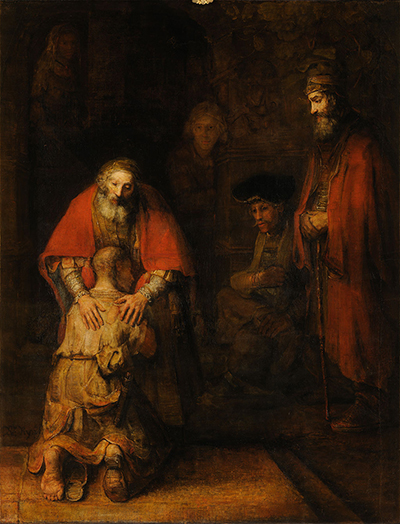
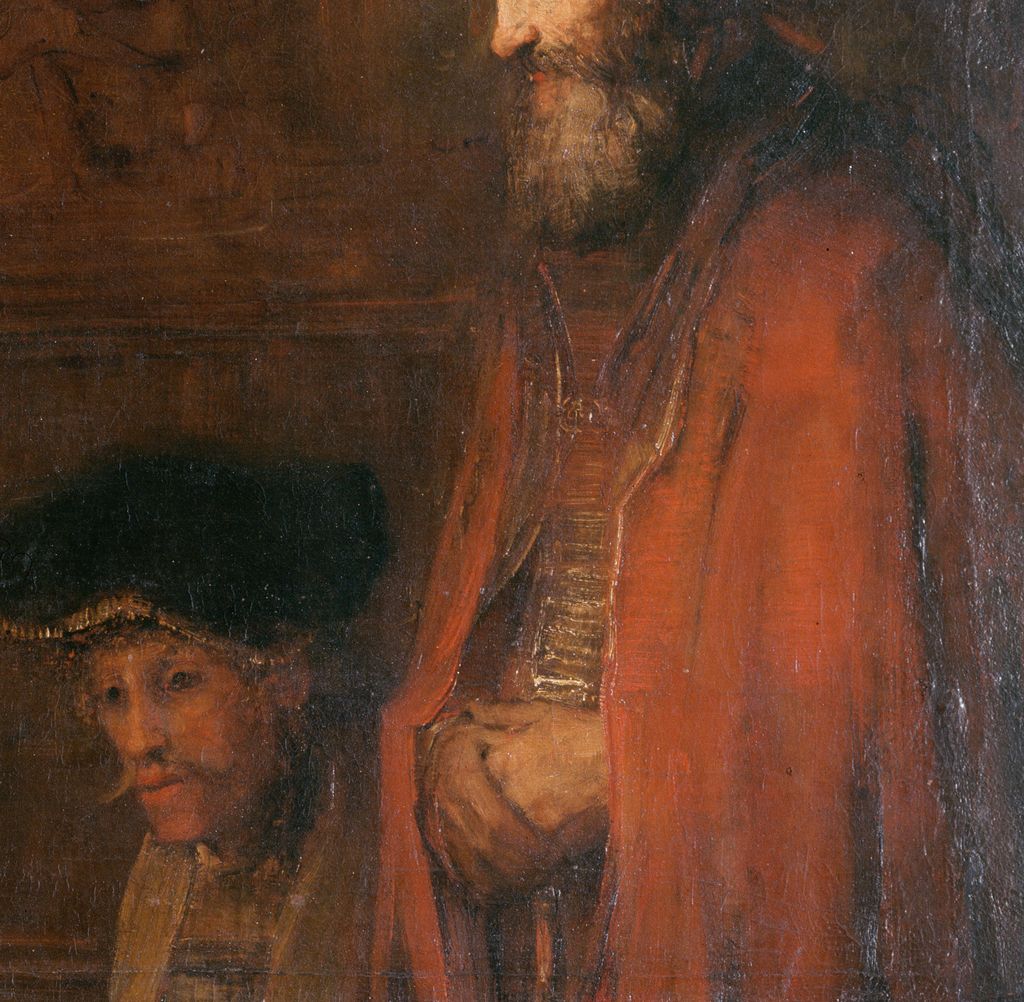
The first thing the returning son offers his father is his weight. He has dropped to his knees, turned his face into the old man’s body and left the soles of his feet exposed. One shoe has slipped off. The father bends over him, spreading both hands across the worn cloth of his back. At the right, a man in a long red garment stands with his hands gathered in front of him. He has a clear view of the reunion, and the space between him and the kneeling son stays open.
Rembrandt’s The Return of the Prodigal Son is an oil painting on lined canvas in the State Hermitage Museum, St Petersburg. It measures 262 × 205 cm and is catalogued as GE-742, entry 1022 in the museum’s 2023 catalogue of Dutch painting. It belongs to Rembrandt’s late career. The Hermitage’s presentation on Google Arts & Culture gives 1663–1665, while published estimates surveyed by the museum extend from around 1660 into the final years of the decade. The work’s size, its altered edges and the differences in handling across its surface all matter to how it looks today. [1] [2]
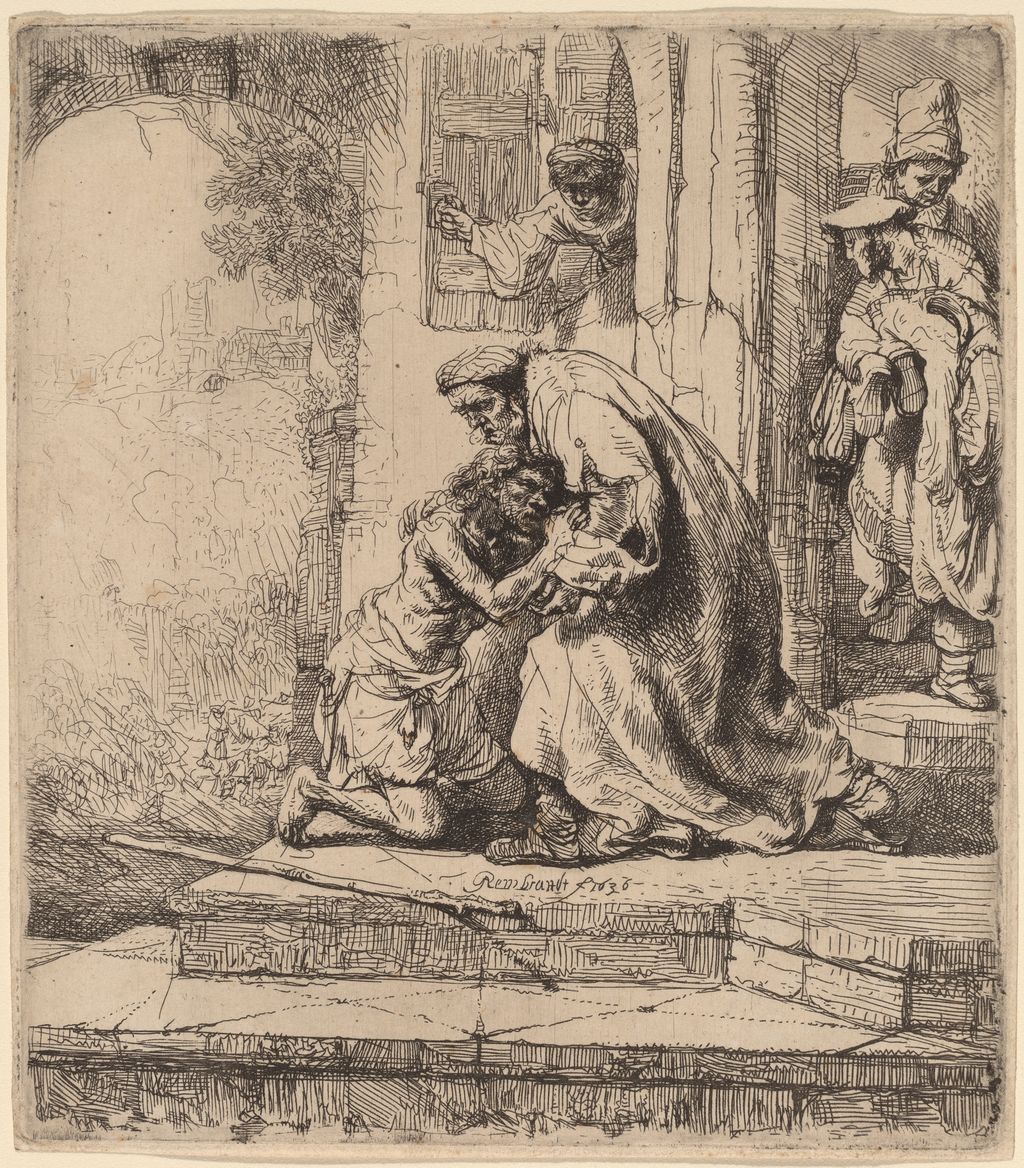
Rembrandt had already etched the same reunion in 1636. In that small print the father and son meet on a recognisable doorstep, with figures at the door and another looking out of a window. The late painting brings the pair close to the front and lets much of the house recede into darkness. Its wide field of shadow can feel almost empty on a first glance. Given time, it reveals a household looking on. The painting’s drama depends on that change in what we can see. [1]
At a Glance
- Date1660s
- MediumPainting
- CollectionState Hermitage Museum, Saint Petersburg
- InventoryGE 742
The two sons in Luke 15
Luke tells the story after the Pharisees and scribes complain that Jesus welcomes sinners and eats with them. The lost sheep and the lost coin come first, each ending with joy over something recovered. The third parable begins with a father and two sons. The younger asks for his share of the estate, and the father divides his property between them. The younger son takes his share to a distant country and spends it. When famine follows, he hires himself out to feed pigs and grows hungry enough to envy their food. [3]
He rehearses a speech. He will acknowledge that he has sinned against heaven and against his father, surrender his claim to be called a son and ask to be taken on as a hired worker. Hunger gives him a practical reason to go home, and the confession he prepares gives that decision a moral shape. The father, meanwhile, sees him at a distance. He runs, embraces him and kisses him before the son speaks. By the time the servants receive orders to bring the best robe, a ring and sandals, the father has already answered the question of whether he will receive him. The feast makes that welcome a household affair. [3]
The elder son has been working in the fields. As he approaches, music and dancing make him ask a servant what is happening. On hearing the answer he stays outside, and the father comes out to plead with him. The elder brother measures the feast against years of obedience and the smaller celebration he feels he has been denied. The father assures him that what remains belongs to him and asks him to acknowledge the return as a cause for joy. Luke ends with the father’s appeal. The elder son’s answer is left open. [3]
The two encounters are linked by the father’s readiness to go out to his children. Rembrandt’s canvas gives the younger son the embrace and gives the space around it some of the tension that belongs to the second encounter. The tall man at the right often reads as the elder brother because the story has taught us to look for him. Taken literally, Luke places that brother away from the house when the reunion occurs. If Rembrandt intended him here, the painting has brought two moments together. The figure’s presence lets us register the cost of accepting another person’s return while the welcome is still taking place. [1] [3]
There is a similar compression in the younger son’s clothing. The father’s promised robe and sandals belong to the next stage of the story. The canvas leaves the son in his old clothes, his bare heel close to the lower edge. The gestures of forgiveness occur while his appearance still bears the consequences of his departure. The passage from estrangement to belonging is visible first in the way another person touches him. [1] [3]
The father’s hands and the son’s worn clothes
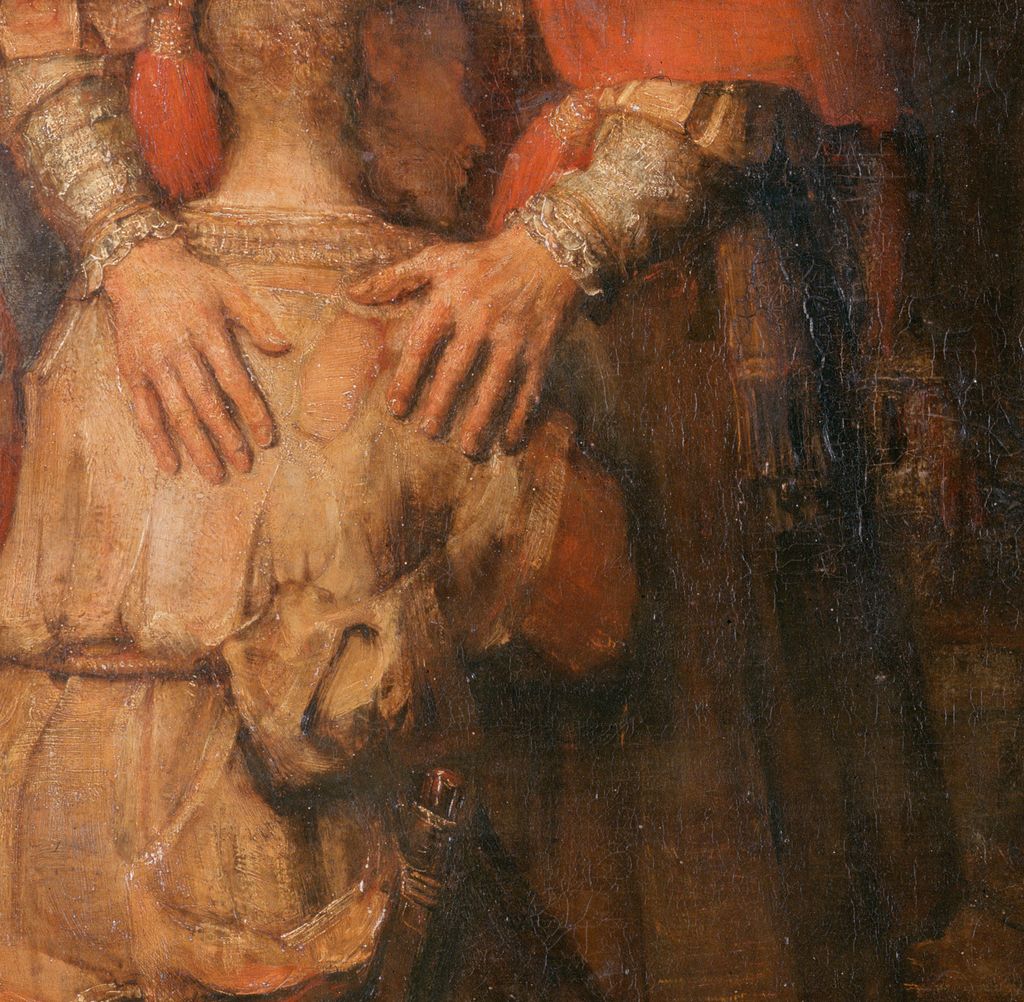
At the left of the embrace, the father’s red cloak follows the downward slope of his shoulder before folding back at the arm. On the other side, the cloak comes forward in a heavier sweep. Its red surrounds a small area of pale skin, grey beard and white sleeve. Below the beard the son’s close-cropped head rises just far enough to catch the light. The side of his face is largely lost where it turns in, so that the plane offered most clearly to the viewer is the back of his neck.
The two hands land at slightly different heights and angles. On the viewer’s left, the fingers lie close together and descend in a fairly even line. On the viewer’s right, they spread across a sloping shoulder, their tips following the uneven cloth. The pale cuffs give each hand a distinct point of emergence. The son’s arms are mostly hidden, which makes the father’s hands the most explicit evidence of contact. The arrangement is close enough to an embrace to be understood immediately and open enough for us to see how it is made.
The father’s eyes are lowered, his mouth largely hidden by the beard. The meeting therefore gives us very little of the facial exchange usually expected at a reunion. The father’s inclination carries the response. His arms enclose the son from either side, and his head continues the movement by bowing over him. One can read the hands as steadying, blessing or feeling for the person who has come home. The paint gives each reading something to work with. A thumb presses near the top of the garment and the fingertips rest along its folds, while the span of both hands makes the son’s shoulders look narrow.
Below this protected area the body comes back into view in a series of exposed details. The ochre garment has split and buckled. A loose flap interrupts the outline near the waist. The lower edge curls away from the legs, and a narrow object with a hilt at the hip is commonly read as a short sword or dagger. It looks like something the traveller has retained while his clothes and footwear have worn through. The picture supplies no history for it. The disrepair around it is enough to make the survival of one fairly distinctive possession worth noticing.
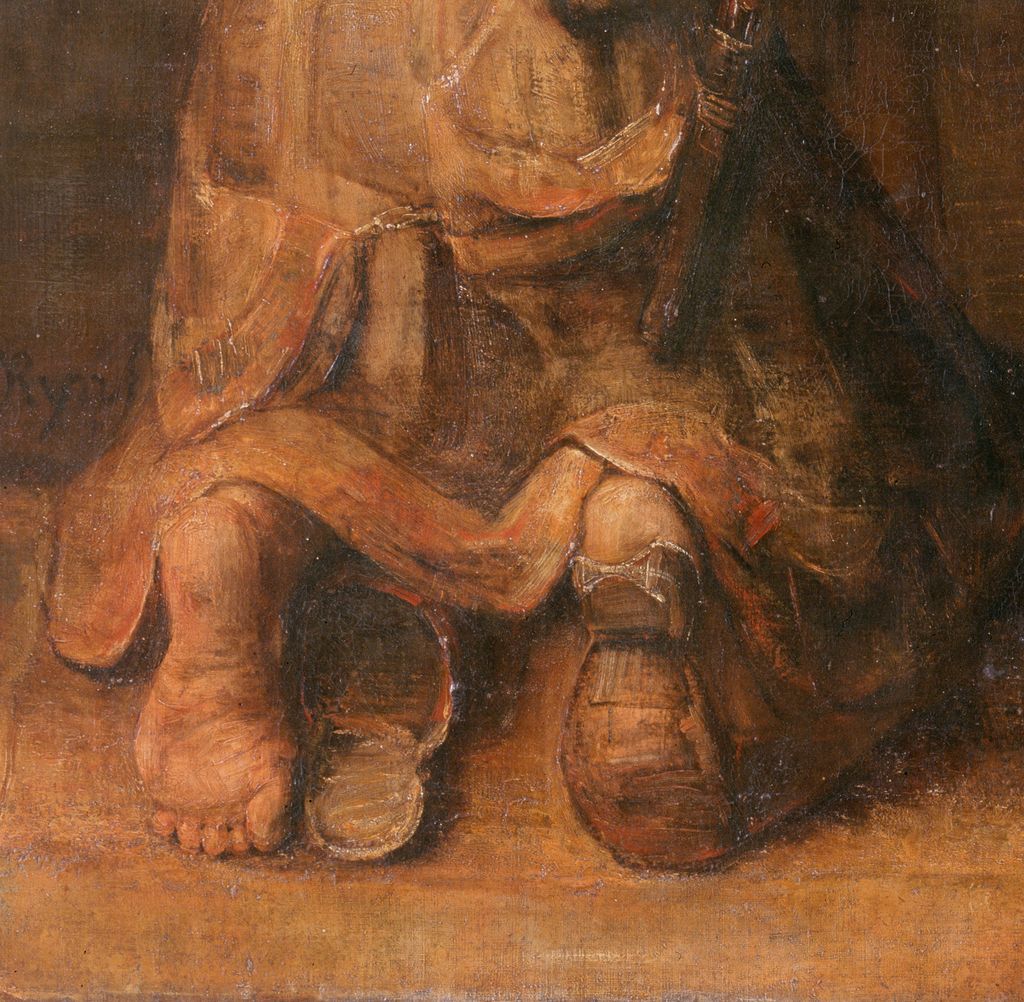
The shoes give the kneeling pose much of its conviction. One foot still carries a battered shoe with its sole turned towards us. The other is bare, with the empty shoe lying alongside it. The feet are close to the picture’s lower boundary, where their size and the angle of the soles make the body feel surprisingly near. From there the folds lead up over the bent legs and towards the shoulders. The son’s journey is available through things that have taken the strain of walking. His face, which could have supplied a conventional expression of remorse, is almost completely withheld.
Seen at a distance, the father and son make a compact group. Seen closely, their contact is built out of different textures and kinds of pressure. The father’s fingers bear down on a comparatively smooth expanse of ochre. The cuffs break into short light strokes. The great red shape has enough breadth to remain legible across a room, and its edges give way to smaller folds as the eye approaches the hands. The size of the painting allows the same gesture to be read first as a silhouette and then as an encounter between skin and cloth. [1]
The man at the right and the figures in shadow
The standing man at the right is the figure most able to draw the eye away from the embrace. Light catches his brow, nose, beard and the backs of his hands. A long staff continues the vertical of his body down towards the step. His red garment recalls the father’s cloak, though its colour runs down the figure in a long strip. The father bends and spreads his hands. The witness keeps his upright stance and holds his hands together. Their similar colours make the differences in posture easy to see.
The elder-brother reading gives this arrangement a particular force. A richly dressed figure stands near a man who has come home in rags. His position is close enough for him to join them, while his stillness leaves open how he feels about what he sees. Yet the visible evidence also allows him to be understood as a witness of uncertain identity. A staff, a beard and fine clothing carry a suggestion of standing within the household. None of these details fixes his relationship to the father. Even his downcast gaze can be read as reserve, disapproval or absorbed attention. [1]
Three further figures come into view with sustained looking. A seated man in a broad dark cap occupies the space between the pair and the standing witness, lower than either of the adult men’s heads. His lit face and one raised forearm are easier to find than the rest of his body. Above him and farther back, another face emerges near the architectural detail. A faint figure at the upper left is close to the edge of the dark opening. The Hermitage catalogue describes the last in terms of a possible household role, as a servant coming down a stair, and describes the central figure more guardedly. Familiar identifications of one of the shadowed figures as the mother belong to interpretation. Luke gives the mother no role in the episode. [1] [3]
The heads help give depth to a space in which the architecture is hard to trace. The father’s face is substantially lower than the standing man’s. The seated witness brings the eye back down towards the embrace. The face near the middle hovers above him, faint enough to be discovered after the main group. Near the top left, the last figure is barely distinct from the dark around her. This distribution allows us to sense people strung through different depths of the house before we have made out any complete wall or staircase.
The architecture still provides a few bearings. A curved opening is discernible behind the group, and a column or pier with a leafy capital survives in the upper half. At floor level the raised area beneath the witnesses meets the warmer surface under the son. Along the bottom right, the edge of a step leads into the shadow beside the standing man. The family home is recognisable through these fragments. Its most legible boundary is the change in level between the man who has knelt and the people who remain above him. [1]
There is also some uncertainty in the headgear of the standing man. The catalogue points out that darkening has brought the shapes above his head so close in tone to his cap that they can be read as part of it. It compares an etching made after the painting by Nikolai Mosolov for an 1872 publication, which helps separate the forms. Possible associations based on the apparent height or extravagance of the hat therefore depend in part on how the surface reads today. The staff and the man’s posture remain safer guides to his pictorial role than any precise story built around the outline of his cap. [1]
Annotated Details from The Return of the Prodigal Son
Look for the places where the father, son and witnesses receive different amounts of light.
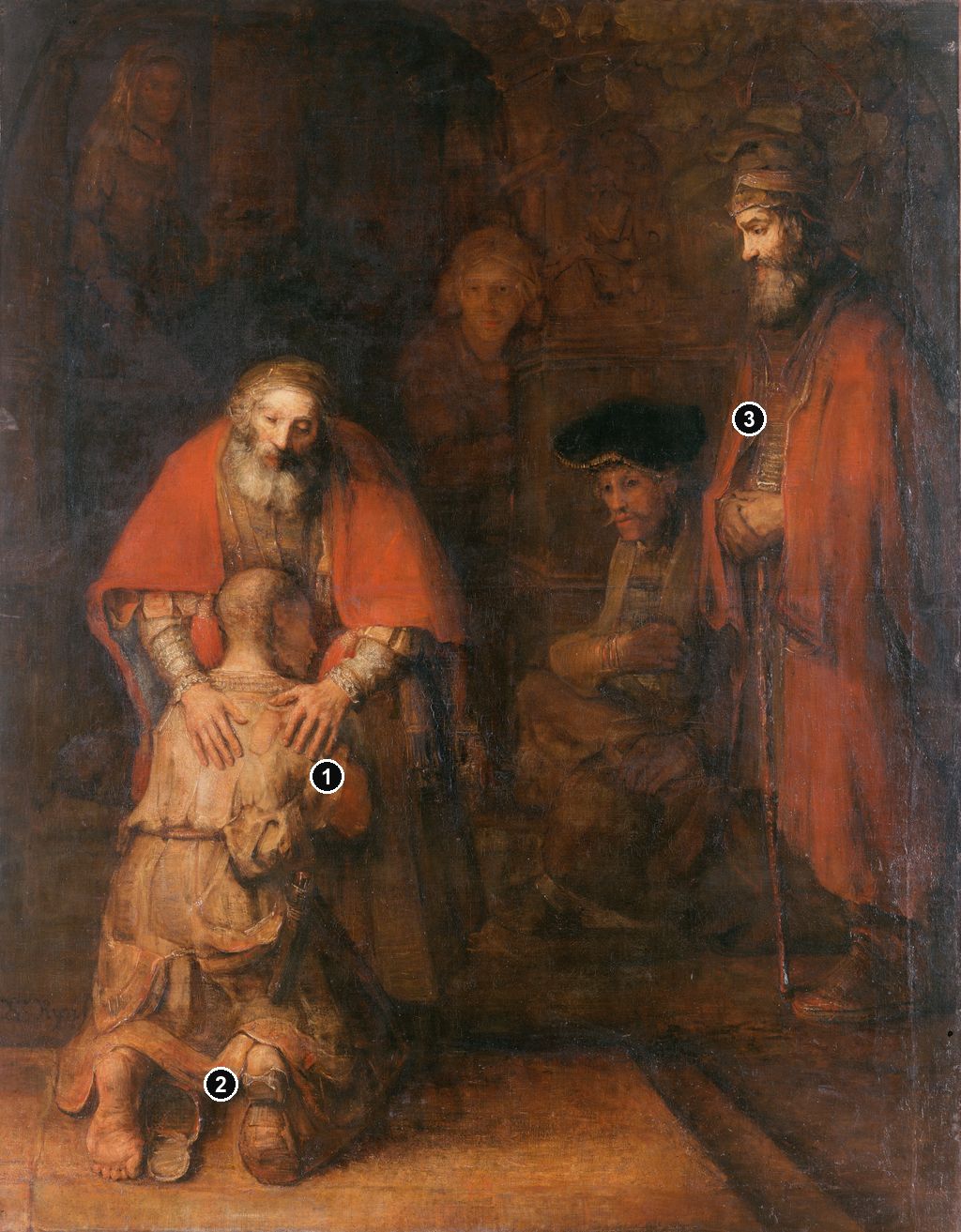
Details from THE RETURN OF THE PRODIGAL SON
Open a detail to inspect it at a larger size.
The father’s hands
The hands settle on the kneeling man’s shoulders and stand out against the red cloak and worn clothing.
The feet and shoes
One exposed heel and the other worn shoe remain visible at the bottom of the kneeling figure.
The standing witness
A separate patch of light picks out the face and edge of the cloak of the figure at the right.
The doorstep in the 1636 etching
The same title belongs to a much smaller work. The Rijksmuseum’s RP-P-1961-1039 is an etching on paper measuring 155 × 137 mm. It carries Rembrandt’s name and the date 1636 and is catalogued as Bartsch 91 and New Hollstein 159, first state of three. The National Gallery of Art in Washington holds another first-state impression, 1991.63.2, the Benedict gift. That record gives a plate measurement of 15.6 × 13.7 cm and a slightly larger sheet measurement. An impression is one sheet printed from the plate. A state records a stage in the plate’s physical development, so two museums can hold separate impressions of the same state. The measurements describe individual objects and, in Washington’s record, distinguish the plate from the paper around it. [4] [5]
The print puts architecture to work immediately. Steps rise to the landing where the son kneels. The father bends forward in profile, with his robe trailing behind him and its folds helping carry the movement towards the younger man. The son’s hair and the profile of his face appear in the gathering of lines between the two bodies. At the right, figures fill the doorway and someone peers from a window above. Melbourne’s National Gallery of Victoria identifies a servant bringing clothes and shoes in its first-state impression, 15-4. This detail advances the action beyond the embrace and gives Luke’s promise of fresh clothing a place in the image. [4] [5] [6]
The paper itself supplies much of the light. The open areas of the steps and wall make room for closely packed marks in the doorway, in the folds and beneath the bodies. At this scale a few fine strokes can register a face, a foot or the edge of a piece of masonry. A viewer can take in the landing, the opening and the witnesses in one look and then move close to follow the marks. In the canvas the same kind of move takes place across a much larger surface. The light that describes a sleeve or a heel is a local event in a field of brown, red and ochre.
Both works build the meeting around an old man inclining towards a son who has lowered himself. The print lets the two bodies be seen more from the side and makes clear where each has come from. In the painting the son turns his back towards us and the father bends almost frontally. The curve of the father’s shoulders now encompasses the son’s head and back. At the same time, the standing witness acquires an independent silhouette and almost a section of the canvas to himself. The print’s doorway connects the reunion to the bustle of a household. The painting gives the witnesses room to watch in silence. [1] [4] [6]
The signature and year printed near the lower centre belong to the etched design. They provide a firm point in Rembrandt’s treatment of the subject. The apparent signature on the canvas has a different status, and there are roughly three decades of work between the print and the painting. The recurring bend of the father and the kneeling son can be followed across that distance. The position of the figures, the role of the onlookers and the difference between ink on a small sheet and oil on a large canvas give each work its own account of the return. [1] [4] [5]
Watch: Rembrandt’s life and work
Explore Rembrandt’s early career, etchings and paintings, and see his work alongside that of other Baroque artists.
Rembrandt | A Life of Art
Curators introduce Rembrandt’s early career and trace how he developed his handling of light and shade.
Watch on YouTubeOther episodes and related drawings
The Dresden painting often called The Prodigal Son in the Tavern belongs to the period of the etching and has been read as a self-portrayal with Saskia in the story of the younger son’s extravagance. A man raises a glass and turns out towards the viewer, with a woman on his lap. Eric Jan Sluijter discusses the picture in relation to Rembrandt’s use of costume, comic expression and self-portrayal. The lifted glass and the performer’s outward glance make the viewer aware of being addressed. In the Hermitage canvas the son’s turned head and lowered body make looking at him an altogether different experience. The Dresden painting is a separate object and represents an earlier episode in the parable. [7]
The Hermitage also compares two drawings of the reunion. The sheet in Teylers Museum, Haarlem, O+ 48, shows how a few strokes of pen and brown ink can set the bending father and kneeling son into relation within a broader gathering. Peter Schatborn discusses it as a Rembrandt drawing. The other sheet, Albertina 8805, appears in the Hermitage catalogue among the graphic comparisons and has a history of attribution to Rembrandt. The Albertina currently catalogues it as anonymous, formerly attributed to him, and dates it to the 1650s. The Vienna drawing remains evidence for the treatment of the story in graphic art around the period. Its present attribution changes the weight it can carry in a chronology of Rembrandt’s own decisions. [1] [8] [9]
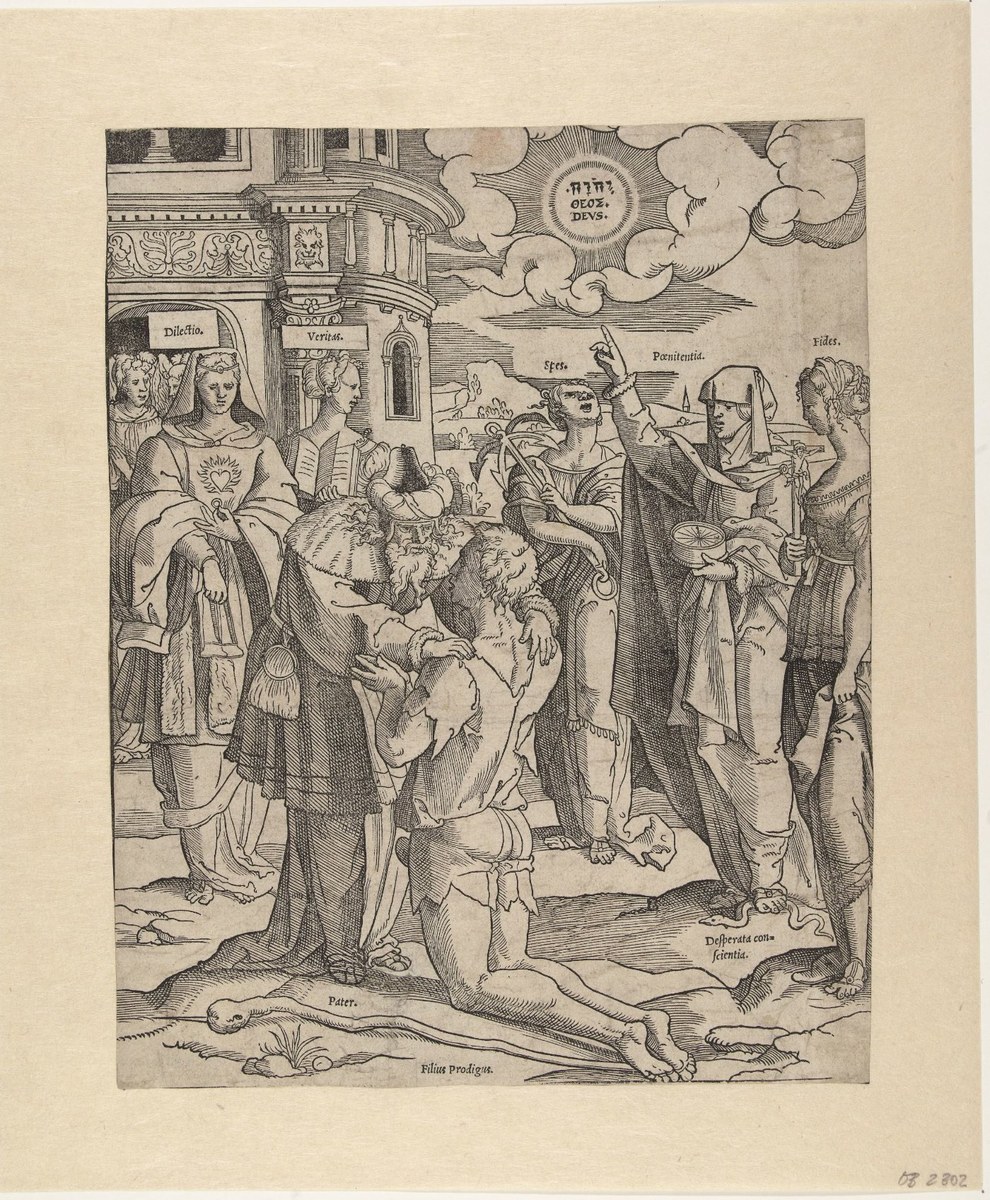
The catalogue also records suggestions of earlier Netherlandish precedents. Irina Linnik drew attention to a woodcut by Cornelis Anthonisz. as a possible precedent for showing the son from behind. Christian Tümpel proposed a painting dated 1559 by Maerten van Heemskerck as a comparison for the composition. The proposals focus attention on something easy to overlook because the finished canvas makes it seem so natural. The choice to put the kneeling figure’s back between us and the father is a major change in the way the reunion is told. We see what the father does to receive his son, while the son’s expression remains largely his own. [1]
The sewn canvas and the painted surface
The Hermitage catalogue describes a canvas assembled from two pieces with a horizontal seam across the middle. It is lined, meaning a secondary canvas supports the original fabric from behind. A strip roughly 10–13 cm deep has been added at the bottom, and a strip about 10 cm wide runs the full height at the right. The top corners were originally rounded and were extended to make the top rectangular in the eighteenth century. The recorded dimensions describe the canvas as it survives with these changes. A document from 1765 helps account for the corners. The seam, the lining and the extensions are physical features with different purposes and histories. [1]
Those alterations affect the space we experience. Along the foot of the present canvas there is room for a run of warm floor beneath the prodigal’s feet. The extension on the right belongs to the history of the margin beyond the standing man. The squared-off corners also frame the dark upper field differently from a support with a rounded top at either side. The painting remains imposing through any of these changes, but the numerical dimensions alone cannot tell us exactly how an early viewer saw its edges. They are a record of the object that reached the museum and has been cared for there.
The paint surface contains its own distinctions. The catalogue describes broad, dense application, use of a palette knife in places and raised impasto in the lights. Around the father’s beard and cloak, fine incisions were made through paint while it was still wet. These marks give lines a physical edge. In the white sleeves, short broken strokes are laid in tiers, so that a turn of the wrist comes out of a succession of small touches. On the younger man’s clothes, the dense yellow layer is relatively smooth. The catalogue compares the latter handling with the dress of the rider in Rembrandt’s equestrian portrait of Frederik Rihel. Its comparison for the broken sleeve strokes is the sleeve of Isaac in The Jewish Bride. [1]
The fall of light can be followed through these differences. The son’s broad ochre back receives and spreads it. The cuffs break it into flecks. The small lines around the beard catch along a surface already worked in several layers. At the right, light reaches the witness’s forehead and hands, then gives way to red cloth and the deep brown under his beard. The arrangement makes illuminated passages feel connected across the picture even when they are separated by a considerable distance. It also makes the poorly lit areas visually active. Their job is to regulate when a form comes into view and how much of it we can see.
Material analysis reinforces the sense that the picture has a more varied palette than its present overall appearance suggests. The museum reports natural azurite and smalt, a blue glass pigment, in the lining of the father’s cloak, identified through X-ray fluorescence analysis. It also records coarsely ground smalt in brown paint and raises the possibility of discolouration. Bone black is present in dark background passages, where it has become more apparent in pigment mixtures over time. A pigment identification can establish that a material is present in a particular area. Reconstructing how strong a patch of blue looked when it was new is a further question. [1]
The museum also records extensive old retouching, particularly below, as well as repaired tears and small losses of paint and ground. The varnish was treated in 1998. These details bear directly on close looking. The lower part of the canvas carries some of the story’s most eloquent evidence, including the heels, the worn shoe and the edge of the step. It is also the part singled out for substantial older restoration. The shapes can be read with confidence as parts of the surviving picture. Assigning every visible accent in that area to a single moment of execution would require more detailed evidence about the passage concerned. [1]
Dating and the question of another hand
The dates proposed for the painting span much of the 1660s. The Hermitage catalogue reports that Horst Gerson placed it around 1661, Christian Tümpel around 1665 and Bob Haak in 1668–1669. Ernst van de Wetering’s sixth volume of A Corpus of Rembrandt Paintings places it around 1660–1665, while Volker Manuth, Marieke de Winkel and Rudie van Leeuwen give 1666–1669. The catalogue also records an earlier suggestion by Ludwig Münz’s contemporary Heinrich Theodor Musper that work began in the 1650s and was completed around 1660. An older Hermitage publication dates it to about 1666–1669, alongside the 1663–1665 range on the museum’s Google Arts & Culture page. [1] [2] [10]
The false signature recorded near the son’s feet supplies no year or authentic endorsement by Rembrandt. Dating rests on the character of the painting and its relationship to other works. Comparisons such as the dense garment paint in the Frederik Rihel and the short strokes in the sleeves of The Jewish Bride help explain why the canvas sits comfortably in discussions of the late work. Such comparisons indicate techniques and effects that Rembrandt was exploring across a period. The chronology inside that period remains open. The often repeated date around 1668 is one placement within the debate. [1] [10]
Authorship raises a related question about the varying degree of finish in the figures. The Hermitage catalogues the work under Rembrandt and records a proposal that an assistant painted the three secondary figures in depth. Van de Wetering assigned the design and the three principal foreground figures to Rembrandt and the secondary figures to a pupil. Tümpel also allowed a workshop role. Manuth and his co-authors describe the painting as Rembrandt’s with possible assistant participation. These accounts concern particular parts of the canvas. The kneeling son, the father and the standing man at the right are the group van de Wetering assigned to Rembrandt. [1]
Van de Wetering drew attention to an apparent difference in scale between the head of the father and that of the standing man. The Hermitage catalogue raises another factor that could affect the comparison. The X-radiograph and infrared reflectogram show forms around the father’s head that suggest his headgear was originally more voluminous. The present head reads as a relatively small shape inside the broad cloak, and the shape picked up by imaging would have given it a different presence. That finding concerns a change in the painted image. The proposal of assistance rests on the wider assessment of the handling and organisation of the picture. Both questions leave room for the effects of revision, shadow and the changing condition of the surface. [1]
Rembrandt’s workshop is a documented part of his practice, and evidence for collaboration varies from object to object. Arthur K. Wheelock Jr.’s account of attribution in the Rembrandt workshop discusses examples where an inscription or a relationship between versions gives the inquiry a specific starting point. Here the uneven visibility of the figures is plain, and the precise division of labour remains debated. A face that barely rises out of shadow also does compositional work. The central background face shows just enough to register a person who is present, then yields attention again to the father’s hands. [11]
From Bonn and Paris to Catherine the Great
The earliest record cited in the 2023 catalogue is an auction in Bonn on 30 September 1742, where the painting appeared as lot 4 from the von Giese collection. It later belonged to Clemens August of Bavaria, Archbishop and Elector of Cologne. Documents place it above the fireplace in the Coronation Hall at Schloss Clemensruhe in Poppelsdorf. That location gives one concrete setting for a picture whose scale can be hard to gauge from reproductions. An already large canvas was displayed high within a room with an architectural centre of its own. [1]
The painting appeared at the sale of the elector’s collection in Bonn in May 1764. On 10 December of the same year it was offered again in Paris, as lot 22 at the Hôtel d’Aligre, where the Duke d’Ancezune bought it for 6,000 livres. In a receipt dated 7 March 1765, auction organiser François-Charles Joullain undertook to extend the upper corners to a rectangular shape at the duke’s request. The catalogue links this document to the upper-corner additions. It gives an unusually precise reason for part of the difference between the original support and the frame of the image we see today. [1]
The Hermitage dates Catherine II’s acquisition to December 1767. Denis Diderot and Prince Dmitry Alexeyevich Golitsyn acted as intermediaries in the purchase from the duke’s collection in Paris, at a recorded price of 3,590 livres. The catalogue cites a valuation of the collection by J.-B. Collin dated 14 December 1767 that identifies the subject and names Rembrandt. The valuation anchors the presence of the painting in the Paris collection that December. The museum’s collection history independently identifies the purchase for Catherine as a Paris acquisition of 1767. An older Hermitage publication gives 1766 through Golitsyn. The more specific dating in the 2023 catalogue is supported by the dated valuation and by the museum’s account of Catherine’s collecting. [1] [10] [12]
Catherine acquired European paintings through agents with access to private collections and the sale rooms in which those collections changed hands. Diderot contributed his knowledge of the French art world, and Golitsyn was part of the diplomatic network through which purchases could be arranged. In the case of The Return of the Prodigal Son, their involvement connects a named object, price and valuation with the growth of the imperial collection. They also inherited the consequences of earlier owners’ decisions. By the time the painting passed to Catherine, the duke had commissioned the change to the upper corners. The canvas had already been adapted to new surroundings before it became a fixture of the Hermitage’s collection. [1] [12]
Rembrandt’s late years and the uses of touch
Rembrandt had to sell his house and possessions after his financial failure in the 1650s. Hendrickje Stoffels died in 1663 and his son Titus in 1668. The losses have encouraged viewers to read a personal history into the picture, especially when they date it close to Rembrandt’s death in 1669. The early etching makes the history of his interest in the subject considerably longer. He had already studied the old man’s stoop and the son’s kneeling body in 1636, decades before those losses. The available dating also leaves open whether the canvas predates Titus’s death. [1] [4] [13]
Rembrandt’s Self Portrait at the Age of 63 in the National Gallery, London, gives a comparison firmly dated to 1669. Light concentrates on the ageing face, which is built up with richly textured paint, and the sitter looks out directly. In the Hermitage painting, the father’s lowered eyes and inclined face direct attention towards a person inside the scene. Both paintings give age a material presence through the handling of skin, hair and light. The self-portrait makes the meeting one between sitter and viewer. In the parable the most consequential encounter takes place below the old man’s face. [14]
Isaac and Rebecca, Known as The Jewish Bride makes a closer comparison for the hands. One figure places a hand across the other’s chest, and her fingers lightly meet his. The Rijksmuseum dates its painting to about 1665–1669. The placement of the hands is inseparable from the distribution of paint across the costume, particularly the thick, worked sleeve next to that contact. In the Prodigal Son, the Hermitage’s comparison between the broken strokes of the sleeves describes a particular shared technique. The narrative use of touch changes. Isaac and Rebecca’s hands meet in a compact exchange, while the father’s hands reach down across the back of a son whose response is largely concealed. [1] [15]
In the Louvre’s Bathsheba at Her Bath, dated 1654, a letter in Bathsheba’s hand carries the consequence of an action taking place beyond the immediate scene. David is absent, yet his summons bears on the way the figure holds herself and looks down. The Hermitage painting likewise leaves much of its story beyond the picture’s edges. It gives us the shoes worn by the journey and the hands that end it. Both works can be read through the way a downward glance, a hand and a small area of illuminated surface hold events that the painting leaves elsewhere. [16]
Henri Nouwen and the painting’s later reception
Henri Nouwen first encountered the image in reproduction at a L’Arche community in France in 1983 and later went to St Petersburg to see the canvas. In The Return of the Prodigal Son: A Story of Homecoming, published in 1992, he describes recognising himself successively in the younger son and the elder son, then understanding the father as the figure whose generosity he was called to practise. His account gives particular attention to the difference between the hands, which he saw as expressing both paternal and maternal love. The breadth of the cloak around the kneeling figure also took on a protective, maternal meaning for him. [17] [18]
That reading starts in details anyone can examine. The unequal spread of the fingers is visible. The larger meaning Nouwen finds in the difference belongs to his spiritual response. The same applies to his identification of the elder son. The man on the right gives his meditation on resentment a definite body and place in the scene. It remains possible to see the figure primarily as a witness and still recognise the distance between looking on and taking part. Nouwen’s account follows the movement of a viewer through the picture, from the person who needs to be received to the person who is in a position to receive someone else. [17] [18]
The relation between the written story and the painted space has also been taken up in scholarship. Jurij Selan’s study of the parable in word and image considers how Rembrandt’s composition and spatial relations carry elements of the narrative. The standing man is an especially telling case. He is physically nearby, linked to the father by colour and to the son by his downcast gaze. The interval between them is legible even before one has decided who he is. Luke puts the elder son outside the celebration and gives the father words to address him. The painting gives us a person within range of the embrace and leaves the space he would cross plainly visible. [3] [19]
The large original and the widely reproduced image lend themselves to different kinds of attention. A close reproduction makes it easy to study the shape of each finger and the broken brushwork at the wrists. The full canvas places those details inside a field taller than a person, where the standing figure has enough scale to hold a viewer’s eye and the background faces can take time to emerge. The contrast between the intimate gesture and its large setting is part of the work’s effect. The father touches the son in front of other people, and each of those people has a different degree of visibility, proximity and apparent involvement.
Rembrandt artworks
Different impressions of the same print can appear as separate records.
| Name | Date | Medium |
|---|---|---|
| The Night Watch | 1642 | Painting |
| The Return of the Prodigal Son | 1660s | Painting |
| The Anatomy Lesson of Dr Nicolaes Tulp | 1632 | Painting |
| The Jewish Bride | c. 1665–69 | Painting |
| Self-Portrait with Two Circles | c. 1665 | Painting |
| Christ in the Storm on the Sea of Galilee | 1633 | Painting |
| Bathsheba at Her Bath | 1654 | Painting |
| The Hundred Guilder Print | c. 1648–49 | |
| The Three Trees | 1643 | |
| Aristotle with a Bust of Homer | 1653 | Painting |
| The Abduction of Ganymede | 1635 | Painting |
| Ahasuerus and Haman at the Feast of Esther | 1660 | Painting |
| The Anatomy Lesson of Dr Jan Deijman | 1656 | Painting |
| Judith at the Banquet of Holofernes | 1634 | Painting |
| Artist in His Studio | c. 1628 | Painting |
| The Artist’s Mother, Head and Bust, Three-Quarters Right | 1628 | |
| The Artist’s Mother, Head Only, Full Face | 1628 | |
| Balaam and the Ass | 1626 | Painting |
| The Baptism of the Eunuch | 1626 | Painting |
| Beggar in a High Cap, Standing and Leaning on a Stick | c. 1629 | |
| Beggar with a Clenched Hand, Leaning on a Stick | c. 1629 | |
| Belshazzar’s Feast | c. 1636–38 | Painting |
| The Blinding of Samson | 1636 | Painting |
| Bust of a Bearded Young Man with a Skullcap | 1663 | Painting |
| Christ Presented to the People | 1655 | |
| The Circumcision | c. 1625 | |
| The Conspiracy of Claudius Civilis | c. 1661–62 | Painting |
| Danaë | Begun 1636 and later revised | Painting |
| The Descent from the Cross | 1632–33 | Painting |
| Descent from the Cross by Torchlight | 1654 | |
| The Descent from the Cross, Second Plate | 1633 | |
| Diana Bathing with Her Nymphs, with Actaeon and Callisto | 1634 | Painting |
| Ephraim Bueno, Jewish Physician | 1647 | |
| Portrait of Frederick Rihel on Horseback | c. 1663 | Painting |
| Flora | 1634 | Painting |
| The Goldweigher’s Field | 1651 | |
| Head of Christ | 1645–50 | Painting |
| The Holy Family with Angels | 1645 | Painting |
| Homer Dictating His Verses | 1663 | Painting |
| Jacob Blessing the Sons of Joseph | 1656 | Painting |
| Jacob Wrestling with the Angel | 1659–60 | Painting |
| Joseph and Potiphar’s Wife | 1655 | Painting |
| Juno | c. 1662–65 | Painting |
| Landscape with a Stone Bridge | c. 1638 | Painting |
| Head of an Old Man with Curly Hair | 1659 | Painting |
| A Man in Armour | Possibly 1655 | Painting |
| Minerva in Her Study | 1635 | Painting |
| Moses with the Tablets of the Law | 1659 | Painting |
| Old Man with a Gold Chain | c. 1631 | Painting |
| Peter and John at the Gate of the Temple | c. 1629 | |
| Philosopher in Meditation | 1632 | Painting |
| The Polish Rider | c. 1655 | Painting |
| Portrait of a Woman with a Lapdog | c. 1665 | Painting |
| Portrait of Gerard de Lairesse | 1665–67 | Painting |
| Portrait of Jan Six | c. 1654 | Painting |
| Portrait of Maerten Soolmans | 1634 | Painting |
| Portrait of a Woman, Probably Maria Trip | 1639 | Painting |
| Portrait of Oopjen Coppit | 1634 | Painting |
| Portrait of Titus | c. 1662 | Painting |
| Rembrandt and Saskia in the Parable of the Prodigal Son | c. 1635 | Painting |
| The Raising of Lazarus | c. 1630–32 | Painting |
| The Rest on the Flight into Egypt | c. 1626 | |
| Self-Portrait as the Apostle Paul | 1661 | Painting |
| Self-Portrait (Cologne) | c. 1668 | Painting |
| Rembrandt’s Self-Portrait, Frowning | 1630 | |
| Self-Portrait in a Cap, Wide-Eyed and Open-Mouthed | 1630 | |
| Self-Portrait in a Fur Cap | 1630 | |
| Self-Portrait in a Fur Cap, in an Oval Border | c. 1629 | |
| Self-Portrait in a Soft Hat and Embroidered Cloak | 1631 | |
| Self-Portrait, Bending Forward | c. 1628 | |
| Self-Portrait with a Broad Nose | c. 1628 | |
| Self-Portrait with Beret and Turned-Up Collar | 1659 | Painting |
| Self-Portrait with Plumed Cap and Lowered Sabre | 1634 | |
| The Shipbuilder and His Wife | 1633 | Painting |
| Simeon’s Hymn of Praise | c. 1640 | |
| Simeon in the Temple | c. 1669 | Painting |
| St Jerome Kneeling | c. 1628–29 | |
| Saint Matthew and the Angel | 1661 | Painting |
| The Stoning of Saint Stephen | 1625 | Painting |
| A Stout Man in a Large Cloak | c. 1629 | |
| The Supper at Emmaus | 1648 | Painting |
| Susanna and the Elders | 1647 | Painting |
| The Syndics of the Drapers’ Guild | 1662 | Painting |
| The Mill | 1645/1648 | Painting |
| The Woman Taken in Adultery | 1644 | Painting |
| Lucretia (1664) | 1664 | Painting |
| Lucretia (1666) | 1666 | Painting |
| Anatomische les van Dr. Jan Deijman (fragment) | 1656 | Painting |
| Isaac and Rebecca, Known as ‘The Jewish Bride’ | c. 1665 - c. 1669 | Painting |
| Johannes Wtenbogaert | 1633 | Painting |
| Man in Oriental Dress | 1635 | Painting |
| Musical Company | 1626 | Painting |
| Portrait of Ephraim Bueno | 1645 - 1647 | Painting |
| Portrait of Haesje Jacobsdr van Cleyburg | 1634 | Painting |
| Portrait of Oopjen Coppit | 1634 | Painting |
| Self-portrait | c. 1628 | Painting |
| Still Life with Peacocks | c. 1639 | Painting |
| Tobit and Anna with the Kid | 1626 | Painting |
| Young Woman in Fantasy Costume | 1633 | Painting |
| A Polish Nobleman | 1637 | Painting |
| A Woman Holding a Pink | 1656 | Painting |
| A Young Man Seated at a Table (possibly Govaert Flinck) | c. 1660 | Painting |
| Man with a Sheet of Music | 1633 | Painting |
| Philemon and Baucis | 1658 | Painting |
| Portrait of a Gentleman with a Tall Hat and Gloves | c. 1656/1658 | Painting |
| Portrait of a Lady with an Ostrich-Feather Fan | c. 1656/1658 | Painting |
| Portrait of a Man in a Tall Hat | c. 1663 | Painting |
| Saskia van Uylenburgh, the Wife of the Artist | probably begun 1634/1635 and completed 1638/1640 | Painting |
| The Circumcision | 1661 | Painting |
| Bellona | 1633 | Painting |
| Flora | ca. 1654 | Painting |
| Hendrickje Stoffels (1626–1663) | mid-1650s | Painting |
| Herman Doomer (ca. 1595–1650) | 1640 | Painting |
| Man in a Turban | 1632 | Painting |
| Man with a Magnifying Glass | early 1660s | Painting |
| Portrait of a Man | 1632 | Painting |
| Portrait of a Man Holding Gloves | 1648 | Painting |
| Portrait of a Man, probably a Member of the Van Beresteyn Family | 1632 | Painting |
| Portrait of a Woman | 1633 | Painting |
| Portrait of a Woman, probably a Member of the Van Beresteyn Family | 1632 | Painting |
| Portrait of a Young Woman with a Fan | 1633 | Painting |
| The Standard Bearer (probably Floris Soop, 1604–1657) | 1654 | Painting |
| The Toilet of Bathsheba | 1643 | Painting |
| Woman with a Pink | early 1660s | Painting |
| Lieven Willemsz van Coppenol (born about 1599, died 1671 or later) | Painting | |
| Portrait of a Man | ca. 1655–60 | Painting |
| Self-Portrait | 1660 | Painting |
| A Cap | c. 1629 - c. 1630 | Drawing |
| A Cow in a Shed | c. 1640 | Drawing |
| A Syndic of the Drapers’ Guild, Jacob van Loon, Seated | c. 1661 - c. 1662 | Drawing |
| Abraham Casting Out Hagar and Ishmael | c. 1650 | Drawing |
| Actor in the Role of Pantalone Engaged in Conservation | c. 1634 - c. 1636 | Drawing |
| Bedroom with Saskia in a Canopy Bed | c. 1638 | Drawing |
| Beheading of John the Baptist | c. 1640 - c. 1641 | Drawing |
| Boaz and Ruth | c. 1645 | Drawing |
| Boy Walking with a Stick | c. 1635 - c. 1640 | Drawing |
| Christ Appearing to Mary Magdalene as a Gardener (Noli me tangere) | c. 1645 | Drawing |
| Christ Healing a Leper | c. 1650 - c. 1655 | Drawing |
| Christ Washing the Disciples’ Feet | c. 1640 - c. 1650 | Drawing |
| Cottage with White Paling among Trees | c. 1648 | Drawing |
| Daniel in the Lions’ Den | c. 1650 | Drawing |
| David Hearing the News of Uriah’s Death | c. 1650 | Drawing |
| Five Studies of Haman’s Head | c. 1655 - c. 1660 | Drawing |
| Four Men Standing, Wearing Hats | c. 1650 | Drawing |
| Indian Archer | c. 1656 - c. 1658 | Drawing |
| Inn on the Amstelveenseweg | c. 1652 | Drawing |
| Jacob and his Sons | c. 1641 | Drawing |
| Jael Killing Sisera | c. 1658 - c. 1659 | Drawing |
| Jahangir | c. 1656 - c. 1658 | Drawing |
| Joseph in Prison Interpreting the Dreams of the Butler and the Baker | c. 1650 - c. 1655 | Drawing |
| Longhouse Farmstead with a Haystack in a Polder Landscape | c. 1652 | Drawing |
| Man Helping a Rider to Mount a Horse | c. 1640 - c. 1641 | Drawing |
| Nude Woman Lying on a Pillow | c. 1661 - c. 1662 | Drawing |
| Nude Woman Seated by a Stove | c. 1661 - c. 1662 | Drawing |
| One of the Three Kings Adoring the Virgin and Child | c. 1635 - c. 1640 | Drawing |
| Recumbent Lion | c. 1660 | Drawing |
| Saskia in Bed | c. 1635 | Drawing |
| Seated Actor in the Role of Capitano | c. 1634 - c. 1636 | Drawing |
| Self-portrait with Tousled Hair | c. 1628 - c. 1629 | Drawing |
| Shah Jahan | c. 1656 - c. 1658 | Drawing |
| Shah Jahan and his Son | c. 1656 - c. 1658 | Drawing |
| Small Study of the Head of the Sick Woman | c. 1647 - c. 1648 | Drawing |
| Standing Man with a Pouch | c. 1629 - c. 1630 | Drawing |
| Standing Man with a Stick, Facing Left | c. 1629 - c. 1630 | Drawing |
| Standing Man with a Stick, Facing Right | c. 1629 - c. 1630 | Drawing |
| Standing Man with Outstretched Arm | c. 1636 - c. 1641 | Drawing |
| Studies for the Sick Woman in the ‘Hundred Guilder Print’ | c. 1648 | Drawing |
| Studies of the Mourning Magdalen and the Virgin | c. 1635 - c. 1636 | Drawing |
| Study of a Man, Seen from Behind | c. 1629 - c. 1630 | Drawing |
| Study of a Woman’s Legs | c. 1628 - c. 1629 | Drawing |
| Susanna and the Elders | c. 1650 - c. 1655 | Drawing |
| The Actor Willem Bartholsz Ruyter as a Peasant | c. 1638 | Drawing |
| The Actor Willem Bartholsz Ruyter as King Ahasuerus on his Throne | c. 1635 - c. 1640 | Drawing |
| The Angel Appearing to Joseph in his Dream | c. 1650 | Drawing |
| The Annunciation to the Shepherds | c. 1650 | Drawing |
| The Entombment, over a Sketch of an Executioner | c. 1640 - c. 1641 | Drawing |
| The Pancake Woman | c. 1635 | Drawing |
| The Swijgh Utrecht Tower in Amsterdam | c. 1650 - c. 1655 | Drawing |
| Three Orientals Conversing | c. 1645 | Drawing |
| Three Scribes | c. 1628 - c. 1629 | Drawing |
| Three Women and a Child by a Door | c. 1645 | Drawing |
| Tobias and the Angel Taking Leave of Raguel | c. 1650 - c. 1655 | Drawing |
| Two Horses at a Halting-place | c. 1637 | Drawing |
| View of the Amstel from the Blauwbrug | c. 1645 - c. 1650 | Drawing |
| View of the Amstelveenseweg outside Amsterdam | c. 1660 - c. 1662 | Drawing |
| View of the Nieuwezijds Voorburgwal | c. 1647 | Drawing |
| Walking Man with a High Cap | c. 1655 - c. 1660 | Drawing |
| Winter View with a Waterway, Cottages and Two Boats | c. 1650 | Drawing |
| Woman with a Urinating Child | c. 1658 - c. 1660 | Drawing |
| Young Woman Seated by a Window (Saskia?) | c. 1638 | Drawing |
| A Landscape with Farm Buildings among Trees | c. 1650/1655 | Drawing |
| Beggar Man and Woman | c. 1630/1631 | Drawing |
| Beggar Woman Leaning on a Stick | 1628/1630 | Drawing |
| Bust of an Elderly Man in a Flat Cap | 1635/1637 | Drawing |
| Cottages and Barn beside a Road | c. 1650 | Drawing |
| Esther before Ahasuerus | 1655/1660 | Drawing |
| Figures on the Anthoniesdijk Entering Houtewael [verso] | c. 1650 | Drawing |
| God the Father Supported by Angels | 1655/1660 | Drawing |
| Head of an Old Man (recto) | c. 1631 | Drawing |
| Jan Cornelisz Sylvius, the Preacher | 1644/1645 | Drawing |
| Joseph Recounting His Dreams | early 1640s | Drawing |
| Seated Old Man | 1630 | Drawing |
| Self-Portrait | c. 1637 | Drawing |
| View of Diemen | c. 1655 | Drawing |
| View of Houtewael near the Sint Anthoniespoort [recto] | c. 1650 | Drawing |
| View over the Amstel from the Rampart | c. 1646/1650 | Drawing |
| Woman Seated on the Ground with Two Children | 1635/1640 | Drawing |
| Cottage among Trees | ca. 1650 | Drawing |
| Cottage near the Entrance to a Wood | 1644 | Drawing |
| Elsje Christiaens Hanging on a Gibbet | 1664 | Drawing |
| Group of Farm Buildings | ca. 1648–52 | Drawing |
| Houses by the Water | ca. 1652 | Drawing |
| Nathan Admonishing David | 1650–55 | Drawing |
| Old Man in Profile | 1620–69 | Drawing |
| Old Man Leaning on a Stick | 1632–35 | Drawing |
| Potiphar's Wife Accusing Joseph Before her Husband | 1620–69 | Drawing |
| Satire on Art Criticism | 1644 | Drawing |
| Seated Man Wearing a Flat Cap | 1635–40 | Drawing |
| St. Peter and St John Healing the Paralytic | 1606–69 | Drawing |
| Study Sheet with Three Women and a Boy | ca. 1638–39 | Drawing |
| The Last Supper, after Leonardo da Vinci | 1634–35 | Drawing |
| The Wedding Night of Tobias and Sarah | 1640–49 | Drawing |
| Two Cottages | ca. 1636 | Drawing |
| Two Studies of a Woman Reading | 1635–40 | Drawing |
| Woman Reading | 1606–69 | Drawing |
| The Annunciation to the Shepherds | c. 1655 | Drawing |
| Elsje Christiaens Hanging on a Gibbet | 1664 | Drawing |
| A blind hurdy-gurdy player and family receiving alms | 1648 | Print impression |
| A cavalry fight | 1629 | Print impression |
| A Polander with a Stick | c. 1631 | Print impression |
| A scholar in his study | c. 1652 | Print impression |
| A Scholar in his Study (‘Faust’) | c. 1652 | Print impression |
| A standing hurdy-gurdy player | c. 1631 | Print impression |
| Aanbidding der herders: nachtstuk | 1650 - 1654 | Print impression |
| Abraham Francen | c. 1657 | Print impression |
| Abraham Francen, apothecary | c. 1657 | Print impression |
| Arnout Tholinx | c. 1656 | Print impression |
| Bald headed man in profile right: the artist's father (?) | 1630 | Print impression |
| Bald man with open mouth, looking down: bust | c. 1631 | Print impression |
| Bald Old Man with a Short Beard | c. 1635 | Print impression |
| Bearded man with short wavy hair: bust | c. 1631 | Print impression |
| Bearded Old Man with High Forehead | c. 1629 | Print impression |
| Bedelaar met een houten been | 1628 - 1632 | Print impression |
| Bedelaar met een stok | 1631 | Print impression |
| Beggar in a high cap, standing and leaning on a stick | c. 1629 | Print impression |
| Beggar in a High Hat, Leaning on a Stick | c. 1629 | Print impression |
| Beggar leaning on a stick, facing left | c. 1630 | Print impression |
| Beggar Man and Woman | c. 1629 | Print impression |
| Beggar Man and Woman behind a Bank | c. 1630 | Print impression |
| Beggar seated warming his hands at a chafing dish | c. 1630 | Print impression |
| Beggar Warming his Hands | c. 1630 | Print impression |
| Beggar with a clenched hand, leaning on a stick | c. 1629 | Print impression |
| Beggar with a Cottage and Two Figures in the Background | c. 1629 | Print impression |
| Beggar with a Crippled Hand, Leaning on a Stick | c. 1629 | Print impression |
| Beggar with a Wooden Leg | c. 1630 | Print impression |
| Beggar Woman with a Gourd | c. 1629 | Print impression |
| Beggar, Seated in an Armchair | c. 1629 | Print impression |
| Bust of an old man with a fur cap and flowing beard, nearly full face | c. 1631 | Print impression |
| Bust of an old man with flowing beard and white sleeve | c. 1630 | Print impression |
| Christ and the woman of Samaria among ruins | 1634 | Print impression |
| Christ before Pilate: large plate | 1635 | Print impression |
| Christ Crucified between the Two Thieves | c. 1641 | Print impression |
| Christ Crucified between the two Thieves: 'The Three Crosses' | 1653 | Print impression |
| Christ crucified between the two thieves: an oval plate | c. 1641 | Print impression |
| Christ Disputing with the Doctors | 1630 | Print impression |
| Christ disputing with the Doctors: small plate | 1630 | Print impression |
| Christ Healing the Sick (‘Hundred Guilder Print’) | c. 1648 | Print impression |
| Christ Preaching | c. 1657 | Print impression |
| Christ preaching ('La Petite Tombe') | c. 1657 | Print impression |
| Christ Preaching, known as La petite tombe | c. 1657 | Print impression |
| Christ Presented to the People (Ecce Homo) | 1655 | Print impression |
| Christ presented to the people: oblong plate | 1655 | Print impression |
| Christus en de schriftgeleerden: kleine plaat | 1630 | Print impression |
| Clump of trees with a vista | 1652 | Print impression |
| Cottage and Boundary Post on the Spaarndammerdijk | c. 1650 | Print impression |
| Cottage and boundary post on the Spaarndammerdijk ('L'Obelisque') | c. 1650 | Print impression |
| Cottage and Farm Buildings with a Man Sketching | c. 1641 | Print impression |
| Cottage beside a canal with a view of Ouderkerk | c. 1641 | Print impression |
| Cottages beside a Canal: View of Ouderkerk aan de Amstel | c. 1641 | Print impression |
| David in gebed | 1652 | Print impression |
| Diana at the bath | c. 1631 | Print impression |
| Driekoningen: een nachtstuk | 1649 - 1653 | Print impression |
| Een student aan tafel bij kaarslicht | c. 1642 | Print impression |
| Farmhouse among Trees | 1652 | Print impression |
| Geleerde in zijn werkkamer (Faust) | 1650 - 1807 | Print impression |
| Girl with a basket | c. 1642 | Print impression |
| Goudsmid | 1655 | Print impression |
| Grotesque profile: man in a high cap | c. 1629 | Print impression |
| Head of a Man in a Fur Cap, Crying Out | c. 1629 | Print impression |
| Head of a man in a high cap | c. 1629 | Print impression |
| Head of a Man in a High Hat | c. 1629 | Print impression |
| Head of an Old Man in a High Fur Hat | c. 1629 | Print impression |
| Hieronymus geknield in gebed, de blik naar beneden gericht | 1635 | Print impression |
| Honderd Gulden prent | 1753 - 1810 | Print impression |
| Jacob's ladder | 1655 | Print impression |
| Jan Antonides van der Linden | 1665 | Print impression |
| Jan Asselijn, painter | 1645 - 1649 | Print impression |
| Jan Lutma, goldsmith | 1656 | Print impression |
| Jan Six | 1647 | Print impression |
| Johannes Lutma | 1656 | Print impression |
| Johannes Wtenbogaert | 1635 | Print impression |
| Jongeman, zittend en staand | 1644 - 1648 | Print impression |
| Jozef vertelt zijn dromen | 1638 | Print impression |
| Kruisiging: kleine plaat | 1633 - 1637 | Print impression |
| Landscape with a cow drinking | c. 1650 | Print impression |
| Landscape with a farm building and the 'house with the tower' | c. 1650 | Print impression |
| Landscape with a farmhouse along a road beside a canal | c. 1652 | Print impression |
| Landscape with a Fisherman (‘The Milkman’) | c. 1650 | Print impression |
| Landscape with sportsman and dogs | c. 1648 | Print impression |
| Landscape with Sportsman and Dogs (‘Het jagertje’) | c. 1648 | Print impression |
| Landschap met drinkende koe | 1648 - 1652 | Print impression |
| Lieven Willemsz van Coppenol | c. 1658 | Print impression |
| Lieven Willemsz. van Coppenol, writing master: the larger plate | c. 1658 | Print impression |
| Lieven Willemsz. van Coppenol, writing master: the smaller plate | c. 1658 | Print impression |
| Loflied van Simeon | 1637 - 1641 | Print impression |
| Male nude, seated and standing | c. 1646 | Print impression |
| Man Crying Out | c. 1629 | Print impression |
| Man drawing from a cast | c. 1641 | Print impression |
| Man Drawing from a Plaster Cast | c. 1641 | Print impression |
| Man in a Close Cap | 1630 | Print impression |
| Man in a Square Cap, in Profile to the Right | c. 1629 | Print impression |
| Man in cap bound around his chin | c. 1631 | Print impression |
| Man with square beard and curly hair: bust | c. 1631 | Print impression |
| Man, tekenend naar een gipsmodel | 1639 - 1643 | Print impression |
| Medea: or the marriage of Jason and Creusa | 1648 | Print impression |
| Naked woman on a mound | c. 1631 | Print impression |
| Old Bearded Man, with Mouth Half Open | c. 1629 | Print impression |
| Old beggar woman with a gourd | c. 1629 | Print impression |
| Old Man in a Fur Coat and Tall Hat | c. 1629 | Print impression |
| Old man in meditation, leaning on a book | c. 1645 | Print impression |
| Old Man Lost in Meditation, Leaning on a Book | c. 1645 | Print impression |
| Old Man Shading his Eyes with his Hand | c. 1639 | Print impression |
| Old Man with a Flowing Beard and White Sleeve | c. 1630 | Print impression |
| Old Man with a Fur Cap and Flowing Beard | c. 1631 | Print impression |
| Old Man, Seen from Behind | c. 1629 | Print impression |
| Old Woman Seated in a Cottage, with a String of Onions | c. 1629 | Print impression |
| Old woman seated in a cottage, with a string of onions on the wall | c. 1629 | Print impression |
| Old Woman Sleeping | c. 1636 | Print impression |
| Oude bedelares met kalebas | 1628 - 1632 | Print impression |
| Peasant family on the tramp | c. 1652 | Print impression |
| Pieter Haaringh: hands and hat | 1655 | Print impression |
| Polander leaning on a stick | c. 1631 | Print impression |
| Portrait of Abraham Francen | c. 1657 | Print impression |
| Portrait of Lieven Willemsz van Coppenol, known as ‘The Smaller Plate’ | c. 1658 | Print impression |
| Portret van de apotheker Abraham Francen | 1655 - 1807 | Print impression |
| Portret van de schrijfmeester Lieven Willemsz. van Coppenol: grote plaat | 1658 | Print impression |
| Portret van predikant Cornelis Claesz. Anslo | 1641 | Print impression |
| Portret van Rembrandt | 1638 | Print impression |
| Profile of a Man in a High Hat | c. 1629 | Print impression |
| Ragged Peasant with his Hands behind him | c. 1630 | Print impression |
| Ragged peasant with his hands behind him, holding a stick | c. 1630 | Print impression |
| Rembrandt’s Mother | 1628 | Print impression |
| Rest on the Flight into Egypt at Night | 1642 - 1646 | Print impression |
| Rest on the flight into Egypt: a night piece | c. 1644 | Print impression |
| Rondtrekkende boerenfamilie | 1650 - 1654 | Print impression |
| Saint Jerome Reading in an Italianate Landscape | c. 1653 | Print impression |
| Schatpenning | 1633 - 1637 | Print impression |
| Self-portrait Bare-headed | c. 1629 | Print impression |
| Self-portrait etching at a window | 1648 | Print impression |
| Self-portrait in a cap and dark cloak: bust | c. 1631 | Print impression |
| Self-portrait in a cap and scarf with the face dark: bust | 1633 | Print impression |
| Self-portrait in a Fur Cap | c. 1629 | Print impression |
| Self-portrait in a Soft Cap | c. 1634 | Print impression |
| Self-portrait in a soft hat and a patterned cloak | 1631 | Print impression |
| Self-portrait in a Soft Hat and Patterned Cloak | 1631 | Print impression |
| Self-portrait in a velvet cap with plume | 1638 | Print impression |
| Self-portrait leaning forward: bust | c. 1629 | Print impression |
| Self-portrait wearing a soft cap: full face, head only | c. 1634 | Print impression |
| Self-portrait with a Broad Nose | c. 1628 | Print impression |
| Self-portrait with bushy hair: bust | c. 1631 | Print impression |
| Self-portrait with cap pulled forward | c. 1630 | Print impression |
| Self-portrait with long bushy hair: head only | c. 1631 | Print impression |
| Self-portrait with Long, Bushy Hair | c. 1631 | Print impression |
| Self-portrait, Bending Forward | c. 1628 | Print impression |
| Self-portrait, frowning: bust | 1630 | Print impression |
| Self-portrait, Leaning Forward | c. 1629 | Print impression |
| Sheet of Slight Studies, One of Two Peasants | c. 1651 | Print impression |
| Sheet of studies of men's head: old man in fur coat and high cap | c. 1629 | Print impression |
| Sheet of studies of men's heads: man crying out, three quarters left: bust | c. 1629 | Print impression |
| Sheet of studies of men's heads: old bearded man nearly in profile to right: mouth half open | c. 1629 | Print impression |
| Sheet of studies of men's heads: old man seen from behind, profile right: half-figure | c. 1629 | Print impression |
| Sheet of Studies with a Tree and the Upper Part of Rembrandt’s Head in a Velvet Cap | c. 1644 | Print impression |
| Sheet of Studies, with a Self-portrait, a Beggar Couple, and Heads of an Old Man and Old Woman | 1632 | Print impression |
| Sheet of Studies, with a Woman Lying Ill in Bed | c. 1639 | Print impression |
| Sheet of studies, with a woman lying ill in bed: busts of two male figures | c. 1639 | Print impression |
| Sheet of studies: head of the artist | 1632 | Print impression |
| Sheet of studies: head of the artist, a beggar couple, heads of an old man and old woman, etc. | 1632 | Print impression |
| Sick woman with a large white headdress (Saskia) | c. 1645 | Print impression |
| Sick Woman with a White Headdress (Saskia) | c. 1645 | Print impression |
| Sleeping Puppy | c. 1640 | Print impression |
| Small Grey Landscape | c. 1640 | Print impression |
| St Jerome beside a pollard willow | 1648 | Print impression |
| St Jerome Kneeling | c. 1628 | Print impression |
| St Jerome kneeling in prayer, looking down | 1635 | Print impression |
| St Jerome reading in an Italian landscape | c. 1653 | Print impression |
| St Peter and St John at the gate of the temple: roughly etched | c. 1629 | Print impression |
| Star of the Kings | c. 1651 | Print impression |
| Straatmuzikanten | 1632 - 1637 | Print impression |
| Strolling Musicians | c. 1635 | Print impression |
| Study of the Head of a Woman | c. 1635 | Print impression |
| The Adoration of the Shepherds | c. 1657 | Print impression |
| The adoration of the shepherds: a night piece | c. 1657 | Print impression |
| The Adoration of the Shepherds: Nocturne | c. 1657 | Print impression |
| The Artist Drawing from a Model | c. 1639 | Print impression |
| The artist drawing from the model | c. 1639 | Print impression |
| The artist's mother seated at a table, looking right: three quarter length | c. 1631 | Print impression |
| The Baby Walker | c. 1646 | Print impression |
| The beheading of St John the Baptist | c. 1631 | Print impression |
| The Blindness of Tobit | c. 1629 | Print impression |
| The blindness of Tobit: a sketch | c. 1629 | Print impression |
| The circumcision | c. 1625 | Print impression |
| The circumcision: small plate | c. 1630 | Print impression |
| The Entombment | c. 1654 | Print impression |
| The Flight into Egypt | c. 1628 | Print impression |
| The Flight into Egypt, on a Plate by Segers | c. 1653 | Print impression |
| The flight into Egypt: a sketch: St Joseph | c. 1628 | Print impression |
| The flight into Egypt: altered plate from Seghers | c. 1653 | Print impression |
| The good Samaritan | 1633 | Print impression |
| The great Jewish bride | 1635 | Print impression |
| The Hundred Guilder Print | c. 1648 | Print impression |
| The Hundred Guilder Print: the ass, the camel and the wheelbarrow | c. 1648 | Print impression |
| The Hundred Guilder Print: the central piece with Christ preaching | c. 1648 | Print impression |
| The Hundred Guilder Print: the central piece with Christ preaching, the plate arched | c. 1648 | Print impression |
| The Hundred Guilder Print: the figures leaning on the wall in the centre left | c. 1648 | Print impression |
| The Hundred Guilder Print: the man seen on the back in the lower left corner | c. 1648 | Print impression |
| The Hurdy-gurdy Player | c. 1631 | Print impression |
| The monk in the cornfield | c. 1646 | Print impression |
| The Presentation in the Temple | c. 1654 | Print impression |
| The presentation in the temple in the dark manner | c. 1654 | Print impression |
| The presentation in the temple: oblong print | c. 1640 | Print impression |
| The Rest on the Flight into Egypt | c. 1644 | Print impression |
| The Skater | c. 1639 | Print impression |
| The sleeping herdsman | c. 1644 | Print impression |
| The small lion hunt (with two lions) | c. 1629 | Print impression |
| The Small Lion Hunt, with One Lion | c. 1629 | Print impression |
| The Spanish gypsy 'Preciosa' | c. 1642 | Print impression |
| The Star of the Kings: a night piece | c. 1651 | Print impression |
| The Three Crosses | 1653 | Print impression |
| The Tribute Money | c. 1634 | Print impression |
| The Triumph of Mordecai | c. 1641 | Print impression |
| The Virgin with the Instruments of the Passion | c. 1642 | Print impression |
| Thomas Haaringh | c. 1655 | Print impression |
| Thomas Haringh (‘Old Haring’) | c. 1655 | Print impression |
| Three heads of women, one lightly etched | c. 1637 | Print impression |
| Three oriental figures (Jacob and Laban?) | 1641 | Print impression |
| Three Studies of Old Men’s Heads | c. 1630 | Print impression |
| Titus | c. 1656 | Print impression |
| Two Beggars | c. 1629 | Print impression |
| Two tramps, a man and a woman | c. 1634 | Print impression |
| View of Amsterdam from the Kadijk | c. 1641 | Print impression |
| View of the Diemerdijk with a milkman and cottages | c. 1650 | Print impression |
| View of the Huis Te Vraag Inn on the Sloterweg | c. 1652 | Print impression |
| Vlucht naar Egypte: nachtstuk | 1651 | Print impression |
| Vrouw in een deuropening, pratend met een man met kinderen | 1641 | Print impression |
| Woman bathing her feet at a brook | 1658 | Print impression |
| Woman in a Fur-trimmed Cloak | 1631 | Print impression |
| Woman with a High Headdress | c. 1630 | Print impression |
| Woman with a high headdress wrapped around the chin: bust | c. 1630 | Print impression |
| Zelfportret met gepluimde fluwelen baret | 1638 | Print impression |
| A Bald Man in Profile (The Artist's Father?) | 1630 | Print impression |
| A Peasant Calling Out: "tis vinnich kout" (It's biting cold) | 1634 | Print impression |
| A Peasant in a High Cap, Standing Leaning on a Stick | 1639 | Print impression |
| A Peasant Replying: "Dats niet" (That's nothing) | 1634 | Print impression |
| Abraham and Isaac | 1645 | Print impression |
| Abraham Caressing Isaac | c. 1637 | Print impression |
| Abraham Casting Out Hagar and Ishmael | 1637 | Print impression |
| Abraham Entertaining the Angels | 1656 | Print impression |
| Abraham's Sacrifice | 1655 | Print impression |
| Adam and Eve | 1638 | Print impression |
| Bald Old Man with a Short Beard in Profile | c. 1635 | Print impression |
| Bearded Man in a Velvet Cap with a Jewel Clasp | 1637 | Print impression |
| Bearded Man, in a Furred Oriental Cap and Robe: the Artist's Father | 1631 | Print impression |
| Beggar Man and Beggar Woman Conversing | 1630 | Print impression |
| Beggar Seated on a Bank | 1630 | Print impression |
| Beggar with His Left Hand Extended | 1631 | Print impression |
| Beggar Woman Leaning on a Stick | 1646 | Print impression |
| Beggars Receiving Alms at the Door of a House | 1648 | Print impression |
| Bust of a Man Wearing a High Cap, Three-Quarters Right (The Artist's Father?) | 1630 | Print impression |
| Bust of an African Woman | c. 1630 | Print impression |
| Bust of an Old Bearded Man, Looking Down, Three Quarters Right | 1631 | Print impression |
| Canal with a Large Boat and Bridge | 1650 | Print impression |
| Canal with an Angler and Two Swans | 1650 | Print impression |
| Christ and the Woman of Samaria: an Arched Print | 1658 | Print impression |
| Christ Appearing to the Apostles | 1656 | Print impression |
| Christ at Emmaus: the Larger Plate | 1654 | Print impression |
| Christ at Emmaus: the Smaller Plate | 1634 | Print impression |
| Christ Carried to the Tomb | c. 1645 | Print impression |
| Christ Disputing with the Doctors: a Sketch | 1652 | Print impression |
| Christ Driving the Money Changers from the Temple | 1635 | Print impression |
| Christ Preaching (The Hundred Guilder Print) | c. 1649 | Print impression |
| Christ Returning from the Temple with His Parents | 1654 | Print impression |
| Christ Seated Disputing with the Doctors | 1654 | Print impression |
| Clement de Jonghe | 1651 | Print impression |
| Cornelis Claesz Anslo | 1641 | Print impression |
| Cottage beside a Canal | c. 1645 | Print impression |
| Cottage with a White Paling | 1648 | Print impression |
| Cottages and Farm Buildings with a Man Sketching | c. 1645 | Print impression |
| David and Goliath | 1655 | Print impression |
| David in Prayer | 1652 | Print impression |
| Death Appearing to a Wedded Couple from an Open Grave | 1639 | Print impression |
| Ephraim Bonus | 1647 | Print impression |
| Faust | c. 1652 | Print impression |
| Jacob Haaringh ('Young Haaringh') (Pieter Haaringh) | 1655 | Print impression |
| Jan Asselijn | c. 1647 | Print impression |
| Jan Cornelisz. Sylvius | 1633 | Print impression |
| Jan Lutma | 1656 | Print impression |
| Jan Uytenbogaert | 1635 | Print impression |
| Jews in the Synagogue | 1648 | Print impression |
| Joseph Telling His Dreams | 1638 | Print impression |
| Joseph's Coat Brought to Jacob | c. 1633 | Print impression |
| Landscape with a Cottage and a Large Tree | 1641 | Print impression |
| Landscape with a Cottage and Hay Barn: Oblong | 1641 | Print impression |
| Landscape with a Cow | c. 1650 | Print impression |
| Landscape with a Hay Barn and a Flock of Sheep | 1652 | Print impression |
| Landscape with a Milkman | c. 1650 | Print impression |
| Landscape with a Road beside a Canal | c. 1652 | Print impression |
| Landscape with a Square Tower | 1650 | Print impression |
| Landscape with a View toward Haarlem (The Goldweigher's Field) | 1651 | Print impression |
| Landscape with an Obelisk | c. 1650 | Print impression |
| Landscape with Sportsman and Dog | c. 1653 | Print impression |
| Landscape with Three Gabled Cottages beside a Road | 1650 | Print impression |
| Landscape with Trees, Farm Buildings and a Tower | c. 1651 | Print impression |
| Lieven Willemsz van Coppenol: the Larger Plate | 1658 | Print impression |
| Lieven Willemsz van Coppenol: the Smaller Plate | c. 1658 | Print impression |
| Man at a Desk Wearing a Cross and Chain | 1641 | Print impression |
| Man Crying Out, Three-Quarters Left | c. 1630/1631 | Print impression |
| Man in a Broad-Brimmed Hat | possibly 1638 | Print impression |
| Man in a Coat and Fur Cap Leaning against a Bank | c. 1630 | Print impression |
| Man in an Arbor | 1642 | Print impression |
| Nude Man Seated and Nude Man Standing, with a Woman and Baby in the Background | c. 1646 | Print impression |
| Nude Man Seated before a Curtain | 1646 | Print impression |
| Nude Man Seated on the Ground with One Leg Extended | 1646 | Print impression |
| Nude Seated on a Bench with a Pillow (Woman Bathing Her Feet at a Brook) | 1658 | Print impression |
| Old Bearded Man in a High Fur Cap, with Eyes Closed | c. 1635 | Print impression |
| Old Man Seen from Behind, Profile to Right | c. 1631 | Print impression |
| Old Man with a Divided Fur Cap | 1640 | Print impression |
| Old Man with Beard, Fur Cap, and Velvet Cloak | c. 1632 | Print impression |
| Peasant with His Hands behind His Back | 1631 | Print impression |
| Peter and John Healing the Cripple at the Gate of the Temple | 1659 | Print impression |
| Portrait of a Boy in Profile | 1641 | Print impression |
| Reclining Female Nude | 1658 | Print impression |
| Return of the Prodigal Son | 1636 | Print impression |
| Saint Francis beneath a Tree Praying | 1657 | Print impression |
| Saint Jerome beside a Pollard Willow | 1648 | Print impression |
| Saint Jerome in a Dark Chamber | 1642 | Print impression |
| Saint Jerome Reading in an Italian Landscape | c. 1653 | Print impression |
| Saint Peter in Penitence | 1645 | Print impression |
| Samuel Menasseh ben Israel | 1636 | Print impression |
| Saskia with Pearls in Her Hair | 1634 | Print impression |
| Self-Portrait (?) with Plumed Cap and Lowered Sabre | 1634 | Print impression |
| Self-Portrait in a Cap and Scarf with the Face Dark | 1633 | Print impression |
| Self-Portrait in a Cap, Open-Mouthed | 1630 | Print impression |
| Self-Portrait in a Cap: Laughing | 1630 | Print impression |
| Self-Portrait in a Flat Cap and Embroidered Dress | c. 1642 | Print impression |
| Self-Portrait in a Heavy Fur Cap | 1631 | Print impression |
| Self-Portrait Leaning on a Stone Sill | 1639 | Print impression |
| Self-Portrait with Raised Sabre | 1634 | Print impression |
| Self-Portrait with Saskia | 1636 | Print impression |
| Self-Portrait, Frowning | 1630 | Print impression |
| Sheet of Studies including a Woman Lying Ill in Bed | c. 1641/1642 | Print impression |
| Sheet of Studies including Head of the Artist, a Beggar Couple, Heads of an Old Man and Old Woman | c. 1632 | Print impression |
| Sheet of Studies with the Head of the Artist, a Beggar Man, and Woman and Child | 1651 | Print impression |
| Sheet with Two Studies: a Tree, and the Upper Part of a Head of the Artist Wearing a Velvet Cap | c. 1642 | Print impression |
| Six's Bridge | 1645 | Print impression |
| Small Gray Landscape: a House and Trees beside a Pool | c. 1640 | Print impression |
| Student at a Table by Candlelight | c. 1642 | Print impression |
| Studies of the Head of Saskia and Others | 1636 | Print impression |
| The Adoration of the Shepherds: with the Lamp | c. 1654 | Print impression |
| The Agony in the Garden | c. 1657 | Print impression |
| The Angel Appearing to the Shepherds | 1634 | Print impression |
| The Angel Departing from the Family of Tobias | 1641 | Print impression |
| The Artist's Mother in a Cloth Headdress, Looking Down | 1633 | Print impression |
| The Artist's Mother Seated at a Table, Looking Right | c. 1631 | Print impression |
| The Artist's Mother Seated, in an Oriental Headdress | 1631 | Print impression |
| The Artist's Mother with Her Hand on Her Chest | 1631 | Print impression |
| The Artist's Mother, Head and Bust | 1628 | Print impression |
| The Baptism of the Eunuch | 1641 | Print impression |
| The Bathers | 1651 | Print impression |
| The Blind Fiddler | 1631 | Print impression |
| The Blindness of Tobit: the Larger Plate | 1651 | Print impression |
| The Card Player | 1641 | Print impression |
| The Circumcision in the Stable | 1654 | Print impression |
| The Crucifixion: Small Plate | c. 1635 | Print impression |
| The Death of the Virgin | 1639 | Print impression |
| The Descent from the Cross by Torchlight | 1654 | Print impression |
| The Descent from the Cross: a Sketch | 1642 | Print impression |
| The Flight into Egypt: a Night Piece | 1651 | Print impression |
| The Flight into Egypt: Altered from Seghers | c. 1653 | Print impression |
| The Flight into Egypt: Crossing a Brook | 1654 | Print impression |
| The Flight into Egypt: Small | 1633 | Print impression |
| The Goldsmith | 1655 | Print impression |
| The Golf Player | 1654 | Print impression |
| The Hog | 1643 | Print impression |
| The Holy Family | c. 1632 | Print impression |
| The Image Seen by Nebuchadnezzar | 1655 | Print impression |
| The Large Lion Hunt | 1641 | Print impression |
| The Little Jewish Bride (Saskia as Saint Catherine) | 1638 | Print impression |
| The Omval | 1645 | Print impression |
| The Pancake Woman | 1635 | Print impression |
| The Persian | 1632 | Print impression |
| The Phoenix or the Statue Overthrown | 1658 | Print impression |
| The Presentation in the Temple with the Angel: Small Plate | 1630 | Print impression |
| The Quacksalver | 1635 | Print impression |
| The Raising of Lazarus: Small Plate | 1642 | Print impression |
| The Rest on the Flight: Lightly Etched | 1645 | Print impression |
| The Shepherd and His Family | 1644 | Print impression |
| The Ship of Fortune | 1633 | Print impression |
| The Stoning of Saint Stephen | 1635 | Print impression |
| The Three Trees | 1643 | Print impression |
| The Virgin and Child with the Cat and Snake | 1654 | Print impression |
| The Windmill | 1641 | Print impression |
| Thomas Haaringh (Old Haaringh) | c. 1655 | Print impression |
| Three Heads of Women, One Asleep | 1637 | Print impression |
| Turbaned Soldier on Horseback | c. 1632 | Print impression |
| View of Amsterdam from the Northwest | c. 1640 | Print impression |
| Virgin and Child in the Clouds | 1641 | Print impression |
| Woman at a Door Hatch Talking to a Man and Children (The Schoolmaster) | 1641 | Print impression |
| Woman at the Bath with a Hat beside Her | 1658 | Print impression |
| Woman Reading | 1634 | Print impression |
| Woman Sitting Half Dressed beside a Stove | 1658 | Print impression |
| Woman with the Arrow | 1661 | Print impression |
| Young Man in a Velvet Cap (Petrus Sylvius?) | 1637 | Print impression |
| Jan Uytenbogaert, "The Goldweigher" | Print impression | |
| A Man Making Water | 1630 | Print impression |
| A Peasant Calling Out: "T is vinnich kout" | 1634 | Print impression |
| A Peasant Replying: "Dats niet" | 1634 | Print impression |
| Bust of an Old Man with a Flowing Beard: the Head Bowed Forward: Left Shoulder Unshaded | 1630 | Print impression |
| Bust of an Old Man with Flowing Beard: the Head Inclined Three-Quarters Right | 1630 | Print impression |
| Canal with a Large Boat and a Bridge | 1650 | Print impression |
| Christ Before Pilate: the large plate | 1636 | Print impression |
| Christ between his Parents, Returning from the Temple | 1654 | Print impression |
| Christ Crucified Between Two Thieves; oval plate | ca. 1641 | Print impression |
| Christ Preaching, called La Petite Tombe | ca. 1657 | Print impression |
| Christ Presented to the People | 1655 | Print impression |
| Clement de Jonghe, Printseller | 1651 | Print impression |
| Cornelis Claesz Anslo, Mennonite Preacher | 1641 | Print impression |
| Cottage Beside a Canal with a View of Ouderkerk (counterproof) | ca. 1641 | Print impression |
| Cottages and a Hay Barn on the Diemerdijk with a Flock of Sheep | 1652 | Print impression |
| Descent from the Cross | 1633 | Print impression |
| Ephraim Bueno, Jewish Physician | 1647 | Print impression |
| Flight into Egypt: Altered from Tobias and the Angel by Hercules Segers | ca. 1653 | Print impression |
| Jan Asselijn, Painter (Krabbetje) | ca. 1647 | Print impression |
| Jan Cornelis Sylvius | 1633 | Print impression |
| Jan Cornelisz. Sylvius, preacher | 1646 | Print impression |
| Jews in a Synagogue | 1648 | Print impression |
| Landscape with a Cottage and a Haybarn | 1641 | Print impression |
| Landscape with a shepherd and a dog | ca. 1653 | Print impression |
| Lieven Willemsz van Coppenol with his Grandson | ca. 1658 | Print impression |
| Man at Desk, Wearing Cross and Chain | 1641 | Print impression |
| Man Crying Out, Three-Quarters Left: Bust | ca. 1629 | Print impression |
| Man in a Cloak and Fur Cap, Leaning against a Bank | ca. 1630 | Print impression |
| Nude Man Seated and Another Standing, with a Woman and a Baby Lightly Etched in Background | ca. 1646 | Print impression |
| Old Man with Divided Fur Cap | 1640 | Print impression |
| Panorama near Bloemendael Showing the Saxenburg Estate | 1651 | Print impression |
| Pieter Haaringh ('Young Haaringh') | 1655 | Print impression |
| Polander Standing with Arms Folded | 1630–40 | Print impression |
| Portrait of Lieven Willemsz van Coppenol, Writing Master (the larger plate) | 1658 | Print impression |
| Rembrandt with Raised Sabre | 1634 | Print impression |
| Rembrandt's Wife and Five Other Heads | 1636 | Print impression |
| Ruth and Naomi, or a scene from Cervantes's "La Gitanilla" | ca. 1642 | Print impression |
| Self-Portrait, Leaning on a Stone Wall | 1639 | Print impression |
| Sheet of Studies with a Woman Lying Ill in Bed, etc. | ca. 1641/42 | Print impression |
| Sheet with Two Studies: A Tree and the Upper Part of a Head of Rembrandt Wearing a Velvet Cap | ca. 1642 | Print impression |
| St. Jerome in a Dark Chamber | 1642 | Print impression |
| St. Jerome in Prayer | 1635 | Print impression |
| St. Jerome Reading | 1634 | Print impression |
| Studies of the Heads of Saskia and Others | 1636 | Print impression |
| Study from the Nude: Man Seated on Ground, with One Leg Extended | 1646 | Print impression |
| The Artist's Mother: Head and Bust Three Quarters Right | 1628 | Print impression |
| The Flute Player | 1642 | Print impression |
| The Fourth Oriental Head | ca. 1635 | Print impression |
| The Raising of Lazarus: The Larger Plate | ca. 1632 | Print impression |
| The Remonstrant Preacher Johannes Uytenbogaert | 1635 | Print impression |
| The Rest on the Flight into Egypt; lightly etched | 1645 | Print impression |
| The Star of Kings: A Night Piece | ca. 1651 | Print impression |
| The Stoning of St. Stephen | 1635 | Print impression |
| The Supper at Emmaus | 1654 | Print impression |
| The Synagogue | 1648 | Print impression |
| View of the Diemerdijk with a Milkman and Cottages ('Het Melkboertje') | ca. 1650 | Print impression |
| Young Man in a Velvet Cap (Ferdinand Bol) | 1637 | Print impression |
| Cornelis Claesz Anslo, Preacher | Print impression | |
| Ephraim Bonus, Jewish Physician | Print impression | |
| The Beheading of John the Baptist | Print impression | |
| The Presentation in the Temple: Oblong Plate | Print impression | |
| A Cavalry Fight | 1629 | Print impression |
| A scholar in his study | c. 1652 | Print impression |
| A standing hurdy-gurdy player | c. 1631 | Print impression |
| Abraham Francen, apothecary | c. 1657 | Print impression |
| Bald man with open mouth, looking down: bust | c. 1631 | Print impression |
| Bedelaar met een houten been | c. 1630 | Print impression |
| Bedelaar met een stok | 1631 | Print impression |
| Beggar in a high cap, standing and leaning on a stick | c. 1629 | Print impression |
| Beggar seated warming his hands at a chafing dish | c. 1630 | Print impression |
| Beggar with a clenched hand, leaning on a stick | c. 1629 | Print impression |
| Christ before Pilate: large plate | 1635 | Print impression |
| Christ crucified between the two thieves: an oval plate | c. 1641 | Print impression |
| Christ disputing with the doctors: small plate | 1819 | Print impression |
| Christ Healing the Sick (‘Hundred Guilder Print’) | c. 1648 | Print impression |
| Christ preaching ('La Petite Tombe') | c. 1657 | Print impression |
| Christ Presented to the People (Ecce Homo) | 1655 | Print impression |
| Christ presented to the people: oblong plate | 1655 | Print impression |
| Girl with a Basket | c. 1642 | Print impression |
| Grotesque profile: man in a high cap | c. 1629 | Print impression |
| Head of a man in a fur cap, crying out | c. 1629 | Print impression |
| Head of a man in a high cap | c. 1629 | Print impression |
| Jan Antonides van der Linden | 1665 | Print impression |
| Johannes Lutma | 1656 | Print impression |
| Landscape with a cow drinking | c. 1650 | Print impression |
| Landscape with a farm building and the 'house with the tower' | c. 1650 | Print impression |
| Landscape with sportsman and dogs | c. 1648 | Print impression |
| Lieven Willemsz van Coppenol | c. 1658 | Print impression |
| Lieven Willemsz. van Coppenol, writing master: the larger plate | c. 1658 | Print impression |
| Lieven Willemsz. van Coppenol, writing master: the smaller plate | c. 1658 | Print impression |
| Male nude, seated and standing | c. 1646 | Print impression |
| Man drawing from a cast | c. 1641 | Print impression |
| Medea: or the marriage of Jason and Creusa | 1648 | Print impression |
| Naked woman on a mound | c. 1631 | Print impression |
| Old man shading his eyes with his hand | c. 1639 | Print impression |
| Old woman sleeping | c. 1636 | Print impression |
| Peasant family on the tramp | c. 1652 | Print impression |
| Polander leaning on a stick | c. 1631 | Print impression |
| Ragged peasant with his hands behind him, holding a stick | c. 1630 | Print impression |
| Self-portrait in a cap and dark cloak: bust | c. 1631 | Print impression |
| Self-portrait in a soft hat and a patterned cloak | 1631 | Print impression |
| Self-portrait leaning forward: bust | c. 1629 | Print impression |
| Self-portrait wearing a soft cap: full face, head only | c. 1634 | Print impression |
| Self-portrait with cap pulled forward | c. 1630 | Print impression |
| Self-portrait with long bushy hair: head only | c. 1631 | Print impression |
| Self-portrait, frowning: bust | 1630 | Print impression |
| Sheet of studies of men's head: old man in fur coat and high cap | c. 1629 | Print impression |
| Sheet of studies of men's heads: man crying out, three quarters left: bust | c. 1629 | Print impression |
| Sheet of studies of men's heads: old man seen from behind, profile right: half-figure | c. 1629 | Print impression |
| Sheet of studies, with a woman lying ill in bed | c. 1639 | Print impression |
| Sick woman with a large white headdress (Saskia) | c. 1645 | Print impression |
| St Jerome Reading in an Italian Landscape | c. 1653 | Print impression |
| The Adoration of the Shepherds | c. 1657 | Print impression |
| The adoration of the shepherds: a night piece | c. 1657 | Print impression |
| The Adoration of the Shepherds: Nocturne | c. 1657 | Print impression |
| The artist drawing from the model | c. 1639 | Print impression |
| The beheading of St John the Baptist | c. 1631 | Print impression |
| The blindness of Tobit: a sketch | c. 1629 | Print impression |
| The circumcision: small plate | c. 1630 | Print impression |
| The Entombment | c. 1654 | Print impression |
| The flight into Egypt: a sketch: St Joseph | c. 1628 | Print impression |
| The flight into Egypt: altered plate from Seghers | c. 1653 | Print impression |
| The good Samaritan | 1633 | Print impression |
| The Hundred Guilder Print | c. 1648 | Print impression |
| The Hundred Guilder Print: the central piece with Christ preaching, the plate arched | c. 1648 | Print impression |
| The Hundred Guilder Print: the figures leaning on the wall in the centre left | 1753 - 1810 | Print impression |
| The Hundred Guilder Print: the man seen on the back in the lower left corner | 1753 - 1810 | Print impression |
| The Monk in the Cornfield | c. 1646 | Print impression |
| The presentation in the temple in the dark manner | c. 1654 | Print impression |
| The presentation in the temple: oblong print | c. 1640 | Print impression |
| The Rest on the Flight into Egypt | c. 1626 | Print impression |
| The rest on the flight into Egypt: a night piece | c. 1644 | Print impression |
| The sleeping herdsman | c. 1644 | Print impression |
| The Small Lion Hunt, with Two Lions | c. 1629 | Print impression |
| The Spanish Gypsy Preciosa | c. 1642 | Print impression |
| The Star of the Kings: a night piece | c. 1651 | Print impression |
| The strolling musicians | c. 1635 | Print impression |
| The Three Crosses | 1653 | Print impression |
| The tribute money | c. 1634 | Print impression |
| The triumph of Mordecai | c. 1641 | Print impression |
| Thomas Haaringh | c. 1655 | Print impression |
| Two Tramps, a Man and a Woman | c. 1634 | Print impression |
| View of Amsterdam from the Kadijk | c. 1641 | Print impression |
| View of the Diemerdijk with a milkman and cottages | c. 1650 | Print impression |
| Woman with a high headdress wrapped around the chin: bust | c. 1630 | Print impression |
| Zelfportret met gepluimde fluwelen baret | 1638 | Print impression |
| Abraham Entertaining the Angels | 1656 | Print impression |
| Abraham Francen | c. 1657 | Print impression |
| Bald Old Man with a Short Beard in Profile | c. 1635 | Print impression |
| Beggar Leaning on a Stick, Facing Left | c. 1630 | Print impression |
| Beggar Man and Woman behind a Bank | c. 1630 | Print impression |
| Beggar with a Wooden Leg | c. 1630 | Print impression |
| Beggars Receiving Alms at the Door of a House | 1648 | Print impression |
| Bust of a Man Wearing a High Cap, Three-Quarters Right (The Artist's Father?) | 1630 | Print impression |
| Bust of an Old Man with Flowing Beard and White Sleeve | c. 1630 | Print impression |
| Christ and the Woman of Samaria Among Ruins | 1634 | Print impression |
| Christ at Emmaus: the Larger Plate | 1654 | Print impression |
| Christ Crucified between the Two Thieves (The Three Crosses) | 1653 | Print impression |
| Christ Disputing with the Doctors: a Sketch | 1652 | Print impression |
| Christ Driving the Money Changers from the Temple | 1635 | Print impression |
| Christ Preaching (The Hundred Guilder Print) | c. 1643/1649 | Print impression |
| Clement de Jonghe | 1651 | Print impression |
| Clump of Trees with a Vista | 1652 | Print impression |
| Cornelis Claesz Anslo | 1641 | Print impression |
| Cottage with a White Paling | 1648 | Print impression |
| Diana at the Bath | c. 1631 | Print impression |
| Ephraim Bonus | 1647 | Print impression |
| Faust | c. 1652 | Print impression |
| Jacob Haaringh (Young Haaringh) (Pieter Haaringh) | 1655 | Print impression |
| Jacob's Ladder | 1655 | Print impression |
| Jan Asselijn | c. 1647 | Print impression |
| Jan Cornelisz. Sylvius | 1646 | Print impression |
| Jan Lutma | 1656 | Print impression |
| Jan Six | 1647 | Print impression |
| Jews in the Synagogue | 1648 | Print impression |
| Landscape with a Cottage and a Large Tree | 1641 | Print impression |
| Landscape with a Cottage and Hay Barn: Oblong | 1641 | Print impression |
| Landscape with a Hay Barn and a Flock of Sheep | 1652 | Print impression |
| Landscape with a Milkman | c. 1650 | Print impression |
| Landscape with a View toward Haarlem (The Goldweigher's Field) | 1651 | Print impression |
| Landscape with Trees, Farm Buildings and a Tower | c. 1651 | Print impression |
| Lieven Willemsz van Coppenol: the Larger Plate | 1658 | Print impression |
| Lieven Willemsz van Coppenol: the Smaller Plate | c. 1658 | Print impression |
| Nude Seated on a Bench with a Pillow (Woman Bathing Her Feet at a Brook) | 1658 | Print impression |
| Old Beggar Woman with a Gourd | c. 1630 | Print impression |
| Old Man in Meditation, Leaning on a Book | c. 1645 | Print impression |
| Old Man with Beard, Fur Cap, and Velvet Cloak | c. 1632 | Print impression |
| Peter and John Healing the Cripple at the Gate of the Temple | 1659 | Print impression |
| Reclining Female Nude | 1658 | Print impression |
| Return of the Prodigal Son | 1636 | Print impression |
| Saint Jerome in a Dark Chamber | 1642 | Print impression |
| Self-Portrait (?) with Plumed Cap and Lowered Sabre | 1634 | Print impression |
| Self-Portrait Etching at a Window | 1648 | Print impression |
| Self-Portrait in a Fur Cap | 1630 | Print impression |
| Self-Portrait in a Velvet Cap with Plume | 1638 | Print impression |
| Self-Portrait Leaning on a Stone Sill | 1639 | Print impression |
| Self-Portrait, Frowning | 1630 | Print impression |
| Sleeping Puppy | c. 1640 | Print impression |
| The Adoration of the Shepherds: with the Lamp | c. 1654 | Print impression |
| The Artist's Mother Seated at a Table, Looking Right | c. 1631 | Print impression |
| The Artist's Mother Seated, in an Oriental Headdress | 1631 | Print impression |
| The Artist's Mother with Her Hand on Her Chest | 1631 | Print impression |
| The Blind Fiddler | 1631 | Print impression |
| The Circumcision in the Stable | 1654 | Print impression |
| The Descent from the Cross: a Sketch | 1642 | Print impression |
| The Flight into Egypt | 1651 | Print impression |
| The Flight into Egypt: a Night Piece | 1651 | Print impression |
| The Great Jewish Bride | 1635 | Print impression |
| The Holy Family | c. 1632 | Print impression |
| The Raising of Lazarus: Small Plate | 1642 | Print impression |
| The Ship of Fortune | 1633 | Print impression |
| The Skater | c. 1639 | Print impression |
| The Small Lion Hunt (with One Lion) | c. 1629 | Print impression |
| The Stoning of Saint Stephen | 1635 | Print impression |
| The Three Trees | 1643 | Print impression |
| The Virgin and Child with the Cat and Snake | 1654 | Print impression |
| The Windmill | 1641 | Print impression |
| Three Heads of Women, One Lightly Etched | c. 1637 | Print impression |
| Three Oriental Figures (Jacob and Laban?) | 1641 | Print impression |
| Virgin and Child in the Clouds | 1641 | Print impression |
| Young Man in a Velvet Cap (Petrus Sylvius?) | 1637 | Print impression |
| A Peasant in a High Cap, Standing Leaning on a Stick | 1639 | Print impression |
| A Scholar in His Study ('Faust') | ca. 1652 | Print impression |
| Abraham and Isaac | 1645 | Print impression |
| Abraham Casting out Hagar and Ishmael | 1637 | Print impression |
| Abraham's Sacrifice | 1655 | Print impression |
| Bearded Man in a Velvet Cap with a Jewel Clasp | 1637 | Print impression |
| Beggar Man and Beggar Woman Conversing | 1630 | Print impression |
| Bust of an Old Bearded Man Looking Down, Three-Quarters Right | 1631 | Print impression |
| Canal with an Angler and Two Swans | 1650 | Print impression |
| Christ and the Woman of Samaria: an Arched Print | 1658 | Print impression |
| Christ Appearing to the Apostles | 1656 | Print impression |
| Christ at Emmaus: The Smaller Plate | 1634 | Print impression |
| Christ Carried to the Tomb | ca. 1645 | Print impression |
| Christ Presented to the People | 1655 | Print impression |
| Christ Returning from the Temple with His Parents | 1654 | Print impression |
| Christ Seated Disputing with the Doctors | 1654 | Print impression |
| Clement de Jonghe, printseller | 1651 | Print impression |
| Cottage and Boundary Post on the Spaarndammerdijk ('L'Obelisque') | ca. 1650 | Print impression |
| Cottage beside a Canal with a View of Ouderkerk | ca. 1641 | Print impression |
| Cottages and Farm Buildings with a Man Sketching | ca. 1645 | Print impression |
| David and Goliath | 1655 | Print impression |
| David in Prayer | 1652 | Print impression |
| Death Appearing to a Wedded Couple from an Open Grave | 1639 | Print impression |
| Descent from the Cross by Torchlight | 1654 | Print impression |
| Ephraim Bueno, Jewish Physician | 1647 | Print impression |
| Jan Asselijn, Painter (Krabbetje) | ca. 1646 | Print impression |
| Jan Lutma, goldsmith | 1656 | Print impression |
| Jan Uytenbogaert (The Gold Weigher) | 1639 | Print impression |
| Joseph Telling His Dreams | 1638 | Print impression |
| Joseph's Coat Brought to Jacob | ca. 1633 | Print impression |
| Landscape with a Farmhouse Along a Road Beside a Canal | ca. 1652 | Print impression |
| Landscape with a Square Tower | 1650 | Print impression |
| Landscape with Three Gabled Cottages Beside a Road | 1650 | Print impression |
| Man at a Desk Wearing a Cross and Chain | 1641 | Print impression |
| Man in a Coat and Fur Cap Leaning against a Bank | ca. 1630 | Print impression |
| Nude Man Seated before a Curtain | 1646 | Print impression |
| Old Man with a Divided Fur Cap | 1640 | Print impression |
| Portrait of a Boy, in Profile | 1641 | Print impression |
| Saint Francis beneath a Tree, Praying | 1657 | Print impression |
| Saskia with Pearls in Her Hair | 1634 | Print impression |
| Self-Portrait in a Flat Cap and Embroidered Dress | ca. 1642 | Print impression |
| Self-Portrait with Saskia | 1636 | Print impression |
| St. Jerome beside a Pollard Willow | 1648 | Print impression |
| Student at a Table by Candlelight | ca. 1642 | Print impression |
| Studies of the Head of Saskia and Others | 1636 | Print impression |
| The Agony in the Garden | ca. 1652 | Print impression |
| The Angel Appearing to the Shepherds | 1634 | Print impression |
| The Artist's Mother Seated at a Table Looking Right: Three-Quarter Length | ca. 1631 | Print impression |
| The Artist's Mother: Head and Bust, Three-Quarters Right | 1628 | Print impression |
| The Baptism of The Eunuch | 1641 | Print impression |
| The Blindness of Tobit | 1651 | Print impression |
| The Blindness of Tobit: The Larger Plate | 1651 | Print impression |
| The Circumcision | ca. 1625 | Print impression |
| The Crucifixion: Small Plate | ca. 1635 | Print impression |
| The Death of the Virgin | 1639 | Print impression |
| The Flight into Egypt: Crossing a Brook | 1654 | Print impression |
| The Goldsmith | 1655 | Print impression |
| The Golf-Player | 1654 | Print impression |
| The Image Seen by Nebuchadnezzar | 1655 | Print impression |
| The Old Bearded Man in a High Fur Cap, with Eyes Closed | ca. 1635 | Print impression |
| The Omval | 1645 | Print impression |
| The Pancake Woman | 1635 | Print impression |
| The Persian | 1632 | Print impression |
| The Raising of Lazarus: The Larger Plate | ca. 1632 | Print impression |
| The Stoning of St. Stephen | 1635 | Print impression |
| Thomas Haaringh (Old Haaringh) | ca. 1655 | Print impression |
| Turbaned Soldier on Horseback | ca. 1629 | Print impression |
| View of Amsterdam from the Northwest | ca. 1640 | Print impression |
| Woman at the Bath with a Hat beside Her | 1658 | Print impression |
| Woman Bathing Her Feet at a Brook | 1658 | Print impression |
| Woman Sitting Half-Dressed beside a Stove | 1658 | Print impression |
| Young Man in a Velvet Cap (Ferdinand Bol) | 1637 | Print impression |
| Jan Uytenbogaert | Print impression | |
| A cavalry fight | 1629 | Print impression |
| A scholar in his study | c. 1652 | Print impression |
| Abraham Francen, apothecary | c. 1657 | Print impression |
| Bald man with open mouth, looking down: bust | c. 1631 | Print impression |
| Bedelaar met een stok | 1631 | Print impression |
| Christ before Pilate: large plate | 1635 | Print impression |
| Christ preaching ('La Petite Tombe') | c. 1657 | Print impression |
| Christ presented to the people: oblong plate | 1655 | Print impression |
| Girl with a basket | c. 1642 | Print impression |
| Head of a man in a fur cap, crying out | c. 1629 | Print impression |
| Jan Antonides van der Linden | 1665 | Print impression |
| Landscape with a Cow Drinking | c. 1650 | Print impression |
| Landscape with a farm building and the 'house with the tower' | c. 1650 | Print impression |
| Landscape with sportsman and dogs | c. 1648 | Print impression |
| Lieven Willemsz. van Coppenol, writing master: the larger plate | c. 1658 | Print impression |
| Lieven Willemsz. van Coppenol, writing master: the smaller plate | c. 1658 | Print impression |
| Male nude, seated and standing | c. 1646 | Print impression |
| Man drawing from a cast | c. 1641 | Print impression |
| Medea: or the marriage of Jason and Creusa | 1648 | Print impression |
| Naked Woman on a Mound | c. 1631 | Print impression |
| Old man shading his eyes with his hand | c. 1639 | Print impression |
| Peasant family on the tramp | c. 1652 | Print impression |
| Polander leaning on a stick | c. 1631 | Print impression |
| Ragged peasant with his hands behind him, holding a stick | c. 1630 | Print impression |
| Self-portrait in a cap and dark cloak: bust | c. 1631 | Print impression |
| Self-portrait in a soft hat and a patterned cloak | 1631 | Print impression |
| Self-portrait with cap pulled forward | c. 1630 | Print impression |
| Self-portrait with long bushy hair: head only | c. 1631 | Print impression |
| Sheet of studies of men's heads: man crying out, three quarters left: bust | c. 1629 | Print impression |
| The Adoration of the Shepherds | c. 1657 | Print impression |
| The adoration of the shepherds: a night piece | c. 1657 | Print impression |
| The Adoration of the Shepherds: Nocturne | c. 1657 | Print impression |
| The artist drawing from the model | c. 1639 | Print impression |
| The beheading of St John the Baptist | c. 1631 | Print impression |
| The circumcision: small plate | c. 1630 | Print impression |
| The Entombment | c. 1654 | Print impression |
| The flight into Egypt: a sketch: St Joseph | c. 1628 | Print impression |
| The flight into Egypt: altered plate from Seghers | c. 1653 | Print impression |
| The good Samaritan | 1633 | Print impression |
| The Hundred Guilder Print | c. 1648 | Print impression |
| The presentation in the temple: oblong print | c. 1640 | Print impression |
| The rest on the flight into Egypt: a night piece | c. 1644 | Print impression |
| The Sleeping Herdsman | c. 1644 | Print impression |
| The Star of the Kings: a night piece | c. 1651 | Print impression |
| The strolling musicians | c. 1635 | Print impression |
| The Three Crosses | 1653 | Print impression |
| The tribute money | c. 1634 | Print impression |
| The triumph of Mordecai | c. 1641 | Print impression |
| View of Amsterdam from the Kadijk | c. 1641 | Print impression |
| View of the Diemerdijk with a milkman and cottages | c. 1650 | Print impression |
| Woman with a high headdress wrapped around the chin: bust | c. 1630 | Print impression |
| Abraham Francen | c. 1657 | Print impression |
| Beggar in a High Cap, Standing and Leaning on a Stick | c. 1630 | Print impression |
| Beggar Seated Warming His Hands at a Chafing Dish | c. 1630 | Print impression |
| Christ and the Woman of Samaria Among Ruins | 1634 | Print impression |
| Christ at Emmaus: the Larger Plate | 1654 | Print impression |
| Christ Crucified between the Two Thieves (The Three Crosses) | 1653 | Print impression |
| Christ Driving the Money Changers from the Temple | 1635 | Print impression |
| Clement de Jonghe | 1651 | Print impression |
| Diana at the Bath | c. 1631 | Print impression |
| Faust | c. 1652 | Print impression |
| Jacob Haaringh (Young Haaringh) (Pieter Haaringh) | 1655 | Print impression |
| Jacob's Ladder | 1655 | Print impression |
| Jan Asselijn | c. 1647 | Print impression |
| Jan Lutma | 1656 | Print impression |
| Jan Six | 1647 | Print impression |
| Landscape with a Cottage and a Large Tree | 1641 | Print impression |
| Landscape with a View toward Haarlem (The Goldweigher's Field) | 1651 | Print impression |
| Landscape with Trees, Farm Buildings and a Tower | c. 1651 | Print impression |
| Nude Seated on a Bench with a Pillow (Woman Bathing Her Feet at a Brook) | 1658 | Print impression |
| Old Woman Sleeping | c. 1635/1637 | Print impression |
| Self-Portrait (?) with Plumed Cap and Lowered Sabre | 1634 | Print impression |
| Self-Portrait Etching at a Window | 1648 | Print impression |
| Self-Portrait Wearing a Soft Cap: Full Face, Head Only | c. 1634 | Print impression |
| Sick Woman with a Large White Headdress (Saskia) | c. 1641/1642 | Print impression |
| The Adoration of the Shepherds: with the Lamp | c. 1654 | Print impression |
| The Blindness of Tobit: a Sketch | c. 1629 | Print impression |
| The Great Jewish Bride | 1635 | Print impression |
| The Presentation in the Temple in the Dark Manner | c. 1654 | Print impression |
| The Return of the Prodigal Son | 1636 | Print impression |
| The Small Lion Hunt (with Two Lions) | c. 1632 | Print impression |
| The Spanish Gypsy "Preciosa" | c. 1642 | Print impression |
| The Three Trees | 1643 | Print impression |
Frequently Asked Questions
The State Hermitage Museum in St Petersburg holds the canvas as GE-742. It measures 262 cm high and 205 cm wide in its present format, which includes additions to the support. The 2023 catalogue records it as oil on lined canvas. [1]
Many scholars and readers identify the man with the staff as the elder brother from Luke’s parable. His position apart from the embrace suits that interpretation. Luke places the elder brother in the fields at the time of the welcome, so this reading involves a joining of moments in the painting. The figure’s identity remains open. [1] [3]
No. The etching shows the reunion at a door and supplies more architectural detail. The late canvas pushes the embrace close to the viewer. [4]
The Hermitage records a horizontal seam joining two pieces of canvas. A secondary lining now supports the original fabric. [1]
Discussion
Follow the light from the father’s hands to the witnesses.
Reader Insights
What does the space between the witnesses and the embrace suggest?
How does the setting change when you compare the painting with the print?
Join the Conversation
Share a detail, comparison or question about The Return of the Prodigal Son below.
References
- State Hermitage Museum, Dutch Painting of the 17th and 18th Centuries: Catalogue of the Collection, vol. 4, 2023, entry 1022, The Return of the Prodigal Son, GE-742. View source.
- State Hermitage Museum, Return of the Prodigal Son, collection feature on Google Arts & Culture. View source.
- United States Conference of Catholic Bishops, The Gospel According to Luke, chapter 15. View source.
- Rijksmuseum, The Return of the Prodigal Son, 1636, etching, RP-P-1961-1039. View source.
- National Gallery of Art, The Return of the Prodigal Son, 1636, etching, 1991.63.2. View source.
- National Gallery of Victoria, Rembrandt: True to Life, exhibition labels, The return of the prodigal son, 15-4. View source.
- Eric Jan Sluijter, “Rembrandt’s Standard Bearer: On Costume, Comedy, and Self-Portrayal, circa 1627–1637,” Journal of Historians of Netherlandish Art. View source.
- Peter Schatborn, study of Rembrandt drawings, including The Return of the Prodigal Son in Teylers Museum, digitised by the RKD. View source.
- Albertina, Die Rückkehr des verlorenen Sohnes, anonymous, formerly attributed to Rembrandt, 8805. View source.
- State Hermitage Museum, Western European Art: Paintings, 13th to 18th Century, entry 107, The Return of the Prodigal Son. View source.
- Arthur K. Wheelock Jr., “Issues of Attribution in the Rembrandt Workshop,” National Gallery of Art. View source.
- State Hermitage Museum, The Hermitage, history of the imperial collections and Catherine II’s acquisitions. View source.
- National Gallery of Art, Rembrandt van Rijn, artist biography. View source.
- National Gallery, London, Self Portrait at the Age of 63, 1669, NG221. View source.
- Rijksmuseum, Isaac and Rebecca, Known as ‘The Jewish Bride’, SK-C-216. View source.
- Musée du Louvre, Bethsabée au bain tenant la lettre du roi David, 1654, MI 957. View source.
- Henri Nouwen Society, The Return of the Prodigal Son: A Story of Homecoming, book record. View source.
- Henri Nouwen, “Meditations on the Prodigal Son,” recorded reflections published by the Henri Nouwen Society. View source.
- Jurij Selan, “Prilika o izgubljenem sinu med besedo in sliko: likovna analiza Rembrandtove slike,” Primerjalna književnost 39, no. 1, 2016. View source.
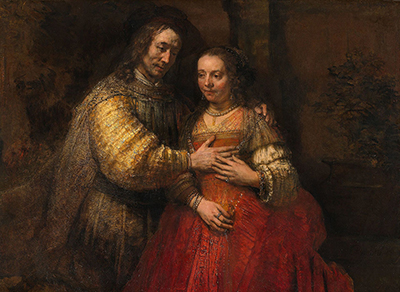
 Rembrandt.jpg)
