


 by Tom Gurney
Tom Gurney BSc (Hons) is an art history expert with over 20 years experience
Published on June 19, 2020 / Updated on August 9, 2026
Email: tomgurney1@gmail.com / Phone: +44 7429 011000
Artist in His Studio by Rembrandt: Introduction
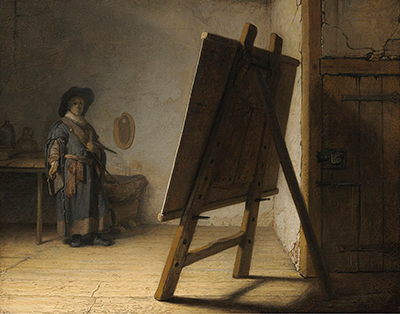
Artist in His Studio is one of Rembrandt's most intriguing early paintings because it makes the act of painting itself the subject. The panel is small, but the question it asks is large: what does it mean for an artist to stand before a work that has not yet become visible to us?
The painting is in the Museum of Fine Arts, Boston. The MFA records it as Artist in His Studio by Rembrandt Harmensz. van Rijn, about 1628, oil on panel, 24.8 x 31.7 cm. Its accession number is 38.1838, and it belongs to the Zoe Oliver Sherman Collection, given in memory of Lillie Oliver Poor.
Those facts matter because the picture can easily be made too romantic. It is tempting to treat the small figure as a direct confession by the young Rembrandt, or to read the studio as a window into his private mind. A safer and more interesting approach begins with what the painting shows: a compact interior, a small artist, a large easel or canvas, and a striking distance between maker and work.
Contents
- Introduction
- What the Painting Shows
- Why the Small Scale Matters
- Is It a Self-Portrait?
- Studio, Thought and Distance
- Rembrandt at the Beginning
- How to Look at Artist in His Studio
- Why Artist in His Studio Matters
What the Painting Shows
The artist stands near the back of the room, small in scale and almost swallowed by the studio space. He faces a large canvas or panel set on an easel. We do not see the image he is making. Instead, we see the support turned away from us, dark, upright and physically imposing.
This reversal is the painting's central invention. Many paintings invite viewers to admire a finished work. Artist in His Studio asks us to imagine the moment before the finished work exists. The canvas is present, but its subject is hidden. The painter is present, but his act is paused or held at a distance. The studio is not crowded with anecdotal detail. It becomes a stage for concentration.
The scale relationship is deliberately unsettling. The artist is not presented as a heroic figure dominating his tools. The large working surface seems to confront him. The open floor between figure and easel gives the scene a charged stillness, as if thought itself has become part of the composition.
Why the Small Scale Matters
At 24.8 x 31.7 cm, the panel is physically modest. That modest size intensifies the strange drama of the image. Rembrandt uses a small format to create a large mental space. The room feels bigger than the object that contains it, and the canvas within the room feels bigger still.
This is one reason the painting belongs so naturally to Rembrandt's early career. Around 1628 he was still a young Leiden artist building his reputation through ambitious invention, dramatic light and compact narrative pressure. He did not need a large canvas to make a large claim. A small panel could carry a serious artistic problem.
Here the problem is not a biblical miracle, a historical scene or a commissioned likeness. It is the painter's relationship to the work before him. The subject is artistic labor before it becomes public achievement.
Is It a Self-Portrait?
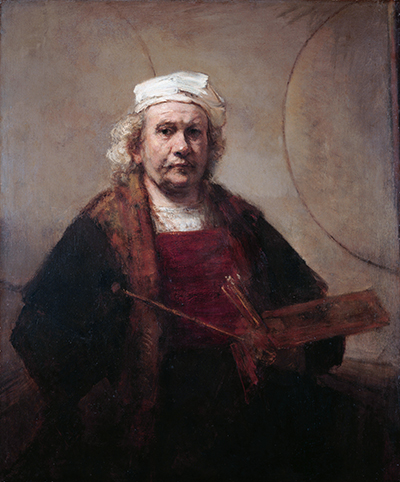
The painting is often discussed in relation to Rembrandt's artistic identity, and that connection is reasonable. Rembrandt's later career would include an extraordinary body of self-portraits in painting and etching, along with images that test costume, expression, status and the role of the artist. Artist in His Studio sits near the beginning of that larger story.
But it should be handled carefully. The MFA title does not require the viewer to identify the figure as a confirmed self-portrait. The safest public reading is that the painting presents an artist in a studio, made by Rembrandt at an early moment in his career. That is already enough.
The picture does not need a firm self-portrait claim to matter. Whether or not the figure is meant as Rembrandt himself in a strict likeness sense, the painting is deeply concerned with artistic identity. It shows the artist as someone who works, pauses, looks and measures himself against the task before him.
That makes it different from a simple portrait of a painter. It is less about appearance than position: artist before canvas, body before work, ambition before result.
Studio, Thought and Distance
The most powerful part of Artist in His Studio may be the distance between the figure and the easel. In ordinary studio imagery, the artist might be shown actively painting, surrounded by tools, models, pupils or evidence of craft. Rembrandt gives us something quieter.
The painter stands apart. The canvas or panel looms. The empty floor becomes meaningful. It suggests that painting is not only manual action but also decision, hesitation and judgment. The work has to be imagined before it can be made.
Smarthistory's reading of the painting is useful here because it stresses how unusual the composition is: the viewer sees the artist and the back or side of the work, not the finished image. The result turns attention away from display and toward the pressure of making.
That pressure should not be overstated into a biography of Rembrandt's feelings. The painting is not a diary entry. It is a constructed image. Its power lies in how pictorial choices make an idea visible: the artist is small, the work is large, and the studio becomes the space where those two facts meet.
Rembrandt at the Beginning
In the late 1620s Rembrandt was developing the qualities that would define his mature art: dramatic light, concentrated staging, strong contrasts of scale, and an interest in the moment when a human situation becomes psychologically charged. Artist in His Studio applies those qualities to artistic work itself.
The painting also helps explain why Rembrandt's early works should not be dismissed as merely small or preliminary. A compact panel could explore ambition, status and invention. The young artist's world was not yet the Amsterdam world of great patrons, civic commissions and international fame, but the questions were already serious.
Later Rembrandt would make self-portraits that present the artist in costume, as printmaker, as old master, as professional presence and as aging figure under pressure. He would also run a studio, teach pupils and create a body of work that later generations would copy, admire and debate. Artist in His Studio is not a summary of all that. It is an early signal that Rembrandt understood artistic identity as something worth picturing.
How to Look at Artist in His Studio
Begin with the room. Notice how much space Rembrandt gives to the floor, wall and air around the figure. The setting is sparse, but not empty. Its emptiness creates tension.
Then look at the artist. He is small, almost distant, but he controls the picture's meaning because his attention is directed toward the working surface. The viewer follows his attention rather than receiving a finished subject.
Next, look at the easel or canvas. It is the largest presence in the room. Because its image is hidden, it becomes a sign of possibility. It could contain anything, but for the moment it contains only the problem of beginning.
Finally, step back and consider the whole structure. The panel is not just about a studio interior. It is about the gap between intention and finished art. Rembrandt turns that gap into a subject.
Why Artist in His Studio Matters
Artist in His Studio matters because it gives Rembrandt's early ambition a compact visual form. It shows a painter not as celebrity, craftsman or courtly figure, but as someone facing the unknown work before him.
That makes the painting especially useful beside Rembrandt's self-portraits, paintings and style-and-technique pages. It prepares readers to see artistic identity as something Rembrandt returned to throughout his career. His later images of himself are more direct and more famous, but this small Boston panel has its own quiet force.
The painting also teaches a broader lesson about looking at Rembrandt. Scale is not only physical. A small work can hold a large idea. A nearly empty room can feel full of thought. A hidden canvas can become the most important object in the picture.
In Artist in His Studio, Rembrandt does not show us the masterpiece on the easel. He shows the moment of facing it. That is why the painting still feels so alive.
Frequently Asked Questions About Artist in His Studio
The MFA dates the painting to about 1628, placing it in Rembrandt's early career.
The painting is oil on panel and measures 24.8 x 31.7 cm.
The painting is often discussed in relation to Rembrandt's artistic identity, but the safest reading is not to treat the figure as a confirmed self-portrait unless a source specifically supports that claim. The work matters because it presents an artist facing the act of painting.
The hidden canvas changes the subject from a finished picture to the process of making one. We see the artist's encounter with the work before we see the work itself.
Discussion
What feels most important in Artist in His Studio: Rembrandt's light, the figure's expression, the material surface, the historical source, or the way the work sits beside his other paintings and prints?
Reader Insights
Begin with one detail in Artist in His Studio, then move outward to light, gesture, surface and the surrounding space.
Connect the work to Rembrandt's biography, workshop, medium and the museum record rather than reading it as an isolated image.
Which detail changes the interpretation most once you know the date, subject, attribution history or present collection?
Join the Conversation
Have a thought or observation about Artist in His Studio? Share it below. Thoughtful responses may be added to this section as the Rembrandt pages develop.
References
- Museum of Fine Arts, Boston, Artist in His Studio: https://mfaboston6.emuseum.com/objects/32665/artist-in-his-studio
- Smarthistory, Rembrandt, The Artist in his Studio: https://smarthistory.org/rembrandt-the-artist-in-his-studio/
- Museum of Fine Arts, Boston, Rembrandt artist search context: https://mfaboston6.emuseum.com/search/Rembrandt
 Rembrandt.jpg)