


 by Tom Gurney
Tom Gurney BSc (Hons) is an art history expert with over 20 years experience
Published on June 19, 2020 / Updated on August 9, 2026
Email: tomgurney1@gmail.com / Phone: +44 7429 011000
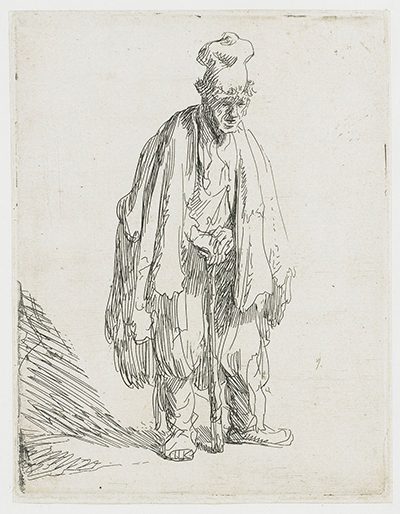
This simple but well delivered artwork from Rembrandt perfectly suited his growing confidence within the etching medium. It was completed in around 1629/1630, but many series of prints would have been produced from it across a period of several years.
Rembrandt was always intrigued by the lives of the poor, certainly more so than most artists of this period. He would even depict himself as a beggar in several self portraits in an attempt to better understand their predicament and mindset. The artist also liked to work fairly quickly with his etchings in the early days and would not always include too much detail, keeping things fairly simple. He was talented enough to achieve an awful lot with just an economical use of line, just as the likes of Picasso would do many centuries later with his famous single line creations. Whilst learning from professional printmakers, Rembrandt was keen to forge his own path and became secretive over time about his methods of production, even unwilling to relay his methods to members of his own studio.
The artist would produce so many portraits that historians would start to name them in a very descriptive manner in order to make identifying them more easy. This piece is therefore known as Beggar in a High Cap, Standing and Leaning on a Stick, and that essentially sums up the content here. There is no background to speak of, and just a slight shadow to the left hand side. The elderly figure looks worn by life and wears some heavy looking clothing which aims to protect him from the elements. He leans onto a stick which underlines his health problems that no doubt have been either caused by, or worsened, by his living conditions. Rembrandt must have had a compassionate side to his character in order to even notice these individuals, as many other members of society would walk by without even being aware of their existence.
One of the prints from this etching can be found in the collection of the Minneapolis Institute of Art in the US. They possess an impressively diverse selection of artifacts from different civilisations and their European art is just a small part of that. You will find, for example, many examples of Chinese and Japanese art here, as well as a number of items from African cultures as well. There is so much to see and enjoy here that almost any taste is catered for somewhere within this large and diverse selection of items. It can be considered one of the more interesting collections within the US, and draws in all manner of different parts of society because of the variety on display.
Object Notes and Research Context
Rijksmuseum and National Gallery of Art records place this etching around 1629-30 and connect it with Rembrandt's early beggar studies. The Rijksmuseum notes the vertical parallel hatching and the relatively coarse but lively handling, while the NGA records the sheet as an etching in the Rosenwald Collection.
The figure belongs to a broader Leiden-period experiment. Rembrandt was looking closely at poor, itinerant and marginal figures, but he was also learning what etched line could do: a few strokes establish posture, weight, clothing and fatigue. Seen beside his other beggar prints, it becomes part of a sustained early printmaking study rather than a single anecdotal image.
The standing pose gives this beggar print a different rhythm from the seated or crouching studies. The stick, high cap and bent body allow Rembrandt to build character through silhouette before the viewer even studies the face. That makes the page a good place to explain how early etching could communicate social type through outline, not just through detail.
Because the figure belongs to a group, it is more than a one-off curiosity. Rijksmuseum and NGA records place it near Rembrandt's earliest print experiments, where roughness, quick hatching and direct observation were part of the learning process. Related beggar prints reveal the wider group of studies.
Further Rembrandt Context
This shorter legacy page remains part of the Rembrandt archive. For fuller context, use the refreshed Rembrandt pages below, which explain the artist's biography, media, technique, attribution issues and major works in greater depth.
For secure object data, attribution and collection history, compare Beggar in a High Cap, Standing and Leaning on a Stick with the relevant museum or catalogue record before treating older page text as final.
 Rembrandt.jpg)
Discussion
What feels most useful when looking at Beggar in a High Cap, Standing and Leaning on a Stick: the subject, the handling of light, the medium, the attribution history, or its place within Rembrandt's wider etching or print output?
Reader Insights
Set this page beside the refreshed Rembrandt hubs before relying on older summaries alone.
Rembrandt pages often need museum records, catalogue history and attribution caution, especially where older sources use broader labels.
Which detail would you most want clarified next: date, medium, collection, attribution, subject, condition or comparison with another Rembrandt work?
Join the Conversation
Have a thought or observation about Beggar in a High Cap, Standing and Leaning on a Stick? Share it below. Thoughtful responses may be added as the Rembrandt archive continues to be reviewed.