


 by Tom Gurney
Tom Gurney BSc (Hons) is an art history expert with over 20 years experience
Published on June 19, 2020 / Updated on August 9, 2026
Email: tomgurney1@gmail.com / Phone: +44 7429 011000
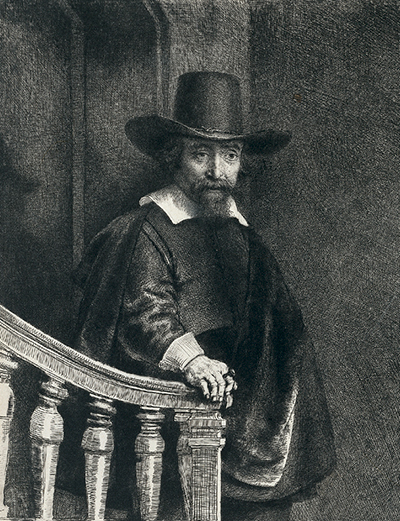
This print derives from a truly accomplished etching which came about after Rembrandt has been working with this medium for around two decades. The gentleman pictured was well known to him and had an involvement in the arts himself.
Ephraim Bonus was a Portuguese Jewish doctor in the 1640s who was sufficiently wealthy to help support local artists. He financed a printing house, for example, which is, no doubt, how he came to know Rembrandt. We do know that the artist initially produced a fast sketch in oils before transferring it into an etching for the purposes of printing. Whilst he was entirely comfortable in that process by now, it was rare for him to work from an oil painting. The model himself stands confidently at the bottom of his stairs, with a hand draped over the banisters. He is smartly dressed but appears entirely approachable at the same time. It is likely that he was particularly popular with the likes of Rembrandt because of his generous support for many struggling artists in that local area.
Rembrandt would increase the variation in tone between each state of this etching, slowly incorporating more detail and a greater contrast between the background and the various parts of the foreground. You will see, for example, some regions which are particularly dark, almost black, such as Ephraim Bonus's hat and clothing, whilst other parts use variations of grey for a more subtle finish. The overall atmosphere portrays this figure as serious but professional and certainly respected within his local community, just as he was.
There are several prints from this etching in existence today, with the most famous one remaining in the collection of the Cincinnati Art Museum in the United States. The proliferation of prints from Rembrandt's career has allowed many more institutions to get hold of some of his work when otherwise the items would be too expensive or scarce. It is quite possible that someone locally had collected this item before later donating it to the institution so that more members of the public would be able to enjoy it themselves. The prints themselves are now fairly valuable, though their precise worth is dictated by how many other versions of the print were produced, and how many still exist in good condition today, which is often very few. You will find many more interesting items in the collection of the Cincinnati Art Museum, with some of the highlights including An Artist Studying from Nature by Claude Lorrain, Samson and Delilah by Peter Paul Rubens, Rocks at Belle-Île, Port-Domois by Claude Monet and also The Fall of Tequendama, Near Bogotá, New Granada by Frederic Edwin Church, which underlines the variety in their collection.
Object Notes and Research Context
Museum records at the Met and British Museum identify this 1647 print as an etching, engraving and drypoint portrait of Ephraim Bonus, or Bueno, a Portuguese Jewish physician in Amsterdam. The British Museum's first-state description notes the figure standing with a hand on the banister; the Met records its impression as the second of two states.
The sitter gives the page a strong Amsterdam context. Ephraim Bueno came from an Iberian Jewish medical family, practised as a physician, wrote and supported Hebrew publishing. Scholarship also connects him with Rembrandt's neighbourhood and with Manasseh ben Israel's circle. That context connects the print to Rembrandt's Amsterdam biography, portraiture, Jan Six and the wider reception of Jewish Amsterdam in his art.
Ephraim Bonus is one of the most useful portrait prints for connecting Rembrandt to Amsterdam's Sephardic Jewish community without overclaiming personal intimacy. The sitter was a physician and intellectual figure, and his portrait circulated through print rather than a single painted likeness. That makes the page relevant to portraiture, Amsterdam biography and Rembrandt's printed public.
The mixed technique also deserves a simple explanation. Museum records describe etching with engraving and drypoint, so the image is not just bitten line. The banister, black cloak, face and hand show Rembrandt refining tonal weight and social presence through several printmaking methods. This gives the page a stronger technical route than a short biographical note alone.
Further Rembrandt Context
This shorter legacy page remains part of the Rembrandt archive. For fuller context, use the refreshed Rembrandt pages below, which explain the artist's biography, media, technique, attribution issues and major works in greater depth.
For secure object data, attribution and collection history, compare Ephraim Bonus Jewish Physician with the relevant museum or catalogue record before treating older page text as final.
 Rembrandt.jpg)
Discussion
What feels most useful when looking at Ephraim Bonus Jewish Physician: the subject, the handling of light, the medium, the attribution history, or its place within Rembrandt's wider etching or print output?
Reader Insights
Set this page beside the refreshed Rembrandt hubs before relying on older summaries alone.
Rembrandt pages often need museum records, catalogue history and attribution caution, especially where older sources use broader labels.
Which detail would you most want clarified next: date, medium, collection, attribution, subject, condition or comparison with another Rembrandt work?
Join the Conversation
Have a thought or observation about Ephraim Bonus Jewish Physician? Share it below. Thoughtful responses may be added as the Rembrandt archive continues to be reviewed.