


 by Tom Gurney
Tom Gurney BSc (Hons) is an art history expert with over 20 years experience
Published on June 19, 2020 / Updated on August 9, 2026
Email: tomgurney1@gmail.com / Phone: +44 7429 011000
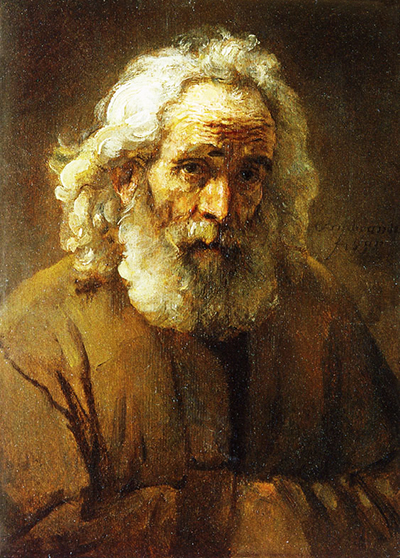
Lighting Study with an Old Man as a Model is an attribution-sensitive late Rembrandt study
Rembrandt was an artist who frequently used the elderly as models for his portraits. His use of lighting enabled him to bring out all the features of an aging face, almost making it beautiful within his own ouevre. Perhaps Van Gogh can be considered as the next best artist to have done this.
Indeed the title of this work, as a study of lighting, indicates precisely the intention of the artist when he requested his elderly model to sit for him. The style and approach is not experimental in any way, it is entirely in line with his other works from this year.
The angle of the head, facial expressions, darkened background and simple clothing all continues throughout other paintings such as another another lighting study of a young woman in a silk gown. The considerable research completed on his career has enabled us to accurately place his work chronolically, and from this we can compare his developments as an artist from one painting to another.
It may seem strange for an artist of Rembrandt's quality to require study paintings at this stage of his career - surely the majority of his skills were set in stone by this point? Like all the great masters, he was never satisfied to consider his development complete, there were always elements to any artwork that could be improved through practice.
Object Notes and Research Context
The work is best understood as a cautious late-study entry rather than as a simple flagship painting. The title itself points readers towards function: the old man's head and upper body are less important as a named portrait than as a test of how a face, beard and garment can be made to emerge from darkness. That makes the work useful within Rembrandt's late lighting studies, but the claims around it need to stay within what the evidence supports.
Specialist Rembrandt catalogues and image repositories connect the painting with the Bader collection and a date around 1659. Within the wider late Rembrandt group, such studies belong beside tronies, apostle heads and old-man figures in which light is used to carry mental presence rather than just visibility. The handling should therefore be compared to the technique and workshop pages, while keeping the attribution note visible for readers.
Speculative biography adds little here. The value lies in a focused explanation of late lighting, old-age models, private collection status and attribution caution.
The attribution warning should remain visible, but the page can still be useful if it is framed around function. A lighting study asks readers to look at the behaviour of illumination: the forehead, cheek, nose and beard catch light unevenly, while the robe and ground fall away. In late Rembrandt and Rembrandt-related work, that kind of restricted visibility often becomes a way of suggesting thought, age and inwardness.
The limits of the documentation also matter. Unlike paintings with full museum catalogues, conservation dossiers and stable collection records, this object is encountered through more fragile catalogue and image pathways. That does not make it irrelevant, but it does make it a support example for technique and attribution rather than a major independent proof text.
This is also a good support page for the style-and-technique hub because it lets readers see chiaroscuro as a working problem rather than just a famous label. The old man's face is legible only because light is rationed carefully across a small number of surfaces.
Further Rembrandt Context
This shorter legacy page remains part of the Rembrandt archive. For fuller context, use the refreshed Rembrandt pages below, which explain the artist's biography, media, technique, attribution issues and major works in greater depth.
For secure object data, attribution and collection history, compare Lighting Study with an Old Man as a Model with the relevant museum or catalogue record before treating older page text as final.
 Rembrandt.jpg)
Discussion
What feels most useful when looking at Lighting Study with an Old Man as a Model: the subject, the handling of light, the medium, the attribution history, or its place within Rembrandt's wider painting output?
Reader Insights
Set this page beside the refreshed Rembrandt hubs before relying on older summaries alone.
Rembrandt pages often need museum records, catalogue history and attribution caution, especially where older sources use broader labels.
Which detail would you most want clarified next: date, medium, collection, attribution, subject, condition or comparison with another Rembrandt work?
Join the Conversation
Have a thought or observation about Lighting Study with an Old Man as a Model? Share it below. Thoughtful responses may be added as the Rembrandt archive continues to be reviewed.