


 by Tom Gurney
Tom Gurney BSc (Hons) is an art history expert with over 20 years experience
Published on June 19, 2020 / Updated on November 19, 2026
Email: tomgurney1@gmail.com / Phone: +44 7429 011000
Introduction
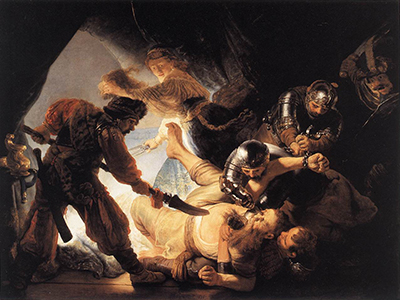
Delilah is almost out of the dark when she turns to look back. She carries a pair of shears and the hair cut from Samson’s head. Below her, the man who once broke his bonds as easily as thread lies on his back, held down by Philistine soldiers. One bare foot kicks into the space beside her, its toes curled. A blade meets Samson’s eye in the lower half of the picture. Rembrandt gives the foot almost as much light as the face, making an involuntary movement register across a canvas more than three metres wide. The whole body seems to recoil from a point that occupies very little of the painted surface.
Rembrandt Harmensz. van Rijn signed and dated The Blinding of Samson in 1636. The Städel Museum in Frankfurt am Main records it as oil on canvas, measuring 219.3 × 305 cm, under inventory number 1383. The inscription is near the lower centre. The painting belongs to the museum’s Old Masters collection and is currently off display during a multiyear conservation project. Its first owner and the circumstances in which Rembrandt undertook it remain uncertain. [1]
The great span of canvas allows several actions to remain legible at once. Delilah’s flight, a soldier’s backward glance across the group, the glint of armour and the exposed skin of the fallen man all compete for attention. Yet a study of the layers beneath the surface shows how deliberately Rembrandt narrowed that attention as he worked. The appearance of sudden catastrophe took shape through successive decisions about how many people to show, where they should stand and how much darkness to leave around them.
At a Glance
- Date1636
- MediumPainting
- CollectionStädel Museum, Frankfurt
- SubjectSamson’s capture in Judges 16
The moment Rembrandt chose from the Book of Judges
Chapter 16 of Judges gives the encounter a long preparation. The Philistine rulers offer Delilah a reward if she discovers how Samson can be subdued. Three times he misleads her. Fresh bowstrings, new ropes and the weaving of his hair into a loom all enter the story before he tells her that his head has never been shaved and that he has been consecrated to God from birth. She has him sleep on her knees and calls a man to shave off the seven locks of his hair. When she raises the alarm, Samson expects to free himself as before. The narrator explains that he does not yet know the Lord has left him. The Philistines seize and blind him, take him to Gaza and put him to work grinding in prison. [2]
The cut hair thus belongs to a story about an obligation extending back to Samson’s birth. It makes the breaking of that obligation visible. The narrative gives the loss of strength particular force by allowing Samson to wake with every expectation that his strength will answer him again. One can imagine a painter choosing that moment of discovery, with the first hands reaching towards him and his confidence about to fail. Rembrandt chooses the moment when the consequences have already become physical. The fallen man has evidently discovered what his captors can do, and his expression belongs to that discovery as much as to the pain of the injury.
The text moves quickly from the cutting of the hair to the blinding and imprisonment. Rembrandt brings the first two events into contact through Delilah. The chapter gives her a role in arranging the haircut, and the finished picture puts the shears in her hand. It keeps her close enough to the assault for her expression to matter. Her portrait of the event, so to speak, is another part of the event we are watching. There is little in the biblical account to specify the cave-like space, the dramatically placed opening or the position in which Samson falls. Those decisions give the action a location, a duration and a set of witnesses. [1] [2]
Judges goes on to say that Samson’s hair begins to grow again. At the Philistines’ celebration in the temple of Dagon, he prays for renewed strength, pulls down the building and dies among his enemies. Knowing the end changes the meaning of the light on his body. This is the point in the story at which his enemies appear to have settled his fate, and the picture grants their success the full weight of a monumental composition. The future destruction of the temple remains outside that composition. The legs of the man who will bring down its pillars are momentarily occupied with the bare effort to pull away. [2]
Samson’s fall and the soldiers around him
Samson’s body cuts across the lower part of the canvas at an awkward angle. His head is low and to the right, his hips and the folds of his pale garment extend leftwards, and a bent leg rises towards the light. The nearer arm ends in a clenched hand close to the bottom of the painting. The other arm is pulled up into the group on the right. The limbs give unusually precise information about the limits of his movement. The foot can rise and the fingers can close, while the weight of his opponents keeps his body on the ground. That discrepancy makes his strength credible even in defeat.
The upturned foot is easy to find from a distance. Close inspection makes the toes important. They curl towards the sole and break the clean contour that a fully extended foot would have made. The gesture involves a small part of a very large figure, yet it carries something of the whole figure’s distress. Jochen Sander, the Städel’s curator of early German, Dutch and Flemish painting, singles it out as an involuntary expression of pain. Its position also gives it a compositional role. The foot enters the light below Delilah, drawing a piece of Samson’s struggle towards the opening through which she is departing. [3]
The attackers occupy sharply differentiated positions. A helmeted soldier bends over the face. Another, higher up, handles the chain at Samson’s raised arm. The figure underneath Samson, his face visible near the bottom right, helps contain the weight of the torso. At the left edge a halberdier leans into the incident, his legs braced apart and the long weapon entering the light across the foreground. The man farthest to the right lifts a sabre. The soldiers’ actions overlap, so that the ease with which we can pick them out depends on exactly where the painter has allowed a sleeve, a hand or part of a helmet to catch the light. [4]
The halberdier’s position gives him a special importance. He is separated from the soldiers on the right by a wedge of light, and his broad footing makes him an obstacle along the foreground. The head of his weapon reaches towards the centre at about the level of Samson’s clothing. Its dark shape interrupts a large pale passage and gives the eye a direction to follow. Across the canvas the sabre answers it from above. Those outer weapons enclose the smaller movement at Samson’s face, which has greater consequences than any of the larger gestures surrounding it.
The face of the soldier who carries out the blinding is difficult to read under the rim of his helmet. Rembrandt supplies more information about the reflection on the metal and about the way the man bends his head. The detail allows the action to feel purposeful while leaving his expression largely inaccessible. Farther towards the right edge, the sabre bearer’s face remains distinct enough to convey a reaction of its own. He can be understood as participating in the attack and as seeing what it has become. The difference between those two soldiers matters in a picture where a viewer keeps moving between awareness of the group and attention to individual acts.
Delilah’s turn towards the dark
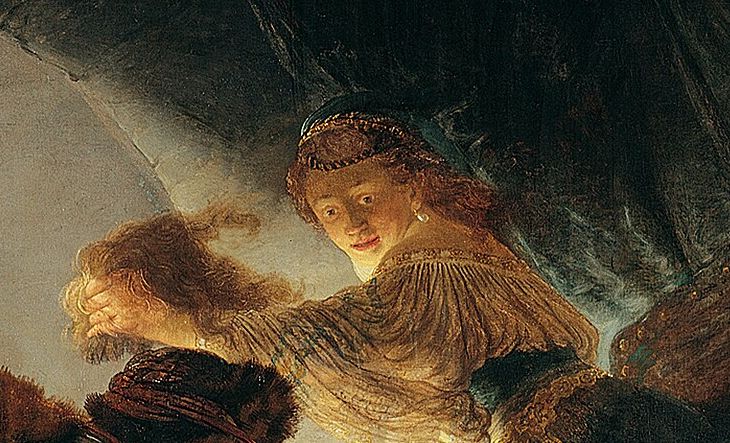
Rembrandt gives Delilah a forward movement and a backward look. Her body leads towards the opening behind the halberdier, while her head turns down towards the scene. The bright folds across her shoulders and arms catch this change of direction. The cloth bends around her body and seems to follow a fraction of a second behind it. The cut hair forms a softer, less regular shape than the metal shears. Both have served their purpose by the time she appears with them. Her glance makes that earlier action and the one at Samson’s face belong to a single moment.
Her expression is open to several readings. The Städel’s account sees triumph, fascination and disgust in the look back. Surprise is equally plausible in the slight opening of her mouth and the sudden turn of her head. The repeated failures in Judges give that surprise a particular context. She has put information to the test before and seen Samson break free. This time she carries material evidence that he told her the truth, and she can see the consequences for herself. A viewer can read satisfaction or alarm into the expression, and the distance between her moving body and her intent gaze allows both emotions to remain in play. [1] [2] [3]
Close examination has also altered what can be said about her headgear. The published technical study identifies evidence of a substantial feather that was much more prominent during the painting’s development. Only a part of the original feature remains discernible close up, where it is absorbed into the cloth around her hair. Her eyes, too, were adjusted slightly during painting. A research image can give these small changes surprising clarity. In the finished work they are felt indirectly, in the balance between a costume elaborate enough to catch the light and a face sufficiently clear to hold a viewer’s attention. [4]
Delilah’s features have sometimes been associated with Rembrandt’s wife, Saskia van Uylenburgh. The man at the far right has likewise been compared with Rembrandt’s self-images. Both proposals depend on visual resemblance. For the soldier, a comparison is the small 1630 Self-Portrait in a Cap, Wide-Eyed and Open-Mouthed. The Städel holds one impression, inventory 6055 D, and the Rijksmuseum holds another. They are separate sheets printed from the same design. The compact face, wide eyes and open mouth show how much expression Rembrandt could bring to a very small space. The comparison helps to explain the liveliness of the soldier’s expression on the margins of an enormous painting. The identity of a model for either figure remains uncertain. [4] [5] [6]
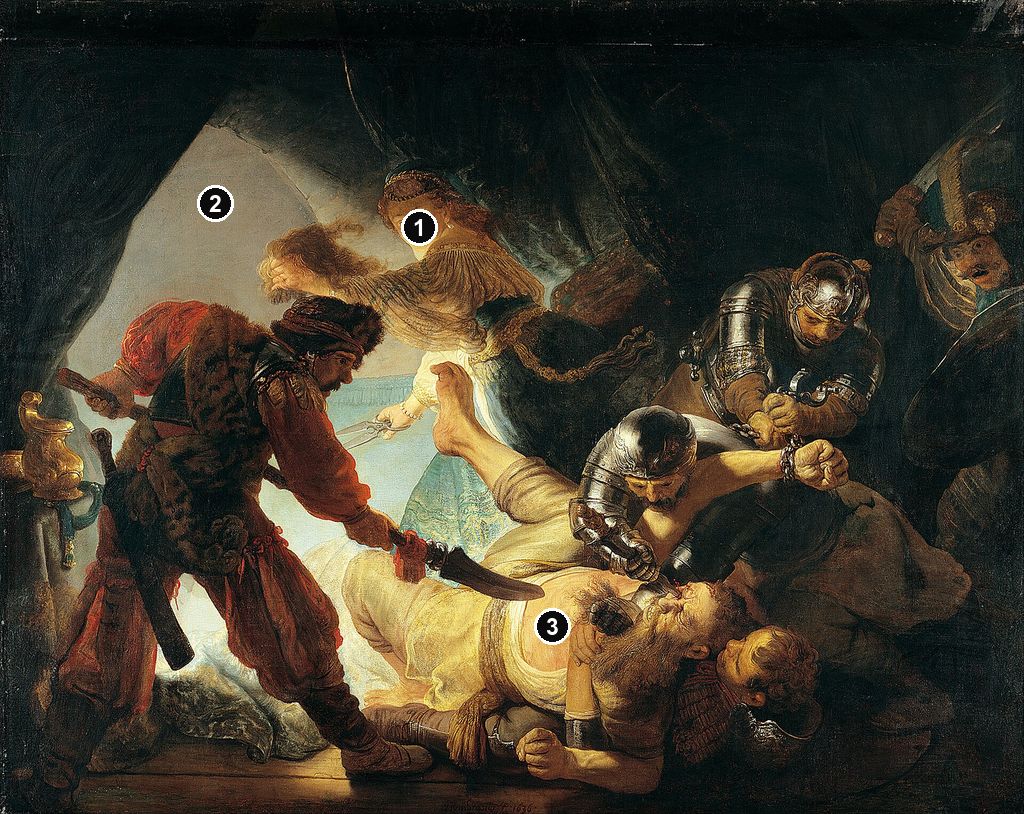
Annotated Details from The Blinding of Samson
Follow the opening behind Delilah and the light crossing the fallen Samson.
Details from THE BLINDING OF SAMSON
Open a detail to inspect it at a larger size.
Delilah’s turn
Delilah looks back across her shoulder as she moves towards the bright opening.
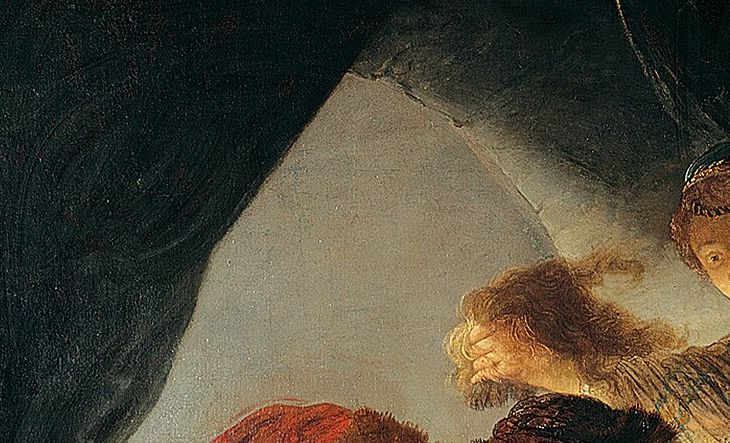
Light at the opening
A pale opening in the dark catches the edge of Delilah’s figure and deepens the shade across the foreground.
Samson in the foreground
Light brings the pale clothing and the body forward against the surrounding figures.
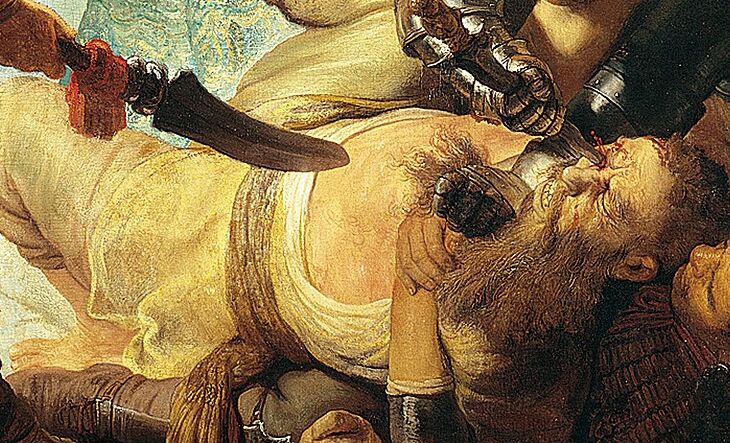
Städel Museum reproduction via Google Art Project. The annotated image adds markers, and the details are cropped. Photograph source · Public Domain Mark 1.0
Light at the entrance and along the floor
The opening behind Delilah and the halberdier establishes a bright area with irregular borders. The dark material hanging above it falls into the scene at an angle, and the interruption of that angle by Delilah’s figure makes her position especially easy to locate. The brightness then seems to move downwards, across Samson’s exposed leg and clothes and towards the cramped space in which his head lies. At the right, it survives in patches on the helmets and armour. The pattern gives the scene depth without requiring the viewer to make out the whole enclosure.
The staging is often described in theatrical terms. Sander relates it to the pleasure audiences in Rembrandt’s Amsterdam took in theatrical effects, noting the opening of the city’s purpose-built Schouwburg soon after the painting was made. The painted hanging resembles a curtain, and the light has the concentrated effect of stage illumination. These are useful analogies for how the picture addresses its audience. The spectators in front of it are given a clear view of a small number of sharply timed actions, while broad passages of darkness keep the surrounding space indefinite. [3]
The light on the soldiers behaves differently from the light on Samson. The high point on a helmet is bounded and sharp, and the curved surface falls quickly into shadow. Samson’s clothing catches broader bands of brightness, so that the weight and depth of its furrows remain visible over several folds. His bare chest and leg offer longer transitions between warm light and half shadow. These changes of texture help establish the positions of overlapping bodies. A narrow flash can locate a soldier within the mass, while the broad light on Samson holds the lower half of the painting together.
The contrast also makes the interior feel more confined than its size suggests. The light beyond the hanging implies space that Delilah can enter. On the right, the dimness beyond the sabre bearer supplies little sense of where the next step might lead. The floor is clearest by the halberdier’s feet, where a few lit shapes and edges anchor his stance. It loses definition towards the right, where soldiers and victim press together. In a reproduction the main diagonals are immediately apparent. At the scale recorded by the Städel, the gradual discovery of figures and objects in the shadows is also part of the experience. [1] [4]
Rubens and the fallen hero
The Städel has placed Rembrandt’s figure in conversation with Prometheus Bound, the great canvas by Peter Paul Rubens and Frans Snyders now in Philadelphia. Rubens devised the twisting body of the Titan and Snyders painted the eagle. The painting was begun around 1611–12 and completed by 1618. In it, the light gives Prometheus’s powerful body a startling clarity against rock, shadow and the dark spread of the eagle’s wings. The pose carries the violence into the limbs, so that even at a distance the viewer can read the twisting torso and the effort of the legs. [7] [8]
The comparison helps explain the dignity Rembrandt gives a hero at his least commanding. Samson retains the powerful physique expected of him. His body is conspicuously large within the available space and requires a whole group to hold it. The image of Prometheus offered a way to make a sprawling body dominate a painting even while under attack. In Rembrandt’s biblical scene that device draws the victim into a dense arrangement of other people, some close enough to touch him and others watching across the space. The Städel interprets the connection as a form of competition with Rubens. The echo in pose and effect supports that reading, while leaving the exact route by which Rembrandt knew the composition open. [7] [8]
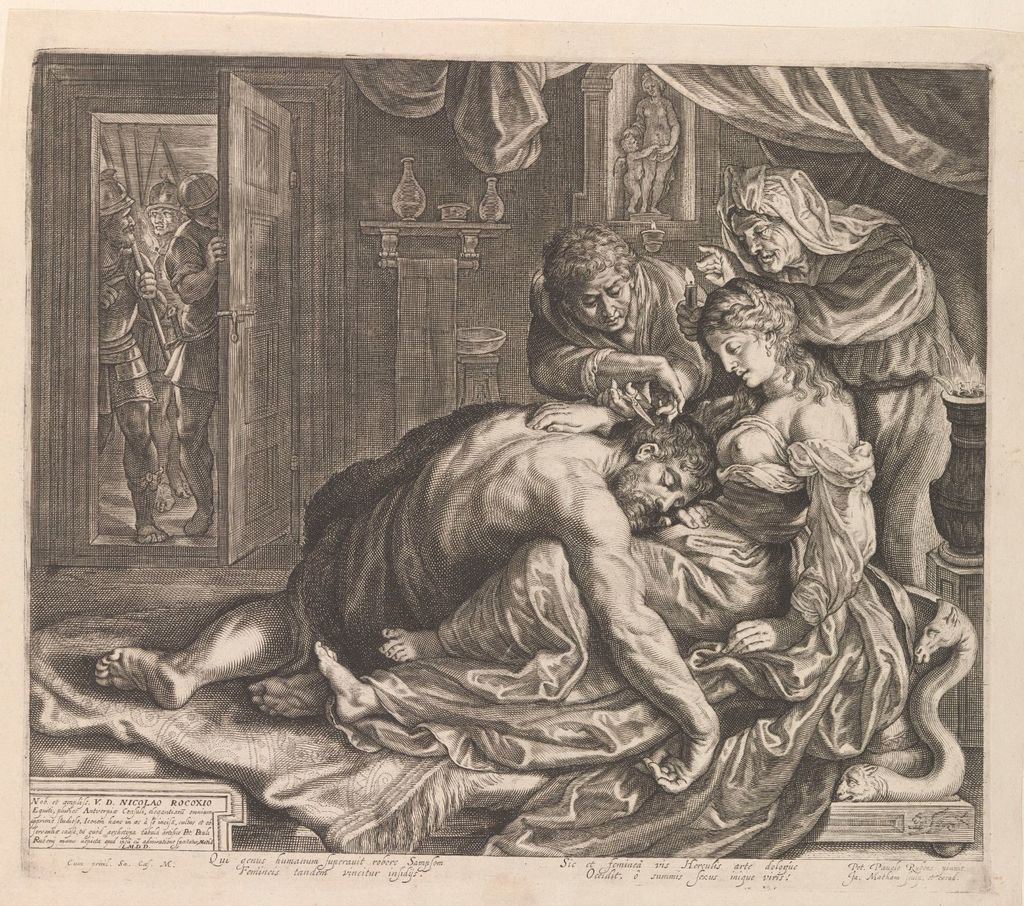
Rubens’s Samson and Delilah, in the National Gallery in London, makes the choice of narrative moment especially clear. Samson sleeps with his head in Delilah’s lap while a man cuts the hair. An older woman holds a candle near the action, and armed men wait at the doorway. The broad sleeping body occupies the foreground, and the candle draws the viewer towards an act carried out in secrecy. Delilah can still reach him and the men at the door have yet to enter. The small radius of candlelight suits a scene in which the outcome depends on preserving sleep for a few more moments. [9]
Rubens also treated the blinding itself in the painting now in the Museo Nacional Thyssen-Bornemisza. That object is distinct both from the London Samson and Delilah and from Rembrandt’s Frankfurt canvas. The Madrid and Frankfurt works share the biblical episode and give an important place to the mass of figures surrounding Samson. In Frankfurt, the extension of Delilah’s flight into the illuminated opening leaves a particularly strong trace of the earlier betrayal inside the scene of physical capture. The cut locks take up little room against all the armour, yet they explain why the soldiers can bring the hero to the ground at all. [10]
Watch: Rembrandt’s life and work
Explore Rembrandt’s early career, etchings and paintings, and see his work alongside that of other Baroque artists.
Rembrandt | A Life of Art
Curators introduce Rembrandt’s early career and trace how he developed his handling of light and shade.
Watch on YouTubeA history painting from Rembrandt’s early Amsterdam years
The ambition of the commission for The Anatomy Lesson of Dr Nicolaes Tulp offers a measure of how quickly Rembrandt enlarged the scope of his work in Amsterdam. The Mauritshuis records that the surgeons commissioned the painting for Tulp’s lesson in January 1632. The pale body of Aris Kindt forms a diagonal in the foreground, while the living men’s faces and hands create a web of attention around the demonstration. Tulp’s teaching gesture and the direction of the surgeons’ gazes allow a group portrait to hold the interest of a particular event. [11]
In The Blinding of Samson, a body in the foreground again determines the positions of the living figures around it. Almost everything about the group’s relation to that body has changed. The men around Tulp can keep their distance and look in several directions. Samson’s captors overlap his limbs and lean across one another’s working space. A bent helmet can take the place of a fully visible face because the figure’s role in the action is already clear from the posture. Rembrandt uses the attentiveness that animated a commissioned group portrait to make a biblical event intelligible across a much larger canvas.
The National Gallery dates Belshazzar’s Feast to about 1636–38. That painting also gives the moment of discovery a visible physical form. The king throws up a hand, vessels tip, and a woman at the edge spills wine as the mysterious writing appears. The light belongs to the sudden intrusion of the sign. In Samson, the strongest light falls across a body already in motion and a woman who can still get clear. The National Gallery’s scholarly catalogue draws attention to the affinity between the pictures in their handling of extreme gesture and light. The comparison is most revealing at the edges, where people beyond the principal figure show how far the shock has travelled. [12]
These works help give the term history painting a concrete meaning. The painter must decide the point at which an event becomes legible through a body and when the eye should move on to the next figure. In Samson, the task extends to the relative visibility of an eye, a weapon and a small handful of hair, all separated by substantial distances on the physical canvas. The particular difficulty is to let one apparent instant contain what has just happened, what people are doing now and what each person understands about it. That work of compression accounts for much of the picture’s theatrical force.
The letter to Constantijn Huygens and the uncertain commission
The signature secures 1636 as the date of the painting. The circumstances that brought a canvas of this size into Rembrandt’s studio are more elusive. On 12 January 1639, the painter wrote to Constantijn Huygens offering a picture described by its dimensions, approximately ten feet wide by eight feet high in the units used in the letter. Huygens was secretary to the stadtholder, Frederik Hendrik, Prince of Orange. He mediated matters of delivery and payment for the Passion paintings that Rembrandt made for the prince. A subsequent letter in January places a canvas in the course of being sent, despite the recipient’s initial reluctance. The correspondence leaves the subject of the offered picture unnamed. [13]
The monumental size makes The Blinding of Samson a plausible candidate. Michael Zell notes that the painting’s original dimensions correspond to those in the letter and discusses how a work of this stature might have functioned as a courtly gift. Its scale and demanding subject make the suggestion vivid. An object that took up such a large part of a wall would be a conspicuous acknowledgment of the secretary’s help. Its ability to advertise the painter’s command of ambitious narrative would travel with it. [13]
Several questions remain open even if the identification is accepted. The letter belongs to 1639, three years after the date on the canvas. An offer at that point could tell us about the use Rembrandt found for an existing work. The original reason for painting it would still need independent evidence. The records of the prince’s Passion commission establish the setting for the correspondence and the value of Huygens’s assistance. The biblical scene in Frankfurt has its own subject and history. Scholars have also differed over the identity of the gift, with Danaë proposed as an alternative, and over whether Huygens ultimately kept the canvas sent to him. [13]
The work invites speculation about its first setting. Its scale would have had an immediate effect in a substantial domestic or courtly room, where the viewer could move from the broad diagonal of the group into the fine detail of the faces. The strenuous composition would also have been a public measure of Rembrandt’s standing as a painter. Those possibilities explain the interest in the Huygens letter. The early ownership gap in the Städel’s provenance leaves the original commission, if there was one, and the first destination unresolved. [1] [13]
From the Schönborn collection to Frankfurt
The most solid part of the painting’s early ownership begins before 1731, when the Städel places it with Count Friedrich Karl von Schönborn-Buchheim, the prince-bishop of Bamberg and Würzburg. Later names in the museum’s provenance link it with the Schönborn family in Vienna. The last transfer is recorded with a precise date. On 15 May 1905 it was sold through Dominik Artaria of Vienna to the Städelsches Kunstinstitut in Frankfurt. The gap before the first documented Schönborn owner still leaves room for more than one account of how it travelled out of the Netherlands. [1]
The purchase required an unusually broad effort. The Städel’s director, Ludwig Justi, negotiated a price of 336,000 marks, beyond what the institution could raise alone. The museum records that eighty-five private donors supplied 167,700 marks within days. The city of Frankfurt and the Städelscher Museums-Verein made large contributions, and the acquisition credit also names the Städelsche Stiftung. The sums and the speed of the fundraising give a sense of the standing the painting had already acquired by the beginning of the twentieth century. [1]
The change of ownership also changed the terms in which the painting could be seen. A large canvas kept in a family collection became available for public comparison with other Dutch and Flemish pictures. Its presence in Frankfurt eventually made possible the juxtaposition with Prometheus Bound and the close comparison with a print from Rembrandt’s own collection of facial inventions, represented by the museum’s 1630 impression. The institutional history is thus part of the history of interpretation. Where the painting hangs, what can be brought beside it and how far it is possible to examine its surface all affect which features come into focus.
What the scans reveal beneath the paint
The painting had already undergone examination in connection with restoration in the 1980s and the work of the Rembrandt Research Project. X-radiographs, infrared reflectography, photographs under different kinds of light and analyses of minute samples provided evidence about the structure of the picture. In early 2021, during the Städel’s pandemic closure, a new micro X-ray fluorescence investigation mapped nearly the whole canvas in sixteen overview scans and a detail scan. Findings were presented at the Städel’s technical symposium in January 2022. Mareike Gerken and Jochen Sander published the fuller study in ArtMatters in 2025. [4]
X-ray fluorescence maps show where particular chemical elements register across the painting. Mercury points to vermilion in passages where that identification fits the other evidence. Copper can help follow a copper-based blue, including some passages where microscopy and analysis of samples identified azurite. Since a signal can come from material under the visible surface, a map may show brushwork quite different from the image a viewer sees. Researchers compare maps with one another, with older imaging and with the physical samples. How strongly an element registers depends in part on the layers above it. A clear shape in one map can be compelling evidence, while a weak trace calls for care in reconstructing an individual feature. [4]
The evidence begins with the preparation of the cloth. The researchers describe two ground layers, a reddish ochre preparation followed by grey containing substantial lead white. The lead map shows the upper ground applied in three broad horizontal sections. The orientation of some marks suggests that the canvas may have been turned during preparation. Other traces are consistent with a tool such as a priming knife. Such evidence brings the scale of the work into the studio. Even the creation of a continuous surface on which to begin painting involved reaching, turning and working across successive areas. [4]
The maps also register changes at the edges of the principal action. An arrow-filled quiver once appeared at the back of the halberdier on the left. Fur now occupies that passage. In the upper-right half of the picture, the mercury map revealed the sketched head of an additional soldier, tipped down towards the left. The researchers identified a helmet and strap in the economical brush lines. The head was abandoned before it was fully painted. A raised spear was also indicated and subsequently covered. The researchers link these changes with the development of the sabre bearer and the concentration of the surviving soldiers on the diagonal towards Samson’s face. [4]
Photographs of a lost workshop version formerly in Kassel give those findings an independent point of comparison. That canvas, destroyed in 1945, showed spears which the Frankfurt painting conceals and preserved an earlier arrangement of the dagger wielder’s arm. It also lacked the extra head sketched in red, suggesting access to a relatively advanced stage of the developing composition. The evidence supports the identification of the Kassel picture as a workshop variant made while the Frankfurt work was taking shape. A related drawing in brush on paper, also discussed in the technical study, is a separate object of unknown whereabouts. Its published image can be compared with the canvases, with the limits that the absence of the sheet places on examination. [4]
Colour, texture and the force of the instant
Rembrandt used several means to bring pale passages forward. Gerken and Sander describe relatively thick, opaque paint over dark underpainting in parts of Samson’s leg and the halberdier’s hand. In parts of Delilah’s skin and the light background, thinner layers incorporate the light underpainting into the final effect. Thus two passages that seem similarly bright at a distance can have quite different physical structures. Some of the curling hair was articulated by scratching through a darker layer to expose lighter paint below. At a small scale that produces the glancing effect appropriate to a strand turning towards the light. [4]
The pigments also give substance to colours that a small image can compress into a general warmth. In the halberdier’s reddish garment, vermilion contributes to both mixtures and individual bright accents. Lead-tin yellow helps account for some of the fine highlights in Delilah’s costume and broader areas of Samson’s pale yellow clothing. Copper-based blue and smalt occur in different areas of Delilah’s skirt. The latter, a cobalt-bearing powdered glass, has also been detected in dark background paint, where its deterioration has contributed to a loss of tonal distinction. The present relationship between blue, brown and shadow consequently bears traces of the painting’s material age. [4]
Some of the most affecting details require very little paint. A sharply placed highlight is enough to bring a link of chain or an edge of armour into view. The red at the point of injury occupies a tiny area in proportion to the pale garment and to the darkness over the group. The study identifies vermilion in that late detail. Its effect depends on the converging poses that make the viewer notice it, and on the way Samson’s larger movements give it consequence. There is room in the painting for the eye to travel, yet a point near the bottom of the canvas determines the significance of nearly everything it encounters. [4]
The technical findings also make the dark intervals easier to appreciate. Part of the large gap above the soldiers exists because Rembrandt abandoned a head there. The final angle of the raised sabre and the rhythm of the helmets belong to a design he was still adjusting on the canvas. A busier upper right would have carried the suggestion of a wider body of troops. The finished group is concentrated within reach of the fallen man. What looks like confusion on first encounter depends on carefully placed areas of quiet, including a stretch of background in which the painter once considered giving us another face to read. [4]
Conservation and the painting’s return to view
The Städel announced the start of extensive conservation and restoration on 30 September 2025, with an estimated duration of three to four years. The planning grew out of the 2021–22 Rembrandt exhibition and the accompanying scientific research. The museum identified both natural ageing and earlier restoration as factors affecting the picture’s appearance. The project is supported by Bank of America’s Art Conservation Project. The three-to-four-year estimate gives the expected scale of the undertaking. The museum has yet to announce a firm date for the painting’s return. [14]
In July 2026, Sander described a problem with the upper varnish that is particularly relevant to a painting so dependent on dark tones. A fine network of cracks scatters incoming light, producing a greyish veil especially apparent in the shadows. The varnish has also yellowed and darkened. Some later retouching disrupts the surface further. These effects can coexist in the same area. A coating may have become darker with age and still produce a paler, cloudy appearance where its cracked surface scatters the light. Small differences in the shadow around a face or between two adjoining fabrics can become difficult to read. [3]
In the Städel’s update of 1 October 2026, conservator Stephan Knobloch reported that work was underway to remove non-original varnish and later overpaint or retouching while conserving the original ground and paint. He discussed the quiver and the additional soldier’s head as evidence of Rembrandt’s changes during composition. Those changes belong to the making of the picture and help explain why conservators need to determine which layer they are seeing before treating a passage. Knobloch described varnishing and retouching losses with reversible materials as later steps. He and conservator Linda Schmidt are carrying out the treatment. The Städel’s object record lists The Blinding of Samson as off display. [1] [15]
The promise of greater clarity is especially significant around the figures who recede into the interior. Their places in the story depend on distinctions that can be finer than the obvious divide between the brilliant opening and the deep upper shadows. A little more separation between a sleeve and the space behind it may help the bend of an arm come into view. A clearer passage around Delilah’s head can give the direction of her glance its full weight. The effect of the treatment will be judged on a painting that has aged for nearly four centuries, with both the changes in the original materials and the evidence of Rembrandt’s working process still part of its history. [3] [15]
One can follow that history back to the open space beside Delilah, where Samson’s foot rises towards the light. The curve of his toes is fixed in paint, while the figure seems to have moved a moment before we saw him and to be about to move again. The soldiers’ collective weight gives the movement its limit. Delilah has time to turn her head and retain what she sees. By placing these different experiences of the same instant in a single field of light, Rembrandt gives the blinding a duration that survives the stillness of the canvas.
Rembrandt artworks
Different impressions of the same print can appear as separate records.
| Name | Date | Medium |
|---|---|---|
| The Night Watch | 1642 | Painting |
| The Return of the Prodigal Son | 1660s | Painting |
| The Anatomy Lesson of Dr Nicolaes Tulp | 1632 | Painting |
| The Jewish Bride | c. 1665–69 | Painting |
| Self-Portrait with Two Circles | c. 1665 | Painting |
| Christ in the Storm on the Sea of Galilee | 1633 | Painting |
| Bathsheba at Her Bath | 1654 | Painting |
| The Hundred Guilder Print | c. 1648–49 | |
| The Three Trees | 1643 | |
| Aristotle with a Bust of Homer | 1653 | Painting |
| The Abduction of Ganymede | 1635 | Painting |
| Ahasuerus and Haman at the Feast of Esther | 1660 | Painting |
| The Anatomy Lesson of Dr Jan Deijman | 1656 | Painting |
| Judith at the Banquet of Holofernes | 1634 | Painting |
| Artist in His Studio | c. 1628 | Painting |
| The Artist’s Mother, Head and Bust, Three-Quarters Right | 1628 | |
| The Artist’s Mother, Head Only, Full Face | 1628 | |
| Balaam and the Ass | 1626 | Painting |
| The Baptism of the Eunuch | 1626 | Painting |
| Beggar in a High Cap, Standing and Leaning on a Stick | c. 1629 | |
| Beggar with a Clenched Hand, Leaning on a Stick | c. 1629 | |
| Belshazzar’s Feast | c. 1636–38 | Painting |
| The Blinding of Samson | 1636 | Painting |
| Bust of a Bearded Young Man with a Skullcap | 1663 | Painting |
| Christ Presented to the People | 1655 | |
| The Circumcision | c. 1625 | |
| The Conspiracy of Claudius Civilis | c. 1661–62 | Painting |
| Danaë | Begun 1636 and later revised | Painting |
| The Descent from the Cross | 1632–33 | Painting |
| Descent from the Cross by Torchlight | 1654 | |
| The Descent from the Cross, Second Plate | 1633 | |
| Diana Bathing with Her Nymphs, with Actaeon and Callisto | 1634 | Painting |
| Ephraim Bueno, Jewish Physician | 1647 | |
| Portrait of Frederick Rihel on Horseback | c. 1663 | Painting |
| Flora | 1634 | Painting |
| The Goldweigher’s Field | 1651 | |
| Head of Christ | 1645–50 | Painting |
| The Holy Family with Angels | 1645 | Painting |
| Homer Dictating His Verses | 1663 | Painting |
| Jacob Blessing the Sons of Joseph | 1656 | Painting |
| Jacob Wrestling with the Angel | 1659–60 | Painting |
| Joseph and Potiphar’s Wife | 1655 | Painting |
| Juno | c. 1662–65 | Painting |
| Landscape with a Stone Bridge | c. 1638 | Painting |
| Head of an Old Man with Curly Hair | 1659 | Painting |
| A Man in Armour | Possibly 1655 | Painting |
| Minerva in Her Study | 1635 | Painting |
| Moses with the Tablets of the Law | 1659 | Painting |
| Old Man with a Gold Chain | c. 1631 | Painting |
| Peter and John at the Gate of the Temple | c. 1629 | |
| Philosopher in Meditation | 1632 | Painting |
| The Polish Rider | c. 1655 | Painting |
| Portrait of a Woman with a Lapdog | c. 1665 | Painting |
| Portrait of Gerard de Lairesse | 1665–67 | Painting |
| Portrait of Jan Six | c. 1654 | Painting |
| Portrait of Maerten Soolmans | 1634 | Painting |
| Portrait of a Woman, Probably Maria Trip | 1639 | Painting |
| Portrait of Oopjen Coppit | 1634 | Painting |
| Portrait of Titus | c. 1662 | Painting |
| Rembrandt and Saskia in the Parable of the Prodigal Son | c. 1635 | Painting |
| The Raising of Lazarus | c. 1630–32 | Painting |
| The Rest on the Flight into Egypt | c. 1626 | |
| Self-Portrait as the Apostle Paul | 1661 | Painting |
| Self-Portrait (Cologne) | c. 1668 | Painting |
| Rembrandt’s Self-Portrait, Frowning | 1630 | |
| Self-Portrait in a Cap, Wide-Eyed and Open-Mouthed | 1630 | |
| Self-Portrait in a Fur Cap | 1630 | |
| Self-Portrait in a Fur Cap, in an Oval Border | c. 1629 | |
| Self-Portrait in a Soft Hat and Embroidered Cloak | 1631 | |
| Self-Portrait, Bending Forward | c. 1628 | |
| Self-Portrait with a Broad Nose | c. 1628 | |
| Self-Portrait with Beret and Turned-Up Collar | 1659 | Painting |
| Self-Portrait with Plumed Cap and Lowered Sabre | 1634 | |
| The Shipbuilder and His Wife | 1633 | Painting |
| Simeon’s Hymn of Praise | c. 1640 | |
| Simeon in the Temple | c. 1669 | Painting |
| St Jerome Kneeling | c. 1628–29 | |
| Saint Matthew and the Angel | 1661 | Painting |
| The Stoning of Saint Stephen | 1625 | Painting |
| A Stout Man in a Large Cloak | c. 1629 | |
| The Supper at Emmaus | 1648 | Painting |
| Susanna and the Elders | 1647 | Painting |
| The Syndics of the Drapers’ Guild | 1662 | Painting |
| The Mill | 1645/1648 | Painting |
| The Woman Taken in Adultery | 1644 | Painting |
| Lucretia (1664) | 1664 | Painting |
| Lucretia (1666) | 1666 | Painting |
| Anatomische les van Dr. Jan Deijman (fragment) | 1656 | Painting |
| Isaac and Rebecca, Known as ‘The Jewish Bride’ | c. 1665 - c. 1669 | Painting |
| Johannes Wtenbogaert | 1633 | Painting |
| Man in Oriental Dress | 1635 | Painting |
| Musical Company | 1626 | Painting |
| Portrait of Ephraim Bueno | 1645 - 1647 | Painting |
| Portrait of Haesje Jacobsdr van Cleyburg | 1634 | Painting |
| Portrait of Oopjen Coppit | 1634 | Painting |
| Self-portrait | c. 1628 | Painting |
| Still Life with Peacocks | c. 1639 | Painting |
| Tobit and Anna with the Kid | 1626 | Painting |
| Young Woman in Fantasy Costume | 1633 | Painting |
| A Polish Nobleman | 1637 | Painting |
| A Woman Holding a Pink | 1656 | Painting |
| A Young Man Seated at a Table (possibly Govaert Flinck) | c. 1660 | Painting |
| Man with a Sheet of Music | 1633 | Painting |
| Philemon and Baucis | 1658 | Painting |
| Portrait of a Gentleman with a Tall Hat and Gloves | c. 1656/1658 | Painting |
| Portrait of a Lady with an Ostrich-Feather Fan | c. 1656/1658 | Painting |
| Portrait of a Man in a Tall Hat | c. 1663 | Painting |
| Saskia van Uylenburgh, the Wife of the Artist | probably begun 1634/1635 and completed 1638/1640 | Painting |
| The Circumcision | 1661 | Painting |
| Bellona | 1633 | Painting |
| Flora | ca. 1654 | Painting |
| Hendrickje Stoffels (1626–1663) | mid-1650s | Painting |
| Herman Doomer (ca. 1595–1650) | 1640 | Painting |
| Man in a Turban | 1632 | Painting |
| Man with a Magnifying Glass | early 1660s | Painting |
| Portrait of a Man | 1632 | Painting |
| Portrait of a Man Holding Gloves | 1648 | Painting |
| Portrait of a Man, probably a Member of the Van Beresteyn Family | 1632 | Painting |
| Portrait of a Woman | 1633 | Painting |
| Portrait of a Woman, probably a Member of the Van Beresteyn Family | 1632 | Painting |
| Portrait of a Young Woman with a Fan | 1633 | Painting |
| The Standard Bearer (probably Floris Soop, 1604–1657) | 1654 | Painting |
| The Toilet of Bathsheba | 1643 | Painting |
| Woman with a Pink | early 1660s | Painting |
| Lieven Willemsz van Coppenol (born about 1599, died 1671 or later) | Painting | |
| Portrait of a Man | ca. 1655–60 | Painting |
| Self-Portrait | 1660 | Painting |
| A Cap | c. 1629 - c. 1630 | Drawing |
| A Cow in a Shed | c. 1640 | Drawing |
| A Syndic of the Drapers’ Guild, Jacob van Loon, Seated | c. 1661 - c. 1662 | Drawing |
| Abraham Casting Out Hagar and Ishmael | c. 1650 | Drawing |
| Actor in the Role of Pantalone Engaged in Conservation | c. 1634 - c. 1636 | Drawing |
| Bedroom with Saskia in a Canopy Bed | c. 1638 | Drawing |
| Beheading of John the Baptist | c. 1640 - c. 1641 | Drawing |
| Boaz and Ruth | c. 1645 | Drawing |
| Boy Walking with a Stick | c. 1635 - c. 1640 | Drawing |
| Christ Appearing to Mary Magdalene as a Gardener (Noli me tangere) | c. 1645 | Drawing |
| Christ Healing a Leper | c. 1650 - c. 1655 | Drawing |
| Christ Washing the Disciples’ Feet | c. 1640 - c. 1650 | Drawing |
| Cottage with White Paling among Trees | c. 1648 | Drawing |
| Daniel in the Lions’ Den | c. 1650 | Drawing |
| David Hearing the News of Uriah’s Death | c. 1650 | Drawing |
| Five Studies of Haman’s Head | c. 1655 - c. 1660 | Drawing |
| Four Men Standing, Wearing Hats | c. 1650 | Drawing |
| Indian Archer | c. 1656 - c. 1658 | Drawing |
| Inn on the Amstelveenseweg | c. 1652 | Drawing |
| Jacob and his Sons | c. 1641 | Drawing |
| Jael Killing Sisera | c. 1658 - c. 1659 | Drawing |
| Jahangir | c. 1656 - c. 1658 | Drawing |
| Joseph in Prison Interpreting the Dreams of the Butler and the Baker | c. 1650 - c. 1655 | Drawing |
| Longhouse Farmstead with a Haystack in a Polder Landscape | c. 1652 | Drawing |
| Man Helping a Rider to Mount a Horse | c. 1640 - c. 1641 | Drawing |
| Nude Woman Lying on a Pillow | c. 1661 - c. 1662 | Drawing |
| Nude Woman Seated by a Stove | c. 1661 - c. 1662 | Drawing |
| One of the Three Kings Adoring the Virgin and Child | c. 1635 - c. 1640 | Drawing |
| Recumbent Lion | c. 1660 | Drawing |
| Saskia in Bed | c. 1635 | Drawing |
| Seated Actor in the Role of Capitano | c. 1634 - c. 1636 | Drawing |
| Self-portrait with Tousled Hair | c. 1628 - c. 1629 | Drawing |
| Shah Jahan | c. 1656 - c. 1658 | Drawing |
| Shah Jahan and his Son | c. 1656 - c. 1658 | Drawing |
| Small Study of the Head of the Sick Woman | c. 1647 - c. 1648 | Drawing |
| Standing Man with a Pouch | c. 1629 - c. 1630 | Drawing |
| Standing Man with a Stick, Facing Left | c. 1629 - c. 1630 | Drawing |
| Standing Man with a Stick, Facing Right | c. 1629 - c. 1630 | Drawing |
| Standing Man with Outstretched Arm | c. 1636 - c. 1641 | Drawing |
| Studies for the Sick Woman in the ‘Hundred Guilder Print’ | c. 1648 | Drawing |
| Studies of the Mourning Magdalen and the Virgin | c. 1635 - c. 1636 | Drawing |
| Study of a Man, Seen from Behind | c. 1629 - c. 1630 | Drawing |
| Study of a Woman’s Legs | c. 1628 - c. 1629 | Drawing |
| Susanna and the Elders | c. 1650 - c. 1655 | Drawing |
| The Actor Willem Bartholsz Ruyter as a Peasant | c. 1638 | Drawing |
| The Actor Willem Bartholsz Ruyter as King Ahasuerus on his Throne | c. 1635 - c. 1640 | Drawing |
| The Angel Appearing to Joseph in his Dream | c. 1650 | Drawing |
| The Annunciation to the Shepherds | c. 1650 | Drawing |
| The Entombment, over a Sketch of an Executioner | c. 1640 - c. 1641 | Drawing |
| The Pancake Woman | c. 1635 | Drawing |
| The Swijgh Utrecht Tower in Amsterdam | c. 1650 - c. 1655 | Drawing |
| Three Orientals Conversing | c. 1645 | Drawing |
| Three Scribes | c. 1628 - c. 1629 | Drawing |
| Three Women and a Child by a Door | c. 1645 | Drawing |
| Tobias and the Angel Taking Leave of Raguel | c. 1650 - c. 1655 | Drawing |
| Two Horses at a Halting-place | c. 1637 | Drawing |
| View of the Amstel from the Blauwbrug | c. 1645 - c. 1650 | Drawing |
| View of the Amstelveenseweg outside Amsterdam | c. 1660 - c. 1662 | Drawing |
| View of the Nieuwezijds Voorburgwal | c. 1647 | Drawing |
| Walking Man with a High Cap | c. 1655 - c. 1660 | Drawing |
| Winter View with a Waterway, Cottages and Two Boats | c. 1650 | Drawing |
| Woman with a Urinating Child | c. 1658 - c. 1660 | Drawing |
| Young Woman Seated by a Window (Saskia?) | c. 1638 | Drawing |
| A Landscape with Farm Buildings among Trees | c. 1650/1655 | Drawing |
| Beggar Man and Woman | c. 1630/1631 | Drawing |
| Beggar Woman Leaning on a Stick | 1628/1630 | Drawing |
| Bust of an Elderly Man in a Flat Cap | 1635/1637 | Drawing |
| Cottages and Barn beside a Road | c. 1650 | Drawing |
| Esther before Ahasuerus | 1655/1660 | Drawing |
| Figures on the Anthoniesdijk Entering Houtewael [verso] | c. 1650 | Drawing |
| God the Father Supported by Angels | 1655/1660 | Drawing |
| Head of an Old Man (recto) | c. 1631 | Drawing |
| Jan Cornelisz Sylvius, the Preacher | 1644/1645 | Drawing |
| Joseph Recounting His Dreams | early 1640s | Drawing |
| Seated Old Man | 1630 | Drawing |
| Self-Portrait | c. 1637 | Drawing |
| View of Diemen | c. 1655 | Drawing |
| View of Houtewael near the Sint Anthoniespoort [recto] | c. 1650 | Drawing |
| View over the Amstel from the Rampart | c. 1646/1650 | Drawing |
| Woman Seated on the Ground with Two Children | 1635/1640 | Drawing |
| Cottage among Trees | ca. 1650 | Drawing |
| Cottage near the Entrance to a Wood | 1644 | Drawing |
| Elsje Christiaens Hanging on a Gibbet | 1664 | Drawing |
| Group of Farm Buildings | ca. 1648–52 | Drawing |
| Houses by the Water | ca. 1652 | Drawing |
| Nathan Admonishing David | 1650–55 | Drawing |
| Old Man in Profile | 1620–69 | Drawing |
| Old Man Leaning on a Stick | 1632–35 | Drawing |
| Potiphar's Wife Accusing Joseph Before her Husband | 1620–69 | Drawing |
| Satire on Art Criticism | 1644 | Drawing |
| Seated Man Wearing a Flat Cap | 1635–40 | Drawing |
| St. Peter and St John Healing the Paralytic | 1606–69 | Drawing |
| Study Sheet with Three Women and a Boy | ca. 1638–39 | Drawing |
| The Last Supper, after Leonardo da Vinci | 1634–35 | Drawing |
| The Wedding Night of Tobias and Sarah | 1640–49 | Drawing |
| Two Cottages | ca. 1636 | Drawing |
| Two Studies of a Woman Reading | 1635–40 | Drawing |
| Woman Reading | 1606–69 | Drawing |
| The Annunciation to the Shepherds | c. 1655 | Drawing |
| Elsje Christiaens Hanging on a Gibbet | 1664 | Drawing |
| A blind hurdy-gurdy player and family receiving alms | 1648 | Print impression |
| A cavalry fight | 1629 | Print impression |
| A Polander with a Stick | c. 1631 | Print impression |
| A scholar in his study | c. 1652 | Print impression |
| A Scholar in his Study (‘Faust’) | c. 1652 | Print impression |
| A standing hurdy-gurdy player | c. 1631 | Print impression |
| Aanbidding der herders: nachtstuk | 1650 - 1654 | Print impression |
| Abraham Francen | c. 1657 | Print impression |
| Abraham Francen, apothecary | c. 1657 | Print impression |
| Arnout Tholinx | c. 1656 | Print impression |
| Bald headed man in profile right: the artist's father (?) | 1630 | Print impression |
| Bald man with open mouth, looking down: bust | c. 1631 | Print impression |
| Bald Old Man with a Short Beard | c. 1635 | Print impression |
| Bearded man with short wavy hair: bust | c. 1631 | Print impression |
| Bearded Old Man with High Forehead | c. 1629 | Print impression |
| Bedelaar met een houten been | 1628 - 1632 | Print impression |
| Bedelaar met een stok | 1631 | Print impression |
| Beggar in a high cap, standing and leaning on a stick | c. 1629 | Print impression |
| Beggar in a High Hat, Leaning on a Stick | c. 1629 | Print impression |
| Beggar leaning on a stick, facing left | c. 1630 | Print impression |
| Beggar Man and Woman | c. 1629 | Print impression |
| Beggar Man and Woman behind a Bank | c. 1630 | Print impression |
| Beggar seated warming his hands at a chafing dish | c. 1630 | Print impression |
| Beggar Warming his Hands | c. 1630 | Print impression |
| Beggar with a clenched hand, leaning on a stick | c. 1629 | Print impression |
| Beggar with a Cottage and Two Figures in the Background | c. 1629 | Print impression |
| Beggar with a Crippled Hand, Leaning on a Stick | c. 1629 | Print impression |
| Beggar with a Wooden Leg | c. 1630 | Print impression |
| Beggar Woman with a Gourd | c. 1629 | Print impression |
| Beggar, Seated in an Armchair | c. 1629 | Print impression |
| Bust of an old man with a fur cap and flowing beard, nearly full face | c. 1631 | Print impression |
| Bust of an old man with flowing beard and white sleeve | c. 1630 | Print impression |
| Christ and the woman of Samaria among ruins | 1634 | Print impression |
| Christ before Pilate: large plate | 1635 | Print impression |
| Christ Crucified between the Two Thieves | c. 1641 | Print impression |
| Christ Crucified between the two Thieves: 'The Three Crosses' | 1653 | Print impression |
| Christ crucified between the two thieves: an oval plate | c. 1641 | Print impression |
| Christ Disputing with the Doctors | 1630 | Print impression |
| Christ disputing with the Doctors: small plate | 1630 | Print impression |
| Christ Healing the Sick (‘Hundred Guilder Print’) | c. 1648 | Print impression |
| Christ Preaching | c. 1657 | Print impression |
| Christ preaching ('La Petite Tombe') | c. 1657 | Print impression |
| Christ Preaching, known as La petite tombe | c. 1657 | Print impression |
| Christ Presented to the People (Ecce Homo) | 1655 | Print impression |
| Christ presented to the people: oblong plate | 1655 | Print impression |
| Christus en de schriftgeleerden: kleine plaat | 1630 | Print impression |
| Clump of trees with a vista | 1652 | Print impression |
| Cottage and Boundary Post on the Spaarndammerdijk | c. 1650 | Print impression |
| Cottage and boundary post on the Spaarndammerdijk ('L'Obelisque') | c. 1650 | Print impression |
| Cottage and Farm Buildings with a Man Sketching | c. 1641 | Print impression |
| Cottage beside a canal with a view of Ouderkerk | c. 1641 | Print impression |
| Cottages beside a Canal: View of Ouderkerk aan de Amstel | c. 1641 | Print impression |
| David in gebed | 1652 | Print impression |
| Diana at the bath | c. 1631 | Print impression |
| Driekoningen: een nachtstuk | 1649 - 1653 | Print impression |
| Een student aan tafel bij kaarslicht | c. 1642 | Print impression |
| Farmhouse among Trees | 1652 | Print impression |
| Geleerde in zijn werkkamer (Faust) | 1650 - 1807 | Print impression |
| Girl with a basket | c. 1642 | Print impression |
| Goudsmid | 1655 | Print impression |
| Grotesque profile: man in a high cap | c. 1629 | Print impression |
| Head of a Man in a Fur Cap, Crying Out | c. 1629 | Print impression |
| Head of a man in a high cap | c. 1629 | Print impression |
| Head of a Man in a High Hat | c. 1629 | Print impression |
| Head of an Old Man in a High Fur Hat | c. 1629 | Print impression |
| Hieronymus geknield in gebed, de blik naar beneden gericht | 1635 | Print impression |
| Honderd Gulden prent | 1753 - 1810 | Print impression |
| Jacob's ladder | 1655 | Print impression |
| Jan Antonides van der Linden | 1665 | Print impression |
| Jan Asselijn, painter | 1645 - 1649 | Print impression |
| Jan Lutma, goldsmith | 1656 | Print impression |
| Jan Six | 1647 | Print impression |
| Johannes Lutma | 1656 | Print impression |
| Johannes Wtenbogaert | 1635 | Print impression |
| Jongeman, zittend en staand | 1644 - 1648 | Print impression |
| Jozef vertelt zijn dromen | 1638 | Print impression |
| Kruisiging: kleine plaat | 1633 - 1637 | Print impression |
| Landscape with a cow drinking | c. 1650 | Print impression |
| Landscape with a farm building and the 'house with the tower' | c. 1650 | Print impression |
| Landscape with a farmhouse along a road beside a canal | c. 1652 | Print impression |
| Landscape with a Fisherman (‘The Milkman’) | c. 1650 | Print impression |
| Landscape with sportsman and dogs | c. 1648 | Print impression |
| Landscape with Sportsman and Dogs (‘Het jagertje’) | c. 1648 | Print impression |
| Landschap met drinkende koe | 1648 - 1652 | Print impression |
| Lieven Willemsz van Coppenol | c. 1658 | Print impression |
| Lieven Willemsz. van Coppenol, writing master: the larger plate | c. 1658 | Print impression |
| Lieven Willemsz. van Coppenol, writing master: the smaller plate | c. 1658 | Print impression |
| Loflied van Simeon | 1637 - 1641 | Print impression |
| Male nude, seated and standing | c. 1646 | Print impression |
| Man Crying Out | c. 1629 | Print impression |
| Man drawing from a cast | c. 1641 | Print impression |
| Man Drawing from a Plaster Cast | c. 1641 | Print impression |
| Man in a Close Cap | 1630 | Print impression |
| Man in a Square Cap, in Profile to the Right | c. 1629 | Print impression |
| Man in cap bound around his chin | c. 1631 | Print impression |
| Man with square beard and curly hair: bust | c. 1631 | Print impression |
| Man, tekenend naar een gipsmodel | 1639 - 1643 | Print impression |
| Medea: or the marriage of Jason and Creusa | 1648 | Print impression |
| Naked woman on a mound | c. 1631 | Print impression |
| Old Bearded Man, with Mouth Half Open | c. 1629 | Print impression |
| Old beggar woman with a gourd | c. 1629 | Print impression |
| Old Man in a Fur Coat and Tall Hat | c. 1629 | Print impression |
| Old man in meditation, leaning on a book | c. 1645 | Print impression |
| Old Man Lost in Meditation, Leaning on a Book | c. 1645 | Print impression |
| Old Man Shading his Eyes with his Hand | c. 1639 | Print impression |
| Old Man with a Flowing Beard and White Sleeve | c. 1630 | Print impression |
| Old Man with a Fur Cap and Flowing Beard | c. 1631 | Print impression |
| Old Man, Seen from Behind | c. 1629 | Print impression |
| Old Woman Seated in a Cottage, with a String of Onions | c. 1629 | Print impression |
| Old woman seated in a cottage, with a string of onions on the wall | c. 1629 | Print impression |
| Old Woman Sleeping | c. 1636 | Print impression |
| Oude bedelares met kalebas | 1628 - 1632 | Print impression |
| Peasant family on the tramp | c. 1652 | Print impression |
| Pieter Haaringh: hands and hat | 1655 | Print impression |
| Polander leaning on a stick | c. 1631 | Print impression |
| Portrait of Abraham Francen | c. 1657 | Print impression |
| Portrait of Lieven Willemsz van Coppenol, known as ‘The Smaller Plate’ | c. 1658 | Print impression |
| Portret van de apotheker Abraham Francen | 1655 - 1807 | Print impression |
| Portret van de schrijfmeester Lieven Willemsz. van Coppenol: grote plaat | 1658 | Print impression |
| Portret van predikant Cornelis Claesz. Anslo | 1641 | Print impression |
| Portret van Rembrandt | 1638 | Print impression |
| Profile of a Man in a High Hat | c. 1629 | Print impression |
| Ragged Peasant with his Hands behind him | c. 1630 | Print impression |
| Ragged peasant with his hands behind him, holding a stick | c. 1630 | Print impression |
| Rembrandt’s Mother | 1628 | Print impression |
| Rest on the Flight into Egypt at Night | 1642 - 1646 | Print impression |
| Rest on the flight into Egypt: a night piece | c. 1644 | Print impression |
| Rondtrekkende boerenfamilie | 1650 - 1654 | Print impression |
| Saint Jerome Reading in an Italianate Landscape | c. 1653 | Print impression |
| Schatpenning | 1633 - 1637 | Print impression |
| Self-portrait Bare-headed | c. 1629 | Print impression |
| Self-portrait etching at a window | 1648 | Print impression |
| Self-portrait in a cap and dark cloak: bust | c. 1631 | Print impression |
| Self-portrait in a cap and scarf with the face dark: bust | 1633 | Print impression |
| Self-portrait in a Fur Cap | c. 1629 | Print impression |
| Self-portrait in a Soft Cap | c. 1634 | Print impression |
| Self-portrait in a soft hat and a patterned cloak | 1631 | Print impression |
| Self-portrait in a Soft Hat and Patterned Cloak | 1631 | Print impression |
| Self-portrait in a velvet cap with plume | 1638 | Print impression |
| Self-portrait leaning forward: bust | c. 1629 | Print impression |
| Self-portrait wearing a soft cap: full face, head only | c. 1634 | Print impression |
| Self-portrait with a Broad Nose | c. 1628 | Print impression |
| Self-portrait with bushy hair: bust | c. 1631 | Print impression |
| Self-portrait with cap pulled forward | c. 1630 | Print impression |
| Self-portrait with long bushy hair: head only | c. 1631 | Print impression |
| Self-portrait with Long, Bushy Hair | c. 1631 | Print impression |
| Self-portrait, Bending Forward | c. 1628 | Print impression |
| Self-portrait, frowning: bust | 1630 | Print impression |
| Self-portrait, Leaning Forward | c. 1629 | Print impression |
| Sheet of Slight Studies, One of Two Peasants | c. 1651 | Print impression |
| Sheet of studies of men's head: old man in fur coat and high cap | c. 1629 | Print impression |
| Sheet of studies of men's heads: man crying out, three quarters left: bust | c. 1629 | Print impression |
| Sheet of studies of men's heads: old bearded man nearly in profile to right: mouth half open | c. 1629 | Print impression |
| Sheet of studies of men's heads: old man seen from behind, profile right: half-figure | c. 1629 | Print impression |
| Sheet of Studies with a Tree and the Upper Part of Rembrandt’s Head in a Velvet Cap | c. 1644 | Print impression |
| Sheet of Studies, with a Self-portrait, a Beggar Couple, and Heads of an Old Man and Old Woman | 1632 | Print impression |
| Sheet of Studies, with a Woman Lying Ill in Bed | c. 1639 | Print impression |
| Sheet of studies, with a woman lying ill in bed: busts of two male figures | c. 1639 | Print impression |
| Sheet of studies: head of the artist | 1632 | Print impression |
| Sheet of studies: head of the artist, a beggar couple, heads of an old man and old woman, etc. | 1632 | Print impression |
| Sick woman with a large white headdress (Saskia) | c. 1645 | Print impression |
| Sick Woman with a White Headdress (Saskia) | c. 1645 | Print impression |
| Sleeping Puppy | c. 1640 | Print impression |
| Small Grey Landscape | c. 1640 | Print impression |
| St Jerome beside a pollard willow | 1648 | Print impression |
| St Jerome Kneeling | c. 1628 | Print impression |
| St Jerome kneeling in prayer, looking down | 1635 | Print impression |
| St Jerome reading in an Italian landscape | c. 1653 | Print impression |
| St Peter and St John at the gate of the temple: roughly etched | c. 1629 | Print impression |
| Star of the Kings | c. 1651 | Print impression |
| Straatmuzikanten | 1632 - 1637 | Print impression |
| Strolling Musicians | c. 1635 | Print impression |
| Study of the Head of a Woman | c. 1635 | Print impression |
| The Adoration of the Shepherds | c. 1657 | Print impression |
| The adoration of the shepherds: a night piece | c. 1657 | Print impression |
| The Adoration of the Shepherds: Nocturne | c. 1657 | Print impression |
| The Artist Drawing from a Model | c. 1639 | Print impression |
| The artist drawing from the model | c. 1639 | Print impression |
| The artist's mother seated at a table, looking right: three quarter length | c. 1631 | Print impression |
| The Baby Walker | c. 1646 | Print impression |
| The beheading of St John the Baptist | c. 1631 | Print impression |
| The Blindness of Tobit | c. 1629 | Print impression |
| The blindness of Tobit: a sketch | c. 1629 | Print impression |
| The circumcision | c. 1625 | Print impression |
| The circumcision: small plate | c. 1630 | Print impression |
| The Entombment | c. 1654 | Print impression |
| The Flight into Egypt | c. 1628 | Print impression |
| The Flight into Egypt, on a Plate by Segers | c. 1653 | Print impression |
| The flight into Egypt: a sketch: St Joseph | c. 1628 | Print impression |
| The flight into Egypt: altered plate from Seghers | c. 1653 | Print impression |
| The good Samaritan | 1633 | Print impression |
| The great Jewish bride | 1635 | Print impression |
| The Hundred Guilder Print | c. 1648 | Print impression |
| The Hundred Guilder Print: the ass, the camel and the wheelbarrow | c. 1648 | Print impression |
| The Hundred Guilder Print: the central piece with Christ preaching | c. 1648 | Print impression |
| The Hundred Guilder Print: the central piece with Christ preaching, the plate arched | c. 1648 | Print impression |
| The Hundred Guilder Print: the figures leaning on the wall in the centre left | c. 1648 | Print impression |
| The Hundred Guilder Print: the man seen on the back in the lower left corner | c. 1648 | Print impression |
| The Hurdy-gurdy Player | c. 1631 | Print impression |
| The monk in the cornfield | c. 1646 | Print impression |
| The Presentation in the Temple | c. 1654 | Print impression |
| The presentation in the temple in the dark manner | c. 1654 | Print impression |
| The presentation in the temple: oblong print | c. 1640 | Print impression |
| The Rest on the Flight into Egypt | c. 1644 | Print impression |
| The Skater | c. 1639 | Print impression |
| The sleeping herdsman | c. 1644 | Print impression |
| The small lion hunt (with two lions) | c. 1629 | Print impression |
| The Small Lion Hunt, with One Lion | c. 1629 | Print impression |
| The Spanish gypsy 'Preciosa' | c. 1642 | Print impression |
| The Star of the Kings: a night piece | c. 1651 | Print impression |
| The Three Crosses | 1653 | Print impression |
| The Tribute Money | c. 1634 | Print impression |
| The Triumph of Mordecai | c. 1641 | Print impression |
| The Virgin with the Instruments of the Passion | c. 1642 | Print impression |
| Thomas Haaringh | c. 1655 | Print impression |
| Thomas Haringh (‘Old Haring’) | c. 1655 | Print impression |
| Three heads of women, one lightly etched | c. 1637 | Print impression |
| Three oriental figures (Jacob and Laban?) | 1641 | Print impression |
| Three Studies of Old Men’s Heads | c. 1630 | Print impression |
| Titus | c. 1656 | Print impression |
| Two Beggars | c. 1629 | Print impression |
| Two tramps, a man and a woman | c. 1634 | Print impression |
| View of Amsterdam from the Kadijk | c. 1641 | Print impression |
| View of the Diemerdijk with a milkman and cottages | c. 1650 | Print impression |
| View of the Huis Te Vraag Inn on the Sloterweg | c. 1652 | Print impression |
| Vlucht naar Egypte: nachtstuk | 1651 | Print impression |
| Vrouw in een deuropening, pratend met een man met kinderen | 1641 | Print impression |
| Woman bathing her feet at a brook | 1658 | Print impression |
| Woman in a Fur-trimmed Cloak | 1631 | Print impression |
| Woman with a High Headdress | c. 1630 | Print impression |
| Woman with a high headdress wrapped around the chin: bust | c. 1630 | Print impression |
| Zelfportret met gepluimde fluwelen baret | 1638 | Print impression |
| A Bald Man in Profile (The Artist's Father?) | 1630 | Print impression |
| A Peasant Calling Out: "tis vinnich kout" (It's biting cold) | 1634 | Print impression |
| A Peasant in a High Cap, Standing Leaning on a Stick | 1639 | Print impression |
| A Peasant Replying: "Dats niet" (That's nothing) | 1634 | Print impression |
| Abraham and Isaac | 1645 | Print impression |
| Abraham Caressing Isaac | c. 1637 | Print impression |
| Abraham Casting Out Hagar and Ishmael | 1637 | Print impression |
| Abraham Entertaining the Angels | 1656 | Print impression |
| Abraham's Sacrifice | 1655 | Print impression |
| Adam and Eve | 1638 | Print impression |
| Bald Old Man with a Short Beard in Profile | c. 1635 | Print impression |
| Bearded Man in a Velvet Cap with a Jewel Clasp | 1637 | Print impression |
| Bearded Man, in a Furred Oriental Cap and Robe: the Artist's Father | 1631 | Print impression |
| Beggar Man and Beggar Woman Conversing | 1630 | Print impression |
| Beggar Seated on a Bank | 1630 | Print impression |
| Beggar with His Left Hand Extended | 1631 | Print impression |
| Beggar Woman Leaning on a Stick | 1646 | Print impression |
| Beggars Receiving Alms at the Door of a House | 1648 | Print impression |
| Bust of a Man Wearing a High Cap, Three-Quarters Right (The Artist's Father?) | 1630 | Print impression |
| Bust of an African Woman | c. 1630 | Print impression |
| Bust of an Old Bearded Man, Looking Down, Three Quarters Right | 1631 | Print impression |
| Canal with a Large Boat and Bridge | 1650 | Print impression |
| Canal with an Angler and Two Swans | 1650 | Print impression |
| Christ and the Woman of Samaria: an Arched Print | 1658 | Print impression |
| Christ Appearing to the Apostles | 1656 | Print impression |
| Christ at Emmaus: the Larger Plate | 1654 | Print impression |
| Christ at Emmaus: the Smaller Plate | 1634 | Print impression |
| Christ Carried to the Tomb | c. 1645 | Print impression |
| Christ Disputing with the Doctors: a Sketch | 1652 | Print impression |
| Christ Driving the Money Changers from the Temple | 1635 | Print impression |
| Christ Preaching (The Hundred Guilder Print) | c. 1649 | Print impression |
| Christ Returning from the Temple with His Parents | 1654 | Print impression |
| Christ Seated Disputing with the Doctors | 1654 | Print impression |
| Clement de Jonghe | 1651 | Print impression |
| Cornelis Claesz Anslo | 1641 | Print impression |
| Cottage beside a Canal | c. 1645 | Print impression |
| Cottage with a White Paling | 1648 | Print impression |
| Cottages and Farm Buildings with a Man Sketching | c. 1645 | Print impression |
| David and Goliath | 1655 | Print impression |
| David in Prayer | 1652 | Print impression |
| Death Appearing to a Wedded Couple from an Open Grave | 1639 | Print impression |
| Ephraim Bonus | 1647 | Print impression |
| Faust | c. 1652 | Print impression |
| Jacob Haaringh ('Young Haaringh') (Pieter Haaringh) | 1655 | Print impression |
| Jan Asselijn | c. 1647 | Print impression |
| Jan Cornelisz. Sylvius | 1633 | Print impression |
| Jan Lutma | 1656 | Print impression |
| Jan Uytenbogaert | 1635 | Print impression |
| Jews in the Synagogue | 1648 | Print impression |
| Joseph Telling His Dreams | 1638 | Print impression |
| Joseph's Coat Brought to Jacob | c. 1633 | Print impression |
| Landscape with a Cottage and a Large Tree | 1641 | Print impression |
| Landscape with a Cottage and Hay Barn: Oblong | 1641 | Print impression |
| Landscape with a Cow | c. 1650 | Print impression |
| Landscape with a Hay Barn and a Flock of Sheep | 1652 | Print impression |
| Landscape with a Milkman | c. 1650 | Print impression |
| Landscape with a Road beside a Canal | c. 1652 | Print impression |
| Landscape with a Square Tower | 1650 | Print impression |
| Landscape with a View toward Haarlem (The Goldweigher's Field) | 1651 | Print impression |
| Landscape with an Obelisk | c. 1650 | Print impression |
| Landscape with Sportsman and Dog | c. 1653 | Print impression |
| Landscape with Three Gabled Cottages beside a Road | 1650 | Print impression |
| Landscape with Trees, Farm Buildings and a Tower | c. 1651 | Print impression |
| Lieven Willemsz van Coppenol: the Larger Plate | 1658 | Print impression |
| Lieven Willemsz van Coppenol: the Smaller Plate | c. 1658 | Print impression |
| Man at a Desk Wearing a Cross and Chain | 1641 | Print impression |
| Man Crying Out, Three-Quarters Left | c. 1630/1631 | Print impression |
| Man in a Broad-Brimmed Hat | possibly 1638 | Print impression |
| Man in a Coat and Fur Cap Leaning against a Bank | c. 1630 | Print impression |
| Man in an Arbor | 1642 | Print impression |
| Nude Man Seated and Nude Man Standing, with a Woman and Baby in the Background | c. 1646 | Print impression |
| Nude Man Seated before a Curtain | 1646 | Print impression |
| Nude Man Seated on the Ground with One Leg Extended | 1646 | Print impression |
| Nude Seated on a Bench with a Pillow (Woman Bathing Her Feet at a Brook) | 1658 | Print impression |
| Old Bearded Man in a High Fur Cap, with Eyes Closed | c. 1635 | Print impression |
| Old Man Seen from Behind, Profile to Right | c. 1631 | Print impression |
| Old Man with a Divided Fur Cap | 1640 | Print impression |
| Old Man with Beard, Fur Cap, and Velvet Cloak | c. 1632 | Print impression |
| Peasant with His Hands behind His Back | 1631 | Print impression |
| Peter and John Healing the Cripple at the Gate of the Temple | 1659 | Print impression |
| Portrait of a Boy in Profile | 1641 | Print impression |
| Reclining Female Nude | 1658 | Print impression |
| Return of the Prodigal Son | 1636 | Print impression |
| Saint Francis beneath a Tree Praying | 1657 | Print impression |
| Saint Jerome beside a Pollard Willow | 1648 | Print impression |
| Saint Jerome in a Dark Chamber | 1642 | Print impression |
| Saint Jerome Reading in an Italian Landscape | c. 1653 | Print impression |
| Saint Peter in Penitence | 1645 | Print impression |
| Samuel Menasseh ben Israel | 1636 | Print impression |
| Saskia with Pearls in Her Hair | 1634 | Print impression |
| Self-Portrait (?) with Plumed Cap and Lowered Sabre | 1634 | Print impression |
| Self-Portrait in a Cap and Scarf with the Face Dark | 1633 | Print impression |
| Self-Portrait in a Cap, Open-Mouthed | 1630 | Print impression |
| Self-Portrait in a Cap: Laughing | 1630 | Print impression |
| Self-Portrait in a Flat Cap and Embroidered Dress | c. 1642 | Print impression |
| Self-Portrait in a Heavy Fur Cap | 1631 | Print impression |
| Self-Portrait Leaning on a Stone Sill | 1639 | Print impression |
| Self-Portrait with Raised Sabre | 1634 | Print impression |
| Self-Portrait with Saskia | 1636 | Print impression |
| Self-Portrait, Frowning | 1630 | Print impression |
| Sheet of Studies including a Woman Lying Ill in Bed | c. 1641/1642 | Print impression |
| Sheet of Studies including Head of the Artist, a Beggar Couple, Heads of an Old Man and Old Woman | c. 1632 | Print impression |
| Sheet of Studies with the Head of the Artist, a Beggar Man, and Woman and Child | 1651 | Print impression |
| Sheet with Two Studies: a Tree, and the Upper Part of a Head of the Artist Wearing a Velvet Cap | c. 1642 | Print impression |
| Six's Bridge | 1645 | Print impression |
| Small Gray Landscape: a House and Trees beside a Pool | c. 1640 | Print impression |
| Student at a Table by Candlelight | c. 1642 | Print impression |
| Studies of the Head of Saskia and Others | 1636 | Print impression |
| The Adoration of the Shepherds: with the Lamp | c. 1654 | Print impression |
| The Agony in the Garden | c. 1657 | Print impression |
| The Angel Appearing to the Shepherds | 1634 | Print impression |
| The Angel Departing from the Family of Tobias | 1641 | Print impression |
| The Artist's Mother in a Cloth Headdress, Looking Down | 1633 | Print impression |
| The Artist's Mother Seated at a Table, Looking Right | c. 1631 | Print impression |
| The Artist's Mother Seated, in an Oriental Headdress | 1631 | Print impression |
| The Artist's Mother with Her Hand on Her Chest | 1631 | Print impression |
| The Artist's Mother, Head and Bust | 1628 | Print impression |
| The Baptism of the Eunuch | 1641 | Print impression |
| The Bathers | 1651 | Print impression |
| The Blind Fiddler | 1631 | Print impression |
| The Blindness of Tobit: the Larger Plate | 1651 | Print impression |
| The Card Player | 1641 | Print impression |
| The Circumcision in the Stable | 1654 | Print impression |
| The Crucifixion: Small Plate | c. 1635 | Print impression |
| The Death of the Virgin | 1639 | Print impression |
| The Descent from the Cross by Torchlight | 1654 | Print impression |
| The Descent from the Cross: a Sketch | 1642 | Print impression |
| The Flight into Egypt: a Night Piece | 1651 | Print impression |
| The Flight into Egypt: Altered from Seghers | c. 1653 | Print impression |
| The Flight into Egypt: Crossing a Brook | 1654 | Print impression |
| The Flight into Egypt: Small | 1633 | Print impression |
| The Goldsmith | 1655 | Print impression |
| The Golf Player | 1654 | Print impression |
| The Hog | 1643 | Print impression |
| The Holy Family | c. 1632 | Print impression |
| The Image Seen by Nebuchadnezzar | 1655 | Print impression |
| The Large Lion Hunt | 1641 | Print impression |
| The Little Jewish Bride (Saskia as Saint Catherine) | 1638 | Print impression |
| The Omval | 1645 | Print impression |
| The Pancake Woman | 1635 | Print impression |
| The Persian | 1632 | Print impression |
| The Phoenix or the Statue Overthrown | 1658 | Print impression |
| The Presentation in the Temple with the Angel: Small Plate | 1630 | Print impression |
| The Quacksalver | 1635 | Print impression |
| The Raising of Lazarus: Small Plate | 1642 | Print impression |
| The Rest on the Flight: Lightly Etched | 1645 | Print impression |
| The Shepherd and His Family | 1644 | Print impression |
| The Ship of Fortune | 1633 | Print impression |
| The Stoning of Saint Stephen | 1635 | Print impression |
| The Three Trees | 1643 | Print impression |
| The Virgin and Child with the Cat and Snake | 1654 | Print impression |
| The Windmill | 1641 | Print impression |
| Thomas Haaringh (Old Haaringh) | c. 1655 | Print impression |
| Three Heads of Women, One Asleep | 1637 | Print impression |
| Turbaned Soldier on Horseback | c. 1632 | Print impression |
| View of Amsterdam from the Northwest | c. 1640 | Print impression |
| Virgin and Child in the Clouds | 1641 | Print impression |
| Woman at a Door Hatch Talking to a Man and Children (The Schoolmaster) | 1641 | Print impression |
| Woman at the Bath with a Hat beside Her | 1658 | Print impression |
| Woman Reading | 1634 | Print impression |
| Woman Sitting Half Dressed beside a Stove | 1658 | Print impression |
| Woman with the Arrow | 1661 | Print impression |
| Young Man in a Velvet Cap (Petrus Sylvius?) | 1637 | Print impression |
| Jan Uytenbogaert, "The Goldweigher" | Print impression | |
| A Man Making Water | 1630 | Print impression |
| A Peasant Calling Out: "T is vinnich kout" | 1634 | Print impression |
| A Peasant Replying: "Dats niet" | 1634 | Print impression |
| Bust of an Old Man with a Flowing Beard: the Head Bowed Forward: Left Shoulder Unshaded | 1630 | Print impression |
| Bust of an Old Man with Flowing Beard: the Head Inclined Three-Quarters Right | 1630 | Print impression |
| Canal with a Large Boat and a Bridge | 1650 | Print impression |
| Christ Before Pilate: the large plate | 1636 | Print impression |
| Christ between his Parents, Returning from the Temple | 1654 | Print impression |
| Christ Crucified Between Two Thieves; oval plate | ca. 1641 | Print impression |
| Christ Preaching, called La Petite Tombe | ca. 1657 | Print impression |
| Christ Presented to the People | 1655 | Print impression |
| Clement de Jonghe, Printseller | 1651 | Print impression |
| Cornelis Claesz Anslo, Mennonite Preacher | 1641 | Print impression |
| Cottage Beside a Canal with a View of Ouderkerk (counterproof) | ca. 1641 | Print impression |
| Cottages and a Hay Barn on the Diemerdijk with a Flock of Sheep | 1652 | Print impression |
| Descent from the Cross | 1633 | Print impression |
| Ephraim Bueno, Jewish Physician | 1647 | Print impression |
| Flight into Egypt: Altered from Tobias and the Angel by Hercules Segers | ca. 1653 | Print impression |
| Jan Asselijn, Painter (Krabbetje) | ca. 1647 | Print impression |
| Jan Cornelis Sylvius | 1633 | Print impression |
| Jan Cornelisz. Sylvius, preacher | 1646 | Print impression |
| Jews in a Synagogue | 1648 | Print impression |
| Landscape with a Cottage and a Haybarn | 1641 | Print impression |
| Landscape with a shepherd and a dog | ca. 1653 | Print impression |
| Lieven Willemsz van Coppenol with his Grandson | ca. 1658 | Print impression |
| Man at Desk, Wearing Cross and Chain | 1641 | Print impression |
| Man Crying Out, Three-Quarters Left: Bust | ca. 1629 | Print impression |
| Man in a Cloak and Fur Cap, Leaning against a Bank | ca. 1630 | Print impression |
| Nude Man Seated and Another Standing, with a Woman and a Baby Lightly Etched in Background | ca. 1646 | Print impression |
| Old Man with Divided Fur Cap | 1640 | Print impression |
| Panorama near Bloemendael Showing the Saxenburg Estate | 1651 | Print impression |
| Pieter Haaringh ('Young Haaringh') | 1655 | Print impression |
| Polander Standing with Arms Folded | 1630–40 | Print impression |
| Portrait of Lieven Willemsz van Coppenol, Writing Master (the larger plate) | 1658 | Print impression |
| Rembrandt with Raised Sabre | 1634 | Print impression |
| Rembrandt's Wife and Five Other Heads | 1636 | Print impression |
| Ruth and Naomi, or a scene from Cervantes's "La Gitanilla" | ca. 1642 | Print impression |
| Self-Portrait, Leaning on a Stone Wall | 1639 | Print impression |
| Sheet of Studies with a Woman Lying Ill in Bed, etc. | ca. 1641/42 | Print impression |
| Sheet with Two Studies: A Tree and the Upper Part of a Head of Rembrandt Wearing a Velvet Cap | ca. 1642 | Print impression |
| St. Jerome in a Dark Chamber | 1642 | Print impression |
| St. Jerome in Prayer | 1635 | Print impression |
| St. Jerome Reading | 1634 | Print impression |
| Studies of the Heads of Saskia and Others | 1636 | Print impression |
| Study from the Nude: Man Seated on Ground, with One Leg Extended | 1646 | Print impression |
| The Artist's Mother: Head and Bust Three Quarters Right | 1628 | Print impression |
| The Flute Player | 1642 | Print impression |
| The Fourth Oriental Head | ca. 1635 | Print impression |
| The Raising of Lazarus: The Larger Plate | ca. 1632 | Print impression |
| The Remonstrant Preacher Johannes Uytenbogaert | 1635 | Print impression |
| The Rest on the Flight into Egypt; lightly etched | 1645 | Print impression |
| The Star of Kings: A Night Piece | ca. 1651 | Print impression |
| The Stoning of St. Stephen | 1635 | Print impression |
| The Supper at Emmaus | 1654 | Print impression |
| The Synagogue | 1648 | Print impression |
| View of the Diemerdijk with a Milkman and Cottages ('Het Melkboertje') | ca. 1650 | Print impression |
| Young Man in a Velvet Cap (Ferdinand Bol) | 1637 | Print impression |
| Cornelis Claesz Anslo, Preacher | Print impression | |
| Ephraim Bonus, Jewish Physician | Print impression | |
| The Beheading of John the Baptist | Print impression | |
| The Presentation in the Temple: Oblong Plate | Print impression | |
| A Cavalry Fight | 1629 | Print impression |
| A scholar in his study | c. 1652 | Print impression |
| A standing hurdy-gurdy player | c. 1631 | Print impression |
| Abraham Francen, apothecary | c. 1657 | Print impression |
| Bald man with open mouth, looking down: bust | c. 1631 | Print impression |
| Bedelaar met een houten been | c. 1630 | Print impression |
| Bedelaar met een stok | 1631 | Print impression |
| Beggar in a high cap, standing and leaning on a stick | c. 1629 | Print impression |
| Beggar seated warming his hands at a chafing dish | c. 1630 | Print impression |
| Beggar with a clenched hand, leaning on a stick | c. 1629 | Print impression |
| Christ before Pilate: large plate | 1635 | Print impression |
| Christ crucified between the two thieves: an oval plate | c. 1641 | Print impression |
| Christ disputing with the doctors: small plate | 1819 | Print impression |
| Christ Healing the Sick (‘Hundred Guilder Print’) | c. 1648 | Print impression |
| Christ preaching ('La Petite Tombe') | c. 1657 | Print impression |
| Christ Presented to the People (Ecce Homo) | 1655 | Print impression |
| Christ presented to the people: oblong plate | 1655 | Print impression |
| Girl with a Basket | c. 1642 | Print impression |
| Grotesque profile: man in a high cap | c. 1629 | Print impression |
| Head of a man in a fur cap, crying out | c. 1629 | Print impression |
| Head of a man in a high cap | c. 1629 | Print impression |
| Jan Antonides van der Linden | 1665 | Print impression |
| Johannes Lutma | 1656 | Print impression |
| Landscape with a cow drinking | c. 1650 | Print impression |
| Landscape with a farm building and the 'house with the tower' | c. 1650 | Print impression |
| Landscape with sportsman and dogs | c. 1648 | Print impression |
| Lieven Willemsz van Coppenol | c. 1658 | Print impression |
| Lieven Willemsz. van Coppenol, writing master: the larger plate | c. 1658 | Print impression |
| Lieven Willemsz. van Coppenol, writing master: the smaller plate | c. 1658 | Print impression |
| Male nude, seated and standing | c. 1646 | Print impression |
| Man drawing from a cast | c. 1641 | Print impression |
| Medea: or the marriage of Jason and Creusa | 1648 | Print impression |
| Naked woman on a mound | c. 1631 | Print impression |
| Old man shading his eyes with his hand | c. 1639 | Print impression |
| Old woman sleeping | c. 1636 | Print impression |
| Peasant family on the tramp | c. 1652 | Print impression |
| Polander leaning on a stick | c. 1631 | Print impression |
| Ragged peasant with his hands behind him, holding a stick | c. 1630 | Print impression |
| Self-portrait in a cap and dark cloak: bust | c. 1631 | Print impression |
| Self-portrait in a soft hat and a patterned cloak | 1631 | Print impression |
| Self-portrait leaning forward: bust | c. 1629 | Print impression |
| Self-portrait wearing a soft cap: full face, head only | c. 1634 | Print impression |
| Self-portrait with cap pulled forward | c. 1630 | Print impression |
| Self-portrait with long bushy hair: head only | c. 1631 | Print impression |
| Self-portrait, frowning: bust | 1630 | Print impression |
| Sheet of studies of men's head: old man in fur coat and high cap | c. 1629 | Print impression |
| Sheet of studies of men's heads: man crying out, three quarters left: bust | c. 1629 | Print impression |
| Sheet of studies of men's heads: old man seen from behind, profile right: half-figure | c. 1629 | Print impression |
| Sheet of studies, with a woman lying ill in bed | c. 1639 | Print impression |
| Sick woman with a large white headdress (Saskia) | c. 1645 | Print impression |
| St Jerome Reading in an Italian Landscape | c. 1653 | Print impression |
| The Adoration of the Shepherds | c. 1657 | Print impression |
| The adoration of the shepherds: a night piece | c. 1657 | Print impression |
| The Adoration of the Shepherds: Nocturne | c. 1657 | Print impression |
| The artist drawing from the model | c. 1639 | Print impression |
| The beheading of St John the Baptist | c. 1631 | Print impression |
| The blindness of Tobit: a sketch | c. 1629 | Print impression |
| The circumcision: small plate | c. 1630 | Print impression |
| The Entombment | c. 1654 | Print impression |
| The flight into Egypt: a sketch: St Joseph | c. 1628 | Print impression |
| The flight into Egypt: altered plate from Seghers | c. 1653 | Print impression |
| The good Samaritan | 1633 | Print impression |
| The Hundred Guilder Print | c. 1648 | Print impression |
| The Hundred Guilder Print: the central piece with Christ preaching, the plate arched | c. 1648 | Print impression |
| The Hundred Guilder Print: the figures leaning on the wall in the centre left | 1753 - 1810 | Print impression |
| The Hundred Guilder Print: the man seen on the back in the lower left corner | 1753 - 1810 | Print impression |
| The Monk in the Cornfield | c. 1646 | Print impression |
| The presentation in the temple in the dark manner | c. 1654 | Print impression |
| The presentation in the temple: oblong print | c. 1640 | Print impression |
| The Rest on the Flight into Egypt | c. 1626 | Print impression |
| The rest on the flight into Egypt: a night piece | c. 1644 | Print impression |
| The sleeping herdsman | c. 1644 | Print impression |
| The Small Lion Hunt, with Two Lions | c. 1629 | Print impression |
| The Spanish Gypsy Preciosa | c. 1642 | Print impression |
| The Star of the Kings: a night piece | c. 1651 | Print impression |
| The strolling musicians | c. 1635 | Print impression |
| The Three Crosses | 1653 | Print impression |
| The tribute money | c. 1634 | Print impression |
| The triumph of Mordecai | c. 1641 | Print impression |
| Thomas Haaringh | c. 1655 | Print impression |
| Two Tramps, a Man and a Woman | c. 1634 | Print impression |
| View of Amsterdam from the Kadijk | c. 1641 | Print impression |
| View of the Diemerdijk with a milkman and cottages | c. 1650 | Print impression |
| Woman with a high headdress wrapped around the chin: bust | c. 1630 | Print impression |
| Zelfportret met gepluimde fluwelen baret | 1638 | Print impression |
| Abraham Entertaining the Angels | 1656 | Print impression |
| Abraham Francen | c. 1657 | Print impression |
| Bald Old Man with a Short Beard in Profile | c. 1635 | Print impression |
| Beggar Leaning on a Stick, Facing Left | c. 1630 | Print impression |
| Beggar Man and Woman behind a Bank | c. 1630 | Print impression |
| Beggar with a Wooden Leg | c. 1630 | Print impression |
| Beggars Receiving Alms at the Door of a House | 1648 | Print impression |
| Bust of a Man Wearing a High Cap, Three-Quarters Right (The Artist's Father?) | 1630 | Print impression |
| Bust of an Old Man with Flowing Beard and White Sleeve | c. 1630 | Print impression |
| Christ and the Woman of Samaria Among Ruins | 1634 | Print impression |
| Christ at Emmaus: the Larger Plate | 1654 | Print impression |
| Christ Crucified between the Two Thieves (The Three Crosses) | 1653 | Print impression |
| Christ Disputing with the Doctors: a Sketch | 1652 | Print impression |
| Christ Driving the Money Changers from the Temple | 1635 | Print impression |
| Christ Preaching (The Hundred Guilder Print) | c. 1643/1649 | Print impression |
| Clement de Jonghe | 1651 | Print impression |
| Clump of Trees with a Vista | 1652 | Print impression |
| Cornelis Claesz Anslo | 1641 | Print impression |
| Cottage with a White Paling | 1648 | Print impression |
| Diana at the Bath | c. 1631 | Print impression |
| Ephraim Bonus | 1647 | Print impression |
| Faust | c. 1652 | Print impression |
| Jacob Haaringh (Young Haaringh) (Pieter Haaringh) | 1655 | Print impression |
| Jacob's Ladder | 1655 | Print impression |
| Jan Asselijn | c. 1647 | Print impression |
| Jan Cornelisz. Sylvius | 1646 | Print impression |
| Jan Lutma | 1656 | Print impression |
| Jan Six | 1647 | Print impression |
| Jews in the Synagogue | 1648 | Print impression |
| Landscape with a Cottage and a Large Tree | 1641 | Print impression |
| Landscape with a Cottage and Hay Barn: Oblong | 1641 | Print impression |
| Landscape with a Hay Barn and a Flock of Sheep | 1652 | Print impression |
| Landscape with a Milkman | c. 1650 | Print impression |
| Landscape with a View toward Haarlem (The Goldweigher's Field) | 1651 | Print impression |
| Landscape with Trees, Farm Buildings and a Tower | c. 1651 | Print impression |
| Lieven Willemsz van Coppenol: the Larger Plate | 1658 | Print impression |
| Lieven Willemsz van Coppenol: the Smaller Plate | c. 1658 | Print impression |
| Nude Seated on a Bench with a Pillow (Woman Bathing Her Feet at a Brook) | 1658 | Print impression |
| Old Beggar Woman with a Gourd | c. 1630 | Print impression |
| Old Man in Meditation, Leaning on a Book | c. 1645 | Print impression |
| Old Man with Beard, Fur Cap, and Velvet Cloak | c. 1632 | Print impression |
| Peter and John Healing the Cripple at the Gate of the Temple | 1659 | Print impression |
| Reclining Female Nude | 1658 | Print impression |
| Return of the Prodigal Son | 1636 | Print impression |
| Saint Jerome in a Dark Chamber | 1642 | Print impression |
| Self-Portrait (?) with Plumed Cap and Lowered Sabre | 1634 | Print impression |
| Self-Portrait Etching at a Window | 1648 | Print impression |
| Self-Portrait in a Fur Cap | 1630 | Print impression |
| Self-Portrait in a Velvet Cap with Plume | 1638 | Print impression |
| Self-Portrait Leaning on a Stone Sill | 1639 | Print impression |
| Self-Portrait, Frowning | 1630 | Print impression |
| Sleeping Puppy | c. 1640 | Print impression |
| The Adoration of the Shepherds: with the Lamp | c. 1654 | Print impression |
| The Artist's Mother Seated at a Table, Looking Right | c. 1631 | Print impression |
| The Artist's Mother Seated, in an Oriental Headdress | 1631 | Print impression |
| The Artist's Mother with Her Hand on Her Chest | 1631 | Print impression |
| The Blind Fiddler | 1631 | Print impression |
| The Circumcision in the Stable | 1654 | Print impression |
| The Descent from the Cross: a Sketch | 1642 | Print impression |
| The Flight into Egypt | 1651 | Print impression |
| The Flight into Egypt: a Night Piece | 1651 | Print impression |
| The Great Jewish Bride | 1635 | Print impression |
| The Holy Family | c. 1632 | Print impression |
| The Raising of Lazarus: Small Plate | 1642 | Print impression |
| The Ship of Fortune | 1633 | Print impression |
| The Skater | c. 1639 | Print impression |
| The Small Lion Hunt (with One Lion) | c. 1629 | Print impression |
| The Stoning of Saint Stephen | 1635 | Print impression |
| The Three Trees | 1643 | Print impression |
| The Virgin and Child with the Cat and Snake | 1654 | Print impression |
| The Windmill | 1641 | Print impression |
| Three Heads of Women, One Lightly Etched | c. 1637 | Print impression |
| Three Oriental Figures (Jacob and Laban?) | 1641 | Print impression |
| Virgin and Child in the Clouds | 1641 | Print impression |
| Young Man in a Velvet Cap (Petrus Sylvius?) | 1637 | Print impression |
| A Peasant in a High Cap, Standing Leaning on a Stick | 1639 | Print impression |
| A Scholar in His Study ('Faust') | ca. 1652 | Print impression |
| Abraham and Isaac | 1645 | Print impression |
| Abraham Casting out Hagar and Ishmael | 1637 | Print impression |
| Abraham's Sacrifice | 1655 | Print impression |
| Bearded Man in a Velvet Cap with a Jewel Clasp | 1637 | Print impression |
| Beggar Man and Beggar Woman Conversing | 1630 | Print impression |
| Bust of an Old Bearded Man Looking Down, Three-Quarters Right | 1631 | Print impression |
| Canal with an Angler and Two Swans | 1650 | Print impression |
| Christ and the Woman of Samaria: an Arched Print | 1658 | Print impression |
| Christ Appearing to the Apostles | 1656 | Print impression |
| Christ at Emmaus: The Smaller Plate | 1634 | Print impression |
| Christ Carried to the Tomb | ca. 1645 | Print impression |
| Christ Presented to the People | 1655 | Print impression |
| Christ Returning from the Temple with His Parents | 1654 | Print impression |
| Christ Seated Disputing with the Doctors | 1654 | Print impression |
| Clement de Jonghe, printseller | 1651 | Print impression |
| Cottage and Boundary Post on the Spaarndammerdijk ('L'Obelisque') | ca. 1650 | Print impression |
| Cottage beside a Canal with a View of Ouderkerk | ca. 1641 | Print impression |
| Cottages and Farm Buildings with a Man Sketching | ca. 1645 | Print impression |
| David and Goliath | 1655 | Print impression |
| David in Prayer | 1652 | Print impression |
| Death Appearing to a Wedded Couple from an Open Grave | 1639 | Print impression |
| Descent from the Cross by Torchlight | 1654 | Print impression |
| Ephraim Bueno, Jewish Physician | 1647 | Print impression |
| Jan Asselijn, Painter (Krabbetje) | ca. 1646 | Print impression |
| Jan Lutma, goldsmith | 1656 | Print impression |
| Jan Uytenbogaert (The Gold Weigher) | 1639 | Print impression |
| Joseph Telling His Dreams | 1638 | Print impression |
| Joseph's Coat Brought to Jacob | ca. 1633 | Print impression |
| Landscape with a Farmhouse Along a Road Beside a Canal | ca. 1652 | Print impression |
| Landscape with a Square Tower | 1650 | Print impression |
| Landscape with Three Gabled Cottages Beside a Road | 1650 | Print impression |
| Man at a Desk Wearing a Cross and Chain | 1641 | Print impression |
| Man in a Coat and Fur Cap Leaning against a Bank | ca. 1630 | Print impression |
| Nude Man Seated before a Curtain | 1646 | Print impression |
| Old Man with a Divided Fur Cap | 1640 | Print impression |
| Portrait of a Boy, in Profile | 1641 | Print impression |
| Saint Francis beneath a Tree, Praying | 1657 | Print impression |
| Saskia with Pearls in Her Hair | 1634 | Print impression |
| Self-Portrait in a Flat Cap and Embroidered Dress | ca. 1642 | Print impression |
| Self-Portrait with Saskia | 1636 | Print impression |
| St. Jerome beside a Pollard Willow | 1648 | Print impression |
| Student at a Table by Candlelight | ca. 1642 | Print impression |
| Studies of the Head of Saskia and Others | 1636 | Print impression |
| The Agony in the Garden | ca. 1652 | Print impression |
| The Angel Appearing to the Shepherds | 1634 | Print impression |
| The Artist's Mother Seated at a Table Looking Right: Three-Quarter Length | ca. 1631 | Print impression |
| The Artist's Mother: Head and Bust, Three-Quarters Right | 1628 | Print impression |
| The Baptism of The Eunuch | 1641 | Print impression |
| The Blindness of Tobit | 1651 | Print impression |
| The Blindness of Tobit: The Larger Plate | 1651 | Print impression |
| The Circumcision | ca. 1625 | Print impression |
| The Crucifixion: Small Plate | ca. 1635 | Print impression |
| The Death of the Virgin | 1639 | Print impression |
| The Flight into Egypt: Crossing a Brook | 1654 | Print impression |
| The Goldsmith | 1655 | Print impression |
| The Golf-Player | 1654 | Print impression |
| The Image Seen by Nebuchadnezzar | 1655 | Print impression |
| The Old Bearded Man in a High Fur Cap, with Eyes Closed | ca. 1635 | Print impression |
| The Omval | 1645 | Print impression |
| The Pancake Woman | 1635 | Print impression |
| The Persian | 1632 | Print impression |
| The Raising of Lazarus: The Larger Plate | ca. 1632 | Print impression |
| The Stoning of St. Stephen | 1635 | Print impression |
| Thomas Haaringh (Old Haaringh) | ca. 1655 | Print impression |
| Turbaned Soldier on Horseback | ca. 1629 | Print impression |
| View of Amsterdam from the Northwest | ca. 1640 | Print impression |
| Woman at the Bath with a Hat beside Her | 1658 | Print impression |
| Woman Bathing Her Feet at a Brook | 1658 | Print impression |
| Woman Sitting Half-Dressed beside a Stove | 1658 | Print impression |
| Young Man in a Velvet Cap (Ferdinand Bol) | 1637 | Print impression |
| Jan Uytenbogaert | Print impression | |
| A cavalry fight | 1629 | Print impression |
| A scholar in his study | c. 1652 | Print impression |
| Abraham Francen, apothecary | c. 1657 | Print impression |
| Bald man with open mouth, looking down: bust | c. 1631 | Print impression |
| Bedelaar met een stok | 1631 | Print impression |
| Christ before Pilate: large plate | 1635 | Print impression |
| Christ preaching ('La Petite Tombe') | c. 1657 | Print impression |
| Christ presented to the people: oblong plate | 1655 | Print impression |
| Girl with a basket | c. 1642 | Print impression |
| Head of a man in a fur cap, crying out | c. 1629 | Print impression |
| Jan Antonides van der Linden | 1665 | Print impression |
| Landscape with a Cow Drinking | c. 1650 | Print impression |
| Landscape with a farm building and the 'house with the tower' | c. 1650 | Print impression |
| Landscape with sportsman and dogs | c. 1648 | Print impression |
| Lieven Willemsz. van Coppenol, writing master: the larger plate | c. 1658 | Print impression |
| Lieven Willemsz. van Coppenol, writing master: the smaller plate | c. 1658 | Print impression |
| Male nude, seated and standing | c. 1646 | Print impression |
| Man drawing from a cast | c. 1641 | Print impression |
| Medea: or the marriage of Jason and Creusa | 1648 | Print impression |
| Naked Woman on a Mound | c. 1631 | Print impression |
| Old man shading his eyes with his hand | c. 1639 | Print impression |
| Peasant family on the tramp | c. 1652 | Print impression |
| Polander leaning on a stick | c. 1631 | Print impression |
| Ragged peasant with his hands behind him, holding a stick | c. 1630 | Print impression |
| Self-portrait in a cap and dark cloak: bust | c. 1631 | Print impression |
| Self-portrait in a soft hat and a patterned cloak | 1631 | Print impression |
| Self-portrait with cap pulled forward | c. 1630 | Print impression |
| Self-portrait with long bushy hair: head only | c. 1631 | Print impression |
| Sheet of studies of men's heads: man crying out, three quarters left: bust | c. 1629 | Print impression |
| The Adoration of the Shepherds | c. 1657 | Print impression |
| The adoration of the shepherds: a night piece | c. 1657 | Print impression |
| The Adoration of the Shepherds: Nocturne | c. 1657 | Print impression |
| The artist drawing from the model | c. 1639 | Print impression |
| The beheading of St John the Baptist | c. 1631 | Print impression |
| The circumcision: small plate | c. 1630 | Print impression |
| The Entombment | c. 1654 | Print impression |
| The flight into Egypt: a sketch: St Joseph | c. 1628 | Print impression |
| The flight into Egypt: altered plate from Seghers | c. 1653 | Print impression |
| The good Samaritan | 1633 | Print impression |
| The Hundred Guilder Print | c. 1648 | Print impression |
| The presentation in the temple: oblong print | c. 1640 | Print impression |
| The rest on the flight into Egypt: a night piece | c. 1644 | Print impression |
| The Sleeping Herdsman | c. 1644 | Print impression |
| The Star of the Kings: a night piece | c. 1651 | Print impression |
| The strolling musicians | c. 1635 | Print impression |
| The Three Crosses | 1653 | Print impression |
| The tribute money | c. 1634 | Print impression |
| The triumph of Mordecai | c. 1641 | Print impression |
| View of Amsterdam from the Kadijk | c. 1641 | Print impression |
| View of the Diemerdijk with a milkman and cottages | c. 1650 | Print impression |
| Woman with a high headdress wrapped around the chin: bust | c. 1630 | Print impression |
| Abraham Francen | c. 1657 | Print impression |
| Beggar in a High Cap, Standing and Leaning on a Stick | c. 1630 | Print impression |
| Beggar Seated Warming His Hands at a Chafing Dish | c. 1630 | Print impression |
| Christ and the Woman of Samaria Among Ruins | 1634 | Print impression |
| Christ at Emmaus: the Larger Plate | 1654 | Print impression |
| Christ Crucified between the Two Thieves (The Three Crosses) | 1653 | Print impression |
| Christ Driving the Money Changers from the Temple | 1635 | Print impression |
| Clement de Jonghe | 1651 | Print impression |
| Diana at the Bath | c. 1631 | Print impression |
| Faust | c. 1652 | Print impression |
| Jacob Haaringh (Young Haaringh) (Pieter Haaringh) | 1655 | Print impression |
| Jacob's Ladder | 1655 | Print impression |
| Jan Asselijn | c. 1647 | Print impression |
| Jan Lutma | 1656 | Print impression |
| Jan Six | 1647 | Print impression |
| Landscape with a Cottage and a Large Tree | 1641 | Print impression |
| Landscape with a View toward Haarlem (The Goldweigher's Field) | 1651 | Print impression |
| Landscape with Trees, Farm Buildings and a Tower | c. 1651 | Print impression |
| Nude Seated on a Bench with a Pillow (Woman Bathing Her Feet at a Brook) | 1658 | Print impression |
| Old Woman Sleeping | c. 1635/1637 | Print impression |
| Self-Portrait (?) with Plumed Cap and Lowered Sabre | 1634 | Print impression |
| Self-Portrait Etching at a Window | 1648 | Print impression |
| Self-Portrait Wearing a Soft Cap: Full Face, Head Only | c. 1634 | Print impression |
| Sick Woman with a Large White Headdress (Saskia) | c. 1641/1642 | Print impression |
| The Adoration of the Shepherds: with the Lamp | c. 1654 | Print impression |
| The Blindness of Tobit: a Sketch | c. 1629 | Print impression |
| The Great Jewish Bride | 1635 | Print impression |
| The Presentation in the Temple in the Dark Manner | c. 1654 | Print impression |
| The Return of the Prodigal Son | 1636 | Print impression |
| The Small Lion Hunt (with Two Lions) | c. 1632 | Print impression |
| The Spanish Gypsy "Preciosa" | c. 1642 | Print impression |
| The Three Trees | 1643 | Print impression |
Frequently Asked Questions
He signed and dated the large canvas in 1636. It is in the Städel Museum in Frankfurt. [1]
She carries the shears and the hair cut from Samson’s head. Rembrandt places her at the opening as she turns for a last look.
It comes from Judges 16. The Philistine rulers promise Delilah a reward if she discovers how Samson’s strength can be taken away. [2]
Prometheus Bound, painted by Rubens and Frans Snyders, also uses a powerful, twisting body to make an attack immediately legible. [7]
A 1639 letter has prompted that suggestion, but the identification of this canvas with the gift in the correspondence remains uncertain. [13]
Studies have used X-radiographs and infrared reflectography to look beneath the surface and distinguish stages of work and later treatment. [4]
Discussion
Look at Delilah’s turn, the figures across the floor and the light at the opening.
Reader Insights
How does the entrance divide the figures into light and shade?
How do the revisions change where your eye goes?
Join the Conversation
Share a detail, comparison or question about The Blinding of Samson below.
References
- Städel Museum, The Blinding of Samson, digital collection record, inventory 1383. View source.
- United States Conference of Catholic Bishops, Judges, chapter 16. View source.
- Jochen Sander, Rembrandts „Die Blendung Simsons“: Ein Meisterwerk voller Spannung und Emotion, Städel Stories, July 2026. View source.
- Mareike Gerken and Jochen Sander, On the Genesis of the Blinding of Samson: New Technical Findings in Context, ArtMatters, special issue 2, 2025, pp. 58–67. View source.
- Städel Museum, Self-Portrait in a Cap, Wide-Eyed and Open-Mouthed, impression 6055 D. View source.
- Rijksmuseum, Self-Portrait in a Cap, Wide-Eyed and Open-Mouthed, collection impression. View source.
- Städel Museum, Rubens. The Power of Transformation, exhibition digitorial. View source.
- Philadelphia Museum of Art, Peter Paul Rubens and Frans Snyders, Prometheus Bound, collection record. View source.
- National Gallery, Samson and Delilah, catalogue of the Flemish paintings. View source.
- Museo Nacional Thyssen-Bornemisza, Peter Paul Rubens, The Blinding of Samson, collection record. View source.
- Mauritshuis, Rembrandt van Rijn, The Anatomy Lesson of Dr Nicolaes Tulp, collection record, inventory 146. View source.
- National Gallery, Belshazzar’s Feast, catalogue of the Dutch paintings. View source.
- Michael Zell, Rembrandt’s Gifts: A Case Study of Actor-Network-Theory, Journal of Historians of Netherlandish Art. View source.
- Städel Museum, Rembrandt’s “The Blinding of Samson” Will Be Restored, 30 September 2025. View source.
- Elisabeth Pallentin, Preserving Rembrandt for Future Generations, interview with Stephan Knobloch and Nikki Wright, Städel Stories, 1 October 2026. View source.
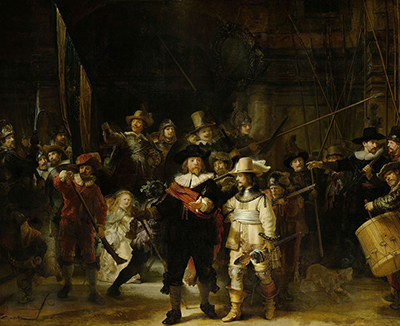
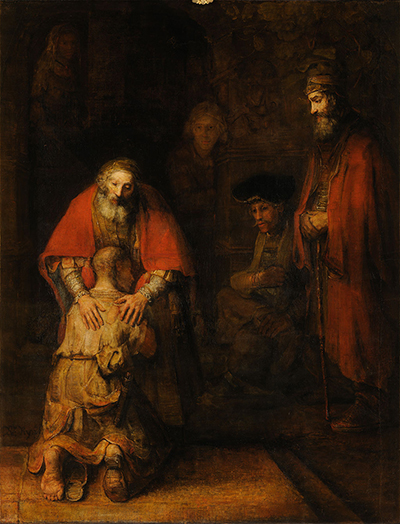
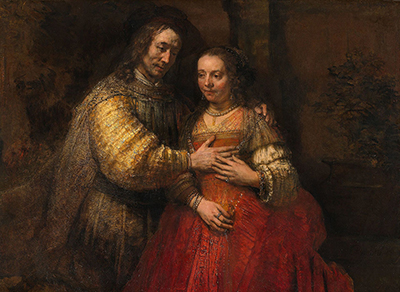
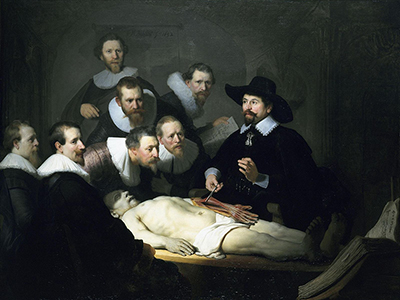
 Rembrandt.jpg)
