


 by Tom Gurney
Tom Gurney BSc (Hons) is an art history expert with over 20 years experience
Page Created on September 22, 2026 / Page Updated on September 22, 2026
Email: tomgurney1@gmail.com / Phone: +44 7429 011000
At a Glance
- ArtistGeorgia O’Keeffe
- ArtworkDeer’s Skull with Pedernal
- Artistic contextAmerican modernism
Contents
- Near bone, far mountain
- The Boston painting
- The first summer at Rancho de los Burros
- A skull made monumental
- Antler, branch and dead juniper
- Pedernal and Tsí Pín
- Flint mountain and deep time
- What bones meant to O’Keeffe
- The 1936 companion, Summer Days
- Realism, abstraction and Surrealism
- Paint, canvas and the visible weave
- Repair, relining and the artist’s concern
- Listening to a painting vibrate
- The 1937 exhibition and critical naming
- William Lane and the route to the MFA
- Bones and stones with Henry Moore
- A mountain beyond one artist
- How to look now
Near bone, far mountain
Georgia O’Keeffe’s Deer’s Skull with Pedernal brings two kinds of endurance into one improbable view. A weathered skull and antlers loom close enough for their ridges and openings to be inspected; the flat summit of Pedernal lies compressed along the distant horizon. Between them rises a dead juniper, dark and twisting, at once support, divider and vertical route through the picture. Nothing behaves quite like ordinary eyesight, although every component remains minutely recognisable.[1][16]
The canvas was painted in 1936, O’Keeffe’s first summer living in the Ghost Ranch house later known as Rancho de los Burros. From its patio, Pedernal dominated the southern distance.[4] That biographical proximity matters, but it is only one history of the mountain. Its Tewa name is Tsí Pín, and current Indigenous-led museum interpretation identifies it as a sacred landmark within the traditional Tewa world.[13] The painting now asks how one artist’s sustained attachment can be honoured without turning attachment into possession.
It also resists the convenient equation of skull with death. O’Keeffe described bleached bones as beautiful and, paradoxically, more living than intact animals because they seemed to reach the keen centre of desert life.[5] Her language does not close interpretation; it changes its starting point. The skull is a material remainder, an object gathered and transported, an anatomical structure and a designed form. The mountain is landscape, geology, homeland and painted profile. Their conjunction creates meaning without reducing either to a single symbol.
The Boston painting
The Museum of Fine Arts, Boston owns the work under accession number 1990.432. It is oil on canvas, 36 by 30 1/8 inches, or approximately 91.4 by 76.5 centimetres, and carries catalogue raisonné number 879. The William H. Lane Foundation gave it to the museum in 1990.[1][2][3] Its upright format is close to human torso scale, allowing the skull to confront a standing viewer while the landscape remains unusually low.
The catalogue title rests on three independent records: the Whitney Archive, O’Keeffe’s Abiquiú Notebooks and her checklist from the 1937 exhibition at An American Place. The Downtown Gallery Archive instead recorded Deer’s Skull and Pedernal.[1] That small grammatical shift matters. “With” makes skull and mountain a constructed visual partnership; “and” merely names two elements. The established title better conveys the way their profiles answer one another across extreme distance.
Early reproduction introduced greater instability. The Springfield Union shortened the title to Deer’s Skull in February 1937; Painters and Personalities misidentified it as Ram’s Head with Pedernal; Art Digest used Deer’s Skull with the Pedernal.[1] Animal taxonomy, article and place name were all still negotiable. On the reverse before relining, however, O’Keeffe wrote a star, the title and “36”, physically anchoring the artist’s own identification to the canvas.[1]
The first summer at Rancho de los Burros
O’Keeffe had first visited Ghost Ranch in 1934 and stayed there in 1935, but 1936 marked her first summer in the house she eventually bought in 1940. She drove to New Mexico in June and occupied Rancho de los Burros while it still belonged to the ranch.[4] The patio offered an unobstructed view of Pedernal. Cliffs, hills, trees and the flat-topped horizon became recurring subjects extending far beyond one season.
The summer was mobile as well as domestic. In July she made a two-week journey through Diné lands to Monument Valley and Rainbow Bridge; in August she worked at the place she called the Black Place; in September she drove back east with the artist Lauren Mosley.[4] The picture should therefore not be imagined as a casual transcription made from a settled lifelong home. It belongs to a season of travel, temporary occupancy and rapidly intensifying attention.
Pedernal paintings continued through 1958, but this early example already establishes a powerful formula. The mountain occupies little space yet provides geographic orientation. A near object is enlarged until it controls the composition, while the recognisable summit holds the bottom edge like a signature. Later familiarity can make that arrangement seem inevitable. In 1936 it was an audacious solution to the problem of joining what O’Keeffe could collect in her hands with what remained immovably far away.[4][10]
A skull made monumental
The skull faces forward and tilts slightly down, exposing a long central seam, bony ridges and the narrowing bridge above the nasal cavity. Cream, beige, pale grey and muted brown replace any simple “bone white”. Dark recesses describe the nose and lateral openings, while two unexpectedly bright circles of blue sky puncture the upper face. Those small blue holes prevent the skull from becoming a sealed mass; the surrounding atmosphere passes through it.
The antlers expand beyond the width of the cranium and approach both side edges. On the left, two long tines curve inward and upward, countered by a lower hook. The right side is more congested: tines overlap one another and the juniper branches, forming oval enclosures of sky. O’Keeffe preserves the asymmetry of grown bone while organising each curve as part of a balanced field. Anatomical observation and compositional adjustment cannot be neatly separated.
Scale completes the transformation. The skull is near life-sized within a three-foot canvas, but its suspension high against open blue makes it monumental. No hand, wall or tabletop explains its distance from the viewer. The object behaves partly like a specimen, partly like a mask and partly like an architectural gate. Those analogies arise from its placement and frontal symmetry; they should not be mistaken for evidence that O’Keeffe intended a ritual, religious or psychological emblem.
Antler, branch and dead juniper
The skull is not simply floating. It appears lodged against, hung from or aligned with a dead juniper trunk that runs nearly the full height of the canvas. Technical researchers identify the tree as juniper, correcting casual descriptions of piñon.[16] Its main shaft broadens as it descends, bending from the skull towards the lower right. A pale broken limb rises diagonally from the horizon, while dark upper branches split behind the antlers.
O’Keeffe makes the juniper’s grain and bends echo bone. Grey, brown and black strokes turn the trunk into a column with tendon-like striations. Near the top, a light-edged branch curves beside the right antler; elsewhere, branch and tine overlap until the eye must work to distinguish them. The meeting is more than camouflage. It reveals structural rhymes between materials produced by growth, weathering and loss.
The trunk also negotiates the impossible spatial jump between skull and mountain. Its upper section shares the skull’s near scale, but its base seems to enter the distant terrain beside Pedernal. Linear perspective would not permit that transition. O’Keeffe instead uses continuity of shape: the dark vertical carries the eye downward, the pale branch points towards the summit, and the mountain answers with its own rising shoulder. Space is assembled through correspondences rather than measured recession.
Pedernal and Tsí Pín
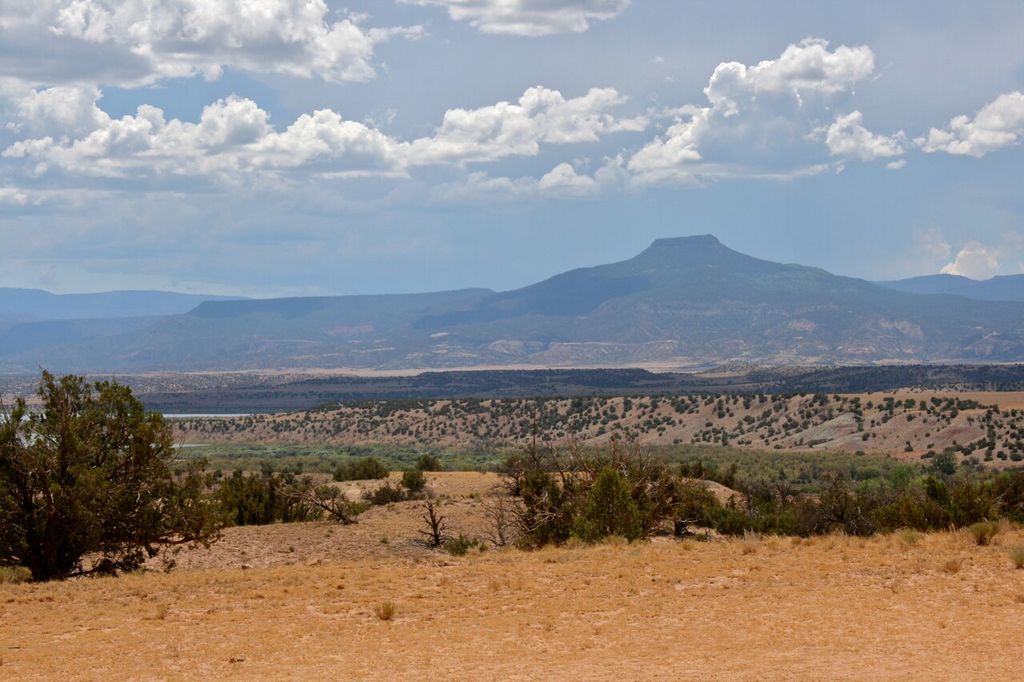
At the bottom of the painting, Pedernal appears as a low, flat-topped blue form slightly left of centre. Green, lavender, tan and deeper blue bands suggest slopes and surrounding country. Its small size is essential. The mountain would lose its power if enlarged into another foreground object; distance gives it steadiness against the skull’s detailed vulnerability. The pale diagonal branch nearly touches the summit, making separation between near wood and far geology visually tense.
“Pedernal” derives from a Spanish word for flint or chert, while the peak also carries other established names.[14][15] The Georgia O’Keeffe Museum’s 2025 Indigenous co-curated research identifies the Tewa name as Tsí Pín. It describes the peak as a significant sacred landmark located within four natural boundaries of traditional Tewa land.[13] That information changes the ethical vocabulary around a profile repeatedly marketed through O’Keeffe’s biography.
The familiar anecdote that O’Keeffe called Pedernal her private mountain and joked that repeated painting would make it hers has helped turn the summit into a personal trademark. Current Tewa interpretation does not require erasing her attachment. It asks viewers to place that attachment within a much longer, living relationship between people and land.[13] “Her mountain” can describe artistic recurrence only if it is not allowed to imply cultural priority, historical discovery or territorial ownership.
Flint mountain and deep time
Geologically, Cerro Pedernal stands in the northern Jemez Mountains. Its resistant cap and chert-bearing strata produce the recognisable flattened crest, while surrounding materials have eroded into sloping shoulders.[14] O’Keeffe reduces this structure to a few colour bands, yet the silhouette is specific enough to identify. The mountain’s formal clarity in the picture depends upon processes measured in geological time, far beyond the lifespan implied by the skull.
New Mexico Geological Society research describes the Pedernal Chert Member within the Abiquiu formation and extensive evidence of quarrying on the mountain’s slopes. Pits, workshops, camps, hammerstones, blanks and worked flakes document sustained Indigenous knowledge of the material. Objects made from Pedernal chert travelled hundreds of miles, and some evidence reaches back ten or eleven thousand years.[15] The distant blue shape was never merely scenery waiting to be painted.
This history gives the title an unintended material resonance. The skull’s bone and the mountain’s flaking stone are both durable natural substances transformed by use and attention. O’Keeffe gathered, arranged and painted bone; generations of Indigenous makers quarried, selected and worked chert. The practices are not equivalent, and the painting does not depict quarrying. Recognising the mountain’s material history nevertheless prevents the horizon from collapsing into a decorative logo for modernist solitude.[13][15]
What bones meant to O’Keeffe
O’Keeffe’s most direct explanation appeared in her statement for a 1939 An American Place exhibition. She admitted that the desert challenged her as a painter and that her visits always seemed too brief; carrying bleached bones home gave her portable symbols through which to approach it. Their beauty lay in sharpness, whiteness and a quality she experienced as more living than animals still covered with hair and eyes.[5]
The statement matters because it resists the automatic memento mori. Bones came after life, but O’Keeffe emphasised what sun and weather revealed rather than what death removed. She also transported them east, where a desert object could be studied and recomposed in a New York or Lake George studio.[11] The resulting paintings are neither straightforward plein-air records nor conventional tabletop still lifes. They are made from remembered distance, portable fragments and deliberately joined scales.
Her phrase “symbols of the desert” should not become a licence for unlimited symbolism. It identifies a personal artistic function, not a fixed code shared across cultures. Christian crucifixion, resurrection, Jungian transformation and Freudian readings have all been proposed around O’Keeffe’s skeletal imagery. Some may stimulate looking, but none overrides her documented language or proves intention in this canvas. The bone can remain materially specific while sustaining more than one emotional register.
The O’Keeffe Museum preserves a mule-deer skull with antlers among objects from the artist’s homes. The catalogue identifies Odocoileus hemionus, records ten teeth with two detached, and gives dimensions of 12 1/2 by 16 by 15 3/4 inches. Its antlers have three-pronged structures and its bone is bleached white.[9] Such records make O’Keeffe’s collecting practice tangible rather than merely anecdotal.
The surviving object resembles the antlered subject in CR 879, but the online catalogue does not formally identify it as the painting’s exact model. Antlers may be viewed from different angles, paired with other elements or adjusted within a composition. O’Keeffe’s natural collection supplied source material, not a rule of mechanical transcription. The responsible comparison notes species and form while leaving one-to-one identification open.[6][9]
This boundary is valuable. It distinguishes an artist’s belonging from an artwork and prevents provenance by visual guess. The museum’s Natural World exhibition sometimes established direct matches between objects and paintings, while other collected things functioned as broader inspiration.[6] Deer’s Skull with Pedernal belongs to that larger ecology of handling, keeping and remembering. Its precision demonstrates close study, but precision alone cannot tell us which individual skull sat before the easel.
The 1936 companion, Summer Days
The next catalogue number, CR 880, is Summer Days, also painted in 1936 on a canvas almost exactly the same size. There, a closely corresponding antlered skull floats above red, yellow and pink flowers, clouds and a warm desert landscape.[7][8] The pairing removes the juniper and replaces Pedernal’s compact profile with a more general horizon. What seemed physically lodged in CR 879 becomes explicitly weightless.
Whitney interpretation describes the bones and blossoms as souvenirs of New Mexico and reads their juxtaposition through natural cycles of life and death.[7] Another Whitney account stresses how these austere new icons challenged sexualised readings of O’Keeffe’s flower paintings and acknowledges the image’s Surrealist affinities.[7] Both approaches are useful if kept as curatorial interpretations. Neither proves that O’Keeffe designed the two works as a closed allegorical pair.
Comparison clarifies the particular force of Deer’s Skull with Pedernal. Summer Days distributes colour among flowers, clouds, hills and bone; CR 879 restricts its drama to antler, juniper, sky and mountain. The tree gives the skull weight and turns suspension into attachment. Pedernal gives the view a named orientation. The result is less buoyant and more tensile, as if organic structures from different times were holding one another in temporary balance.
In Ram’s Head, White Hollyhock—Hills of 1935, a skull and flower interrupt rolling New Mexico hills. The Metropolitan Museum’s Lowenthal catalogue describes O’Keeffe’s method there as a union of near-photographic realism and abstract design.[12] That formulation also fits CR 879, but the later painting sharpens the contrast: the skull becomes frontal, the flower disappears, and the dark juniper creates a continuous vertical armature.
The following year, From the Faraway, Nearby enlarged a mule-deer skull and doubled its antlers above a generalised landscape. The Met observes that this placement can recall a prized hunting trophy, though O’Keeffe’s “hunt” consisted of collecting discarded bones.[10] Its former title, Deer’s Horns, Near Cameron, located the scene on Diné Bikéyah in Arizona. The changed title made near and far into an emotional and spatial theme rather than a geographic label.
Together these works show that O’Keeffe did not repeat one skull formula. She varied support, horizon, flora, orientation, scale, attachment and title. The bone might hang, hover or combine with another set of antlers; the land might be named or generalised. Deer’s Skull with Pedernal is distinguished by the juniper’s role and by the mountain’s exact profile. Its uncanniness grows from recognisable things placed in a spatial relationship that could not simply have been found.
Realism, abstraction and Surrealism
The skull is carefully modelled, yet the painting is not a neutral anatomical illustration. O’Keeffe enlarges it, suppresses environmental explanation and makes two eye-region apertures coincide with the sky. The mountain is recognisable, yet reduced to bands. The juniper is observed, yet behaves like a compositional spine. Each object remains real while its relation to the others is designed. This is why the work can seem simultaneously lucid and dreamlike.
Surrealism offers one historical vocabulary for such disjunction. During the 1930s, European and American artists used unexpected object combinations, altered scales and suspended forms to unsettle ordinary perception. Whitney and the recent O’Keeffe and Moore exhibition both recognise surreal qualities in O’Keeffe’s bone compositions.[7][19] Yet she did not need to become a doctrinaire Surrealist for the comparison to hold. Shared devices are not the same as declared allegiance.
A different later interpretation comes from Jungian scholar Lisa A. Pounders, who reads the beige skull and blackened snag through alchemical stages of ascent, embodiment and psychological transformation. She contrasts CR 879’s earthbound attachment with the hovering skull of Summer Days, proposing movement between New Mexico and New York as a psychic analogue.[24] This is a declared theoretical reading, not evidence of O’Keeffe’s programme; its value lies in showing how the pair has sustained competing symbolic histories.
Abstraction operates differently. It lies in the long arcs of antler, the dark branching axis, the repeated openings and the horizon’s compressed stripes. If the subject names were removed, these relations would still organise the canvas. Representation supplies resistance: antlers grow unevenly, bone changes colour, and Pedernal has a particular silhouette. O’Keeffe’s modernism depends on keeping those two systems active, so that designed shape never fully detaches from observed material.
Paint, canvas and the visible weave
A 2025 technical study gives this painting an unusually detailed structural account. O’Keeffe worked on twill-weave canvas and generally applied colours in single layers thin enough for the textile texture to remain visible. The dead juniper is carefully brushed through the vertical centre, while horizontal forms at the bottom describe the landscape around Ghost Ranch.[16] These findings support what close looking suggests without relying on appearance alone.
The method produces different material zones. Broad blue sky is relatively even, but not featureless; the weave quietly interrupts its colour. The skull’s pale modelling requires controlled value changes, while the juniper’s brown and black passages carry richer texture and directional strokes. O’Keeffe did not build one uniform skin across the picture. She adjusted paint behaviour to the structural character of bone, wood, air and distant land.[16]
Technical specificity also corrects metaphor. The central form may look burned, muscular or stone-like, but the study identifies a dead juniper and measures the consequences of its paint texture. The skull’s dominant pale pigment is lead carbonate white, which cures into a particularly stiff oil-paint layer.[16] Material analysis does not settle meaning, but it shows that the picture’s contrasts exist physically as well as visually: colour regions possess different mechanical properties.
Repair, relining and the artist’s concern
The earliest treatment record is incomplete. O’Keeffe’s Abiquiú Notebooks contain “Keck: 1948”, but the catalogue labels that notation unverified. In September 1952 she wrote to dealer Edith Halpert that she had received a $100 bill from Caroline Keck for “fixing” the skull painting, which she had sent the previous year without glass.[1] The letter confirms intervention and cost while leaving the exact procedure unclear.
Between 1970 and 1976, in preparation for travelling exhibitions, conservators carried out a much more consequential treatment. They adhered a second canvas to the reverse using a heat-activated mixture of natural resins and waxes. The aim was to flatten creases and secure paint cracks produced during roughly four decades of display and travel.[16] The original reverse inscription was recorded before this lining, because the added canvas would conceal direct access to it.[1]
The work now consists of two canvas supports stretched over a new heavy wooden stretcher. The wax-resin adhesive is not evenly distributed: the viewer’s left half has a thicker layer than the right, making it probably heavier and stiffer.[16] This asymmetry is more than conservation trivia. It means the physical object no longer responds uniformly to movement, even when the painted image appears visually continuous. Exhibition history has become part of its mechanics.
Listening to a painting vibrate
Multi-point laser Doppler vibrometry offers a non-contact way to map those mechanics. Sixteen sensors measured surface responses after a controlled low-energy excitation, allowing researchers to compare displacement and velocity across the canvas at different frequencies.[16] The method treats the stretched painting partly like a complex drumhead, while recognising that weave, pigment, paint thickness, cracks, lining and edge restraint make its behaviour far less regular than a simple membrane.
The painting’s first natural frequency was measured at 8.6 hertz. At that frequency the centre moved with displacement and velocity about eight times greater than the edges fixed to the stretcher. The lead-white skull region behaved much more stiffly, closer to the restrained margins. At 13.5, 23.67 and 26.1 hertz, researchers observed a vertical band of movement along the textured brown-black juniper.[16] The compositional spine is also a mechanically distinct zone.
Most consequentially, cracks addressed by the 1970s lining showed preferential movement around 16 hertz. Two areas displaced more than adjacent paint, a pattern the researchers interpret as possible fatigue in parts of the old repair.[16] This does not mean visible failure is imminent. It demonstrates the value of detecting unusual response before deterioration becomes obvious, creating a baseline for safer handling, transport and future treatment. Conservation here becomes a form of listening to stresses that sight alone cannot register.
The 1937 exhibition and critical naming
Alfred Stieglitz organised Georgia O’Keeffe: New Paintings at An American Place from 5 February to 17 March 1937.[17] CR 879 appeared under the title still recognised today. The exhibition introduced a body of recent work shaped by O’Keeffe’s Ghost Ranch summer, translating private collection and distant landscape into a Manhattan gallery setting. The blue sky and stark bone would have arrived within an art world already accustomed to arguing over the meaning of her flowers.
Contemporary publication titles reveal the difficulty of fixing the subject. One paper removed Pedernal entirely; another changed deer to ram; a third inserted “the” before the mountain.[1] These slips show how quickly an image could become generic “Southwest” imagery in reproduction. The proper names matter: deer is not ram, and Pedernal is not an interchangeable desert backdrop. Current recognition of Tsí Pín adds another necessary correction to that history of naming.[13]
The work continued to circulate: in 1938, the 1952 Lowenthal collection exhibition, a 1958 Whitney friends presentation, the Lane Foundation’s 1958–59 tour, Worcester’s 1960 retrospective, Women Artists in America Today in 1962, and the Whitney–Chicago–San Francisco retrospective of 1970–71.[1] Tate reproduced it for the 2016 London retrospective.[22] Each journey increased visibility but also imposed handling risk, culminating in the lining carried out for travel during the 1970s.[16]
Another British encounter is already scheduled. The Courtauld has announced Georgia O’Keeffe: Ghost Ranch for 1 October 2027 to 30 January 2028, the first exhibition devoted specifically to her Ghost Ranch landscapes; Deer’s Skull with Pedernal is featured as an MFA loan and lead image.[23] Almost two dozen paintings are promised, many never previously shown in Britain, where no O’Keeffe work belongs to a public collection. A companion display of LIFE photographs will place the painted landscape beside Philippe Halsman’s 1948 and John Loengard’s 1966 views of the artist and her surroundings.[23]
William Lane and the route to the MFA
O’Keeffe retained the painting and consigned it to Edith Halpert’s Downtown Gallery as stock number 149. On 29 September 1953 the gallery sold it to the William H. Lane Foundation in Leominster, Massachusetts. Downtown Gallery sales and purchase slips survive in the Archives of American Art, giving the transaction an unusually precise documentary footing.[1] The Foundation held the painting until its 1990 gift to the MFA.
Lane assembled a major collection of American modernism. The MFA describes the 1990 Foundation gift as ninety paintings and works on paper that transformed its twentieth-century holdings, including works by O’Keeffe, Charles Sheeler, Stuart Davis, Marsden Hartley and Arthur Dove.[21] CR 879 therefore entered Boston not as an isolated celebrity image but within a collector’s account of American modernist development.
That context has consequences for reception. At An American Place, the painting belonged to O’Keeffe’s newest work under Stieglitz’s direction; in the Lane collection, it joined a canon of modernist American artists; at the MFA, it became a collection landmark, podcast subject and exhibition anchor.[18][21] Provenance changes neither pigment nor design, but it changes the neighbours, narratives and publics through which the work is repeatedly understood.
Bones and stones with Henry Moore
From 2023 to 2025, O’Keeffe and Moore travelled through San Diego, Albuquerque, Montreal and Boston.[20] The exhibition compared O’Keeffe with the British sculptor Henry Moore through their rural working environments and extensive collections of bones, stones, shells and other found natural forms. Studio reconstructions brought tools and source objects into the gallery, shifting attention from iconic biography towards processes of gathering, handling and formal transformation.[18]
The comparison is especially apt for CR 879. Both artists looked through openings in bones and experimented with shifts of scale, but their media and decisions remained distinct. O’Keeffe turned the skull’s apertures into fragments of blue atmosphere and set an actual mountain beyond them; Moore often transformed bone-like cavities into sculptural interior and exterior space.[18][19] Dialogue clarifies procedure without making one artist the explanation for the other.
The Musée des beaux-arts de Montréal framed the exhibition in French through sections including “Le réel et le surréel”, “Des os et des pierres” and “Paysages de formes”.[19] Those phrases expose the painting’s central tensions with useful economy: observed matter becomes uncanny, collected object meets geology, and landscape is understood as structured form. The French catalogue adaptation also confirms that the recent comparison was conceived as international scholarship rather than a single-venue display.
A mountain beyond one artist
The most important recent change in interpretation comes from Tewa Nangeh/Tewa Country. Bess Murphy co-curated the project with Jason Garcia/Okuu Pín, an artist from Santa Clara Pueblo. It includes voices from Nambé, Pojoaque, San Ildefonso, Ohkay Owingeh, Santa Clara and Tesuque Pueblos, addressing sacred landscape, Indigenous belonging, cultural ownership, memory and the erasure produced when northern New Mexico is described as empty or untouched.[13]
For this painting, Tsí Pín cannot remain a blue formal accent whose history begins with O’Keeffe’s patio view. The mountain’s sacred Tewa significance and ancient chert industries precede the modern canvas by millennia.[13][15] The skull, too, enters a landscape shaped by living communities rather than an abstract “wilderness”. None of this requires claiming that O’Keeffe encoded Tewa knowledge. It requires recognising the boundaries of her viewpoint and of older art-historical narratives.
Such correction deepens rather than diminishes the work. O’Keeffe’s visual invention becomes more specific when separated from myths of discovery and possession. She joined portable bone, dead juniper and distant mountain into an image of extraordinary tension. Present-day viewers can value that act while understanding that the mountain exceeds it—geologically, culturally and historically. The picture records a modern artist’s encounter with Tsí Pín; it does not contain the mountain’s meaning.
How to look now
Begin with the smallest blue openings in the skull. They are easy to miss because the antlers command attention, yet those apertures establish the painting’s governing idea: sky can occupy bone, and absence can become colour. Follow the central seam down into the nasal cavity, then continue along the dark juniper. Notice where anatomical symmetry yields to the tree’s irregular bend and how the two structures remain visually locked together.
Next, separate antler from branch. On the right, pale curves and dark limbs cross until several shapes seem to change identity midway. On the left, more open sky lets each tine retain its outline. Then descend along the pale broken branch towards Tsí Pín. The branch points but does not quite touch. That interval keeps the mountain distant even as the composition links every major form through a chain of curves and diagonals.
Finally, remember that the calm surface has a complex physical life. Twill weave remains under single paint applications; lead-white bone is mechanically stiff; wax-resin lining and a replacement stretcher bear the history of travel; repaired cracks respond at measurable frequencies.[16] At the same time, the distant summit carries histories the canvas cannot show.[13][15] The painting rewards close looking because every apparent simplicity—white skull, blue sky, dark tree, flat mountain—opens into another scale of evidence.
Discussion
Which piece of evidence most changes the way you read Deer’s Skull with Pedernal?
Reader Insights
Which visible detail most changes your reading of Deer’s Skull with Pedernal?
How do medium, setting and documented history shape the encounter?
What remains uncertain when documented fact is separated from interpretation?
Join the Conversation
Share your reading of Deer’s Skull with Pedernal below.
References
- Access O’Keeffe, “Deer’s Skull with Pedernal, 1936”, CR 879. View Source
- Museum of Fine Arts, Boston, “Deer’s Skull with Pedernal”, accession 1990.432. View Source
- Smithsonian Institution, “Deer’s Skull with Pedernal”. View Source
- Access O’Keeffe, “Chronology”. View Source
- Access O’Keeffe, “In Her Words”. View Source
- Georgia O’Keeffe Museum, “The Natural World”. View Source
- Whitney Museum of American Art, “Summer Days”. View Source
- Access O’Keeffe, “Summer Days, 1936”, CR 880. View Source
- Access O’Keeffe, “Mule deer skull with antlers”. View Source
- Metropolitan Museum of Art, “From the Faraway, Nearby”. View Source
- Metropolitan Museum of Art, Georgia O’Keeffe, 1984 Bulletin. View Source
- Metropolitan Museum of Art, American Art: The Edith and Milton Lowenthal Collection. View Source
- Georgia O’Keeffe Museum, “Tewa Nangeh/Tewa Country”, 2025 press release. View Source
- New Mexico Bureau of Geology and Mineral Resources, “Geologic Tour: Cerro Pedernal”. View Source
- A. Helene Warren, “The Ancient Mineral Industries of Cerro Pedernal”, New Mexico Geological Society. View Source
- David Damiani, Vikrant Palan and Dale Kronkright, “Safeguarding Masterpieces: Multi-point Vibrometry (MPV) Based Monitoring of Georgia O’Keeffe’s Art”. View Source
- Access O’Keeffe, “Georgia O’Keeffe: New Paintings”, An American Place, 1937. View Source
- Museum of Fine Arts, Boston, “Georgia O’Keeffe and Henry Moore”. View Source
- Musée des beaux-arts de Montréal, “Georgia O’Keeffe et Henry Moore : géants de l’art moderne”. View Source
- Access O’Keeffe, “O’Keeffe and Moore”, touring exhibition. View Source
- Museum of Fine Arts, Boston, “MFA Journey: Explore 150 Years in 15 Works of Art”. View Source
- Tate, “Georgia O’Keeffe Deer’s Skull with Pedernal”, 2016 exhibition print record. View Source
- The Courtauld, “Georgia O’Keeffe: Ghost Ranch”. View Source
- Lisa A. Pounders, “Her ‘Symbols of the Desert’: An Emerging Alchemical Impression in the Bone Paintings of Georgia O’Keeffe,” Journal of Jungian Scholarly Studies 14, no. 1 (2019), pp. 16–29, View Source.