


 by Tom Gurney
Tom Gurney BSc (Hons) is an art history expert with over 20 years experience
Page Created on September 22, 2026 / Page Updated on September 22, 2026
Email: tomgurney1@gmail.com / Phone: +44 7429 011000
Introduction
Georgia O’Keeffe’s New York, Night looks north through darkness from a room high above Lexington Avenue. The Beverly Hotel rises in the centre, almost black below a pink-orange rooftop pavilion. A pale rosette shines from its façade. On the right, the avenue becomes a narrow, tilted channel of white, yellow and red lights; on the left, scattered windows puncture another tower. No figure can be isolated, yet the city is densely inhabited.
The view came from O’Keeffe and Alfred Stieglitz’s thirtieth-floor apartment in the Shelton Hotel. Painted in 1928–29, it belongs to the end of her concentrated New York cityscape period and the beginning of her annual journeys to New Mexico. The canvas refuses the later myth that one place simply replaced the other. When it debuted in 1930, New York appeared beside New Mexico and Lake George as one of several environments through which O’Keeffe was remaking modern painting.[1][5][7]
At a Glance
- ArtistGeorgia O’Keeffe
- ArtworkNew York, Night
- Artistic contextAmerican modernism
Contents
- Object identity
- Which New York—Night ?
- Viewpoint, Beverly and Shelton Hotels
- Hotel Alley and the vertical city
- Crown, rosette and electric night
- Darkness, windows and irregular geometry
- Photography and the shared window
- Painting the skyscraper as a woman
- Date and New Mexico threshold
- The 1930 debut and early circulation
- Return, Precisionism and Venice
- Nebraska acquisition
- A long exhibition life
- Centennial and international retrospectives
- My New Yorks , 2024–25
- Dialogue with other New York painters
- Material evidence and its limits
- Unresolved questions and significance
Object identity
- Artist: Georgia O’Keeffe (1887–1986)
- Title: New York, Night
- Date: 1928–1929
- Medium: oil on canvas
- Dimensions: 40 1/8 × 19 3/16 inches (101.9 × 48.7 cm)
- Catalogue raisonné: CR 646
- Collection: Sheldon Museum of Art, University of Nebraska–Lincoln
- Credit: Nebraska Art Association, Thomas C. Woods Memorial
- Accession: N-107.1958[1][2]
The title is supported by the Whitney Archive, Downtown Gallery Archive and the checklist of the painting’s 1930 exhibition at An American Place. O’Keeffe’s Abiquiú Notebooks preserve two variants, New York – Night and New York Night. The punctuation changes; the identity does not.[1] Sheldon verified the public-collection record on 14 August 2025, and Access O’Keeffe updated the core fields on 26 August 2026. Those dates document current catalogue maintenance rather than a change of title, ownership or attribution.[1][4]
Which New York—Night?
O’Keeffe used nearly the same title for a different canvas. CR 530, now at the Museum of Fine Arts, St Petersburg, is dated 1926 and also called Madison Avenue. It is a pale, semi-abstract vertical composition crossed by diagonals, measuring 32 1/2 by 12 inches.[3] CR 646 is the dark cityscape dated 1928–29, nearly forty inches high, with the Beverly Hotel, coloured windows and a receding avenue.
Confusing the two changes the date, collection, subject and visual argument. The shared name is historically revealing. “New York at night” was not one fixed image for O’Keeffe. It could become an abstracted street geometry in 1926 or a dense, elevated city view two years later. The title identifies a condition of perception as much as a single address. Catalogue numbers, dimensions and collections are therefore essential identifiers whenever the shortened title New York Night appears without punctuation.[1][3]
Viewpoint, Beverly and Shelton Hotels
The canvas is more than twice as high as it is wide. A central brown-black tower rises through most of it. Its upper parapet forms a row of pointed notches. Above them sits a warm terracotta pavilion with a pitched, ribbed roof and small pale forms at its crest. Near the tower’s upper centre, a turquoise-white rosette resembles a lit circular window.
Rectangular windows appear sparingly below it. Some burn yellow or orange; others carry muted red, grey or green. The building’s broad face remains predominantly dark. At left, another skyscraper is cut by the edge and continues beyond the top. Its windows multiply more densely, although large areas disappear into black. The cropped tower establishes that the view extends beyond the narrow support; it is neither a complete skyline nor a portrait of one isolated building.
At right, a block with a gridded band of windows obstructs the middle distance. Between the central and right buildings, Lexington Avenue opens as an improbably slender wedge. Rows of tiny lamps and windows climb its diagonal margins. Larger circular lights step down towards the lower left. The street is both a real recession and a luminous seam cut into the architectural mass.[1][6]
Several earlier New York pictures adopt the pedestrian’s view. New York Street with Moon looks sharply upwards from a constricted street. City Night places immense façades around a small moon. Radiator Building—Night, New York turns a recognisable tower into a vertical emblem.[6][14][30] New York, Night begins from another bodily condition: living inside a skyscraper.
The viewer is neither on the pavement nor outside the city. O’Keeffe’s room is absent from the image, but its height determines every relation. The central roof is seen across rather than from below. The avenue can be followed downward through the gap, while distant lights climb towards the horizon. The painting combines command and enclosure.
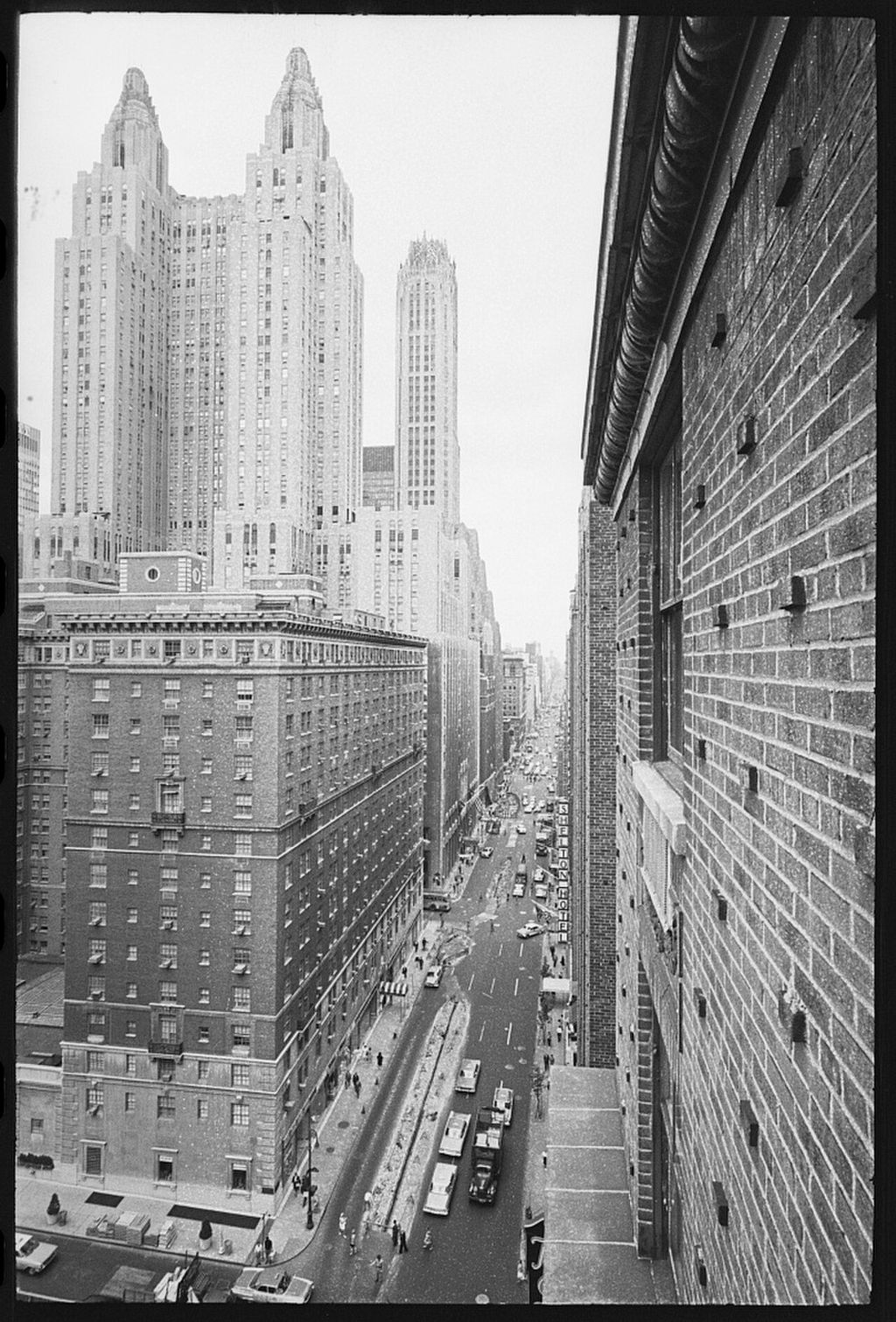
Height gives access to a wide urban field, yet neighbouring buildings occupy almost the entire visual range. The catalogue identifies the central structure as the Beverly Hotel, visible from the north window of O’Keeffe’s thirtieth-floor rooms at the Shelton. The Beverly stood at Lexington Avenue and East 50th Street, immediately north of the Shelton’s position at East 49th Street.[1][6][9] Built in 1926–27, the Beverly was designed by Emery Roth with Sylvan Bien.
New York’s Landmarks Preservation Commission describes its neo-Romanesque ornament, outdoor terraces and picturesque profile. It was marketed to comparatively sophisticated residents at moderate rates and became a subject for O’Keeffe, Stieglitz and Charles Sheeler.[9] O’Keeffe does not inventory its pelicans, owls or warrior-head corbels. At night and from above, ornament condenses into roof silhouette, a few pale shapes and the circular opening.
Recognition depends on the building’s summit more than its street façade. O’Keeffe and Stieglitz moved into the Shelton in November 1925, first occupying lower rooms and later moving higher. By late 1928 they were on the thirtieth floor. The building did more than supply a subject; it created a new viewing apparatus.[5] Arthur Loomis Harmon designed the Shelton, completed in 1923–24.
Its stepped massing was widely praised as an early successful response to New York’s 1916 Zoning Law, which required tall buildings to recede from the street so light and air could reach below. At thirty-one storeys plus penthouse, it was then described as the world’s tallest hotel.[9][10][11] The room converted zoning geometry into lived perception. From its windows, O’Keeffe could see roofs, towers, streets and the East River from heights unavailable to most pedestrians. A modern building thus became studio, home, lookout and frame.
Hotel Alley and the vertical city
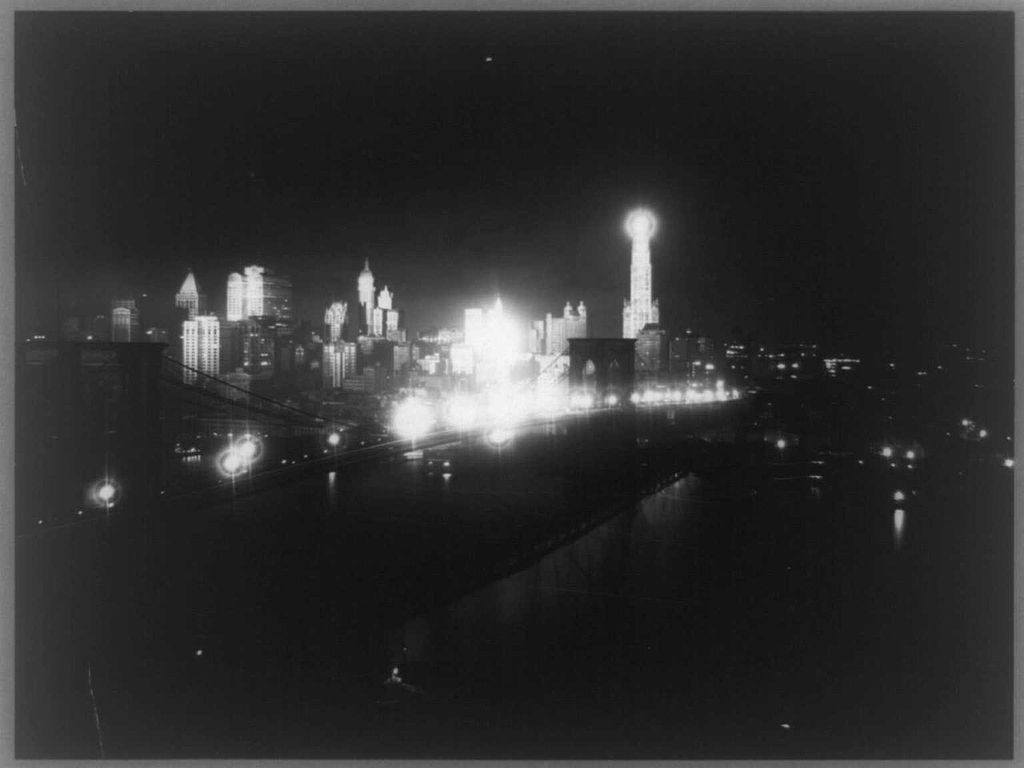
The Shelton and Beverly belonged to the concentration of skyscraper hotels along Lexington Avenue sometimes called “Hotel Alley”. Their growth followed the opening of Grand Central Terminal and the Lexington Avenue subway, which intensified East Midtown redevelopment.[9][10] The cityscape in CR 646 is therefore not a timeless Manhattan skyline. Much of what O’Keeffe saw had been constructed only a few years earlier.
The Beverly itself was new. The Hotel Lexington, further south, was still part of the same late-1920s transformation. New York’s zoning setbacks generated a new sculptural skyline. Towers rose, narrowed and produced terraces, crown-like roofs and irregular gaps. O’Keeffe’s narrow composition translates that planning history into pictorial pressure: buildings occupy vertical strips, while the street survives as a thin corridor between them.
O’Keeffe later remembered that Lexington Avenue at night looked like a very tall, thin bottle with coloured things moving up and down inside it. The High Museum connects that recollection directly to the animated lights in New York, Night.[6] The metaphor clarifies the right-hand wedge. Architecture becomes a container, while lamps, windows and traffic become mobile colour held inside it.
The bottle is not painted as an outlined object; it is produced by the dark walls flanking the avenue. Because the remark was made later, it should be treated as remembered perception rather than a studio note written in 1928. It tells us how O’Keeffe understood the experience after the fact. It does not settle the number of sittings, whether she drew first or how literally she followed the visible street.
Crown, rosette and electric night
The Beverly’s summit is the painting’s clearest architectural passage. A dark parapet with repeated points forms a band. Above it, a pavilion opens into muted rose walls and a ribbed red roof. Pale projections at the apex separate from the sky. This crown gives the central block an identity; without it, the dark rectangle might be any tower. O’Keeffe concentrates specificity at the top and allows the lower façade to dissolve. The method reverses ordinary architectural description, which begins at the entrance and explains a building upwards from street level. The rooftop can also be read as a small building placed on a larger one.
Its scale is difficult to judge because the picture supplies no visible people. Warm colour brings it forward, while the black façade below remains immense and almost depthless. It behaves simultaneously as observed hotel architecture and as a suspended geometric construction. The pale circular motif below the parapet is composed of repeated lobes around a darker centre. It resembles a rose window, illuminated clock or ornamental opening.
The principal institutional descriptions do not assign it a more exact architectural function.[1][2] Its pictorial function is clearer. The rosette fixes the centre of the upper canvas and breaks the building’s otherwise opaque face. It also answers the small round lights descending along the avenue. One large static circle belongs to the façade; many smaller circles animate the street.
Cool blue-green and white distinguish it from the amber windows. That temperature shift prevents all illumination from carrying the same emotional charge. Some lights suggest warm interiors, while the rosette reads as a harder public sign within the architecture. Sheldon’s interpretive publication proposes that this “petal-shaped” window turns the hotel towards floral delicacy and even functions as a personal O’Keeffe emblem.
The comparison is productive because it reverses her familiar scale operation: a massive hotel becomes delicate rather than a small flower becoming monumental.[31] It remains an interpretation. The window’s shape does not prove that O’Keeffe intended the building as a disguised flower or self-portrait. Its value lies in noticing a formal rhyme across supposedly separate subjects while keeping architecture and botany distinct.
By the late 1920s, New York’s illuminated skyline and commercial streets were powerful symbols of modern life. O’Keeffe had already used the Radiator Building’s glowing crown and electric sign in a more emblematic nocturne. New York, Night distributes light across a deeper urban field.[30] There is no single blazing advertisement here. The brightest passage is the oblique avenue, where points and strokes accumulate instead of forming a legible word.
Electricity makes circulation visible: the eye follows the route even when it cannot identify each source. The darkness remains dominant. O’Keeffe does not turn night into a uniformly brilliant consumer spectacle. Light appears costly, intermittent and local. The city’s energy is registered through contrast with unlit rooms and façades.
Darkness, windows and irregular geometry
The painting may appear black at first glance, but its night is chromatically complex. Deep brown, burgundy, maroon, charcoal and muted violet separate adjacent masses. Some boundaries are almost lost; others emerge through a small difference in temperature or value. The rooftop pavilion gathers the warmest sustained colour. Pink-orange walls and a russet roof rise from the central black block like an illuminated stage.
Its pale crest sits against a blue-black sky, while the rosette below introduces a cool counterpoint. Lights are not uniformly bright. They range from cream and lemon to orange, red, grey and blue-green. This unevenness prevents the city from becoming an electrical diagram. Every light appears embedded in a material surface or suspended within atmospheric darkness.
No body is large enough to identify, but human presence is everywhere inferred. A lit window suggests a room; a line of street lamps implies movement and infrastructure; red and yellow points on the avenue can be read as vehicles or signals. This is a different urban sublime from an empty monument. The central tower seems enormous because the individual lights are small. At the same time, those lights resist total abstraction.
They imply many private interiors beyond O’Keeffe’s own elevated room. The viewer cannot enter those rooms or know their occupants. The painting holds urban intimacy at a distance, offering collective evidence of life while denying narrative access to any single life. The city is organised by verticals, but they are not mechanically repeated. The central mass leans subtly through colour changes, the street cuts diagonally, rooflines step and dip, and windows cluster unevenly rather than forming a perfect grid. These irregularities matter when the work is associated with Precisionism.
Its hard-edged architecture, compressed space and modern subject align it with painters such as Charles Demuth and Charles Sheeler. The painting later entered a major exhibition titled The Precisionist View in American Art.[1] Yet atmospheric darkness, hand-varied lights and uncertain boundaries prevent a clean machine aesthetic. O’Keeffe’s city is structured but not sterilised. Precisionist affiliation helps locate the work historically; it does not exhaust its visual behaviour.
Photography and the shared window
Alfred Stieglitz repeatedly photographed New York from the Shelton. The National Gallery of Art’s Key Set includes views made from the hotel, preserved by O’Keeffe and later given to the museum. Their elevated angles, haze and compressed buildings establish that the apartment window was a shared field of experiment.[12][13] This does not make New York, Night a painted Stieglitz photograph.
No located image reproduces its exact composition, and the canvas organises darkness and coloured light through means unavailable to monochrome photography. The comparison is most useful at the level of practice. Two artists used the same architectural position to test how a modern city could be framed. Photography could register weather, scaffolding and changing skyline; paint could reorganise night into slow, selective colour.
Painting the skyscraper as a woman
A photograph records light admitted during a bounded exposure. O’Keeffe’s canvas can combine observations made at different moments. A window that went dark, a traffic light that changed or a roof that emerged only after the eye adjusted could be retained together in paint. This temporal layering is an inference from the medium, not documented procedure for CR 646.
It explains why the scene should not be judged as though it were a single frozen optical instant. Its lights may describe the experience of looking over time. Stieglitz’s Shelton photographs often use mist, snow, smoke or construction to make the city unstable. O’Keeffe’s instability comes through colour boundaries and selective illumination. Their works share a site while producing different durations and material facts.[12][13]
The skyscraper was commonly coded as a masculine subject: engineering, finance, height and public power. O’Keeffe later recalled that “the men” around her did not want her to paint New York, even though she believed her New York pictures could overturn expectations.[6][26] Her position complicates simple claims of exclusion. Stieglitz promoted her work and gave it annual exhibitions, while also shaping how critics encountered her and favouring interpretations bound to gender and sexuality.
The 2016 retrospective scholarship has stressed the need to remove those inherited constraints without pretending they had no historical effect.[23] CR 646 claims the city through sustained observation. It does not imitate the swagger of a street-level tower portrait. O’Keeffe paints from a domestic room inside the modern structure, converting a supposedly private position into a commanding account of public space.
Date and New Mexico threshold
The Whitney Archive, Downtown Gallery Archive and Abiquiú Notebooks all date the painting 1928. The canvas itself carries “G. O’Keeffe 1928-29” in white paint on the reverse, and its first documented exhibition occurred in early 1930.[1] The catalogue therefore uses 1928–29. That range gives priority to physical evidence, allows work to have continued across the turn of the year and distinguishes the canvas from works merely exhibited in 1929 but completed earlier. The stretcher inscription “Georgia O’Keeffe” is identified as Alfred Stieglitz’s graphite hand. The Whitney Archive records a March 1946 examination at An American Place; no signature was found on the painted face.[1]
On 27 April 1929 O’Keeffe left New York with Rebecca Strand for Santa Fe and Taos. Her first extended New Mexico season transformed the subjects available to her, but it did not cancel the urban work already under way.[5][29] CR 646 is often described as marking the close of her 1920s New York cityscapes. “Close” should not become “rejection”.
In 1932 she made the large Manhattan, and bones gathered in New Mexico were painted in the Shelton apartment. Objects and places travelled through her working life.[6] The date range makes New York, Night a hinge. It records an intensely inhabited eastern city just as O’Keeffe began establishing a recurring western practice. Its subsequent debut placed those geographies together.
The 1930 debut and early circulation
Alfred Stieglitz presented Georgia O’Keeffe: 27 New Mexico, New York, Lake George, Etc. at An American Place from 7 February to 17 March 1930. CR 646 was included and appears in Stieglitz’s installation photographs, which also documented it in the 1935 gallery display.[1][7] The exhibition title is a compact manifesto. New Mexico received first billing, but New York and Lake George remained active categories. The show included early paintings of New Mexico crosses and the Ranchos church alongside other recent work.[5]
The National Gallery’s surviving installation photograph confirms the character of Stieglitz’s gallery and his practice of arranging O’Keeffe’s canvases as an ensemble. A photograph can establish that a work was present and how nearby pictures were scaled; it cannot reproduce the low tonal distinctions of the painting itself.[8] In June 1931 the painting was reproduced in Creative Art under the title New York – Night. The publication helped detach the work from the temporary gallery installation and circulate it as an image of American modernism.[1]
It entered the Twenty-Seventh Annual Exhibition of Paintings by American Artists in 1932, then returned to O’Keeffe exhibitions in 1935, 1937 and 1938. A 1935 Boston exhibition placed it under the unlikely umbrella Flower Paintings by O’Keeffe, H. Dudley Murphy and John C. E. Taylor.[1] That title is a useful warning. Exhibition categories can be broader, narrower or stranger than an object’s subject. The presence of a skyscraper nocturne in a flower-painting context may reflect a multi-artist programme or checklist structure rather than a claim that CR 646 is floral.
Return, Precisionism and Venice
Stieglitz’s 1935 Georgia O’Keeffe: Exhibition of Paintings (1919–1934) returned CR 646 to the gallery in a retrospective frame. Installation photographs again preserve its presence.[1] The interval was short in years but large in O’Keeffe’s public imagery. By 1935 she had repeatedly travelled to New Mexico and exhibited bones, crosses, churches and desert landscapes. The nocturne could now be viewed as part of a longer formal development rather than only as a new city subject.
Its dark vertical forms also offered continuities with later work. The abrupt silhouettes of crosses and hills do not derive from skyscrapers in a simple one-way sequence, but O’Keeffe repeatedly tested large shapes against narrow intervals of sky or light. The retrospective made such comparisons possible without collapsing distinct places. The Precisionist View in American Art travelled from the Walker Art Center to the Whitney Museum, Detroit Institute of Arts, Los Angeles County Museum of Art and San Francisco Museum of Modern Art.
Its artist list placed O’Keeffe with figures including Charles Demuth, Charles Sheeler, Ralston Crawford and Joseph Stella.[1] That exhibition helped institutionalise “Precisionism” as a way of grouping American artists who simplified industrial, architectural and vernacular forms. CR 646 supports the association through its tall geometry and reduced building masses. It also reveals the category’s limits. The painting’s most compelling space is not a crisp façade but an ambiguous dark gap filled with lights.
Its surfaces breathe through tonal variation. Historical classification clarifies one network of affinities while the object continues to exceed the label. In 1956 New York, Night travelled to the Twenty-Eighth Venice Biennale in American Artists Paint the City. Katharine Kuh assembled the exhibition, and its catalogue survives in institutional libraries.[17][19] The display recoded a painting made before the Depression.
In Venice during the Cold War, it became evidence in an international argument about American urban modernity. Bram Dijkstra’s study places Kuh’s exhibition within a cultural field in which New York’s skyline, energy and artistic authority were presented as signs of national modernity.[18] The current Access O’Keeffe entry gives 1 July as both opening and closing date. That is probably an incomplete database span rather than proof of a one-day Biennale exhibition. The secure facts are the 1956 Venice venue, the American city theme and CR 646’s inclusion.[17]
Nebraska acquisition
The Nebraska Art Association purchased New York, Night from the Downtown Gallery in 1958. The Thomas C. Woods Memorial credit and accession number N-107.1958 preserve the acquisition’s institutional identity.[1][2] The purchase occurred in the year the painting appeared in the Association’s sixty-eighth annual exhibition. It was shown again in the sixty-ninth annual exhibition in 1959, then travelled with The Precisionist View in American Art in 1960–61.[1] The Sheldon’s current building opened in 1963, so CR 646 belongs to the collection history that preceded the building.
A 2023 installation titled Before Sheldon used the work to tell that longer institutional story.[28] The provenance is unusually concise: artist, Downtown Gallery, public purchase. There is no auction chain or series of private owners. Current data were verified with Sheldon in 2025.[1][4] The Thomas C. Woods Memorial designation indicates that the purchase was supported as an act of commemoration, although the publicly accessible object page does not provide the donor history or acquisition deliberations.
Those records remain a useful target for local archival research. Public ownership altered the painting’s availability. Before 1958 it remained with the artist or her dealer. Once acquired, it could participate in annual Nebraska exhibitions, national touring projects and later collection installations. Provenance therefore changed the work’s scholarly and civic life, not merely its address.
A long exhibition life
CR 646 circulated more continuously than a sequence of famous retrospectives alone suggests. It entered Daniel Catton Rich’s Art Institute of Chicago exhibition in 1943, The American Paintings of the Phillips Collection in Washington in 1944 and a 1955 O’Keeffe exhibition at the Gibbes Museum in Charleston.[32][33][34] After Venice, acquisition and the Precisionist tour, Milwaukee’s 1961 10 Americans placed O’Keeffe among Davis, Demuth, Dove, Feininger, Graves, Marin, Shahn, Tobey and Weber.[35] These settings moved the nocturne among single-artist, collection, national and stylistic narratives.
Later displays continued to change its company. Sheldon included it in a 1980 exhibition of O’Keeffe’s oils, watercolours and drawings; Madison showed it in a 1984 O’Keeffe exhibition; and the Des Moines Art Center placed it in Shifting Visions: O’Keeffe, Guston, Richter in 1998–99.[36][37][38] In 2001 the O’Keeffe and Muscarelle museums used CR 646 in a reconstruction of a five-day 1938 William and Mary exhibition, recovered after Stieglitz’s handwritten checklist surfaced in college archives.[39] Reconstruction made exhibition history itself the subject.
In the 1987 centennial the painting exemplified a phase within a long career; in 2016 it served international reassessment; in 2024 it became evidence that New York was central to O’Keeffe’s modernism.[1][17][20][22][24] Each frame selects a different property: place, nation, style, biography, gender or architecture. The painting’s ability to survive them comes from its density. It is recognisably local and formally abstract, historically specific and psychologically open. No exhibition title supplies its final meaning; together, the changing frames constitute its reception history.
Centennial and international retrospectives
The National Gallery of Art organised a major centennial exhibition in 1987. More than 120 paintings, watercolours, drawings and pastels travelled to Washington, Chicago, Dallas, New York and Los Angeles through 1989. New York, Night helped place cityscape within a career too often reduced to flowers and desert imagery.[20][21] In 2016–17 the painting travelled in another large retrospective from Tate Modern in London to Kunstforum Wien and the Art Gallery of Ontario in Toronto.
The three-country itinerary broadened the work’s international reception and encouraged reassessment of the gendered interpretations attached to O’Keeffe.[22][23] The Spanish-language Georgia O’Keeffe Museum presentation translates the painting as Nueva York, Noche and situates it within an account of geometric urban light. The Thyssen’s Spanish and English material similarly traces O’Keeffe’s New York series from her first 1925 city painting through later nocturnes.[14][15]
My New Yorks, 2024–25
The Art Institute of Chicago organised Georgia O’Keeffe: “My New Yorks”, shown in Chicago and then at the High Museum in Atlanta. The project was the first exhibition to investigate her paintings, drawings and pastels of New York’s built environment in sustained depth.[24][25] Its catalogue defines 1925–30 as an intense investigation of the changing skyline and maps O’Keeffe’s residences, exhibition spaces and depicted buildings.[40] CR 646 was central because it joins recognisable site, unusual vantage, coloured night and the final phase of that city group.
The High Museum’s interpretation emphasised the dance of lights and the work’s densely populated atmosphere.[6] The exhibition’s importance was historiographic as well as visual. As the Panorama review observed, it built on earlier scholarship while correcting the imbalance by which the New Yorks were treated as a brief prelude to the “real” O’Keeffe of flowers and New Mexico.[26]
Dialogue with other New York painters
In 2023 Sheldon placed New York, Night beside Edward Hopper’s Room in New York, Joseph Stella’s Battle of Lights, Coney Island and Yasuo Kuniyoshi’s Fruit on Table. The installation framed several ways American modernists negotiated urban experience.[27] Hopper’s room exposes a private interior from outside, whereas O’Keeffe looks from one private interior towards hundreds of partially visible rooms. Stella fractures amusement-park light into a more aggressive spectacle; O’Keeffe’s points of colour remain embedded in architectural darkness. The comparison reveals the specificity of her nocturne. It is neither social narrative nor technological celebration alone, but joins remoteness, habitation, darkness and concentrated illumination.
Material evidence and its limits
The painting is oil on canvas. High-resolution institutional photography reveals modulated dark passages, visible surface texture and individually placed lights. These observations concern appearance rather than a laboratory reconstruction of technique.[1][2] The recorded inscriptions supply physical evidence for date and handling history, but they say nothing about paint stratigraphy or condition. Museo Nacional Thyssen-Bornemisza’s technical project has shown that O’Keeffe often planned compositions with fine graphite or charcoal and used colour samples and commercial paints.
That research provides a comparative account of her practice rather than an examination of this canvas.[16] No public object-specific report located for CR 646 identifies underdrawing, pigments, X-radiography, infrared findings, varnish, relining, treatment, condition or original frame. Those details cannot be borrowed from other O’Keeffe canvases. Sheldon’s verification of catalogue fields in 2025 confirms current institutional custody and supplied data, but it does not imply that a conservation dossier has been published. The known reverse and stretcher inscriptions should not be expanded into a full treatment history.[1][4]
Unresolved questions and significance
The evidence does not reveal whether O’Keeffe painted exclusively at night, worked from drawings, relied on repeated observation or altered the arrangement from memory. No documented preparatory drawing or matching photograph has been located for this first pass. The exact identities of every building at the left and right edges are not established in the principal catalogue record. Individual coloured points cannot safely be classified as particular cars, traffic signals or rooms.
Early installation photographs prove exhibition history but still require high-resolution study to reconstruct exact neighbours and hanging height. The full editorial context of the 1931 Creative Art reproduction, the exact 1956 Biennale placement, Nebraska purchase minutes and an object-specific conservation file remain unlocated after the separate completeness search. The painting makes a modern city legible without making it clear. Architecture is massive but unstable in darkness. Windows assert habitation but withhold stories.
Height promises command while neighbouring towers hem the viewer in. It also demonstrates that O’Keeffe’s modernism did not divide neatly into feminine nature and masculine city. From a room inside one of New York’s newest skyscraper hotels, she painted another recent hotel and the moving life between them. Domestic position, public city and abstract structure become inseparable. The work’s later histories deepen that achievement.
Stieglitz presented it beside New Mexico in 1930; Kuh sent it to Venice as an American city in 1956; Nebraska made it a public object in 1958; international retrospectives restored it to the breadth of O’Keeffe’s career; My New Yorks finally treated the built environment as central rather than incidental. New York, Night is therefore more than a record of Lexington Avenue. It is a painting about how a city is known from within: through partial views, artificial light, architectural constraint, remembered movement and the private vantage from which public modernity becomes visible.
Discussion
Which piece of evidence most changes the way you read New York, Night?
Reader Insights
Which visible detail most changes your reading of New York, Night?
How do medium, setting and documented history shape the encounter?
What remains uncertain when documented fact is separated from interpretation?
Join the Conversation
Share your reading of New York, Night below.
References
- Access O’Keeffe, New York, Night, 1928–1929, CR 646 — View Source
- Sheldon Museum of Art, New York, Night — View Source
- Access O’Keeffe, New York – Night, 1926, CR 530 — View Source
- Access O’Keeffe, “Information for Researchers.” — View Source
- Georgia O’Keeffe Museum, artist timeline, 1925–30 — View Source
- High Museum of Art, Georgia O’Keeffe: “My New Yorks” — View Source
- Access O’Keeffe, Georgia O’Keeffe: 27 New Mexico, New York, Lake George, Etc. — View Source
- National Gallery of Art, Stieglitz installation photograph of the 1930 An American Place exhibition — View Source
- New York City Landmarks Preservation Commission, 2016 East Midtown designations — View Source
- New York City Landmarks Preservation Commission, Shelton Hotel designation report — View Source
- Historic Districts Council, Shelton Hotel — View Source
- National Gallery of Art, Alfred Stieglitz, New York from the Shelton — View Source
- National Gallery of Art, second New York from the Shelton record — View Source
- Museo Nacional Thyssen-Bornemisza, New York Street with Moon — View Source
- Georgia O’Keeffe Museum, Spanish “Música para los ojos.” — View Source
- Museo Nacional Thyssen-Bornemisza, O’Keeffe technical research — View Source
- Access O’Keeffe, American Artists Paint the City, XXVIII Venice Biennale — View Source
- Bram Dijkstra, “American Artists Paint the City: Katharine Kuh, the 1956 Venice Biennale, and New York’s Place in the Cold War Art World.” — View Source
- Smithsonian Libraries, American Artists Paint the City catalogue record — View Source
- Access O’Keeffe, 1987–89 Georgia O’Keeffe touring exhibition — View Source
- National Gallery of Art, Georgia O’Keeffe 1887–1986 — View Source
- Access O’Keeffe, 2016–17 Georgia O’Keeffe touring exhibition — View Source
- Georgia O’Keeffe Museum, “Examining New Dimensions through the Retrospective.” — View Source
- Access O’Keeffe, Georgia O’Keeffe: “My New Yorks” — View Source
- Georgia O’Keeffe Museum Library, Georgia O’Keeffe: My New Yorks — View Source
- Panorama, review of Georgia O’Keeffe: “My New Yorks” — View Source
- Sheldon Museum of Art, Sheldon Treasures: Edward Hopper and His Contemporaries — View Source
- Sheldon Museum of Art, Sheldon Treasures: Before Sheldon — View Source
- Library of Congress, O’Keeffe and Stieglitz correspondence timeline — View Source
- Smarthistory, Radiator Building—Night, New York — View Source
- Sheldon Museum of Art, “Painting from the Collection: Georgia O’Keeffe, New York, Night.” — View Source
- Access O’Keeffe, Georgia O’Keeffe, Art Institute of Chicago, 1943 — View Source
- Access O’Keeffe, The American Paintings of the Phillips Collection, 1944 — View Source
- Access O’Keeffe, Georgia O’Keeffe, Gibbes Museum of Art, 1955 — View Source
- Access O’Keeffe, 10 Americans, Milwaukee Art Center, 1961 — View Source
- Access O’Keeffe, Georgia O’Keeffe: An Exhibition of Oils, Watercolors and Drawings, Sheldon Museum of Art, 1980 — View Source
- Access O’Keeffe, Georgia O’Keeffe, Madison Museum of Contemporary Art, 1984 — View Source
- Access O’Keeffe, Shifting Visions: O’Keeffe, Guston, Richter, Des Moines Art Center, 1998–99 — View Source
- Access O’Keeffe, Georgia O’Keeffe in Williamsburg: A Re-Creation of the Artist’s First Exhibition in the South, 2001 — View Source
- A&AePortal and Art Institute of Chicago, Georgia O’Keeffe: “My New Yorks”, 2024 — View Source