

 Buy Art Prints Now
from Amazon
* As an Amazon Associate I earn from qualifying purchases.
Image reference [image]
 by Tom Gurney
Tom Gurney BSc (Hons) is an art history expert with over 20 years experience
Published on August 14, 2026 / Updated on August 14, 2026
Email: tomgurney1@gmail.com / Phone: +44 7429 011000
Circe Invidiosa: Introduction
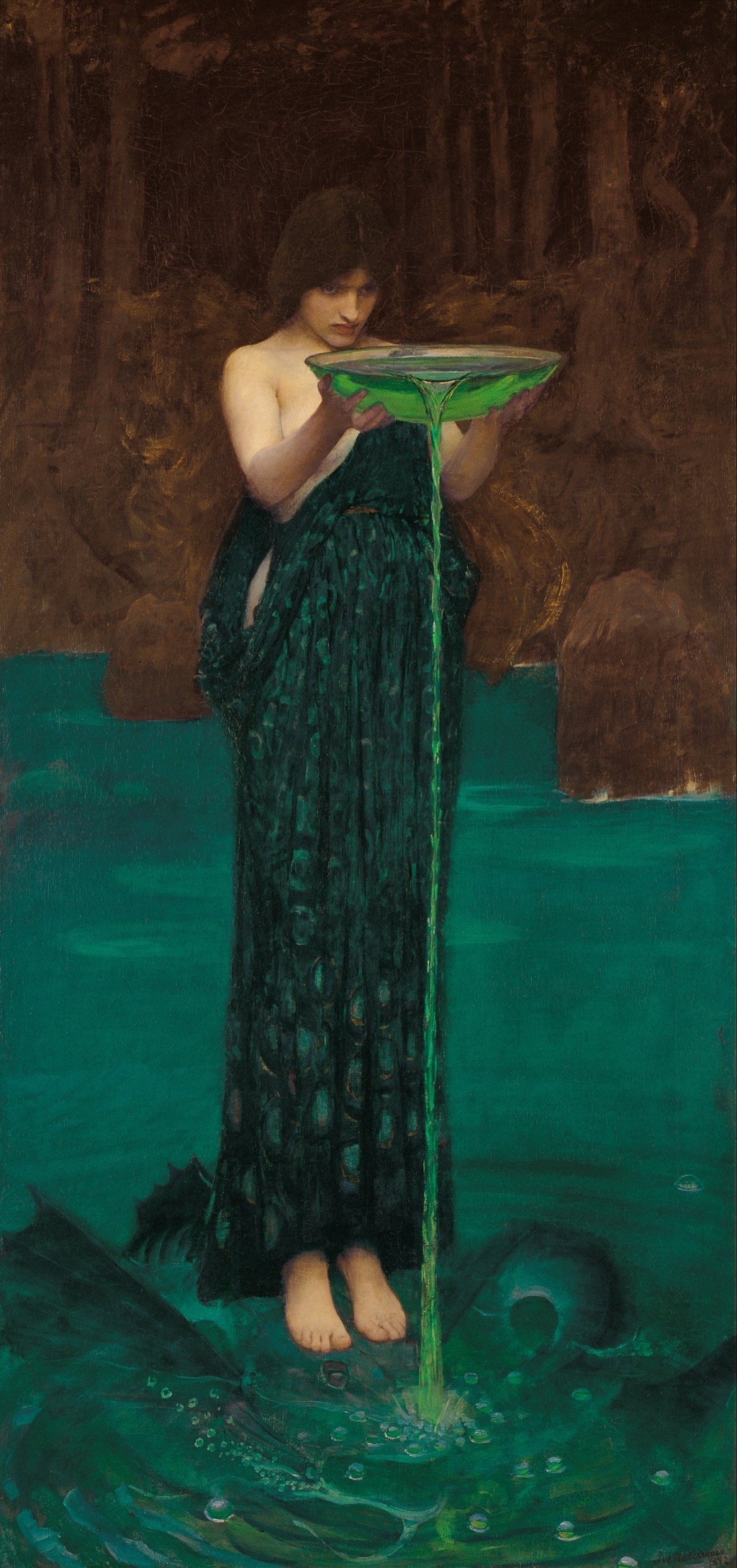
John William Waterhouse’s Circe Invidiosa shows jealousy becoming an environment. The enchantress stands alone above dark water and tips a bowl of brilliant green liquid into the sea. Poison spreads beneath her, but its colour also seems to rise through water, dress and atmosphere. The intended victim is absent. Waterhouse concentrates on the instant when inward resentment becomes an irreversible act.
Painted in 1892 and acquired immediately for the Art Gallery of South Australia, the tall canvas draws on Book XIV of Ovid’s Metamorphoses. Circe desires the sea-god Glaucus; Glaucus loves Scylla; Circe retaliates by contaminating the cove where Scylla bathes and transforming her into a monster. Waterhouse removes both members of that triangle and gives the whole field to Circe. Her beauty is not an alternative to danger, and her self-possession is not innocence. The painting’s power comes from watching deliberate harm carried out with the composure of a ritual.
At a Glance
- ArtistJohn William Waterhouse (1849–1917)
- TitleCirce Invidiosa—commonly translated as Envious Circe
- Date1892
- Place madeLondon
- MediumOil on canvas
- Dimensions180.7 × 87.4 cm
- CollectionArt Gallery of South Australia, Adelaide
- Accession number0.106
- SignatureSigned and dated “J.W. Waterhouse./1892.” at lower right
- First exhibitedRoyal Academy, London, 1892, catalogue no. 20
- AcquisitionPurchased from the artist in 1892 through the South Australian Government Grant [1] [3]
Contents
- Introduction
- The Moment When Emotion Becomes Action
- Circe, Glaucus and Scylla in Ovid
- Ovid’s Circe and Waterhouse’s Invention
- The Poison as the Painting’s Second Figure
- Sea, Air and an Unnatural World
- Circe’s Face and the Ethics of Expression
- Hands, Bowl and the Performance of Control
- Dress, Hair and the Jewel-Like Colour Structure
- The Narrow Vertical Composition
The Moment When Emotion Becomes Action
Waterhouse chooses neither the cause nor the visible result of Circe’s revenge. Glaucus is not present to reject her. Scylla is not present as a beautiful nymph or fully formed monster. Instead the painting isolates a transfer: liquid leaves a vessel, enters the sea and begins to change the world.
The action is small enough to be controlled with both hands. Circe does not strike, struggle or summon lightning. She tips the broad bowl at a measured angle and watches its contents descend. That restraint makes the act more disturbing. Violence is contained in preparation, knowledge and intention rather than physical exertion.
The eye follows the poison down. Circe’s face is high in the canvas; her gaze, forearms and the rim of the vessel direct attention towards the green stream. The body remains almost upright while the liquid introduces movement. Waterhouse builds narrative from a vertical chain: thought, look, hand, bowl, poison, sea.
This downward movement separates agency from consequence. Circe controls the bowl, but once the liquid reaches the water it disperses beyond her hands. Ovid’s Scylla will enter the contaminated cove without knowing what has been done. Waterhouse makes that unseen future feel present through the spreading colour.
The painting’s title supplies motive. Invidiosa is commonly translated by the Gallery as “Envious Circe”. [6] The name Circe alone would identify a powerful sorceress; the adjective directs attention towards corrosive comparison. She does not attack the person who refuses her. She changes the body of the woman he prefers.
Yet the image does not reduce Circe to an uncontrolled outburst. Her posture is too concentrated and her method too exact. Jealousy here is not momentary heat. It has become a plan, a material substance and an exercise of expertise.
Circe, Glaucus and Scylla in Ovid
The source episode crosses the end of Book XIII and beginning of Book XIV of Ovid’s Metamorphoses. Glaucus, once mortal and now a sea-god, sees the nymph Scylla and desires her. Frightened by his sea-changed form, Scylla flees. Glaucus then travels to the herb-rich home of Circe and asks her to use magic on his behalf. [2]
Circe answers his request by offering herself. She argues that a goddess who desires him would be a more suitable partner than a nymph who rejects him. Glaucus refuses. In Ovid’s account his attachment to Scylla will endure while seaweed grows on mountains and forests grow beneath the sea. The impossibility of those images makes his fidelity absolute.
Circe does not direct her rage at Glaucus. Ovid explains that love prevents her from wishing to harm him, so anger turns towards the woman chosen over her. She gathers powerful roots, infects the quiet cove where Scylla escapes the midday heat, scatters plant juices over the water and repeats a secret incantation three times nine. [2]
Scylla enters without warning. At her waist appear barking creatures, which she initially mistakes for monsters surrounding her. When she attempts to flee them, she discovers that they are attached to her body. The victim cannot escape because transformation has made the threat part of herself. Later, as the sea monster familiar from the Odyssey, she kills sailors from Ulysses’ ship. [2]
Ovid’s tale is therefore not only a triangle of unreturned desire. It is a story about displaced punishment. Scylla has not harmed Circe. Glaucus has already pursued Scylla against her wishes, then seeks magic to change those wishes, but his body remains untouched. The woman whose refusal began the episode bears the physical consequence.
Waterhouse’s painting depends upon this context while refusing to narrate it in full. Without the title or knowledge of Ovid, a viewer may recognise enchantment and pollution but not the identities of lover and victim. With the text in mind, every calm feature of the image becomes morally charged.
Ovid’s Circe and Waterhouse’s Invention
Ovid describes the poisoned cove and the magical procedure but does not provide Waterhouse’s exact tableau. His Circe infects the water with juices drawn from harmful roots and spoken charms. Waterhouse gathers those actions into the visible pouring of one luminous liquid from an enormous bowl. [2]
That invention gives the spell a single material focus. Speech cannot be heard in paint, and scattered herbs would disperse attention. The green stream makes causation immediate. We see where the poison comes from and whose hands release it.
Waterhouse also monumentalises a private act. Ovid’s sorceress visits the cove before Scylla arrives. The crime has no audience within the story. The painting enlarges Circe to near life-size and places her before the viewer as though the secret action were a public ceremony.
The omission of Glaucus prevents Circe’s emotion from being read through an exchange of looks. The omission of Scylla prevents her suffering from competing visually with the perpetrator. This is ethically uncomfortable, and it is meant to be. The viewer is held with the person exercising power while the absent victim survives only in title, text and anticipated consequence.
Some reproductions and descriptions discern monstrous forms beginning in the lower water. Dark shapes and disturbances are visible, but their exact identity should not be overstated without technical or documentary evidence. Waterhouse does not clearly show Scylla’s complete human body or the ring of dogs described by Ovid. Transformation is suggested through poisoned water rather than anatomically explained.
The result is less an illustration of Scylla’s metamorphosis than a portrait of its cause. Circe is not shown after revenge, looking satisfied or remorseful. She remains inside the act. Waterhouse suspends moral judgement at the point where intention becomes contamination.
The Poison as the Painting’s Second Figure
Although Circe is the only human body, the green liquid behaves like a second presence. It begins in the bowl, narrows into a falling stream and expands into the water. Its path has direction, force and consequence. The figure remains stable while the poison moves.
Colour makes that movement legible. The liquid is brighter than the surrounding sea and more unnatural than the muted flesh. It does not disappear when poured. Instead it seems to stain the world, creating a visible record of an invisible chemical or magical change.
The Art Gallery of South Australia interprets green as the colour of envy and argues that the poison appears to affect not only the sea but the atmosphere around Circe. [1] [6] This is a persuasive reading because the title names envy and because related greens recur across the canvas. It should still be recognised as interpretation rather than a universal colour code. Green can also signify sea, vegetation, sickness, precious material or supernatural light.
The crucial effect is contamination. Circe can direct the first pour but cannot keep the colour confined to one narrow line. Green enters blue; reflected tones reach her gown and skin; distinctions between body, poison and environment become less secure. The emotion that prompts harm appears to alter the person who acts upon it.
That visual spread supports the Gallery’s moral reading that envy is poisonous to its maker as well as its victim. [6] Waterhouse does not show Circe physically transformed, and it would be too literal to claim that her own spell attacks her body. But the atmosphere denies her a clean separation from what she releases.
The bowl is important in this process. It resembles a ritual or domestic vessel rather than a weapon. Its broad rim receives light; its weight requires two hands; its controlled tilt suggests practised knowledge. Waterhouse makes sorcery credible by giving it material procedure.
Sea, Air and an Unnatural World
The Art Gallery describes the aquamarine ocean and elongated canvas as creating an uncanny world recognisably different from ordinary experience. [1] The setting is maritime, but it is not an open seascape designed to offer distance and freedom. Water rises close to Circe and occupies much of the narrow field.
The horizon and surrounding rocks provide little escape from the figure. In a conventional landscape, horizontal recession invites the eye outward. Here the format pulls attention up and down. Sea becomes a vertical screen of colour behind and beneath the body.
This compression suits the subject. Circe has chosen a secluded bathing place whose safety depends on its privacy. The painting offers no city, ship or observer within the scene. Magic enters an apparently self-contained natural system and changes it before the victim arrives.
Water is the ideal medium for this crime because it carries without revealing. A poisoned object could be avoided; contaminated water surrounds the body. Ovid’s Scylla wades to the waist before discovering what has happened. [2] The place associated with coolness and refuge becomes inseparable from danger.
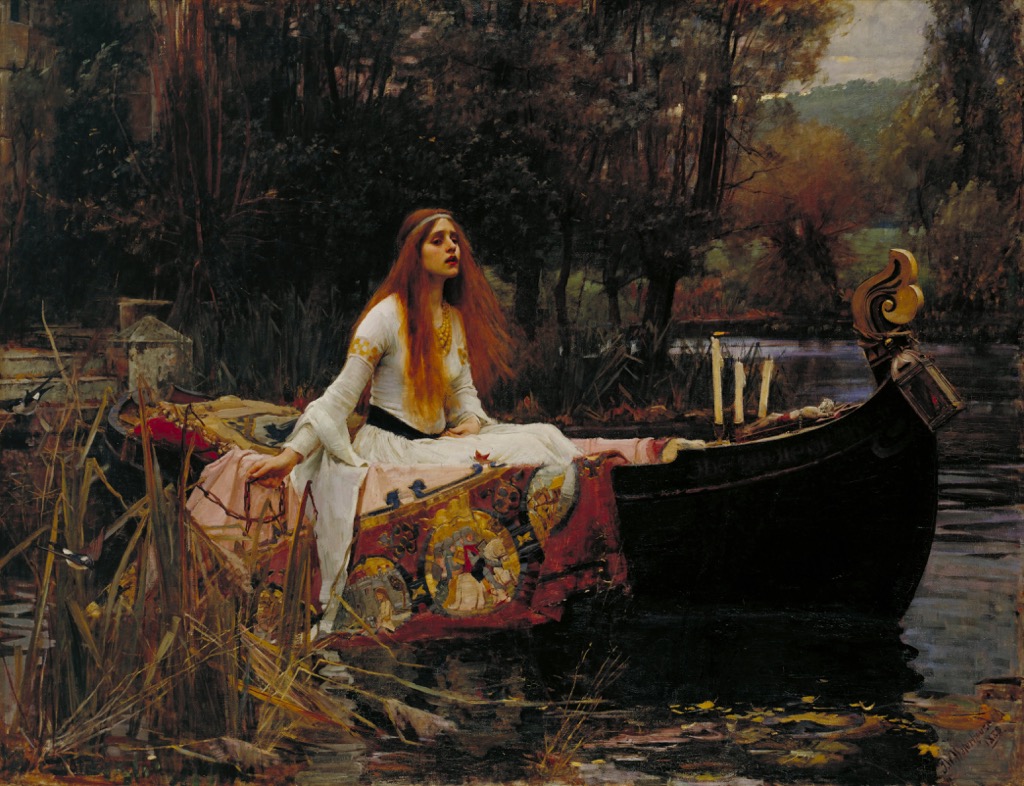
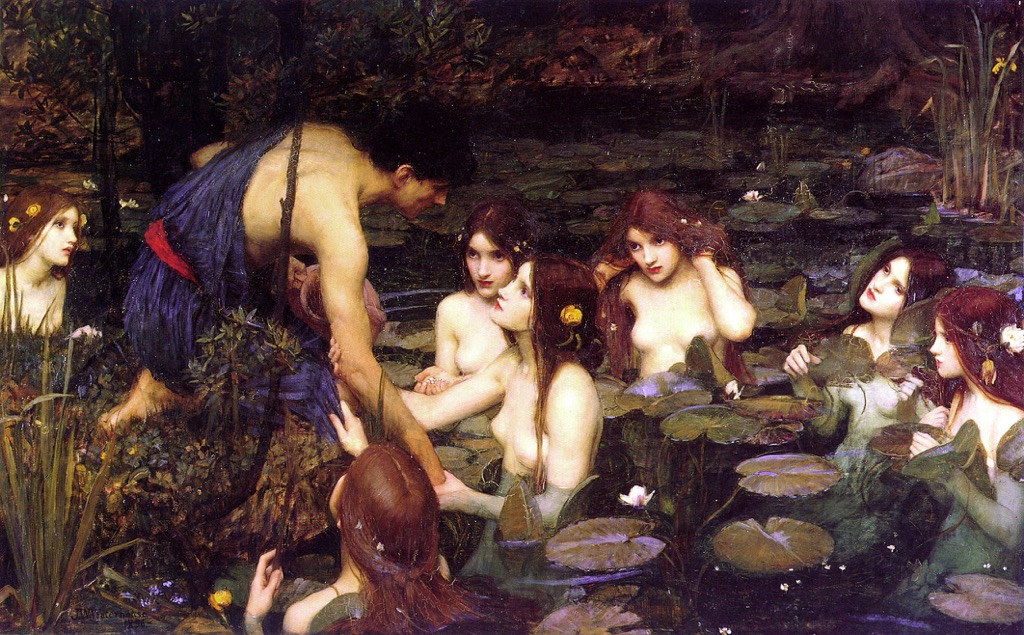
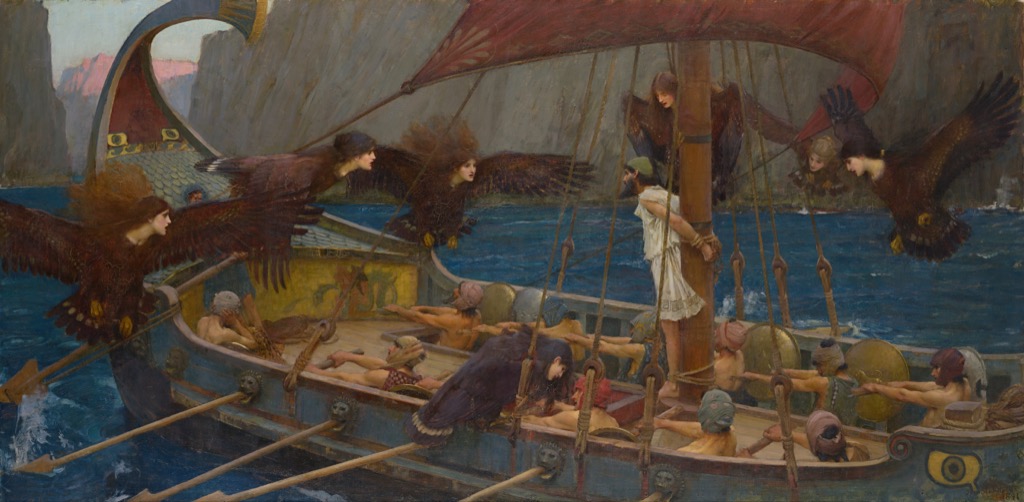
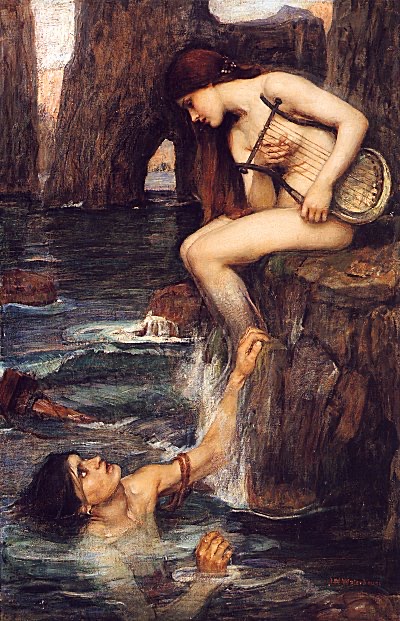
The sea also joins this Circe to Waterhouse’s wider mythology. In Ulysses and the Sirens, ocean surrounds a ship under attack. In Hylas and the Nymphs, a pool conceals a fatal attraction. In Echo and Narcissus, water returns a deceptive image. Circe Invidiosa makes water the carrier of another person’s will. Across these works, beauty and danger do not merely coexist beside water; water is the instrument that connects them.
Atmospheric ambiguity prevents exact geography. Ovid locates Scylla around the strait between Italy and Sicily, but Waterhouse does not provide a topographical portrait of a named cove. The setting is mythic space constructed from sea, rock, colour and isolation.
Circe’s Face and the Ethics of Expression
Circe’s face is grave, lowered and highly controlled. She looks towards the action rather than at the viewer. No open mouth, widened eyes or violent grimace converts jealousy into melodrama. Waterhouse makes expression difficult to classify.
That difficulty has encouraged incompatible readings. She can appear cold, angry, sorrowful, trance-like or resigned depending on whether the viewer begins with the title, the poison or the face. The painting establishes what she does but leaves the exact quality of her feeling unsettled.
It is important not to let ambiguity erase responsibility. In Ovid, Circe acts deliberately after Glaucus refuses her. She selects Scylla’s bathing place, prepares drugs and performs repeated incantations. [2] Waterhouse’s measured pose reinforces premeditation. A melancholy expression might complicate the act; it does not undo it.
At the same time, the absence of theatrical hatred prevents Circe from becoming a one-note monster. Her beauty and composure require the viewer to confront a disturbing fact: destructive action does not always announce itself through a deformed face. The person who harms and the person who appears aesthetically compelling can be the same.
The face is also visually affected by the surrounding colour. Cool green-blue light makes the flesh less warm than it might be in an ordinary portrait. Circe seems immersed in the world she is creating. The effect does not prove an allegory of self-poisoning, but it denies the fantasy that intention remains pure while only the victim is changed.
Waterhouse avoids eye contact, yet he does not release the viewer. Because Circe looks down, we follow her gaze towards the poison. We are made witnesses to the method rather than recipients of a direct challenge. The quiet concentration is more absorbing than confrontation would have been.
Hands, Bowl and the Performance of Control
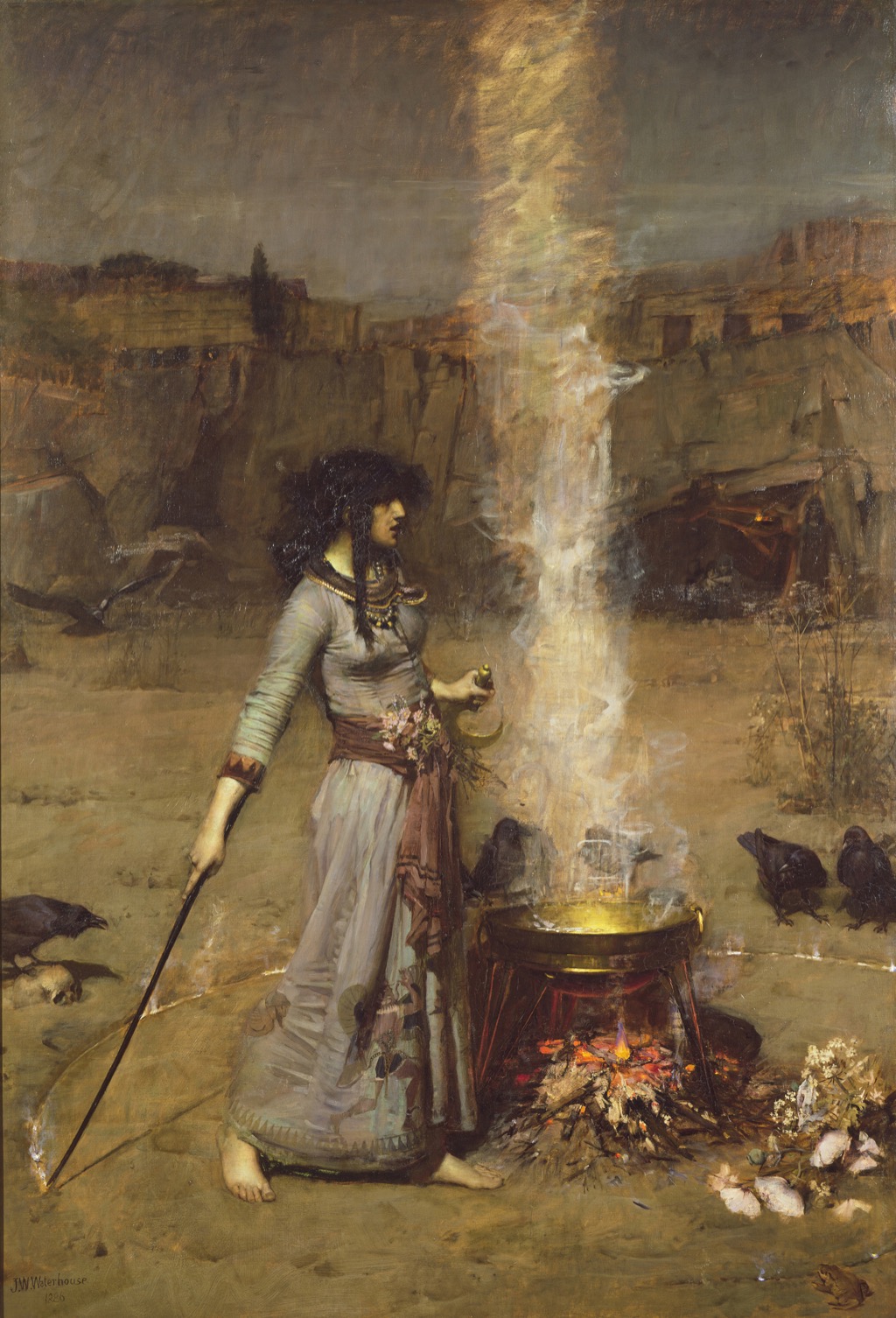
Both hands support the vessel. Their symmetry and care contrast with the damage contained in the liquid. Waterhouse repeatedly used hands to explain magical power: the staff and smoking vessel in The Magic Circle, the cup extended towards Ulysses in the 1891 Circe and the flowers held by the nymphs around Hylas. Here control lies in angle and grip.
The bowl creates a horizontal interruption across Circe’s vertical body. Its rounded form and dark metallic colour stand between face and falling stream. It is both container and threshold. Above the rim, poison is possessed; below it, poison is environmental.
The falling liquid is narrow enough to suggest that Circe regulates the dose. She is not emptying the bowl in panic. That precision connects sorcery with craft: knowledge of materials, sequence and destination matters. Magic becomes a specialised practice rather than unexplained spectacle.
The viewer may also notice the physical strain that the elegant pose conceals. A broad vessel held away from the torso would have weight. The preparatory drawings show Waterhouse’s attention to head, shoulders and the relation of hands to bowl. [4] [5] Grace is constructed through bodily effort.
Nothing visibly spills onto Circe. Her mastery appears complete at the level of gesture. The broader colour design, however, makes clean control questionable. She can control the vessel but not the moral or narrative afterlife of the act. Scylla’s transformation will later kill Ulysses’ companions, extending harm far beyond the immediate rivalry. [2]
Dress, Hair and the Jewel-Like Colour Structure
Circe wears a long blue-green gown enriched with darker pattern and touches of gold. Its folds lengthen the body and join her visually to the sea. The dress does not identify a precise ancient costume. It creates an archaic, sumptuous register suitable for a mythic goddess while allowing colour to carry the painting’s emotional force.
Gown and water are related but not identical. Cloth holds patterned highlights and folds; sea breaks into shifting areas; poison cuts through both with a more lurid green. The eye moves among substances that share colour while retaining different surfaces.
Her dark hair is controlled and lifted away from the face. Unlike the loose red hair associated with many of Waterhouse’s later heroines, it reinforces severity. Head, bowl and dress form an ordered sequence. Ornament does not loosen the composition into decorative abundance.
The attraction of the palette created one of the picture’s historical paradoxes. Colours associated with sickness, poison and jealousy are also beautiful. A later account attributed to Gleeson White compared Waterhouse’s colours with stained glass or jewels; whether or not the phrase defines every passage, it captures the dense luminosity for which the painting became famous. [9]
Beauty does not excuse the subject, but neither can moral content cancel visual pleasure. Waterhouse makes viewers experience the same tension built into many late Victorian enchantress images: we are drawn towards a figure whose action the story asks us to condemn. The painting knows that danger represented unattractively would pose a simpler problem.
The secure account of technique remains visual. The published sources cited here do not provide a full pigment analysis, X-radiograph or infrared examination of the canvas. The relation of green, blue, gold and flesh can be described from the visible surface, while particular pigments or hidden changes would require separate technical evidence.
The Narrow Vertical Composition
At 180.7 cm high and only 87.4 cm wide, Circe Invidiosa is more than twice as tall as it is broad. [1] The proportion makes Circe monumental while denying her extensive surroundings. She nearly fills the available height.
The format turns pouring into the organising principle. In a broad canvas, liquid might travel through a larger narrative setting. Here every stage stacks vertically. Face and shoulders occupy the upper zone, the bowl crosses the centre, the falling poison passes through the lower torso and the sea receives it near the bottom.
Circe’s elongation can feel elegant and unnatural at once. The figure appears to rise out of the same environment she alters. The Gallery explicitly links the narrow proportion with the work’s otherworldliness. [1] A conventional portrait format is stretched until the body becomes an apparition.
Verticality also affects power. We look up towards Circe’s head while looking down with her towards the water. The spectator occupies two positions simultaneously: beneath the monumental figure and above the contaminated cove. This instability prevents a neutral outside view.
The frame edges press close to dress and sea. There is no room for Glaucus on one side or Scylla on the other. Their absence may begin in Ovid’s sequence, since Circe poisons the cove alone, but format makes that solitude dominant. The painting becomes an image of concentrated agency rather than social encounter.
Its large physical height matters. Reproductions often turn Circe Invidiosa into a decorative vertical image and reduce the bowl to an accessory. At gallery scale the figure confronts an adult viewer with near-bodily presence. The stream of poison is not a tiny emblem; it descends through a substantial field of colour.
Preparatory Drawings and the Construction of Circe
The Art Gallery of South Australia owns a study for Circe Invidiosa dating from about 1892. Executed in charcoal and brown chalk on white card, it measures 34 × 23.8 cm within a sheet of 35.7 × 25.5 cm. Waterhouse signed the image but did not date it. [4]
Its history is unusually meaningful. Waterhouse gave the drawing to the Gallery in 1899, seven years after the institution acquired the painting. [4] Painting and study therefore entered the same public collection through separate direct relationships with the artist.
A further study for Circe’s head has appeared at Sotheby’s. The catalogue connects it specifically with the 1892 picture and records its later ownership history. [5] Together the drawings show that the apparently unified figure was prepared through focused studies rather than invented entirely on the canvas.
Head and body posed different problems. The head needed to sustain emotional ambiguity without losing concentration. The body needed to make the broad vessel, long dress and downward action convincing within a narrow field. Separate studies allowed Waterhouse to develop those demands before uniting them.
The existence of studies also cautions against overconfident claims about the model. Facial resemblance across Waterhouse’s pictures may suggest repeated sitters or a preferred type, but the sources used here do not securely name the woman who posed for Circe Invidiosa. The figure is a constructed mythological role, not a documented portrait.
Drawings reveal process without revealing everything. They do not by themselves establish the order of every painted layer, the composition of the green liquid or all revisions made during execution. Their strongest evidence concerns pose, attention and Waterhouse’s deliberate preparation.
Circe Offering the Cup and the Changing Enchantress
Waterhouse had painted Circe the previous year in Circe Offering the Cup to Ulysses. There she sits frontally on a throne, extends a cup towards the approaching hero and uses a mirror behind her to include Ulysses and his ship. The viewer occupies the dangerous position of the person offered the drink. In Circe Invidiosa, the vessel turns away from a male recipient and towards the natural world.
The change is decisive. The 1891 Circe confronts, performs and negotiates. The 1892 Circe looks down and works alone. One offers transformation directly; the other prepares it for an absent victim. The first painting stages a contest between enchantress and resistant hero. The second removes resistance from sight.
Circe’s morality also shifts with the source. In the Odyssey, she transforms Ulysses’ men into swine but later restores them and assists the hero. In Ovid’s Scylla episode, her action is retaliation against an uninvolved rival. Circe Invidiosa therefore presents one of her least defensible deeds.
Waterhouse returned to Circe or a Circe-like sorceress in later studies and an unfinished picture generally called The Sorceress. Christie’s records the continuing theme and the relation among these works. [9] The recurrence shows that Circe offered more than one fixed femme-fatale formula.
Calling her a “femme fatale” can identify a major late nineteenth-century type—the beautiful, sexually powerful woman associated with male danger—but it can also flatten differences. The victim here is Scylla, another woman, and the immediate conflict follows Circe’s own rejected desire. The picture is as much about rivalry, agency and misdirected punishment as male fear.
The two completed Circes should therefore be read as distinct decisions. Waterhouse is not merely repeating an attractive sorceress. He tests how power appears when addressed directly to a man and when exercised secretly upon a woman’s environment.
The Royal Academy Exhibition of 1892
Circe Invidiosa appeared at the Royal Academy in 1892 as catalogue number 20. [3] Waterhouse was then an Associate of the Royal Academy; he would become a full Academician in 1895. The exhibition placed the tall, chromatically intense mythological subject before a large London audience.
Its catalogue title was essential. Viewers familiar with Ovid could reconstruct the absent triangle and the destination of the poison. Those without the text could still read an enchantress, bowl and altered water, but the adjective Invidiosa turned mysterious ritual into envious revenge.
The painting followed both Ulysses and the Sirens and Circe Offering the Cup to Ulysses, which had appeared in 1891. Waterhouse’s early 1890s were densely occupied by classical enchantment and maritime danger. This was not an isolated classical exercise but part of a sustained reworking of ancient narrative.
Waterhouse’s institutional position complicates the frequent label “Pre-Raphaelite”. He was trained within the Academy, pursued large public exhibition pictures and was not a member of the original Brotherhood. His precise literary imagery and brilliant colour absorbed Pre-Raphaelite precedents while his scale, classical source and professional route also connected him with the Victorian Olympians. [1] [7]
Modern familiarity can obscure how strange the picture looked in exhibition. The format is unusually narrow, the principal colours verge on unnatural and the victim is omitted. It asks viewers to admire controlled design while confronting an action that violates bodily autonomy.
Adelaide’s Immediate Purchase and Early Hostility
The Art Gallery of South Australia purchased the painting from Waterhouse in 1892 using a South Australian Government Grant. The decision followed advice from an expert committee consisting of Frederic Leighton, Edward Poynter and Hubert von Herkomer. It departed Southampton for Adelaide aboard the S.S. Orient in February 1893. [1]
This direct acquisition gives the work an exceptionally clear early provenance: artist to public collection. It also continues an important relationship. In 1883 the same Gallery had acquired The Favourites of the Emperor Honorius, the first Waterhouse painting to enter any public institution. [1]
Public ownership did not mean immediate public approval. The Gallery records mixed responses in Adelaide. The Daily Telegraph in 1893 said the work repelled rather than attracted the average visitor; another contemporary judgement predicted that it would never become generally popular. [1] [6]
Those reactions are valuable because they confirm the picture’s unsettling force. Later reproduction can make its colour and elegant figure seem familiar, even luxurious. Early viewers could be disturbed by the sickly sea, stretched format and combination of female beauty with deliberate poisoning.
The historical reversal is striking. The Gallery now describes Circe Invidiosa as one of its most beloved and reproduced works. [1] Popularity has not changed the act shown, but it has changed the balance between attraction and repulsion. What some viewers encountered as hostile strangeness has become a defining image of Waterhouse.
The acquisition also placed an ambitious British Academy painting in Adelaide almost as soon as it existed. Its history is not merely the movement of European art to a later overseas market. South Australian advisers and public funding participated in the contemporary reception of Waterhouse’s career.
Envy, Agency and the Absent Victim
The title makes envy unavoidable, but its moral structure deserves precision. Circe suffers rejection, yet the painting does not show her as powerless. She possesses knowledge, materials and freedom of action. Scylla, who has already exercised her own refusal of Glaucus, will be attacked without warning.
The absence of Scylla intensifies rather than erases her vulnerability. She cannot meet Circe’s gaze, resist the spell or even know that the place of refuge has been altered. The viewer is given more knowledge than the victim and no ability to intervene.
Glaucus is absent in a different way. He is the object of Circe’s desire and the person whose request brought him to her, but the punishment bypasses his body. The triangle exposes a pattern in which rivalry redirects anger away from a desired person and towards the person perceived as competition.
Waterhouse does not paint an explicit moral caption. The beautiful surface can make Circe’s power fascinating, and her concentrated face may produce sympathy. Yet the green spread records harm too clearly for the scene to become harmless fantasy. Ambivalence belongs to the viewer’s encounter, not to the facts of the story.
The painting can consequently be read without either demonising female power in general or romanticising this exercise of it. Circe is neither proof that powerful women are dangerous nor an innocent misunderstood healer. She is a particular mythic agent committing a particular act because Ovid and Waterhouse use her to explore desire, resentment and transformation.
Her isolation matters. There is grandeur in standing alone, but there is also imprisonment within one’s fixation. No one shares the frame, and green seems to claim the atmosphere. Envy has removed every relationship except the one between actor and poison.
How to Look Closely at Circe Invidiosa
Begin with the proportions. Notice how little space exists beside Circe compared with the space above and below the bowl. The canvas trains the eye to move vertically before the subject is fully understood.
Then follow the action from her eyes to her hands. Look at the angle of her head, the level of the bowl and the narrowing fall of liquid. The story is contained in that sequence. Ask whether the face appears to control the hands or whether the ritual seems to hold the entire body.
Compare greens. Some belong to poison, some to sea, some to dress and reflected atmosphere. Where can one end and another begin? The difficulty is part of the picture’s contamination effect, although it does not justify naming unverified pigments.
Look at the absence around her. There is no Glaucus, no untransformed Scylla and no clearly complete monster. The painting gives just enough narrative information for the title and Ovid to activate. Consider whether seeing the victim would make the image more compassionate or less concentrated.
Finally, imagine the work at its actual height of more than 1.8 metres. Circe is not a miniature decorative figure. She occupies the viewer’s bodily scale, while the bright stream descends towards the lower edge and into the spectator’s space.
Related Pages
- Paintings: Return to the Waterhouse paintings hub and the wider mythological sequence.
- Literary and Mythological Sources: Follow the Ovidian source tradition behind Circe, Scylla and Glaucus.
- The Magic Circle: Compare another Waterhouse image of ritual power and sorcery.
Frequently Asked Questions
The title is commonly translated as Envious Circe. It identifies Circe’s motive in the episode: jealousy after Glaucus rejects her in favour of Scylla. [2] [6]
Waterhouse signed and dated it in 1892. It was exhibited at the Royal Academy that year as catalogue number 20. [1] [3]
It has belonged to the Art Gallery of South Australia since 1892. Its accession number is 0.106. [1]
The oil on canvas measures 180.7 × 87.4 cm. Its unusually tall, narrow proportion is central to the downward movement of the poison. [1]
She poisons the water where the nymph Scylla bathes. Scylla is transformed into a sea monster after Glaucus rejects Circe and declares his love for her. [2]
The Gallery interprets its lurid green as the colour of envy and as a sign that Circe’s emotion contaminates her surroundings. [6] The painting does not provide a written symbolic key, so this remains a strong interpretation rather than a proven formula.
Not clearly in her human or fully transformed form. Dark disturbance in the lower water may suggest transformation, but Waterhouse concentrates on Circe pouring the poison before the victim arrives.
Yes. The Art Gallery of South Australia owns a charcoal-and-brown-chalk study given by Waterhouse in 1899, and a separate study for Circe’s head has been documented by Sotheby’s. [4] [5]
Its brilliant colour, literary source and precise, sensuous detail continue aspects of Pre-Raphaelite art. Waterhouse was not a member of the original Brotherhood; he was a Royal Academy-trained painter whose classical subjects also align him with the Victorian Olympians. [1] [7] [8]
Discussion
Circe Invidiosa holds attention because its most beautiful element is also its sign of corruption. The green that makes the painting visually unforgettable is the colour of poison spreading through water. Waterhouse does not allow pleasure and judgement to occupy separate parts of the canvas.
Reader Insights
Does Circe’s calm make her seem more powerful, more tragic or more responsible?
How would the meaning change if Scylla’s body appeared in the water?
At what point does the green stop belonging to the potion and begin to belong to Circe’s whole world?
Join the Conversation
Describe the first feature that makes the scene feel dangerous: the falling poison, Circe’s expression, the narrow format, the colour of the sea or something less obvious.
References
- Main image: John William Waterhouse, Circe Invidiosa, 1892, Art Gallery of South Australia, public-domain photographic reproduction via Wikimedia Commons / Google Art Project.
- Art Gallery of South Australia, “Circe Invidiosa,” institutional collection record and curatorial account, including dimensions, signature, provenance, acquisition, shipment and reception. View source
- Ovid, Metamorphoses, Book XIV, “Scylla Transformed to a Rock,” translated by Brookes More, Theoi Classical Texts Library. View source
- Algernon Graves, The Royal Academy of Arts: A Complete Dictionary of Contributors and Their Work from Its Foundation in 1769 to 1904, vol. VIII, Waterhouse exhibition record, including Circe Invidiosa, Royal Academy no. 20 in 1892. View source
- Art Gallery of South Australia, “Study for Circe Invidiosa,” institutional drawing record, including medium, dimensions, accession and the artist’s 1899 gift. View source
- Sotheby’s, “John William Waterhouse, R.A., R.I., Study for the head of Circe in Circe Invidiosa,” catalogue record and note. View source
- Art Gallery of South Australia, “Circe Invidiosa,” Melrose Wing self-guided audio transcript, including the Ovidian narrative, colour interpretation and Adelaide reception. View source
- National Portrait Gallery, London, “John William Waterhouse (1849–1917), Figure Painter,” biographical record including Royal Academy training and status. View source
- Elizabeth Prettejohn, Peter Trippi, Robert Upstone and Patty Wageman, J. W. Waterhouse, 1849–1917: The Modern Pre-Raphaelite, exhibition-catalogue and retrospective record, University of Bristol Research Portal, 2008. View source
- Christie’s, “John William Waterhouse, R.A., Circe,” catalogue account of Waterhouse’s repeated treatments of Circe and the later unfinished Sorceress. View source