

 Buy Art Prints Now
from Amazon
* As an Amazon Associate I earn from qualifying purchases.
Image reference [image]
 by Tom Gurney
Tom Gurney BSc (Hons) is an art history expert with over 20 years experience
Published on August 14, 2026 / Updated on August 14, 2026
Email: tomgurney1@gmail.com / Phone: +44 7429 011000
Hylas and the Nymphs: Introduction
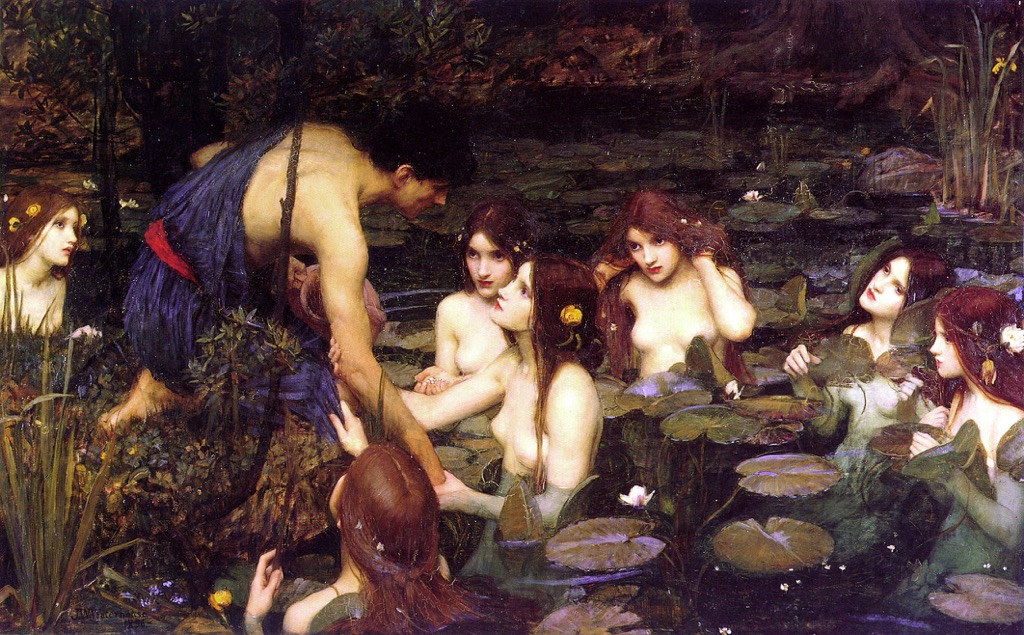
John William Waterhouse’s Hylas and the Nymphs makes danger still. At a dark pool, a young man kneels with a water jar. Seven nymphs rise among white lilies. One touches his arm; another reaches towards his clothing; others watch. Nothing shows the violence that will follow, yet the ancient story supplies it: Hylas has come to fetch water for the Argonauts, and he will not return.
Painted in 1896, the oil on canvas measures 98.2 × 163.3 cm and belongs to Manchester Art Gallery. The gallery purchased it directly from Waterhouse in the year it was painted. He signed and dated it at the lower left, and it was exhibited at the Royal Academy in 1897. [1] [7]
The picture’s hold on viewers comes from a contradiction Waterhouse never resolves. The nymphs appear both human and inseparable from the pool; their faces are inviting, but their hands have begun to close around Hylas. His body leans towards them of its own accord even as the myth tells us that he is being taken. Attraction and capture, looking and possession, nature and the supernatural occupy the same surface.
At a Glance
- ArtistJohn William Waterhouse (1849–1917)
- TitleHylas and the Nymphs
- Date1896
- MediumOil on canvas
- Dimensions98.2 × 163.3 cm
- CollectionManchester Art Gallery
- Accession number1896.15
- AcquisitionPurchased from the artist, 1896
- SignatureSigned and dated at the lower left, “J.W.Waterhouse / 1896” [1]
- First Royal Academy exhibition1897, catalogue number 307 [7]
- SubjectHylas, the companion of Heracles, drawn into a spring by water nymphs during the voyage of the Argonauts [2] [3]
Contents
- Introduction
- The Instant Before Disappearance
- Hylas Among the Argonauts
- One Myth, Several Ancient Versions
- A Composition Divided Between Land and Water
- The Hands That Carry the Story
- Seven Faces and the Power of Repetition
- Lilies, Reflections and the Living Pool
- Beauty, Desire and the Question of Agency
- Preparatory Studies and Waterhouse’s Working Process
The Instant Before Disappearance
Waterhouse chooses the last moment in which Hylas still belongs to the visible world. The youth has reached the spring, knelt on the bank and lowered his bronze-coloured vessel. He is close enough for the nearest nymph to hold his forearm. Yet he has not fallen, struggled or cried out. Heracles is absent, the Argo is absent, and the search that follows has not begun.
This pause is the painting’s narrative engine. Anyone unfamiliar with the myth may initially see a secluded encounter: one clothed young man meeting seven unclothed women in a woodland pool. Anyone who knows the outcome sees a trap in progress. Waterhouse preserves both experiences. He does not paint the nymphs as obvious monsters, nor does he give Hylas the expression of a victim who recognises his fate. Knowledge resides partly outside the image, in the story carried by its title.
The chosen instant also turns a physical abduction into an exchange of looks and touches. Hylas bends into the nymphs’ space. The foremost figure looks directly up at him. Their faces approach his one shadowed profile from several directions, while their arms and the pale curves of their bodies repeat through the water. There is no single gesture that announces the point of no return. Instead, several small contacts accumulate until the viewer realises that Hylas is already encircled.
The waterline makes the outcome present without showing it. All seven nymphs belong below it, although their heads and torsos emerge into air. Hylas belongs above it, although his arm, jar and gaze descend towards the surface. The painting arrests him at the boundary between those worlds. Its tragedy lies less in a fall than in a gradual change of element.
Hylas Among the Argonauts
Hylas enters Greek literature through the wider story of Jason and the Golden Fleece. He travels on the Argo with Heracles, the hero known to the Romans as Hercules. Ancient authors vary in their description of the relationship, but they agree that Hylas is exceptionally beautiful and closely attached to Heracles. His disappearance separates the pair and removes Heracles from the voyage.
In Book I of Apollonius of Rhodes’s Argonautica, the company lands in Mysia. Hylas takes a bronze pitcher and goes to find water for the evening meal. At the spring called Pegae, a water nymph sees him in moonlight. Aphrodite makes her desire him; when he dips the pitcher, she places one arm around his neck, catches his elbow with the other hand and pulls him into the eddy. The Argonaut Polyphemus hears his cry. He alerts Heracles, who rushes through the darkness calling and searching while the ship eventually continues without him. [2]
The story is therefore not merely a decorative episode about bathing spirits. It breaks heroic fellowship. A routine task—fetching water—opens a gap in an expedition built on coordinated action. The strongest man among the Argonauts cannot retrieve the person he loves, and Hylas’s beauty exposes him to a force physical strength cannot overcome.
Waterhouse strips away most of that epic setting. Hylas carries no visible reminder of the Argo beyond the vessel that explains his errand. Heracles’s anguish lies in the future. The compression has an important effect: rather than seeing the nymph’s action from outside, as one incident in a crowded adventure, the viewer occupies Hylas’s narrowed field of attention. The forest closes behind him. The pool fills the foreground. For the duration of the image, the voyage of the Argonauts has contracted into one dangerous act of looking.
One Myth, Several Ancient Versions
There is no single ancient account that Waterhouse copied detail by detail. The myth reached the nineteenth century through Greek epic and pastoral poetry, Roman elegy, shorter classical allusions and a long visual tradition. Those sources disagree about the spring, the number and names of the nymphs, and what happens to Hylas after he is pulled beneath the water.
Theocritus’s thirteenth Idyll begins from the love of Heracles for Hylas. When the Argonauts halt, Hylas goes with a bronze pitcher to fetch water. The spring is thick with plants, and three named nymphs—Eunica, Malis and Nycheia—dance in its depths. They all fasten upon his arm and draw him headlong into the dark water. The poem does not simply describe death. The nymphs take the weeping youth on their knees and soothe him; by the close, he is numbered among the blessed. Heracles calls three times, and Hylas answers three times, but the submerged voice sounds impossibly far away. [3]
Apollonius, by contrast, brings one water nymph into immediate action. The full moon illuminates Hylas; the sound of water entering the bronze vessel accompanies the seizure. Her embrace is erotically charged and mechanically precise, one arm reaching for his neck and the other drawing down his elbow. [2] Waterhouse’s nearest nymph does not reproduce that pose exactly, but her contact with Hylas’s arm gives the ancient description a visual echo.
Propertius retells the episode in the first book of his Elegies as a warning to a friend named Gallus. His Hylas pauses beside a spring surrounded by fruit trees, lilies and poppies. The youth gathers flowers and lingers over reflections before nymphs pull him into the water. Heracles answers his shout, but the wind returns only the name. The poem makes Hylas’s delay and absorption part of the danger. [4]
These variations matter when looking at Waterhouse. The group of seven nymphs is not dictated by Apollonius, who gives the seizure to one. It expands even Theocritus’s named group of three. The lilies have a particularly close precedent in Propertius, although their presence in the painting does not by itself prove that Waterhouse followed that poem rather than another source or his own study of aquatic plants. The bronze vessel belongs firmly to more than one ancient telling. [2] [3] [4]
The outcome is also less uniform than the shorthand phrase “lured to his death” suggests. Modern museum descriptions commonly summarise the episode that way, and disappearance makes death a natural reading. [1] Theocritus, however, imagines Hylas comforted below the water and ultimately blessed. [3] Waterhouse leaves the distinction unresolved. His painting shows neither a corpse nor an immortal youth beneath the spring. It shows the threshold at which several possible endings are still held together.
A Composition Divided Between Land and Water
The long horizontal canvas is organised around two unequal worlds. Hylas occupies the far left. The seven nymphs spread across the centre and right, so that their collective presence outweighs his single body. Land rises behind him, while the pool runs beneath and around them. The boundary between bank and water bends diagonally through the picture rather than dividing it into stable halves.
Hylas is cropped by the left edge. We see enough of his kneeling body to understand its direction, but not enough to let him dominate the scene. His bent back, dark hair and blue clothing form a compact mass against the bank. A red sash introduces a narrow warm accent. The vessel in his left hand extends downward, connecting the practical world of the expedition to the supernatural space of the spring. [1]
The nymphs, by contrast, are distributed in a shallow arc. The nearest pair rises high enough for the upper body to be clearly seen; others recede through decreasing visibility. Heads, shoulders and arms overlap, but none disappears completely behind another. The arrangement feels abundant without becoming a crowd. Each figure has a place in a rhythm that moves from the nymph holding Hylas to the two faces near the right edge.
There is almost no distant view. Slender tree trunks rise at the right, but their tops are cut off. Foliage closes the upper background. No horizon or sky provides escape. Even the bank seems temporary: plants fray its edge, and the pool reflects and absorbs the surrounding green. Waterhouse makes the glade secluded not by painting a vast remote landscape, but by removing every route beyond the encounter.
The viewer’s position contributes to the unease. We look down on the pool at an angle similar to Hylas’s. That elevated view reveals lily pads and pale bodies beneath the surface, but it does not reveal the spring’s depth. We share his privilege of seeing the nymphs and his inability to measure the danger below them.
The Hands That Carry the Story
The painting’s drama can be followed almost entirely through hands. Hylas steadies himself at the bank and holds the pitcher he was sent to fill. The nearest nymph closes both hands around his arm. Another hand reaches to his clothing. Near the centre, one nymph lifts a strand of dark hair; another extends an open palm bearing a small string or cluster of pale beads, usually described as pearls. [10] [11]
These gestures do not all perform the same action. Some restrain, some invite, some display and some simply frame a face or body. Their variety prevents the group from reading as a single mechanical force. Yet the hands also form a chain across the composition. Hylas’s functional grasp on the vessel meets the nymphs’ personal grasp on him, and the errand begins to be replaced by another economy of touch and exchange.
The nearest contact is especially ambiguous. The nymph’s fingers appear gentle; there is no visibly violent pressure. But gentleness does not make the hold harmless. Apollonius’s nymph is also moved by sudden desire before she plunges Hylas into the eddy. [2] Waterhouse uses the difference between appearance and consequence to keep the viewer uncertain about how force enters the scene.
Hylas does not recoil. His head moves towards the foremost nymph and his body is already pitched over the bank. This posture can be read as attraction, curiosity or the unstable balance of someone reaching for water. It should not be converted into proof that he freely chooses everything that follows. The ancient stories describe a seizure. The painting complicates that action by showing desire and capture before either can be cleanly separated.
The pitcher offers the clearest measure of his vulnerability. It is a tool from the ordinary human world, designed to contain water. Beside the nymphs, that confidence in containment becomes absurd. The spring is not inert matter that Hylas can collect and carry away. It has faces, arms and intentions of its own.
Seven Faces and the Power of Repetition
The nymphs resemble one another so strongly that first impressions may register them as variations of one face. They share long dark hair, pale skin, youthful features and a narrow range of grave, attentive expressions. Their likeness was noticed from the painting’s earliest reception, and published studies on paper support the conclusion that Waterhouse worked from two models for the seven figures rather than seven distinct sitters. [10]
This evidence does not identify the models, and no name is needed to understand the device. Repetition loosens the group from ordinary social reality. Seven sharply individual portraits might suggest seven separate women who happened to gather at a pool. Waterhouse’s related faces suggest recurrence: one supernatural presence multiplying through water and flowers.
The sameness is not absolute. Heads turn at different angles. Eyes meet Hylas, glance outward or lower towards the surface. Hair is gathered, lifted or allowed to fall. The nymph offering pearls has a distinct action, while the figure nearest Hylas bears the physical work of contact. Individuality survives inside the pattern.
This balance between difference and repetition creates the hypnotic effect. Hylas encounters not a single object of desire but a sequence of similar invitations. His gaze appears to meet the foremost nymph, yet the painting gives the viewer many faces to inspect. We are encouraged to repeat his looking even while knowing where it leads.
The repetition also disrupts a simple moral division between innocent victim and predatory group. The nymphs do have collective power, and the myth makes their action fatal or transformative for Hylas. But Waterhouse does not give them expressions of triumph or cruelty. Some look solemn, some curious, some almost apprehensive. A contemporary admirer, A. G. Temple, praised the “sweet and winsome expression” mixed with wonder on their faces, while other critics were troubled by their resemblance. [10] Early viewers therefore encountered the same uncertainty that remains active today.
Lilies, Reflections and the Living Pool
Water lilies cover much of the pool. Their round pads build a second surface above the water, while white flowers echo the nymphs’ pale faces and bodies. Stems can be glimpsed below. The figures do not simply sit among plants; they appear to rise according to the same vertical rhythm as the flowers.
The botanical association is unusually suggestive without requiring an invented code. Nymphaea is the name of the water-lily genus, a connection discussed by Waterhouse scholar Peter Trippi. [10] More important than the wordplay is the visible continuum. Flower, woman and water share colours and contours. The nymphs look supernatural because they are human forms in an impossible habitat, yet they also look natural because the entire pool seems capable of producing them.
Propertius’s Hylas delays near shining lilies and reflections. [4] Waterhouse turns those attractions into the structure of the image. The flowers spread beauty over the dark spring and interrupt any clear reading of depth. They invite close inspection while concealing the very element into which Hylas will disappear.
The water is neither a perfect mirror nor a transparent window. In places it reflects foliage; elsewhere it reveals submerged stalks or pale portions of the nymphs’ bodies. Dark passages refuse penetration. The surface therefore changes function across the canvas. It gives, withholds and distorts information—exactly what the narrative requires.
The forest reinforces this living enclosure. Leaves, grasses, reeds and fungi fill almost every gap. The setting is not an archaeological reconstruction of ancient Mysia. It feels closer to a damp northern woodland imagined into myth. That lack of geographical specificity allows the supernatural event to seem local and immediate: an ancient danger appearing in vegetation a nineteenth-century viewer might recognise.
Nature in the painting is not a passive backdrop to a human story. The pool causes the story. The plants disguise its limits. The nymphs personify it without ceasing to be figures of desire. Waterhouse’s title names Hylas and the nymphs, but the glade itself is the larger body that receives him.
Beauty, Desire and the Question of Agency
The painting is openly concerned with looking. Hylas looks at the nearest nymph. Several nymphs look back at him. The viewer looks down upon all of them, with a broad view that no figure inside the story possesses. Because the women are nude and Hylas is clothed, the image also belongs to the nineteenth-century exhibition culture of the idealised female nude.
Yet its distribution of power is more complicated than clothing alone suggests. The nymphs are exposed to Hylas and to the spectator, but they are not passive within the fiction. They initiate contact, command the spring and determine the youth’s fate. Hylas is clothed, but he is also the beautiful body desired, encircled and taken. Simon Goldhill’s study of Waterhouse places the artist’s classical pictures within Victorian anxieties about sexuality and draws attention to the male subject of desire—an aspect easily missed if the painting is discussed only as an image of female nudity. [9]
That does not cancel questions about the way the nymphs are presented. Their youthful beauty, repeated type and arrangement across the pool were created for public viewing in a culture where mythological subjects could make nudity acceptable in prestigious exhibition spaces. The painting can simultaneously give its female figures power inside the story and present their bodies for a viewer’s pleasure. One observation does not refute the other.
Nor should the ancient relationship between Hylas and Heracles be erased. Theocritus explicitly frames the story through Heracles’s love for the beautiful youth, and ancient authors present Hylas as companion, beloved or both. [3] [4] Waterhouse removes Heracles from the scene, but the search and grief to come remain part of the myth. The picture’s erotic field is therefore not confined to the encounter between a man and women. It begins in a male bond that the nymphs’ desire interrupts.
The painting is strongest when agency remains distributed. Hylas leans, the nymphs hold, the water conceals, the flowers attract and the spectator continues to look. No single element can be isolated as the complete cause of what happens next.
Preparatory Studies and Waterhouse’s Working Process
Waterhouse did not arrive at the group without preparation. Surviving drawings isolate individual nymphs and pairs, demonstrating repeated study of heads, hair, shoulders and gestures. A black-chalk Study of Two Nymphs for “Hylas and the Nymphs”, dated around 1895–96, belongs to the Ashmolean Museum. Its two heads correspond to figures at the right of the finished painting. Another surviving sheet, executed in charcoal, white chalk and pencil, studies the nymph who extends pearls towards Hylas. [10] [11]
The latter drawing also carries a useful chain of ownership. It remained with Waterhouse’s widow, Esther, and was included with other drawings in the 1926 sale of the artist’s remaining works. Its record connects a preparatory object to the dispersal of studio material after his death. [11] Such evidence is more secure than attempts to name an undocumented sitter from facial resemblance.
The studies show that the repetition of faces was constructed rather than careless. Waterhouse examined figures separately and then coordinated them within the painted arc. The nymphs’ likeness may have drawn criticism, but it cannot be explained simply as a failure to distinguish seven people. The process evidence points towards deliberate variation within a restricted type. [10]
Drawing also helps explain the painting’s peculiar combination of clarity and dream. Each head can be traced to attentive figure study, yet the assembled group exceeds an ordinary gathering. Observation provides the components; repetition transforms their reality.
What the drawings do not reveal is equally important. They do not supply a complete step-by-step record of the canvas, prove the identity of every model or explain every alteration made during painting. They are evidence of preparation, not a transcript of intention.
Paint Handling and the Limits of Technical Evidence
From normal viewing distance, the canvas alternates between controlled figure painting and more broken description. Faces, arms and the rim of Hylas’s clothing are given enough definition to carry the encounter. In the vegetation, smaller touches gather into moss, leaves, stalks and reflected light without making every plant equally sharp. The contrast keeps the figures legible while allowing them to belong to a humid, unstable setting.
Colour works through restrained opposition. Hylas’s blue clothing separates him from the green-brown bank, and the red sash gives his body a concentrated warmth. The nymphs share the cool pale range of lilies and water light. Their dark hair repeats the deep tones in the pool. As a result, Hylas reads as a visitor, while the nymphs appear chromatically native to the spring.
Waterhouse’s modelling avoids hard sculptural isolation. Reflections soften submerged bodies; hair merges with shadow; pale flesh sometimes approaches the flowers beside it. The effect is not formlessness but uncertain boundary. The picture needs viewers to believe in distinct bodies and in their possible dissolution into water at the same time.
Historical accounts describe Waterhouse as a slow, layered painter and connect the delayed exhibition of Hylas and the Nymphs with that painstaking practice. [10] This is valuable contextual evidence, but it is not a substitute for a published technical examination of this canvas. Without conservation imaging or materials analysis, claims about exact pigments, underdrawing, revisions or the sequence of every paint layer would go beyond the available evidence.
The safest conclusion is therefore visual and limited. Waterhouse varies finish, edge and colour to distinguish Hylas from the pool while binding the nymphs to it. His preparatory drawings demonstrate planning of the figures. The precise material route from drawing to completed surface remains less fully documented.
Waterhouse’s Earlier Nymphs and Later Mythologies
Hylas and the Nymphs did not emerge as an isolated experiment. In 1893 Waterhouse painted A Naiad, also known as Hylas with a Nymph, in which a water spirit watches a sleeping or resting youth at much closer range. The same year brought A Hamadryad and La Belle Dame sans Merci, subjects in which an encounter with an uncanny woman unsettles the ordinary world. Trippi places these works within Waterhouse’s sustained interest in minor pagan divinities and dangerous, ambiguous enchantment. [10]
The 1896 painting expands that earlier two-figure tension into a chorus. The single watcher or temptress becomes seven related presences. At the same time, Hylas remains much more than a pretext for displaying a group: his bend across the bank provides the diagonal pressure that activates their calm arrangement.
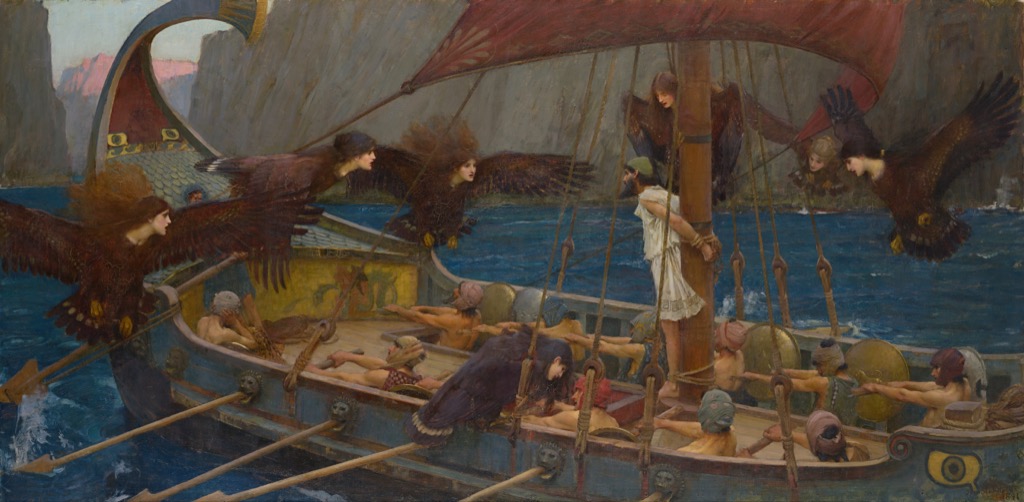
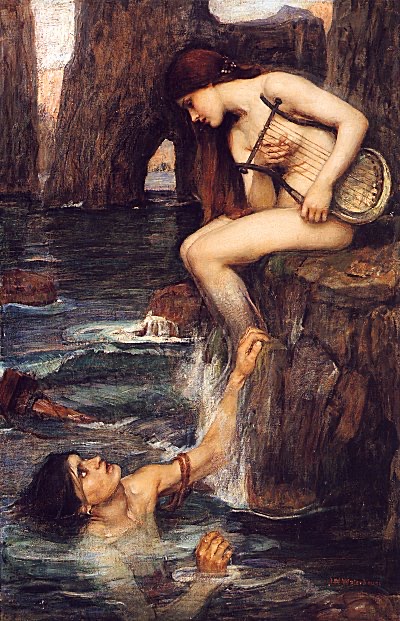
The work also belongs beside Waterhouse’s Ulysses and the Sirens of 1891. Both paintings show a male traveller surrounded by female supernatural beings whose attraction threatens life and onward journey. But their drama differs. Ulysses is tied to the mast amid wings, claws, waves and a crowded ship; Hylas kneels alone in a nearly silent glade. One stages resistance, the other fascination.
Later paintings such as Nymphs Finding the Head of Orpheus and Echo and Narcissus return to water as a place where beauty, loss and looking meet. This recurrence should not be turned into one universal symbol. Water carries different stories in each work. In Hylas, its distinctive role is to appear desirable, inhabitable and unknowably deep.
The Royal Academy Exhibition of 1897
Waterhouse completed and dated the painting in 1896, the year Manchester purchased it, but its major London exhibition came in 1897. The Royal Academy catalogue listed it as number 307. The Academy’s historical chronicle notes that it appeared a year later than Waterhouse had intended and that the exhibition contained so many sea spirits, naiads and water nymphs that one critic joked of a “Mermaid’s Cavern.” [7]
The context matters. Seen alone in reproduction, Hylas and the Nymphs can appear to be an entirely private fantasy. At Burlington House it belonged to a densely hung public exhibition and to a visible fashion for aquatic myth. Its long format, pale bodies and dark pool had to distinguish themselves amid many competing pictures.
The painting did attract sustained notice. The Studio devoted a separate illustrated article to it in May 1897, including reproductions of preparatory studies. [8] Contemporary reactions did not converge. Some critics admired its reserve, colour and poetic atmosphere; others objected to the similarity of the nymphs’ faces or found the mood insufficiently joyful. Later scholarship has shown how that disagreement centres on the painting’s essential choice: it makes desire quiet and repetitive rather than dramatic. [9] [10]
Waterhouse exhibited as a full Royal Academician. He had been elected an associate in 1885 and an Academician in 1895, after a long record of annual exhibition. [6] Hylas therefore appeared not as an outsider’s challenge to the institution but as an ambitious work by one of its established members.
The public could also recognise the myth through a classical education and through earlier art. A second-century Roman wellhead now at the Metropolitan Museum, for example, combines Hylas’s abduction with the story of Narcissus and Echo; several nymphs take part in that ancient visual treatment. [5] Waterhouse’s seven figures were his own formulation, but a many-nymph composition had classical visual precedent.
Purchase, Ownership and Changing Display
Manchester Art Gallery purchased Hylas and the Nymphs directly from Waterhouse in 1896. Its accession number, 1896.15, fixes the acquisition to the year of completion. [1] That unusually short provenance should not be mistaken for a lack of history. The work has remained in the same public collection, but the meanings attached to its display have changed repeatedly.
Peter Trippi’s account traces some of those movements. The gallery lent the painting to the British Empire Exhibition at Wembley in 1925. In 1926 it was transferred away from the central gallery to the Queens Park site and, apart from a period at the Horsfall branch in Ancoats from 1928 to 1934, remained out of the main building until the 1960s. It then became a regular presence in Manchester’s displays of Victorian art. [10]
The painting’s ownership also shapes its modern life. It was bought as part of a municipal collection, not preserved in a private house. Arguments about how it should be displayed therefore become arguments about public interpretation: who a civic gallery addresses, what context it supplies and whether an established hang can itself be treated as open to artistic intervention.
Manchester Art Gallery currently identifies the painting as being on display in Gallery 10, although gallery arrangements can change and visitors should check before travelling. [16]
The 2018 Manchester Intervention
In January 2018, Hylas and the Nymphs became the centre of an unusually visible debate about museums, gender and curatorial power. The event is sometimes described simply as a gallery banning or censoring the painting. That summary omits both the temporary nature of the removal and its place within a commissioned participatory artwork. Describing it only as an uncontroversial relabelling exercise would be equally incomplete, because many viewers experienced the empty wall as suppression and responded forcefully.
The removal took place on 26 January during a gallery “takeover” developed with the artist Sonia Boyce. It formed one of six performative acts that were filmed and later assembled as Six Acts, a six-screen film and wallpaper installation. Boyce worked with gallery staff, invited performers and visitors to reconsider gender, race and sexuality within displays of eighteenth- and nineteenth-century painting. [12] [13] [14]
When Waterhouse’s painting came down, questions were placed in the vacant space and visitors were invited to add responses. The official interpretation of Six Acts describes the absence as deliberate and temporary: one action within a larger collaborative process, rather than a decision to deaccession the work or remove it permanently from public ownership. [13]
The distinction did not prevent controversy. News coverage and social media rapidly reframed the act as censorship, while supporters understood it as institutional critique or a device for widening participation. A peer-reviewed study by Maria Paula Arias analyses how the resulting online network formed, noting the role not only of people and organisations but of the mechanics of social media in producing the public narrative. [14]
The painting returned to display on 3 February after seven days. Manchester’s statement acknowledged the scale and range of reaction and presented the response as a basis for further discussion. [15] Boyce’s completed Six Acts was shown in her Manchester retrospective from March to July 2018, so the removal survived not as an empty wall but as documented material within a new artwork. [12] [13]
The episode cannot be resolved by deciding whether the nymphs are powerful or objectified and treating one answer as final. Within the myth they desire and seize Hylas. Within the painted composition their nude bodies are arranged for spectators in a late Victorian exhibition culture shaped largely by men. The 2018 intervention focused attention on the second condition; many critics replied by emphasising the first. The disagreement demonstrated that narrative agency inside a painting and the conditions under which bodies are displayed are different questions.
It also made display history part of the object’s meaning. Taking a painting down, leaving a labelled absence, inviting comments, rehanging it and exhibiting documentation are all public actions. None changes the oil paint on the canvas. Each changes what viewers are asked to notice around it.
The most useful legacy of the episode is not a command to approve or condemn the intervention. It is a sharper awareness that museums do not present historic art neutrally. Selection, placement, labels and temporary absence all frame interpretation. Hylas and the Nymphs proved capable of carrying that debate precisely because its own image is structured around looking, desire, power and an unseen disappearance.
What the Painting Can—and Cannot—Be Said to Mean
The clearest interpretation begins with narrative. Hylas has entered a space that attracts him and will separate him from human companions. The pool’s beauty is not incidental to its danger; beauty is the means through which danger becomes effective. Waterhouse lets the viewer experience the same attraction without sharing the physical consequence.
The nymphs can also be understood as nature personified. Their bodies emerge among Nymphaea lilies, their colours belong to the water, and their repetition makes them seem generated by the spring. [10] This is more securely grounded than assigning a separate symbolic meaning to every flower. The plants create habitat, pattern and concealment; no surviving statement from Waterhouse explains each specimen as a code.
Desire is reciprocal in gaze but unequal in consequence. Hylas looks; the nymphs look back. He moves towards them; they take hold of him. Because the painting freezes the instant before the outcome, it does not tell us whether fascination has become consent, whether he understands the risk or whether the nymphs intend death, transformation or possession. The ancient sources themselves differ. [2] [3] [4]
The work can support a gendered reading without yielding a single verdict. It presents idealised nude women to a public gaze and gives those women supernatural power over a beautiful man. It evokes the fear of dangerous female sexuality and the vulnerability of the male object of desire. It also carries an ancient story about love between Heracles and Hylas. These strands intersect; none erases the others. [3] [9]
The similarity of the faces may suggest enchantment, multiplication or the loss of individuality within a fantasy. Preparatory evidence confirms a restricted model base, but it does not record Waterhouse’s private explanation of the effect. [10] [11] The repetition should therefore be treated as a visible and deliberate structure whose implications remain open, not as a cipher with one authorised solution.
Finally, the painting can be read as an image about viewing itself. Hylas leans towards an appearance that will absorb him. The spectator leans, imaginatively, over the same pool. Waterhouse gives us more knowledge than Hylas—the title and myth tell us what is coming—but knowledge does not end the attraction. The painting’s lasting achievement is to make awareness of danger intensify looking rather than stop it.
Why Hylas and the Nymphs Still Matters
The image remains memorable because Waterhouse found a form for suspense that does not depend on movement. A hand around an arm, repeated faces and a waterline carry the pressure usually assigned to struggle. The decisive event seems always about to happen, no matter how long the viewer looks.
It is also an unusually rich meeting point of traditions. Greek and Roman texts supply varying stories. Ancient art demonstrates the subject’s long visual history. Victorian classicism provides an exhibition culture in which myth could accommodate desire and nudity. Waterhouse’s own studies and earlier nymph paintings turn those materials into a recognisable personal language. [2] [3] [4] [5] [7] [10]
The painting’s modern history shows that popularity does not make interpretation stable. It has moved from Royal Academy success through reduced twentieth-century visibility to renewed display, mass reproduction and intense public argument. The 2018 intervention did not create its questions about desire and spectatorship, but it changed the public circumstances in which those questions were asked. [13] [14]
Most importantly, the work rewards the return from debate to the object. The nymphs are neither merely innocent decorations nor a slogan about danger. Hylas is neither simply a helpless victim nor a free chooser untouched by power. The pool is beautiful because Waterhouse made its surfaces, plants and bodies cohere; it is frightening because that coherence threatens to absorb the only figure who does not belong there.
A Closer-Looking Guide
Begin at the left edge. Notice how abruptly Hylas’s body is cut by the frame. Follow the blue of his clothing down to the red sash and the vessel. Ask how much of his identity is given through his face, and how much through posture and task.
Move to the nearest nymph’s hands. One contact can look tender at first and restrictive a moment later. Compare her grip with Hylas’s hold on the pitcher. Which object or person is being controlled in each case?
Then count the seven faces. Look for differences before accepting their sameness. Compare the direction of eyes, the tilt of heads and the arrangement of hair. The group becomes stranger when repetition and individuality are seen at once.
Trace the waterline across every body. Some forms are sharply visible above it and broken or obscured below. Notice where reflection ends and transparency begins. The spring never reveals one consistent depth.
Examine the lilies as a compositional network. They fill gaps between heads, repeat pale flesh and prevent the dark water from reading as empty space. Consider how differently the scene would feel if the pool were clear and plantless.
Finally, step back until small gestures become difficult to see. Hylas contracts into one dark clothed figure against a field of pale faces and flowers. At that distance, the painting’s numerical imbalance becomes unmistakable. Move close again, and the group breaks back into individual encounters.
Related Pages
- John William Waterhouse: Return to the artist overview and wider mythological context.
- Paintings: Compare the painting with Waterhouse's broader artwork sequence.
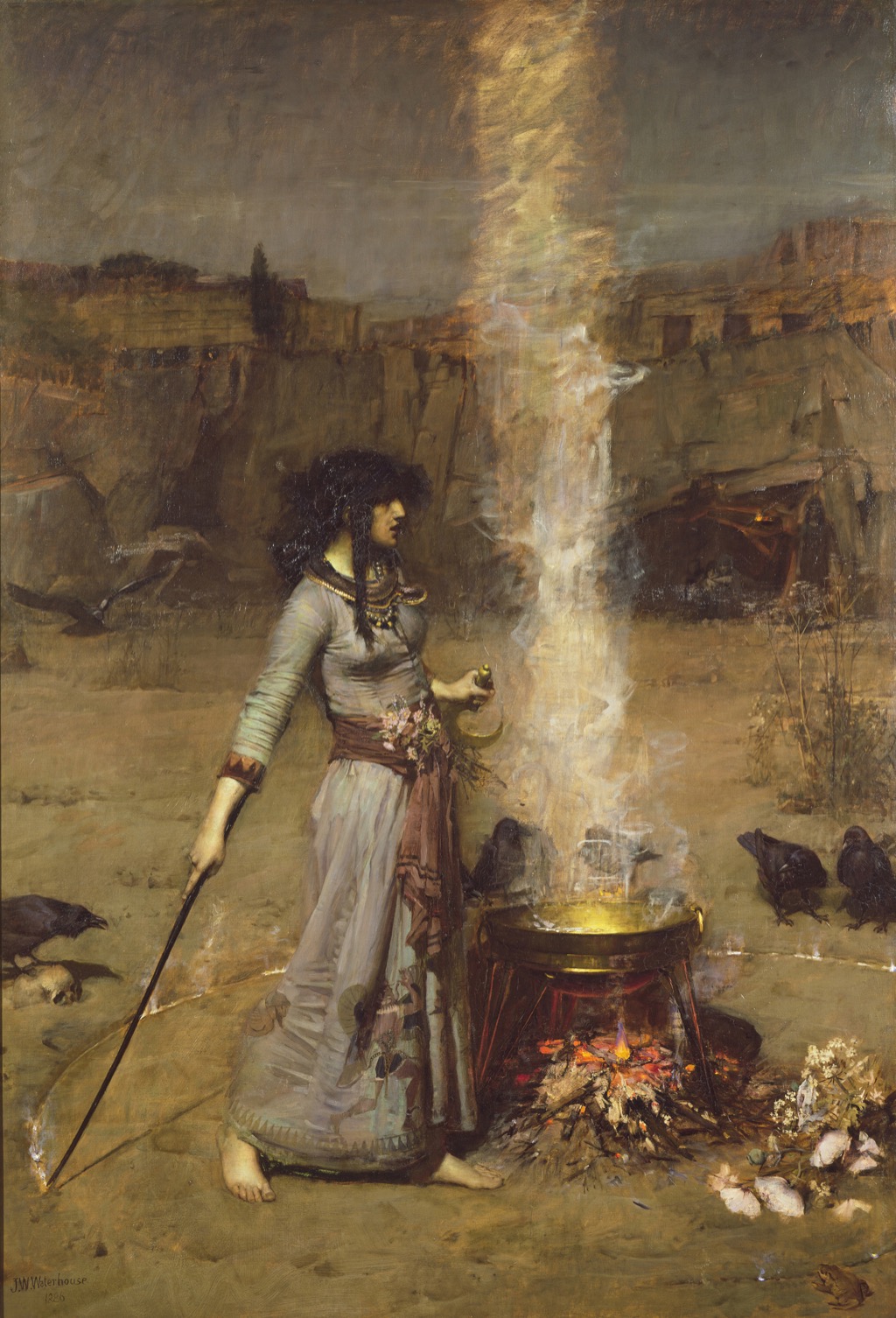
- The Magic Circle: Move from water mythology to Waterhouse's early image of ritual power.
Frequently Asked Questions
Hylas was a beautiful youth associated with Heracles and a member of the Argonautic expedition. When the travellers stopped in Mysia, he went to fetch water and was drawn into a spring by one or more nymphs. Heracles searched for him and was separated from the Argo. [2] [3]
Hylas kneels to collect water while seven nymphs rise from the pool. The nearest has taken hold of his arm and other hands reach towards him. Waterhouse shows the instant before his disappearance rather than the plunge or Heracles’s search.
Many modern summaries describe the nymphs tempting Hylas to his death. [1] Ancient versions are more varied. Theocritus says that the nymphs comfort him beneath the water and that he becomes one of the blessed, while all accounts agree that he is lost to Heracles and the Argonauts. [3]
The number is Waterhouse’s compositional choice rather than a constant feature of the myth. Apollonius gives the decisive action to one water nymph; Theocritus names three. [2] [3] Waterhouse’s seven create an enveloping visual chorus.
Surviving studies support the view that Waterhouse used two models while planning the seven figures. [10] [11] Their repetition gives the group a supernatural unity. The models’ identities are not securely established by the evidence cited here.
They make the nymphs appear to grow from the pool and conceal its depth. The water-lily genus is called Nymphaea, strengthening the visible association between flower and water spirit. [10] There is no documented Waterhouse key assigning a fixed meaning to each lily.
It was shown at the 1897 Royal Academy Summer Exhibition as catalogue number 307. Although painted and acquired in 1896, it appeared at the Academy a year later than initially intended. [7] [10]
The gallery purchased the painting directly from Waterhouse in 1896. It has the accession number 1896.15. [1]
No. It was taken down temporarily on 26 January as part of a participatory project developed with Sonia Boyce and returned on 3 February after seven days. Documentation of the action became part of Boyce’s installation Six Acts. [13] [14] [15]
Discussion
Hylas and the Nymphs offers no neutral place from which to look. Hylas is fascinated by the nymphs, the nymphs look back, and the spectator sees both their bodies and the danger that none of them openly acknowledges.
Reader Insights
How would the meaning change if Waterhouse showed Hylas resisting, already submerged or being sought by Heracles?
Do the related faces make the nymphs seem less individual, more powerful, more natural—or all three?
How can the nymphs possess power within the story while their bodies are also arranged for viewers outside it?
Join the Conversation
Choose one contact point—the held arm, the pitcher, the offered pearls, a reflection or a lily—and explain how it changes your understanding of whether this is an invitation, an abduction or a transformation.
References
- Main image: John William Waterhouse, Hylas and the Nymphs, 1896, Manchester Art Gallery, public-domain photographic reproduction via Wikimedia Commons.
- Art UK and Manchester Art Gallery, Hylas and the Nymphs, official national collection record, including date, medium, dimensions, accession, signature and acquisition. View source
- Apollonius of Rhodes, Argonautica, Book I, translated by R. C. Seaton, Internet Classics Archive, Massachusetts Institute of Technology. View source
- Theocritus, Idyll XIII: Hylas, translated by J. M. Edmonds, Classical Texts Library. View source
- Sextus Propertius, Elegies, Book I.20, “Addressed to Gallus,” Perseus Digital Library, Tufts University. View source
- The Metropolitan Museum of Art, Puteal (Wellhead) with Narcissus and Echo, and Hylas and the Nymphs, second-century Roman object record and curatorial account. View source
- National Portrait Gallery, London, John William Waterhouse: Biography and References, Royal Academy training, exhibitions and membership chronology. View source
- Chris Breward, Royal Academy of Arts and Paul Mellon Centre, “1897: Fancy Dressing,” in The Royal Academy of Arts Summer Exhibition: A Chronicle, 1769–2018, including the exhibition context and catalogue record. View source
- The Studio, “Mr. J. W. Waterhouse’s Painting ‘Hylas and the Nymphs’,” vol. 10, May 1897, pp. 243–247, digitised by Heidelberg University Library. View source
- Simon Goldhill, “The Art of Reception: J. W. Waterhouse and the Painting of Desire in Victorian Britain,” Ramus, vol. 36, no. 2, 2007, pp. 143–186. View source
- Peter Trippi, “The Very Victorian Nymphs of J. W. Waterhouse,” Apollo, 16 February 2018, historical context, studies, reception and display history. View source
- Sotheby’s, John William Waterhouse, Study for a Nymph in Hylas and the Nymphs, catalogue entry, 2016, including medium, dimensions, provenance and relation to the finished painting. View source
- Manchester Art Gallery, Sonia Boyce, exhibition and commission description, 23 March–22 July 2018. View source
- Manchester Art Gallery, Sonia Boyce: Six Acts, long-label text describing the collaborative project and temporary removal. View source
- Maria Paula Arias, “From Takeover to Debacle: An Analysis of the Nympghate Network Using Twitter Data,” Museums and Society, vol. 18, no. 2, 2020, pp. 132–150, University of Leicester; record hosted by the University of Manchester. View source
- Manchester Art Gallery, “Presenting the Female Body: Challenging a Victorian Fantasy,” archived official statements on the temporary removal and return, February 2018. View source
- Manchester Art Gallery, #MAGfiction: John William Waterhouse, Hylas and the Nymphs, current gallery display notice and collection description. View source