

 by Tom Gurney
Tom Gurney BSc (Hons) is an art history expert with over 20 years experience
Published on August 14, 2026 / Updated on August 14, 2026
Email: tomgurney1@gmail.com / Phone: +44 7429 011000
La Belle Dame sans Merci: Introduction
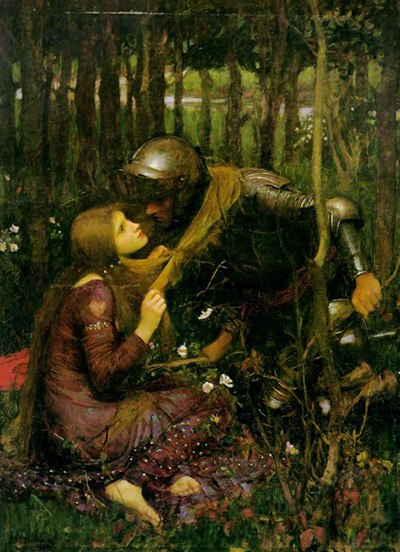
An armoured knight bends towards a young woman in a dark wood. Her long hair loops around his neck and draws their faces together. His metal body should signify protection; her soft gesture controls the encounter. John William Waterhouse paints the moment when attraction becomes binding.
Exhibited at the Royal Academy in 1893, La Belle Dame sans Merci interprets John Keats's ballad of a knight enchanted and abandoned by a mysterious “faery's child.” Waterhouse does not show the poem's cold aftermath or the dream of death-pale warriors. He chooses the earlier meeting, when danger can still be mistaken for love.
At a Glance
- ArtistJohn William Waterhouse (1849–1917)
- TitleLa Belle Dame sans Merci
- Date1893
- MediumOil on canvas
- DimensionsApproximately 112 × 81 cm [1]
- CollectionHessisches Landesmuseum Darmstadt, Germany [2]
- First exhibitedRoyal Academy, London, 1893 [2]
- Literary sourceJohn Keats, “La Belle Dame sans Merci: A Ballad,” written in 1819 [3]
- Title meaning“The beautiful lady without mercy,” borrowed by Keats from the title of Alain Chartier's fifteenth-century poem [3]
- Known preparationA highly finished oil study on board, 36.8 × 29.5 cm [2]
- Important precedentDante Gabriel Rossetti treated the subject in watercolour in the 1850s [2]
Contents
- Introduction
- Enchantment Before Its Cost Is Known
- The Ballad's Two Times
- The Knight as Narrator and Participant
- Hair as Caress and Bond
- Armour Without Protection
- Is the Lady Cruel?
- Woodland and Bodily Compression
- Rossetti and the Pre-Raphaelite Tradition
- Exhibition, Collection and the Oil Study
Enchantment Before Its Cost Is Known
Keats opens after disaster. An unidentified speaker asks why a knight wanders alone, haggard and pale, in a landscape where sedge has withered and no birds sing. Only then does the knight recount meeting the beautiful lady. [3]
Waterhouse reverses that order by painting the memory. The knight is not yet visibly starved on the cold hillside. He is fully armoured and physically close to the woman who will leave him there.
Readers know the end while the painted man appears not to. This dramatic irony turns every tender detail into warning. Hair, touch and closeness belong to an encounter already framed by abandonment.
The selected moment may fall soon after the knight meets the “faery's child” in the meadow, or it may condense several stages of courtship. Keats does not describe this exact hair-looping gesture. It is Waterhouse's visual invention.
That invention makes enchantment physical. Rather than painting an invisible spell, he gives attraction a material line around the knight's neck.
The encounter is still mutual enough to remain ambiguous. The knight bends willingly and returns her gaze. Power has not erased desire; it works through it.
The Ballad's Two Times
“La Belle Dame sans Merci” alternates between present aftermath and remembered encounter. The first speaker sees the weakened knight; the knight narrates the lady, journey, grotto, sleep and dream; the final stanza returns to his lonely present. [3]
This frame means the entire romance reaches readers through the enthralled man's memory. The lady never receives an independent narrative voice.
He describes her as beautiful and supernatural, with long hair, light feet and wild eyes. He makes a garland and bracelets, sets her on his horse, hears her song and accepts roots, honey and manna-like dew. [3]
In the elfin grotto she weeps and sighs. He closes her wild eyes with kisses. She lulls him asleep, and he dreams of pale kings, princes and warriors who warn that the beautiful merciless lady has him in thrall. [3]
He wakes alone on the cold hill and remains there even after the warning has proved true. The poem does not explain whether he cannot leave, chooses not to leave or is dying.
Waterhouse paints inside the remembered portion but lets the frame contaminate it. The woodland meeting carries the colour and warmth missing from the poem's final landscape, yet the loop around the neck anticipates captivity.
The ballad's compressed last lines create abruptness and repetition. Waterhouse answers that formal pressure by compressing two figures into a narrow, close encounter. There is little room for escape or wider narrative.
The poem's short stanzas also work through omission. Keats never tells readers where the lady has gone, what she intended or whether the knight survives. Martin Earl describes the poem's uncertainty as cultivated rather than accidental: voice, form and gaps prevent one stable explanation. [4]
Waterhouse adopts the same strategy in pictorial terms. He removes the speaker, hillside, horse, grotto and pale dream figures. What remains is not a summary but a gap made visible—an encounter whose meaning depends on the absent ending.
Ballad repetition makes the knight seem caught inside his story. His final return to the opening landscape does not advance time; it confirms that he remains where the questioner first found him. The structure itself becomes a kind of enthralment. [3] [4]
The painting cannot repeat a stanza, so it creates a loop. The lady's hair travels around the knight's neck and back towards her body. A circular line replaces the poem's circular narration.
The Knight as Narrator and Participant
Keats's knight is both victim and the source of nearly everything known about the lady. His account deserves sympathy but cannot provide neutral evidence.
He interprets her strange language as a declaration of true love. He reads her sounds, gestures and food through his own desire. [3]
Waterhouse visualises that vulnerability through the gaze. The knight looks at the woman from extremely close range, leaving little space in which to evaluate what he sees.
Armour gives him the appearance of worldly identity and experience. Yet the poem's dream reveals other kings and warriors similarly defeated. Martial rank offers no immunity.
His bending pose surrenders height. Although he may stand or crouch above her, he lowers his head into the space controlled by her face and hair.
The action can appear like courtship. He is not visibly dragged, and the poem says he actively adorns and carries her. Reading him only as passive prey erases his participation.
His account also transforms his own actions into evidence of her power. He makes the garland, places her on his horse, follows her to the grotto and closes her eyes with kisses. Only after the dream does the narrative reorganise these acts as steps towards captivity. [3]
Waterhouse lets the earlier uncertainty survive. The knight's lowered body can be surrender, desire or simple movement towards a kiss. Viewers who know the poem call it danger; a viewer without the title might call it intimacy.
At the same time, desire is not equal power. She belongs to a supernatural realm whose conditions he does not understand. What he treats as romance may be a pattern repeated with earlier men.
Waterhouse holds him at the instant before knowledge. The pale warriors of the dream are absent, so viewers must supply the warning he has not received.
Hair as Caress and Bond
The lady's hair is the composition's most striking instrument. It travels from her body around the knight's neck, converting a sign of beauty into a flexible tether.
Hair can touch where hands do not. It crosses armour and draws the vulnerable head towards her while leaving the gesture outwardly gentle.
The loop may also resemble a garland. In Keats, the knight makes a garland for the lady; Waterhouse reverses the direction, letting her natural attribute encircle him. [3]
This reversal shifts agency. The knight thinks he adorns the supernatural woman, but the painting shows him becoming the adorned or bound figure.
The hair is not a literal rope. He could perhaps pull away. Its power depends upon his willingness to remain close, which makes it a precise image of enthralment.
“Thrall” historically carries associations of bondage or servitude. Keats's warning warriors use the word after the romance; Waterhouse translates it into a visual condition before the dream. [3]
Hair also creates continuity between faces. Their identities almost join along one flowing line, making intimacy and loss of separation occur together.
The device can be admired as formal elegance, but its meaning is not merely decorative. The most beautiful line in the picture is also the line of danger.
Armour Without Protection
The knight's armour divides his body into hard reflective surfaces. It protects against weapons but cannot stop song, gaze, food, sleep or desire.
This mismatch belongs to Keats's poem, where kings, princes and warriors are collectively conquered by a figure who does not fight in military terms. [3]
Waterhouse uses armour to make vulnerability visible by contrast. An unarmoured lover would simply appear exposed; this man wears defence and remains defenceless.
Metal also changes touch. The lady cannot easily reach his torso as ordinary flesh, so she concentrates power around hand, face and neck.
His lowered head leaves the part not protected by breastplate closest to her. The pose defeats equipment.
Armour identifies him as a “knight-at-arms,” securing the image in Keats's ballad rather than in a generic woodland romance. [3]
It also introduces coldness into the otherwise organic setting. The later cold hillside is not yet visible, but metal carries its temperature into the meeting.
Waterhouse does not paint battle damage. The threat lies entirely outside the system for which armour was designed.
Is the Lady Cruel?
The title says she lacks mercy, and the dream reveals a history of pale male victims. It is reasonable to read her as dangerous. [3]
Yet Keats gives her tears, sighs, strange speech and song without explaining motive. She may knowingly entrap, act according to a non-human nature, or be remembered through a knight who cannot understand her.
Waterhouse preserves that uncertainty. Her face can appear intent, seductive, vulnerable or sad. No triumph confirms conscious malice.
The label “femme fatale” places her within a late nineteenth-century fascination with women whose beauty destroys men. That context is useful but can become reductive.
The label can also make the outcome look like punishment for male desire by an essentially malicious woman. Keats's narrative is stranger. The lady speaks a language the knight does not understand, provides food that sounds both natural and supernatural, weeps in the grotto and then disappears from the poem. [3]
Because all of this reaches readers through the knight, even her declaration of love is an interpretation. He says she spoke “in language strange” and that he was sure she said she loved truly. Certainty belongs to him, not to an independently quoted statement. [3] [4]
Waterhouse makes that problem visible by bringing their eyes close while keeping their minds inaccessible. A gaze can appear mutual without proving that the two people understand the encounter in the same way.
She is a “faery's child,” not merely a human woman exercising excessive sexual independence. The boundary between mortal and supernatural worlds is central to the ballad.
Nor is the knight wholly without agency. He adorns, carries, kisses and follows. The fatal bond is made through reciprocal acts interpreted differently by each participant.
The painting's ambiguity does not make consequence uncertain. Whatever her intention, the knight will wake abandoned and remain in thrall.
Waterhouse makes pity difficult to assign exclusively. The man faces destruction, but the lady's isolated supernatural existence may also resist ordinary moral explanation.
Woodland and Bodily Compression
Dark trees and foliage enclose the pair, reducing the meadow and journey of the poem to a private threshold.
The forest blocks long view. The knight cannot see the future company of pale warriors, and the spectator has little landscape through which to imagine escape.
Their faces occupy a tight area of the vertical canvas. The rest of the bodies lead towards that knot of gaze, hair and touch.
Organic curves contrast with armoured planes. Hair, branch and fabric bend; metal divides light into hard surfaces.
Colour draws the lady out of the shadow while reflective armour catches scattered highlights. Exact pigment claims are unsupported, but the visible contrast between living softness and constructed hardness is secure.
The dark setting also makes the encounter feel remembered or dreamlike. It does not need to represent the later elfin grotto literally.
Nor does it reproduce the poem's opening season. Keats stresses a withered lakeside, empty granary and completed harvest after the enchantment. Waterhouse chooses living woodland before that desolation. [3]
The contrast creates an emotional chronology. Warmth, colour and growth belong to the remembered lady; cold, pallor and absence belong to the knight's present. Although Waterhouse paints only the first world, the title brings the second with it.
The bodies themselves form a landscape of enclosure. Her bent arm, hair and fabric curve around the armoured figure, while branches close behind them. There is no single visible prison, but several soft boundaries reinforce one another.
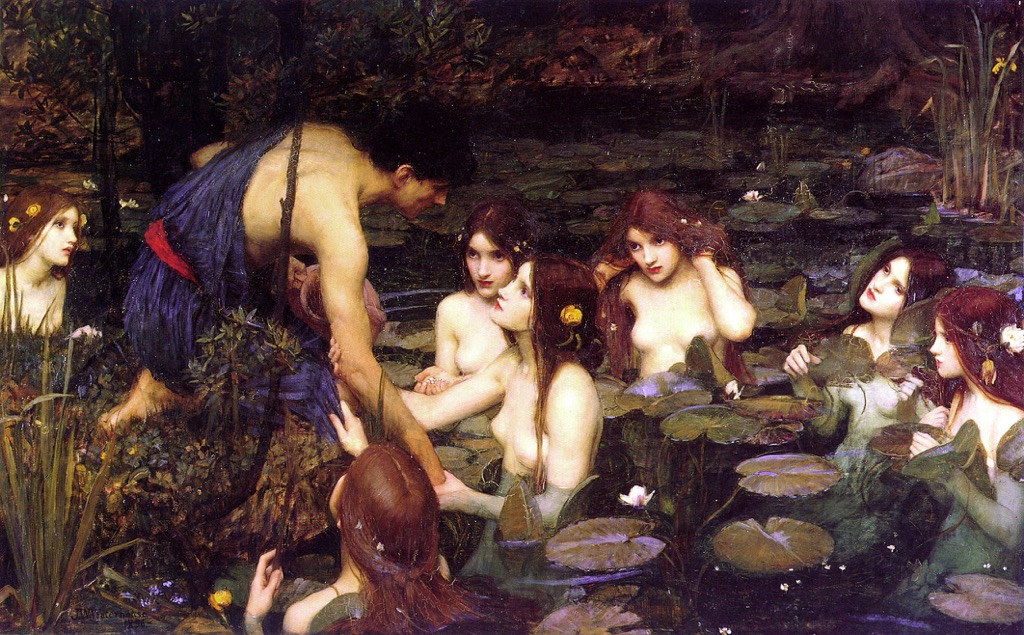
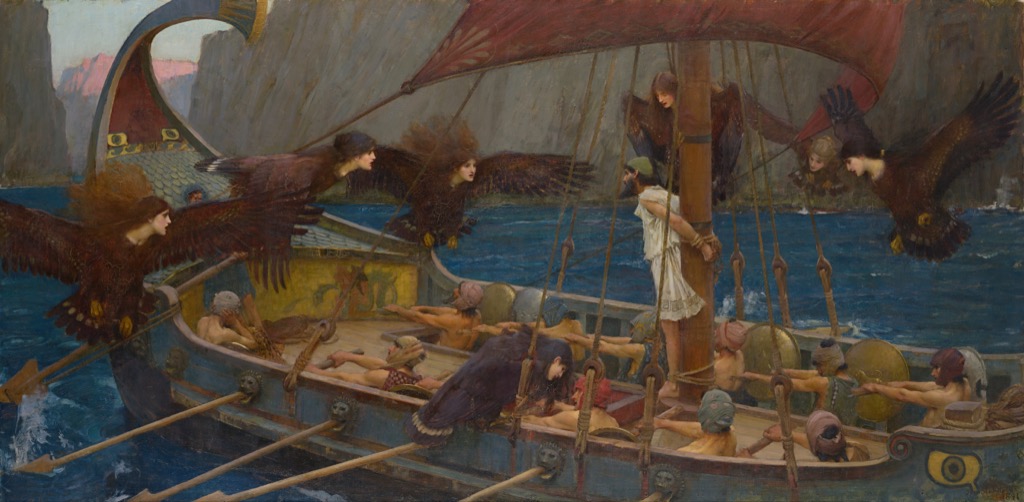
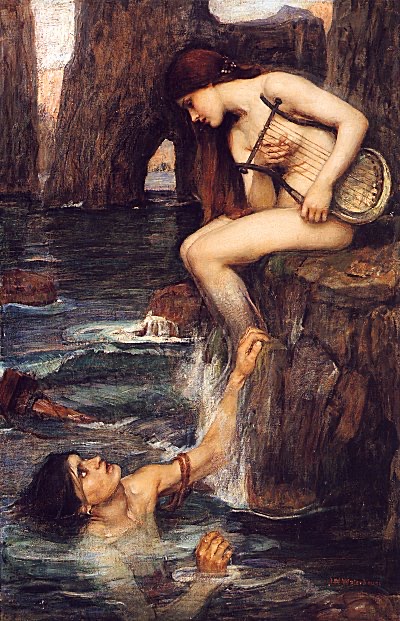
Waterhouse often places danger in beautiful natural enclosures: Hylas at the pool, a sailor at the siren's rock, Lamia and Lycius in a wooded setting. Here the wood narrows attention until relationship becomes the whole world.
That narrowing answers the knight's claim that he saw nothing else all day while the lady rode his horse. Enchantment is a failure of surrounding vision. [3]
Rossetti and the Pre-Raphaelite Tradition
Dante Gabriel Rossetti treated La Belle Dame sans Merci in an early watercolour, and Christie's describes Waterhouse's painting as reminiscent of that precedent. [2]
Rossetti and other Pre-Raphaelite artists helped establish Keats as a major visual source. His medievalising settings, sensuous language and compressed supernatural encounters readily crossed into painting.
Waterhouse was not an original member of the Brotherhood. His 1893 work belongs to a later revival in which Pre-Raphaelite poetry and colour were reworked through academic exhibition practice.
That timing matters. La Belle Dame sans Merci entered the Royal Academy, the central institution against which the original Pre-Raphaelites had defined their early rebellion. By 1893, a Keatsian subject and Pre-Raphaelite inheritance could be brought into Waterhouse's successful Academy career.
The image is therefore both revival and transformation. Waterhouse inherits the close, literary, medievalising encounter but makes it operate at the scale and finish of a major exhibition picture.
The comparison matters most at the level of intimacy. Rather than illustrate the whole ballad, both traditions concentrate on charged relation between beautiful figures.
Waterhouse's distinct contribution is the hair loop and the armour's exposed failure. He makes “thrall” visible before the knight can name it.
The picture also anticipates his later Keatsian paintings. Lamia places another armoured young man before a beautiful non-human woman, while Isabella and the Pot of Basil turns from enchantment to grief.
These returns demonstrate attention to different structures within Keats: seduction, metamorphosis, memory and mourning. They are not one repeated warning about women.
Exhibition, Collection and the Oil Study
The finished La Belle Dame sans Merci was exhibited at the Royal Academy in 1893 and is held by the Hessisches Landesmuseum Darmstadt. [2]
Published dimensions are approximately 112 × 81 cm. [1] The work's substantial vertical scale gives the figures physical presence while retaining the compression of an intimate scene.
A highly developed oil study survives on board laid down on panel, measuring 36.8 × 29.5 cm. Its documented provenance includes J. S. Maas & Co., Colin Tennant and Lady Anne Tennant. [2]
Christie's notes that the study is unusually complete and can resemble a small independent version, but its preparatory status and dimensions distinguish it from the Darmstadt canvas. [2]
The study shows that emotional intensity was developed before the final surface rather than added only through finish. Pose and relation already carry the core.
The work appeared at an important moment in Waterhouse's career, between the Homeric and Circe paintings of the early 1890s and his election as a full Royal Academician in 1895.
Its institutional location in Germany also gives it a different public history from privately owned Keats subjects such as the 1907 Isabella.
The surviving oil study helps separate composition from finish. Its faces, bend of the knight and enclosing hair are already sufficiently resolved to carry the central drama. [2]
That evidence discourages a reading in which meaning depends only on luxurious surface. The bond is structural: it exists in pose and line before the larger canvas supplies its fullest colour and detail.
The study's independent beauty can nevertheless cause confusion. It is not a second full-size 1893 version. Its board support and 36.8 × 29.5 cm measurements identify a smaller preparatory work. [2]
How to Look at the Painting
Begin with the hair and trace its path. It is the line that turns two faces into one dangerous circuit.
Then inspect the armour. Ask which parts of the knight it can protect and which the lady approaches.
Notice how willingly he bends. Enchantment is not represented as external force alone.
Compare her face with the title. The phrase “without mercy” may tell you more than her expression does.
Try then to describe the scene without using the poem. The exercise reveals how much warning comes from literary knowledge rather than visible violence.
Return to the painting with the final stanza in mind. The dark woodland becomes not the place where the knight is trapped forever, but the remembered image he cannot stop inhabiting.
Finally remember the cold hillside that lies outside the painted moment. Waterhouse's colour belongs to a memory whose aftermath has already withered.
Related Pages
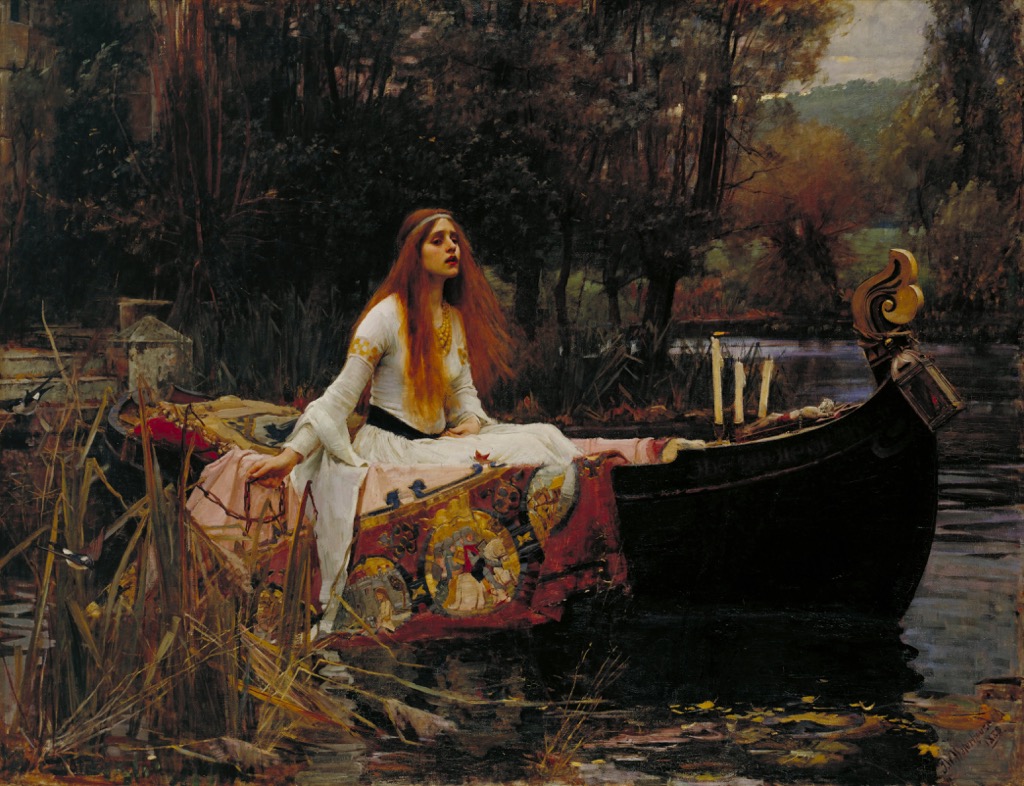
- The Lady of Shalott: Compare Waterhouse's best-known literary composition.
- Hylas and the Nymphs: Compare another major mythological scene.
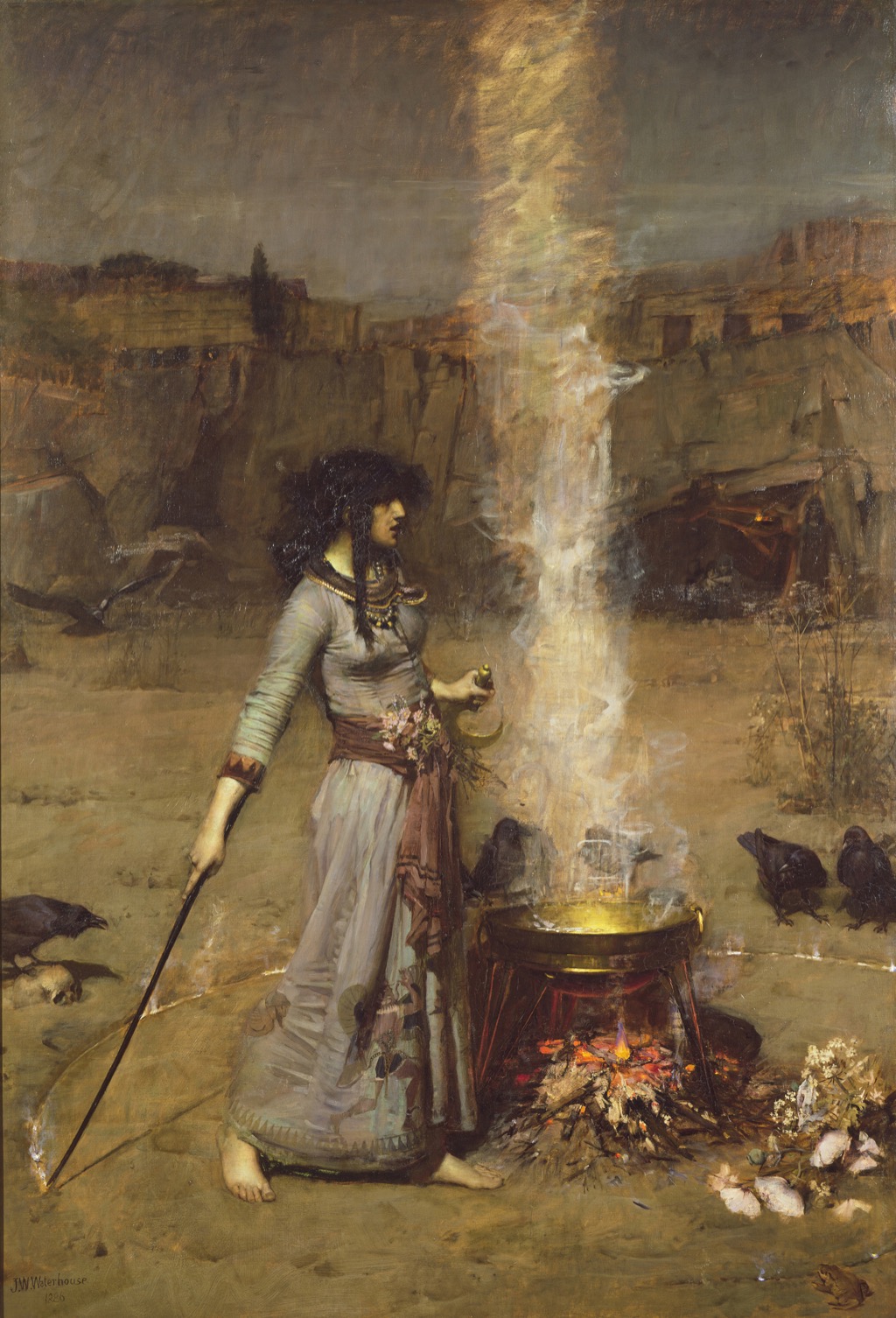
- The Magic Circle: Compare Waterhouse's treatment of ritual and symbolism.
Frequently Asked Questions
John Keats wrote the ballad in 1819. Its title borrows from a fifteenth-century French poem by Alain Chartier, but Keats created a new supernatural story. [3]
He shows the knight and faery lady in close encounter before abandonment and the warning dream. The hair loop is Waterhouse's visual invention rather than a literal action specified by Keats.
Keats calls him a “knight-at-arms.” The armour also demonstrates that military defence cannot protect against enchantment. [3]
It acts as caress, garland and bond. By looping around his neck it gives visible form to the poem's claim that the knight is “in thrall.” [3]
The title and dream make her dangerous, but Keats and Waterhouse leave her motive uncertain. She may be cruel, non-human in ways the knight cannot understand, or both.
The finished 1893 canvas is in the Hessisches Landesmuseum Darmstadt. A smaller, highly finished preparatory oil study is separately owned. [2]
The dark enclosure can recall it, but Waterhouse does not provide enough specific architecture to identify the place literally. The scene more securely condenses the woodland meeting and the later idea of captivity.
In Keats's poem he is lulled asleep, dreams of other pale victims and wakes alone on a cold hillside. The poem ends with him still wandering there. [3]
Discussion
Waterhouse paints the seduction of certainty. The knight believes a look, song or strange phrase means love; the audience knows his interpretation will leave him alone. The lady's beauty is not a disguise placed over obvious malice. It is the experience through which danger becomes desirable.
The painting's most elegant form—the curve of hair—is also its most exact argument. The knight is bound because he comes close enough to be bound. Desire, choice and supernatural power meet in one loop that remains soft to the eye and severe in meaning.
Reader Insights
Which visible detail most changes the way you read this page?
Which source or comparison helps the work feel less familiar and more specific?
What question would you bring back to the painting after reading?
Join the Conversation
Share your reading of this page below.
References
- Wikimedia Commons. “John William Waterhouse, La Belle Dame sans Merci (1893),” object metadata and dimensions. View source
- Christie's. “John William Waterhouse, A Study for ‘La Belle Dame sans Merci’,” object record and catalogue essay identifying the Royal Academy painting, Darmstadt collection, Rossetti comparison and preparatory study. View source
- Poetry Foundation. John Keats, “La Belle Dame sans Merci: A Ballad,” full text and notes. View source
- Martin Earl / Poetry Foundation. “John Keats: ‘La Belle Dame sans Merci’,” discussion of the poem's ballad form, voices and cultivated uncertainty. View source