

 Buy Art Prints Now
from Amazon
* As an Amazon Associate I earn from qualifying purchases.
Image reference [image]
 by Tom Gurney
Tom Gurney BSc (Hons) is an art history expert with over 20 years experience
Published on August 14, 2026 / Updated on August 14, 2026
Email: tomgurney1@gmail.com / Phone: +44 7429 011000
A Mermaid: Introduction
John William Waterhouse’s A Mermaid is an image of solitude at the sea’s edge. A red-haired mermaid sits upon a rock, combing the long strands that fall across her body while surf breaks beyond her. Pearls lie beside her. Her silver-green tail curves down towards the water, but her face turns away from it, absorbed in a thought the viewer cannot share.
Painted in 1900 and accepted by the Royal Academy in 1901 as Waterhouse’s Diploma Work, the picture had an unusually important institutional purpose. It was the work through which he chose to represent his art permanently in the Academy’s collection. Yet its meaning is not fixed by a named story. Tennyson’s poem The Mermaid offers a close verbal and visual parallel, and Waterhouse had explored the subject in studies for years, but the finished painting remains deliberately open: neither innocent sea-creature nor demonstrated destroyer, neither portrait nor exact illustration, its mermaid inhabits the unstable boundary between beauty, desire and danger.
At a Glance
- ArtistJohn William Waterhouse (1849–1917)
- TitleA Mermaid
- Date1900
- MediumOil on canvas
- Dimensions96.5 × 66.6 cm
- CollectionRoyal Academy of Arts, London
- AcquisitionGiven by John William Waterhouse as his Diploma Work; accepted in 1901
- Institutional significanceDiploma Works form the core of the Royal Academy’s collection and are donated by Academicians following election [1] [2]
- Related studiesA dated oil sketch of 1892, a large oil study probably made between 1892 and 1895, and surviving drawings [3] [4]
- Possible literary sourceAlfred Tennyson’s The Mermaid (1830), although no located statement by Waterhouse proves a single source [3] [5]
Contents
- Introduction
- A Solitary Figure on a Divided Shore
- What the Mermaid Is Doing—and What She Is Not
- Tennyson’s The Mermaid and an Uncertain Source
- A Diploma Work Eight Years in the Making
- Hair, Comb and Pearls
- Human Body, Fish Tail and the Moment of Transformation
- Rock, Surf and the Painting of a Threshold
- Beauty Without an Audience
- A Mermaid Among Waterhouse’s Water-Women
A Solitary Figure on a Divided Shore
The picture is built around a division. Rock rises at the left; open sea extends at the right. The mermaid occupies the narrow place where these environments meet. She is not fully submerged in her native element, yet she cannot belong on land in the way a human sitter might. Waterhouse makes her body itself a boundary: woman above, fish below, warm flesh passing into cool scales.
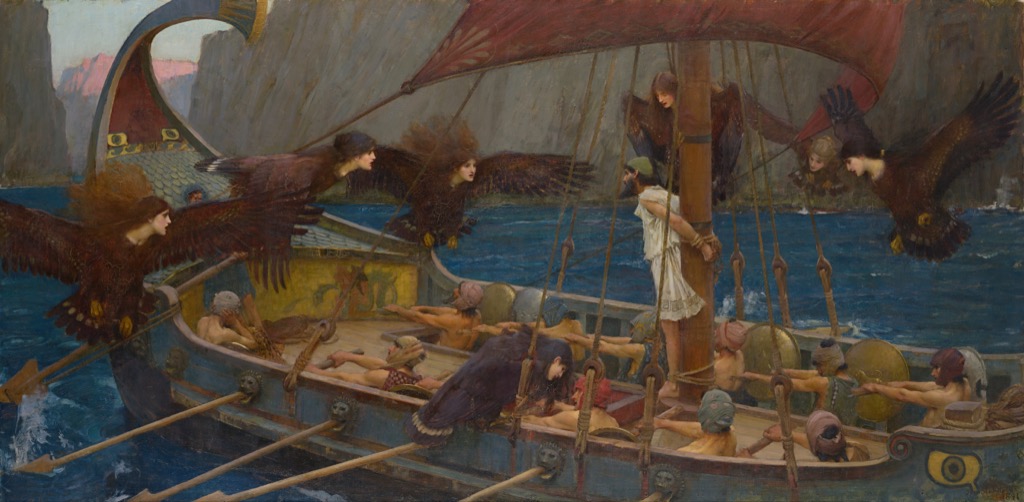
This threshold gives a quiet image its tension. No ship is visible. No sailor is being lured to destruction. There is no external event comparable with the attack in Ulysses and the Sirens or Hylas’s fatal encounter with the nymphs. The drama lies in incompatible possibilities held within one figure. She can sit upon the rock and look towards the human world, but the tail declares the limit of that approach.
Her solitude is therefore more than an absence of companions. It is the condition the composition imposes. The steep rock closes one side of the canvas and the distant horizon opens the other, yet neither offers an obvious route. She remains between enclosure and distance. The viewer is brought close enough to study her hair, skin and scales but is not given a narrative that would explain why she has come ashore.
Waterhouse reinforces this isolation through the vertical format. The narrow canvas contains the figure rather than allowing the coast to become a broad landscape. Her upper body occupies the central zone, while the descending tail continues the composition towards the lower edge. The sea is essential, but it remains a setting for the figure rather than the picture’s independent subject.
The title contributes to the openness. It is A Mermaid, not The Mermaid, and it does not give a personal name. The indefinite article presents one being of a type while withholding the myth, poem or incident to which she belongs. A viewer may recognise familiar lore, but recognition does not resolve identity.
That refusal is a major source of the painting’s durability. The mermaid can be approached through Tennyson, folklore, Victorian ideas of dangerous femininity, the aesthetics of the female figure or the sensory appeal of sea, skin and hair. None of these routes exhausts the image. Waterhouse provides enough narrative material to awaken a story and too little to close it.
What the Mermaid Is Doing—and What She Is Not
The visible action is simple. The mermaid draws a section of her long auburn hair through a comb. Her head inclines, her gaze falls sideways and the loose strands cross her torso. The gesture appears habitual rather than theatrical. She is occupied with herself and does not perform directly for the spectator.
Combing has practical and pictorial functions. Within the fiction, wet hair needs ordering after the sea. Within the design, the action permits Waterhouse to carry warm colour diagonally across pale flesh and to link face, hands and torso. The arm and hair make a loose enclosure around the upper body, while the comb supplies a small point of concentrated attention.
The mermaid does not sing visibly. Her lips are parted only slightly, if at all, and the painting cannot confirm sound. Nor does she hold a mirror, despite the long-established pairing of mermaids with combs and mirrors. Most importantly, no victim appears. To call her a seductress describes a cultural possibility, not an action shown in this particular scene.
Her lowered or distant gaze matters. A figure who looked outward could recruit the viewer into the position of an approaching sailor. Waterhouse denies that direct exchange. We may look at her, but she is not visibly looking at us. This weakens the simplest femme-fatale interpretation without making her harmless. A power need not be exercised at every moment in order to exist.
The pearls or bead-like strand lying on the rock introduce another possible activity. They may be ornament recently removed, treasure gathered from the sea or a visual echo of the combing ritual. The picture does not determine which. Their rounded pale forms connect foam, skin and jewellery, turning the rock into a small stage for objects associated with the mermaid’s body.
Even the emotional tone resists precision. The face can appear wistful, distracted or self-possessed. Contemporary critics saw sadness and distance in it, but the expression does not securely represent grief. [3] Waterhouse avoids tears, alarm and overt invitation. The figure’s emotional reserve keeps the painting suspended between inward reverie and inhuman detachment.
Tennyson’s The Mermaid and an Uncertain Source
Alfred Tennyson’s early poem The Mermaid provides the most compelling literary comparison. Its speaker imagines being a beautiful mermaid, “Singing alone, / Combing her hair” beneath the sea with a pearl comb. [5] Those details align closely with Waterhouse’s solitary figure, her grooming and the pearly objects beside her.
The poem’s mermaid speaks in the first person. She imagines her hair as a fountain of gold, enjoys the adoration of sea-creatures and mermen, refuses indiscriminate kisses and anticipates being chosen by their king. She is playful, mobile and vocal. Her solitude is not necessarily sorrowful; it becomes a stage from which she imagines desire on her own terms.
Waterhouse keeps the most memorable outward motifs but changes their atmosphere. His mermaid sits above rather than beneath the sea. Her hair is auburn rather than literally golden. She does not leap among coloured underwater groves or proclaim who may love her. The poem’s exuberant voice becomes visual silence.
This difference is important. If Tennyson contributed to the conception, Waterhouse did not simply translate each line. He extracted a compact image—solitary mermaid, comb and hair—and gave it a psychology absent from the poem’s confident fantasy. The painting’s rocky shore introduces contact with the human world while making that contact physically precarious.
Auction scholarship treats the Tennysonian source as probable rather than certain. [3] [6] That is the right degree of confidence. Waterhouse repeatedly used Tennyson, and the verbal correspondence is unusually close, but no inscription, exhibition quotation or surviving statement located for this account identifies the poem as his declared programme.
Other traditions were readily available. Mermaids appeared in folklore, ballads, fairy tales, decorative art and paintings throughout nineteenth-century Europe. Hans Christian Andersen’s The Little Mermaid had made the desire to cross from sea-life to human love especially poignant, while older traditions cast the combing mermaid as an omen or lure. These contexts may shape reception without becoming provable sources for every detail.
The finished picture works precisely because it does not require a reader to identify one text. Tennyson clarifies the comb, solitude and pearl imagery; broader lore supplies the mermaid’s unstable morality; close observation supplies the physical encounter with rock and sea. Literature opens the painting but does not lock it.
A Diploma Work Eight Years in the Making
The Royal Academy records A Mermaid as an oil on canvas measuring 96.5 by 66.6 centimetres, given by Waterhouse as his Diploma Work and accepted in 1901. [1] Its status distinguishes it from a normal sale or annual exhibition submission. The Academy’s founding rules required elected Academicians to deposit a representative example of their abilities, and Diploma Works remain the core of its collection. [2]
Waterhouse had been elected a full Royal Academician in 1895. [7] The date of the finished canvas, 1900, and its acceptance in the following year mean that the work arrived well after that election. The interval encourages a tempting narrative of perfectionism, but only the documented sequence is secure: the subject occupied him over many years, and the Academy ultimately received this version.
A small oil sketch signed and dated 1892 establishes that Waterhouse had conceived a combing mermaid at least eight years before completing the Diploma Work. [3] A larger oil study, almost the scale of the final composition, probably dates from 1892–95. It remained in the artist’s studio and was sold after his death at Christie’s in 1926. [3]
That larger study is unusually informative. It already presents the full figure, sea, hair and tail, but the coast differs. Christie’s describes brighter pink cliffs related to settings in Ulysses and the Sirens and Ariadne, whereas the final picture uses heavier grey rock. [3] The change alters more than local colour. Warm distance in the study opens the fantasy outward; the darker mass in the Diploma Work makes solitude denser and the mermaid’s pale body more exposed.
A surviving drawing also studies the mermaid at half length, with another figure study on its reverse. [4] Drawings and oils together show that Waterhouse tested the pose, facial character, setting and balance of body to sea rather than arriving at the final image in a single act.
The long development is especially significant because the finished picture looks unforced. Its apparent simplicity—the seated figure, the rock, the open water—conceals years of return and revision. Waterhouse removed competing incident until the mermaid’s self-contained gesture could carry the work.
As a Diploma Work, A Mermaid also becomes an artistic self-selection. Waterhouse did not offer a survey of his range. He chose one canvas to stand within an institutional history of Academicians. The selection placed the imagined female figure, literary possibility, colour, anatomy and natural setting at the centre of how his mature achievement would be remembered.
Hair, Comb and Pearls
The mermaid’s hair is the composition’s warmest continuous element. It falls from the head across the shoulder and chest, breaking the pale unity of the torso before reaching the hands. Its reddish brown distinguishes her from Tennyson’s explicitly golden fantasy while connecting her to Waterhouse’s recurring auburn-haired women.
Hair can be both body and adornment. It grows naturally, yet it can be arranged, displayed and read socially. By painting the mermaid combing it, Waterhouse gives a legendary creature an ordinary bodily routine. The supernatural becomes credible through an action familiar from domestic life.
The same action has a long iconographic history. Mermaids and sirens were frequently shown grooming, sometimes with a mirror, and the combination could signify beauty, vanity, seduction or forewarning. Those associations remain available, but the missing mirror alters the emphasis. Waterhouse’s figure does not confirm her appearance through reflection. Attention passes through touch: hand, comb and hair.
The comb is easily overlooked because it is small, yet it provides the painting’s finest instrument of order. Its teeth separate strands just as Waterhouse distinguishes the mermaid’s human and piscine surfaces. It turns luxuriant hair into a sequence of lines and gives the hands a credible task.
Pearls deepen the relation between body and sea. A loose strand rests on the rock near the mermaid. Pearls are ornaments worn by humans but produced within marine life, making them unusually apt objects for a creature divided between sea and human form. They can suggest luxury, tears, purity or seduction in other settings; here no single symbolic code is proved.
Their pictorial function is clearer. Pale beads repeat the highlights on water and scales. Their curve answers the tail and the fall of hair. An object small enough to be jewellery also evokes the countless rounded forms concealed beneath the sea’s surface.
Waterhouse does not force the viewer to decide whether the mermaid has collected, made or worn them. Like the figure herself, the pearls cross domains. They are marine matter transformed into human adornment. The comb may similarly be treasure rather than a manufactured object purchased on land. These possibilities make the scene materially persuasive without producing a fixed plot.
Human Body, Fish Tail and the Moment of Transformation
The painting’s fantasy depends upon the junction between woman and fish. If the transition were awkward, the mermaid would appear as two unrelated forms attached together. Waterhouse instead uses pose, hair, shadow and curving contour to make the hybrid body read as a continuous organism.
The upper torso is painted with the volume expected of a living sitter. Shoulder, arm and back turn in space; the hands engage with resistance in the hair. The tail is not a decorative afterthought. It bears weight against the rock, descends through the lower composition and returns the body towards the sea.
Colour manages the transition. Warm flesh cools towards silver, green and blue. Small highlights on the scales answer the water, while warmer reflected tones prevent the tail from becoming wholly separate. The boundary can be located, but it does not behave like a costume seam.
Waterhouse also avoids spectacle. There is no burst of magic and no visible change from legs to fins. The mermaid simply exists. That calm acceptance allows attention to move from anatomical novelty to psychological presence. We cease asking how transformation occurred and begin asking what she thinks.
The final tail differs in mood from the pale human torso. Its hard, overlapping surface protects what skin leaves vulnerable. Yet it also confines. Human legs could stand, walk or climb; this tail is magnificent in water but burdensome on rock. The figure’s posture makes the land-sea threshold physically felt.
It would be easy to turn this difference into a single allegory of a woman trapped by her nature. The painting does not justify so complete a reading. The mermaid may have chosen the rock and may return to the sea at will. What can be said is that Waterhouse visualises two kinds of bodily capacity in one form. Beauty and limitation become inseparable.
The hybrid also complicates desire. The upper body resembles the idealised female nudes familiar to academic art, inviting an established mode of viewing. The tail interrupts that familiarity. It marks the figure as non-human and makes possession, courtship or social identification impossible. Attraction reaches a biological boundary.
Rock, Surf and the Painting of a Threshold
The rock is more than a seat. Its grey face encloses the mermaid from behind and creates a rough material contrast with skin, hair and scales. She appears vulnerable against it, yet the close fit between body and ledge suggests habitual knowledge of the place.
The shore is not a calm decorative bay. White water breaks around the lower rocks, and the sea changes colour with depth, foam and reflection. Movement surrounds the still figure. Her composure becomes more striking because the environment does not share it.
Waterhouse had used the sea dramatically in Ulysses and the Sirens, where vessel, oars, wings and attacking bodies turn water into a field of action. In A Mermaid, he narrows that energy to repeated waves. The sea neither wrecks a ship nor delivers a hero. Its motion becomes time: wave follows wave while the mermaid remains absorbed.
The horizon creates a second rhythm. It extends beyond the confined rock, offering a distance the figure does not visibly enter. The viewer may look past her towards open water, but her face and hands continually draw attention back. Near and far compete without one cancelling the other.
The painting also plays with exposure. A cavern or enclosed grotto might make the mermaid inaccessible. Waterhouse places her in daylight at the open edge of the sea. She can be seen completely, yet her mental state and origin remain concealed. Physical visibility produces no equivalent narrative knowledge.
The palette binds the zones together. Blue water enters the tail; warm hair answers reddish or brown passages in rock; white foam returns in flesh and pearls. These echoes prevent the figure from looking pasted into a landscape. She belongs chromatically to both sides of the threshold.
No published technical examination cited here supplies pigment analysis, X-radiography or a full account of the canvas’s construction. Claims about named pigments, underdrawing or hidden revisions would therefore exceed the evidence. The surviving oil studies do, however, show Waterhouse changing the setting and concentrating finish around face and hair. [3] His process can be discussed through visible and preparatory evidence without pretending to reconstruct every layer.
Beauty Without an Audience
The mermaid belongs to a long tradition in which a beautiful female being is imagined for the gaze of a sailor, lover or spectator. Waterhouse both uses and unsettles that structure. The body is prominently displayed, but the figure does not return the viewer’s attention. Beauty exists without a visible human audience inside the picture.
Her combing may be preparation for display, but it can equally be self-care without an observer. Tennyson’s mermaid asks who loves her and imagines universal attention; Waterhouse’s figure appears less publicly triumphant. She does not need to be read as ashamed or lonely, only self-contained.
This makes the spectator’s position uncomfortable in a productive way. We occupy the absent watcher’s place yet receive no invitation. The figure’s averted face lets us see more of her body while withholding reciprocity. Looking becomes an act the composition stages rather than an innocent window onto a myth.
At the same time, it would be misleading to make the work a modern rejection of the female nude tradition. Waterhouse shaped the scene for visual pleasure. Pale flesh, flowing hair, iridescent tail, jewellery and breaking water are deliberately seductive materials. The picture’s power comes from joining that appeal to emotional distance.
The mermaid is therefore neither simply subject nor object. She conducts her action independently, but her body has been arranged for the canvas. She may possess supernatural power within the fiction, while remaining exposed to the viewer within the composition. Waterhouse leaves these conditions unresolved.
Her beauty also differs from portrait beauty. There is no social name, biography, fashionable setting or encounter between sitter and viewer. Individual detail makes her credible, but type and title move her beyond ordinary identity. The painting asks how intensely a fictional being can be present without becoming personally knowable.
A Mermaid Among Waterhouse’s Water-Women
Water is one of the most persistent environments in Waterhouse’s art. It can divide worlds, reflect an image, conceal danger or mark the instant before death. A Mermaid belongs to this larger pattern but occupies it unusually quietly.
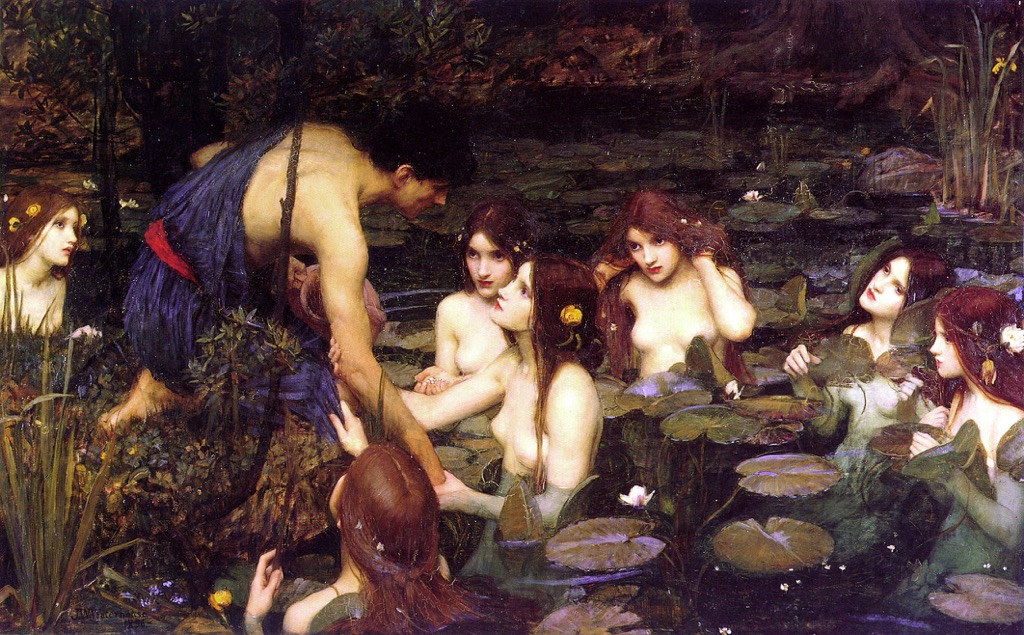
In Hylas and the Nymphs, beautiful water-women act collectively. Their gazes and gestures pull a mortal towards disappearance. The pool conceals depth beneath a surface of flowers and reflections. A Mermaid reverses the direction: the supernatural woman has emerged towards rock and air, and no mortal arrives to meet her.
In Ulysses and the Sirens, Waterhouse followed ancient vase evidence in giving the attacking sirens women’s heads and birds’ bodies. The 1891 painting is crowded, violent and narrative. A Mermaid demonstrates that “siren” and “mermaid” should not be treated as interchangeable anatomical labels in his work. Here the fish tail belongs to a later, medieval and modern visual tradition, and menace is latent rather than enacted.
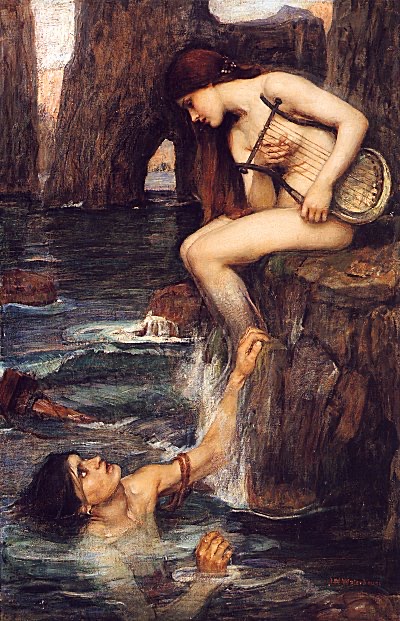
The closely related The Siren, conceived around the same period, makes danger more explicit. A mermaid-like singer with an instrument sits above a shipwrecked sailor clinging to the rocks. Sotheby’s notes the similar scale and preparatory relationship between the works. [6] In The Siren, two figures generate a fatal encounter; in A Mermaid, the absent second figure becomes the source of ambiguity.
Waterhouse also painted Nymphs Finding the Head of Orpheus in 1900. There, women at a dark pool discover the severed head and lyre of the murdered poet. Water joins female looking to male death. A Mermaid removes the body, story and shock, leaving only the possibility that song and desire might eventually draw someone across the water.
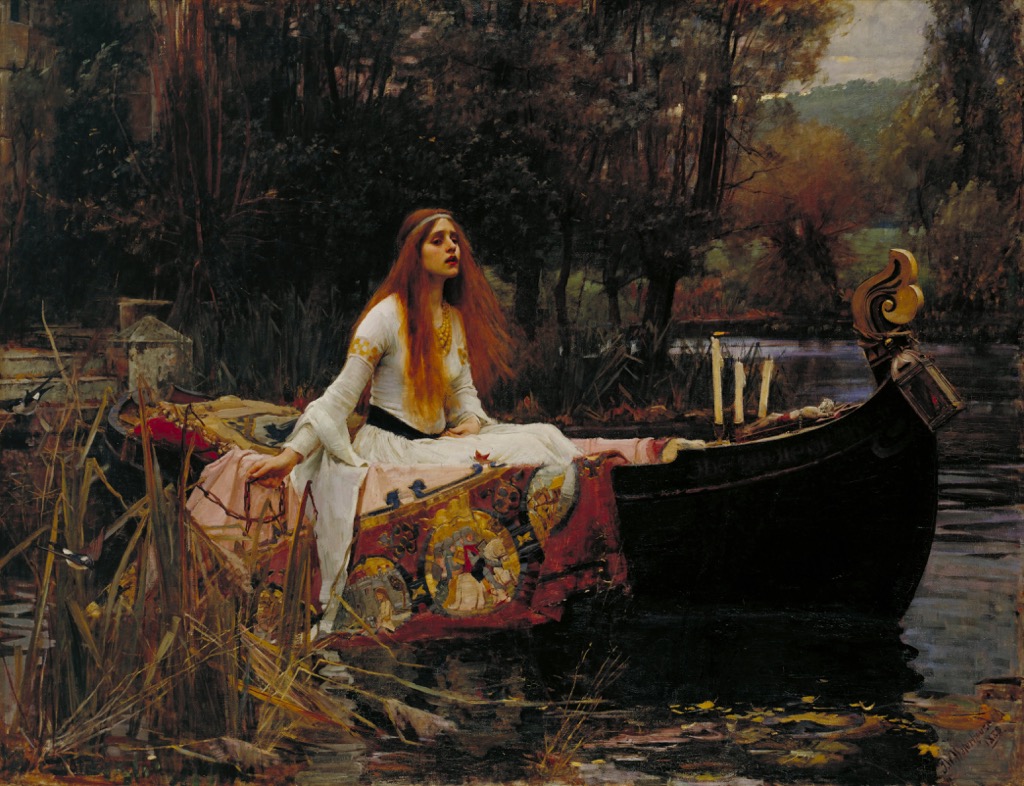
The Lady of Shalott paintings offer a different relation to water. Their heroine is human, and the river carries narrative fate rather than biological identity. Yet the recurring conjunction of woman, long hair, separation and fatal water makes comparison inevitable. Waterhouse repeatedly positioned beauty at an edge where looking could become dangerous.
These comparisons do not reduce every woman to a femme fatale or victim. They show Waterhouse changing the moral and narrative function of related materials. Pool, river and sea can conceal, transport, reflect or isolate. A female figure may attack, invite, mourn, resist or simply exist. A Mermaid is powerful because it withholds the verb that would settle her role.
Contemporary Reception: Sadness, Distance and the Inhuman
Contemporary critics responded to the final painting’s emotional remoteness. Christie’s account records that the Daily Telegraph emphasised a beauty separated from human warmth, while the Art Journal noticed a “wistful-sad look” and imagined the mermaid excluded from ordinary womanhood. [3] These comments reveal the interpretive problem the picture created in 1901.
Both readings make hybridity psychological. The tail is not merely fabulous anatomy; it appears to explain why the figure cannot enter human experience. Her beauty attracts sympathy, but her species seems to forbid fulfilment. The critics consequently read sorrow into an expression that remains visually restrained.
Their language also belongs to its period. It assumes a stable category of “womanhood” against which the mermaid is measured, and it makes human romantic experience the standard of completeness. Modern viewers need not accept that framework in order to value the evidence of first reception.
The criticism proves that the painting did not operate only as decorative fantasy. Viewers debated whether the figure was cold or troubled, impersonal or emotionally excluded. Waterhouse’s ambiguity was active from the beginning rather than invented entirely by later interpretation.
It also shows how the lack of a clear story redirected attention to expression. Had Waterhouse depicted a sailor in immediate peril, critics could describe action and moral consequence. With no such event, the mermaid’s face had to carry their accounts. Slight features became evidence for entire imagined lives.
The Diploma context increased the stakes. This was not only a popular mythical subject but a work placed permanently in the institution to which Waterhouse had devoted much of his exhibiting career. Its combination of academic figure painting, literary suggestion and elusive psychology offered an apt summary of the qualities for which he had become known.
From Finished Icon Back to Working Process
Reproduction has made A Mermaid appear inevitable: one of those images so closely associated with Waterhouse that another solution is difficult to imagine. The surviving studies undo that illusion. Different backgrounds, scales and stages show a composition that was chosen among alternatives.
The large oil study is particularly valuable because it reveals loose, energetic handling outside the concentrated face and hair. [3] Waterhouse could establish water through strokes of blue, green and mauve while reserving greater resolution for the figure. The contrast anticipates the final work’s hierarchy of attention.
The change from luminous distant cliffs to imposing grey rock demonstrates that setting was an expressive decision. A coast does not merely certify that the creature lives by the sea. Its temperature, enclosure and weight determine whether the scene feels festive, exotic, lonely or threatening.
The dated 1892 sketch also changes the chronology of interpretation. The final canvas belongs to 1900, near The Siren and Nymphs Finding the Head of Orpheus, but the idea originated before those finished works. Rather than a single late burst of marine imagery, Waterhouse’s mermaid was a motif carried through much of the 1890s.
That persistence helps explain the stripped-down final design. Over time he could separate what the subject required from what it merely allowed. The Diploma Work needs no palace beneath the sea, no sea-serpent, mermen or drowning sailor. Rock, comb, hair, pearls and tail are sufficient.
The studies do not reveal Waterhouse’s private intention. They cannot prove why he delayed completion, whether he identified a particular model or which text lay open in the studio. Their value is more concrete. They show duration, experiment and revision—the material history behind an image of effortless reverie.
What A Mermaid Can—and Cannot—Be Said to Mean
The safest interpretation begins with the painting’s visible threshold. A hybrid being sits between rock and sea, caring for her hair while remaining emotionally inaccessible. Her body connects worlds that the composition keeps distinct.
Tennyson makes self-conscious desire a plausible context. His mermaid sings of beauty, love and choice while combing her hair. [5] Waterhouse retains the motif but silences its voice, allowing sadness, self-possession and dangerous allure to compete.
Pearls and comb support meanings related to beauty and adornment, but they do not prove vanity. The open water supports ideas of freedom and danger, but it does not prove that the mermaid is trapped. The absence of a sailor prevents the scene from documenting seduction or murder. Interpretation is strongest when it grows from these limits rather than ignoring them.
The work may be understood as a meditation on inaccessible beauty. The figure is visually near and ontologically remote: rendered like a living woman, named as a creature that cannot exist, displayed for sight but withdrawn in attention. The more credible Waterhouse makes her body, the more poignant the separation becomes.
It may also be understood as an image of autonomy. The mermaid is not performing a role in a hero’s adventure. No Ulysses defeats her and no prince grants her a soul. She occupies her own time. The viewer’s wish to supply romance or danger reveals the narratives brought to her rather than a plot enacted before us.
These readings can coexist because the picture’s central facts do not change. Hair passes through a comb. Pearls rest on stone. Surf breaks. A tail returns the eye towards water. The mermaid looks elsewhere. Waterhouse’s achievement lies in making those facts feel like the beginning of several stories while completing none of them.
Discussion: Looking Without Solving
A Mermaid rewards a slower question than “What does the symbol mean?” Begin with the direction of looking. The spectator looks towards the mermaid; the mermaid looks away; the open sea leads farther beyond her. Attention moves across the picture without being returned.
Then follow the materials. Hair meets comb, flesh meets scales, tail meets rock and foam meets shore. Each junction joins unlike things without erasing the boundary between them. The mermaid’s hybrid anatomy is only the most obvious version of the painting’s larger structure.
Finally, compare what the picture shows with what mermaid stories encourage us to expect. There is beauty but no admirer, a possible singer but no visible song, an enchantress without a victim and a sea-creature above the water. Waterhouse activates the legend through deliberate omissions.
For readers, the most revealing debate may concern solitude. Does the figure appear lonely because she cannot join human life, or self-possessed because no human story controls her? Contemporary critics leaned towards exclusion and sadness. [3] A modern viewer may see autonomy. The canvas supports both responses while proving neither.
That openness is not vagueness. The setting, body and action are remarkably specific. Ambiguity arises because Waterhouse makes the visible world convincing and refuses to explain its inward cause. A Mermaid remains memorable not because it tells the best-known mermaid story, but because it gives a legendary creature a private life just beyond the reach of narrative.
Related Pages
- John William Waterhouse: Return to the artist overview and late-career reputation.
- Paintings: Browse Waterhouse's mythological and literary paintings.
- The Lady of Shalott: Compare another solitary Waterhouse heroine beside water.
Frequently Asked Questions
He completed the Royal Academy canvas in 1900. The Academy accepted it in 1901 as his Diploma Work. [1] A small oil sketch dated 1892 proves that he had been developing the subject for at least eight years. [3]
It belongs to the Royal Academy of Arts in London. The Academy records it as a Diploma Work given by Waterhouse and accepted in 1901. [1]
Royal Academicians donate a representative example of their work to the Academy following election. This practice derives from the Academy’s founding rules, and Diploma Works form the core of its collection. [2] The term does not mean a student examination picture.
Probably, but not with absolute documentary certainty. Tennyson’s The Mermaid describes a solitary mermaid combing her hair with a pearl comb, a close match for Waterhouse’s motif. [5] Modern catalogue scholarship proposes the connection, but no located statement by Waterhouse confirms that the poem was his sole source. [3] [6]
The painting does not show her harming or enticing anyone. Mermaid and siren traditions made danger available to contemporary viewers, and Waterhouse explored fatal enchantment elsewhere. In this canvas, however, menace remains a possibility rather than an event.
Combing belongs to established mermaid imagery and is also the central physical action of Tennyson’s poem. Pictorially, it links hands, hair and torso and makes a fabulous creature convincing through an ordinary routine.
No definitive symbolic explanation by Waterhouse is known. Pearls connect the sea to human adornment and may suggest beauty, treasure or tears, but their most secure role is visual and material rather than a single coded message.
No. A Mermaid shows a solitary figure combing her hair. The Siren, a separate work conceived around the same period, includes a shipwrecked sailor and an instrument, making fatal enchantment more explicit. [6] Waterhouse’s 1891 Ulysses and the Sirens uses bird-bodied sirens derived from ancient imagery.
No model for the finished Diploma Work is securely identified in the sources used here. Resemblance to women in other Waterhouse paintings cannot by itself establish a name.
It was Waterhouse’s chosen Diploma Work, developed through many studies and placed permanently at the Royal Academy. It also condenses several central features of his mature art: a literary or legendary woman, an exact bodily gesture, beautiful surfaces, natural setting and unresolved psychological narrative.
Discussion
A Mermaid rewards a slower question than “What does the symbol mean?” Begin with the direction of looking. The spectator looks towards the mermaid; the mermaid looks away; the open sea leads farther beyond her. Attention moves across the picture without being returned.
Then follow the materials. Hair meets comb, flesh meets scales, tail meets rock and foam meets shore. Each junction joins unlike things without erasing the boundary between them. The mermaid’s hybrid anatomy is only the most obvious version of the painting’s larger structure.
Reader Insights
Which visible detail most changes the way you read this page?
Which source or comparison helps the work feel less familiar and more specific?
What question would you bring back to the painting after reading?
Join the Conversation
Share your reading of this page below.
References
- Main image: John William Waterhouse, A Mermaid, 1900, Royal Academy of Arts Diploma Work, public-domain reproduction via Wikimedia Commons.
- Royal Academy of Arts. “A Mermaid,” collection information reproduced by Royal Academy Prints: artist, dimensions, medium and acquisition as a Diploma Work accepted in 1901. View source
- Royal Academy of Arts. An Introduction to the Paintings, Sculptures and Works on Paper in the Collection of the Royal Academy of Arts for Teachers and Students, 2012; and Collections Development Policy, on the founding Diploma Work requirement and the collection’s core. View source
- Christie’s. “John William Waterhouse, R.A., Sketch for ‘A Mermaid’,” Important Victorian & British Impressionist Art, London, 11 July 2013, lot essay, provenance and literature. View source
- Christie’s. “John William Waterhouse, R.A., Study for The Mermaid, half-length (recto); study of a kneeling girl to the waist (verso),” sale catalogue record. View source
- Alfred Tennyson. “The Mermaid,” in Poems, 1843 edition, vol. 1; first published in Poems, Chiefly Lyrical (1830). View source
- Sotheby’s. “John William Waterhouse, R.A., R.I., The Siren,” Victorian, Pre-Raphaelite & British Impressionist Art, London, 12 July 2018, lot 12: description, provenance, literature and catalogue note. View source
- Encyclopædia Britannica. “Waterhouse, John William,” 11th ed., 1911: contemporary career assessment and Royal Academy elections. View source