

 Buy Art Prints Now
from Amazon
* As an Amazon Associate I earn from qualifying purchases.
Image reference [image]
 by Tom Gurney
Tom Gurney BSc (Hons) is an art history expert with over 20 years experience
Published on August 14, 2026 / Updated on August 14, 2026
Email: tomgurney1@gmail.com / Phone: +44 7429 011000
Ulysses and the Sirens: Introduction
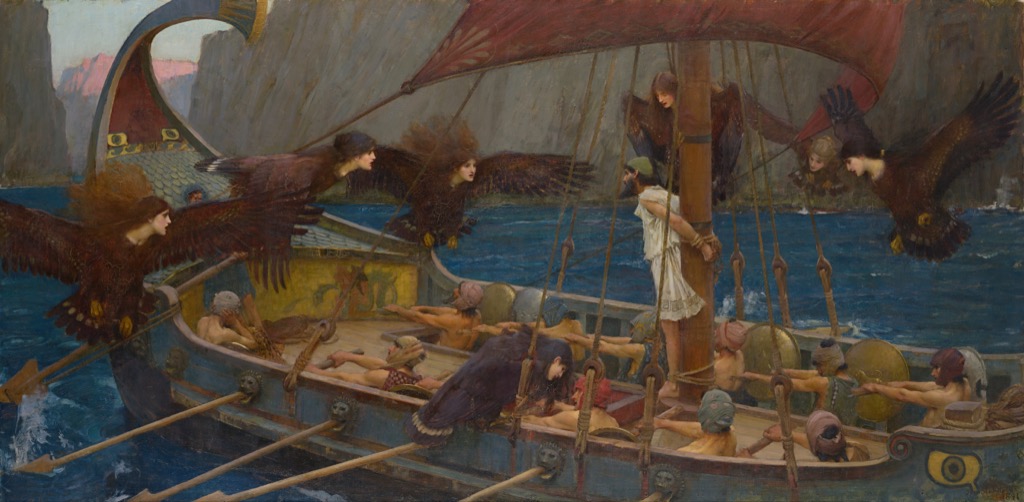
John William Waterhouse’s Ulysses and the Sirens turns a song into a physical assault. Seven bird-bodied creatures with the faces of young women crowd around a long, narrow ship. Sailors pull at the oars while Ulysses stands bound to the mast, exposed to the voices that his companions cannot hear. The danger is invisible in Homer. Waterhouse gives it wings, claws and the force of a siege.
Painted in 1891 and now in the National Gallery of Victoria, Melbourne, the picture is one of Waterhouse’s boldest confrontations with classical tradition. Homer does not describe the Sirens’ bodies, and his two singers remain in a meadow surrounded by the remains of earlier victims. Waterhouse borrowed the ancient bird-woman type from a Greek vase in the British Museum, multiplied the figures and brought them directly to the ship. The result divided critics: some admired his union of archaeology, imagination and colour; others thought predatory bodies destroyed the idea of irresistible music. That argument is still the key to the painting. It asks how a silent image can make us believe in a fatal sound.
At a Glance
- ArtistJohn William Waterhouse (1849–1917)
- TitleUlysses and the Sirens
- Date1891
- MediumOil on canvas
- Dimensions100.6 × 202 cm, unframed
- CollectionNational Gallery of Victoria, Melbourne
- Accession numberp.396.3-1
- SignatureInscribed in black paint “J. W. WATERHOUSE./1891” at lower right
- First exhibitedRoyal Academy, London, 1891, catalogue no. 475
- AcquisitionPurchased from the artist for £1,200 by Sir Hubert von Herkomer for the National Gallery of Victoria, June 1891
- FrameOriginal 1891 water-gilded timber frame, maker unknown [1] [2]
Contents
- Introduction
- A Painting Organised as a Siege
- The Sirens in Homer’s Odyssey
- Controlled Temptation and the Limits of Self-Control
- What Homer Does Not Say About the Sirens
- The British Museum Vase and Classical Authority
- The Ship as a Machine for Survival
- The Crew and the Hero
- How a Silent Painting Suggests Sound
- Bird-Women and the Question of the Femme Fatale
A Painting Organised as a Siege
The ship runs almost the full width of the canvas. Its long hull supplies a stable horizontal form, but everything around it is unstable: oars strike the water, bodies lean, wings beat and bird-women approach from above and beside the vessel. Waterhouse traps human effort inside a ring of movement.
Ulysses stands near the centre, tied upright to the mast. His elevated position makes him the focus, yet his importance is inseparable from helplessness. He is the only sailor permitted to hear the Sirens and the only one who cannot move freely. Knowledge and restraint occupy the same body.
The Sirens do not wait at a distance. They hover, descend and crowd the gunwales. Some appear close enough for claws to touch wood or flesh. Waterhouse turns attraction into encirclement. The danger no longer lies only in sailing towards a fatal shore; it has arrived at the ship.
That change creates the picture’s immediate drama. In Homer, the crew must continue rowing while the song tempts Ulysses to stop. In Waterhouse, they look like sailors under aerial attack, even though wax protects them from the true danger. The physical appearance of threat has become more legible than the sound that defines it.
The composition therefore operates on two levels. A viewer unfamiliar with Homer can recognise emergency, predatory creatures and a bound leader. A viewer who knows the poem understands that the men’s survival depends not on fighting the Sirens but on maintaining a plan made before the song began.
The broad format strengthens this reading. We scan along the vessel, observing different responses rather than one isolated confrontation. Ulysses endures; rowers labour; ropes and mast hold; Sirens attack from several directions. Survival is distributed across a system.
The Sirens in Homer’s Odyssey
The episode occurs in Book XII of the Odyssey, as Ulysses—or Odysseus in Greek—continues his long journey home after the Trojan War. Circe warns him about the dangers ahead. The Sirens beguile every man who approaches, she says; anyone who hears them in ignorance will never return to wife and children. Around the singers lies a heap of decaying bodies. [3]
Circe’s instructions are precise. Ulysses must knead wax and seal the ears of his companions. If he wishes to listen, the crew must bind him hand and foot upright against the mast. If he orders them to release him, they must tighten the ropes instead. The plan anticipates that the person hearing the song will no longer be a trustworthy judge of his own safety. [3]
Ulysses tells the men about the Sirens but reserves the listening role for himself. As the ship approaches, the wind falls and the sea becomes calm. He cuts and softens the wax, stops each companion’s ears and accepts the bonds. The rowers continue with their oars while he remains exposed. [3]
The Sirens’ promise is important. They praise Ulysses as the glory of the Achaeans and invite him to stop. They claim that no ship passes before its sailors have heard their sweet voices; those who listen depart knowing more. Their lure combines pleasure, fame and knowledge. They know the sufferings at Troy and everything that happens on the fruitful earth. [3]
The temptation is therefore more complex than sexual seduction. Ulysses has already spent years making his name through war and wandering. The song addresses his identity, curiosity and desire to understand. It offers a total account of the very experiences that have cost him and others so much.
Ulysses signals or cries for release, but the deaf crew obeys his earlier command. Perimedes and Eurylochus bind him more tightly. Only when the ship has passed beyond hearing do the men remove the wax and loosen the ropes. [3] The hero succeeds because he has arranged in advance for others to resist his future will.
Controlled Temptation and the Limits of Self-Control
Ulysses does not avoid the Sirens in the simplest possible way. Circe gives him permission to listen if properly bound, and he chooses that dangerous privilege. He wants experience without consequence: knowledge of the song while preserving the journey home.
The arrangement is sometimes described in modern thought as a “Ulysses pact”—a decision made in a clear state that restricts choices in a future state of temptation. The phrase can clarify the structure, although it belongs to later discussions rather than Homer or Waterhouse. In the picture, ropes make advance commitment visible.
Self-control alone is insufficient. Ulysses expects to reverse his decision, so he transfers authority to a crew unable to hear his pleas. His survival depends on trust, hierarchy and the physical labour of other people. The famous individual hero cannot pass the Sirens individually.
Waterhouse gives this paradox bodily form. Ulysses appears commanding because he occupies the centre and rises above the rowers, but the mast immobilises him. His upright stance resembles leadership while proving his lack of present control. The crew below is less visually prominent yet more effective.
The restraints are not punishment. They are tools requested by the bound man. That distinction separates the image from a scene of capture even though one contemporary critic thought Ulysses looked like a criminal exposed to birds of prey. [2] The ropes record strategy, not defeat.
At the same time, the plan contains privilege. Ulysses claims the pleasure and knowledge of hearing while his companions receive silence and work. They must row through a danger they cannot fully perceive and deny their leader’s urgent commands. Waterhouse’s wide composition gives those men a presence that a heroic summary can overlook.
The episode asks whether knowledge justifies risk. Ulysses survives and gains the experience, but the Sirens’ promise of total understanding remains unverified. The painting captures the price of testing it: exposure, collective effort and a moment in which the hero’s own voice must be treated as dangerous.
What Homer Does Not Say About the Sirens
Homer tells us what the Sirens sound like, what they promise and what surrounds them. He does not describe their bodies. Later art and literature supplied forms ranging from women with bird bodies to beautiful mermaid-like figures. Victorian viewers commonly expected the latter type. [1] [2] [3]
Waterhouse’s choice of bird-women was therefore both archaeologically grounded and visually surprising. Each Siren has a recognisably human female head attached to a feathered body with wings and powerful claws. The join is not hidden beneath flowing drapery or a gradual transformation. Beauty and animal threat meet abruptly.
The number also departs from Homer. The poem uses the dual form and refers to two Sirens; Waterhouse paints seven. [2] [3] Multiplication allows them to encircle the ship, vary their positions and fill the long canvas with repeated heads and wings.
Their similarity matters. Several contemporary reviewers thought the faces resembled the same English model. [2] Repetition can make the Sirens feel like a collective force rather than seven individuals. The song is plural but coordinated; one temptation arrives through many bodies.
The painting also changes their behaviour. Homer’s Sirens sit in a meadow while the ship passes. Waterhouse’s creatures leave any fixed island and fly at the sailors. The shift converts a danger of attraction—men going to them—into a danger of pursuit—the Sirens coming to men.
This is not a small illustrative error. It changes the emotional structure from invitation to siege. Yet it helps a silent painting communicate urgency. Without audible music, bodies must make temptation and peril visible. Waterhouse sacrifices some narrative distance to gain physical pressure.
The British Museum Vase and Classical Authority
The National Gallery of Victoria identifies an ancient Greek vase in the British Museum as Waterhouse’s source for the bird-bodied Sirens. [1] The object is an Attic red-figure stamnos dating to about 480–470 BCE, now registered as 1843,1103.31. It shows the ship of Odysseus passing three Sirens; one plunges headlong from a cliff as though already defeated. [4]
Waterhouse does not copy the vase literally. He borrows its hybrid type and the relation between bound hero, ship and bird-women, then enlarges the scene into coloured oil painting. The small vessel’s economical profile becomes a crowded marine drama more than two metres wide.
The antique model provided authority at a moment when Victorian archaeology and museum culture shaped classical painting. Critics who defended Waterhouse could point to Greek evidence rather than treating the bird-women as modern fantasy. M. H. Spielmann acknowledged the difficulty of giving up familiar womanly Sirens but accepted the support of ancient vases. [2]
Authority did not end the debate. A Greek vase could show that ancient artists imagined Sirens as birds, but it could not prove that Waterhouse’s attacking flock best expressed Homer’s irresistible voices. Archaeological form and literary effect posed different questions.
Waterhouse’s solution is thus an act of selective classicism. He goes beyond Homer to ancient visual tradition, then goes beyond the vase to serve his own composition. He is neither simply faithful nor simply free. He establishes a historical basis and uses it as permission for invention.
The comparison also reveals a reversal. On the stamnos, a Siren falls because Odysseus has passed successfully. In Waterhouse, all seven appear active and dangerous; no defeat is obvious. He fixes the image at maximum pressure before escape becomes certain.
The Ship as a Machine for Survival
The long vessel is more than a setting. It is the human structure that carries the men through temptation. Hull, mast, ropes, oars and crew must continue to function despite the Sirens’ presence. Every component contributes to escape.
The mast transforms from sailing equipment into a restraint. Ropes normally control sail and movement; here they also control the commander. The ship’s ordinary technology is repurposed against an extraordinary psychological danger.
The oars provide rhythm. Repeated diagonals move from hull into water, translating the passage of time into physical strokes. Survival depends on continuing the sequence long enough for the song to fall out of range. There is no single heroic blow that ends the threat.
The rowers’ bodies reinforce this rhythm. Their torsos bend and arms work while Ulysses remains vertical. The contrast distinguishes action from endurance. He performs the difficult task of hearing without acting; they perform the exhausting task of moving without hearing.
Shields, timber, rope and garments lend archaeological density, although contemporary reviewers debated details. The Athenaeum praised the classical treatment but objected that shields lay on the deck rather than hanging outside the bulwarks. [2] Such criticism shows how closely Academy audiences inspected the material credibility of history painting.
Waterhouse does not turn that detail into dry reconstruction. The sailors feel exposed. The open craft has no roof or cabin; Sirens approach from the same air the sail requires. The means of travel is also the surface on which danger lands.
The ship’s horizontal stability counters the winged swarm. It remains legible as one continuous object even when figures interrupt its outline. Human survival appears as cohesion: a constructed vessel, agreed plan and coordinated labour holding together while temptation arrives from every side.
The Crew and the Hero
Ulysses gives the painting its title and narrative centre, but the crew gives the episode its outcome. Wax makes the men resistant not by strengthening their will but by removing the stimulus. They do not overcome the Sirens’ song; they cannot hear it.
This sensory division produces two realities on one deck. Ulysses inhabits a world filled with irresistible sound. His companions inhabit visible danger, physical work and perhaps the muffled noise of sea and oars. They can look at him and the bird-women without sharing the experience that drives his pleas.
The plan also reverses normal command. A captain’s orders should direct the crew, yet success requires them to disregard commands given during the passage. Earlier Ulysses has instructed them to treat later Ulysses as untrustworthy. Authority survives by dividing itself across time.
Waterhouse does not present the men as anonymous machinery. Their varied poses create fear and effort. Some bend to the oars, some turn towards the threat and those nearest the mast participate in keeping the hero bound. The scene becomes collective crisis rather than an isolated portrait of legendary self-mastery.
The crew’s covered or protected ears are difficult to emphasise at the scale of a large composition, so literary knowledge remains important. A viewer may otherwise wonder why the men do not respond to the song or why they ignore their leader. The Royal Academy catalogue supplied a summary of the myth, allowing text and image to work together. [1] [2]
Ulysses’ elevated body should therefore not be read as proof that he alone conquers temptation. He designed the experiment, but its success belongs to people, wax, ropes, wood and repeated rowing. Waterhouse’s composition makes heroism infrastructural.
How a Silent Painting Suggests Sound
The central artistic problem is impossible in literal terms. Paintings do not sing. Waterhouse must show the effects of music without giving the viewer access to it. He chooses mouths, wings, repetition and Ulysses’ exposure as substitutes.
The Sirens’ human faces permit the possibility of voice. Their proximity suggests that song fills the air around the mast. Repeated heads at different positions can imply a chorus, while repeated wings create a visual pulse analogous to rhythm.
Ulysses is the receiving instrument. Because his ears are open and his body is bound, any tension in head, torso or rope can be interpreted as the song’s effect. Several contemporary critics nevertheless thought the temptation insufficiently visible. The Art Journal complained that his involuntary effort to follow the sound was hardly suggested. [2]
That criticism identifies a genuine tension. Waterhouse emphasises external attack more strongly than internal enchantment. The Sirens look capable of tearing the sailors with claws, so their song risks becoming unnecessary. If physical violence can stop the ship, why rely upon melody?
Other critics defended the image on the ground that voices, not appearance, enchant. Spielmann’s point was that ugly or strange bodies do not prevent beautiful sound. [2] Indeed, the conflict between face, claws and imagined music may deepen the myth. Hearing promises delight while sight produces fear.
Colour contributes another sensory translation. Spielmann praised a “carnival of colour,” and the Athenaeum noticed dark blue-green water, shadowed strait and sunlight beyond. [2] Contrasts can feel orchestral: repeated patches balance across the surface, dark enclosure gives way to brighter distance and the eye encounters visual intensity where the ear expects song.
The painting finally asks the viewer to occupy the crew’s position. We see the Sirens but cannot hear them. We know from Ulysses and Homer that the sound is beautiful, yet our direct evidence is silent and menacing. The gap is not merely a limitation of the medium. It reproduces the crew’s protected ignorance.
Bird-Women and the Question of the Femme Fatale
Late Victorian art repeatedly imagined the beautiful, dangerous woman who lures men away from reason, duty or life. Sirens, mermaids, sphinxes, Circe and other enchantresses supplied established subjects. Waterhouse worked within that visual culture, but his bird-women do not offer its most conventional erotic spectacle.
Their faces are young and attractive; their bodies are squat, feathered and clawed. Michelle Bonollo argues that this hybrid form made the Sirens more disturbing than the sensuous women viewers expected. [2] Seduction is displaced from visible body to invisible song.
The picture can therefore register masculine anxieties about female power, sexuality and changing social roles, as Bonollo proposes. [2] Seven female-headed beings surround a bound male hero and his crew. Yet this historical reading should be attributed, not treated as a documented statement of Waterhouse’s private intention.
It is also important to distinguish mythic function from women as a group. The Sirens are supernatural predators within a specific story. Reading them as proof of a general fear of actual women repeats the misogynistic logic that scholarship seeks to analyse. The painting can expose cultural anxiety without requiring modern viewers to endorse it.
The Sirens’ collective similarity complicates individuality. They may seem like one multiplied temptation rather than characters with separate motives. Homer gives them a shared voice and promise. Waterhouse gives that shared agency multiple bodies, a swarm whose unity threatens the organised unity of the crew.
Ulysses is not an innocent man attacked without choice. He knowingly enters hearing range, protects himself through restraints and claims an experience denied to his men. The painting stages both external danger and cultivated exposure. Desire is not simply something done to him; it is something he chooses to test.
This balance makes the work richer than a warning against seductive women. It concerns the attraction of knowledge, the limits of command, the fear generated by unfamiliar bodies and the mechanisms through which a person survives an experience he has deliberately sought.
Royal Academy Exhibition and Contemporary Debate
Ulysses and the Sirens was exhibited at the Royal Academy in 1891 as catalogue number 475. [1] [5] The catalogue itself explained the Sirens, Circe’s warning, the wax and the bonds. Such text helped viewers reconstruct the unheard narrative while standing before the canvas.
British reviews were predominantly favourable but sharply divided over interpretation. Spielmann called the painting a startling triumph and praised its balanced colour as a considerable advance in Waterhouse’s work. [2] The Athenaeum admired the use of ancient art and judged the legend well told. The Saturday Review thought archaeology and imagination had been successfully joined. [2]
The objections were equally revealing. The Times, The Academy and The Art Journal argued that Waterhouse had produced harpies rather than true Sirens. Claws and aggressive flight made the creatures seem capable of attack without any song. The very feature that supplied visible drama seemed to undermine the source’s invisible temptation. [2]
Critics also disputed number, anatomy, naval detail and Ulysses’ response. These were not pedantic side issues to an Academy culture that valued narrative intelligibility and archaeological seriousness. The debate asked whether historical authority lay in Homer’s words, later Greek visual tradition or a modern painter’s imaginative synthesis.
The disagreement shows that the work was never a neutral illustration. It arrived as an argument about adaptation. A faithful painting could not simply reproduce a text that omitted the Sirens’ appearance and depended upon sound. Any visual form required an interpretive choice.
Waterhouse’s reputation benefited from the ambition even where the choice was challenged. The painting demonstrated his ability to coordinate a large cast, marine setting, complex silhouette and intense colour within a single public exhibition picture. Bonollo identifies it as an important point in the emergence of the mythic style for which he later became known. [2]
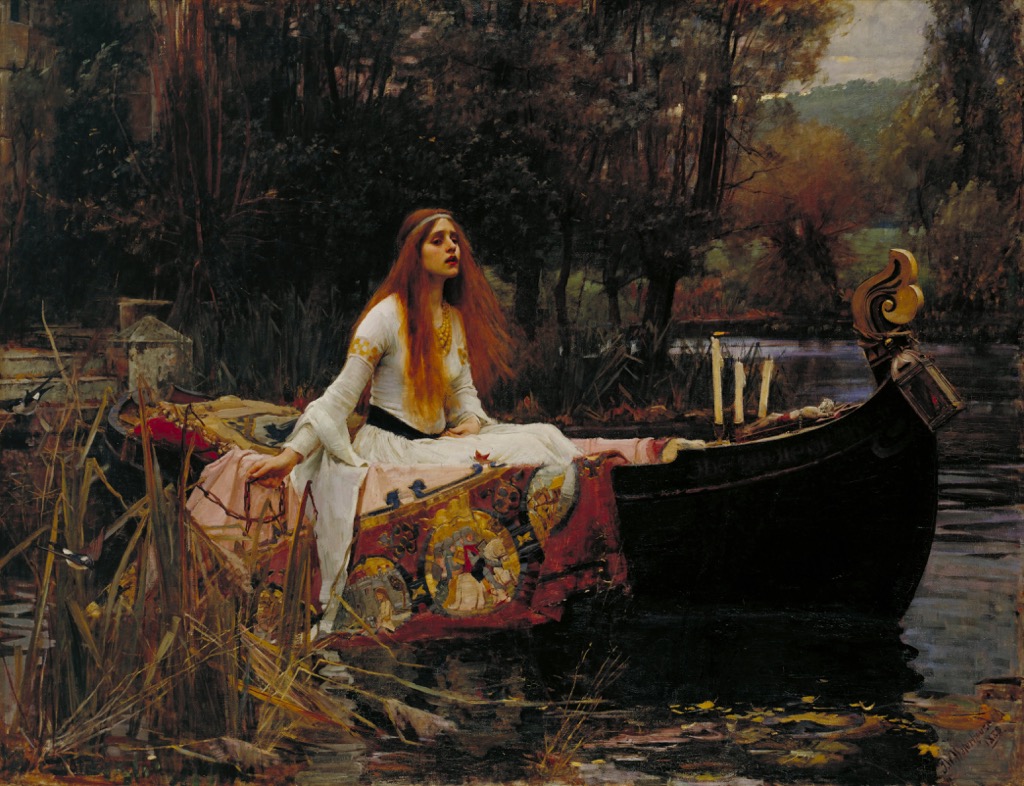
This chronology matters. The Lady of Shalott had already appeared in 1888, but the 1891 Ulysses announced a particularly forceful version of Greek legend. Its predatory bird-women would remain exceptional within Waterhouse’s art, even as sorceresses, nymphs and sirens continued to occupy him.
Purchase for Melbourne in 1891
Sir Hubert von Herkomer purchased Ulysses and the Sirens for the National Gallery of Victoria in June 1891 for £1,200, soon after its Royal Academy display. [2] [6] It was only the second Waterhouse painting to enter a public gallery; the Art Gallery of South Australia’s The Favourites of the Emperor Honorius had been the first in 1883. [2]
The acquisition belongs to a nineteenth-century practice in which Australian public collections bought contemporary European paintings directly from artists or major exhibitions. The NGV did not wait for Waterhouse’s historical reputation to settle. It acquired a new, debated work at the moment it was shaping that reputation.
Reaction in Melbourne was more hostile than the generally favourable British response. Critics challenged the mythological departures, the authority given to Herkomer and the expenditure of public funds. [2] The controversy mixed aesthetic judgement with questions of governance and collection-building.
Herkomer defended the purchase as imaginative art informed by Greek vase painting. He praised the rich colour and described Waterhouse as working directly, completing and repainting a passage as necessary rather than slowly constructing it through an opposite method. [2] His account is valuable evidence from a contemporary artist-adviser, although it is not a modern technical examination.
The painting has remained in the NGV under accession number p.396.3-1. [1] That continuous public history gives it a secure provenance and preserves the acquisition debate as part of the object’s meaning.
Its move from London to Melbourne also makes reception geographically double. One audience debated what counted as legitimate classicism at the Royal Academy; another debated whether a distant public collection should spend heavily on the result. Ulysses and the Sirens became part of Australian cultural politics almost immediately after leaving Waterhouse’s studio.
The Original Frame
The painting retains its original 1891 frame, an uncommon and valuable survival. [1] The maker is unknown. The NGV describes a profiled timber structure with a deeply recessed scotia, reeded inner edge, water gilding and a matte surface. Its condition is recorded as good and original.
The frame is not incidental to the wide composition. Its long horizontal opening reinforces the ship’s passage, while the deep recession separates the bright, crowded scene from the surrounding gallery wall. Gold provides a controlled threshold around blue-green sea and patterned wings.
Because the picture was purchased from the Royal Academy in the year it was shown, the frame preserves something of its original exhibition presence. Modern reproductions usually remove that material context and crop attention to the canvas alone.
The NGV notes that the design probably served as the model for a frame made the following year for Rupert Bunny’s Sea Idyll. [1] This suggests that the acquired object influenced local framing practice as well as the collection’s painting holdings.
Frame evidence should remain distinct from canvas technique. The Gallery documents timber profile, gold leaf and condition. The published sources cited here do not provide a full pigment analysis, X-radiography or infrared imaging of Waterhouse’s paint layers. Visual observations about handling should therefore remain separate from unsupported technical claims.
Looking at the framed work also restores scale. More than two metres wide, the canvas creates a bodily field across which the viewer must scan. The original gold boundary contains the swarm just as hull and ropes contain the human response.
Place in Waterhouse’s Career
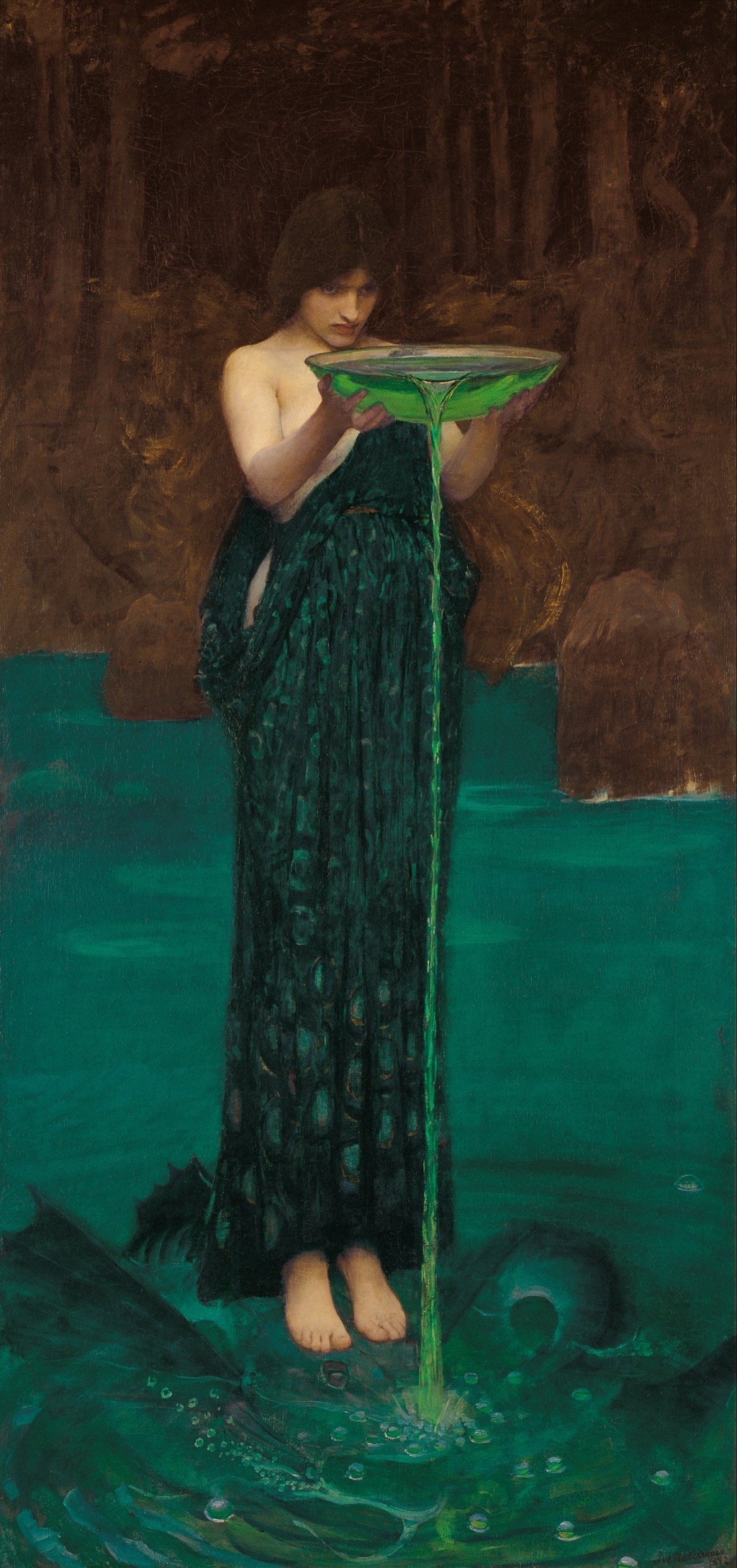
The year 1891 was unusually concentrated. Waterhouse also painted Circe Offering the Cup to Ulysses, exhibited at the New Gallery. One work shows the hero at sea after following Circe’s warning; the other places him before the enchantress whose magic he resists. Together they explore danger through listening, looking and advance knowledge. [2]
In 1892 Circe Invidiosa followed, shifting from Homer to Ovid and from a threatened male traveller to the poisoning of an absent woman’s bathing place. The sequence does not form a literal continuous cycle, but it demonstrates Waterhouse’s sustained interest in Circe, Ulysses, transformation and maritime peril.
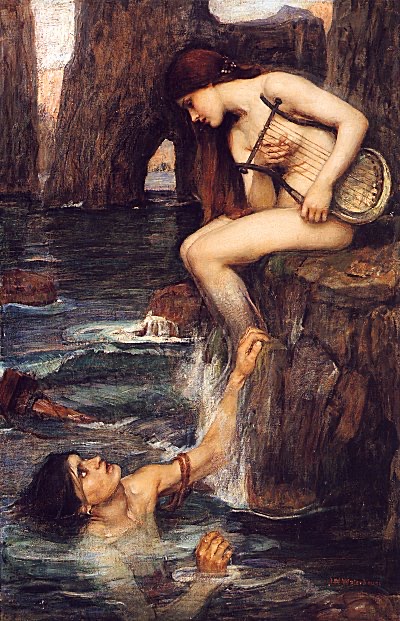
The Sirens themselves later changed. Around 1900 Waterhouse painted The Siren as a human-bodied young woman seated at the water’s edge with a lyre, much closer to the beautiful marine temptress familiar to Victorian audiences. [2] The attacking bird swarm of 1891 was not his permanent formula.
This development cautions against treating every Waterhouse woman as the same femme fatale. Human nymph, sorceress, grieving heroine and hybrid monster make different narrative demands. Recurrent beauty and danger do not erase differences of agency, source or bodily form.
The painting also helps position Waterhouse between labels. His close attention to literary narrative, rich colour and precise objects aligns with later Pre-Raphaelite practice; his Royal Academy career, classical archaeology and large exhibition format connect him with the Victorian Olympians. [7] [8] He was not a member of the original Pre-Raphaelite Brotherhood.
Ulysses and the Sirens is crucial because those inheritances do not sit quietly together. Archaeological learning produces a nightmare, decorative pattern produces violence and classical narrative becomes a modern debate about gender and fear. Waterhouse’s mature identity emerges through collision rather than simple continuity.
Knowledge, Desire and the Price of Hearing
The Sirens offer knowledge, not merely pleasure. They claim access to the history of Troy and to everything that happens across the earth. [3] Their song flatters Ulysses as a famous hero before promising an even wider understanding. It appeals to the person he has become through war and wandering.
Waterhouse’s image can obscure this intellectual lure because claws and wings dominate the eye. Recovering the words changes the bound figure. Ulysses is not simply resisting sexual beauty; he is enduring the desire to stop, listen and complete his knowledge.
The episode refuses a clean division between curiosity and prudence. Ulysses would be safest if he blocked his own ears. He instead devises a way to hear and survive. His ingenuity makes the experience possible, while the need for ropes admits that reason will fail inside it.
The crew bears part of the cost. They receive neither song nor promised knowledge, but they perform the labour that brings everyone through. Their silence is protective and imposed. Waterhouse’s composition allows the hero’s exceptional experience and the group’s ordinary effort to coexist.
The Sirens’ promise may itself be true, false or dangerously incomplete. Homer does not need to settle the question. Even true knowledge can be fatal if the conditions of receiving it destroy return, family and future action. A listener who never leaves cannot use what he learns.
The painting’s final subject is therefore passage. Ship and viewers must move beyond an experience designed to stop movement. Wings, song, curiosity and command all pull towards suspension; oars and prior agreement pull towards home. Waterhouse freezes the struggle without showing which force has won, though the story assures us that the ship will escape.
How to Look Closely at Ulysses and the Sirens
Begin with the hull. Follow its line from one end of the canvas to the other before looking at any face. Notice how the ship makes one continuous human platform within broken water and winged movement.
Then find Ulysses and trace the ropes that hold him to the mast. Compare his vertical stillness with the diagonal bodies of rowers and Sirens. Ask whether he appears tempted, tormented, protected or displayed.
Count the Sirens. Their seven bodies are not arranged as a neat sequence, yet repeated heads and wings create visual rhythm. Compare the human faces with the claws. Which part dominates your first response, and can you imagine a beautiful voice coming from the combined form?
Look beyond the ship to the channel, rocks and lighter water. Critics in 1891 noticed the movement from shadowed strait towards sunlit outer sea. [2] The landscape can be read as the spatial equivalent of duration: danger occupies the present enclosure; escape lies ahead.
Examine the crew individually. Which men row, look, crouch or attend to Ulysses? Their wax is difficult to see, but their actions explain the plan. The more closely the crew is studied, the less the painting becomes a duel between one hero and seven monsters.
Finally, remember that you hear nothing. Your position resembles that of the protected sailors, not Ulysses. The painting asks you to believe his experience on the evidence of bodies, ropes and a source text. Its silence is part of its meaning.
Related Pages
- Circe Offering the Cup to Ulysses: Compare Waterhouse's companion Homeric subject from the same year.
- Literary and Mythological Sources: Place the Homeric episode within Waterhouse's wider literary sources.
- Paintings: Return to the wider Waterhouse paintings hub.
Frequently Asked Questions
He signed and dated it in 1891. It was exhibited at the Royal Academy that year as catalogue number 475. [1] [5]
It is in the National Gallery of Victoria, Melbourne, which acquired it directly in 1891. Its accession number is p.396.3-1. [1]
The oil on canvas measures 100.6 × 202 cm without the frame. Its exceptional width allows the entire ship, crew and surrounding Sirens to operate as one composition. [1]
Odysseus is the Greek form of the hero’s name; Ulysses is the Latinised form commonly used in English when Waterhouse painted the picture.
He wants to hear the Sirens without steering the ship towards destruction. Circe tells him to have the crew bind him and tighten the ropes if he asks for release. [3]
Ulysses softens wax and uses it to seal their ears. They can therefore keep rowing and ignore his commands during the dangerous passage. [3]
Homer does not describe their bodies. Waterhouse used an ancient Greek bird-woman tradition represented by a red-figure stamnos in the British Museum. [1] [4]
Seven. Homer refers to two, while the British Museum vase shows three. Waterhouse multiplied them to surround the ship and intensify the scene. [2] [3] [4]
Yes. Many London critics admired its colour and imaginative archaeology, while others thought the clawed creatures looked like attacking harpies rather than singers. Melbourne debate also focused on classical accuracy, the purchase process and its £1,200 price. [2]
Yes. The NGV records the 1891 water-gilded timber frame as original and in good condition. [1]
Discussion
Ulysses and the Sirens makes temptation visible by changing it. Homer’s danger enters through the ear and promises knowledge. Waterhouse’s danger surrounds the body and threatens with claws. The painting’s departure from the poem is therefore not separate from its achievement; it is the method by which a silent medium stages fatal sound.
Reader Insights
Do the attacking bird-bodies help you imagine the song’s force, or do they make music seem unnecessary?
Is Ulysses the heroic centre, or does survival belong equally to the deafened crew?
Does his decision to listen appear courageous, arrogant, intellectually serious or all three?
Join the Conversation
Describe the first element that communicates danger to you: the ropes, the Sirens’ claws, the crowded air, the rowers’ effort, the dark channel or something else.
References
- Main image: John William Waterhouse, Ulysses and the Sirens, 1891, National Gallery of Victoria, public-domain photographic reproduction via Wikimedia Commons / Google Art Project.
- National Gallery of Victoria, “John William Waterhouse, Ulysses and the Sirens,” institutional collection and frame record, including dimensions, inscription, accession, acquisition, classical source and original-frame details. View source
- Michelle Bonollo, “J. W. Waterhouse’s Ulysses and the Sirens: Breaking Tradition and Revealing Fears,” Art Bulletin of Victoria, no. 40, National Gallery of Victoria, including acquisition history, contemporary criticism and gender analysis. View source
- Homer, Odyssey, Book XII, translated by A. T. Murray, Theoi Classical Texts Library, including Circe’s warning, the wax, bonds and Sirens’ song. View source
- British Museum, “Stamnos: The Ship of Odysseus Passing the Sirens,” Attic red-figure pottery, about 480–470 BCE, registration no. 1843,1103.31. View source
- Algernon Graves, The Royal Academy of Arts: A Complete Dictionary of Contributors and Their Work from Its Foundation in 1769 to 1904, vol. VIII, Waterhouse exhibition record, including Ulysses and the Sirens, Royal Academy no. 475 in 1891. View source
- National Gallery of Victoria, “1891: John William Waterhouse,” NGV collection timeline recording Hubert von Herkomer’s acquisition. View source
- National Portrait Gallery, London, “John William Waterhouse (1849–1917), Figure Painter,” biographical record including Royal Academy training and professional status. View source
- Elizabeth Prettejohn, Peter Trippi, Robert Upstone and Patty Wageman, J. W. Waterhouse, 1849–1917: The Modern Pre-Raphaelite, exhibition-catalogue and retrospective record, University of Bristol Research Portal, 2008. View source