

 Buy Art Prints Now
from Amazon
* As an Amazon Associate I earn from qualifying purchases.
Image reference [image]
 by Tom Gurney
Tom Gurney BSc (Hons) is an art history expert with over 20 years experience
Published on August 14, 2026 / Updated on August 14, 2026
Email: tomgurney1@gmail.com / Phone: +44 7429 011000
John William Waterhouse Technique and Style: Introduction
John William Waterhouse made imaginary scenes feel physically present. A chain rests beneath the Lady of Shalott’s hand; Circe tips poison into water; Hylas bends towards a pool; Penelope turns from her suitors while continuing to weave. The stories may come from Homer, Ovid, Shakespeare or Tennyson, but their emotional force enters through bodies, objects, colour and paint.
His style cannot be reduced to a formula called “Pre-Raphaelite.” Waterhouse trained at the Royal Academy, established his reputation with classical history and genre subjects, absorbed the colour and literary intensity of later Pre-Raphaelitism, and used a direct, sometimes broad manner that contemporary observers associated with French painting. Surviving drawings, oil studies and unfinished canvases reveal careful preparation alongside repeated repainting. What they do not provide is one universal sequence for every work. The most revealing account of his technique therefore joins documented working evidence to close looking—and keeps both distinct from unsupported claims about pigments or hidden layers.
At a Glance
- Principal mediumOil on canvas, with preparatory work in pencil, chalk and oil on paper, board or canvas
- TrainingRoyal Academy Schools, entered as a sculpture student in 1871; began exhibiting paintings at the Academy in 1874 [1]
- Academic foundationFigure drawing, modelled bodies, large exhibition compositions and legible narrative action
- Preparatory practiceSketchbooks, drawings, full-scale figure studies and oil sketches survive for subjects including Echo, Ophelia, Flora, Psyche, the mermaid and La Belle Dame sans Merci [2] [3] [4]
- Contemporary accountHubert von Herkomer described Waterhouse in 1892 as painting directly, completing and repainting a passage rather than building it by a slow, uniform sequence [5]
- Characteristic finishDetailed faces, hands and narrative objects set against broader foliage, water, fabric or architecture
- Major visual inheritancesAcademic classicism, Pre-Raphaelite colour and literary subject matter, archaeological sources, and aspects of contemporary French naturalism [5] [6] [7]
- Technical limitationPublished collection records provide uneven access to pigment analysis, underdrawing and scientific imaging; no single material recipe can responsibly be assigned to the entire career
Contents
- Introduction
- What Makes a Waterhouse Painting Recognisable?
- Royal Academy Training and the Body as Narrative
- Choosing the Charged Moment
- Drawing, Sketchbooks and Oil Studies
- Direct Painting and Repainting
- Selective Finish: Where Detail Matters
- Colour as Structure, Atmosphere and Event
- Painting Water, Mirrors, Fabric and Flowers
- Early Style: Archaeology, Architecture and Public Narrative
What Makes a Waterhouse Painting Recognisable?
A Waterhouse painting often announces itself before its story is known. One or more figures occupy a charged enclosure: a boat, pool, throne room, garden, doorway, mirror or circle. A gesture connects the body to an object. Colour concentrates around that action. The surrounding space is convincing enough to sustain the fiction but rarely neutral.
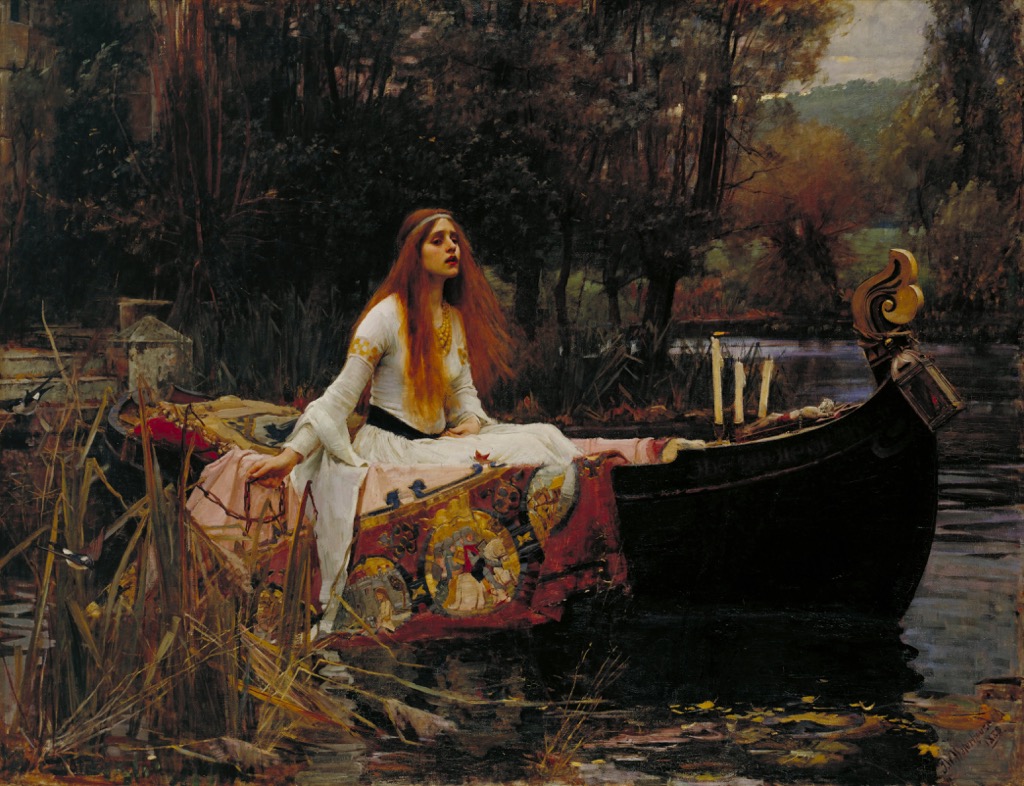
The face alone does not carry the drama. In The Lady of Shalott, the heroine’s hand, the chain, the loosening tapestry and the extinguished candles make departure visible. In Circe Offering the Cup to Ulysses, the cup advances towards the viewer while the wand and mirrored hero establish power. In Echo and Narcissus, bodies turned in incompatible directions reveal failed desire before a reader recalls Ovid.
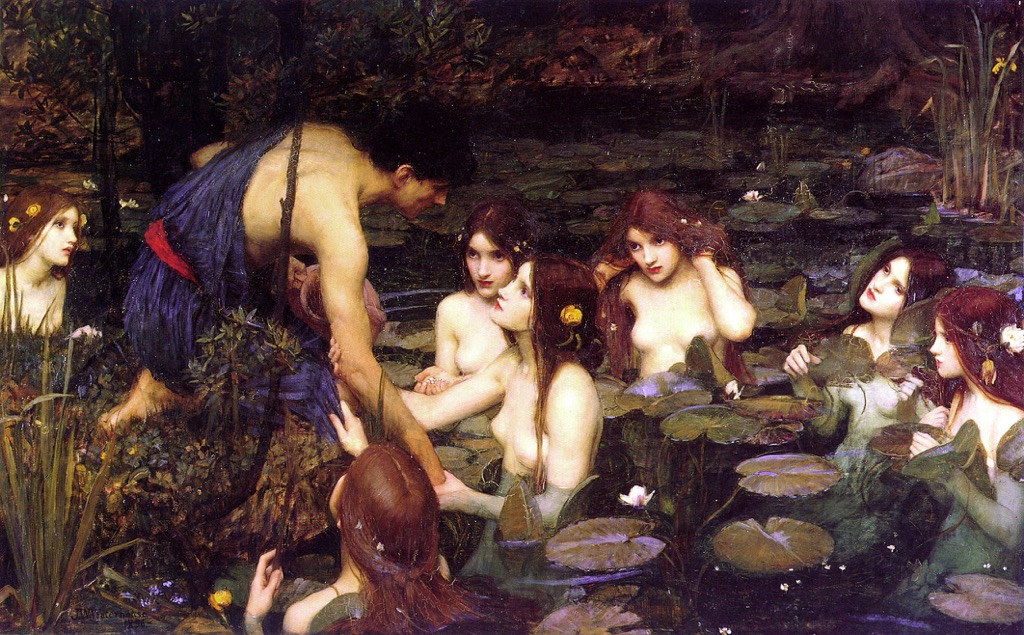
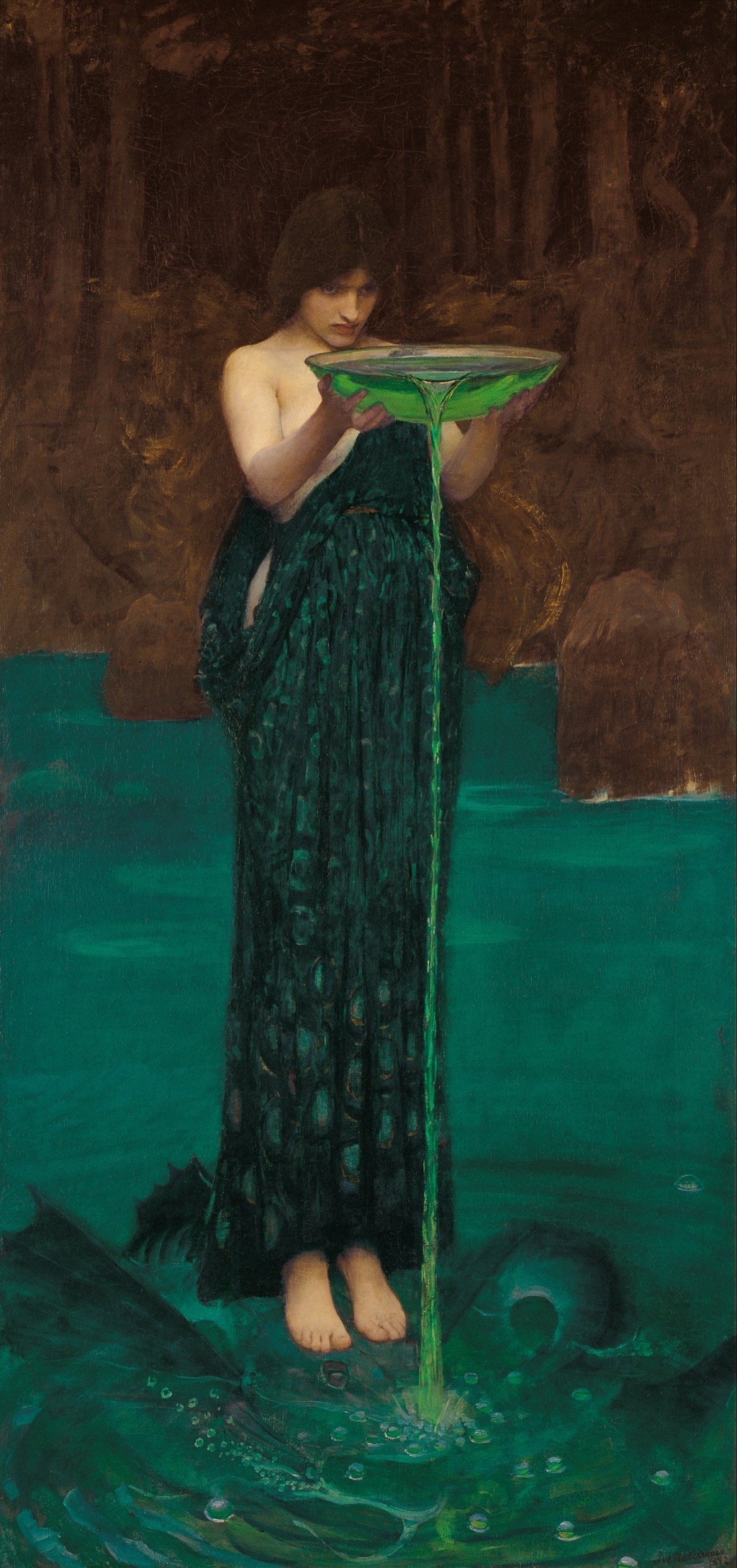
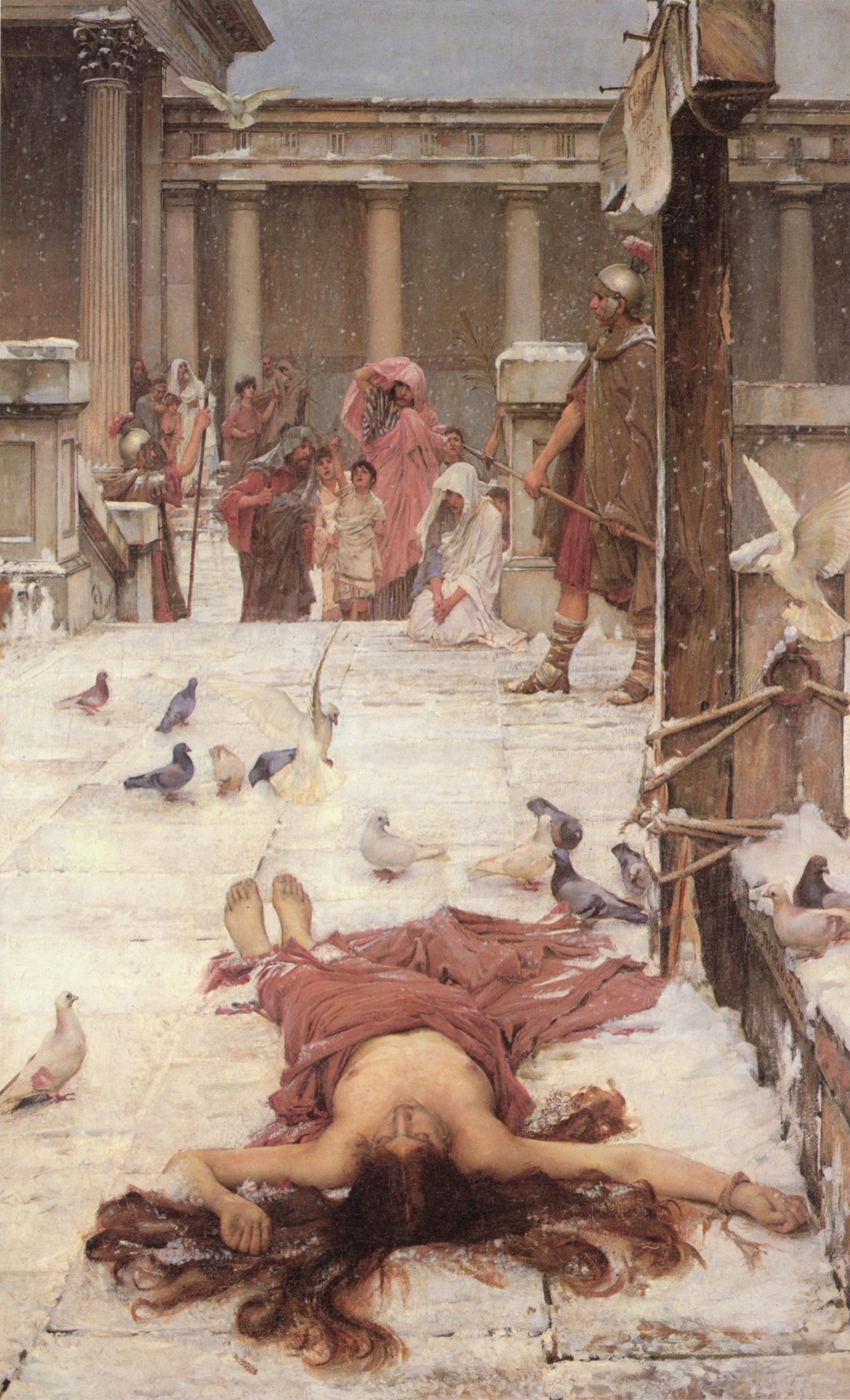
This bodily clarity belongs to Waterhouse’s academic formation. Yet the paintings do not usually resemble diagrams. Landscape and colour introduce sensations that a story summary cannot provide: the damp density of the Hylas pool, the cold open paving around Saint Eulalia, the poisoned aquamarine in Circe Invidiosa, the enclosed fragrance of The Soul of the Rose.
Waterhouse’s mature style also depends upon uneven emphasis. Faces, hands and decisive objects may be sharply resolved, while leaves, reflections, distant masonry and fabrics loosen into more visible strokes. The eye receives sufficient information to understand the action, then moves through areas whose paint remains active as paint.
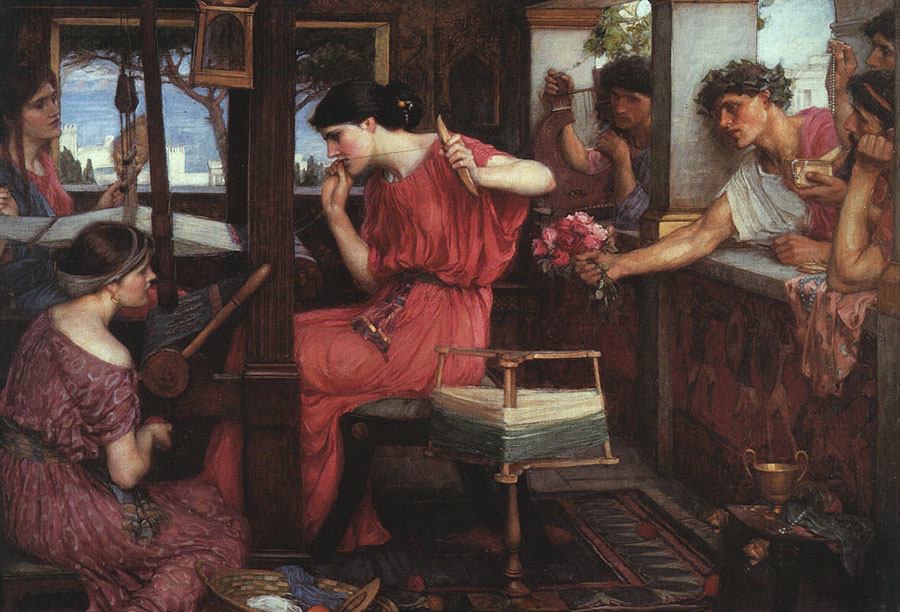
That variation distinguishes him from a common idea of Pre-Raphaelite technique as minute detail spread evenly across the entire surface. A contemporary response to The Lady of Shalott found something closer to French work in the light handling of willow, weeds and water. [6] Decades later, Aberdeen’s account of Penelope and the Suitors similarly calls attention to broad, loose brushwork associated with French influence. [8]
Recognition therefore comes from a combination rather than a single trademark: strongly constructed figures, literary or legendary tension, sensuous colour, objects that make thought physical, and a surface that moves between description and breadth. Red hair, beautiful women and medieval costume are frequent, but they are not enough. The deeper signature is the organisation of an irreversible or psychologically charged moment.
Royal Academy Training and the Body as Narrative
The National Portrait Gallery records that Waterhouse entered the Royal Academy Schools in 1871 as a sculpture student before turning decisively towards painting. [1] It would be speculative to explain every later contour through this beginning, but the sculptural emphasis of his figures is difficult to miss. Bodies have weight, direction and clear relation to the space around them.
Consider Saint Eulalia. The martyr’s body lies as a long diagonal across the foreground, seen from an unusually low position. Its placement determines the viewer’s relation to the empty paving, bystanders, snowfall and sky. Before miraculous meaning is identified, the composition is organised by a body that has fallen. [9]
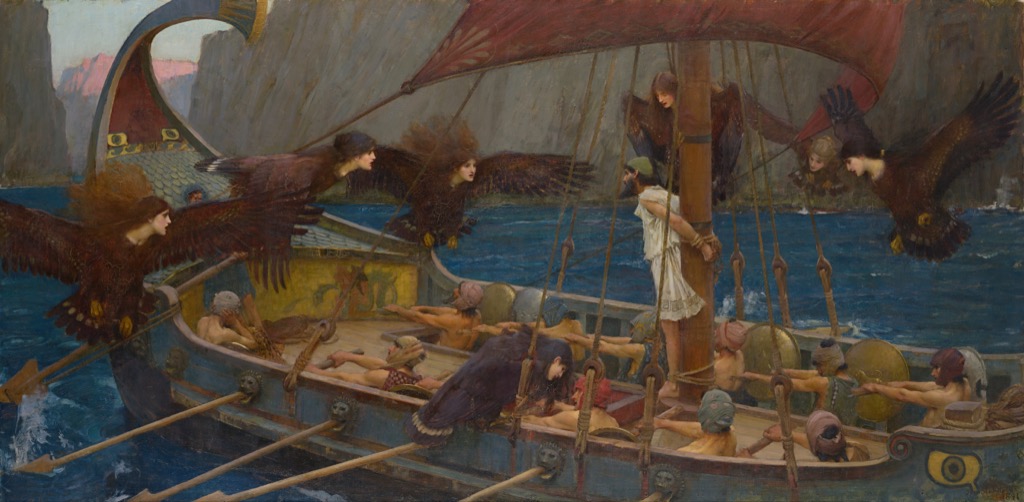
In Ulysses and the Sirens, the bound hero twists against the mast while sailors pull their oars and bird-bodied attackers close around the ship. The scene is crowded, but each pose belongs to an action: resisting, rowing, assaulting or calling. Herkomer praised the painting as “imaginative art,” yet its fantasy depends upon bodily mechanics. [5]
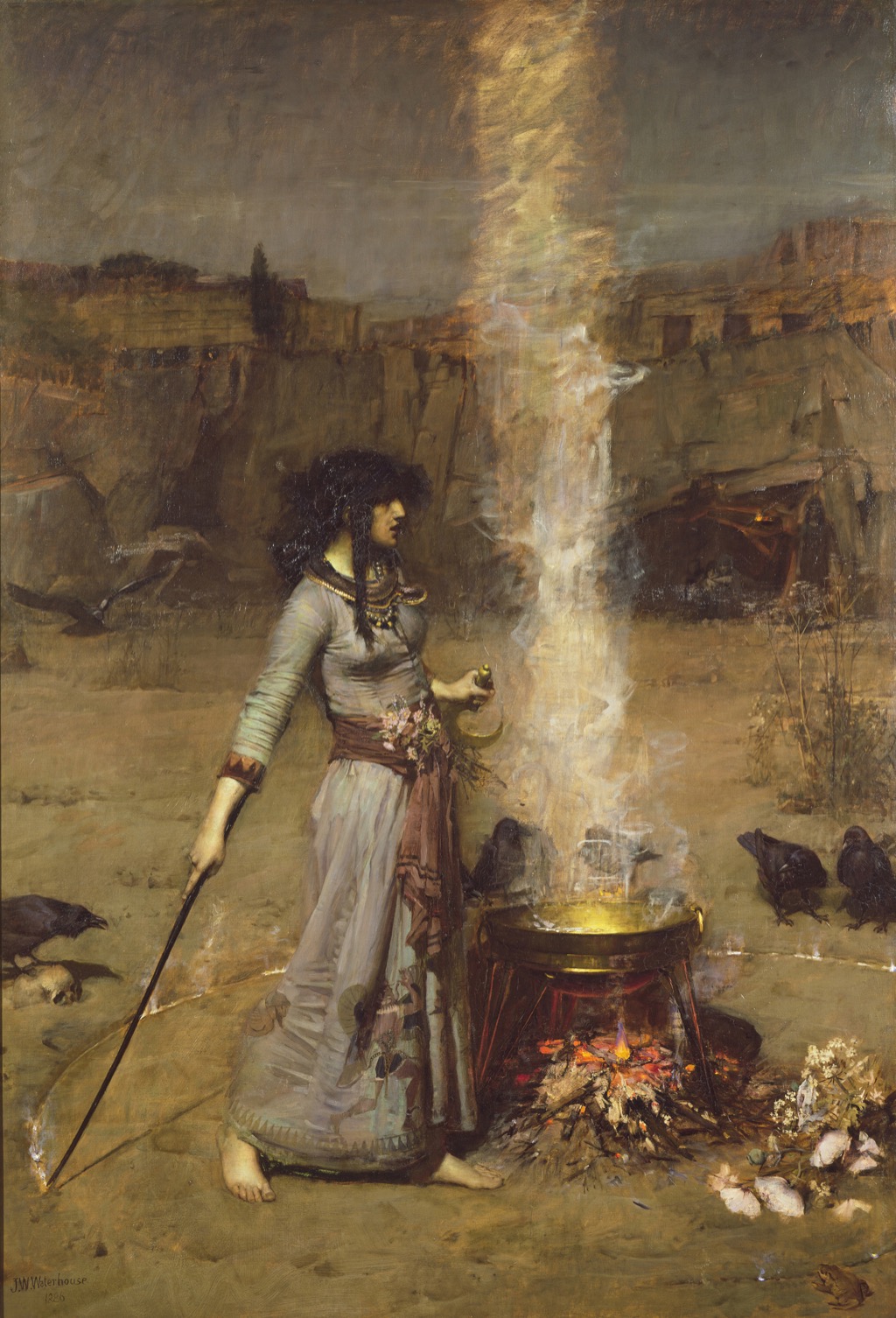
The solitary women are equally constructed. The Magic Circle is not merely a standing model surrounded by props. The sorceress leans into the line drawn by her wand, and the long vertical of her figure is stabilised by the circular boundary beneath her. [10] Circe Invidiosa holds a container high and pours downward, making jealousy a continuous action from arm through vessel to sea.
Waterhouse’s preparatory studies confirm that such poses were worked rather than improvised. A full-scale black-chalk drawing for Echo establishes the tension of her compressed body before drapery and landscape were added. Christie’s describes the sheet as the same scale as the figure in the finished Echo and Narcissus, an unusually large study within his surviving practice. [2]
The nude model in that drawing is not the mythological character in any simple sense. Anatomy and posture are first solved through observation; costume, flowers, landscape and relation to Narcissus then turn a studio body into Echo. Technique is therefore also a process of transformation. A sitter provides physical evidence, but composition gives her a literary identity.
Hands are especially important. They grip chains, gather thread, lift cups, touch flowers, hold combs, draw circles and shield faces. Waterhouse frequently sets the psychological centre of a painting at the point where hand meets object. The face can remain ambiguous because the gesture supplies the verb.
This helps explain why even his apparently passive women are not merely posed. The Lady of Shalott releases or has just released a chain. Psyche opens a box or approaches a forbidden space. Echo presses her fingers against rock while leaning towards someone who cannot hear her. Waterhouse constructs inward states through the distribution of bodily effort.
Choosing the Charged Moment
Waterhouse rarely tries to illustrate an entire poem or myth. He selects a moment in which knowledge, desire or danger changes direction. The choice determines every subsequent technical problem: how many figures are needed, what object identifies the action, which viewpoint gives the greatest pressure and how much of the outcome should remain unseen.
The 1888 Lady of Shalott begins after the mirror has cracked and before the boat reaches Camelot. Tennyson supplies the cause and consequence, but Waterhouse paints departure. The heroine, chain, boat, tapestry and three candles condense a long narrative into one physical arrangement. [11]
Hylas and the Nymphs takes a similarly unstable instant. Hylas is still above water, yet his bent posture and the nymph’s hand at his arm indicate that safety is already weakening. The repeated female heads transform the pool into a collective intelligence. Waterhouse needs no image of drowning because the composition makes the remaining distance visible.
With Circe, he changes the relation between moment and viewer. In Circe Offering the Cup to Ulysses, the enchantress pushes the instrument of transformation outward. In Circe Invidiosa, she pours poison into a sea whose future victim is absent. One picture confronts; the other anticipates. Vertical, frontal interior and cup give way to vertical shoreline, downward stream and poisoned water.
This ability to choose explains why related works are not repetitions. Waterhouse painted the Lady of Shalott in the boat, turning towards Lancelot in the loom, and still seated before the decisive transgression. He painted Ophelia in different states before death rather than copying Millais’s already floating figure. Each new composition asks where uncertainty is greatest.
The device is technical as much as literary. A selected instant determines the axes of the picture. The boat requires a broad horizontal field. Circe’s pour requires height. The Magic Circle requires a standing figure within a visible ground plane. Echo and Narcissus require lateral separation. Format becomes part of interpretation.
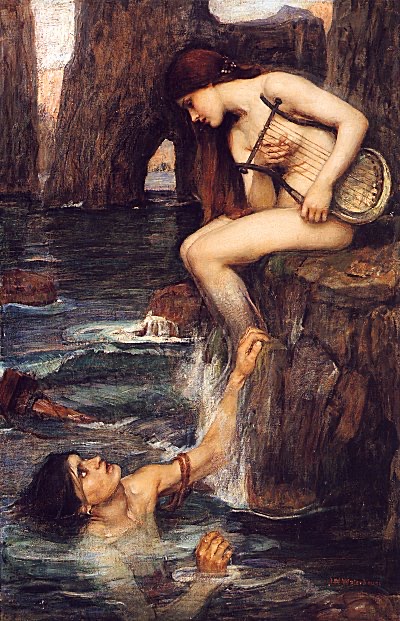
Waterhouse also uses omission as a compositional tool. Lancelot is absent from the 1888 Lady of Shalott; Scylla is absent from Circe Invidiosa; the sailor is absent from A Mermaid. The missing figure allows landscape, object and gesture to carry more emotional weight. It also prevents literary recognition from becoming a closed illustration.
The result can feel cinematic, but the paintings do not imitate a camera. They often combine information that a literal instant could not contain so neatly. In Echo and Narcissus, flowers associated with Narcissus’s eventual transformation already grow near him while Echo still has a body, joining different stages of Ovid’s narrative. Waterhouse designs a meaningful simultaneity rather than freezing ordinary time.
Drawing, Sketchbooks and Oil Studies
Waterhouse’s finished surfaces can hide the amount of preparation behind them. The 2008–2010 international retrospective brought paintings together with studies in pencil, chalk and oil, sketchbooks and volumes of poetry in which he had drawn. [7] This surviving material demonstrates a flexible, subject-led process rather than one fixed preparatory ritual.
Some drawings isolate a pose. The full-scale study for Echo tests the compression of back, shoulder, hip and folded legs. [2] A graphite study for the 1910 Ophelia works out the figure’s forward motion and relation to the bank. [12] Studies for Flora and the Zephyrs examine a standing flower-carrier, while the reverse of the sheet resembles a pose used years later, suggesting that figure ideas could remain available beyond one project. [4]
Other works are oil experiments close to finished compositions. The study for La Belle Dame sans Merci is painted on board and is unusually complete, almost an independent small version. [3] Its survival shows that reduction in scale did not necessarily mean a rough first thought. An oil study could test emotional relation, colour and full design together.
The mermaid material offers an extended sequence. A small signed oil sketch dated 1892 establishes the motif eight years before the final 1900 Diploma Work. A much larger study from about 1892–95 is close in scale and conception to the finished canvas but uses different cliffs and looser water. Drawings test the head and body. [13] The final simplicity emerged through long return.
Preparatory work could also begin in a book associated with the literary source. Sotheby’s records a sketch related to The Siren in Waterhouse’s copy of Shelley, initially with three mermaids rather than the final single supernatural woman and sailor. [14] Reading and designing were not separate stages. A page could become a space in which verbal imagery began to take bodily form.
These materials caution against two opposite myths. Waterhouse was not a mechanical academic who merely transferred a completely determined cartoon to canvas. Nor was he an inspired improviser who discovered every figure in paint without preparation. He drew, tested, revised, retained and sometimes transformed ideas over years.
The exact route varied. A full-size chalk study might solve anatomy; an oil sketch might test colour and atmosphere; a small book drawing might explore the number of figures; the canvas might then be repainted directly. “Preparation” is therefore not synonymous with a polished preliminary design. It is the distributed labour through which separate problems become one image.
Surviving studies also expose contingency. A pose can be reversed. A plain model can become a richly costumed heroine. Pink cliffs can become grey rock. Three mermaids can become one siren. Finished pictures look necessary because alternatives have been removed; studies let those discarded possibilities return.
Direct Painting and Repainting
The most valuable contemporary description of Waterhouse’s method concerns Ulysses and the Sirens. Defending its purchase for Melbourne in 1892, Hubert von Herkomer called the painting “direct and simple” and said that its parts were painted more or less at once. He immediately clarified that this did not mean Waterhouse achieved the result in one untouched attempt: a passage might be painted twenty times, but each attempt would be complete. [5]
This description deserves precision. “Direct” does not necessarily mean a whole large canvas completed wet in a single sitting. Herkomer describes a way of resolving passages through repeated complete restatement rather than a slow accumulation in which every area moves through identical stages. The account concerns one mature painting, but surviving studies and unfinished work make it relevant more broadly.
QAGOMA’s The Mystic Wood, left unfinished at Waterhouse’s death, offers rare visible evidence. The museum describes broad tonal washes of thinned paint and direct work on the canvas without a squared transfer drawing. Because the picture stopped before full resolution, early decisions remain exposed: forms emerge from masses rather than from an evenly completed surface. [15]
The unfinished canvas should not be treated as an exact cross-section of every finished work. Waterhouse could alter method with date, size and subject. It does, however, show that free, broad establishment was part of his late practice and that finish could be concentrated progressively rather than spread everywhere.
Oil studies reinforce this understanding. The large mermaid sketch uses loose strokes in water while focusing more sharply on face and hair. [13] The difference is not simply unfinished versus finished. It reveals a hierarchy. Identity and expression demand resolution first; atmosphere can remain mobile.
Repainting also explains why visible spontaneity need not equal haste. A decisive stroke may be the final version of a form attempted repeatedly. Herkomer’s testimony joins freshness to persistence: each restatement seeks completeness, yet the painter is willing to destroy or cover a previous solution.
This method can create edges that feel immediate. A forearm may be defined firmly against a dark ground while neighbouring foliage remains broken. Fabric may shift from precise pattern near a hand to broad colour lower in the composition. The surface records attention rather than an obligation to equal polish.
The evidence does not establish whether Waterhouse always worked from dark to light, used a particular commercial ground, or followed one drying schedule. Those questions require direct material examination. “Direct painting” is useful when anchored to Herkomer and the visible studies; it becomes misleading when expanded into an invented universal recipe.
Selective Finish: Where Detail Matters
Waterhouse’s pictures are often called detailed, and many contain closely observed flowers, textiles, jewellery and architectural objects. Yet detail is selective. It gathers where narrative clarity, bodily presence or sensory intensity requires it.
Faces and hands usually receive a high degree of control because they identify attention and action. The Lady of Shalott’s expression remains ambiguous, but the hand near the chain must be legible. Circe’s fingers must hold cup and wand convincingly. The Soul of the Rose depends upon hands meeting petals without crushing them.
Objects can be equally exact. A loom must explain the Lady’s confinement; an oar must establish the sailors’ exertion; a vessel must make Circe’s magic physical. Waterhouse does not paint these things as a collector’s inventory. Their detail has grammatical force: each turns a psychological condition into an action a viewer can read.
Elsewhere, broader passages prevent the image from hardening. Smarthistory contrasts the evident brushwork in the reeds of Waterhouse’s Lady of Shalott with the more exacting natural description in Millais’s Ophelia. [6] The comparison does not make one painting better observed than the other. It shows different uses of natural detail.
Waterhouse’s riverbank is dense but directional. Reeds, branches and reflections help contain and propel the boat. If every leaf demanded separate attention, the emotional hierarchy would weaken. Broader handling keeps the landscape atmospheric while allowing a few plants and objects to become sharp anchors.
Late paintings extend this contrast. Aberdeen describes Penelope and the Suitors as using a loose brushwork connected to French painting. [8] Faces, arms, loom and gifts remain readable within a surface that does not disguise every stroke. Waterhouse retains narrative complexity while relaxing uniform finish.
Pattern provides a revealing middle ground. A textile can look richly woven without every motif being completed at the same level. Waterhouse may establish the principal colours and repeated rhythm, sharpen folds near the figure, and let other sections merge into broader masses. The mind supplies continuity.
Selective finish is therefore not incompletion. It is an allocation of labour and attention. The painter decides what must be materially persuasive, what can remain atmospheric and where a visible stroke will add energy. The viewer’s eye follows that hierarchy, often without consciously noticing why.
Colour as Structure, Atmosphere and Event
The 1911 Encyclopædia Britannica called Waterhouse an able draughtsman and fine colourist, placing colour beside imaginative power as a defining achievement. [16] The judgement is useful because colour in his paintings is not merely decorative enrichment. It organises the story.
In Saint Eulalia, the whiteness of snow and dove enters a scene of bodily violence. In The Magic Circle, the warm earth, smoke and figure are contained by the drawn boundary while black birds hold the outer ground. In The Lady of Shalott, red, white and dark passages connect dress, tapestry, boat and autumn vegetation.
Circe Invidiosa makes colour an event. The vivid blue-green poison descends from the vessel and spreads through the sea, so transformation begins as a change in the environment before Scylla appears. The Art Gallery of South Australia calls attention to the work’s extraordinary aquamarine and emerald intensity. [17]
In Hylas and the Nymphs, pale bodies and faces emerge among dark water and green lily pads. Repetition makes attraction rhythmic. The pool appears both richly natural and uncannily inhabited. A limited range of flesh, green, white and shadow lets the nymphs seem to grow from the water without losing their individuality.
Waterhouse’s reds are especially effective because they can warm skin, hair, cloth or flowers while directing attention across large formats. The red-haired heroine has become a familiar Waterhouse type, but colour functions differently in each scene. Against green water it intensifies bodily presence; against rose and garden it joins figure to vegetation; against pale stone it isolates.
The paintings also use subdued areas to make saturated passages powerful. A bright garment needs brown, grey or green restraint around it. The colouristic effect is relational rather than a matter of placing jewel tones everywhere.
There are affinities here with later Pre-Raphaelite colour, but Waterhouse’s atmosphere can be softer and more broken. Contemporary critics noticed French qualities in his landscape handling, and Herkomer linked the direct method itself to French influence. [5] [6] QAGOMA compares the unfinished late manner with Jules Bastien-Lepage and the Newlyn School while still recognising its Pre-Raphaelite inheritance. [15]
Such comparisons describe visual and technical relationships, not a documented list of masters copied in the studio. Waterhouse could respond to currents circulating through exhibitions, criticism and colleagues without following one painter. His colour is best understood as a synthesis: academic control, Pre-Raphaelite intensity and modern breadth directed towards narrative mood.
Painting Water, Mirrors, Fabric and Flowers
Waterhouse repeatedly chose subjects that demanded difficult surfaces. Water reflects and conceals. Mirrors offer images within images. Fabric folds, shines and carries pattern. Flowers must be botanically credible enough to support a setting while also contributing rhythm and colour.
Water is the most important. In The Lady of Shalott, the river is a route. Its horizontal reflections extend the boat’s movement. In Hylas and the Nymphs, the pool is a vertical boundary between the mortal looking down and bodies emerging upward. In Echo and Narcissus, reflection traps desire in a surface that cannot answer.
The paint handling changes accordingly. Moving sea in Ulysses and the Sirens needs broken directional strokes and white accents. Dark pool water needs depth beneath reflected vegetation. A quiet river can join sky, foliage and boat through elongated horizontal colour. “Water” is not one technical effect because its narrative function changes.
Mirrors create another kind of surface. In Circe Offering the Cup to Ulysses, the large circular mirror places the hero behind the enthroned figure while simultaneously reflecting what lies before her. It makes the viewer occupy an unstable place near Ulysses. In the Lady of Shalott paintings, a mirror delivers an indirect world whose inadequacy drives the story.
Waterhouse generally makes reflection legible without allowing it to rival the primary figure. Mirrored people and landscapes are compressed, darkened or framed. The surface announces another space but remains an object inside the pictured room.
Textiles carry both history and emotion. Classical garments help establish antiquity; medievalising dresses remove a heroine from modern London; tapestry makes the Lady’s constrained art visible. Folds reveal weight and pose, while pattern slows broad passages of colour.
Flowers operate between observed nature and narrative association. Narcissi anticipate transformation; water lilies conceal the Hylas pool; roses become objects of scent and desire. Individual plants should not be assigned fixed symbolic meanings without evidence, but their location and treatment are never accidental to the composition.
These surfaces demonstrate Waterhouse’s central technical intelligence: material description is never separate from story. A mirror is painted to divide experience, water to conceal or transport, fabric to locate and bind, flowers to attract and foreshadow. Technique becomes meaning through function.
Early Style: Archaeology, Architecture and Public Narrative
Waterhouse’s early professional paintings of the 1870s and early 1880s often take place in the ancient Mediterranean world. Architecture, costume and objects establish historical distance. The scenes reflect Royal Academy history-painting ambitions even when they depict everyday or anecdotal episodes rather than heroic climax.
In Diogenes of 1882, the philosopher’s low tub, the stone steps and the richly dressed women create a social geometry. Surface and setting matter, but the picture’s intelligence lies in opposed forms of life: material display looks down upon chosen poverty. [18]
The Favourites of the Emperor Honorius uses a wide, carefully furnished interior. Coloured birds and the emperor’s absorbed attention contrast with waiting officials. Architectural depth and polished objects turn a historical anecdote into an image of political withdrawal. [19]
This early phase is sometimes treated as if Waterhouse were only imitating Lawrence Alma-Tadema. The comparison is understandable: both painted antiquity for a modern exhibition public. Yet Waterhouse’s developing interests in psychological separation, looking and bodily tension are already distinct.
The surfaces can appear more uniformly finished than in late work, but a simple transition from “tight” to “loose” would misrepresent the career. Broad handling appears in mature 1890s canvases, while precise detail continues late wherever the narrative needs it. Style changes by subject as well as date.
The early paintings also establish habits that survive every later label. Waterhouse stages figures against architecture, uses objects to make character visible and chooses moments in which attention reveals power. Honorius ignores ministers for birds; Narcissus later ignores Echo for his reflection. Historical genre and mythological tragedy share a compositional logic.
Mature Style: Enchantment, Landscape and Literary Pressure
From the mid-1880s, Waterhouse increasingly concentrates his scenes around supernatural action and literary heroines. Saint Eulalia, The Magic Circle and The Lady of Shalott are not identical in subject or handling, but together they demonstrate a shift away from crowded archaeological description towards singular emotional pressure.
Landscape becomes active. Snow interprets martyrdom; the circle divides magical space; river and autumn growth accompany the Lady’s doomed departure. Nature no longer serves mainly as period setting. It participates in the condition of the figure.
During the 1890s, classical sources remain central, but their treatment changes. Ulysses and the Sirens uses archaeological evidence for bird-bodied sirens while producing a violently immediate attack. [5] The Circe pictures isolate female magical action. Hylas and the Nymphs turns myth into a psychologically charged encounter at a recognisable pool.
The mature figures are frequently beautiful, but beauty is unstable. It may belong to a victim, enchantress, mourner or being whose role is unknown. Waterhouse uses physical appeal to delay moral judgement. The spectator feels attraction before resolving whether the figure acts, suffers or threatens.
Colour strengthens this suspension. Saturated hair, water, flowers and cloth draw the eye towards the very point where danger operates. Beauty does not disguise the narrative; it is one of its mechanisms.
Preparatory evidence from the decade shows sustained experiment. The mermaid motif evolves across eight years. La Belle Dame sans Merci survives in a highly developed oil study. [3] [13] Sketches for The Siren change the number and relationship of figures. [14] Waterhouse’s mature fluency rests upon design carried through multiple forms.
The mature style is therefore not a rejection of academic training. It is the point at which figure construction and public composition become sufficiently secure to support greater atmospheric and literary ambiguity. The stories grow stranger while the bodies remain credible.
Late Style: Broader Handling and Recurrent Motifs
Waterhouse’s later paintings revisit weaving, gardens, flowers, music and mythic women with increasing freedom of handling. A work such as Penelope and the Suitors remains crowded and narrative, yet Aberdeen emphasises its broad, loose brushwork. [8] Late style is not withdrawal from storytelling; it is a redistribution of finish.
The flower-women of the years around 1908 often reduce external incident. A woman gathers roses, smells a bloom or stands within an enclosed garden. Gesture, colour and atmosphere replace climactic plot. In The Soul of the Rose, hands and profile are precise while distant architecture softens.
The unfinished Mystic Wood makes this breadth especially visible. QAGOMA describes direct work, thinned tonal washes and an absence of squared transfer. [15] Figures and woodland emerge together from an active surface. Because the canvas is unfinished, it reveals both the energy of establishment and the further resolution a completed work might have received.
Late return subjects complicate any narrative of decline. Penelope and the Suitors transforms Homer into a crowded opposition of making and pressure. The 1915 “I am half sick of shadows,” said the Lady of Shalott returns to Tennyson before the heroine’s fatal look. Waterhouse is not repeating old successes; he is revisiting the structure of mediated experience from another point in the poem. [20]
The late paintings can appear more dreamlike because background and costume merge through broader colour. Yet faces, hands and significant objects remain anchors. The core hierarchy survives: resolve what carries identity and action, allow atmosphere to breathe around it.
Illness and incomplete works warn against treating every late looseness as deliberate stylistic liberation. An unfinished surface may record interruption as well as intention. The best evidence comes from comparing completed canvases, studies and The Mystic Wood rather than assuming that visible brushwork always has one cause.
Academic, Pre-Raphaelite, Symbolist and Modern
No single label contains Waterhouse because each names a different aspect of his art. “Academic” describes training, professional institutions, figure construction and the scale of major exhibition works. It should not be used as a synonym for rigid or unimaginative.
“Pre-Raphaelite” describes a powerful inheritance: literary subjects, saturated colour, attention to natural and material detail, medieval revival and psychologically charged beauty. Waterhouse was born in 1849, after the Brotherhood formed, and was never a member of its original circle. He belongs to its later history rather than its founding event.
His technique also differs from the earliest Pre-Raphaelite ideal of intense, equal clarity. Contemporary critics already noticed French qualities in The Lady of Shalott, and Herkomer praised direct repainting in Ulysses and the Sirens. [5] [6] Later work makes the combination of precision and breadth increasingly visible.
“Symbolist” helps explain the mature concentration on mirrors, magic, transformation, desire and dreamlike isolation. The international retrospective presented Waterhouse as a modern Pre-Raphaelite while situating him within broader European currents. [7] Yet he rarely abandons bodily credibility and narrative source for completely private symbolism.
“Classicist” remains necessary because Homer, Ovid and ancient history persist across his career. But his classicism is not only archaeological reconstruction. A Greek vase may guide the anatomy of the sirens; the finished painting then uses that authority to stage modern fears and desires. [5]
“Modern” is most useful when it identifies synthesis rather than avant-garde allegiance. Waterhouse makes inherited stories speak through selective finish, direct handling and psychological ambiguity. He did not need to abandon the Academy or the human figure to change the way narrative painting operated.
The labels are therefore best treated as lenses. Academic structure, Pre-Raphaelite colour, classical learning, Symbolist atmosphere and French-influenced breadth can coexist within one canvas. The particular balance shifts from work to work.
What the Material Evidence Does Not Yet Tell Us
Readers often want a list of Waterhouse’s pigments, brushes, mediums and layer sequence. The published sources used here do not support a reliable career-wide list. Collection pages usually identify oil on canvas, dimensions and provenance; they do not necessarily publish sample analysis, cross-sections or imaging.
Tate’s archive catalogue records conservation-science documentation concerning The Lady of Shalott, but the online entry does not provide the findings themselves. [21] The existence of a technical file cannot be converted into claims about what it contains.
Auction condition reports can describe lining, varnish, craquelure and retouching for a particular object. Sotheby’s report for The Siren, for example, records an unlined canvas on its original keyed stretcher, discoloured varnish and minimal retouching at the time of sale. [14] Those observations belong to that painting’s condition, not automatically to Waterhouse’s entire practice.
Likewise, visible colour does not identify a pigment. A blue-green sea might contain several materials, mixtures and later varnish effects. A red garment cannot safely be assigned vermilion, madder or another colourant by eye alone. Naming pigments without analysis would replace technical history with guesswork.
Underdrawing presents the same problem. Surviving preparatory drawings prove that Waterhouse designed figures on paper. The Mystic Wood suggests that at least one late canvas was developed without squared transfer. [15] Neither fact establishes the transfer method used for every large finished composition.
The right response is not to abandon technical discussion. It is to match each claim to its evidence. Herkomer supports direct repeated painting in 1891. Studies support prior design and revision. The unfinished canvas supports broad tonal establishment late in life. Visible surfaces support observations about edge, focus and brushwork. Scientific claims await published scientific evidence.
This discipline improves interpretation. It prevents a seductive invented recipe from obscuring what Waterhouse’s actual objects reveal: technique was adaptable, attention was selective, and preparation could coexist with fresh restatement.
How to Look Closely at a Waterhouse Painting
Begin with the action rather than the costume. Identify what the body is doing and which object completes the gesture. A hand near a chain, loom, cup, flower or comb often reveals more than facial expression.
Next, find the boundary. It may be the edge of a pool, the side of a boat, a mirror frame, a doorway, a wall or a circle drawn on the ground. Ask who remains inside, who crosses and what changes at that line.
Then compare levels of finish. Move from face and hands to fabric, plants, water and distance. Notice where contours sharpen and where strokes remain visible. The change is likely to guide attention as deliberately as colour or composition.
Follow one hue through the canvas. Red may travel from hair to cloth to flower; blue-green may link poison, water and shadow; pale tones may join skin, snow, lilies or pearls. Colour relationships construct unity and unease.
Finally, separate observation from explanation. “The reflected figure is smaller and darker” is visible. “The mirror symbolises the unconscious” is an interpretation requiring argument. Waterhouse rewards both looking and interpretation, but they should not be confused.
Comparisons are especially revealing. Set Ulysses and the Sirens beside A Mermaid to see crowd against solitude, bird-body against fish-tail and violent action against reverie. Compare the three Shalott compositions to see how format and object change with the chosen verse. Compare early Honorius with late Penelope to see how a crowded interior can move from polished archaeological distance to broader psychological pressure.
The goal is not to reverse-engineer a painting into a set of rules. It is to see how Waterhouse’s decisions cooperate. Pose, format, colour, edge, object and source converge so completely that technique becomes narrative.
Related Pages
- Biography: Place technique and style within Waterhouse's career.
- Paintings: Browse the paintings that carry the visual patterns discussed here.
- The Magic Circle: Compare the style guide with a close reading of a key Tate painting.
Frequently Asked Questions
His major paintings are predominantly oils on canvas. Preparatory works survive in graphite, black chalk and oil on paper, board, panel or canvas. The medium varies with the problem being explored. [2] [3] [4] [13]
Yes, although no single preparatory sequence applies to every work. Surviving sketchbooks, figure drawings, full-scale studies and oil sketches show him testing pose, anatomy, composition, colour and setting. [2] [3] [4] [7]
Contemporary testimony says that Ulysses and the Sirens was painted in a direct manner, with a passage potentially restated many times as a complete unit. [5] QAGOMA also identifies direct work and broad tonal washes in the unfinished Mystic Wood. [15] This does not prove identical handling for every canvas.
Partly, but not exclusively. He inherited literary subjects, strong colour and close engagement with natural and material detail. His selective finish and broader brushwork differ from the uniform precision associated with the earliest Brotherhood and were linked by contemporaries to French painting. [5] [6]
“Alla prima” is sometimes used for direct wet-into-wet painting, but it can misleadingly imply a whole work completed in one session. Herkomer instead describes repeated complete repainting of passages. [5] “Direct method” is the more accurate public term unless a specific canvas has stronger technical evidence.
A responsible general list cannot be given from the published sources consulted here. Visible hues do not securely identify chemical pigments, and collection records do not consistently publish analysis. Pigment claims should be tied to a named technical examination of an individual painting.
Waterhouse concentrated definition where identity and action required it—often faces, hands and important objects—and allowed foliage, water, fabric or distance to remain broader. Selective finish directs attention and creates atmosphere.
No general claim is made here. The surviving evidence clearly includes live-model studies, drawings, sketchbooks and oil sketches. A photographic source for any specific painting would need its own documentary proof.
Early paintings often give more space to classical architecture and historical setting. Mature works concentrate on literary or mythic thresholds with increasingly expressive landscape and colour. Late paintings frequently use broader handling and quieter recurrent motifs, while retaining firm figure construction and narrative objects.
They allow Waterhouse to divide seeing from knowing. Water can reflect, conceal, transport or threaten; mirrors can mediate experience, duplicate a space or place an absent figure within the scene. Their meaning changes with the source and composition.
Discussion
Waterhouse’s popularity has made his visual appearance easy to imitate superficially: an auburn-haired woman, antique or medieval dress, flowers, water and saturated colour. Yet those ingredients do not explain why the strongest paintings hold attention.
His deeper style is a way of thinking through narrative. He finds the moment when a choice remains open but its consequence has begun. He gives that moment a bodily action. He chooses an object that makes the action readable, a boundary that gives it danger and a colour structure that makes it felt.
Reader Insights
Which visible detail most changes the way you read this page?
Which source or comparison helps the work feel less familiar and more specific?
What question would you bring back to the painting after reading?
Join the Conversation
Share your reading of this page below.
References
- Main image: John William Waterhouse, The Magic Circle, 1886, Tate, public-domain photographic reproduction via Wikimedia Commons.
- National Portrait Gallery. “John William Waterhouse (1849–1917), Figure painter,” Later Victorian Portraits Catalogue: Royal Academy Schools, exhibiting career and institutional chronology. View source
- Christie’s. “John William Waterhouse, R.A., Study for the figure of Echo in Echo and Narcissus,” black chalk on blue-grey paper, full-scale preparatory study. View source
- Christie’s. “John William Waterhouse, R.A., A Study for ‘La Belle Dame sans Merci’,” oil on board laid on panel, provenance and catalogue note. View source
- Christie’s. “John William Waterhouse, R.A., Studies for Flora and the Zephyrs (recto and verso),” drawing record and relation to later figure designs. View source
- Michelle Bonollo / National Gallery of Victoria. “J. W. Waterhouse’s Ulysses and the Sirens: breaking tradition and revealing fears,” including Hubert von Herkomer’s 1892 account of Waterhouse’s direct method and French influence. View source
- Chloë Portugeis / Smarthistory. “John William Waterhouse, The Lady of Shalott,” analysis of composition, Pre-Raphaelite inheritance and contemporary comparison with French handling. View source
- Royal Academy of Arts. “J. W. Waterhouse: The Modern Pre-Raphaelite,” 2009 exhibition account, archived by The Victorian Web, describing the paintings, studies, sketchbooks and annotated books brought together for the retrospective. View source
- Aberdeen Archives, Gallery & Museums. “Penelope and the Suitors,” collection record and commentary on the painting’s subject and late handling. View source
- Tate. “Saint Eulalia,” collection record and display text, 1885, oil on canvas. View source
- Tate. “The Magic Circle,” collection record and display text, 1886, oil on canvas. View source
- Tate. “The Lady of Shalott,” collection record and display text, 1888, oil on canvas. View source
- Paul Crowther / The Victorian Web. “Study for ‘Ophelia’ by John William Waterhouse,” graphite study connected with the 1910 painting. View source
- Christie’s. “John William Waterhouse, R.A., Sketch for ‘A Mermaid’,” oil-study record, long development of the subject and discussion of the painted surface. View source
- Sotheby’s. “John William Waterhouse, R.A., R.I., The Siren,” object record, catalogue note and condition report. View source
- David Burnett / Queensland Art Gallery | Gallery of Modern Art. “John William Waterhouse, The Mystic Wood, c.1910,” account of the unfinished canvas, direct work, tonal washes and French naturalist affinities. View source
- Encyclopædia Britannica. “Waterhouse, John William,” 11th ed., 1911, contemporary assessment of drawing, colour and imaginative style. View source
- Art Gallery of South Australia. “Circe Invidiosa,” collection record and curatorial interpretation, 1892, oil on canvas. View source
- Art Gallery of New South Wales. “Diogenes,” collection record, 1882, oil on canvas. View source
- Art Gallery of South Australia. “The Favourites of the Emperor Honorius,” collection record, c.1883, oil on canvas. View source
- Art Gallery of Ontario. “‘I am half sick of shadows,’ said The Lady of Shalott,” collection record, 1915, oil on canvas. View source
- Tate Archive. “Conservation science materials and analysis documentation concerning N01543,” 1993 archive catalogue record. View source