

 Buy Art Prints Now
from Amazon
* As an Amazon Associate I earn from qualifying purchases.
Image reference [image]
 by Tom Gurney
Tom Gurney BSc (Hons) is an art history expert with over 20 years experience
Published on August 14, 2026 / Updated on August 14, 2026
Email: tomgurney1@gmail.com / Phone: +44 7429 011000
The Charmer: Introduction
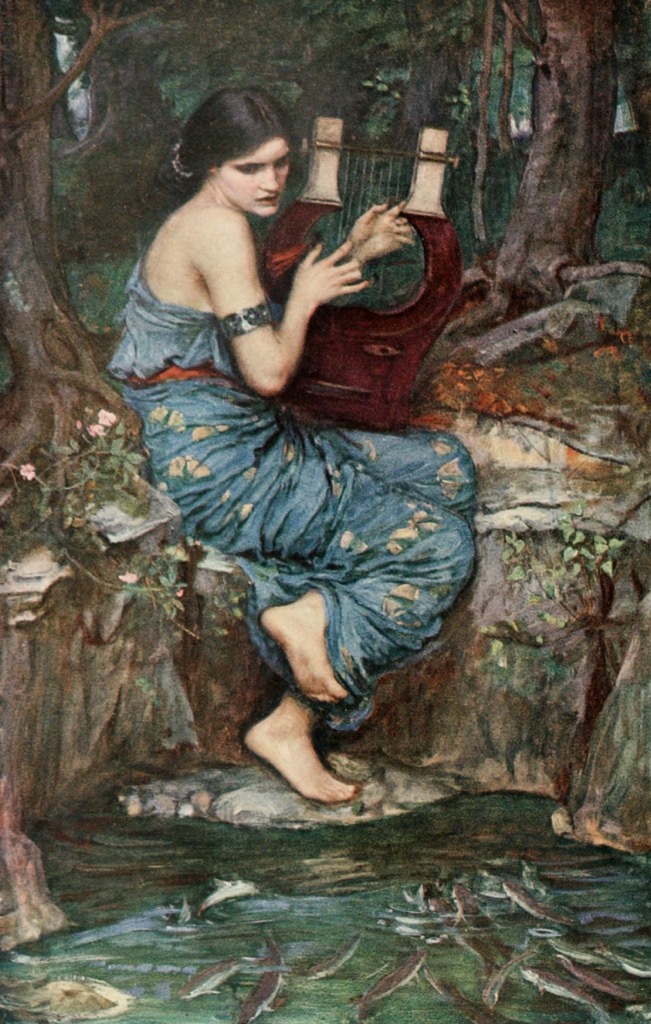
John William Waterhouse's The Charmer shows music crossing the boundary between human and natural worlds. A young woman sits barefoot on rocks at the edge of a dark pool, playing a small stringed instrument while fish gather or break the surface below. No literary text identifies her, no listener shares the bank, and no explicit spell is visible. The title makes the musical effect magical.
Exhibited at the Royal Academy in 1911, the painting belongs to Waterhouse's late Symbolist mode rather than to direct illustration of Homer, Ovid, Shakespeare or Tennyson. Its uncertainty is deliberate in effect. The woman may be a nymph, musician, enchantress or unnamed Arcadian figure; the fish may be charmed, curious or simply arranged as the visible answer to sound. Waterhouse makes an invisible force legible through attention and water. [1] [2] [3]
At a Glance
- ArtistJohn William Waterhouse
- Date1911 [1]
- MediumOil on canvas [1]
- Dimensions96.5 × 61 cm [1]
- First exhibitionRoyal Academy, 1911, no. 111 [1]
- Later 1911 exhibitionLiverpool Autumn Exhibition, no. 1004 [1]
- Original buyerMajor the Hon. Alec P. Henderson [1]
- SubjectA barefoot woman playing music beside a pool while fish respond
- Literary sourceNo specific primary text is securely identified in the principal catalogue record [1]
- Related 1911 workListening to My Sweet Pipings, another treatment of music's power [1]
Contents
- Introduction
- What The Charmer shows
- What “charmer” means
- Music made visible
- Woman, instrument and pool
- Fish as listeners
- A recurring waterside figure
- Symbolism without a fixed myth
- Royal Academy 1911
- Henderson patronage and provenance
What The Charmer shows
A solitary woman sits on a rocky bank above or beside a pool. She wears a light blue, violet or silvery drapery and is barefoot. Her head bends towards a small stringed instrument held close to the body.
Below her, fish are visible in or at the surface of the water. Their placement transforms them from background natural detail into audience. The woman's lowered gaze may include them, the instrument or both.
Trees, foliage and dark water enclose the encounter. There is no architecture to specify ancient Greece, medieval legend or a contemporary garden. Historical dress and instrument remove the scene from modern daily life while leaving its narrative identity open.
The vertical canvas places the musician above the fish. Sound appears to travel downward, while the viewer's eye follows from hands and strings to ripples and bodies in water. This axis gives invisible music a spatial direction.
No human companion witnesses the performance. The absence makes the fish's response essential. Without them, the scene could be a private practice session or reverie. With them, the title's promise of charm acquires visual evidence.
The work is not a snake-charmer scene, despite the familiar phrase. Its enchantment joins string music with aquatic life, so the fish and instrument are central to its subject.
What “charmer” means
To charm can mean to delight, attract, soothe or influence through magic. Waterhouse allows all four senses to operate.
The musician is charming in the ordinary aesthetic sense: beautiful, absorbed and harmoniously placed in nature. She may also charm the fish, using music as an active force. The title does not say whether the effect is supernatural or simply poetic.
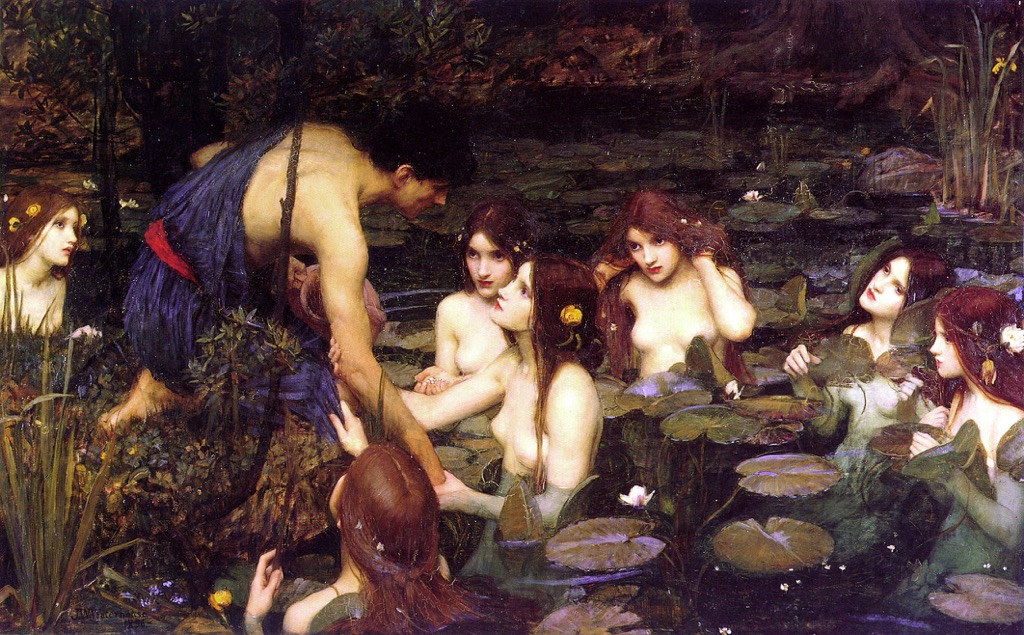
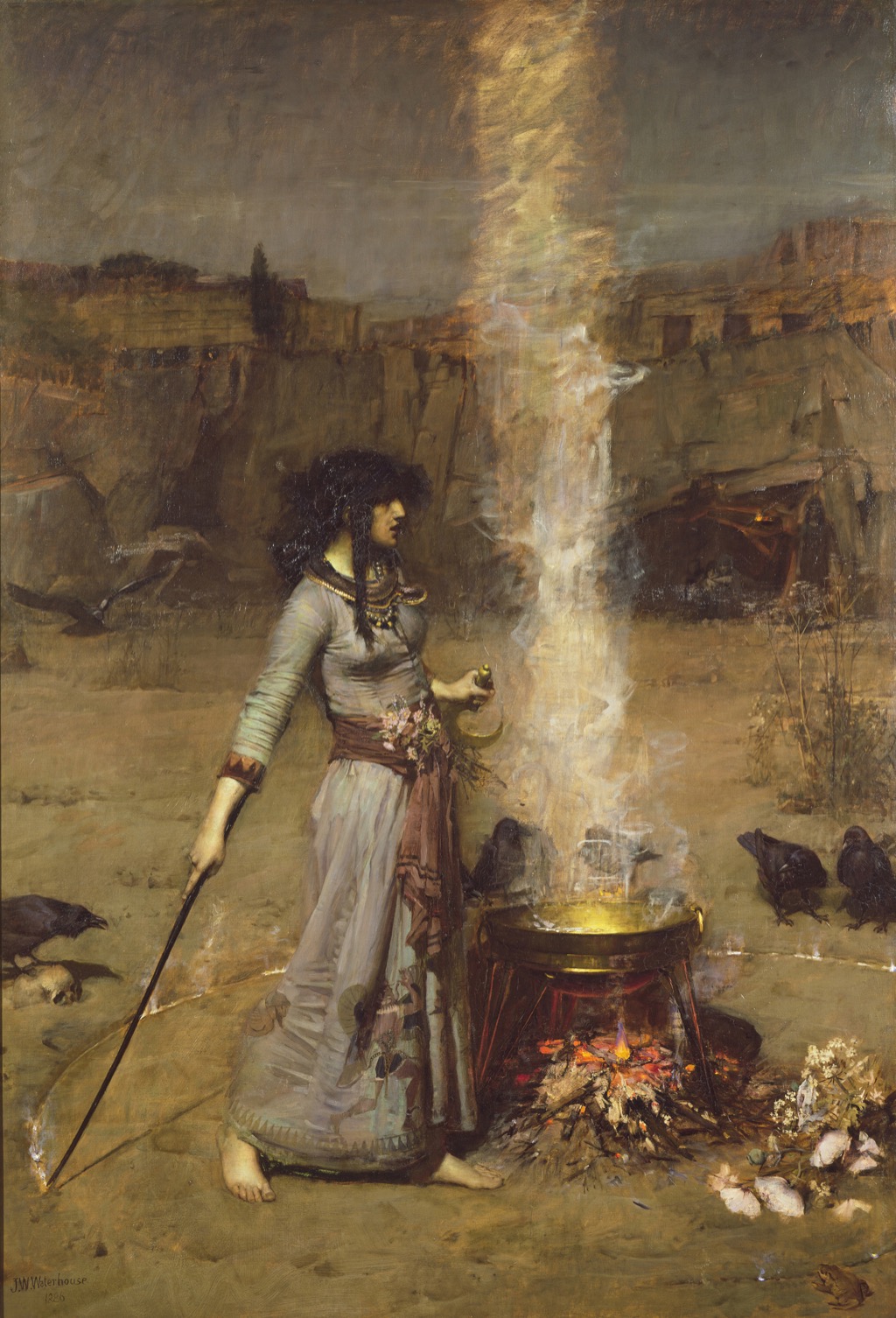
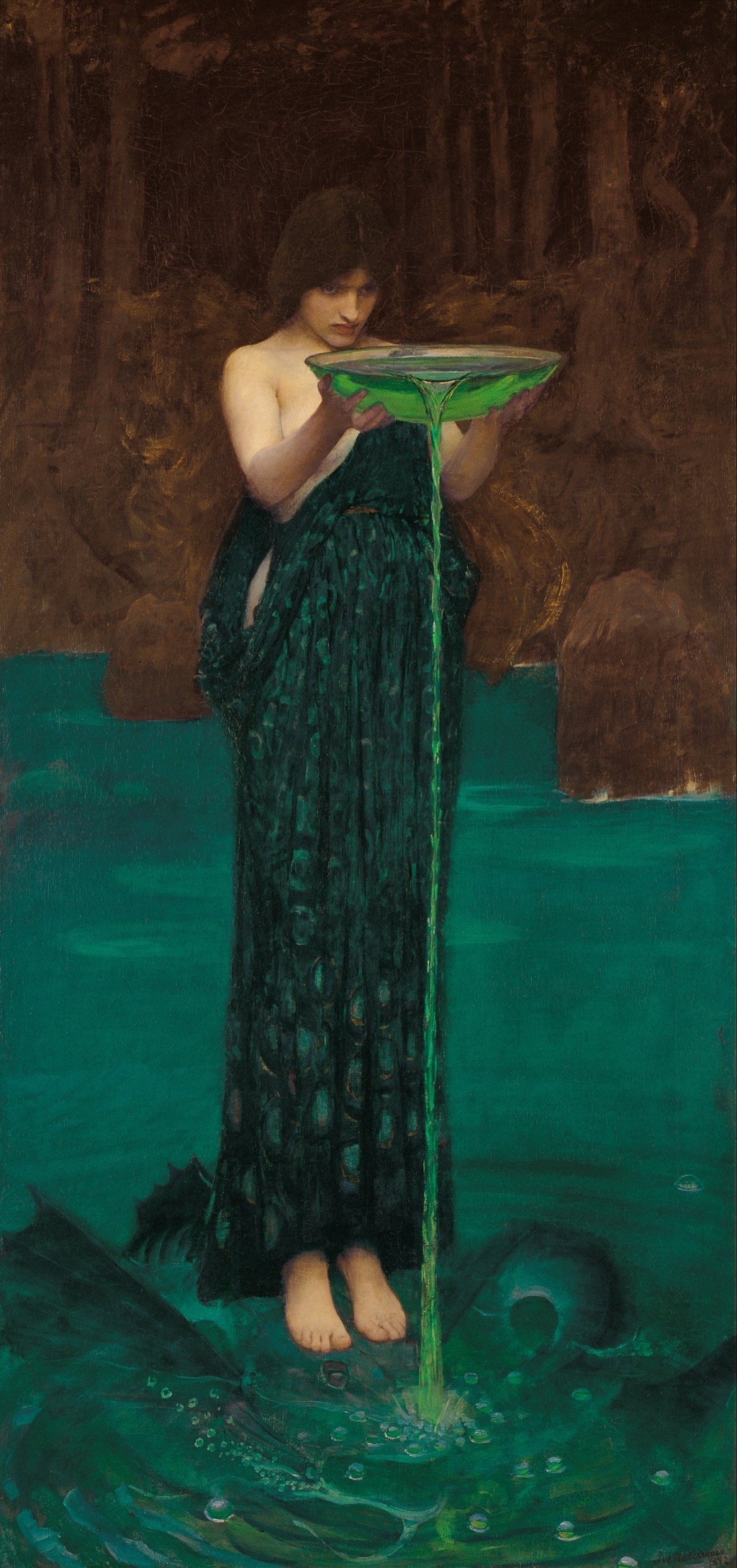
“Charmer” can name the performer or describe her social power. Unlike Circe, she has no cup, wand or poison. Unlike the nymphs around Hylas, she belongs to one body rather than a collective lure. Her only instrument of influence is music.
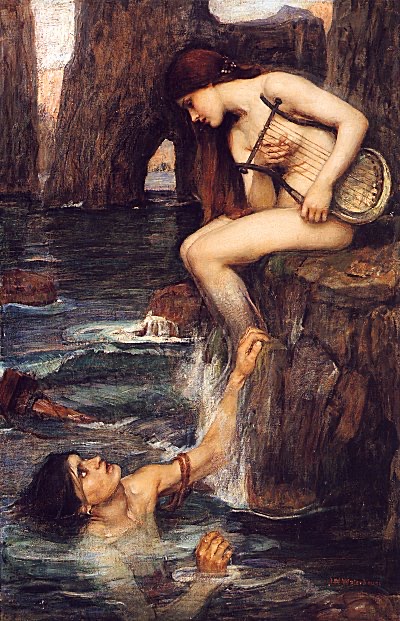
The word carries ethical ambiguity. Enchantment can be pleasure freely received or control that bypasses choice. Fish gathering to sound look harmless, yet Waterhouse's wider work repeatedly connects attraction with danger. A siren's song, Lamia's beauty and a nymph's gaze all complicate the boundary between invitation and capture.
Here no harm follows within the frame. The charmed creatures remain in their element; the woman does not seize them. The title can therefore support a gentler idea of music bringing species into relation.
The lack of explicit myth distinguishes “charmer” from a named identity. One should not promote Brizo, Circe, a Siren or Orpheus into the title without source evidence. These figures may offer comparisons, not identification.
Music made visible
Painting cannot reproduce sound. Waterhouse must show its cause and response: fingers at strings, attentive posture, water disturbed and fish gathering.
The compact instrument concentrates movement in the woman's hands. Its small size suits an intimate performance rather than public ceremony. Whether classified precisely as lyre, zither or another ancient-style stringed instrument requires organological study; “small stringed instrument” is the safest description.
Her bent head suggests listening as well as playing. A musician monitors tone through her own body. The title may call her a charmer, but she is also inside the sound she produces.
The fish provide the rhythm's visible consequence. Different orientations and surface breaks can be read like notes or beats below the more stable seated figure. Water turns vibration into ripple.
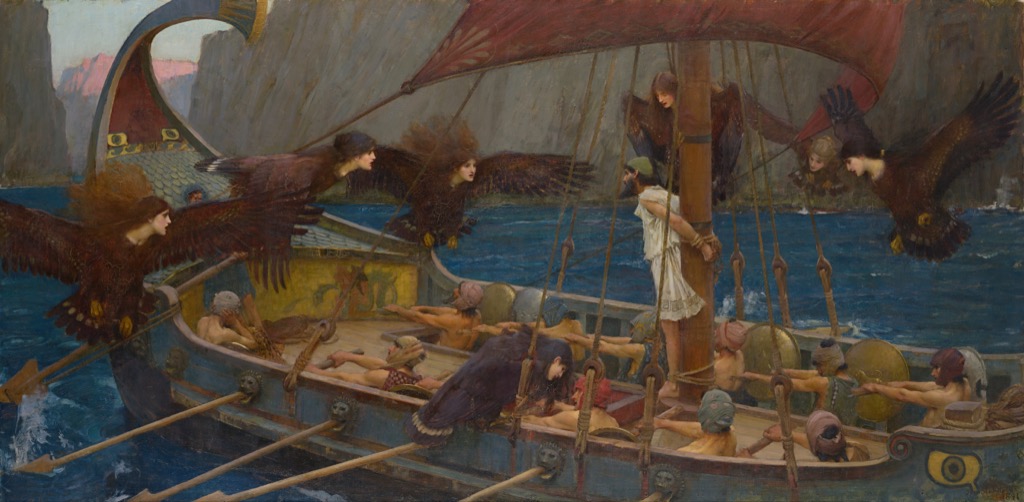
Waterhouse had already painted musical danger in Ulysses and the Sirens. There the song is unheard by the viewer but represented through attacking bodies, open mouths and Ulysses bound to the mast. The Charmer removes struggle and makes listening voluntary in appearance.
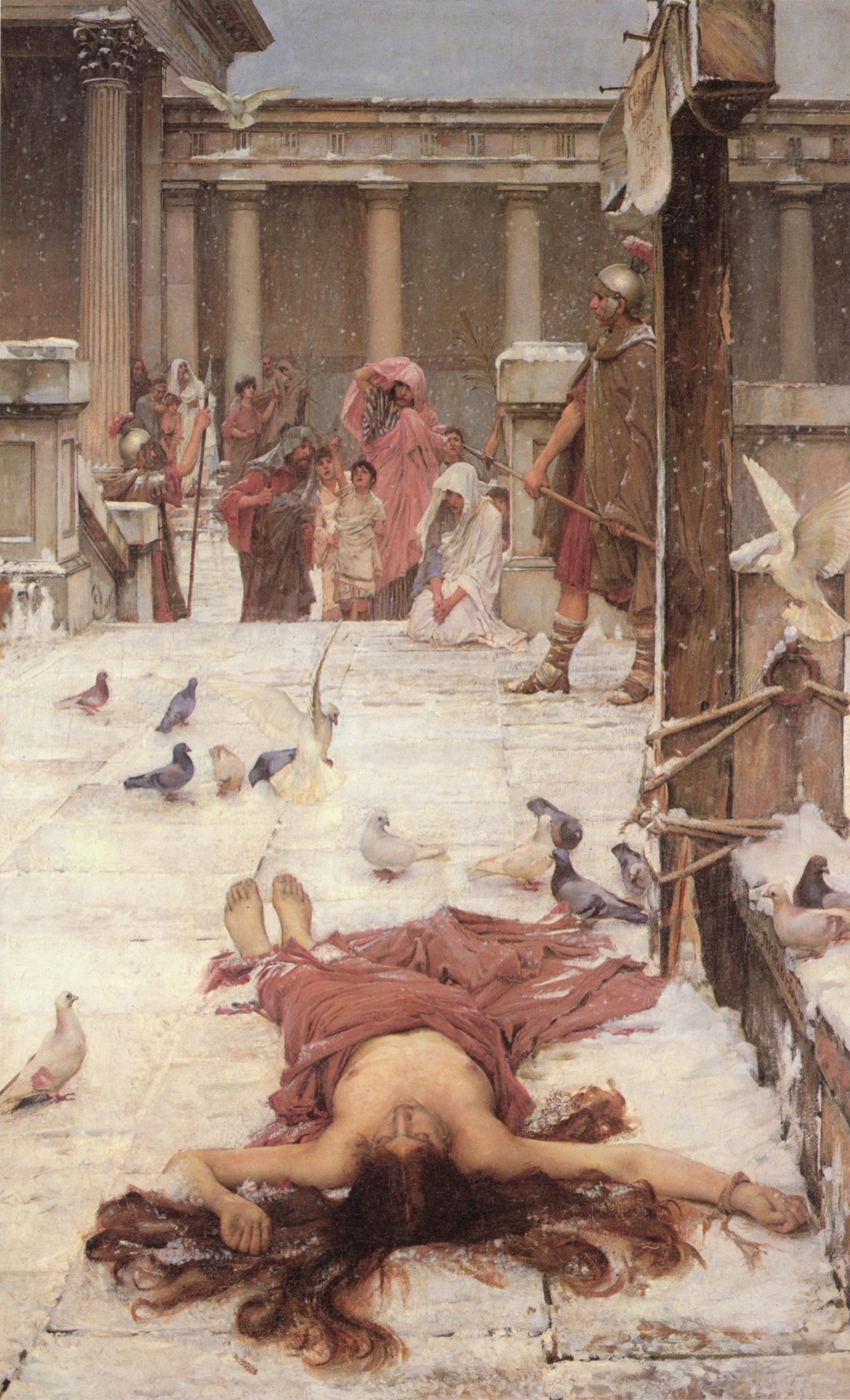
Saint Cecilia offers another contrast. The saint sleeps beside instruments while angels embody celestial music. In The Charmer, the woman is awake and actively performs; the listeners are animals; the setting is natural rather than architectural.
Music in Waterhouse therefore does not possess one fixed meaning. It can threaten, sanctify, awaken inward vision or create cross-species attention. The present painting is his most stripped-back version of musical influence.
Woman, instrument and pool
The seated pose secures the woman against the unstable visual field of water. Rock supports her; drapery softens the contact; bare feet join the body directly to the setting.
Her clothing is light enough to echo water and air but substantial enough to prevent the figure becoming a classical nude. Waterhouse's late figures often occupy the boundary between historical costume and loosely draped body. The result is timelessness rather than accurate reconstruction.
The downward turn protects the woman's inwardness. She does not perform for the exhibition spectator. We watch an action addressed towards the pool.
This creates an unusual reversal of the male gaze often discussed in Waterhouse. The beautiful woman is visible to us, but her influence is directed elsewhere. Fish rather than human viewers occupy the position of acknowledged audience.
The pool is dark enough to conceal and reveal selectively. Fish emerge as bodies or flashes at the surface, suggesting a larger unseen population below. Enchantment draws hidden life into visibility.
Waterhouse frequently uses water as a threshold between worlds. Hylas is lured beneath it; Narcissus mistakes a reflection; nymphs find Orpheus's head in it; Circe poisons the sea. The Charmer turns that threshold acoustic: sound passes where the woman cannot.
The scene's beauty should not be described as “innocent” without qualification. It is peaceful, but the title retains power. The musician controls attention through an effect unavailable to the viewer's ears.
Fish as listeners
Fish have no facial expressions easily legible to a human viewer. Waterhouse therefore represents attention through position. They approach the musician's side of the pool and rise towards the sound.
The image participates in traditions of miraculous or legendary command over animals, but the principal catalogue does not connect it with a named saint or myth. [1] The analogy with Orpheus is tempting because his music moves animals, trees and stones; yet Waterhouse does not title the woman as Orpheus or an identifiable female equivalent.
Fish also belong to silence. Their underwater world contrasts with the instrument's audible human world. The charm crosses an environmental boundary.
The water both connects and separates. Sound can enter; the woman cannot join the fish without leaving her supported position. They rise but do not leave the pool. Contact remains incomplete.
This incompleteness preserves the painting's mood. A fully supernatural spectacle—fish flying, speaking or transforming—would resolve the title into fantasy. Natural-looking behaviour keeps magic as an interpretation.
The fish should not be assigned a species from reproductions unless a reliable source identifies them. Their iconographic function matters more than zoological precision.
Nor should they automatically symbolise Christianity merely because fish can have Christian meanings. The Arcadian setting, instrument and lack of Christian iconography provide no strong basis for that claim.
A recurring waterside figure
Christie's places The Charmer within a series of Waterhouse paintings showing lightly clad women at rocky pools. It compares Nymphs Finding the Head of Orpheus, the 1909 Lamia and the unfinished The Necklace. [1]
The motif allows variation within a stable studio problem: seated body, sloping rock, reflective water, drapery and lowered attention. In Lamia, the woman holds or arranges a necklace and mythic danger comes through title and Keats. In Nymphs Finding the Head of Orpheus, two women discover the remains of a murdered poet. In The Charmer, music moves from woman to water.
Repeating a motif is not evidence of declining invention. Comparison shows Waterhouse testing different directions of agency. One figure attracts; another discovers; another remembers or adorns.
The recurrent model noted by the catalogue provides studio continuity. [1] Her name is not supplied there, and resemblance should not transform her into a documented individual. The same body type can carry separate fictional or symbolic roles.
The pool motif also helps Waterhouse reduce architecture in late work. Natural forms provide setting, psychological enclosure and reflective surface at once. A figure can remain monumental without an elaborate palace or temple.
This economy suits the indeterminate title. The scene looks specific enough to feel observed yet open enough to resist one source.
Symbolism without a fixed myth
The principal catalogue describes The Charmer as one of Waterhouse's more indeterminate and Symbolist subjects. [1] That phrase is useful because it distinguishes symbolic effect from a puzzle with one missing solution.
Symbolism here arises through correspondences: music and ripple, human attention and animal response, visible body and invisible sound. No explanatory emblem is required.
The woman might evoke Orpheus, Sirens, nymphs or folk traditions of musical enchantment. Each comparison highlights one aspect, but none accounts for the title and image completely.
Calling her Brizo, a Greek goddess associated with sailors and dreams, has circulated in reproduction texts. The cited Christie’s scholarship does not make that identification, and the visible string-playing beside fish is insufficient proof. It should therefore not appear as fact.
Similarly, the fish do not prove that the woman is a water deity. A human musician can be placed poetically in relation with nature. Waterhouse's late Arcadia often blurs mortal and supernatural types without naming them.
The openness is historically meaningful. By 1911 he could rely on audiences familiar with his visual language: the beautiful solitary woman, dark pool, absorbed gesture and suggestion of enchantment. A precise legend was no longer necessary to activate it.
The risk is that modern pages fill the silence with confident mythology. Quality lies in preserving the indeterminacy documented by scholarship.
Royal Academy 1911
Waterhouse exhibited three works at the Royal Academy in 1911: The Charmer, Listening to My Sweet Pipings and Fatima. [1] The first two both addressed music's power; the third, now lost and apparently unreproduced, likely referred to the Bluebeard story.
The Charmer was catalogue no. 111 and later appeared at the Liverpool Autumn Exhibition as no. 1004. [1] This dual exhibition history gave the privately owned work a public life beyond its first London display.
Christie's notes that no press notices have been found for the painting. [1] Absence of a review should not be interpreted as hostile reception. By 1911 exhibition coverage was shorter, and romantic subject painting competed with work perceived as more modern.
That silence does, however, illuminate Waterhouse's historical position. He remained a Royal Academician producing ambitious imaginative pictures while critical attention shifted. The Charmer was not made outside institutions; it was made inside an institution whose cultural centrality was changing.
The coronation year of George V also intensified the exhibition calendar and public spectacle. Yet no direct political or coronation meaning should be assigned to the quiet pool scene.
A. L. Baldry reproduced The Charmer in his 1917 memorial article on Waterhouse, with permission from its owner. [3] The image therefore entered posthumous assessment even though lifetime press coverage was slight.
Henderson patronage and provenance
Major the Hon. Alec P. Henderson bought The Charmer from Waterhouse and owned it by 1917. [1] He also acquired Listening to My Sweet Pipings.
The Henderson family were important late patrons. Alexander Henderson, later Lord Faringdon, formed a major collection at Buscot Park; family members owned Waterhouse paintings and commissioned portraits. [1] [4]
This context helps explain how late imaginative works could be sustained even as reviewers gave them less space. Private collectors did not simply follow journal fashion. Patronage allowed Waterhouse to continue developing the subjects for which he was valued.
The painting later appeared at Christie's in 1967, and its current public status is best described as privately held unless a current authoritative record says more. [1]
Provenance also ties image reproduction to permission. Baldry's 1917 caption named Major Henderson, preserving ownership at the moment of Waterhouse's death. [3]
The work's dimensions—about 96.5 × 61 centimetres—give the musician near life-size presence within a vertical field. [1] A small digital image understates the bodily scale of the encounter.
No later price history is necessary to interpret the painting. Auction information is useful for object identity and provenance, not as a proxy for artistic quality.
Reception, model and evidence limits
The lack of a known 1911 review sets a firm boundary. It is inaccurate to claim the work was acclaimed, condemned or ignored by all contemporary audiences. It was exhibited and purchased; surviving press attention appears limited. [1]
The catalogue notes that the model recurs in late Waterhouse paintings. [1] It does not securely name her. The models guide in this collection explains why repeated features are weaker evidence than inscriptions or documented research.
The source is likewise open. “Symbolist subject” is more accurate than “illustration of the goddess Brizo” or “female Orpheus” when no primary text or catalogue title supports those names.
The instrument should be described conservatively. Its ancient styling is visible, but modern classification varies across image databases. “Stringed instrument” preserves what matters for the charm.
The full composition should be reproduced. Cropping out the fish eliminates the title's action; cropping out the musician's hands converts performance into pose.
Finally, musical interpretation should not become sound reconstruction. No melody survives. The painting represents effects of music, not a recoverable score.
Charm, listening and Waterhouse's wider art
The title defines the woman by effect rather than ancestry. We are not told where she came from, whom she serves or what will happen after the last note. She is “the charmer” because something responds. This economy places agency in performance.
Listening is distributed unevenly. The woman may hear her own instrument, the fish register vibration, and the spectator imagines a melody. Each participant receives a different version of the event. Painting unites those inaccessible experiences through one visible arrangement.
That structure makes The Charmer a useful counterpart to Waterhouse's mirror paintings. A mirror lets one figure see what another cannot; music lets the fish sense what the spectator cannot hear. Both devices create knowledge that crosses the painted surface only indirectly.
The work also resists the frequent opposition between active sorceress and passive beauty. The musician is visually beautiful, physically seated and inwardly absorbed, but she produces the force organising the scene. Stillness of location is compatible with agency.
The fish, meanwhile, are not mere decoration. Their movement confirms her action just as transformed sailors confirm Circe's power or the broken loom confirms the Lady of Shalott's curse. A later crop, caption or social post that omits them removes the painting's narrative verb.
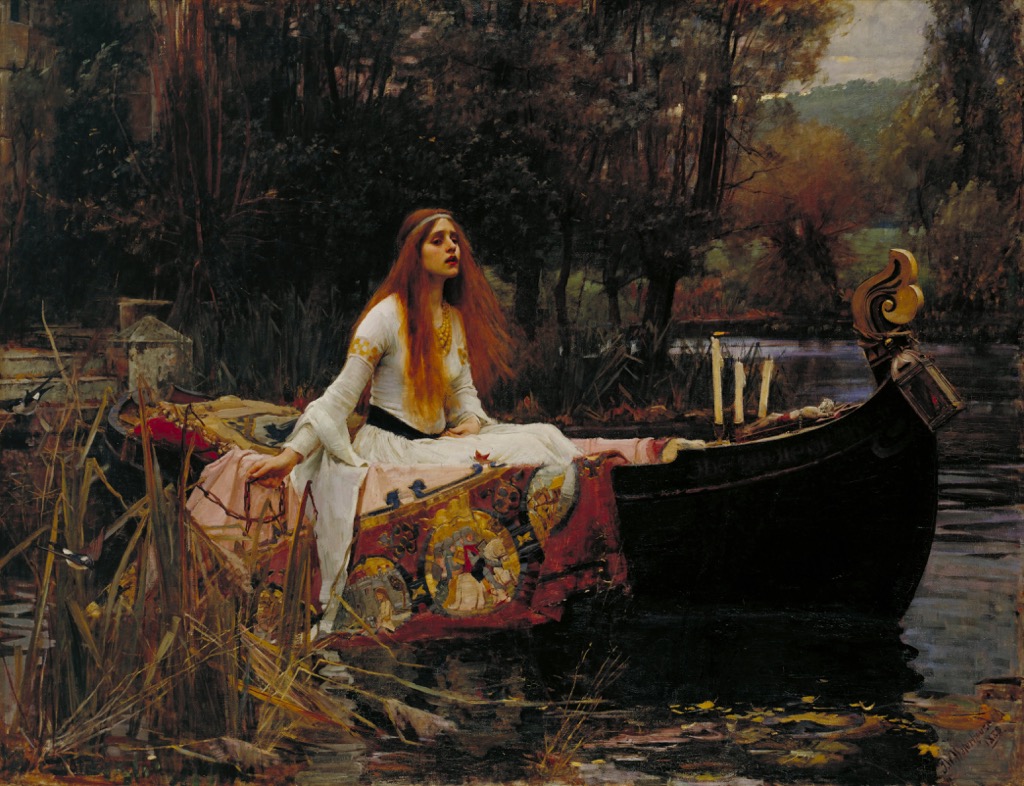
For internal linking, the strongest companions are Listening to My Sweet Pipings, Saint Cecilia, Ulysses and the Sirens and Nymphs Finding the Head of Orpheus. Together they show Waterhouse treating music as performance, dangerous attraction, celestial dream and surviving trace. The Charmer occupies the calmest point in that range, but calm does not mean empty.
Its restraint is therefore part of its meaning. Waterhouse turns a potentially theatrical enchantment into a private experiment in attention, allowing a glance, a gesture and a few ripples to carry the drama.
Related Pages
- Saint Cecilia: Compare another Waterhouse painting organised around music and listening.
- Ulysses and the Sirens: Contrast a more dangerous Waterhouse treatment of musical power.
- Destiny: Compare another late Waterhouse figure whose symbolic meaning stays open.
Frequently Asked Questions
It was exhibited in 1911 at the Royal Academy and Liverpool Autumn Exhibition. [1]
She plays a small stringed instrument beside a pool while fish gather or rise towards her.
No specific identity is securely established in the principal catalogue record. The work is described as an indeterminate Symbolist subject. [1]
That is the title's strongest visual implication. Their response makes musical influence visible, whether understood as magic or poetic natural behaviour.
It measures 96.5 × 61 centimetres. [1]
Major the Hon. Alec P. Henderson, a member of an important patron family, bought it from the artist. [1]
Christie's reports that no press notices were found, while explaining that exhibition reviews had become shorter by then. [1]
The catalogue recognises a recurring late model but does not provide a secure name. [1]
Discussion
The Charmer turns sound into relation. The woman plays; fish rise; water records movement. The viewer hears nothing, yet the arrangement makes musical power the most important event.
Its lack of a fixed myth is not a research failure to be repaired with a goddess's name. It is part of Waterhouse's late method. Familiar motifs—beautiful musician, dark pool, responding nature—carry symbolic force without narrative closure.
Reader Insights
Which visible detail most changes the way you read this page?
Which source or comparison helps the work feel less familiar and more specific?
What question would you bring back to the painting after reading?
Join the Conversation
Share your reading of this page below.
References
- Image reference
- Christie's, “John William Waterhouse, R.A., The Charmer,” object, provenance, exhibition, patronage and scholarly catalogue essay. View source
- Royal Academy, Royal Academy Pictures, 1911, digitised exhibition record. View source
- A. L. Baldry, “The Late J. W. Waterhouse, R.A.,” The Studio, vol. 71, 1917, including reproduction of The Charmer. View source
- Buscot Park, Faringdon Collection history and the Henderson family's collection context. View source