

 Buy Art Prints Now
from Amazon
* As an Amazon Associate I earn from qualifying purchases.
Image reference [image]
 by Tom Gurney
Tom Gurney BSc (Hons) is an art history expert with over 20 years experience
Published on August 14, 2026 / Updated on August 14, 2026
Email: tomgurney1@gmail.com / Phone: +44 7429 011000
Destiny: Introduction
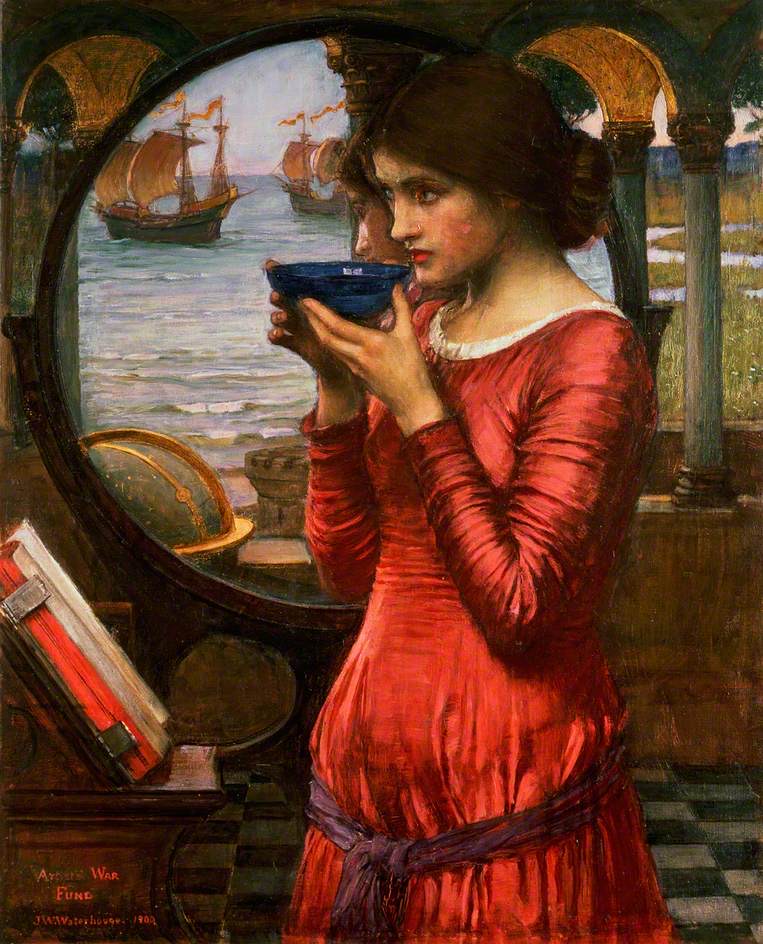
A woman in red raises a blue cup while ships depart in a circular mirror behind her. An open book and globe turn the room into a place where private farewell meets world history. John William Waterhouse painted Destiny in 1900 for the Artists' War Fund, a charitable exhibition and auction organised during the Second Boer War. [1] [2] [3]
Its beauty cannot be separated from that imperial conflict. The picture aided people affected on the British military side and translated departure into an idealised female act of valediction. Waterhouse gives no battlefield, enemy or wounded body. War enters through the fund inscription, sailing ships and the knowledge of why the picture was made. [2] [3] [4]
At a Glance
- ArtistJohn William Waterhouse (1849–1917)
- TitleDestiny [1] [5]
- DateSigned and dated 1900 [1] [5]
- MediumOil on canvas [1] [5]
- Dimensions68.6 × 54.6 cm [1] [5]
- CollectionTowneley Hall Art Gallery and Museum, Burnley [1] [5]
- Accession numberBURGM:paoil17 [5]
- Inscription“ARTISTS' WAR / FUND” above Waterhouse's signature and date [5]
- Original purposeDonated for the Artists' War Fund exhibition and auction during the Second Boer War [2] [3] [4]
- SubjectA woman raises a cup in farewell while departing ships appear in a mirror [2]
- Preparatory evidenceA surviving pencil study differs substantially from the finished composition [2]
- Essential contextThe fund supported British war sufferers; the painting should not be detached from the colonial conflict that created its occasion
Contents
- Introduction
- A Farewell Staged Through Reflection
- The Artists' War Fund of 1900
- The Second Boer War Context
- Woman, Cup and the Act of Valediction
- Mirror, Ships, Globe and Book
- Red, Blue and the Compressed Interior
- Preparatory Drawing and Waterhouse's Revisions
- Towneley Hall and the Work's Later Place
A Farewell Staged Through Reflection
The woman occupies the physical room; the ships occupy a mirror. Waterhouse separates the person who remains from those who depart and lets a reflective surface connect them.
She raises a small blue vessel to her lips. Christie's describes the gesture as a valediction to heroes sailing away. [2] “Heroes” belongs to the work's contemporary patriotic interpretation; “departing ships” is what the image securely shows.
This distinction matters. The painting does not identify individual soldiers, a battle or a precise harbour. Its emotional structure is general enough to serve a collective fundraising cause.
The title Destiny converts departure into fate. What happens beyond the reflected water seems both distant and already determined.
Yet the figure does not look helpless. Her upright pose and deliberate gesture give ritual form to uncertainty.
The farewell may resemble a toast, libation or final drink. No inscription within the image fixes one ancient rite. Waterhouse draws upon a broad classical and historic vocabulary rather than reconstructing a documented ceremony.
The mirror is essential because it prevents the ships from sharing her ordinary space. They are visible but unreachable, present to sight and absent to touch.
That separation gives the picture psychological force. Farewell is not represented by an embrace at a dock but by an interior figure sustaining an image of distance.
The viewer sees both woman and reflection at once. She may see the ships only through the mirror, depending on her angle. We are therefore granted a compositional knowledge that may exceed hers.
Waterhouse had used mirrors to structure knowledge before and would do so again. Here reflection carries public history into a private room.
The Artists' War Fund of 1900
Waterhouse created Destiny for the Artists' War Fund. His inscription identifies that purpose directly. [5]
Christie's records that roughly 330 painters and sculptors contributed, that the works were displayed at the Guildhall Art Gallery and then auctioned, raising more than £12,000. [2] Other contemporary and later accounts differ slightly in totals, reflecting whether they count works, contributors or final receipts.
The 1900 Art Journal reported approximately 328 works and described royal contributions alongside those of popular artists. [4] This contemporary evidence shows how the exhibition linked artistic generosity, elite patronage and public wartime culture.
A study in British Art Studies says Waterhouse encouraged colleagues to donate works to raise funds for widows and the wounded. Contributors included Alma-Tadema, Poynter, Herkomer and Sargent, and Princess Louise opened the exhibition. [3]
The auction took place at Christie's in February 1900. The fund transformed paintings into money: artists gave objects, visitors supplied attention and buyers converted cultural prestige into charitable receipts. [2] [3]
Destiny was therefore functional as well as aesthetic. It had to attract a purchaser while embodying an appropriate response to conflict.
Its subject is well suited to that purpose. Rather than showing combat that might divide taste or require military expertise, Waterhouse offers dignified feeling, beautiful surfaces and an expandable farewell.
The auction setting shaped this accessibility. A donated work needed to retain the artist's recognisable appeal while standing within a crowded collective display. Waterhouse supplied the single ideal figure, reflective device and literary ambiguity associated with his mature art, then anchored them to the cause through an inscription.
That inscription performs work the imagery avoids. Remove it and the scene could be an unspecified classical meditation upon travel. Preserve it and the ships become inseparable from the movement of troops and the fund's beneficiaries.
The canvas therefore has two registers: an image broad enough for domestic ownership and a marked object tied to one public campaign. Its success as fundraising art depended upon both.
The figure can stand for a wife, mother, lover, nation or personification without being securely restricted to any one role.
Charity does not make the event politically neutral. The fund addressed suffering connected with British forces and their families. Its public appeal participated in the emotional mobilisation of a society at war.
The people aided were real, while the frame through which their need became publicly compelling was selective. Boer and African suffering does not enter Waterhouse's room. That absence should be named without pretending the painting was commissioned as a comprehensive history of the war.
Its task was narrower: to convert metropolitan sympathy into money. Modern interpretation can recover the larger conflict around that task while still recognising the immediate relief the fund sought to provide.
That layered function should remain visible. The exhibition could provide material help and reinforce patriotic narratives at the same time.
The Second Boer War Context
The Second Boer War began in 1899 in southern Africa and continued until 1902. It was fought between the British Empire and the two Boer republics, the South African Republic and Orange Free State.
Destiny was made during the early crisis of the conflict, when British reverses generated intense public anxiety and fundraising. [3] Its date is not an abstract fin-de-siècle marker; it belongs to a specific imperial war.
Waterhouse does not represent South Africa, Boer civilians, Black South Africans or the material conditions of campaign. The ships in the mirror leave a beautiful, undamaged world.
This absence is historically meaningful. The painting expresses how war might be imagined from metropolitan Britain through departure, sacrifice and those waiting at home.
The woman gives that home front an ideal body. She is elegant, composed and removed from labour, poverty or public disorder.
The image can therefore console without documenting. It asks viewers to feel the nobility and uncertainty of going away, not to examine policy or violence.
Calling the ships' occupants “heroes” reproduces the fund's likely patriotic frame. [2] That language needs attribution because the conflict has multiple histories and perspectives.
The title Destiny can make imperial movement appear inevitable. Yet wars are political decisions, not natural seasons. The tension between title and history is worth examining.
At the same time, individual grief does not become unreal because public ideology shapes its representation. Widows, wounded soldiers and dependants faced material consequences that fundraising sought to relieve. [3]
The picture's ethical complexity lies here: sincere care, idealised femininity, aesthetic pleasure and imperial patriotism occupy the same small canvas.
Woman, Cup and the Act of Valediction
The woman's raised cup is the painting's clearest action. It pauses just before or at her lips, suspending the ceremony rather than completing it.
Blue separates the vessel from her red dress. The cool object becomes a concentrated point between face and hand.
The gesture may be read as a toast to those departing, a libation to fate, communion with absent travellers or private attempt at courage. Christie's favours valediction. [2]
No visible liquid or ritual text confirms exactly what she drinks. Interpretation should remain open within the secure context of farewell.
Her gaze appears directed towards the cup or inward rather than openly at the mirror. This makes remembrance seem absorbed into bodily action.
She is not shown waving. The conventional public gesture of farewell is replaced by a contained ceremony that can recur after ships are gone.
The red dress attracts attention and conveys warmth, life and emotional intensity. It also prevents the figure from fading into the subdued room.
Waterhouse's women are often treated as objects of beauty. Here the woman performs the central symbolic work. The unseen travellers depend upon her gesture to receive meaning.
Yet her agency is prescribed by the fundraising narrative. She remains, remembers and sanctifies departure while others act beyond the room.
The picture can dignify that role and expose its gendered limits. Emotional labour becomes feminine, silent and visually beautiful.
No documented sitter identity is supplied by the collection and catalogue records cited here. The figure should not be named from resemblance to other Waterhouse models.
Mirror, Ships, Globe and Book
The circular mirror is an image within the image. It gathers ships, water and distance into a bounded field behind the woman's head and shoulders.
Its round form echoes the globe nearby. One surface reflects a particular departure; the other represents the world as an object of knowledge and travel.
Together they enlarge the room. Sea routes and geography enter through instruments rather than open architecture.
The globe carries imperial associations in a painting made for a British war fund. It can signify worldly reach, navigation and knowledge, but also the global scale of British power.
An open book rests nearby. Its contents are not legible enough in ordinary reproduction to support a specific identification.
Book and globe suggest study or contemplation. The woman is not merely waiting in an empty chamber; she occupies an environment of mediated knowledge.
The mirror complicates truth. Mirrors in Waterhouse do not simply duplicate. They reveal what lies outside the main field, compress distance and create alternative spatial orders.
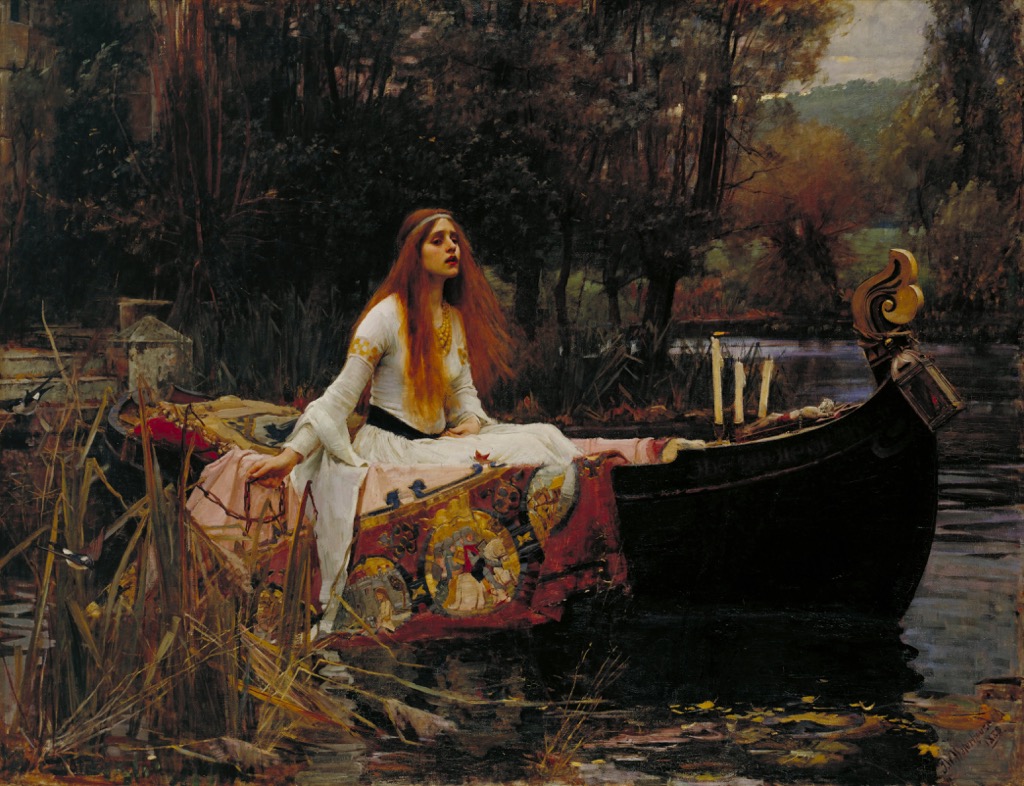
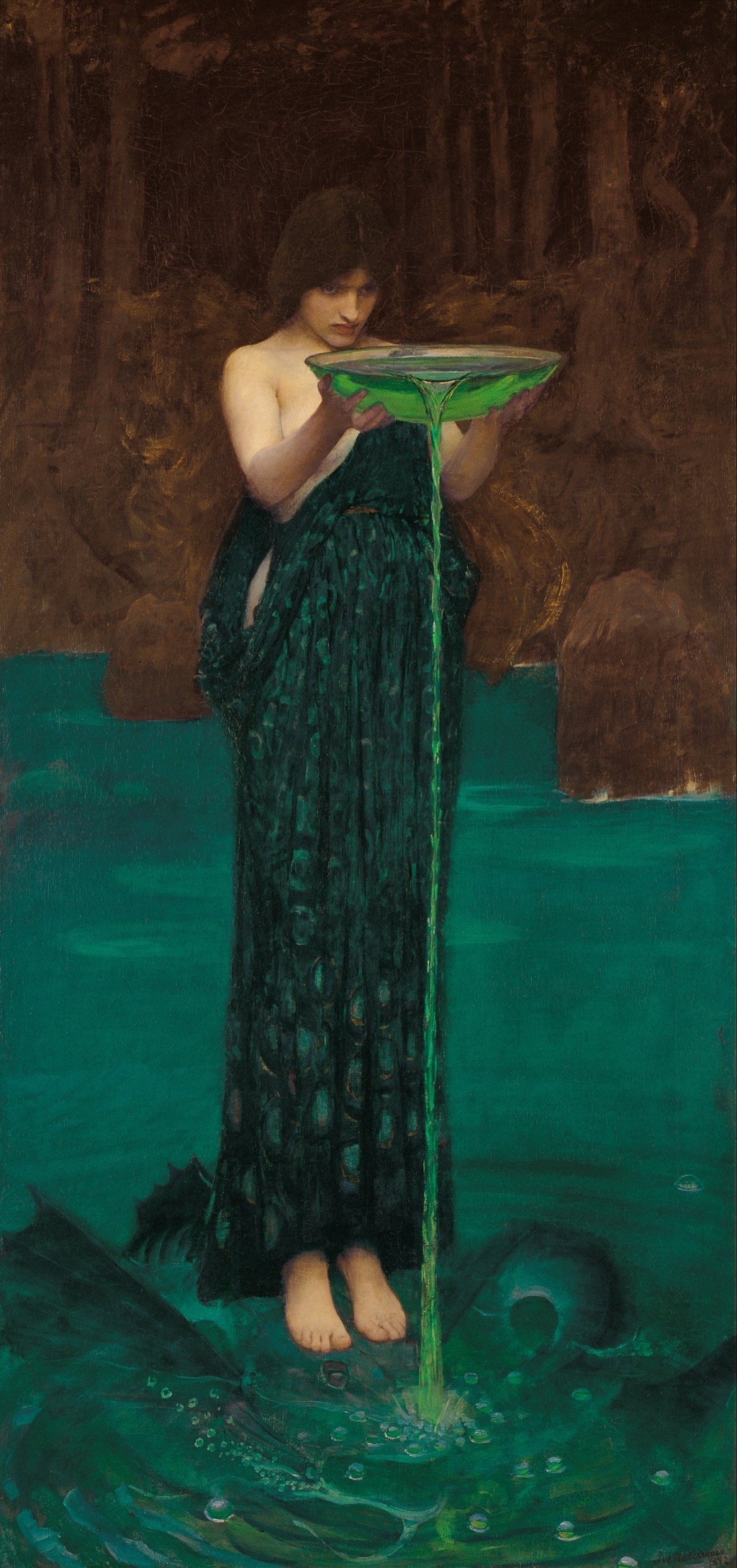
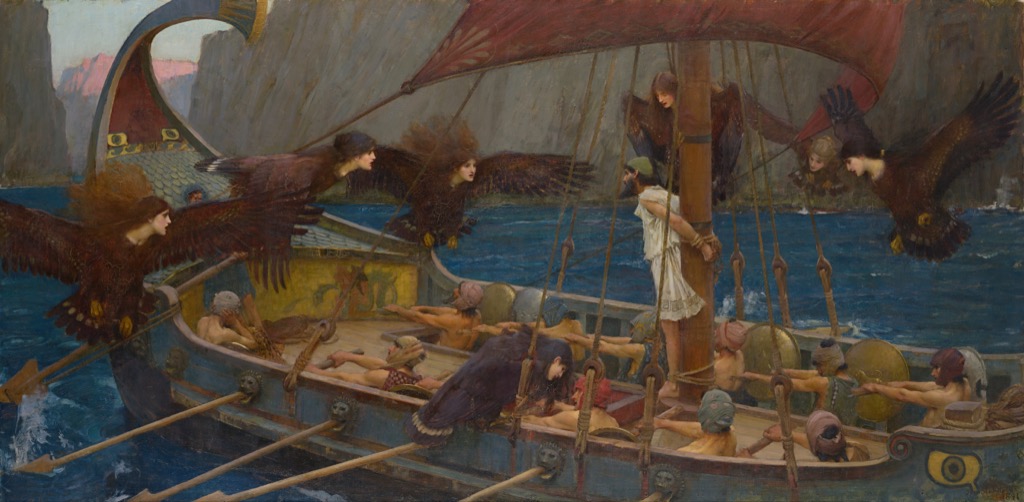
In the 1894 Lady of Shalott, a mirror reflects Lancelot and precipitates catastrophe. In Circe Offering the Cup to Ulysses, it contains the approaching hero behind Circe. In Destiny, it holds departing ships within the world of someone left behind.
The reflection may also resemble memory. A scene that appears optically present can be read psychologically as what the woman continues to see.
Waterhouse does not force a choice between literal mirror and mental image. Painting lets one device carry both.
The ships are small relative to the figure. Public war becomes a distant image within private emotion, even though the external event created the canvas's entire purpose.
Red, Blue and the Compressed Interior
The painting measures only 68.6 by 54.6 centimetres. [1] [5] It is substantial enough for a full visual statement but smaller than Waterhouse's great Royal Academy narratives.
Its compactness suits the fundraising auction. The work could enter a domestic collection while retaining the finish and symbolism associated with the artist.
Red dominates the figure, blue punctuates the cup and reflected sky or water, and darker architectural tones hold the interior together.
Complementary temperature separates living body from distant sea. The woman is warm and immediate; departure is cool and mediated.
Circular objects interrupt the vertical format. Mirror, globe and cup repeat curves at different scales.
Those curves link fate, world and personal gesture. The largest circle contains ships, the middle represents earth, and the smallest reaches her mouth.
This relationship need not be a hidden code planned in words by Waterhouse. It is a visible compositional structure that rewards close looking.
The room is richly imagined but not securely located in one historical period. As with many Waterhouse interiors, architectural and decorative elements create distance from contemporary London.
That historicising veil universalises the farewell and prevents modern military detail from ageing the scene too quickly.
It also aestheticises the war's occasion. The more timeless the image appears, the easier it is to forget the particular politics of 1900.
The painting's preservation in a public collection now allows those layers to be restored through interpretation. Object, inscription and history correct the tendency of reproduction to turn it into a generic “woman with cup.”
Preparatory Drawing and Waterhouse's Revisions
A pencil study for Destiny survives on one side of a sheet that carries a witchcraft scene on the reverse. It measures 27.8 by 17 centimetres and descended through the artist's family. [2]
Christie's notes substantial differences between drawing and finished painting. A ship appears in the middle distance at the left, but the final arrangement is not fixed. [2]
This is valuable evidence of invention. Waterhouse did not simply transfer a complete small design to canvas.
The ship motif existed early, while the mirror's final role developed through revision. Distance may have moved from an opening in ordinary space into reflection.
That change, if the drawings are read in this way, intensifies separation. A ship outside a window shares the room's world; a ship in a mirror is one step further removed.
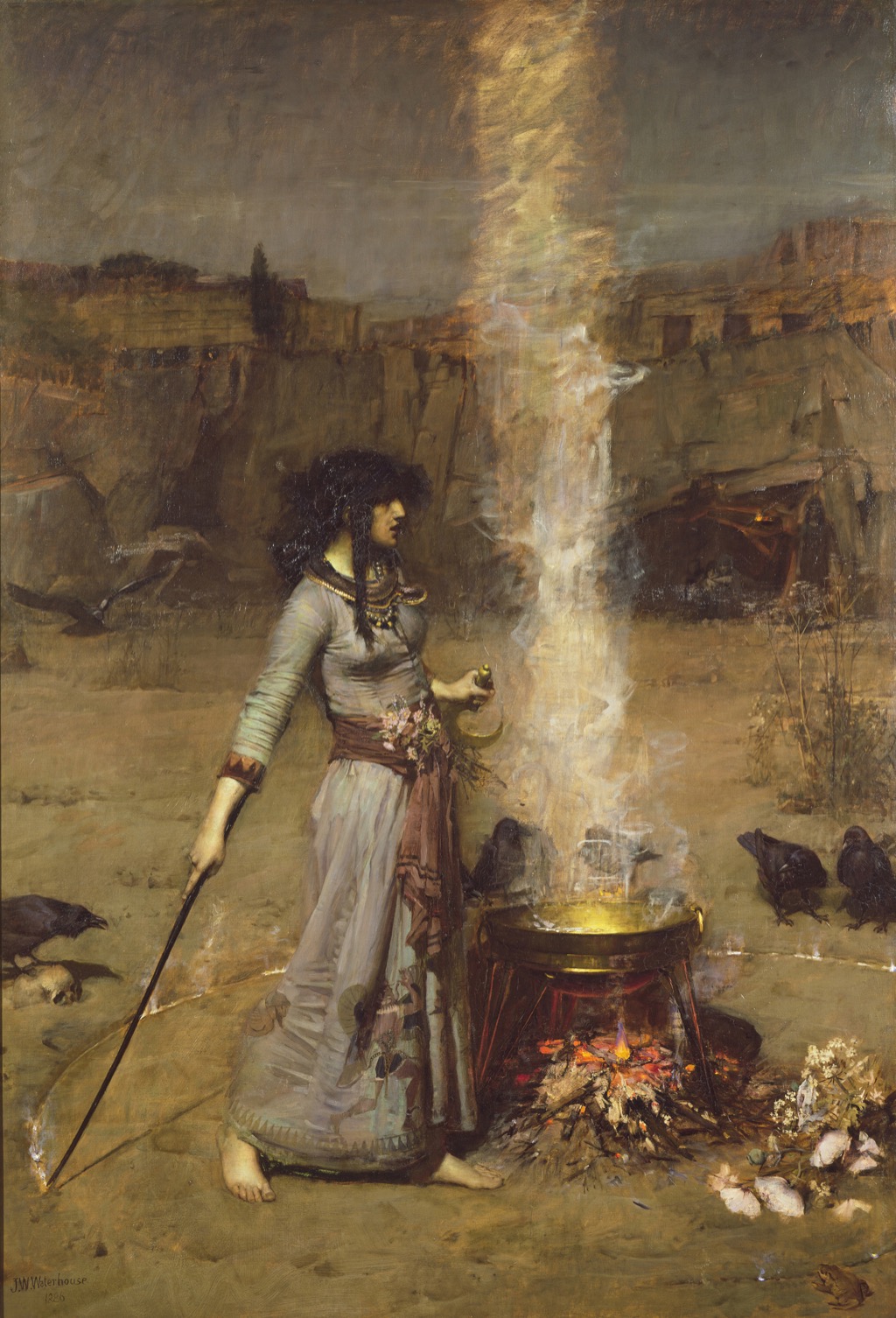
The reverse drawing relates broadly to Waterhouse's scenes of witchcraft and has been compared with The Crystal Ball and The Love-Philtre. [2] Its presence shows how different subjects could coexist within studio practice.
It should not be used to call the woman in Destiny a sorceress. Recto and verso are separate studies, not one iconographic programme.
The sheet also demonstrates economy. Paper supported alternative ideas and themes before a particular canvas required resolution.
No full scientific study of Destiny is cited here, so claims about underdrawing, pigments or hidden alterations should not be invented from the visible study alone.
What the evidence supports is enough: Waterhouse tested the ship motif, altered the composition and gave reflection far greater narrative power in the final work.
Towneley Hall and the Work's Later Place
Destiny is in the collection of Towneley Hall Art Gallery and Museum in Burnley, with accession number BURGM:paoil17. [1] [5]
The collection record gives the work's date, medium and dimensions. Embedded object metadata records acquisition in 1905. [5]
Public ownership distinguishes it from many Waterhouse flower-women and late mythological paintings that remain inaccessible in private collections.
The Artists' War Fund inscription remains a crucial material fact. It binds the attractive image to the specific economy of donation and auction. [5]
Towneley Hall's acquisition in 1905 brought a privately purchased fundraising work into municipal custody. [5] That transition expanded its possible audiences and eventually changed its function. It no longer raises money for the 1900 cause; it can instead serve as evidence about art, charity, gender and imperial culture.
Museum display also places local history beside global history. A painting preserved in Burnley carries ships imagined during a southern African war, a London Guildhall exhibition and a national network of donors and buyers.
The work can be placed beside The Crystal Ball, painted two years later. Christie's explicitly identifies Destiny as a compositional echo for that larger sorceress scene. [2]
Both use a single woman, interior objects and a circular device to open another reality. Their purposes differ: one is a wartime farewell, the other a scene of occult vision.
That comparison shows Waterhouse reusing formal solutions without repeating meaning. Mirror and crystal sphere both mediate distance, but one reflects ships and the other promises supernatural sight.
Destiny also broadens the usual account of Waterhouse as a painter detached from contemporary life. He seldom painted modern political events directly, yet this work participated materially in one.
Its contemporary engagement is indirect but real. The canvas was not commentary from outside the war; it was an object made to raise funds within wartime culture.
Today, museum interpretation can acknowledge both Waterhouse's compositional intelligence and the colonial history that an older celebratory account might leave unexamined.
Related Pages
- Windflowers: Compare another late Waterhouse figure shaped by weather and symbolism.
- Influences, Reputation and Legacy: Set the work within Waterhouse’s later reputation and source-led legacy.
- Paintings: Return to the protected Waterhouse paintings hub.
Frequently Asked Questions
He donated it to the Artists' War Fund exhibition and auction in 1900, organised during the Second Boer War. [2] [3] [4]
A small blue cup raised towards her lips.
Ships departing across water, conventionally read as those to whom she makes a farewell. [2]
They introduce travel, world knowledge and contemplation. The painting does not securely identify the open book's text.
It is signed and dated 1900. [5]
No secure model or character identity is documented in the cited sources.
The title encourages personification, but no documented attribute proves a precise classical identity. It is safer to describe her as an allegorical farewell figure.
Yes. A pencil drawing shows an earlier, substantially different design with a ship visible at left. [2]
Discussion
1. How does the mirror separate the woman from the departing ships? 2. Does the title make war seem inevitable rather than political? 3. How do charity and patriotic mobilisation coexist in the Artists' War Fund? 4. What is gained by showing farewell rather than battle? 5. How do cup, globe and mirror repeat circular forms at different scales? 6. Does the historic interior universalise grief or conceal the conflict's specificity? 7. What does the preparatory drawing reveal about Waterhouse's revisions? 8. How should a modern museum discuss the painting's beauty and imperial context together?
Reader Insights
Which visible detail most changes the way you read this page?
Which source or comparison helps the work feel less familiar and more specific?
What question would you bring back to the painting after reading?
Join the Conversation
Share your reading of this page below.
References
- Image reference
- Art UK, “John William Waterhouse, Destiny,” collection record for Towneley Hall Art Gallery and Museum, View source.
- Christie's, “John William Waterhouse, R.A., Study for ‘Destiny’ (recto); and A Scene of Witchcraft (verso),” catalogue record and essay documenting the study, Artists' War Fund, finished composition and related works, View source.
- Elizabeth Prettejohn and Peter Trippi, “Laboratories of Creativity: The Alma-Tademas' Studio-Houses and Beyond,” British Art Studies, discussion of Waterhouse's role in the Artists' War Fund exhibition, its contributors and beneficiaries, View source.
- The Art Journal, 1900, contemporary report on the Artists' War Fund Exhibition at the Guildhall Gallery and its approximately 328 works, View source.
- Wikimedia Commons / Art UK object metadata, “John William Waterhouse — Destiny,” recording dimensions, accession number, acquisition, signature and Artists' War Fund inscription, View source.