

 Buy Art Prints Now
from Amazon
* As an Amazon Associate I earn from qualifying purchases.
Image reference [image]
 by Tom Gurney
Tom Gurney BSc (Hons) is an art history expert with over 20 years experience
Published on August 14, 2026 / Updated on August 14, 2026
Email: tomgurney1@gmail.com / Phone: +44 7429 011000
Spring Spreads One Green Lap of Flowers: Introduction
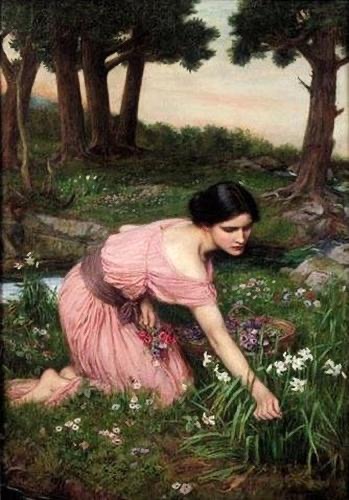
John William Waterhouse's Spring Spreads One Green Lap of Flowers appears at first to celebrate seasonal abundance. A young woman kneels low in a wooded meadow, gathering small blossoms into a basket. Her rose-coloured dress emerges from greens, white flowers and broken sunlight. Yet the title comes from Christina Rossetti's “Death-Watches,” a poem in which spring's flowered garment is explicitly buried by autumn.
Painted in 1910, the work is therefore not simply “a picture of spring.” It joins beauty to duration. The woman gathers what is alive now, while Rossetti's line makes disappearance part of the act. Waterhouse had explored the same tension through Robert Herrick's Gather Ye Rosebuds While Ye May; here the pressure is quieter and more solitary. A season spreads flowers across the earth, and one figure bends close enough to collect them before they pass. [1] [2] [3]
At a Glance
- ArtistJohn William Waterhouse
- Date1910 [1]
- MediumOil on canvas [1]
- DimensionsPublished secondary records differ; approximately one metre high and 0.8 metres wide [1] [3]
- CollectionPrivate collection / privately held [1] [3]
- SubjectA young woman gathering flowers in a green woodland or meadow
- Title sourceFirst line of Christina Rossetti's poem “Death-Watches” [2] [3]
- Poem's central contrastSpring bloom is buried by autumn [2]
- Related workGather Ye Rosebuds While Ye May of 1909 [3] [4]
- Possible mythic associationPersephone or Proserpine has been proposed, but the painting is not securely titled as her [3]
Contents
- Introduction
- What the painting shows
- Christina Rossetti's “Death-Watches”
- A spring image titled through autumn
- The flower-gatherer's bodily action
- Colour and the green “lap”
- Landscape, stream and seasonal time
- Relation to Gather Ye Rosebuds While Ye May
- Is the woman Persephone?
- Late Waterhouse and reduced narrative
What the painting shows
A single young woman occupies a green outdoor setting. She bends or kneels low, extending her arms towards small pale flowers near the ground. A basket stands ready to receive what she gathers. Trees and foliage frame the space, while a strip of water or shallow stream divides parts of the landscape.
The figure's posture makes the work unusually close to the earth. She is not posed upright as Flora, spring's crowned personification, and no flying Zephyrs surround her. She performs a practical task: identifying, reaching, plucking and collecting.
Her dress brings rose and violet tones into the green. The costume is historical or Arcadian rather than recognisably Edwardian, but no precise ancient or medieval setting is established. Waterhouse removes ordinary date without supplying a named story.
The basket is important because it turns looking into taking. The woman does not merely admire the meadow. She removes flowers from it and creates a portable group, changing scattered growth into a human arrangement.
No companion appears in the principal composition. Solitude distinguishes the painting from the 1909 Gather Ye Rosebuds, where two women collect flowers in a broad landscape. [4] Here Waterhouse concentrates the relation among one body, one basket and the ground.
The title supplies the picture's largest narrative context. Without Christina Rossetti, the scene might seem purely seasonal. With the poem, gathering becomes time-conscious whether or not the woman herself is thinking about death.
Christina Rossetti's “Death-Watches”
The title reproduces the opening line of Christina Rossetti's short poem “Death-Watches.” The first stanza begins with spring spreading a green lap of flowers and immediately says that autumn buries them when they fall. Rain cannot make them stay or recall them; wind becomes a dirge while earth puts away its garment of delight. [2]
The second stanza repeats the structure on a daily scale. The east brings forth the sun; the west buries it after its course; moon and stars follow like funeral lights. [2] Season and day are parallel clocks. Birth, beauty and illumination contain their own ending.
Waterhouse quotes only the opening image in the title. That selection matters. A viewer meets the abundance before the burial, just as the painting shows living flowers rather than autumn decay. Yet anyone who recognises or reads the poem carries the rest of it back into the scene.
Rossetti's “lap” personifies spring or the earth as a figure holding flowers in green cloth. Waterhouse does not paint a literal seasonal goddess. The meadow itself becomes the green lap, while the woman gathers from it.
The title should be attributed correctly. These are Rossetti's words, not Waterhouse's personal statement and not a line by Dante Gabriel Rossetti. Christina's relation to the Pre-Raphaelite circle may have appealed to Waterhouse, but her authorship and independent poetic career must remain clear. [5]
The poem does not instruct the reader to seize pleasure in the direct manner of Herrick's “To the Virgins, to Make Much of Time.” It observes universal burial with austere compression. Waterhouse's scene softens the funeral imagery visually while retaining it through title.
A spring image titled through autumn
Spring paintings usually promise renewal. Fresh green, new flowers and outdoor light can make seasonal return seem triumphant. Rossetti's line refuses to isolate that promise. The lap will be emptied; autumn will bury its contents.
Waterhouse chooses the season at its fullest rather than painting decay. This is not contradiction but temporal layering. The viewer sees present beauty and knows future loss.
The woman's gathering can respond to that knowledge in different ways. She may preserve flowers briefly in a basket, enjoy them before they fade, or simply participate in seasonal labour without contemplating mortality. The poem belongs to the picture's title, not necessarily to the character's conscious thought.
This distinction prevents over-biography. Waterhouse was ageing and would die in 1917, but no cited letter says that this painting expresses fear about his health. Late date can make mortality contextually resonant; it cannot turn Rossetti's poem into a medical confession.
Nor is the scene despairing. Gathering requires expectation that flowers will be carried, arranged or shared. The act gives brief human form to seasonal abundance. Impermanence increases attention rather than cancelling pleasure.
The title's grammar is active: spring “spreads.” Nature is not a static backdrop. Green growth opens like fabric, offering flowers across space. The woman answers that action with her own spreading body and reaching arms.
The flower-gatherer's bodily action
Waterhouse brings the figure lower than many of his late women. Her knees, hands and torso organise a compact shape near the flowers. The body follows the ground rather than dominating it.
This posture carries effort. A gathering figure must shift weight, protect clothing, search among grasses and repeatedly bend. Waterhouse's beautiful Arcadia is not completely weightless.
Her bare or lightly visible feet, depending on the reproduction, intensify contact with the landscape. Even where exact details are soft, the body's nearness makes the ground tactile.
The reach directs attention away from the face. Unlike a portrait, the painting does not depend on eye contact or an expressive head. Gesture identifies purpose.
The basket gives the sequence an implied before and after. It may already contain flowers; more will be added; eventually the woman will rise. Waterhouse stops during accumulation rather than after the finished bouquet.
This action distinguishes gathering from smelling. The Shrine and The Soul of the Rose bring face to blossom and make scent central. Here the hands act and the flowers move from earth to container. The primary sensory field includes touch, posture and visual selection.
The spectator observes from enough distance to see the setting, not from the intimate proximity of The Soul of the Rose. The woman belongs to a landscape rather than filling an enclosed half-length frame.
Colour and the green “lap”
Green is the painting's governing field. It surrounds, supports and partially absorbs the woman. The title makes that colour semantic: green is not merely naturalistic local colour but spring's spreading garment.
The rose or mauve dress creates a complementary human centre. It resembles a cultivated flower without making the woman literally floral. Her clothing allows the figure to belong chromatically to the meadow while remaining distinct.
Small white and coloured blossoms punctuate the green. Their scale matters. Waterhouse does not require enormous symbolic roses; seasonal life appears as numerous modest points.
The basket introduces brown or straw colour, a manufactured natural material positioned between body and plants. It will convert scattered colour into a concentrated portable arrangement.
Trees create darker verticals and shelter. Open grass catches more light, so the setting can feel both enclosed and spacious. This alternation gives the woman a clearing without isolating her from woodland.
Reproductions vary considerably in colour and resolution. The accessible public image is relatively small, and privately held status limits direct surface study. [1] Exact claims about pigment, glazing or brush sequence should therefore be avoided.
Waterhouse's late technique often combines focused figure passages with broader landscape handling. That general pattern can guide viewing, but only technical examination of this canvas could establish its specific materials and revisions.
Landscape, stream and seasonal time
A narrow stream or change in ground divides parts of the setting. Water gives the landscape movement beyond the woman's action and may connect this picture visually with the 1909 Gather Ye Rosebuds. [3] [4]
The stream is not securely identified as a mythological river. It can be read as ordinary landscape structure. Waterhouse often uses water to carry transformation and danger, but repetition across an oeuvre does not make every stream symbolic in the same way.
Trees register longer cycles than flowers. The small blossoms may last days; leaves and branches follow seasons; the stream continues through both. The landscape contains multiple temporal scales.
Rossetti's poem adds day and night to season and year. Although Waterhouse paints daylight, the title's source recalls eventual dimming. Light across the meadow is therefore beautiful because it is temporary.
The scene may resemble an English woodland more than a reconstructed ancient landscape. That familiarity brings the literary Arcadia close to Waterhouse's audience. Historical dress displaces ordinary time while native-looking growth preserves sensory credibility.
There is no visible autumn warning such as yellow leaves or storm. Waterhouse trusts the title to supply it. The decision keeps the painting visually generous and intellectually double.
Relation to Gather Ye Rosebuds While Ye May
Waterhouse painted a multi-figure Gather Ye Rosebuds While Ye May in 1909. Its title comes from Robert Herrick's “To the Virgins, to Make Much of Time,” a poem urging young women to act before youth and opportunity pass. [4] [6]
The 1909 painting places two women in a flowered landscape with a stream and trees. Modern scholarship notes visual continuity between its more distant gatherer and the single woman in the 1910 work: pose, hairstyle, sash, water and landscape motifs connect the compositions. [3]
This does not make the 1910 canvas a cropped replica. Waterhouse removes a companion and gives one gathering body the whole vertical field. Solitude changes the emotional register from shared pastoral activity to concentrated absorption.
The literary source also changes. Herrick's poem is an imperative addressed to young women. Rossetti's “Death-Watches” is a meditation on cyclical disappearance. Both connect flowers with time, but one urges action and the other observes burial.
Waterhouse thus explores the same action under different verbal pressure. In 1909 gathering can embody carpe diem. In 1910 it occurs within a larger natural cycle that no act can prevent.
The comparison should remain version-controlled. The 1908 Gather Ye Rosebuds is a different single-figure interior. It features a woman with a bowl of roses and a more Rossettian, portrait-like format. [7] Three paintings share flower-and-time concerns but not object identity.
Is the woman Persephone?
Peter Trippi and later scholarship have associated the solitary flower-gatherer with Persephone or Proserpine at the moment before abduction. [3] The proposal is plausible because ancient myth places Persephone among flowers when Hades seizes her, and flower gathering becomes a threshold between seasons and the underworld.
The interpretation also suits Rossetti's cycle of spring bloom and autumn burial. Persephone's movement between upper and lower worlds provides a mythic structure for seasonal change.
Yet the title does not name Persephone, and Hades, companions, chariot and explicit underworld signs are absent. The picture can evoke the myth without illustrating one securely defined instant.
Waterhouse had already treated flower gathering and myth in Flora and the Zephyrs and the proposed Awakening of Adonis. His late paintings often reduce narrative clues, allowing a mythic association to hover behind a sensory action.
The best public wording is therefore “has been associated with Persephone” or “may evoke Persephone gathering flowers.” Calling the work Persephone as an alternate title would overstate the accessible documentation.
The distinction matters for gender. If she is Persephone, danger lies just outside the frame. If she is unnamed, the work centres seasonal labour without an approaching male actor. Waterhouse leaves both readings available.
Late Waterhouse and reduced narrative
By 1910 Waterhouse had not abandoned literature. He had changed how it operated. A title could provide the verbal frame while the painting reduced external plot to one figure and one action.
This late manner is sometimes dismissed as decorative. Spring Spreads One Green Lap of Flowers shows why that judgment is too simple. Colour and composition provide immediate pleasure, but the Rossetti source makes the scene temporally severe.
The painting also moves away from the tightly enclosed half-length flower-woman. Landscape becomes an active field, and the body submits to its level. The woman is part of spring's spread rather than a flower displayed indoors.
Waterhouse's literary practice was selective. He did not paint every noun in “Death-Watches.” Autumn, dirge, funeral moon and stars are absent. One line is enough to make their eventuality present.
This is a modern form of illustration: not transcription but intertext. The painting and poem each contribute what the other withholds. Rossetti supplies burial; Waterhouse supplies the embodied act of gathering.
The result is emotionally balanced. The work neither denies death nor refuses delight. Spring's garment is worth entering precisely because it cannot remain.
Object facts and measurement conflict
The painting is dated 1910 and privately held. [1] [3] Published online records disagree on exact dimensions. One widely circulated record gives approximately 106 × 77 centimetres; scholarly discussion reports about 101 × 83 centimetres. [1] [3]
The discrepancy remains part of the object record rather than a detail to resolve silently. It may arise from inaccurate secondary copying, different measurement conventions, or confusion in older sale records. Until an authoritative current catalogue is consulted, approximate scale is the most responsible summary.
Scholarly literature records that the work was sold through Sotheby's in 2002, but the cited public records do not supply an archived auction-lot page. [3] Exact sale prices and fuller provenance chains therefore remain outside the documented evidence.
The title is much more secure because it appears within exhibition catalogue history and corresponds exactly to Rossetti's line. [2] [8] Capitalisation may vary; the wording should remain complete.
The model is not securely identified. The visual link to the second woman in the 1909 Gather Ye Rosebuds can support comparison, not a biographical name. [3]
For display, the full vertical composition is necessary. Cropping to the upper body would remove basket, reach and the green “lap,” turning an active gatherer into a generic beauty.
The image record also illustrates why search results should not dictate taxonomy. Some aggregators call the picture a genre painting, others a Pre-Raphaelite work, and scholarly writing explores a Persephone association. [1] [3] Those descriptions answer different questions. “Late literary flower subject” is the most useful page role: the visible activity is everyday gathering, the title is poetic, and myth remains a proposed undertone rather than a confirmed subject.
Its relationship with Christina Rossetti deserves internal linkage to Waterhouse's broader literary guide. Waterhouse is most readily associated with male poets—Tennyson, Shakespeare, Keats, Homer and Ovid—but this title places a woman's compressed meditation on death at the centre of a late canvas. The connection expands rather than merely decorates his source field.
Rossetti's full poem is brief and public domain, but the painting depends most directly on its opening image. Accurate summary and a source link keep the focus on how Waterhouse selected that image and altered its emotional balance through colour, landscape and bodily action, rather than replacing an edition of Rossetti.
Related Pages
- Gather Ye Rosebuds While Ye May (1909): Compare another Waterhouse flower-gathering subject whose title comes from poetry.
- Windflowers: Compare a late outdoor figure shaped by weather, flowers and motion.
- Literary and Mythological Sources: Follow the literary source framework behind Waterhouse's late flower subjects.
Frequently Asked Questions
Christina Rossetti wrote the line as the opening of “Death-Watches.” [2]
Rossetti says autumn buries spring's flowers and compares the sun's daily setting with burial, moon and stars with funeral lights. [2]
It is dated 1910. [1]
She is gathering small flowers into a basket in a green landscape.
The painting has been associated with Persephone gathering flowers before her abduction, but the title does not name her and explicit narrative signs are absent. [3]
The 1910 figure and landscape share motifs with the 1909 two-woman version, but the literary source, number of figures and composition differ. [3] [4]
Discussion
Waterhouse paints the first half of Rossetti's thought and lets the title carry the second. Spring spreads flowers; the woman gathers them; autumn remains outside the frame but inside the work.
This division preserves delight without making it naïve. The meadow is genuinely abundant, and the dress genuinely luminous. Mortality does not expose those pleasures as false. It gives attention a deadline.
Reader Insights
Which visible detail most changes the way you read this page?
Which source or comparison helps the work feel less familiar and more specific?
What question would you bring back to the painting after reading?
Join the Conversation
Share your reading of this page below.
References
- Image reference
- Wikimedia Commons, “John William Waterhouse — Spring Spreads One Green Lap of Flowers,” public-domain image record, date, medium and one published set of dimensions. View source
- Christina Rossetti, “Death-Watches,” in Poems (1901), public-domain text transcribed by Wikisource. View source
- Cátia Severino, “Narciso nas Metamorfoses de Ovídio e na pintura de J. W. Waterhouse,” Forma Breve, discussion of the Rossetti source, Gather Ye Rosebuds relationship, Persephone association, dimensions and 2002 sale. View source
- Sotheby's, “Gather Ye Rosebuds While Ye May,” catalogue essay for the 1909 landscape version. View source
- Poetry Foundation, “Christina Rossetti,” biography and account of her poetic themes and career. View source
- Poetry Foundation, Robert Herrick, “To the Virgins, to Make Much of Time,” text of the source for Waterhouse's Gather Ye Rosebuds titles. View source
- Christie's, “Gather Ye Rosebuds While Ye May,” catalogue essay for the 1908 single-figure version. View source
- Exhibition catalogue compilation, digitised catalogue page attributing the title line to Christina Rossetti. View source