

 Buy Art Prints Now
from Amazon
* As an Amazon Associate I earn from qualifying purchases.
Image reference [image]
 by Tom Gurney
Tom Gurney BSc (Hons) is an art history expert with over 20 years experience
Published on August 14, 2026 / Updated on August 14, 2026
Email: tomgurney1@gmail.com / Phone: +44 7429 011000
The Shrine: Introduction
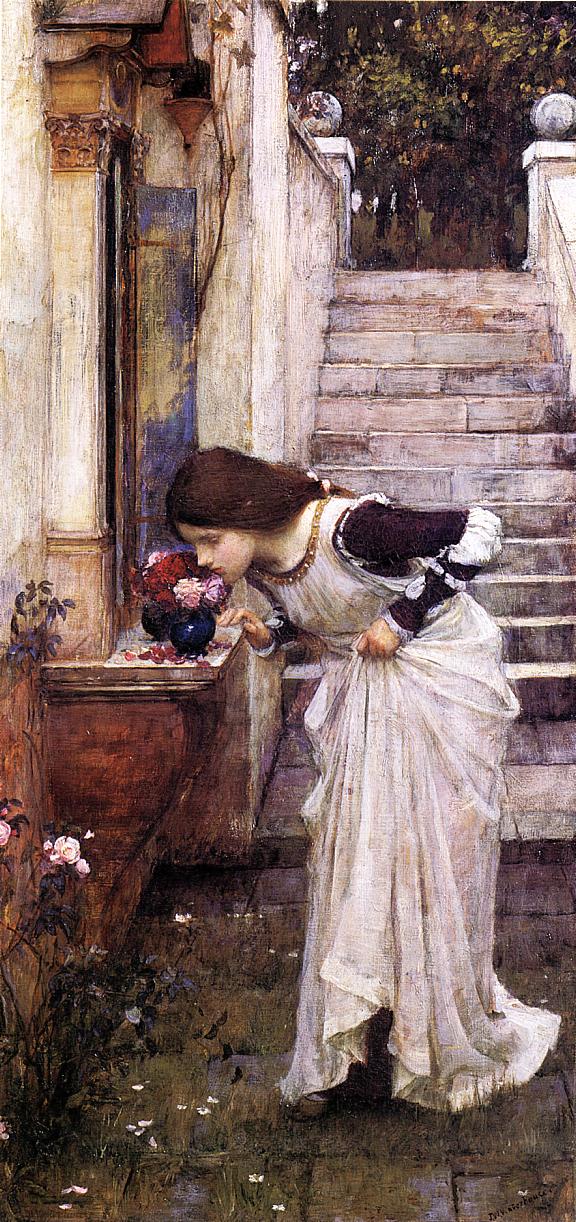
John William Waterhouse's The Shrine compresses an encounter with beauty into an unusually narrow space. A young woman bends towards roses arranged in a vessel on a stone ledge. Steps rise behind her through weathered garden architecture. Whether she is smelling an offering, approaching a devotional place, or surrendering privately to fragrance remains uncertain. The title makes the setting sacred; her bodily action makes it sensory.
Painted in 1895, The Shrine belongs beside Waterhouse's later flower-women even though it precedes their fullest development by more than a decade. It also preserves a revealing critical dispute. A contemporary reviewer treated the woman's absorption in scent as morally and socially troubling, exposing the assumptions Victorian criticism could attach to class, purity and female pleasure. What now seems an intimate, tranquil scene was not necessarily received as innocent decoration. [1] [2] [3]
At a Glance
- ArtistJohn William Waterhouse
- Date1895 [1]
- MediumOil on canvas [1]
- Dimensions88 × 42 cm [1]
- CollectionPrivate collection [1]
- FormatExceptionally narrow vertical canvas
- SubjectA young woman bending towards roses at a stone garden structure
- Exhibition contextDiscussed in connection with the New Gallery's 1895 summer exhibition [2]
- Key ambiguitySmelling flowers, making an offering and private devotion overlap
- Important reception issueContemporary criticism moralised the figure's class and sensory pleasure [2]
Contents
- Introduction
- What The Shrine shows
- Why the title matters
- The bending pose
- Roses, scent and invisible experience
- Stairs, stone and vertical composition
- Devotion or private pleasure?
- Contemporary criticism in 1895
- A forerunner of the late flower-women
- Gender, looking and interrupted privacy
What The Shrine shows
The painting contains few elements: one woman, a vessel of roses, stone architecture, steps and garden growth. Their arrangement is more complex than the inventory suggests. The woman's body bends across the vertical structure, linking flowers below with the route rising behind her.
She wears a long pale dress with dark patterning or bands. One hand gathers or steadies the skirt while the upper body inclines towards the flowers. The gesture is practical as well as expressive. To reach the scent without soiling or tripping over the dress, she must manage fabric and balance.
The roses stand in a dark vessel on a projecting ledge or pedestal. They are neither growing freely nor carried as a conventional bouquet. Someone has cut and arranged them. Their placement makes them look like an offering, but the painting does not show the giver or a visible sacred image.
Behind the woman, worn steps move upward and out of immediate access. The architecture gives the small encounter a larger setting: an old garden, terrace, cemetery-like precinct or imagined devotional enclosure. No securely identified historical site is documented by the cited object record.
The title directs attention to the stone structure as a shrine. Without it, a viewer might describe only a woman stopping to smell roses in a garden. With it, fragrance becomes an approach to something set apart. Waterhouse lets the bodily and devotional readings coexist.
Why the title matters
A shrine is a place where sacred presence, memory or devotion is concentrated. It may contain an image, relic or offering, or mark a site approached with reverence. Waterhouse does not provide enough iconographic detail to identify a named saint, deity or ritual.
That omission is important. If a sculpted Madonna, cross or classical god were visible, the woman's act could be attached to a defined religious system. Instead the roses occupy the visual position of sacred object. The shrine may be dedicated to something beyond the frame, but the painting makes colour and scent the immediate focus.
The title can therefore be read literally and metaphorically. Literally, the stone setting may be a wayside or garden shrine decorated with flowers. Metaphorically, the woman's concentration makes the flowers themselves worthy of devotion. Waterhouse does not require a choice between these possibilities.
The word also changes the ethics of looking. A shrine implies respect and perhaps privacy. The spectator observes the woman without being seen, entering a space defined as intimate or sacred. Her lowered face prevents any return of the gaze.
Titles in Waterhouse often supply a literary or mythological identity absent from the image alone. Here the title supplies a category of place rather than a narrative source. No poem or legend is needed to explain who the woman is. The interpretive work shifts from story to action.
The bending pose
Waterhouse builds the composition around inclination. The woman is neither standing fully upright nor kneeling. Her body crosses the painting diagonally as she brings her face close to the roses.
The pose makes fragrance visible. Smell has no shape or colour, so a painter must represent its effects: closing distance, tilting the head, narrowing attention, perhaps drawing breath. The flowers remain still while the body testifies that something invisible moves between them and her.
Her balance contains energy. One leg bears weight; fabric is lifted or controlled; the back forms a curve that could reverse quickly. This is not deep devotional prostration. It is a pause from which she can rise.
That readiness contributes to the scene's secrecy. The viewer may feel that she has stopped momentarily and could be surprised. The rising stairs strengthen the possibility that another person might enter from above. No intruder is painted, but the architecture makes interruption imaginable.
The curve also works against the narrow canvas. Most vertical formats encourage upright figures. Waterhouse uses a bent body to fill the middle while keeping the steps legible. Human movement crosses architectural ascent.
The hand holding the dress prevents the pose from becoming disembodied reverie. Sensory absorption still requires bodily management. That detail is characteristic of Waterhouse: myth, poetry or contemplation is made credible through contact with material things.
Roses, scent and invisible experience
Roses carry an unusually dense range of associations: love, beauty, secrecy, devotion, the Virgin Mary, mortality and sensual pleasure. The painting's sparse evidence does not authorise every meaning at once. Their immediate functions are colour, fragrance and possible offering.
The dark vessel concentrates red and pink blossoms into a small field near the woman's face. Against pale stone and clothing, the flowers become the principal chromatic intensity. Her bend directs the eye to the same point.
Because scent cannot be reproduced by paint, the viewer depends on memory. Anyone who knows roses can imagine sweetness, variation and the intimacy of bringing the face close. Waterhouse therefore activates a sense beyond sight without depicting it directly.
That sensory transfer can make the image more private than a conversation. The woman receives an experience unavailable to the spectator except through imagination. We see more of the setting than she does; she knows more of the fragrance.
The cut flowers also introduce time. Roses at their richest are already detached and will fade. The painting does not turn this into an explicit memento mori, but later Waterhouse works titled from Herrick and Christina Rossetti make the relation between flowers and passing time overt. The Shrine prepares the visual language before the later literary titles.
Religious and sensual readings need not cancel one another. Traditions of floral offering use beauty and scent as devotional materials. A rose can be sacred because it appeals to the body, not despite that appeal. The tension arises when critics demand that devotion look detached from pleasure.
Stairs, stone and vertical composition
At 88 centimetres high and only 42 centimetres wide, The Shrine is more than twice as tall as it is broad. [1] The proportions create a slender pictorial corridor.
The steps use that corridor to suggest continuation beyond the visible scene. They climb behind the woman, their sequence broken by her body and the stone ledge. The viewer cannot enter physically but follows their rhythm upward.
Weathered masonry places soft skin, cloth and petals against durable material. Stone bears age; roses embody brief bloom; the woman pauses between them. The contrast supplies a temporal dimension without adding narrative incident.
Architecture also creates social position. If someone appeared at the top of the steps, that person would look down upon the bending woman. Literary scholar Christina Bradstreet notes how the arrangement gives a potential newcomer a literal and moral “high ground” within the Victorian critical imagination. [2]
The setting should not be assigned automatically to medieval Italy, ancient Rome or a Christian cemetery. Waterhouse combined architectural motifs for atmosphere. The figure's dress is historical in flavour but not sufficient to date an exact event.
The narrow format requires careful reproduction. Cropping the upper steps would remove the imagined route of interruption; cropping the flowers would remove the sensory centre. A full view is essential to understanding how vertical ascent frames a private downward bend.
Devotion or private pleasure?
The woman's action can be described in several ways. She may smell roses placed at a shrine. She may inspect or arrange an offering. She may bow towards something sacred. The visible evidence secures proximity, flowers and concentration; it does not reveal an explicit prayer.
Waterhouse exploits the overlap. Devotion often requires bodily gestures—bending, kneeling, touching, offering—that can resemble absorption in material beauty. Scent can signify sacred atmosphere and sensual gratification simultaneously.
The title encourages elevated interpretation, but the figure's face remains close to the blossoms rather than directed toward heaven or an icon. That focus made at least one contemporary critic uneasy. [2] The problem was not merely whether she smelled flowers. It was whether a woman's sensory pleasure was judged compatible with the purity expected at a shrine.
Modern viewers should resist solving the tension by declaring the act innocent. “Innocence” repeats part of the moral framework, only with a different verdict. A richer reading asks why scent, solitude and a young woman's body could carry social meaning.
Nor is the image proof of a private erotic narrative. No lover appears, and the model's identity is not securely documented in the sources used here. Sensual describes the work's appeal to the senses; it does not establish sexual intention or biography.
The painting's quietness gives the encounter dignity. The woman is not shown displaying flowers to the spectator. Her attention is elsewhere. Whatever the shrine means, her experience is self-contained until the viewer intrudes.
Contemporary criticism in 1895
Research on smell in nineteenth-century art recovers an Athenaeum response to The Shrine at the New Gallery's 1895 summer exhibition. The critic judged the woman as socially and morally insufficiently refined, finding her absorption in the roses too sensual for the purity expected of the setting. [2]
The review is valuable evidence of reception, not a reliable diagnosis of the model or character. It shows how bodily type, class and morality could be read from a painted woman. The critic treated facial appearance and sensory behaviour as signs of social rank.
That response helps explain the title's power. Had the picture been called Smelling Roses, the act might have seemed ordinary. “Shrine” raises an expectation of reverence against which smelling can be judged. Waterhouse may have cultivated that ambiguity, although no artist statement cited here confirms his intention.
The review also exposes a gendered double standard. The woman is observed at close range without observing anyone. Her private pleasure becomes publicly available for evaluation, and the critic claims authority to decide whether it is pure enough.
At the same time, the criticism warns against treating all Victorian viewers as prudish in a uniform way. One review is one voice. Other visitors may have admired the intimacy, colour or technical handling. The source establishes controversy, not consensus.
Its vocabulary should remain historical. The hostile review can be reported as moralising class and sensuality without adopting its judgment as description. The woman is not factually “low” or “impure” because a reviewer said so.
A forerunner of the late flower-women
The Shrine precedes The Soul of the Rose of 1908, the two versions of Gather Ye Rosebuds While Ye May, Windflowers and Spring Spreads One Green Lap of Flowers. Across these works, Waterhouse reduces external plot and lets a woman's relation to flowers carry emotional meaning.
The closest comparison is The Soul of the Rose. Both women bring their faces near roses and turn away from the viewer. In the later painting, the figure presses against a garden wall and closes her eyes; the source of the title is literary and the composition is more intimate. The Shrine keeps more architectural distance and makes the sacred setting explicit. [4]
In the Gather Ye Rosebuds paintings, flowers become signs of time through Robert Herrick's poem. In Spring Spreads One Green Lap of Flowers, Christina Rossetti's title makes seasonal burial part of the context. The Shrine has no securely identified literary text, so scent and setting remain more open.
The comparison reveals development rather than repetition. Waterhouse returned to flower contact but changed the bodily task: smelling, holding, gathering, losing blossoms to wind. Each action creates a different relation between attention and time.
The 1895 date also places The Shrine beside Saint Cecilia, the year Waterhouse became a Royal Academician. [3] One work gives a literary saint an elaborate dream attended by angels; the other makes uncertain devotion from one woman and a jug of roses. Sacred feeling could be monumental or almost private.
Gender, looking and interrupted privacy
The woman's lowered face denies eye contact. This can protect inwardness, but it also gives the spectator an unreturned view of her body. The bend exposes pose and profile while attention to scent prevents response.
Waterhouse often uses this imbalance. The viewer watches the Lady of Shalott depart, Juliet glance from the corner of her eyes, Psyche approach a door and women gather flowers without acknowledgement. The pictures create intimacy while withholding mutual relationship.
In The Shrine, possible interruption is built into the stairs. The scene feels discovered rather than formally presented. The spectator occupies the role of someone who has come upon a private act, although our exact position is not identical with the unseen person who might descend.
This makes the critic's judgment especially revealing. The woman can be condemned for appearing sensual even though she does not solicit a gaze. Her absorption becomes a spectacle because painting and exhibition make it one.
A contemporary feminist reading can recognise both her autonomous pleasure and the conditions under which it is offered to viewers. She claims a moment organised around her own sense of smell. The composition also renders that moment permanently available for inspection.
Neither point requires a biographical model story. The tension belongs to representation: who looks, who senses, who judges and who remains silent.
Object history and responsible interpretation
The painting is in a private collection, and the accessible object record is limited. [1] Its date, medium and dimensions are established, while a complete modern provenance is not supplied by the cited sources.
Private status increases dependence on reproductions. Colour, surface and frame may be encountered differently in person. Statements about exact pigments, underdrawing or condition should not be made without technical study.
The model is not securely identified. Claims that she is one named favourite should be excluded unless supported by documentary scholarship. Facial type can connect the work visually with others from the decade without recovering a person.
The sacred identity is equally open. No visible icon secures a Christian saint or classical deity. “Shrine” is Waterhouse's title, but the particular dedication remains unstated.
This restraint should carry into image captions and metadata. Calling the structure a Marian shrine, a pagan altar or a grave would turn atmosphere into fact. A precise caption can say that a woman bends towards roses arranged at a stone shrine in a garden. Interpretation can then explore devotional possibilities without fixing a religion the painting itself withholds.
Close visual analysis is strongest when it matches these limits. The woman bends; she approaches roses; stone steps rise; the setting produces privacy and possible interruption. Smell is a compelling inference supported by pose and period criticism. Prayer, offering and sensual retreat remain overlapping interpretations.
Related Pages
- Saint Cecilia: Compare another 1895 Waterhouse painting where reverence, music and sensory absorption shape the figure.
- Windflowers: Follow a later flower-woman in which scent, wind and bodily inwardness replace overt narrative.
- Gather Ye Rosebuds While Ye May (1908): Place The Shrine beside Waterhouse's later treatment of flowers, enclosure and private pleasure.
Frequently Asked Questions
It is dated 1895. [1]
It is recorded in a private collection. [1]
The oil on canvas measures 88 × 42 centimetres, giving it a notably narrow vertical format. [1]
She bends towards roses arranged in a vessel, probably to smell them. The shrine setting also allows readings of offering or devotion. [2]
No named sacred figure is securely visible or identified in the sources used here.
An Athenaeum critic moralised the woman's sensual absorption and social type when discussing the 1895 New Gallery exhibition. That response documents one period viewpoint, not universal opinion. [2]
They are not versions of the same composition, but both turn a woman's close encounter with roses into a private sensory event. The later painting has different literary and object histories. [4]
No model is securely named in the cited records. Resemblance to other Waterhouse women is insufficient evidence.
Discussion
The Shrine makes an invisible sense the centre of painting. The roses provide colour, but the woman's bend asks the viewer to imagine scent. She receives what the spectator cannot directly access, even while we are allowed to watch her more freely than she can watch us.
The title intensifies the exchange. At a shrine, smelling can be offering, reverence, temptation or private pleasure. Waterhouse leaves the object of devotion unseen and makes the bodily approach unmistakable.
Reader Insights
Which visible detail most changes the way you read this page?
Which source or comparison helps the work feel less familiar and more specific?
What question would you bring back to the painting after reading?
Join the Conversation
Share your reading of this page below.
References
- Image reference
- Victorian Web, “The Shrine,” object data, dimensions and bibliography. View source
- Christina Bradstreet, Scented Visions: Smell in Art, 1850–1914, Penn State University Press, discussion of The Shrine and the Athenaeum review. View source
- National Portrait Gallery, “John William Waterhouse (1849–1917), Figure Painter,” biography and 1895 Royal Academician record. View source
- Christie's, “The Soul of the Rose,” object and catalogue essay on Waterhouse's later treatment of scent, enclosure and flower-women. View source