


 by Tom Gurney
Tom Gurney BSc (Hons) is an art history expert with over 20 years experience
Page Created on September 22, 2026 / Page Updated on September 22, 2026
Email: tomgurney1@gmail.com / Phone: +44 7429 011000
At a Glance
- ArtistGeorgia O’Keeffe
- ArtworkMy Shanty, Lake George
- Artistic contextAmerican modernism
Contents
- A building that fills the view
- The Phillips painting
- Two titles and one documented date
- Making a room apart
- Lake George as a working landscape
- A wall, a roof and a window
- Low colour as a deliberate challenge
- Gender and the terms of seriousness
- Number 54 at the Anderson Galleries
- The Phillipses choose the shanty
- A sombre Celtic mood disputed
- Precision and softness
- The building through a camera
- A public provenance with gaps
- Ninety years of exhibition movement
- Architecture before New Mexico
- What the legacy story overstates
- Reading without closing the door
A building that fills the view
Georgia O’Keeffe’s My Shanty, Lake George turns a modest workroom into a structure of remarkable visual authority. A low brown building occupies most of the horizontal canvas, its enormous grey-blue roof rising like a second mountain in front of the distant hills. Trees press in from both sides, long clouds cross the sky, and small flowers punctuate the grass, yet the uncompromising wall and roof hold the composition together.[1][2]
The view is close enough to exclude any approach road, neighbouring house or useful account of the building’s surroundings. O’Keeffe gives no figure, easel or brush to identify an artist’s studio; only the title and documentary history disclose its function. What might have been picturesque rural scenery becomes a study in concentrated presence, in which a private place for work is known through mass, colour and the sharp interruption of one white-framed window.[1][3]
That combination has produced divergent readings. The Phillips Collection has interpreted the shanty as a symbolic self-portrait and a vessel for O’Keeffe’s artistic spirit, while the artist’s own later account emphasised a jokingly competitive experiment in sombre colour.[1][2] The painting supports both inwardness and irony, but neither should replace close attention to how an ordinary outbuilding was made simultaneously solid, secluded and visually strange.
The Phillips painting
The Phillips Collection in Washington owns the painting as object 1448. It dates from 1922 and is oil on canvas; the Georgia O’Keeffe Museum’s catalogue record assigns it catalogue raisonné number 367.[1][2] The owner publishes the dimensions as 20 by 27 1/8 inches, or 50.8 by 68.9 centimetres, and records a framed size of 21 5/8 by 28 1/4 by 1 7/8 inches.[2]
Access O’Keeffe gives the height as 20 1/2 inches while agreeing on the width.[1] This half-inch discrepancy remains in two current institutional records and cannot be solved from their public data. The owner’s measurement is the appropriate display figure for its own object, but preserving the variation matters: dimensions often appear definitive, even though cataloguing history, measuring conventions or later examination can produce competing authoritative values.
The stretcher carries “54 / 1922” in graphite, attributed to Alfred Stieglitz.[1] The year anchors the object firmly, while 54 identifies its number in O’Keeffe’s 1923 Anderson Galleries exhibition. No conservation report or object-specific technical study is publicly attached to the record, so claims about underdrawing, paint sequence, varnish or alteration would exceed available evidence; the visible surface can support close description, but not laboratory conclusions.[1][19]
Two titles and one documented date
The Downtown Gallery Archive and O’Keeffe’s Abiquiú Notebooks support the 1999 catalogue raisonné title My Shanty.[1] The Phillips Collection uses My Shanty, Lake George, which supplies the place needed by viewers unfamiliar with the building. Both titles are documented institutional forms, although the shorter one has priority in the catalogue raisonné rather than representing an incomplete version of the owner’s title.
Another historical title complicates the record. When the painting appeared in The Arts in February 1923, it was called Landscape.[1] That generic label directs attention away from possession and studio use towards the surrounding terrain, demonstrating how a change of name can change the picture’s apparent subject before any formal analysis begins or the building’s personal history is known.
The date is unusually secure because the stretcher and catalogue agree on 1922.[1] Its place of execution is equally well grounded in the building’s identity at the Stieglitz property at Lake George. What remains unavailable is a narrower chronology within the year: the public record does not state whether O’Keeffe began it immediately after arriving in June, during Stieglitz’s illness, or later in the summer.[6]
Making a room apart
The shanty stood beyond the farmhouse on the Stieglitz family property, in the Adirondacks of northern New York. In August 1920 O’Keeffe supervised the renovation of the outbuilding as a studio, according to the catalogue chronology based on correspondence and primary documents.[4] Stieglitz’s family had sold the larger Oaklawn estate but retained a farmhouse and outbuildings renovated as “The Hill”, making the studio part of a changing family compound rather than an untouched rustic retreat.[5]
O’Keeffe later explained that she wanted somewhere to work away from the house.[1] That practical need had force: the chronology records that frequent relatives and associates compromised her concentration at Lake George, sometimes prompting trips to Maine in search of quiet.[4] The shanty was therefore neither decorative folly nor simple emblem; it was an intervention in the daily organisation of artistic labour, creating distance inside a socially crowded landscape.
The building’s exterior had never been painted, and its boards had been scorched brown by the sun.[1] O’Keeffe did not disguise that weathering beneath imagined renovation. She took the old surface as the basis of the picture, setting its dense brown wall against fresh grass, blue hills and white-grey clouds, so the room established for making art appears through the accumulated exposure of its materials.
Lake George as a working landscape
O’Keeffe first came to the Stieglitz property in 1918 and returned for extended stays over many years. The lake, gardens, woods, farm buildings, fruit and changing weather generated more than two hundred works across different media, as the 2013–14 exhibition Modern Nature demonstrated through roughly fifty-five examples.[7][8] My Shanty belongs to this broad field of work rather than forming an isolated rustic episode.
The place combined production with domestic strain. In 1922 O’Keeffe was at Lake George from June to September; Stieglitz suffered kidney illness, and she also reacted badly to a vaccination.[4] These events form the year’s lived context, but no document connects them directly to the sombre palette, so converting dark boards or clouds into medical symbols would make biography determine visual meaning without supporting evidence.
International retrospectives have helped recover Lake George from the shadow of New Mexico. The Centre Pompidou’s French guide described the period as ranging from detailed leaves, fruit and flowers to lake views and weathered barns, while its exhibition text set those rural buildings against O’Keeffe’s later Manhattan skyscrapers.[14][15] The contrast reveals a practice moving between kinds of architecture, not a career divided cleanly into nature and city.
A wall, a roof and a window
The shanty’s front wall is a broad, shallow plane whose dark red-brown changes subtly across the surface. A nearly black door occupies the left end, while a small divided window sits right of centre, outlined in pale paint against an opaque interior. The door does not read securely as open, despite the legacy page’s assertion; the digital image permits only the cautious description of a dark, closed-looking or visually ambiguous rectangle.
The window has disproportionate force because it is the picture’s clearest grid. Its light frame separates four dark panes and establishes a small pulse of exact geometry inside softer vegetation, clouds and hills. It offers no view into the room, turning the studio’s interior into withheld space: the place where O’Keeffe worked is represented through an exterior that refuses access to the work itself.
Above it, the roof becomes the largest single shape. Its sloping blue-grey face nearly spans the width of the canvas, rising behind the front wall and descending towards the right trees. The roof’s triangular end and long diagonal repeat the nearby mountain profiles, binding constructed shelter to landscape while preserving the blunt distinction between boarded surface and living growth.[2][18]
Trees on both sides prevent the building from standing as an isolated geometric diagram. At left, a dark trunk bends in an S-shaped movement beneath drooping green foliage; at right, thinner reddish trunks and narrow crowns overlap the roof’s edge. Their asymmetry keeps the central structure from becoming static, as if organic forms were pushing against a carefully balanced architectural mass.
The foreground is yellow-green rather than uniformly pastoral. Muted pink and orange flowers rise as short vertical marks, small enough to remain subordinate yet bright enough to loosen the heavy lower wall. Behind the roof, layered blue-green hills continue its diagonals, so building and land rhyme without merging; resemblance grows from O’Keeffe’s adjustment of contour and colour, not from the claim that architecture simply belongs to nature.
Long pale clouds sweep laterally across the upper band. Their soft, continuous movement answers the roof’s breadth and opens small blue intervals of sky, preventing the dark building from sealing the scene. The painting’s rhythm consequently depends on opposition: rectilinear wall against irregular growth, sharp window against diffuse distance, scorched boards against fertile ground, and shelter against a landscape that surrounds but never overwhelms it.
Low colour as a deliberate challenge
O’Keeffe remembered having clear colours in mind before looking at the brown, sun-burned boards and deciding to make a low-toned, dreary picture “like the men”.[1][2] Her recollection frames the palette as a conscious test of an artistic double standard. Dark colour did not disclose an involuntary mood; it became a register she chose because male colleagues and critics treated it as evidence of seriousness.
The joke depended on contrast with expectations already attached to her work. O’Keeffe named the men around Stieglitz—Arthur Dove, John Marin, Charles Demuth, Marsden Hartley and Paul Strand—as the audience whose approval followed the painting’s display.[2] Their response, as she recalled it, suggested that she had only now begun to paint, exposing how light colour or botanical subject matter could be coded as lesser achievement when produced by a woman.
Yet the canvas is not colourless. Brown modulates towards burgundy, the roof contains blue, the hills shift through cool greens, and small blossoms warm the foreground. Calling it dark accurately describes its lowered key, but “dreary” belongs to O’Keeffe’s satirical account rather than to a neutral inventory; the painting demonstrates how much chromatic variation can operate inside a deliberately restrained range.
Gender and the terms of seriousness
The 1923 exhibition intensified the problem O’Keeffe was answering. Stieglitz presented one hundred works at the Anderson Galleries, while critics repeatedly interpreted her abstractions through Freudian ideas and gendered notions of female instinct.[6][11] Such readings made her body and sex explanatory frameworks for her art, even when the formal decisions on view required sustained training, selection and revision.
My Shanty offered a strategic counterexample without abandoning O’Keeffe’s own subjects. It took a building she used, a place she knew and colours prompted by observed material, but recoded those elements in a mode her peers recognised as grave. The work therefore complicates any simple opposition between authentic self-expression and tactical response; an artist can make a calculated intervention in criticism while producing an image that exceeds the debate prompting it.
Her later retelling also deserves historiographic caution. It was published in 1976, more than fifty years after the painting, when O’Keeffe had long been shaping her public account and resisting earlier myths.[1] The statement is indispensable first-person evidence, but it is retrospective evidence: it tells us how she wanted the choice understood later, not a verbatim record of thought at the easel in 1922.
Number 54 at the Anderson Galleries
Stieglitz exhibited the painting as number 54 in Alfred Stieglitz Presents One Hundred Pictures at the Anderson Galleries in 1923.[1][9] The graphite stretcher number preserves that public identity on the object itself. Installation photographs reproduced in the catalogue raisonné show it in three views of the display, giving stronger evidence of exhibition presence than a checklist alone.[1]
The show assembled oils, watercolours, pastels and drawings rather than presenting a single recent series. Its scale encouraged reviewers to build a career narrative around O’Keeffe, while the visual density of the installation placed each canvas in conversation with many neighbours.[9][11] My Shanty entered criticism through that constructed ensemble, not through the spacious, isolated viewing conditions of a modern collection page.
It also circulated in print under the title Landscape in February 1923.[1] Reproduction detached the work from the building’s private function while exhibition numbering tied it to a particular room and sequence. These parallel routes matter because reception never begins from the naked object alone: title, display, adjacent works, print quality and critical assumptions all help determine what an audience believes it sees.
The Phillipses choose the shanty
Duncan and Marjorie Phillips viewed O’Keeffe’s work at the Intimate Gallery early in 1926. My Shanty, Lake George was one of three works placed on approval, and they acquired it that year along with Pattern of Leaves.[2][10] The purchase made My Shanty the first O’Keeffe painting to enter a museum collection, a milestone confirmed by the Phillips, its centennial history and the Library of Congress.[3][6][24]
In filmed testimony broadcast by PBS in 1986, O’Keeffe remembered Phillips buying the painting on the first day.[27] The owner’s account of three works sent on approval need not contradict that speed: selection could have occurred promptly within an approval process. Neither source supplies the absent invoice or complete transaction file. The recollection is valuable because it joins the purchase directly to O’Keeffe’s memory of male approval, while its retrospective character prevents “first day” from becoming an unquestioned ledger date.
This was not merely a delayed reward for the 1923 exhibition. The Intimate Gallery, opened by Stieglitz in late 1925, created a concentrated setting for his circle and a new channel between O’Keeffe and collectors.[6] The Phillips purchase placed her inside an institution that was actively constructing a modern American collection, where the shanty could be read beside works by Dove, Marin, Sheeler and other contemporaries.[10][20]
The museum’s “Phillips Firsts” history records O’Keeffe under 1926 with both acquisitions.[10] That pairing is revealing: the dark architectural painting and an enlarged leaf pattern presented different forms of close attention to nature and structure. Their joint acquisition resists the idea that institutional legitimacy came only when O’Keeffe adopted a supposedly masculine palette; Phillips chose both low-toned building and organic design.
A sombre Celtic mood disputed
Duncan Phillips valued the painting’s “portentous solitude” and described it as a “stark expression” of a sombre Celtic mood.[1][2] His language translated an American farm building into atmosphere, temperament and ancestry, treating colour as the outward sign of inward feeling. That response helped secure the picture’s institutional life but also supplied precisely the kind of biographical certainty that O’Keeffe distrusted.
She rejected the characterisation in her Abiquiú notes, insisting that she had not been in such a mood and had painted darkly to show male peers that she could.[1] The disagreement is unusually productive because collector and artist preserved incompatible explanations of the same surface. Neither changes the colour before us, yet each makes that colour perform a different historical role: emotional revelation for Phillips, strategic demonstration for O’Keeffe.
The Phillips Collection’s present interpretation adds a third possibility, calling the shanty a metaphysical self-portrait and the physical site of artistic retreat.[2] This reading fits the building’s function and closed interior, but no cited statement from O’Keeffe names the image as a self-portrait. It should remain an attributed institutional interpretation rather than a recovered intention, alongside rather than above the documented contest over mood.
Precision and softness
The Phillips describes the building’s definition with critic Alexander Brook’s phrase “a clean dagger that pierces neatly”, then contrasts that precision with diffuse flowers, trees, hills and clouds.[2] The observation captures the canvas’s refusal to settle into a single stylistic category. Its architecture is simplified and firmly edged, but the landscape does not become the immaculate geometry associated with a narrow account of Precisionism.
The shallow space contributes to that instability. The roof overlaps the mountains, trees overlap roof and wall, and flowers stand before the building, yet none of these layers opens a deep, traversable distance. O’Keeffe stacks forms in bands while allowing contours to echo one another, making the scene legible as a place and equally available as an arrangement of planes, diagonals and intervals.
This balance distinguishes selection from literal transcription. Windows, boards, foliage and cloud are reduced to what the composition requires, while scale and placement are adjusted to give the building unusual weight. The painting remains representational without promising topographical completeness; it records a real studio through decisions about what to exclude, compress and emphasise, the same process by which apparently objective description becomes authored form.[14][16]
The building through a camera
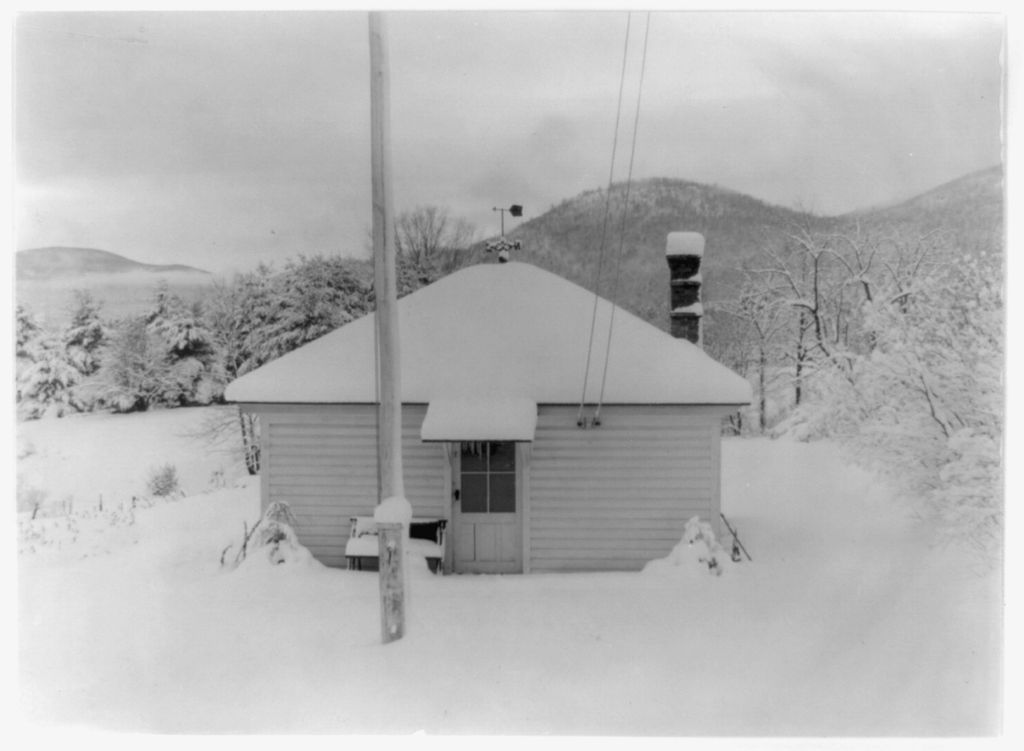
Alfred Stieglitz photographed the shanty in 1923, and the Library of Congress identifies the print explicitly as O’Keeffe’s Lake George studio.[12] The photograph is valuable evidence that the building existed and that its appearance interested another artist in the same circle. It also prevents the painted image from becoming the only surviving visual account through which the structure is imagined.
A second Stieglitz photograph, dated 1922 and preserved in the National Gallery of Art’s Key Set, shows O’Keeffe outdoors carrying this very canvas.[26] The small gelatin silver print joins artist and object at the moment of production, with the painted building held bodily rather than hanging in a gallery. It documents possession and scale without explaining meaning, and gives the painting an unusually vivid pre-exhibition biography.
Comparison should not be reduced to influence. A photograph records light, lens position and a particular instant, while O’Keeffe’s canvas reorganises colour, proportion and surrounding forms through paint. The shared subject instead permits a study of two acts of selection: where each artist stood, how much environment each admitted, and whether the shanty reads as useful building, private retreat, geometric mass or participant in the landscape.[12]
The correspondence archive broadens that context. O’Keeffe and Stieglitz were committed letter writers whose surviving material documents artistic practice, travel and their changing relationship; the Library of Congress warns, by the very structure of the archive, against treating one late recollection as the whole historical record.[12][13] The painting belongs within a network of images, letters, exhibitions and later cataloguing, even when every relevant document is not publicly transcribed.
A public provenance with gaps
Access O’Keeffe lists the Intimate Gallery in the provenance field, while the Phillips records acquisition in 1926.[1][2] Together these establish the decisive transfer from Stieglitz’s commercial exhibition space to Duncan and Marjorie Phillips’s collection. The public entries do not provide a dated invoice, purchase price, exact approval chronology or complete chain of custody before the gallery, so those details should not be inferred.
The absence is modest but worth stating. Museum biographies often turn acquisition into a single clean event, whereas works may move on approval, remain with a dealer, receive changing titles and enter accession systems later. Here, the institutional milestone is secure even though its transactional texture is not fully exposed online, making provenance a distinction between what the object’s record proves and what a fuller archive might eventually clarify.
The painting’s continued place in the historic Phillips house also shapes access, while a recent museum programme invited responses about shelter, labour, decay and relationships with nature.[22] Its current collection page locates it in Gallery D at 1600 21st Street, and Out of Many groups it under “Places: Cities and Landscapes”, though displays can change.[2][23] A work once made to secure solitude now hangs in a domestic-scale museum setting, where its small studio subject encounters visitors inside another converted and expanded private environment.
Ninety years of exhibition movement
After 1923, My Shanty entered Phillips exhibitions in 1926, 1927 and 1928, then travelled to Dartmouth and Williams in 1931.[1] The multi-venue Pioneers of Modern Art in America tour of 1946–47 carried it from the Whitney to university, civic and regional museums across the United States. That itinerary helped position O’Keeffe within a national modernist history rather than only Stieglitz’s circle.
It later served the Art in Embassies programme from 1963 to 1967 and appeared in Phillips, university and thematic exhibitions through the late twentieth century.[1] Two Lives in 1992–93 paired O’Keeffe and Stieglitz across painting and photography, while In the American Grain placed her among Dove, Hartley, Marin and Stieglitz. Each framework made different relations visible and assigned the shanty a different historical job.
The 2013–14 Modern Nature tour to the Hyde Collection, Georgia O’Keeffe Museum and de Young Museum returned it to the full range of Lake George production.[7][8] The 2021–22 retrospective moved through Madrid, Paris and Basel, giving the picture an explicitly international and multilingual reception.[17][21] Exhibition history here is not a list of prestige venues; it is evidence that the work’s meaning changes with the field assembled around it.
The Museo Thyssen-Bornemisza checklist translated the title as Mi cabaña, Lake George and published the owner’s 50.8-by-68.9-centimetre dimensions.[17] “Cabaña” makes the structure sound like a cabin, while “shanty” carries stronger associations of roughness and makeshift construction. Translation therefore transmits the object while subtly altering its social and architectural register for a Spanish-speaking exhibition audience.
The Centre Pompidou presented Lake George as a crucial passage between New York modernism and later New Mexico, describing weathered barns as forms endowed with stability and harmony.[14][15] Its French framing connected O’Keeffe to Romantic landscape, American Transcendentalism and the spiritual thought circulating around Stieglitz.[15] Those traditions enlarge the interpretive field, but the painting’s competitive joke about male approval prevents “spiritual nature” from becoming a complete account.
At the Fondation Beyeler, the retrospective stressed O’Keeffe’s bold way of looking and the alternating places that structured her practice.[16][21] German-language presentation likewise identified Lake George as the origin of a large part of her production at the time.[21] Across languages, the shanty has consequently moved between cabin, barn, studio, landscape and self-image, showing that even apparently simple subject labels contain cultural choices.
Architecture before New Mexico
In September 2026 the Detroit Institute of Arts opened Georgia O’Keeffe: Architecture, assembling nearly forty works around rural New York, New York City and New Mexico.[25] Curator Ben Colman called My Shanty career-defining and treated Lake George’s sheds, barns and farmhouses as the setting in which O’Keeffe developed an architectural language concerned with form, colour, texture, light, balance and composition.[25]
The Phillips Collection compares My Shanty with Ranchos Church, No. II, NM of 1929, arguing that O’Keeffe’s concern with architecture integrated into landscape returned with greater strength in the adobe church.[18] The comparison is useful because it links northeastern boards and southwestern earth without pretending that the buildings, communities or histories attached to them are equivalent.
In both pictures, a simplified façade becomes a large bodily presence and surrounding contours answer its shape. Yet the shanty remains angular, roofed and visibly assembled from timber, while the Ranchos church swells into rounded masses that seem continuous with the ground.[18] Repetition lies in the problem O’Keeffe set herself—how architecture can organise a landscape—rather than in a single formula applied unchanged.
Her Manhattan paintings provide a second comparison. After moving to the Shelton Hotel in 1925, O’Keeffe painted vertical skyscrapers and views across the city, works often narrated as urban opposites to Lake George.[6][14] My Shanty makes that division less secure: years before the city series, she was already testing façade, window, scale and the pressure of a built form against its surroundings.
What the legacy story overstates
The earlier page correctly identified the building as O’Keeffe’s studio, her dark-palette challenge and the landmark Phillips acquisition. It also described the door as open, although the image does not establish that securely, and treated the painting’s nearby pine as the tree beneath which she later buried Stieglitz’s ashes. No authoritative object, archive or owner source found in this research connects a depicted tree to the 1946 burial.
That distinction does not deny that O’Keeffe returned Stieglitz’s ashes to Lake George; it rejects the unsupported identification of one painted tree as the burial place. The picture predates his death by twenty-four years, and its trees are formal components as well as observed vegetation. A later event can deepen associations with a place without retroactively turning every earlier feature into a memorial symbol.
The legacy account also simplified the critical exchange into male friends wanting brighter pictures. O’Keeffe’s own statement is sharper: she recalled being judged as though low-toned painting validated artistic seriousness.[1][2] Restoring that nuance matters because the issue was not a casual request for flowers, but a gendered hierarchy of subject, colour and professional legitimacy that she exposed through parody.
Reading without closing the door
Begin with the window. Its white frame is the smallest high-contrast form, and following its verticals outward reveals how rarely the rest of the painting uses a straight line without interruption. The eye moves from grid to wall, from wall to roof, and from roof to hills, discovering that the apparently dominant building is held in place by a chain of much quieter correspondences.
Then compare the two kinds of darkness. The door and window panes appear almost black, withholding the studio interior, while the brown boards remain varied and exposed to light. This difference lets the building represent privacy without becoming an impenetrable block; work occurs behind the dark openings, but the weathered exterior records time, use and the conditions that made the room necessary.
Finally, keep the rival interpretations in view. Phillips found solitude and mood; O’Keeffe remembered a pointed joke; later curators saw spiritual self-portraiture, formal precision and harmony with landscape.[1][2][14] The painting survives all of them because its structure remains exact and unresolved: a real studio, a public demonstration and a private enclosure whose closed-looking façade says less about what happened inside than its commanding place in the landscape makes us want to know.
Discussion
Which piece of evidence most changes the way you read My Shanty, Lake George?
Reader Insights
Which visible detail most changes your reading of My Shanty, Lake George?
How do medium, setting and documented history shape the encounter?
What remains uncertain when documented fact is separated from interpretation?
Join the Conversation
Share your reading of My Shanty, Lake George below.
References
- Georgia O’Keeffe Museum, Access O’Keeffe, “My Shanty, 1922”, CR 367: View Source
- The Phillips Collection, “My Shanty, Lake George”: View Source
- The Phillips Collection, Breaking It Down: Conversations from the Vault, wall text: View Source
- Georgia O’Keeffe Museum, Access O’Keeffe, “Artist’s Chronology”: View Source
- Library of Congress, “Alfred Stieglitz: Impresario of Art, 1864 to 1946”: View Source
- Library of Congress, “Georgia O’Keeffe: The Making of the Artist, 1887 to 1950, and After”: View Source
- Georgia O’Keeffe Museum, Access O’Keeffe, “Modern Nature: Georgia O’Keeffe and Lake George”: View Source
- The Hyde Collection, “Erin Coe to Return to The Hyde as Director”: View Source
- Georgia O’Keeffe Museum, Access O’Keeffe, “Alfred Stieglitz Presents One Hundred Pictures”, 1923: View Source
- The Phillips Collection, “Phillips Firsts”: View Source
- Georgia O’Keeffe Museum, Exhibiting O’Keeffe: The Making of an American Modernist: View Source
- Library of Congress, “Curator’s Note on the Context of the Correspondence”: View Source
- Library of Congress, “About this Collection: Georgia O’Keeffe and Alfred Stieglitz Correspondence”: View Source
- Centre Pompidou, Georgia O’Keeffe exhibition podcast transcript, English: View Source
- Centre Pompidou, “Georgia O’Keeffe”, 2021 retrospective: View Source
- Fondation Beyeler, “Georgia O’Keeffe”, 2022 retrospective: View Source
- Museo Nacional Thyssen-Bornemisza, Georgia O’Keeffe, list of works: View Source
- The Phillips Collection, “Ranchos Church, No. II, NM”: View Source
- Museo Nacional Thyssen-Bornemisza, “Georgia O’Keeffe in the Thyssen-Bornemisza Collections”: View Source
- The Phillips Collection, “Made in the USA”: View Source
- Fondation Beyeler, Georgia O’Keeffe press kit: View Source
- The Phillips Collection, “What else is it?”: View Source
- The Phillips Collection, Out of Many: Reframing an American Art Collection, checklist: View Source
- The Phillips Collection, Centennial press kit: View Source
- Detroit Institute of Arts, “Seeing Georgia O’Keeffe Anew: A Q&A with Curator Ben Colman”: View Source
- National Gallery of Art, Alfred Stieglitz, Georgia O’Keeffe, 1922, Key Set no. 823: View Source
- PBS, American Masters: Georgia O’Keeffe, season 1, episode 11, premiered 1 September 1986, transcript and film. View Source