

 by Tom Gurney
Tom Gurney BSc (Hons) is an art history expert with over 20 years experience
Published on July 26, 2026 / Updated on September 6, 2026
Email: tomgurney1@gmail.com / Phone: +44 7429 011000
John James Audubon: Introduction
John James Audubon made birds impossible to treat as minor decoration. His great publication, The Birds of America, turned North American species into images of size, drama, color, movement and memory. A heron stands with long wetland patience. A flamingo folds its immense body into a sheet. A hummingbird hovers among flowers. A parakeet, pigeon or woodpecker carries the extra weight of a later world that has lost, nearly lost or still searches for the living bird behind the image.
Audubon was an artist-naturalist, field observer, writer, publisher and performer of his own legend. He was born in Saint-Domingue, raised partly in France, and remade himself in the United States and Britain as the man who could picture the birds of North America more vividly than anyone before him. His career joined outdoor study, specimen collecting, drawing, engraving, subscription publishing, family labor and social persuasion. The result was one of the most famous bodies of natural history art ever printed.
His legacy is powerful because it is not simple. Audubon changed the look of bird illustration, but his work also belongs to a nineteenth-century world of hunting, collecting, slavery, racial hierarchy, settler expansion and self-mythmaking. The strongest way to read him today is with both attention and caution: to see the visual brilliance, to understand the publication labor, to notice the birds as historical subjects, and to remember that beautiful images can come from difficult histories.
At a Glance
- Born26 April 1785, Les Cayes, Saint-Domingue, now Haiti [1]
- Died27 January 1851, New York City [1]
- Known forThe Birds of America, natural history illustration, bird plates, field observation and subscription publishing [2], [3]
- Major publicationThe Birds of America, 435 hand-colored plates, issued 1827-1838 [3], [8]
- Formatdouble-elephant folio, designed for dramatic life-size bird imagery [8], [9]
- Print collaboratorsWilliam Home Lizars and Robert Havell Jr., with hand-coloring and publication labor around the printed plates [2], [8]
- Start withBiography, Works and The Birds of America
Contents
- Introduction
- Why Audubon Matters
- Life, Fieldwork and Reinvention
- The Birds of America
- Image Paths Through the Cluster
- Natural History, Art and Printmaking
- Audubon in American Art
- Public-Domain Access and Image Caution
- A Complicated Legacy
- Where to Begin
Why Audubon Matters
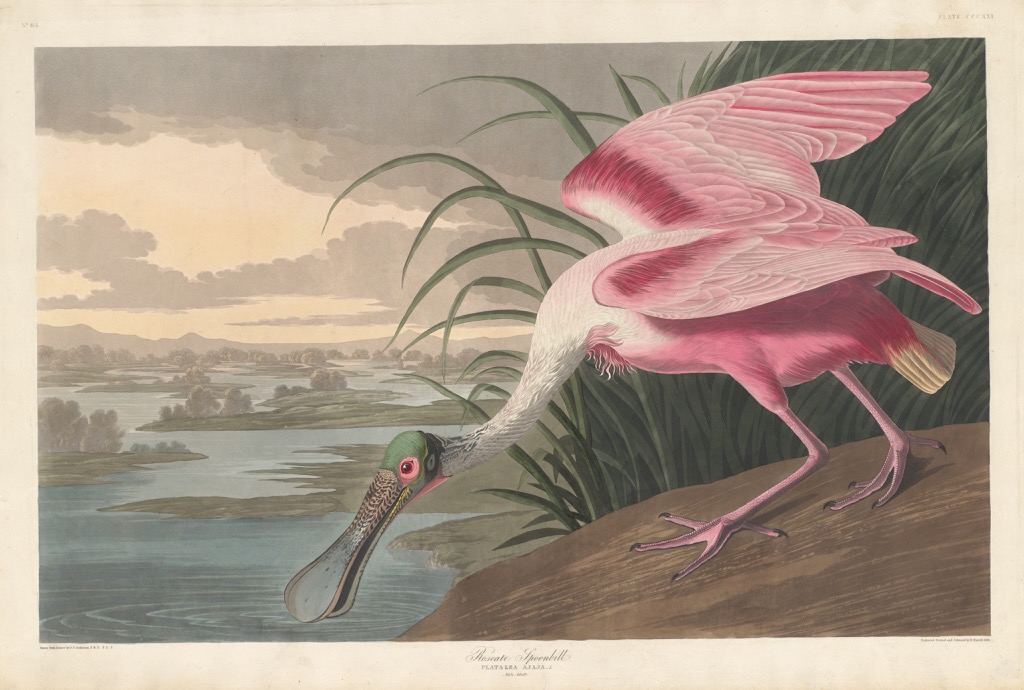
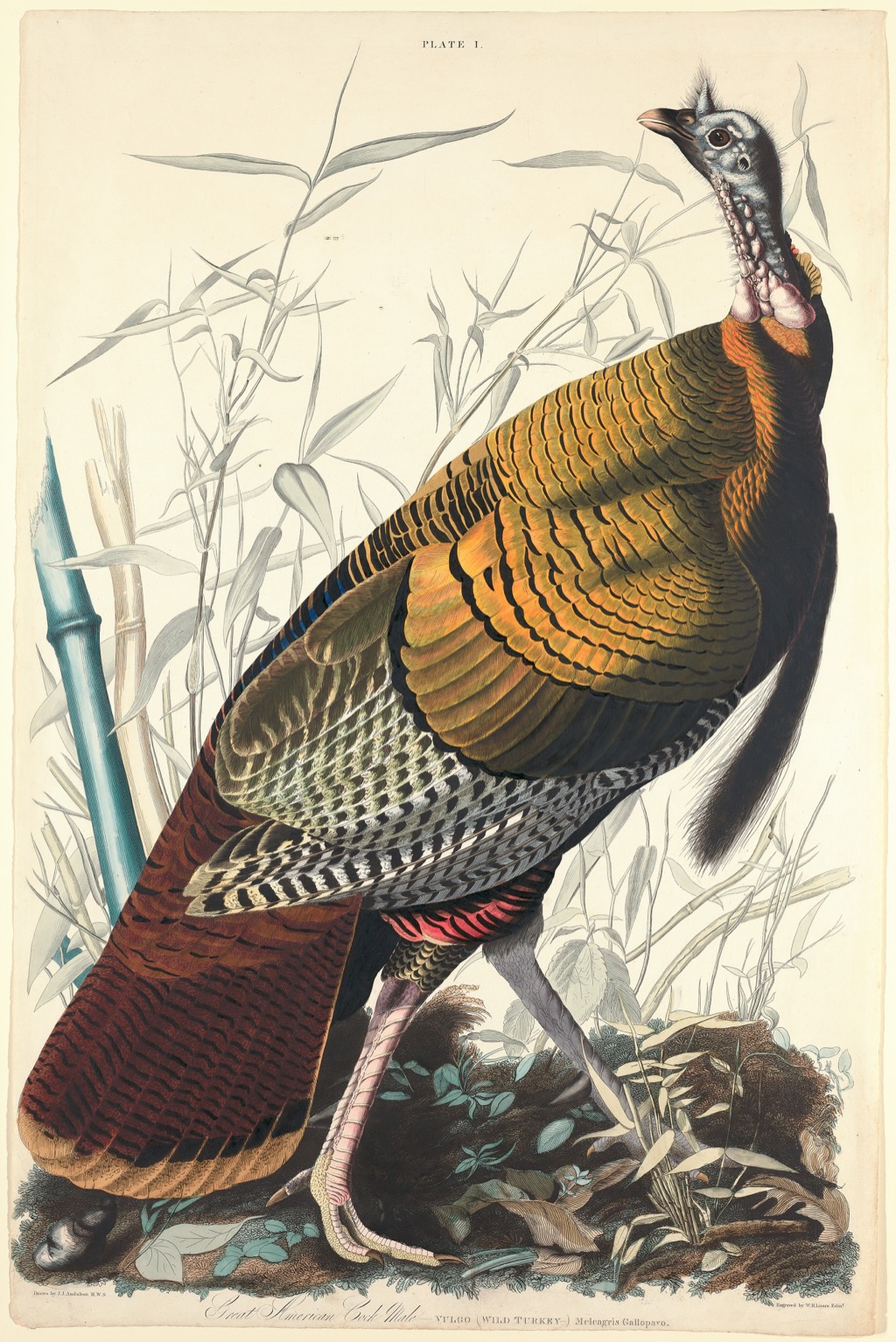
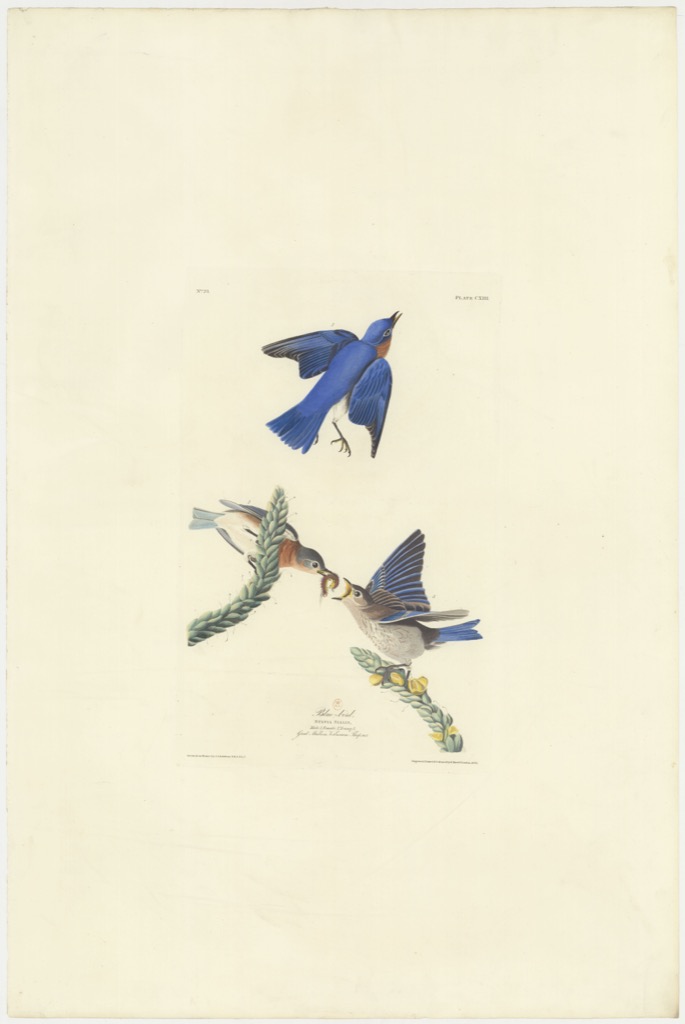
Audubon matters because he made natural history illustration feel physically present. Many earlier bird images were valuable, careful and scientifically useful, but they often favored comparison and profile clarity. Audubon wanted more. He wanted the bird to appear as a living body in a chosen moment: a turkey striding into view, an osprey locking onto prey, a spoonbill bending its peculiar bill, or a small bluebird gathering life around a plant stem.
That pictorial force made The Birds of America more than an identification book. It became a luxury object, a performance of American nature, a test of print technology and a statement about scale. The original double-elephant format let Audubon present many birds at or near life size. For small birds, the large paper gave room for branches, flowers, young, nests and motion. For large birds, it created design problems that became some of his most memorable solutions.
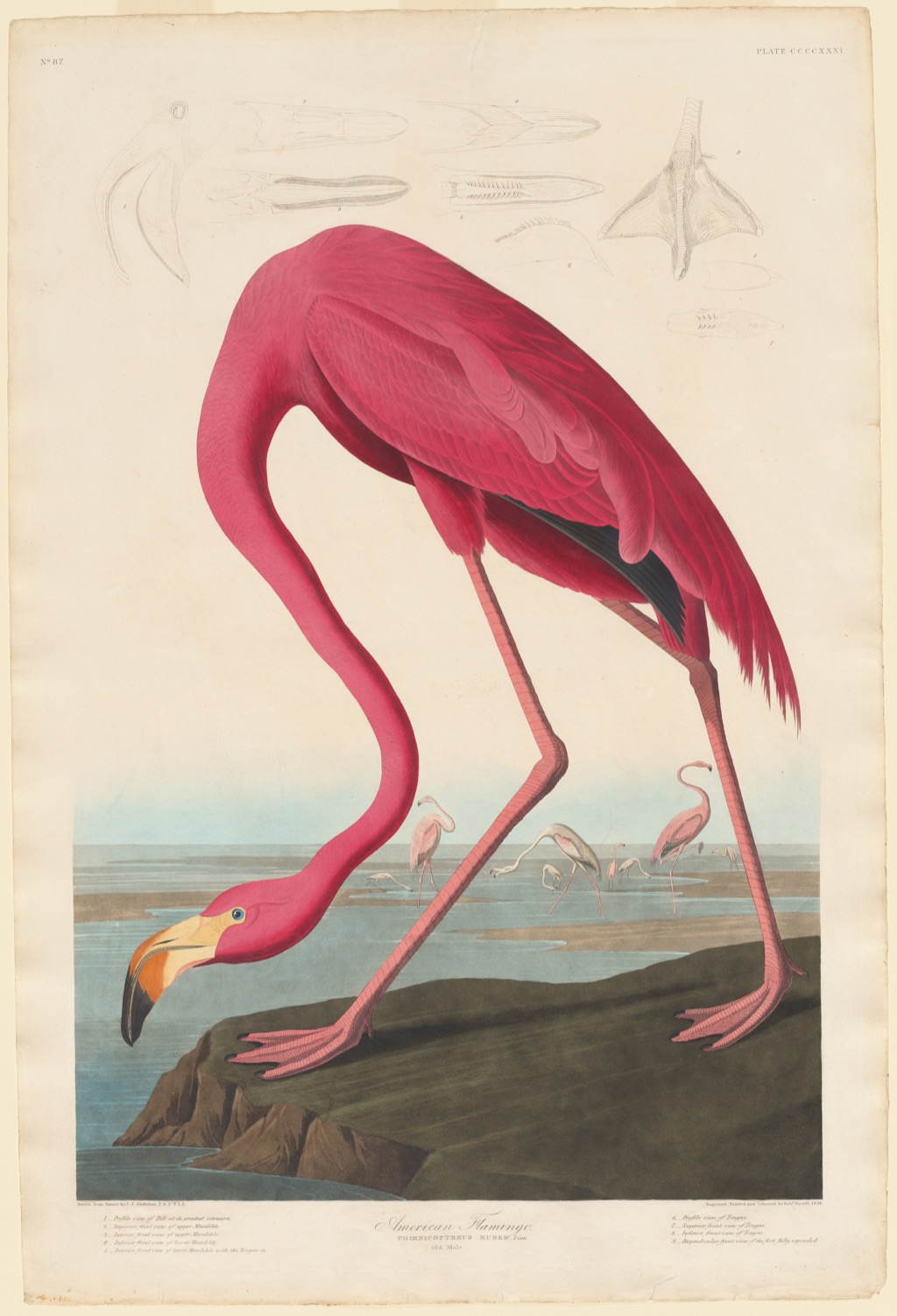
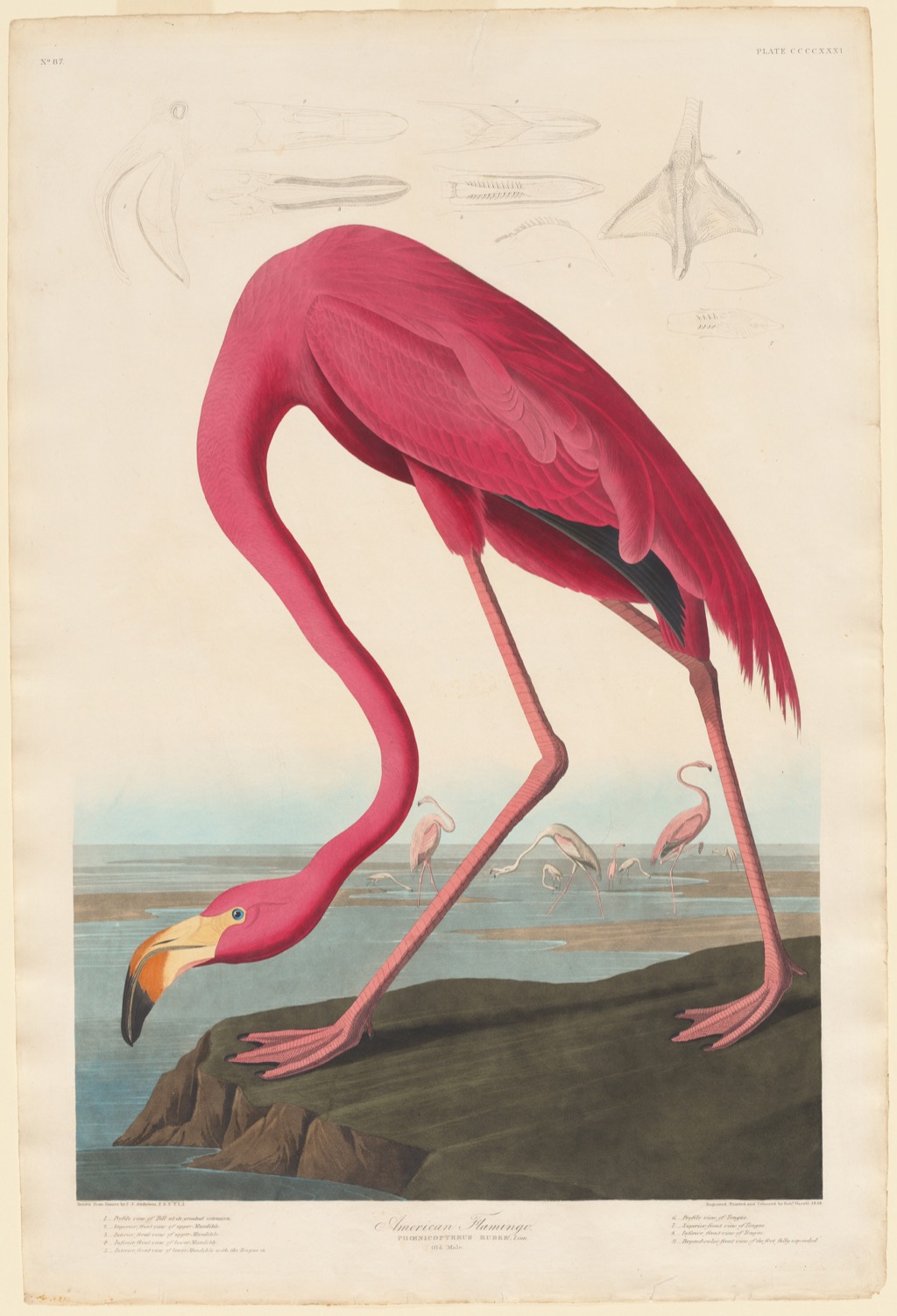
The American Flamingo is one of the clearest examples. A real flamingo is too tall to stand casually on even a huge sheet, so the bird bends into an elegant compressed pose. The result is both an image of a species and a record of Audubon's compositional intelligence. The Wild Turkey, published as Plate I under the historic title Great American Cock, works differently. It opens the publication with a commanding American subject, using posture and scale as a kind of announcement.
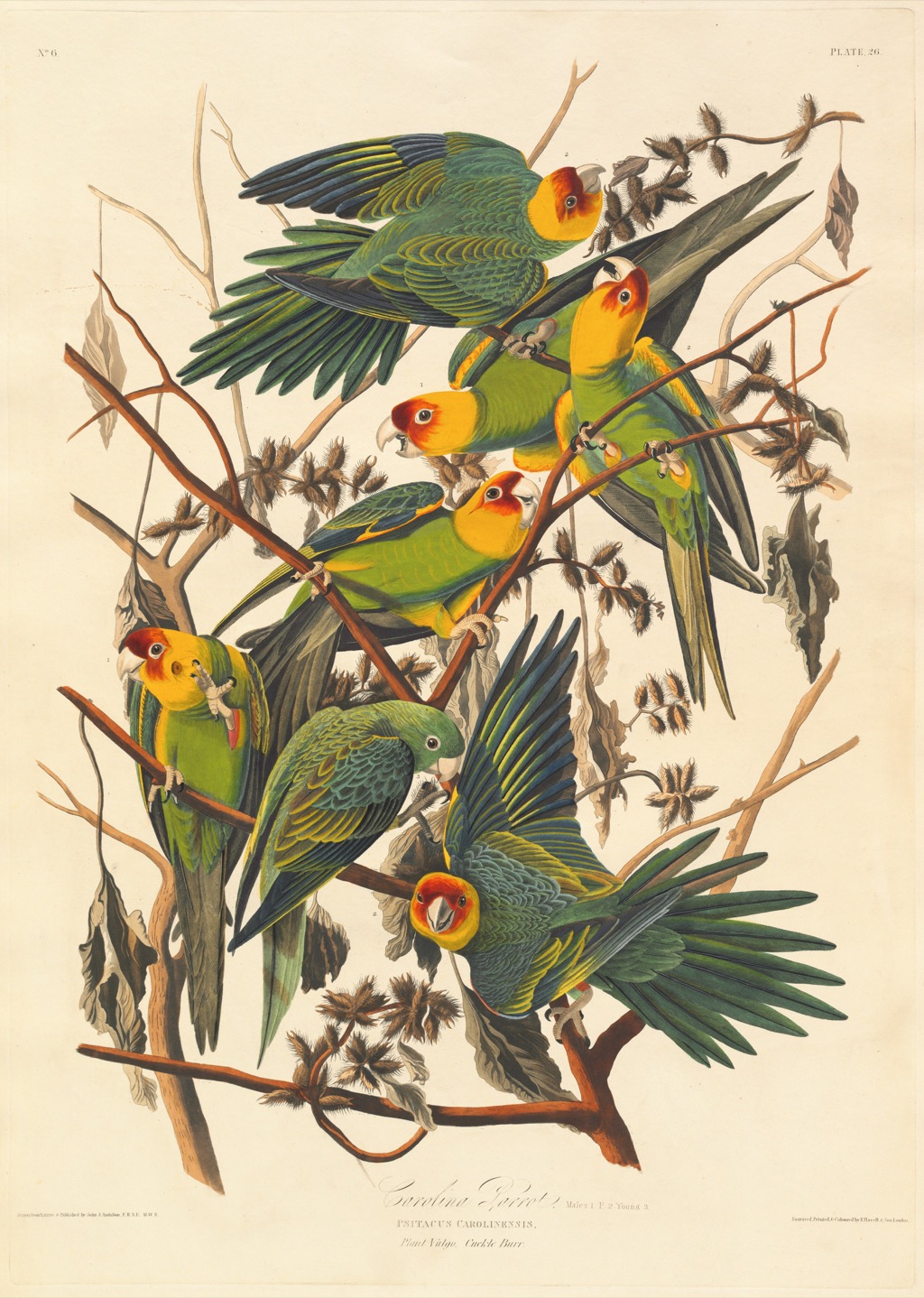
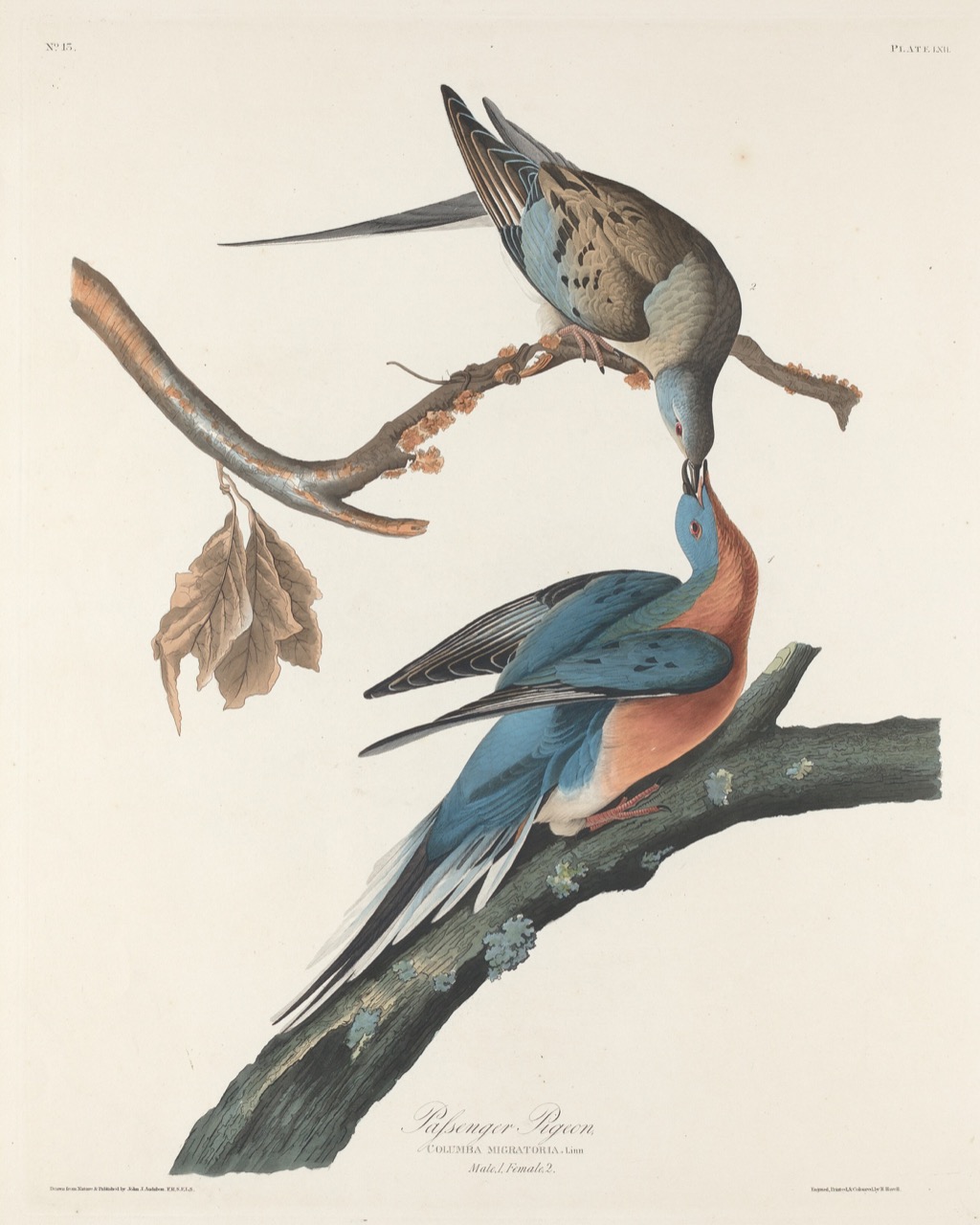
Audubon's images also matter because later history has changed them. The Carolina Parakeet and Passenger Pigeon were not originally made as memorials, but they now show species that disappeared after Audubon's lifetime. The Ivory-billed Woodpecker carries a different modern tension, because the bird has long been linked with lost habitat, rare sightings and cautious conservation language. These works ask viewers to look backward at abundance and forward toward what human activity can erase.
Life, Fieldwork and Reinvention
Audubon's life helps explain the restless energy of the work. He was born Jean-Jacques Rabin in the Caribbean world of French colonial plantation society, then raised in France in his father's household. In 1803 he moved to the United States, where he lived at Mill Grove near Philadelphia and began shaping the identity that would later make him famous. He married Lucy Bakewell in 1808. Her income, teaching, correspondence and practical endurance became essential to the long project that followed.
Before fame, Audubon failed in business. He worked as a merchant and miller in Kentucky and elsewhere, then endured bankruptcy and instability. The collapse did not make drawing easy, but it made drawing more urgent. He moved between portrait work, teaching, taxidermy, collecting and bird study while assembling the visual material that would become his great publication.
Audubon's fieldwork was energetic and physically demanding. He travelled, observed, hunted, collected and wrote. He also used methods modern readers may find disturbing. Like many naturalists of his period, he killed birds for study, arranged specimens and used their bodies as the basis for lifelike poses. That practice is part of the historical reality behind the images. The animation that makes many plates feel alive often came through direct control over dead specimens.
The life story also involves performance. Audubon struggled to gain support in the United States and travelled to Britain in 1826 with his portfolio. There he presented himself as an American woodsman and used personality, dress, stories and drawings to win patrons. This was not a side act. The publication depended on social belief. Subscribers had to trust that Audubon could continue a vast, expensive work across many years.
His public identity was therefore a blend of truth, talent and self-fashioning. He really did travel and observe. He really did draw with extraordinary force. He also shaped stories around himself, sometimes exaggerating or obscuring parts of the record. For a fuller account of the life and its controversies, the John James Audubon Biography gives the broader narrative.
The Birds of America
The Birds of America is the center of Audubon's reputation. Published in Britain between 1827 and 1838, the original folio contains 435 hand-colored plates. It was issued by subscription rather than as an ordinary finished book, so subscribers received groups of plates over time. This structure helped finance the project, but it also kept Audubon under constant pressure to find supporters, manage production and maintain confidence.
The publication's scale remains astonishing. Double-elephant folio paper gave the plates a physical presence that smaller books could not match. A viewer encountering an original volume is not only looking at bird identification. They are confronting paper, printing, hand coloring, luxury, ambition and the practical difficulty of making a continent's birds appear in a coherent printed sequence.
The making of the plates was collaborative. Audubon supplied drawings and designs, but engravers and colorists translated them into printed form. William Home Lizars began the engraving work in Edinburgh. Robert Havell Jr. then became the crucial London collaborator for most of the project. The finished plates combine engraved line, aquatint tone and hand coloring. They carry Audubon's vision, but they also carry print-shop skill.
The companion text, Ornithological Biography, was published separately between 1831 and 1839 with the assistance of William MacGillivray. That text gives descriptions, anecdotes, bird habits and travel writing related to the plates. It is valuable, but it should be read as a nineteenth-century source with its own voice, assumptions and self-presentation.
The dedicated Birds of America section explores this publication in depth: the scale, plate sequence, subscription model, printmaking process, relation between image and text, and the way institutional digital collections now make the work accessible while also separating plates from their original volumes.
Image Paths Through the Cluster
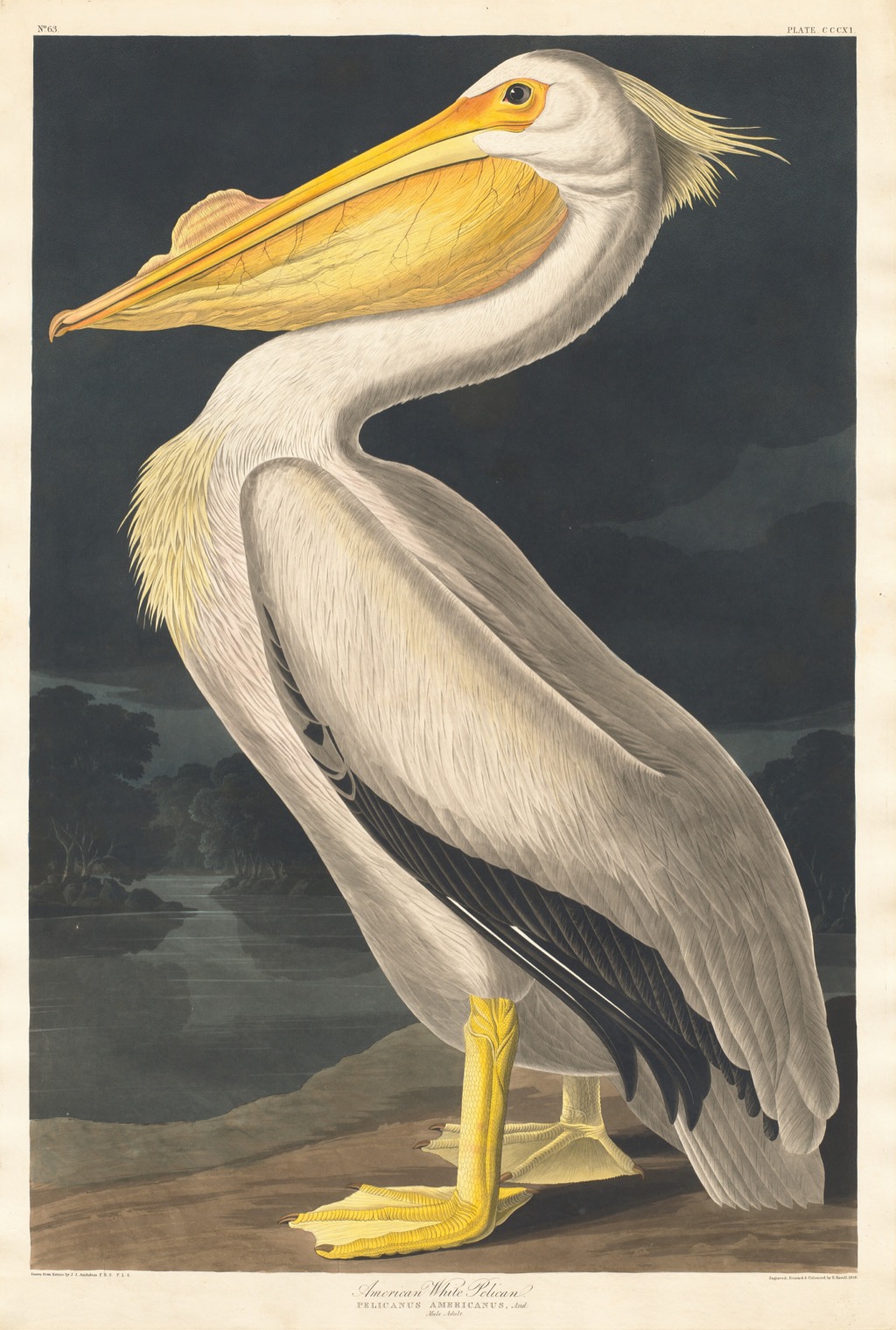
Audubon is easiest to enter through images. Some subjects are famous because of scale. The American White Pelican fills the sheet with pale mass, long bill and a strong sense of bodily weight. The Roseate Spoonbill is instantly memorable for its pink plumage and strange spoon-shaped bill. The Great Blue Heron and Louisiana Heron lead into long-legged wetland forms, patient hunting and historic naming changes.
Other subjects are powerful because of disappearance or uncertainty. The Carolina Parakeet shows the extinct North American parrot in vivid social color. The Passenger Pigeon now carries the memory of a species once described as enormously abundant and later gone. The Ivory-billed Woodpecker needs especially cautious wording because modern sources differ in how they frame the bird's possible survival, rarity and loss.
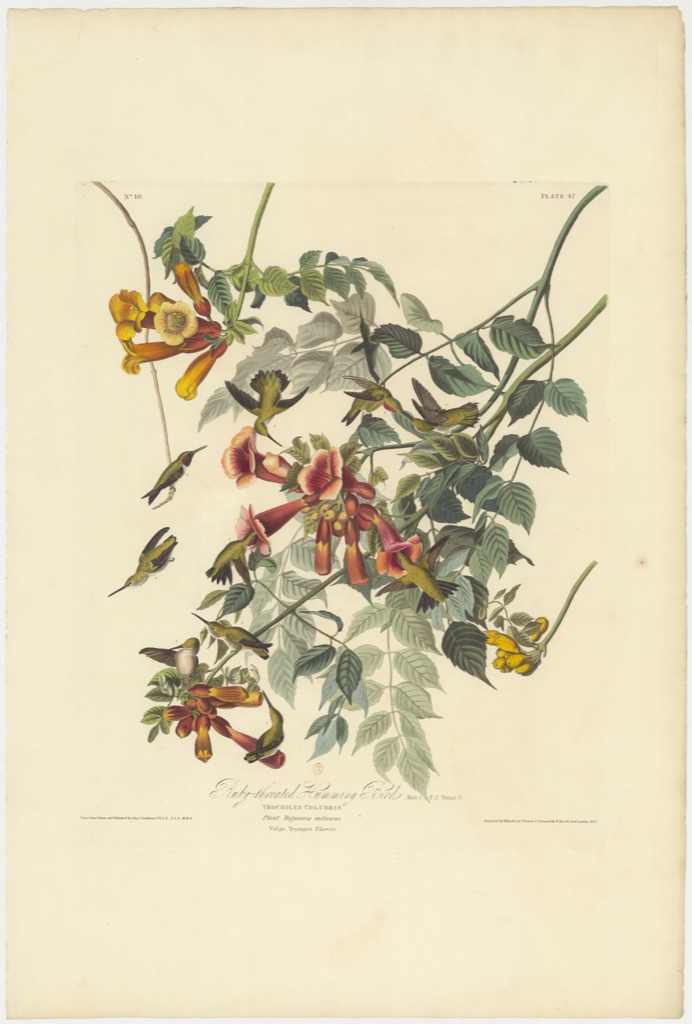
Some of the strongest routes are more familiar or intimate. The Eastern Bluebird connects Audubon's historic Blue-bird plate to a species many readers associate with open country, nest boxes and seasonal return. The Cardinal Grosbeak points toward the Northern Cardinal, with its red plumage and long life in popular bird imagery. The Ruby-throated Hummingbird uses small scale, flower setting and motion to show how Audubon could make a tiny bird active on a huge sheet. The Snowy Owl adds a northern, winter and predatory presence.
The cluster also includes Osprey and Weakfish, an oil painting rather than a standard plate article. It is a useful reminder that Audubon was not only a producer of printed book images. He could also compose action in paint, using predator and prey to turn natural history into visual drama.
Natural History, Art and Printmaking
Audubon's works stand at the meeting point of several disciplines. They are natural history images because they describe birds, names, plumage, behavior and habitat associations. They are works of art because they depend on composition, color, gesture, scale and emotional effect. They are print objects because the most famous images passed through engraving, aquatint, hand coloring, paper and publication management.
This layered identity is why basic object facts matter. A plate title is not only a label. A plate number places the image inside the sequence of The Birds of America. A historic title can preserve older naming systems even when modern species language has changed. A medium line can distinguish a double-elephant folio plate from a later octavo edition, a watercolor study, an oil painting or a modern reproduction.
The difference between historic and current names is especially important. Audubon's Carolina Parrot is now normally discussed as Carolina Parakeet. Louisiana Heron is commonly connected with Tricolored Heron. Cardinal Grosbeak points toward Northern Cardinal. Blue-bird points toward Eastern Bluebird. These shifts do not mean that the old titles were simply wrong in their own time. They show that natural history knowledge is historical and that names carry the systems of the period that produced them.
Printmaking also changes the way authorship should be understood. Audubon's name is central, but the finished plates belong to a network. Havell's work, the labor of colorists, the management of subscribers, the support of Lucy Bakewell Audubon, the involvement of Audubon's sons and the preservation of later institutions all shaped what survives. The single famous name is useful, but it is not the whole production story.
Audubon in American Art
Audubon is sometimes placed beside scientists, collectors and ornithologists before he is placed beside artists. That makes sense, but it can also hide part of his achievement. His bird images belong within the wider story of American artists who used landscape, animals and national subject matter to define a visual language for the nineteenth century. He was not painting vast wilderness scenes in the same way as later landscape painters, but he was doing something just as ambitious with birds. He made North American nature feel large enough to carry cultural meaning.
This is one reason his work speaks across art history and natural history. The plates are built from species observation, yet they often behave like composed pictures. A bird may command the sheet like a portrait sitter. A plant may structure the scene like architecture. A predator-prey moment may carry the tension of narrative painting. A large water bird may use open paper, curve and silhouette in ways that feel close to design. Audubon's art is most interesting when these categories overlap rather than when one is forced to cancel the others.
His work also helps connect bird imagery to older traditions of animal drawing. Artists had long studied animals for symbolism, anatomy, scientific curiosity and pictorial invention. Audubon brought that tradition into a specific American and Atlantic world of travel, collecting, print commerce and publication spectacle. His birds are local species and public performances at once. They promise closeness to nature, but they also ask to be admired as art objects.
That mixture makes him useful for readers who arrive from different directions. A bird lover may begin with the species and then discover engraving, plate order and publication history. An art-history reader may begin with composition and then discover taxonomy, extinction and habitat. A print collector may begin with the object and then return to the bird's body. The homepage route is meant to keep those approaches open, because Audubon's images lose force when they are narrowed too quickly.
Public-Domain Access and Image Caution
Audubon's bird images are widely available online, but not every file has the same evidentiary value or reuse clarity. Responsible study begins with institutional records: museums, libraries and archives that identify the object, edition, title, plate number, medium, dimensions, maker information, credit line and reuse guidance. The National Gallery of Art, Biodiversity Heritage Library, Smithsonian Libraries and Archives, Harvard Library, Yale's Beinecke Library, Boston Public Library, the Bibliotheque nationale de France, Amon Carter Museum of American Art and Museums Victoria are all important routes through the material.
This matters because Audubon images circulate heavily as posters, shop files, unsourced uploads, decorative reproductions and cropped digital fragments. The historic artwork may be old enough for public-domain treatment, but a modern viewer still needs to know which scan, object record or edition is being used. A plate detached from its source may look appealing, but it becomes harder to cite, caption or interpret accurately.
The safest public-facing approach is to treat each image as an object before treating it as an illustration. What is the title on the record? What plate number is given? Is the file from an original Havell folio, a later edition, a museum photograph, a library scan or a derivative? What credit does the institution request? Those questions keep Audubon's art from dissolving into anonymous vintage bird imagery.
A Complicated Legacy
Audubon's name is attached to bird art, natural history and conservation memory, but the person behind the name remains difficult. He enslaved people, expressed racist views and moved through social systems shaped by slavery and colonial power. His collecting methods depended on killing birds. His writings can be vivid and useful, but his stories and claims are not always equally reliable. Modern readers should not smooth those facts away.
At the same time, criticism does not require pretending the art is visually unimportant. Audubon's plates changed how birds could be imagined in print. They influenced wildlife art, natural history publishing and the public image of North American birds. The difficulty is to hold the achievement and the harm in the same frame. That is not a compromise position. It is the only historically honest one.
The later conservation use of Audubon's name adds another layer. He died decades before bird-protection societies adopted that name, and modern institutions continue to debate how to handle it. The tension is understandable. Audubon's images helped many people care about birds, yet his own life does not match a simple conservation hero story. His legacy asks for attention to art, animals, memory, race, science and naming all at once.
This complexity can make the images more meaningful rather than less. The extinct and endangered subjects show how an artwork can outlive the natural abundance it pictured. The beautiful plates show how art can shape care and desire. The difficult biography shows why admiration must be informed by context. Audubon is worth studying precisely because his work remains beautiful, influential and morally unsettled.
Where to Begin
Start with the John James Audubon Biography if you want the life: Saint-Domingue, France, Mill Grove, Lucy Bakewell Audubon, business failure, fieldwork, Britain, publication, later fame and modern reassessment. Move to John James Audubon Works if you want the range of drawings, paintings, prints and book projects. Then read The Birds of America for the double-elephant folio itself.
For a first image group, choose three different kinds of plate. American Flamingo or American White Pelican gives the drama of scale. Carolina Parakeet or Passenger Pigeon brings extinction and conservation memory into view. Eastern Bluebird or Ruby-throated Hummingbird shows how smaller birds could become intimate, lively scenes.
Readers interested in wetland birds can follow Great Blue Heron, Louisiana Heron, Roseate Spoonbill and American White Pelican as a group. Readers interested in familiar North American birds can compare Wild Turkey, Cardinal Grosbeak, Eastern Bluebird and Ruby-throated Hummingbird. The bird drawings and animal drawings sections widen the route beyond Audubon into related traditions of animal and natural history art.
However you begin, the most useful habit is to keep the bird, the object and the history together. Look at the pose. Check the title and plate number. Notice the print process. Ask how the image was made, how it circulated, and what later knowledge has added. Audubon rewards close looking because his works are never only one thing. They are birds, pictures, printed objects, historical documents and arguments about how nature should be seen.
Frequently Asked Questions
Discussion
Audubon's art invites close looking, but it also asks readers to think carefully about natural history, printmaking and historical context.
Use the prompts below to compare the bird images, publication history and complicated legacy without reducing the work to a single reaction.
Reader Insights
Which Audubon plate feels most alive through pose, scale, color or movement?
How does knowing the print process change the way you read the bird image?
How should modern readers balance admiration for the plates with the harder history around their maker?
Join the Conversation
Share your reading of Audubon's work, images and legacy below.
References
- Smithsonian American Art Museum, John James Audubon artist record, accessed 26 July 2026.
- National Gallery of Art, John James Audubon artist and object records, accessed 26 July 2026.
- Biodiversity Heritage Library, The Birds of America, accessed 26 July 2026.
- Biodiversity Heritage Library, Ornithological Biography, accessed 26 July 2026.
- Smithsonian Libraries and Archives, The birds of America record, accessed 26 July 2026.
- Harvard Library, John James Audubon Collection, accessed 26 July 2026.
- Archives of American Art, John James Audubon and Audubon family letters, accessed 26 July 2026.
- Natural History Museum, London, The Birds of America overview, accessed 26 July 2026.
- Yale Beinecke Library, The Double Elephant Folio, accessed 26 July 2026.
- National Gallery of Art, American Flamingo, accessed 26 July 2026.
- Museums Victoria, Ivory-billed Woodpecker object record, accessed 26 July 2026.
- Amon Carter Museum of American Art, Ruby-throated Humming Bird object record, accessed 26 July 2026.
- Cornell Lab of Ornithology, All About Birds species references, accessed 26 July 2026.
- Biodiversity Heritage Library, Alexander Wilson, American Ornithology, accessed 26 July 2026.
- Natural History Museum, London, John James Audubon and The Birds of America, accessed 26 July 2026.
- Victoria Gallery & Museum, University of Liverpool, Audubon Gallery, accessed 26 July 2026.