


 Buy Art Prints Now
from Amazon
* As an Amazon Associate I earn from qualifying purchases.
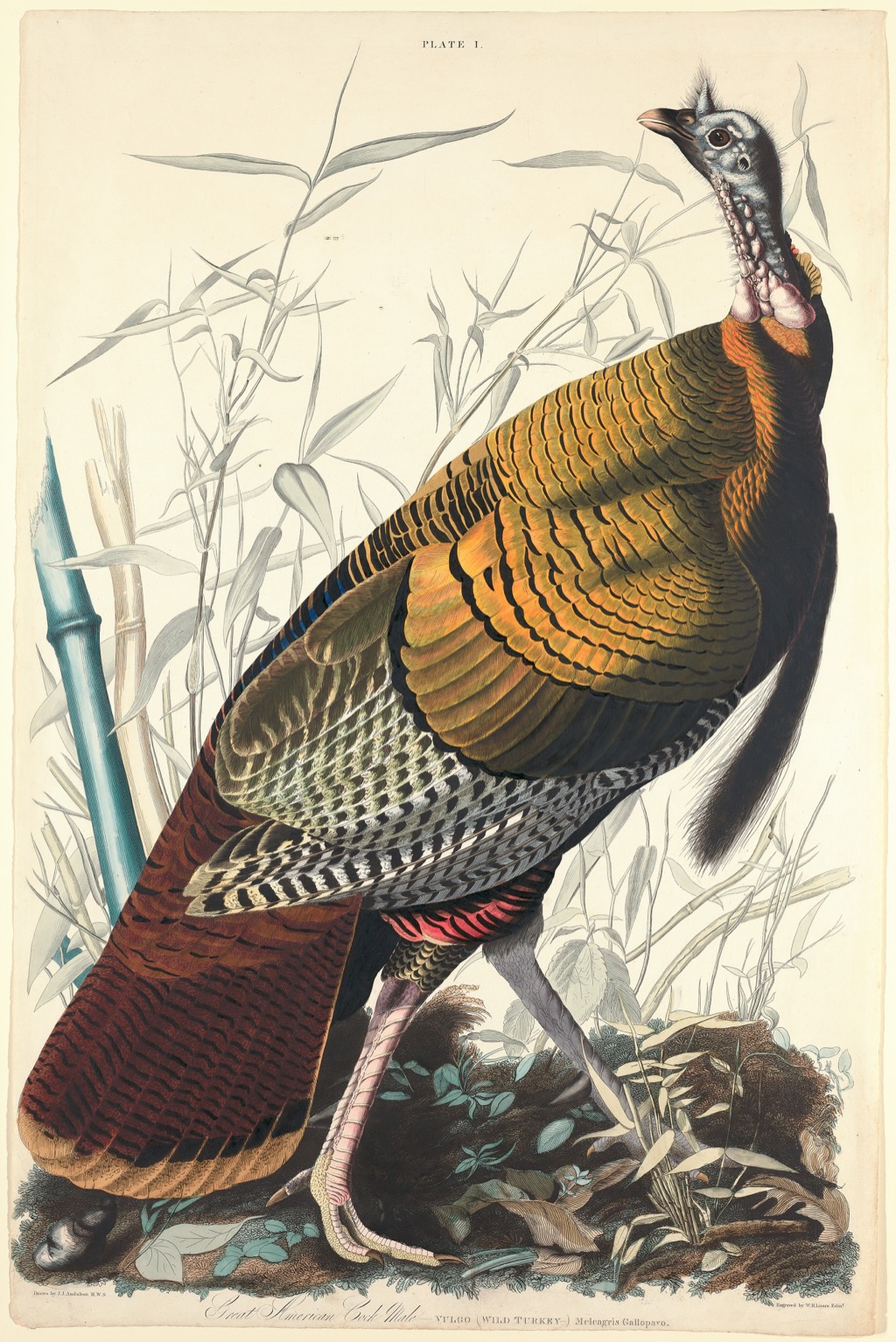
Wild Turkey, published as Great American Cock, Plate I of The Birds of America; National Gallery of Art public-domain object record.
 by Tom Gurney
Tom Gurney BSc (Hons) is an art history expert with over 20 years experience
Published on July 26, 2026 / Updated on September 6, 2026
Email: tomgurney1@gmail.com / Phone: +44 7429 011000
The Birds of America: Introduction
The Birds of America is John James Audubon's monumental book of North American birds, published between 1827 and 1838 and remembered as one of the most ambitious works in the history of natural history illustration. It contains 435 hand-colored plates, usually bound in four huge volumes, and was made on double-elephant folio paper so that Audubon could present birds at or near life size. That scale is central to its impact. The book does not merely identify birds. It asks the viewer to meet them as bodies in motion: feeding, flying, courting, hunting, clinging to branches, guarding nests or filling a sheet with startling physical presence.
The work is also more than a beautiful set of bird pictures. It is a publishing feat, a printmaking project, a scientific document, a performance of American wilderness and a record of nineteenth-century collecting culture. Audubon drew from direct observation, travel, specimens and memory. Engravers and colorists translated his drawings into printed plates. Subscribers funded the project in installments. Libraries, museums and private collectors preserved the volumes that survive.
Modern readers often encounter individual plates online, but the achievement belongs to the book as a whole: paper, copperplate, hand coloring, subscription economics, accompanying text and the sheer burden of making 435 large images cohere. The result changed the visual language of ornithology because Audubon wanted drama, size and behavior as well as identification.
At a Glance
- PublicationThe Birds of America, issued 1827-1838 [1], [3]
- Formatdouble-elephant folio, commonly described at about 38 by 26 inches [5]
- Plate count435 hand-colored plates, usually bound in four volumes [1], [4]
- Print productionengraving, aquatint, printing and hand coloring, with Robert Havell Jr. central to the London production [7]
- Companion textOrnithological Biography, produced with William MacGillivray [2]
- Read nextWorks, Biography and selected plate pages
Contents
- Introduction
- What Is The Birds of America?
- The Double-Elephant Folio
- Publication by Subscription
- The Sequence of Plates
- From Drawing to Plate
- Image and Text Together
- Birds in Motion
- Selected Plates to Start With
- How to Read the Book Today
What Is The Birds of America?
The Birds of America is a large-format illustrated publication based on drawings made by Audubon in the United States and its territories. The original edition was printed in Britain from 1827 to 1838. The title is often used casually for any reproduction of Audubon's bird images, but the historic work refers to the great folio project: 435 plates, printed and colored by hand, issued to subscribers and usually bound into four volumes.
The book was designed around a bold promise. Audubon wanted to show the birds of North America at life size whenever possible. That meant small birds could appear with branches, flowers, insects or nests, while large birds strained against the limits of the paper. The scale gives the work its authority and its theatrical tension. A hummingbird and a pelican do not simply differ in species; they force different solutions to the same sheet.
The publication also had a companion text. Ornithological Biography, issued in five volumes between 1831 and 1839, provided written accounts of the birds, their habits, settings and associated observations. Audubon worked with the Scottish naturalist William MacGillivray on that text. The plates and biographies now tend to be separated in digital collections, but together they formed Audubon's full presentation of North American bird life: image and narrative, spectacle and description.
The Double-Elephant Folio
The phrase double-elephant folio refers to the huge paper size used for the original plates. Institutional descriptions commonly give dimensions around 38 by 26 inches, or about 90 by 67 centimeters. This was among the largest paper formats available to printers, and it gave Audubon room to preserve his life-size ambition.
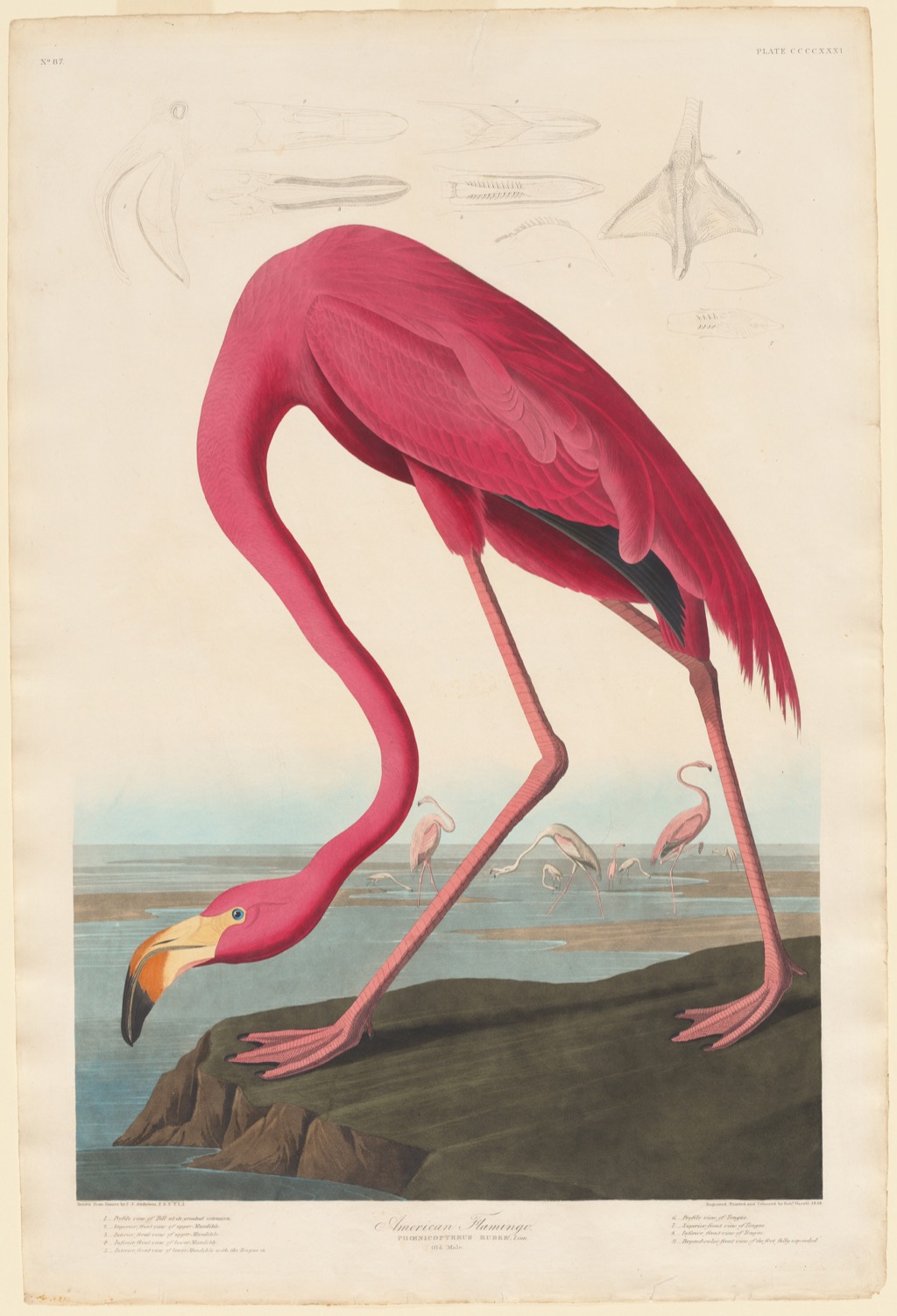
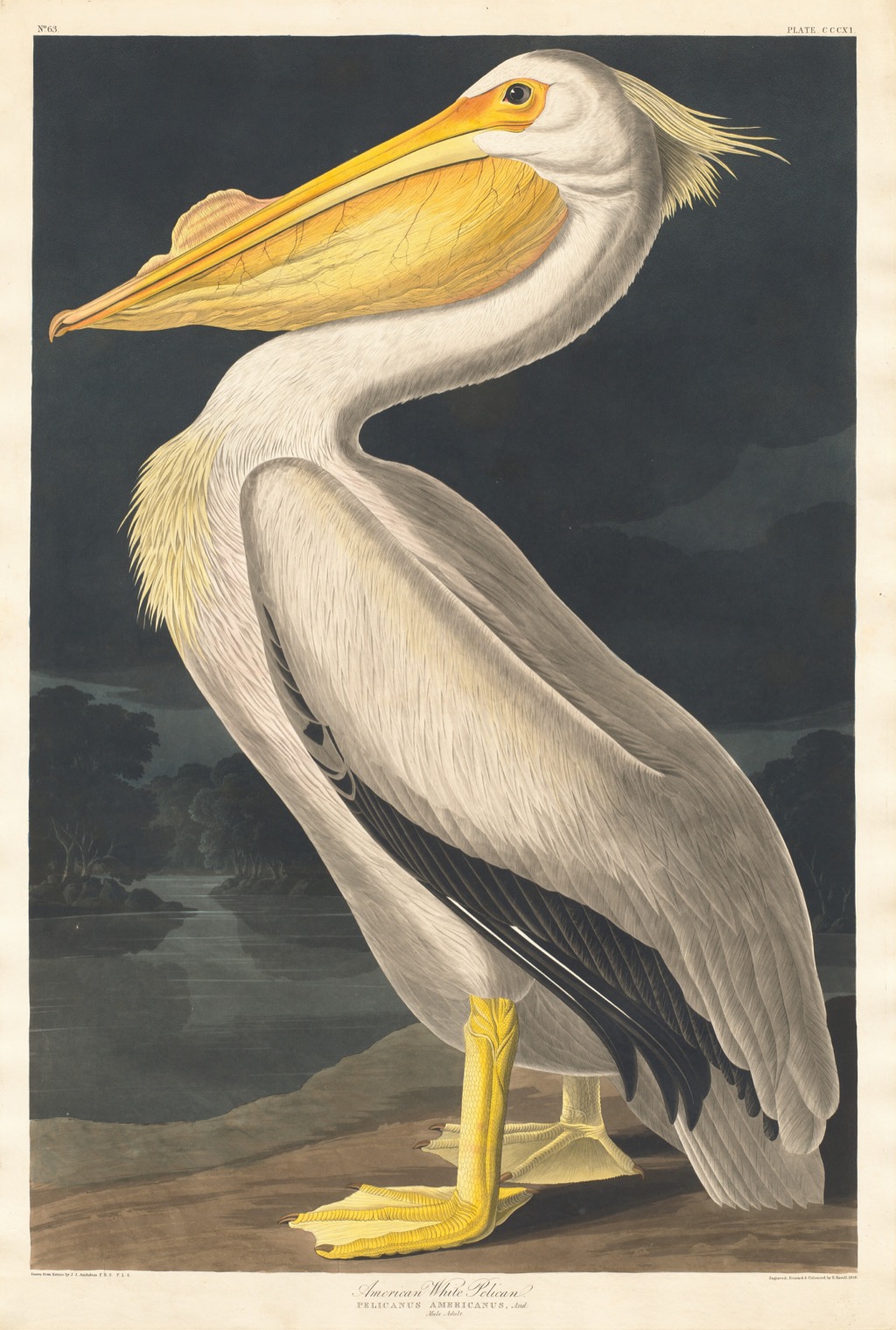
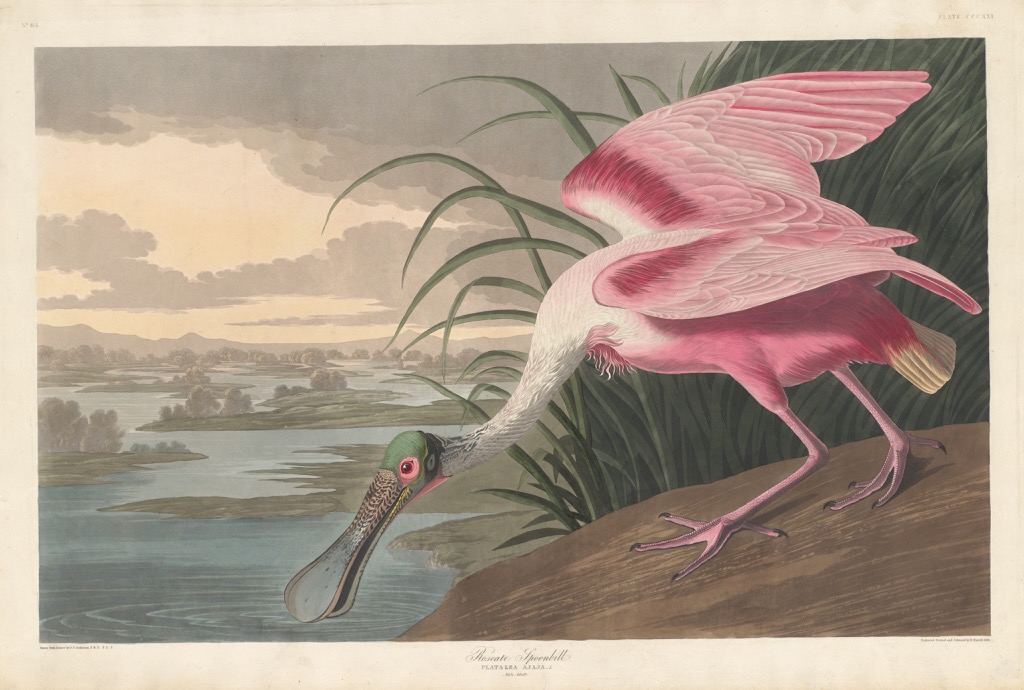
The size is not a decorative footnote. It shaped the entire work. A large bird such as a turkey, flamingo, pelican or heron had to be fitted into the sheet without losing bodily force. The Wild Turkey stands as a commanding opening plate. The American Flamingo bends and folds into the format, making its long body into an elegant design problem. The American White Pelican and Roseate Spoonbill use broad wings, long bills and large pale or pink forms to make the page feel almost sculptural.
For smaller birds, the same format created a different opportunity. Audubon could surround them with plants, nests, branches or other birds, turning scale into intimacy rather than grandeur. The Ruby-throated Hummingbird depends on delicacy and movement. The Eastern Bluebird invites attention to familiar woodland and garden presence. The large sheet allowed small birds to become scenes rather than isolated specimens.
Publication by Subscription
Audubon did not publish The Birds of America as a normal single-volume book. It was issued through subscriptions. Patrons agreed to receive plates in installments, typically in groups that balanced large, medium and small birds. This made the project financially possible, but it also created constant pressure. Audubon had to attract subscribers, maintain their confidence, coordinate production and keep the work moving across more than a decade.
The subscription structure influenced the visual rhythm of the publication. Subscribers did not receive all the most spectacular birds at once. Groups of plates mixed sizes and subjects, helping distribute cost and visual variety. The system also meant that The Birds of America was experienced over time. A subscriber encountered the project as a sequence of arrivals, not as a complete monument from the beginning.
This practical context matters because it explains some of Audubon's public behavior. He was not only an artist-naturalist in the field. He was also a promoter, negotiator and self-mythologizing figure seeking support in Britain and America. The work needed scientific credibility, but it also needed social confidence. It had to persuade people that the vast undertaking would continue long enough to be worth funding.
The model brought risk. Large paper was expensive. Engraving and coloring were expensive. Shipping, binding and subscriber management were expensive. The work's success depended on sustained belief in Audubon's promise. That promise was partly scientific, partly artistic and partly national: North American birds deserved a publication as grand as any European natural history book.
The Sequence of Plates
The 435 plates were not simply arranged as a modern field guide might arrange them. The sequence reflects the publication's installment structure and the need to balance visual size and subscriber expectation. Large, medium and small birds were distributed across the issue pattern, giving subscribers variety while spreading the most technically demanding subjects across the project.
This is one reason plate numbers matter. Plate I, the Wild Turkey, carries symbolic force because it opens the whole project. The Carolina Parakeet appears early as Plate XXVI, a brilliant group image now shadowed by extinction. The Ruby-throated Hummingbird appears as Plate XLVII, showing how small birds could become animated scenes. The Passenger Pigeon follows as Plate LXII, a number that now feels strangely early for a species later remembered through disappearance.
Later plates show the publication gathering range and confidence. The Snowy Owl appears as Plate CXXI. The Cardinal Grosbeak appears as Plate CLIX. Wetland and water-bird subjects gather in the middle and later volumes, including the Great Blue Heron as Plate CCXI, Louisiana Heron as Plate CCXVII, American White Pelican as Plate CCCXI and Roseate Spoonbill as Plate CCCXXI. The American Flamingo is near the end as plate number 431.
From Drawing to Plate
The finished plates are printed images, but they began as drawings and watercolors. Audubon drew birds from observation, collected specimens and arranged poses. He wanted activity and character, so he often arranged birds in ways that went beyond static identification. A bird might twist, attack, feed, display or stretch across a branch. The pose made the plate memorable, but it also made the image a constructed scene.
The process was demanding because the printed plate had to carry many kinds of information at once. It needed the proportions of the bird, the character of feathers and bill, the relation to plants or prey, and the composition that made the image worth owning. Audubon's original drawings supplied the design, but printmaking transformed that design into a reproducible object.
The first plates were associated with William Home Lizars in Edinburgh. After difficulties there, the project moved to London, where Robert Havell Jr. became the central engraver, printer and colorist for the publication. Havell's role was not mechanical. He had to translate Audubon's designs into etched and engraved copperplates, manage tonal and textural effects, and oversee hand coloring that could preserve the vitality of the image across many impressions.
Engraving, Aquatint and Hand Coloring
The original folio plates were made through engraved and aquatinted copperplates, then finished with hand coloring. Engraving could define line, feather structure, outlines, eyes, feet and inscriptions. Aquatint could create areas of tone, atmosphere and softness. Hand coloring brought plumage, vegetation, water, sky and anatomical details to life.
This combination helped Audubon achieve a balance between precision and effect. The sharpness of the plate could support identification. The color could make the bird feel fresh, dramatic or luminous. In a plate such as the American Flamingo, color is inseparable from subject. In the Roseate Spoonbill, the pink body and strange bill make the bird instantly memorable. In the Louisiana Heron, now commonly connected with the Tricolored Heron, the long-legged form depends on both linear elegance and tonal restraint.
Because the plates were hand colored, each impression has a human finish. The work is reproducible, but not purely mechanical. Different surviving copies may vary in condition, color freshness, trimming, binding history and institutional treatment. That is one reason museum and library records matter. They identify not just the subject, but the particular object being viewed.
Image and Text Together
Ornithological Biography is essential to understanding The Birds of America. The folio plates were issued without descriptive text in the same volumes, but Audubon and MacGillivray supplied a separate written work that described the birds and their habits. The title itself makes the relationship clear: it presents accounts of birds represented in The Birds of America and adds observations of American scenery and manners.
The written biographies gave Audubon space for anecdote, habitat, behavior, travel memory and scientific description. They also reveal the mixture of knowledge and storytelling that runs through his career. Some passages can be vivid and valuable. Others need to be read critically, especially when Audubon's claims, memories or self-presentation become difficult to verify. Modern readers should treat the text as a historical source, not as neutral field data.
This is why a publication hub is useful. Individual bird articles can look closely at a plate and species. A works overview can place Audubon among drawings, paintings and print culture. But The Birds of America needs its own space because the book's meaning lies in the system: plates, text, subscriptions, engravers, institutions and the ambition to picture a continent's birds.
Birds in Motion
Audubon's most famous innovation was not simply scale. It was animation. He wanted birds to seem alive and characteristic. Institutional accounts emphasize how striking this was against older conventions of painting mounted specimens. Audubon's birds often appear in natural settings and dramatic behavior, even when the actual working process involved collected bodies and arranged poses.
The tension between life and staging is part of the work's power. The Passenger Pigeon can be read as an image of abundance before extinction. The Ivory-billed Woodpecker now carries associations with rarity and lost habitat. The Carolina Parakeet appears vivid and social, but modern viewers know the species disappeared. Audubon did not create these plates as memorials, yet later history has changed them into images of absence as well as presence.
Even birds that remain familiar gain intensity through Audubon's staging. The turkey is not a small taxonomic entry. It is a large bird occupying the opening of the sequence. The hummingbird is not only a tiny identification subject. It becomes a study in suspended movement, scale and delicacy. The herons and pelicans are not merely wading birds. They are exercises in long anatomy, balance, curve and extension.
Selected Plates to Start With
No single article can responsibly treat all 435 plates in detail. A better way into The Birds of America is through a focused set of representative works. The group below uses public-domain National Gallery of Art object records already prepared for this Audubon cluster.
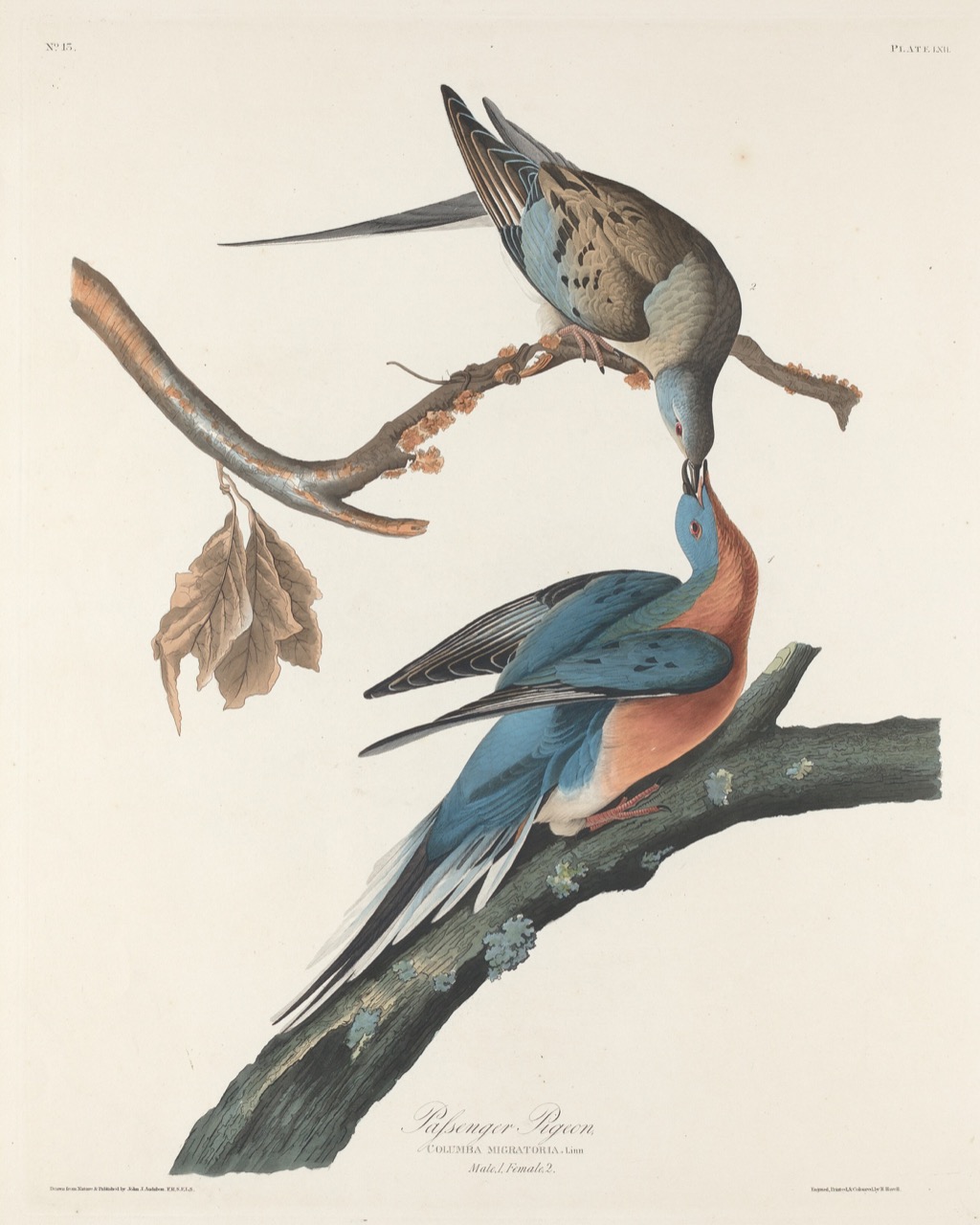
These selected works should be read as paths into the book, not as a replacement for the full sequence. Together they reveal the range: opening statement, decorative grandeur, extinct species, wetland birds, small birds, familiar birds and taxonomic change.
Public-Domain Access and Institutional Copies
One reason The Birds of America remains so visible today is that many institutions have digitized copies, records or related materials. The Biodiversity Heritage Library gives readers access to historic volumes and related texts. Smithsonian Libraries and Archives holds and describes Audubon material, including later editions and scanned book access. The National Gallery of Art provides object records for many individual plates, with detailed media, dimensions, accession numbers and catalogue references. Harvard Library preserves early drawings, letters, manuscripts and related records that help connect the finished publication to Audubon's working life.
These institutional records are important because The Birds of America is heavily reproduced. A viewer may encounter the same bird through a museum record, a library scan, a later edition, a poster, a commercial print, an encyclopedia image or an unsourced online file. The historic artwork may be old enough to be public domain, but each digital file still comes from somewhere. Responsible use depends on the specific institution, object record, edition, credit line and reuse terms.
Later Editions and Reproductions
The fame of The Birds of America did not remain locked inside the original folio. Later editions, especially smaller octavo forms, helped carry Audubon's images to wider audiences. Smithsonian records for later editions show how the plates were adapted to reduced size and connected to the text of Ornithological Biography. The Metropolitan Museum of Art identifies the first octavo edition of 1840-1844 as a smaller publication sometimes known as The Birds in Miniature.
Shrinking the format changed the images. The subject, composition and many details remained recognizable, but the physical encounter shifted. A life-size bird became a portable illustration. A luxury subscription plate became a more accessible book image. This widening of access helped make Audubon's birds familiar, but it also separated many viewers from the scale that defined the original project.
Later reproduction has continued that transformation. Audubon images circulate as fine-art prints, educational illustrations, digital files, posters and decorative objects. Some reproductions preserve strong source information. Others strip away title, plate number, edition and maker. For a reader trying to understand the art, those details are not secondary. They tell us whether we are looking at the original folio design, a later edition, a facsimile or a modern derivative.
How to Read the Book Today
A first reading of The Birds of America should begin with scale. Ask how the bird occupies the sheet. Does it fill the format? Does it bend to fit? Does the scene give space to plants, water, sky or additional birds? Audubon often turns physical limitation into composition.
A second reading should look for behavior. Is the bird feeding, hunting, displaying, nesting or moving? Is the behavior observed, arranged, generalized or theatrical? The answer is not always simple. Audubon wanted natural life, but his working methods often involved specimens arranged into poses. The liveliness of the plates should be admired with that history in mind.
A third reading should notice the print. The plate is not only a picture of a bird. It is a manufactured image with inscriptions, plate numbers, paper, engraved lines, aquatint tone and hand coloring. Its beauty depends on technical collaboration. Robert Havell Jr. and the print-shop labor behind the folio deserve attention whenever the publication is discussed.
Finally, the reader should resist two easy extremes. The Birds of America is not simply a neutral scientific book, and it is not merely a set of decorative vintage images. It is a work of art, science, commerce and history. Its plates are beautiful because they are carefully made, but their meanings are complicated because they come from a world of collecting, ambition, empire, violence toward animals, print labor and changing ecological memory.
Why The Birds of America Still Matters
The Birds of America still matters because it made birds visually monumental. It gave North American species a scale and drama usually reserved for history painting, portraiture or luxury illustrated books. It showed that natural history illustration could be exacting, theatrical and emotionally powerful at once.
It also matters because it is a record of collaboration. Audubon's name dominates the title, but the finished publication required engravers, colorists, subscribers, printers, family members, scientific colleagues, collectors and later institutions. The book is a reminder that artistic fame often compresses a network into a single signature.
Most of all, it matters because the plates continue to change as the world around them changes. The John James Audubon Works overview shows how the book fits into his larger career. The John James Audubon Biography explains the life and controversies behind the achievement. This publication stands between them: a vast printed attempt to make birds visible, memorable and desirable, now read with admiration, caution and a sharper awareness of what has been lost.
Frequently Asked Questions
Discussion
The Birds of America invites readers to think about birds, images, books and historical memory at the same time.
Use the prompts below to compare scale, sequence, printmaking and the modern meanings attached to Audubon's plates.
Reader Insights
Which selected plate best shows why Audubon wanted a huge folio format?
How does knowing a plate number change the way you read the image?
What changes when the plate is understood as engraving, aquatint, paper and hand coloring rather than only as a bird picture?
Join the Conversation
Share your reading of The Birds of America, its plates and its publication history below.
References
- Biodiversity Heritage Library, The Birds of America, accessed 26 July 2026.
- Biodiversity Heritage Library, Ornithological Biography, accessed 26 July 2026.
- Smithsonian Libraries and Archives, The birds of America record, accessed 26 July 2026.
- Natural History Museum, London, The Birds of America overview, accessed 26 July 2026.
- Yale Beinecke Library, The Double Elephant Folio, accessed 26 July 2026.
- Harvard Library, John James Audubon Collection, accessed 26 July 2026.
- Biodiversity Heritage Library, The Copper-Plates of the Folio Edition of Audubon's Birds of America, accessed 26 July 2026.
- Metropolitan Museum of Art, The Birds of America, first octavo edition record, accessed 26 July 2026.
- National Gallery of Art, John James Audubon artist and object records, accessed 26 July 2026.
- National Gallery of Art, Great American Cock, accessed 26 July 2026.
- National Gallery of Art, American Flamingo, accessed 26 July 2026.
- National Gallery of Art, American White Pelican, accessed 26 July 2026.
- National Gallery of Art, Roseate Spoonbill, accessed 26 July 2026.
- National Gallery of Art, Passenger Pigeon, accessed 26 July 2026.