

 by Tom Gurney
Tom Gurney BSc (Hons) is an art history expert with over 20 years experience
Published on July 26, 2026 / Updated on September 6, 2026
Email: tomgurney1@gmail.com / Phone: +44 7429 011000
Roseate Spoonbill: Introduction
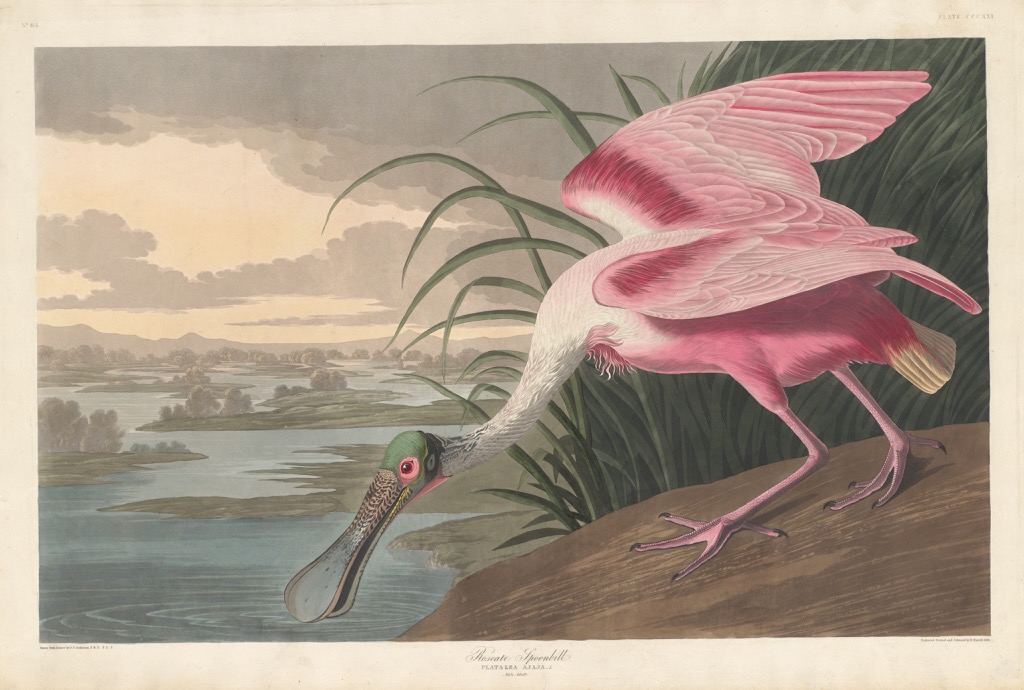
John James Audubon's Roseate Spoonbill is one of the most immediately attractive plates in The Birds of America. The subject is a large pink wading bird, now identified as Platalea ajaja, shown in side view on a sloped bank at the edge of water. Its head leans down toward the left, its long bill flares into the spoon shape that gives the bird its common name, and its pale neck connects a greenish head to a body flushed with pink. The wings are slightly lifted, the legs and feet are pink, and the background opens into a quiet wetland of water, grasses, land and soft sky. [1], [5]
The National Gallery of Art records the work as Roseate Spoonbill, dated 1836, by Robert Havell after John James Audubon. It is a hand-colored engraving and aquatint on Whatman wove paper, accession number 1945.8.321, and is catalogued as Birds of America, no. 321. The NGA record also states that the object's media is free and in the public domain. Those details make the plate unusually well anchored for modern readers, because the image can be connected to a specific museum record rather than treated as an anonymous historic bird picture. [1]
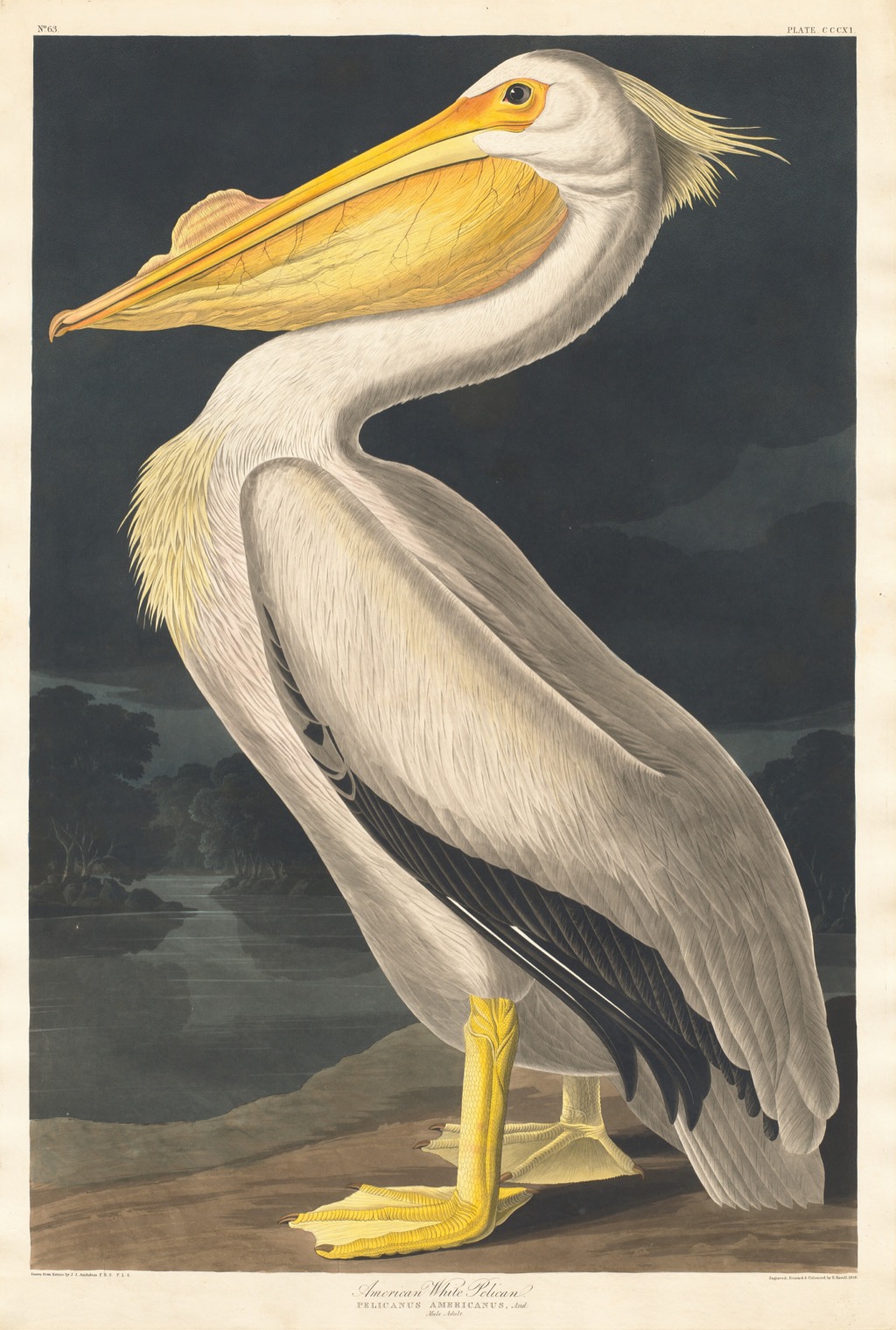
The appeal of the plate is obvious, but its interest goes beyond color. Audubon and Havell turn an unusual bird into a study of bill shape, wetland posture, food-derived plumage and folio-scale design. Unlike the American White Pelican, which depends on mass and whiteness, or the Great Blue Heron, which depends on height and reserve, the spoonbill is built around curve, pinkness and tactile feeding. It is decorative, but it is not merely decorative.
At a Glance
- Public titleRoseate Spoonbill
- SeriesThe Birds of America, Plate CCCXXI [1]
- Catalogue referenceBirds of America, no. 321 [1]
- Date1836 [1]
- Maker lineRobert Havell after John James Audubon [1]
- Mediumhand-colored engraving and aquatint on Whatman wove paper [1]
- AccessionNational Gallery of Art, 1945.8.321 [1]
- Current species namePlatalea ajaja [5], [8]
- Image statusNGA public-domain media route [1]
Contents
- Introduction
- Annotated Details
- Object Facts
- What the Plate Shows
- Pink, Pale and White
- The Bird Behind the Image
- The Spoon-Shaped Bill
- Wetland Setting
- Place in The Birds of America
- Printmaking and the Folio Page
- Natural History and Modern Conservation
- Why This Plate Matters
Annotated Details from Roseate Spoonbill
These annotated details follow the Roseate Spoonbill through bill, eye, neck, pink plumage, wing, feet, marsh plants and distant water, keeping the reading close to what is visible in the plate.
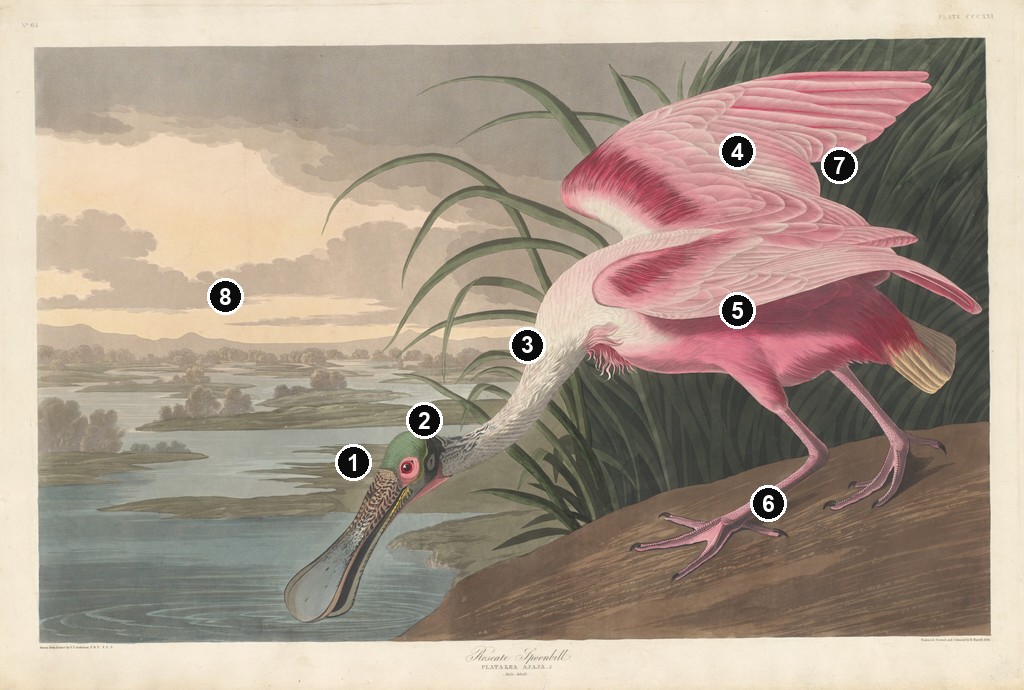
Details from ROSEATE SPOONBILL
Close looking shows how Audubon builds a vivid bird image from a specialized bill, delicate feather layering, environmental setting and a strong diagonal stance.
Spoon-shaped bill
The broad, flattened bill is the plate's clearest identifying form. Its shape gives the bird an almost tool-like presence at the edge of the water.
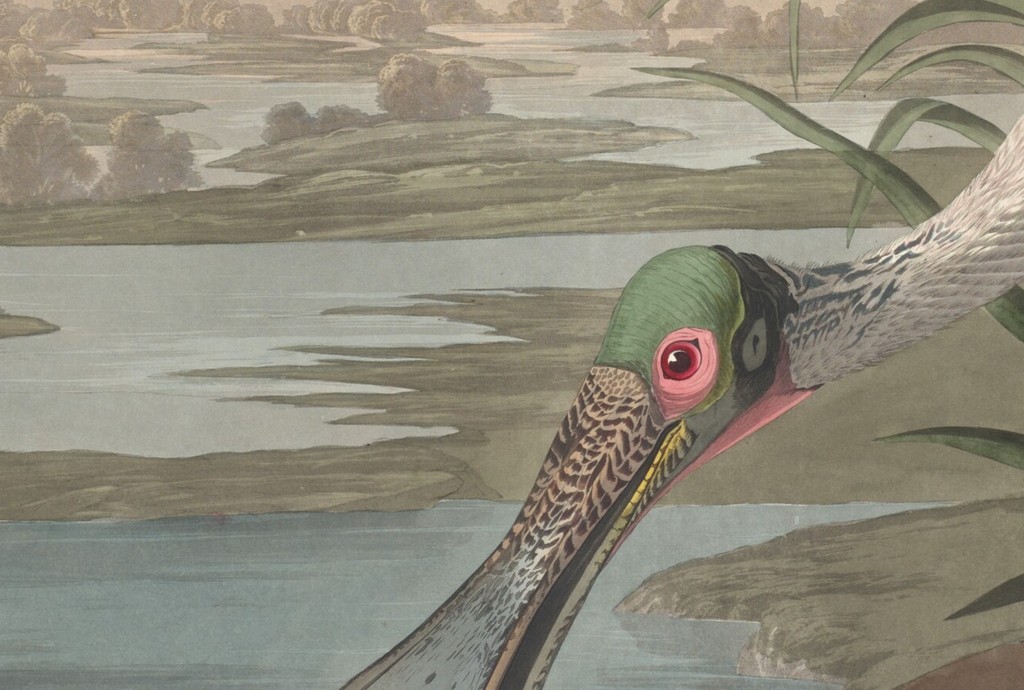
Eye and patterned head
The red eye and patterned head sit between decorative colour and natural-history precision. This small area carries much of the bird's character.
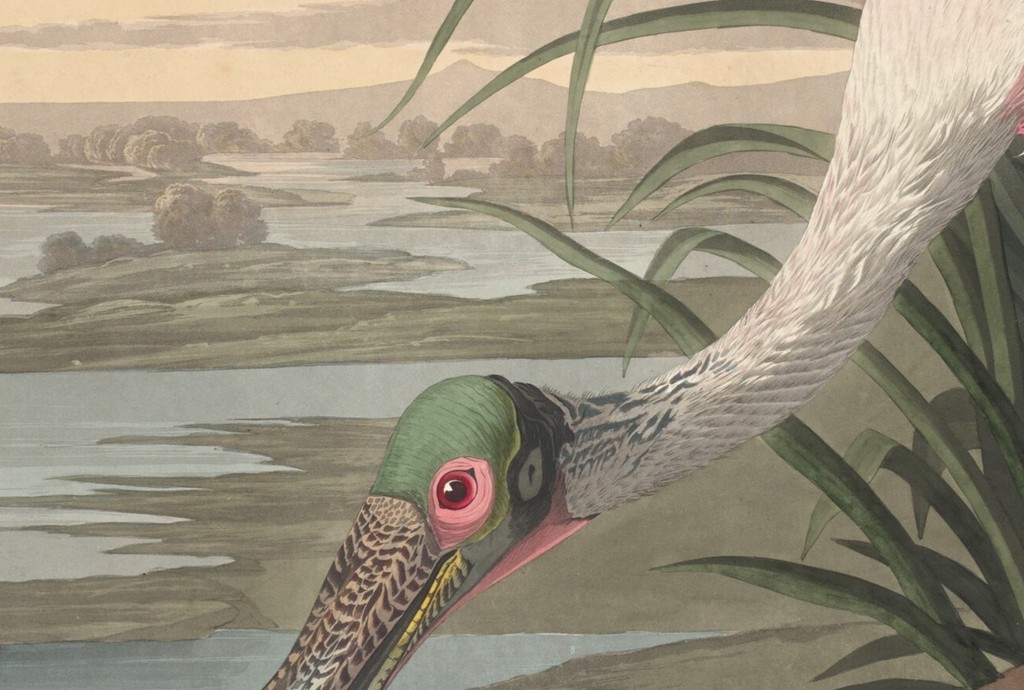
Extended neck
The long neck directs the viewer from the body down toward the bill. It makes feeding posture into the plate's main movement.
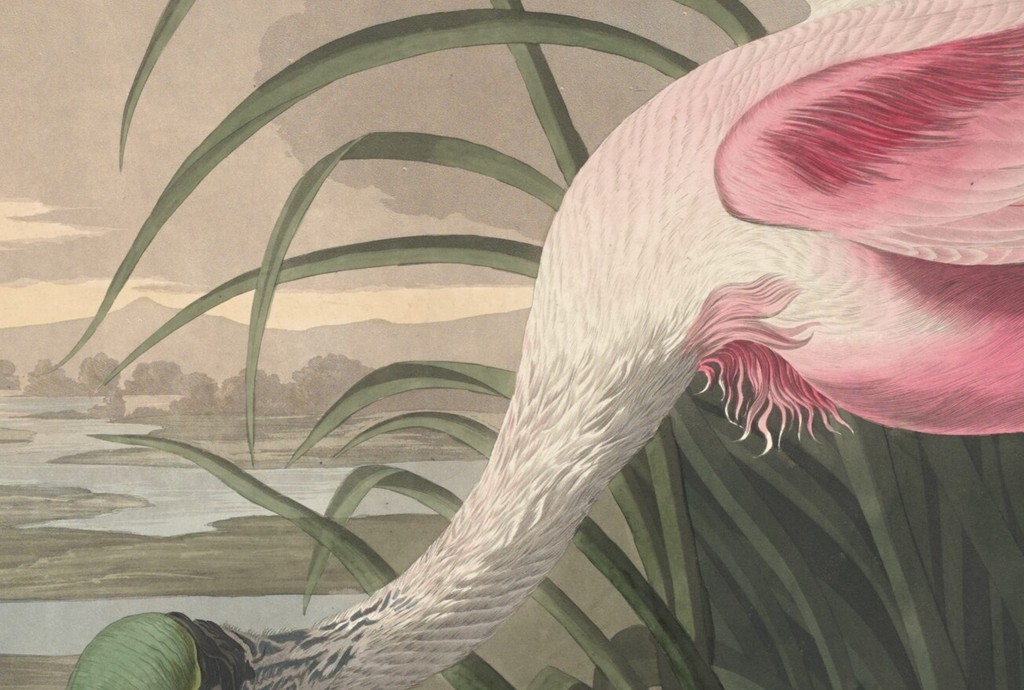
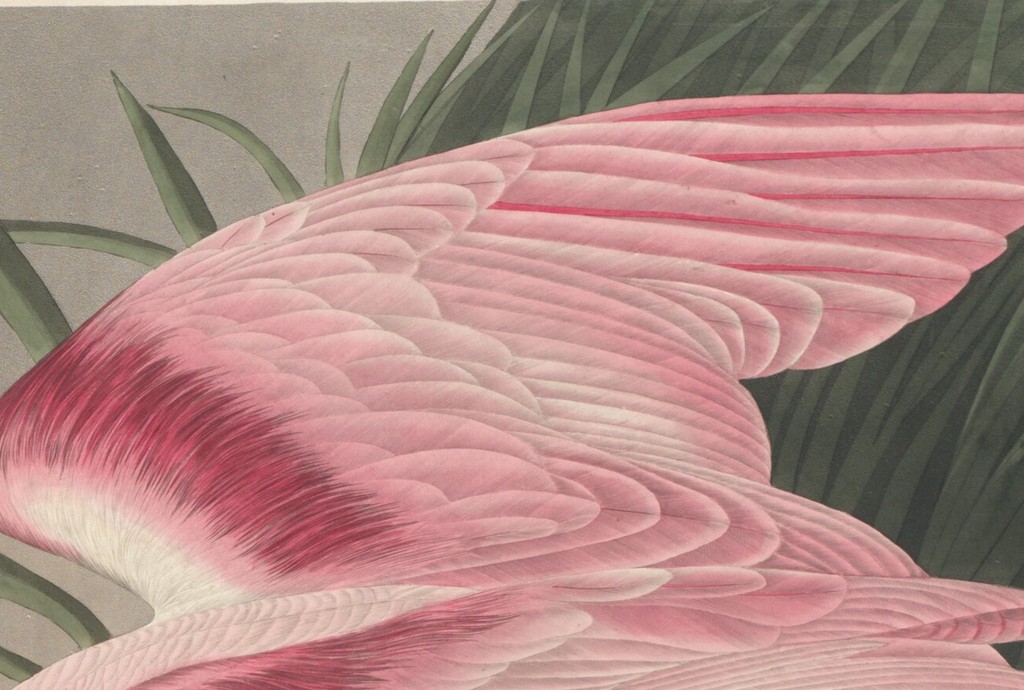
Raised pink wing
The lifted wing turns the bird into a fan of pink forms. Repeated feathers organise the bright colour into readable layers.
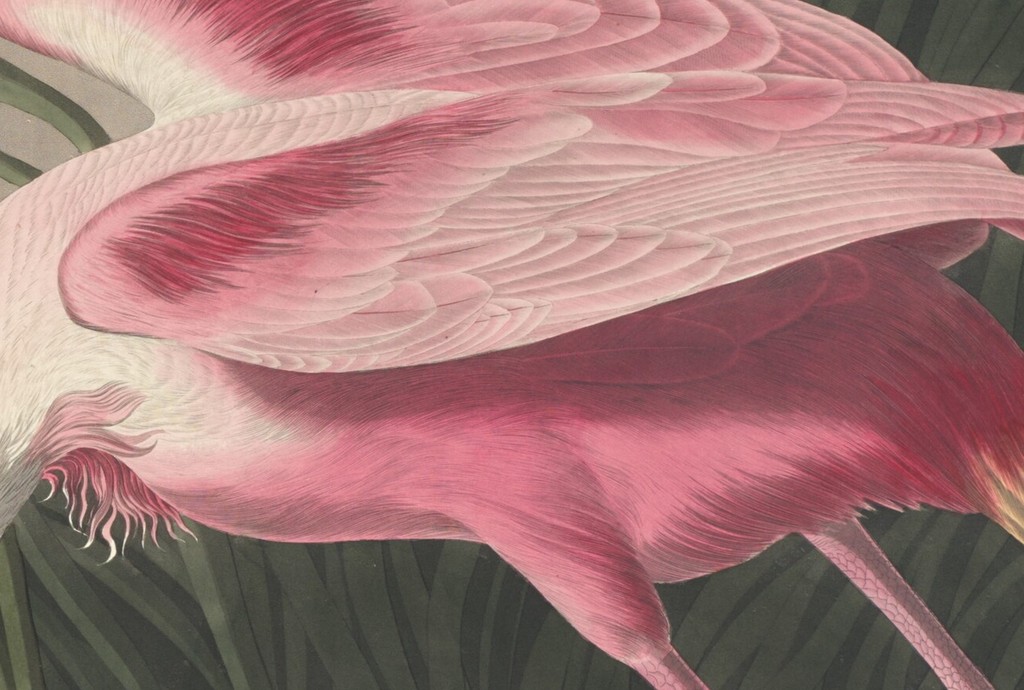
Dense rose body
The deeper rose body gives the plate its visual weight. Audubon shifts tone across the bird so the colour remains lively rather than uniform.
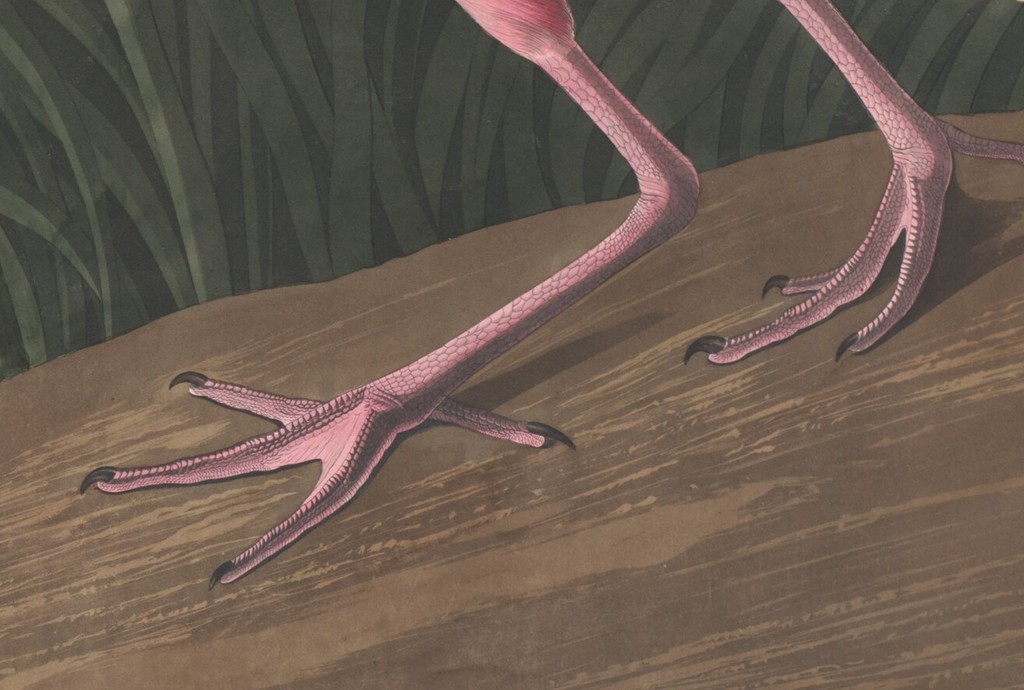
Long legs and feet
The legs and feet hold the diagonal pose against the sloping branch. They make the bird's balance part of the picture's drama.
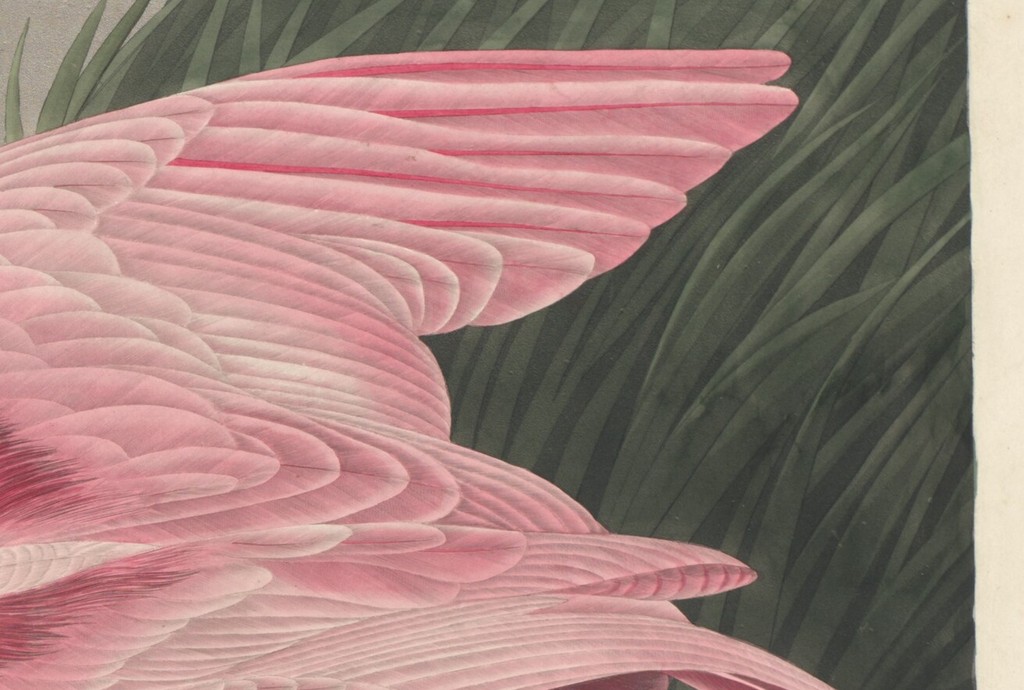
Reeds and dark leaves
Dark reeds behind the bird sharpen the outline of the pale and pink feathers. The setting is also a compositional foil.
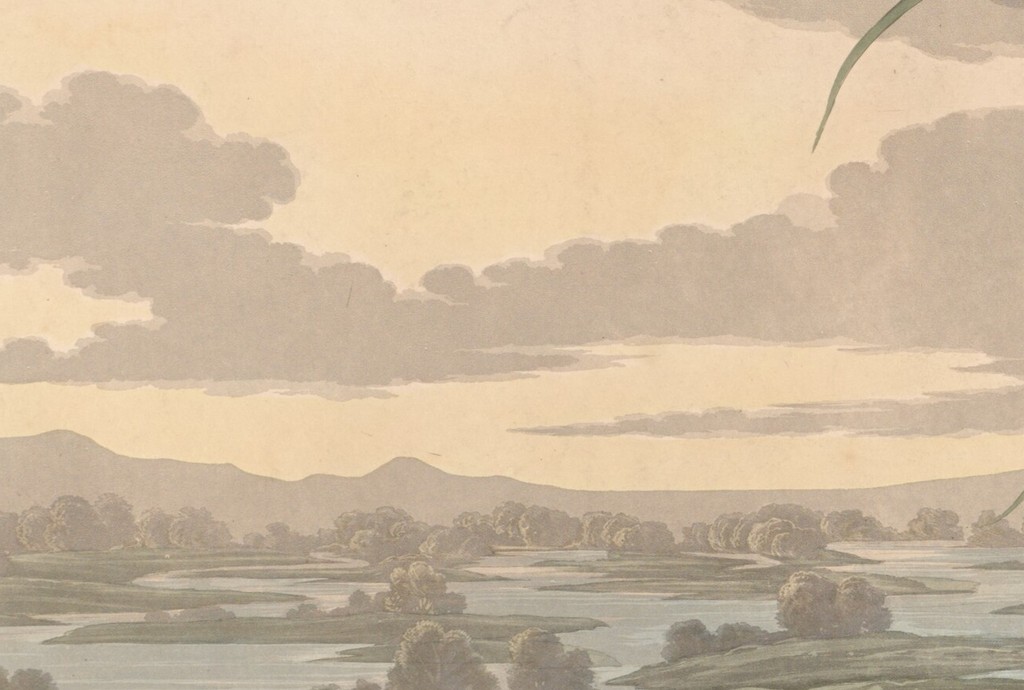
Marsh distance
The water, low land and cloudy sky open the plate beyond the foreground bird. The setting helps the image feel observed in a habitat, not cut out as a specimen.
Object Facts
Roseate Spoonbill belongs to The Birds of America, Audubon's double-elephant folio publication of North American birds. The plate is number 321 in the sequence. The National Gallery of Art gives the date as 1836 and the maker line as Robert Havell after John James Audubon. That phrase is important. Audubon supplied the bird image and compositional design, while Havell translated it into the finished printed plate. [1], [2]
The medium is hand-colored engraving and aquatint on Whatman wove paper. NGA records the plate size as 64.5 by 97.2 centimetres and the sheet size as 67.3 by 100.3 centimetres. The format is horizontal, which suits the spoonbill's sloping posture and the spread of landscape behind it. The plate is not currently listed as on view in the NGA record, but its museum page provides a visual description, object data, credit line, download route and public-domain media note. [1]
The plate's credit line is the Gift of Mrs. Walter B. James. Its exhibition history includes Audubon's Dream Realized: Selections from The Birds of America at the National Gallery of Art in 2005. These institutional facts keep the image attached to a specific print, rather than letting it drift into the category of anonymous vintage bird art. [1]
What the Plate Shows
The spoonbill stands on a sloping brown bank beside water. Its head drops toward the left, as if the bird is about to probe or sweep at the water's edge. The bill is the visual anchor: long, flattened and widened at the end. It is patterned with pale, dark and bluish tones, so the odd shape becomes a carefully described object rather than a simple silhouette. [1], [6]
The body is pink, with stronger color in the wings, legs and feet. The neck is long and pale, and the head is greenish with red eyes set within pinkish facial skin. On the right, tall grasses rise behind the bird. On the left, the landscape opens into water and patches of land beneath a pale sky. The composition gives the bird a habitat without making the setting too busy. [1]
The pose is both elegant and practical. A Roseate Spoonbill feeds by moving its bill through shallow water, sensing prey by touch. Audubon does not show a large flock feeding in a line. Instead, he gives one bird a downward lean that hints at feeding behavior while preserving the clarity of an individual portrait. The plate is poised between action and display. [5], [6]
Pink, Pale and White
Color is the first thing most viewers notice. Roseate Spoonbills are pink because pigments in their food, especially crustaceans and other aquatic invertebrates, influence the color of their feathers. Cornell's All About Birds and the Smithsonian National Zoo both connect the species' pink coloration to diet. Audubon's plate makes that color central, but it does not turn the bird into a flat block of pink. [5], [7]
The plate is more subtle than that. The neck is pale, almost white. The head is greenish and partly bare. The eye is red. The wings and body carry different intensities of pink. The bill is patterned and cool-toned. The sky and water soften the whole arrangement. If the plate were only bright, it would be less persuasive. Its beauty depends on modulation.
The color also helps separate the spoonbill from the American Flamingo, a natural comparison for modern readers. Both are pink wetland birds, but they are not close equivalents. Cornell places the Roseate Spoonbill in the ibis and spoonbill family, Threskiornithidae, and its defining form is the flattened spoon bill rather than the flamingo's curved feeding bill and towering proportions. Audubon's spoonbill plate makes that difference visible through anatomy. [5]
The plate also captures an adult bird rather than the paler impression of a juvenile. Cornell notes that juveniles are paler and have a fully feathered head before they acquire adult breeding plumage. Audubon's bird has the stronger color contrasts that make the species so recognizable: pink body, pale neck, bare-looking head and intense eye. This gives the image a mature presence. The bird is not simply pretty; it is particular. [6]
The Bird Behind the Image
The Roseate Spoonbill is a wading bird of freshwater and saltwater wetlands, mangroves, swamps, rivers, bays, estuaries, mudflats and lagoons. Cornell gives the current scientific name as Platalea ajaja and places the species in the family Threskiornithidae. The Smithsonian describes a large wader with pink body color, a spoon-shaped bill and range through parts of the southeastern United States, the Gulf Coast, Mexico, Central America and South America. [5], [6], [7]
The bird's behaviour helps explain Audubon's pose. Cornell describes Roseate Spoonbills foraging in shallow water with the bill under the surface, swinging the head from side to side and feeling for prey. That action is tactile as much as visual. The bird is not waiting to spear prey like a heron. It is built to sweep. Audubon's lowered head therefore matters: it makes the bill's purpose visible. [5], [6]
Roseate Spoonbills are also social birds, often nesting, roosting and foraging with other large wading birds. Audubon isolates one individual, but the surrounding wetland still hints at the broader world of flocks, roosts and shallow-water feeding. The plate does not need to show a crowd to make the species intelligible. It lets one bird carry the anatomy of the group. [5], [6]
The Spoon-Shaped Bill
The bill is the plate's most memorable structure. Modern bird guides describe Roseate Spoonbills feeding in shallow fresh or salt water by sweeping the partly open bill from side to side. Cornell notes that they forage with the bill under water, feeling for prey, while Smithsonian describes the bill as a tool for scooping prey from shallow water. This touch-based feeding strategy makes the bill both strange-looking and highly functional. [5], [6], [7]
Audubon's composition understands that. The bird's head is lowered, the bill points toward the water, and the body is angled in a way that makes the feeding posture believable. The spoon-shaped end is not treated as a joke or curiosity. It is the practical centre of the bird's life, and therefore the natural centre of the image.
Havell's printmaking helps give the bill presence. The shape widens dramatically, but the surface is broken by pattern and tone. The viewer can sense the hard flattened structure without losing the organic oddness of the bird's head. The long pale neck acts like a visual handle, leading the eye down toward the bill and then back through the pink body.
The bill also changes how the viewer imagines movement. A heron suggests a spear-like strike. A pelican suggests a scoop. A spoonbill suggests a sweeping motion, broad and lateral, through shallow water. Audubon does not need to show a flock moving in formation to imply that behavior. The lowered head and extended bill are enough to make the viewer understand the body as a feeding instrument. [6]
Wetland Setting
Roseate Spoonbills are wetland birds. Cornell describes them in fresh, brackish and marine waters, including marshes, mangroves, swamps, rivers, bays, estuaries, mudflats and lagoons. Smithsonian places them in marsh-like areas and mangroves, with United States populations especially associated with Florida, the Gulf Coast and nearby coastal regions. [6], [7]
Audubon's plate does not need to identify a precise locality to feel wetland-based. The water, low ground and grasses are enough. The bird is not perched like a songbird on an isolated branch, nor set against an empty studio background. It stands on a bank where land and water meet, which is exactly the kind of edge habitat that makes the spoon-shaped bill useful.
The setting also gives the plate a quiet horizontal rhythm. The bank slopes, the bird leans, the bill extends, and the horizon opens behind it. This horizontal pull suits a bird that forages by moving through shallow water rather than striking downward from height. The plate's landscape is therefore more than scenery. It supports the bird's way of being.
The grasses on the right and water on the left also keep the plate balanced. Without the grasses, the leaning bird might feel too exposed. Without the open water, the bill would lose its natural direction. Audubon uses a small amount of setting to give the subject a world. The landscape is not botanically overwhelming, but it is enough to prevent the bird from becoming an isolated studio specimen.
Place in The Birds of America
As plate number 321, Roseate Spoonbill belongs to the later part of The Birds of America. By this point Audubon's project had already established its range: large birds, small birds, familiar species, extinct species, predators and wetland subjects. The spoonbill fits especially well within the large wading and water-bird group, but it has a different personality from the pelican, herons or flamingo. [1], [2]
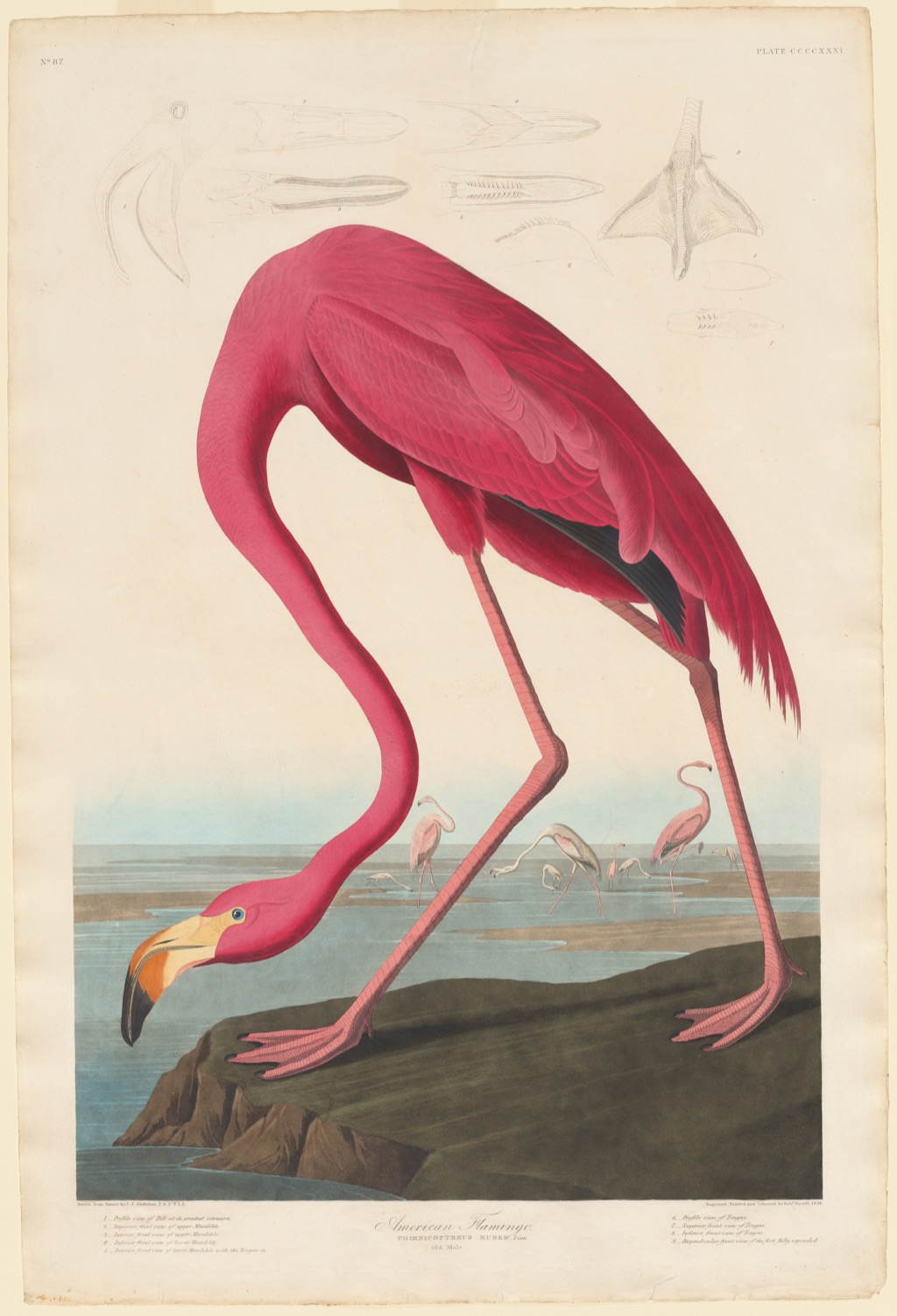
The American White Pelican emphasizes scale and bodily mass. The Louisiana Heron and Great Blue Heron emphasize long-legged wetland presence. The American Flamingo presents a problem of height and compression. The spoonbill offers a problem of color and shape. How can an artist make a pink bird with a flattened bill look convincing, graceful and anatomically specific rather than comic?
Audubon's answer is restraint. The bird is colorful, but the pose is controlled. The bill is odd, but it is integrated into feeding posture. The background is open enough to support the subject without competing with it. The plate shows how The Birds of America could make an unusual bird visually memorable without sacrificing credibility.
That restraint matters because the Roseate Spoonbill could easily become theatrical in the wrong way. Its color, eye, bare head and bill are all attention-seeking features. Audubon does not exaggerate them into caricature. Instead, he lets the bird's own anatomy do the work. The viewer's pleasure comes from discovering that the strange shape has a purpose.
Printmaking and the Folio Page
The double-elephant folio format shaped every plate in The Birds of America. For a large bird such as the spoonbill, the format allowed Audubon to show the bird at a scale that made anatomy and posture legible. The Natural History Museum in London describes the original work as 435 color plates bound into four volumes, printed in double-elephant folio size. Yale's Beinecke Library emphasizes Audubon's life-size ambition and the technical difficulty created by large sheets. [3], [4]
Roseate Spoonbill uses the wide sheet especially well. The bird's body, neck and bill move laterally across the page. The format gives room for the sloped bank, the water, the grasses and the bird's extended pose. A smaller page could preserve the outline, but it would weaken the physical generosity of the design.
The medium also matters. Engraving gives the plate its lines and structure. Aquatint helps with tonal passages. Hand coloring creates the pinks, greens, browns, blues and pale sky that make the image so appealing. The finished print is not simply Audubon's drawing reproduced. It is a collaborative object built from drawing, copperplate work, printing and color.
Natural History and Modern Conservation
The Roseate Spoonbill is currently treated by Cornell as a species of low conservation concern, and Smithsonian notes that populations in marsh areas of Florida and the Gulf Coast have recovered from periods of heavy hunting. That history is important because the spoonbill's beauty made it vulnerable. Pink plumage and distinctive form could inspire admiration, but also exploitation. [5], [7]
Modern conservation reading therefore changes the plate. The image is not a memorial in the way that Audubon's Passenger Pigeon or Carolina Parakeet plates have become. The spoonbill survives. Yet the plate still points toward wetland protection, hunting pressure, coastal habitat and the fragility of birds whose beauty attracts human attention.
It would be an anachronism to make Audubon into a modern conservationist. But a modern reader can hold two ideas together: Audubon gave the Roseate Spoonbill a powerful visual life on paper, and the living bird's future depends on wetland habitats that were not understood in the same way in his century.
The spoonbill is therefore a useful contrast within Audubon's work. Some plates are now dominated by the knowledge that their species disappeared. This one instead asks how beauty, rarity, recovery and habitat awareness can coexist. Its vivid pink body may draw the first glance, but the longer lesson lies in marshes, mangroves, feeding grounds and the social lives of wading birds.
Why This Plate Matters
Roseate Spoonbill matters because it shows Audubon at his most visually seductive without losing natural-history structure. Color draws the viewer in first. Then the bill, head, neck, legs and wetland setting explain why the bird looks the way it does. The plate works because beauty and function are not separated.
It is also one of the strongest reader pathways into Audubon's large-bird plates. The spoonbill can sit beside the pelican, flamingo and herons as part of a wetland group, but it remains unmistakably itself. Its pink body and spoon bill make it easy to recognize, while the plate's quieter decisions reward slow looking.
For collectors, designers and nature readers, the plate has obvious appeal. But its lasting value comes from the way that appeal is built. Pink color, shallow water, feeding posture, careful printmaking and folio scale all work together. A weaker image would rely on novelty alone. Audubon's plate makes novelty disciplined.
Within the broader Audubon cluster, the page connects naturally to The Birds of America and John James Audubon Works. The publication hub explains the folio project. The works hub explains Audubon's range across drawing, painting, print and book-making. This plate shows those larger ideas in one concentrated image: a living species transformed into a printed object of color, form and wetland intelligence.
Frequently Asked Questions
Discussion
Roseate Spoonbill turns color, wetland posture and an extraordinary bill into a disciplined folio image.
Use the prompts below to think about pink plumage, tactile feeding and the difference between decorative appeal and natural-history structure.
Reader Insights
How does Audubon keep the pink body vivid without letting it become a flat decorative patch?
What does the spoon-shaped bill tell you about feeding before the page explains the behavior?
How do the sloped bank, water and grasses make the bird's posture feel practical?
Join the Conversation
Share your reading of Audubon's Roseate Spoonbill and its balance of beauty and function below.
References
- National Gallery of Art, Roseate Spoonbill, accession 1945.8.321, accessed 26 July 2026.
- Biodiversity Heritage Library, The Birds of America, accessed 26 July 2026.
- Natural History Museum, London, The Birds of American Animals, accessed 26 July 2026.
- Yale Beinecke Library, The Double Elephant Folio, accessed 26 July 2026.
- Cornell Lab of Ornithology, All About Birds, Roseate Spoonbill overview, accessed 26 July 2026.
- Cornell Lab of Ornithology, All About Birds, Roseate Spoonbill identification, accessed 26 July 2026.
- Smithsonian's National Zoo and Conservation Biology Institute, Roseate Spoonbill, accessed 26 July 2026.
- Cornell BirdNET taxonomy, Platalea ajaja, accessed 26 July 2026.