

 by Tom Gurney
Tom Gurney BSc (Hons) is an art history expert with over 20 years experience
Published on July 26, 2026 / Updated on September 6, 2026
Email: tomgurney1@gmail.com / Phone: +44 7429 011000
American Flamingo: Introduction
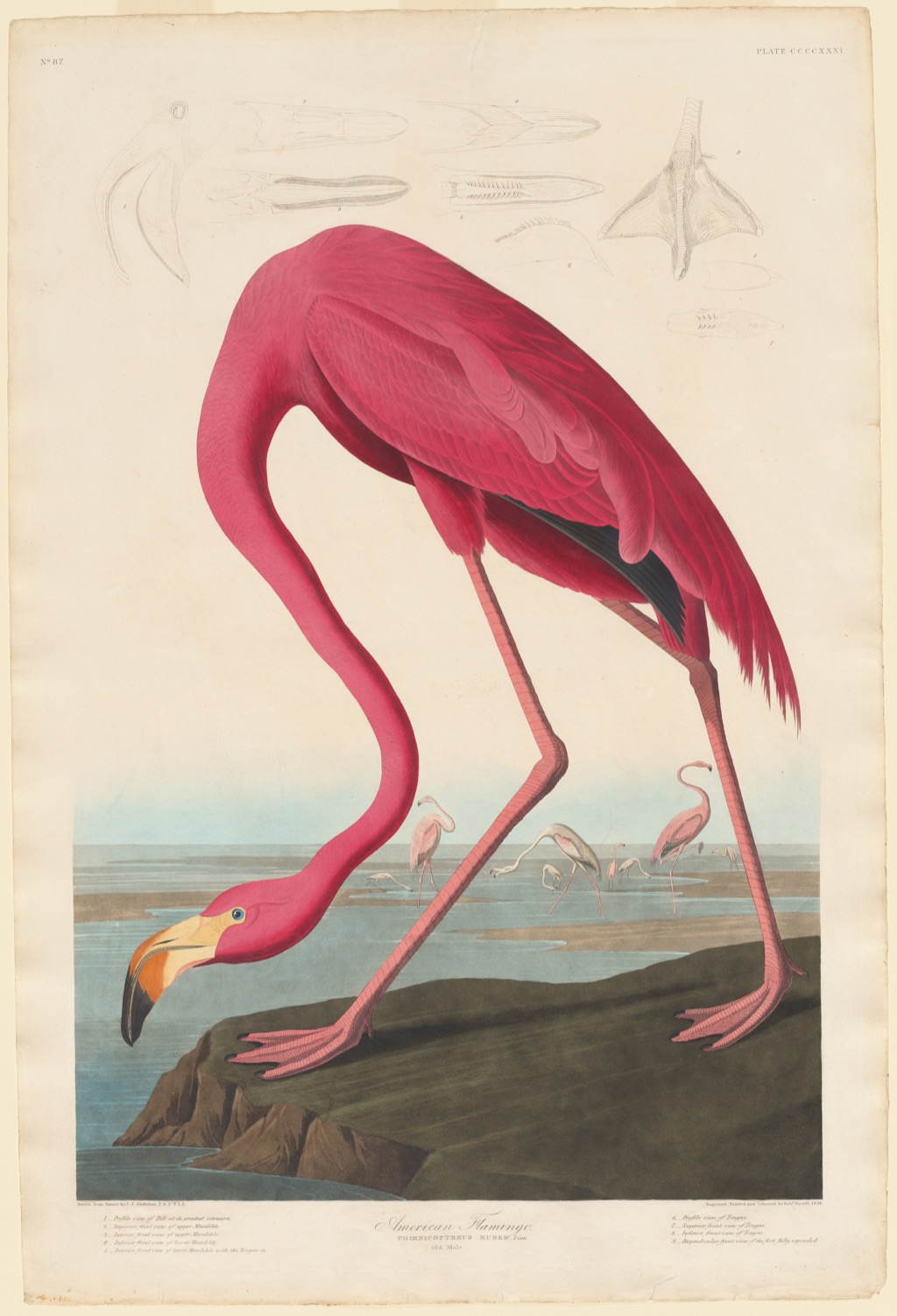
John James Audubon's American Flamingo is one of the most celebrated large-bird plates in The Birds of America. The bird stands at the edge of shallow water, facing left, its long neck bent sharply downward and its pink body held on stiltlike legs. In the distance, smaller flamingos gather across a pale lagoon. Above the main figure, Audubon includes anatomical studies of the bill, tongue and foot, turning the plate into both a dramatic bird portrait and a close natural-history study.
The National Gallery of Art records the work as American Flamingo, dated 1838, by Robert Havell after John James Audubon. It is a hand-colored engraving and aquatint on Whatman wove paper, accession number 1945.8.431, and catalogued as Birds of America, no. 431. Those details are essential because Audubon's flamingo is often reproduced as a decorative image, but the historic work is a specific double-elephant folio print from a particular publication, maker network and museum record.
The current species name is American Flamingo, Phoenicopterus ruber. Modern bird sources describe a highly social tropical flamingo of shallow saline lagoons and estuaries, feeding on aquatic invertebrates by filtering water through the bill. Cornell currently treats the species as Low Concern, and Smithsonian's National Zoo lists it as Least Concern. That modern status should not flatten the historical artwork into a simple wildlife poster. Audubon's plate is about the bird, but also about scale, anatomy, color, printmaking, source material and the difficulty of making a tall living creature fit a sheet of paper.
At a Glance
- TitleAmerican Flamingo [1]
- Date1838 [1]
- MakerRobert Havell after John James Audubon [1]
- Mediumhand-colored engraving and aquatint on Whatman wove paper [1]
- Dimensionsimage: 87.63 x 58.58 cm; plate: 97 x 65 cm; sheet: 101.3 x 68.3 cm [1]
- CatalogueThe Birds of America, no. 431 / Plate CCCCXXXI [1]
- AccessionNational Gallery of Art, 1945.8.431 [1]
- SpeciesAmerican Flamingo, Phoenicopterus ruber [6], [8]
Contents
- Introduction
- Annotated Details
- Object Facts
- What the Plate Shows
- The Problem of Scale
- Color, Bill and Body
- The Bird Behind the Image
- Source Material and Observation
- Place in The Birds of America
- Printmaking and Collaboration
- How to Look at American Flamingo
Annotated Details from American Flamingo
These annotated details follow Audubon's American Flamingo through the parts that make the plate work at double-elephant scale: bill, eye, neck, wing, black flight feathers, long legs and the small coastal flock in the distance.
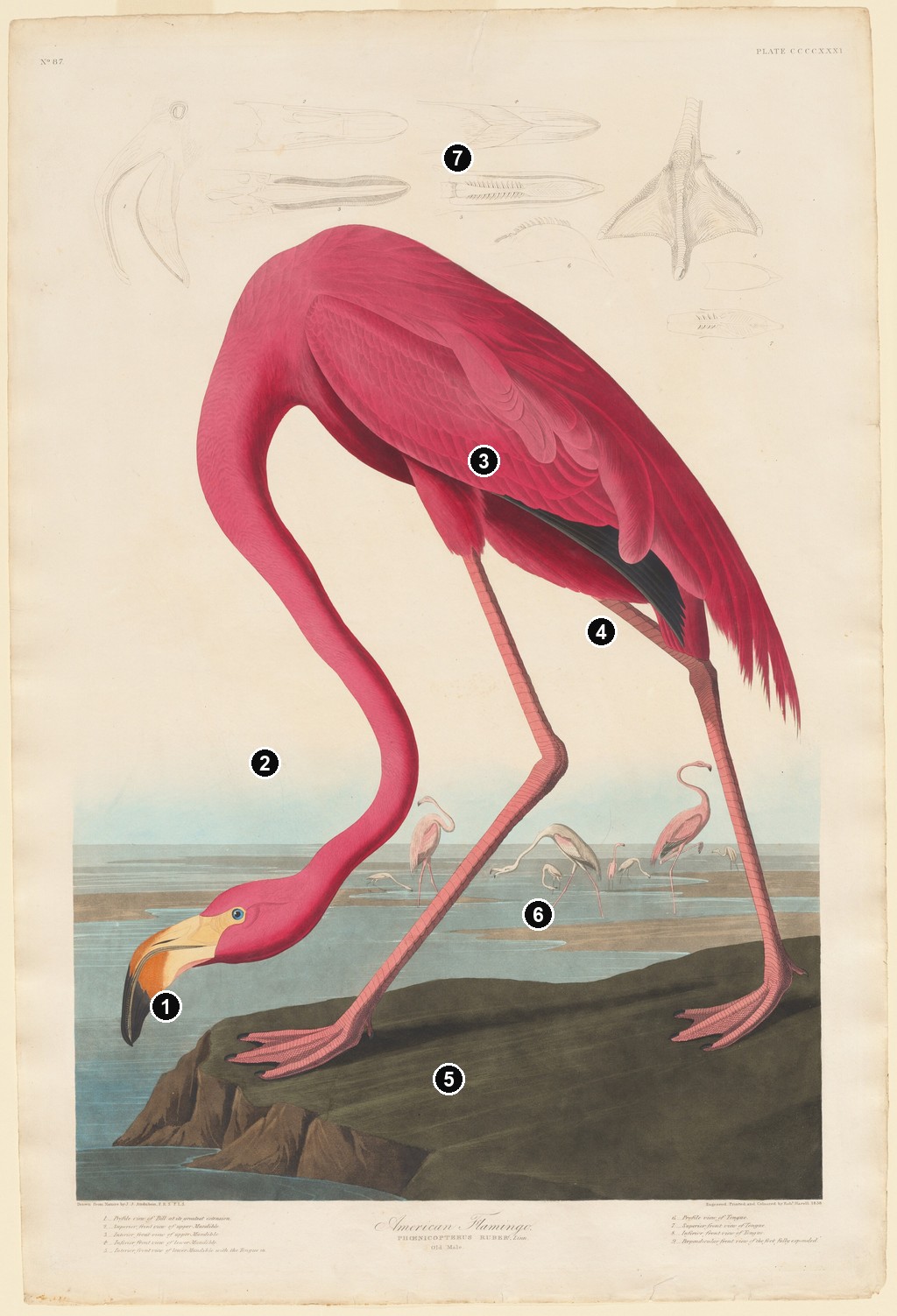
Details from AMERICAN FLAMINGO
Close looking shows how a spectacular bird plate balances scientific attention, decorative colour and the physical problem of fitting an enormous bird onto one sheet.
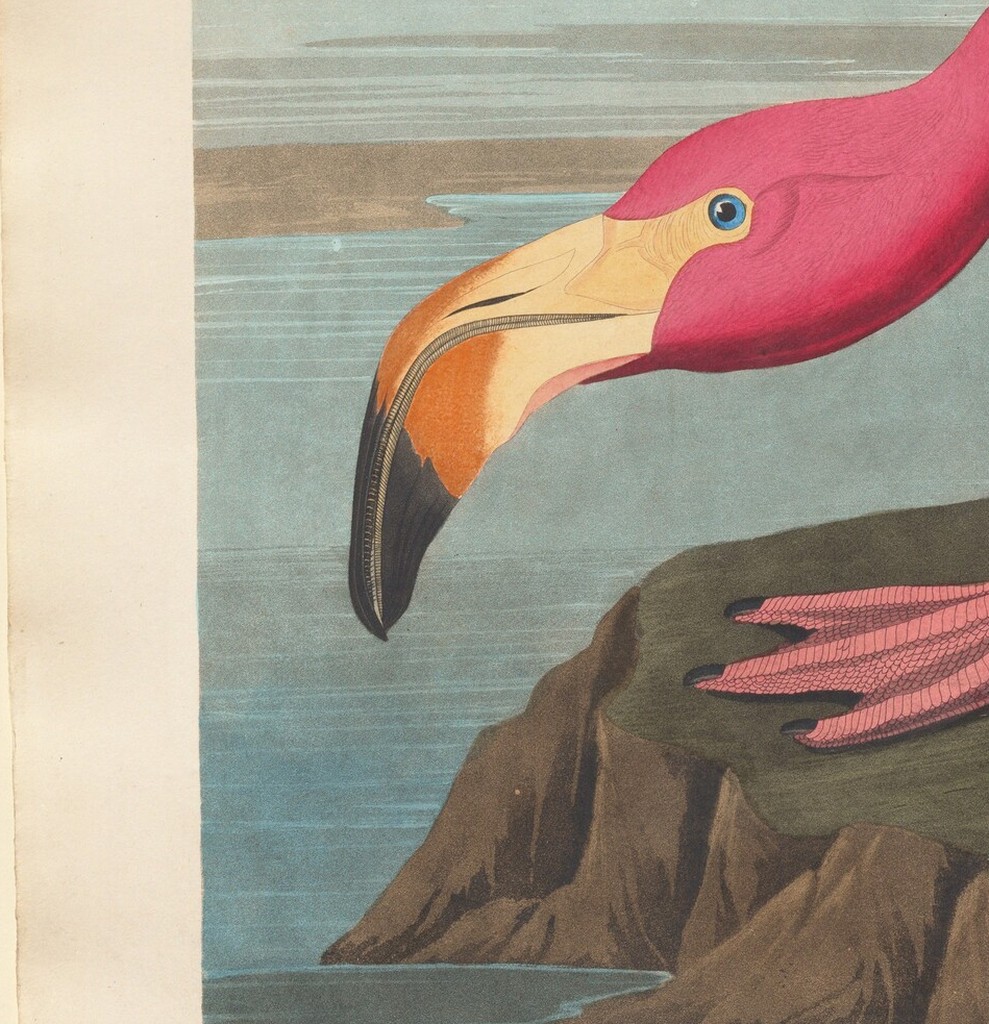
Bill and eye
The curved bill and small eye concentrate the bird's identity near the lower edge of the sheet. Audubon makes the head legible without isolating it from the long sweep of the neck.
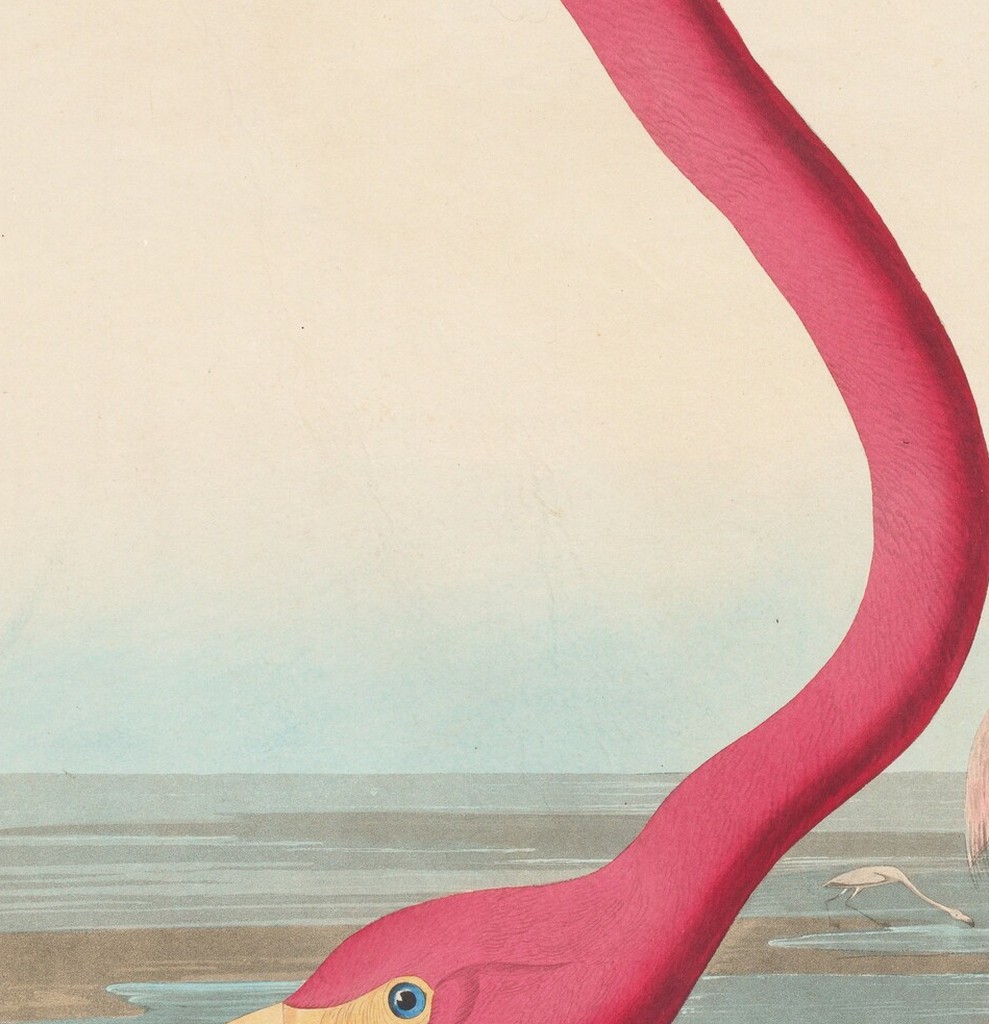
Long neck curve
The neck is almost a compositional line. Its broad curve lets the tall bird bend back into the page rather than breaking the sheet's vertical limits.
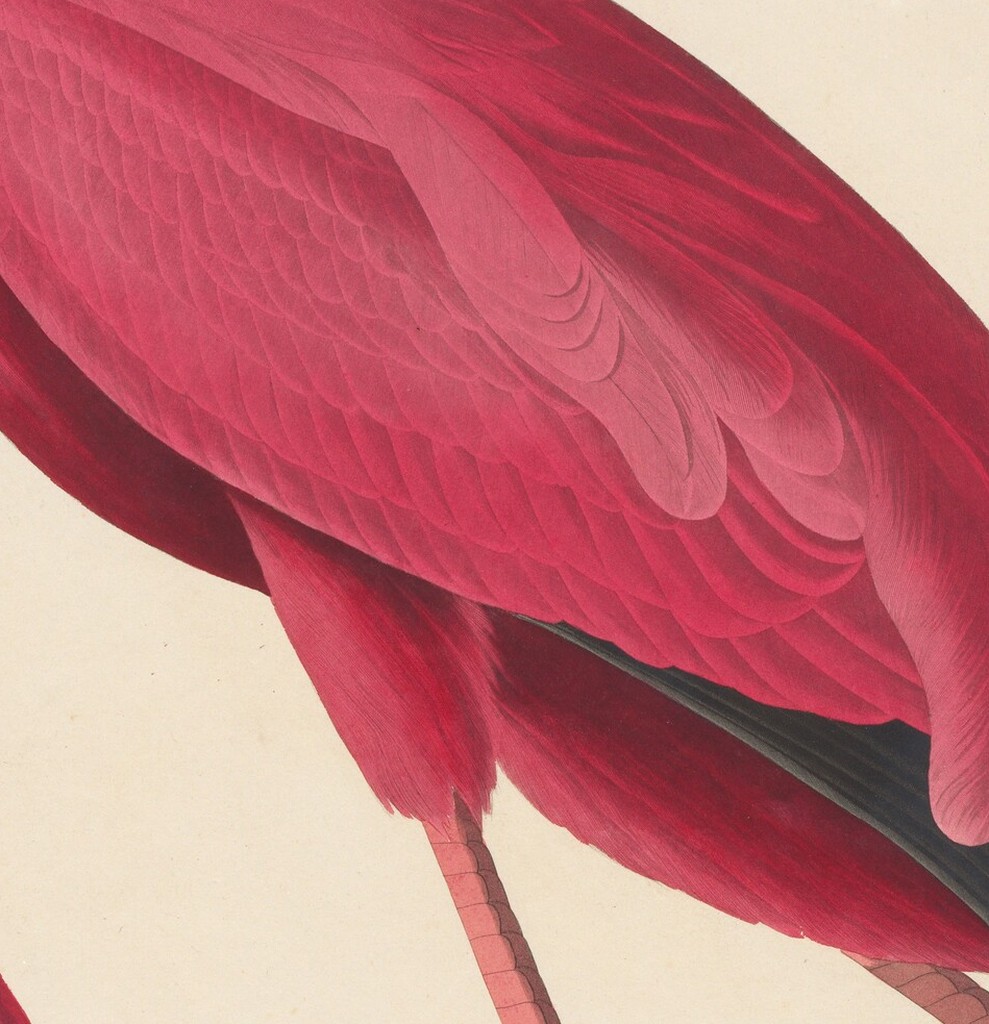
Layered wing coverts
Fine overlapping feathers slow down the expanse of pink. The wing is decorative, but it is also carefully structured by repeated feather forms.
Dark flight feathers
The black flight feathers create the plate's strongest colour contrast. They keep the body from reading as a single flat field of red and pink.
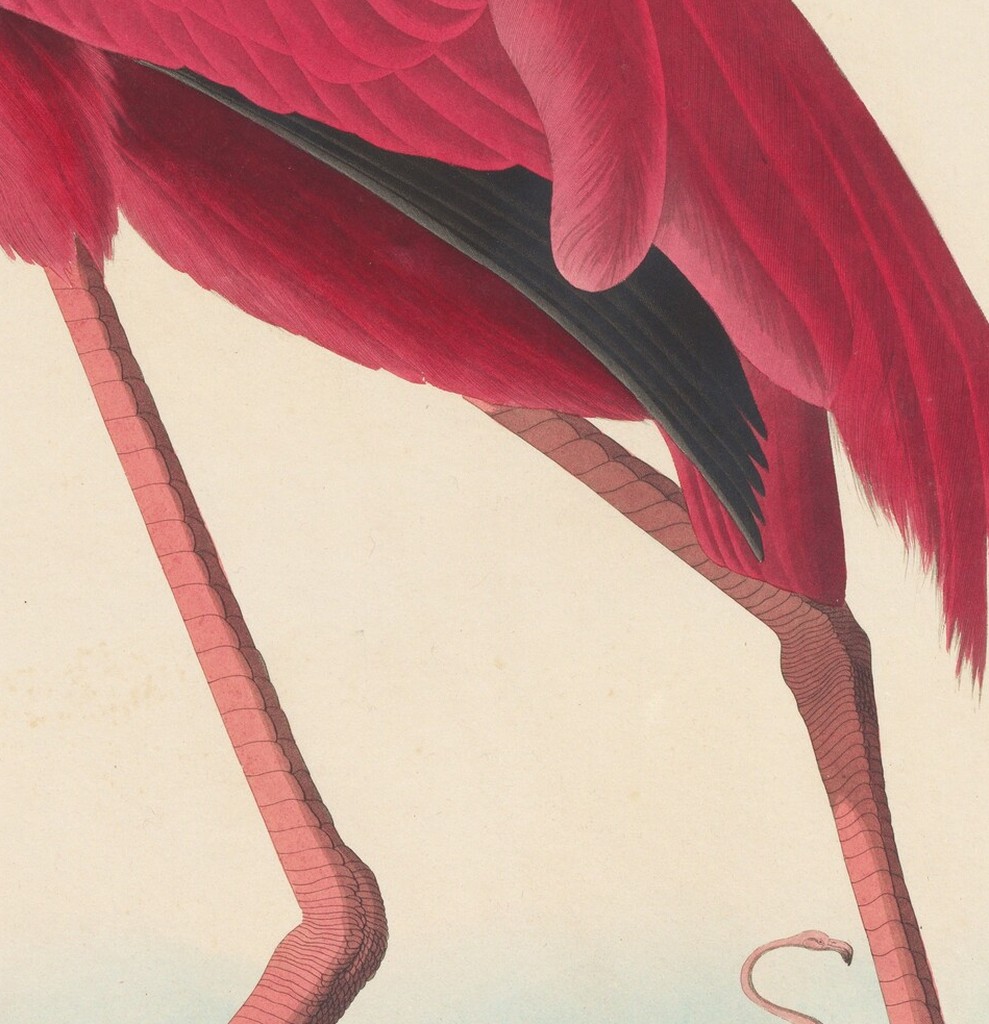
Legs and feet
The long legs give the figure its height and odd elegance. The feet spread across the foreground, making the bird feel physically anchored.
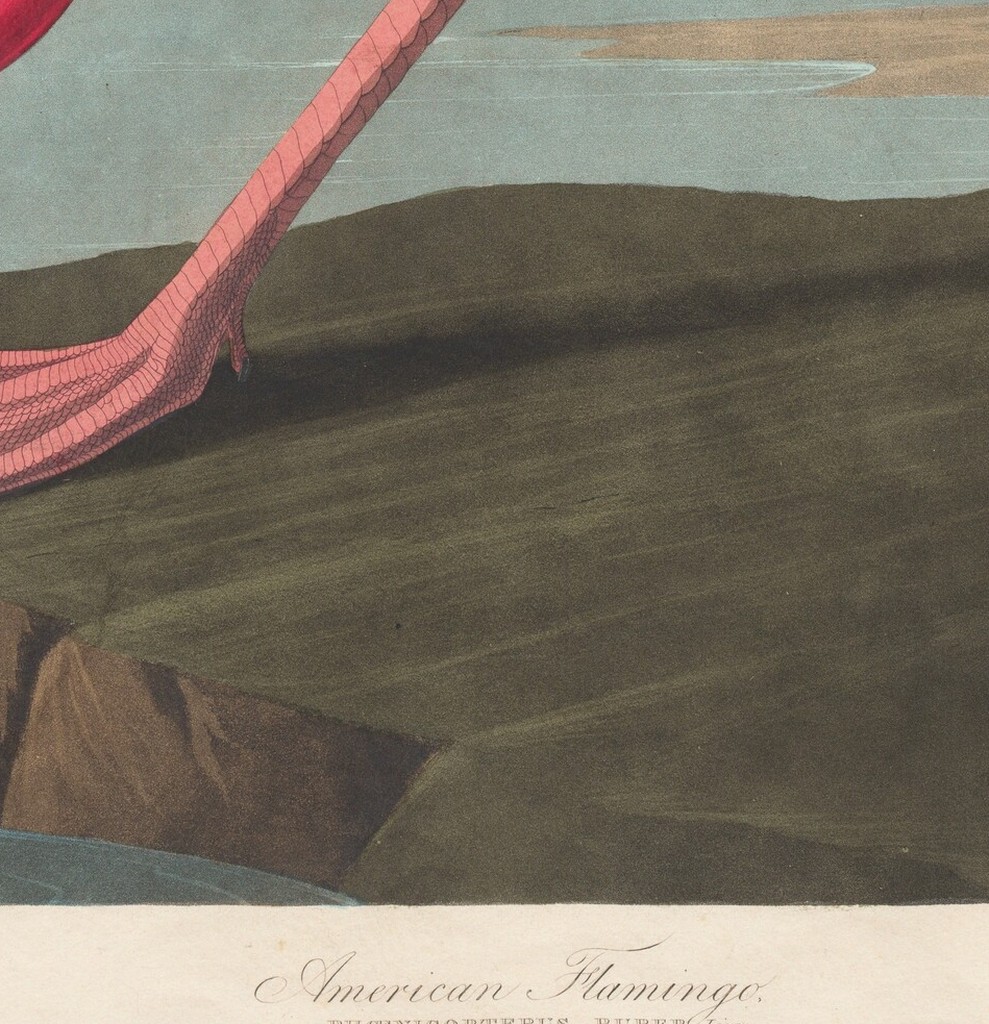
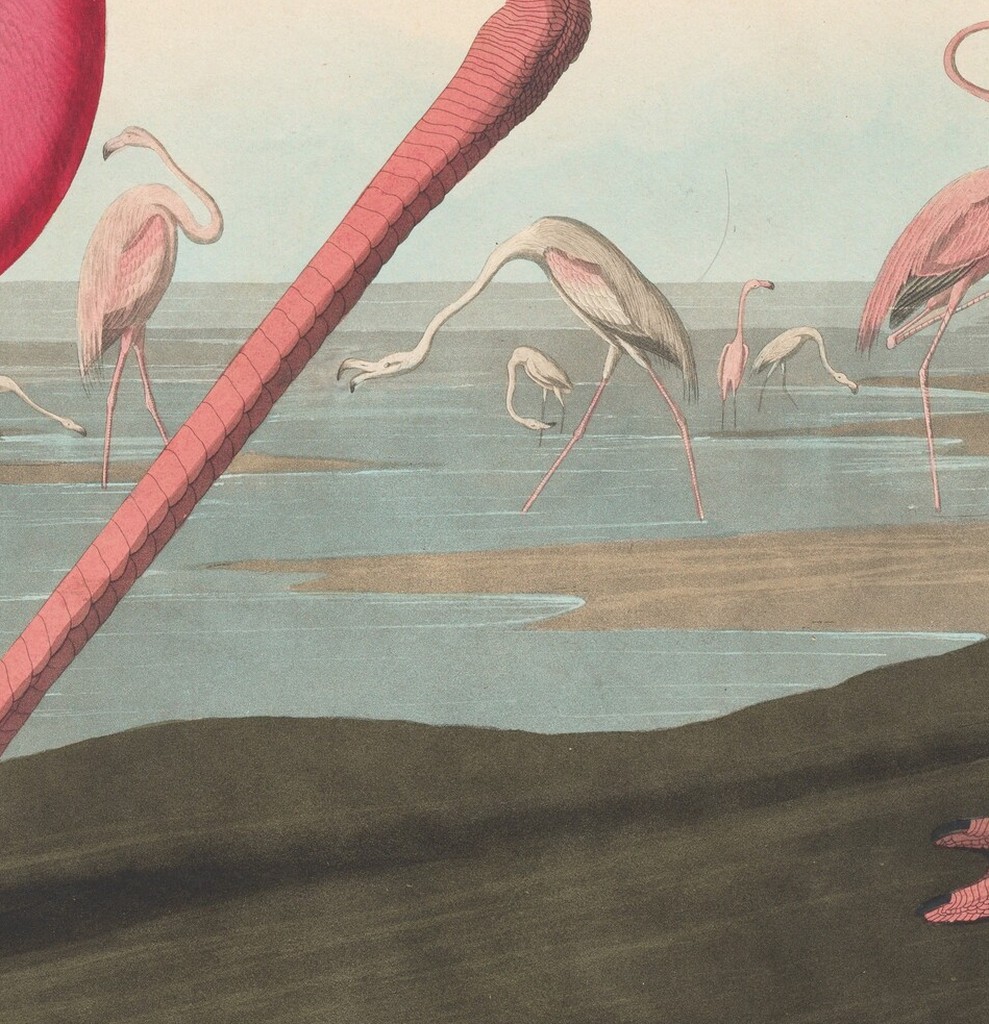
Distant flock and shore
Small background birds and strips of water set the main figure inside a coastal environment. Scale shifts from monumental specimen to living group.
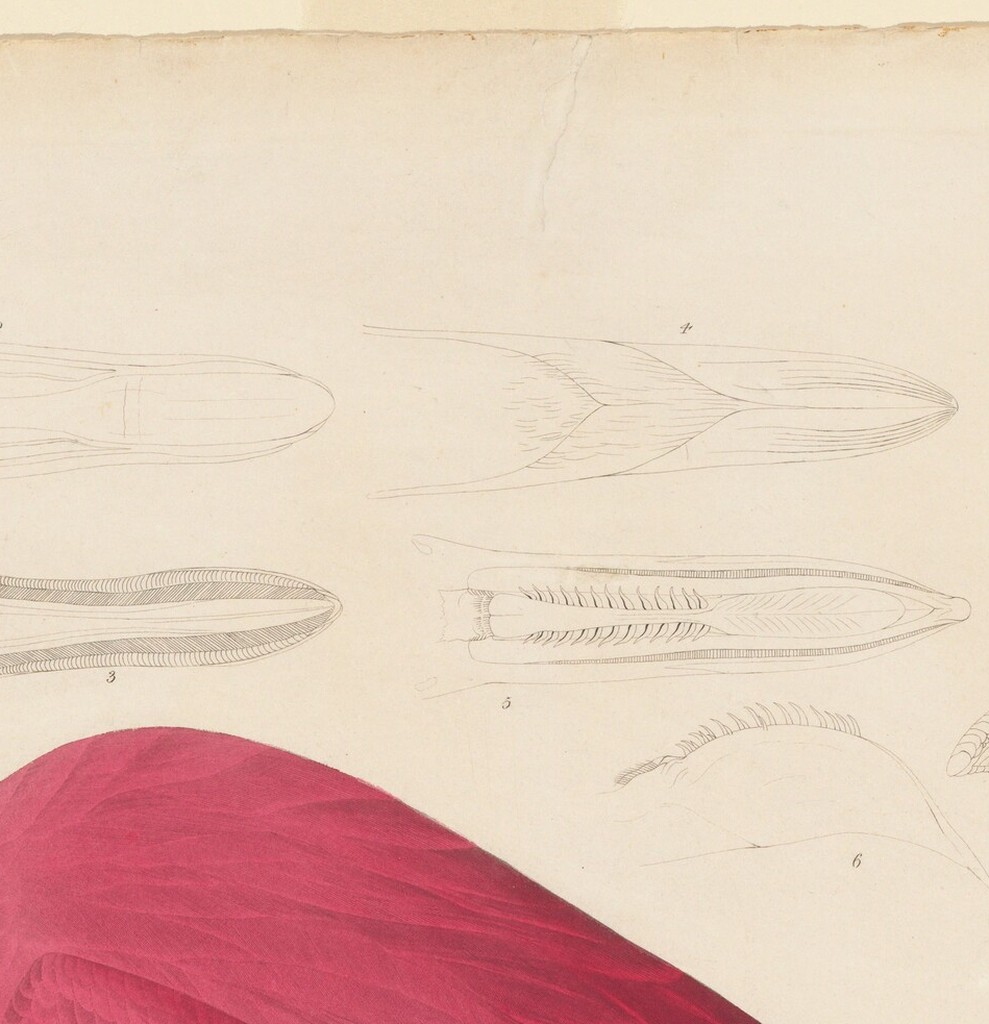
Anatomical studies
The pale studies at the top turn the plate into more than a portrait of one bird. They preserve the comparative, anatomical side of Audubon's natural-history project.
Object Facts
Audubon's American Flamingo belongs to The Birds of America, the double-elephant folio publication issued between 1827 and 1838. The plate is number 431 in the sequence. This number is especially important. Some secondary or display contexts can create confusion around the flamingo, but the National Gallery of Art record identifies the plate as number 431.
The NGA object record dates the plate to 1838 and gives the maker line as Robert Havell after John James Audubon. That wording captures the collaborative nature of the finished print. Audubon supplied the design, observation and source image. Havell translated that design into the engraved, aquatinted and hand-colored folio plate.
The medium is hand-colored engraving and aquatint on Whatman wove paper. NGA records the image size as 87.63 by 58.58 centimeters, the plate as 97 by 65 centimeters, and the sheet as 101.3 by 68.3 centimeters. The print is vertical, which suits the flamingo's height, but even this large format could not accommodate a standing flamingo without invention. Audubon solved the problem by folding the neck downward and allowing the legs, bill and body to create an elegant compressed rhythm.
The plate's credit line is the Gift of Mrs. Walter B. James. NGA also states that the object's media is free and in the public domain. That makes the NGA record the strongest current institutional record for the image used here, while also grounding the page in a specific museum object rather than a loose decorative reproduction.
What the Plate Shows
The main flamingo stands on a low outcrop beside water. Its body is deep pink, its legs are long and narrow, and its neck drops in a sweeping curve toward a bill that is pale, orange and dark at the tip. One visible eye appears bright and alert. A darker feather tucks beneath the wing, adding contrast to the otherwise rose-colored body.
The setting is quiet. Pale water stretches back toward the horizon, where smaller flamingos stand or walk near distant sandbars. The background does not compete with the main bird. It gives the flamingo a social and coastal world while keeping the viewer's attention on the large figure in front.
The anatomical studies across the upper sheet are unusual and important. Audubon includes numbered details of the bill, mandibles, tongue and foot. These additions remind the viewer that the flamingo is not only a spectacular pink form. It is a bird with specialized feeding structures and a body adapted to shallow water. The plate therefore moves between spectacle and explanation.
That mixture gives the image much of its power. The flamingo is beautiful at first glance, but the longer view is stranger and more exacting. The bent bill, filtering tongue, long legs, webbed foot and distant flock all matter. Audubon and Havell make color seductive, then ask the viewer to study function.
The Problem of Scale
The American Flamingo was exactly the kind of bird that tested Audubon's life-size ambition. Yale's Beinecke Library explains that Audubon wanted birds to appear life-sized when possible, and that the double-elephant folio paper was chosen to accommodate the largest American birds. Even that enormous format was not always enough. A flamingo is tall, leggy and long-necked. If shown upright in a relaxed standing pose, it would overwhelm the sheet.
Audubon's solution was to bend the bird. The neck curves down, the bill reaches toward the water, and one foot steps forward. Instead of looking cramped, the pose becomes graceful. The bird's anatomy turns into composition. Height becomes curve; length becomes rhythm; the folio's limits become part of the image's elegance.
This is why American Flamingo is more than a bright plate of a pink bird. It shows Audubon using design to preserve the sense of a living species while managing the physical limits of print. The bird is not floating in empty space. It is posed at the exact moment when its neck, bill and legs can fit the page without losing their drama.
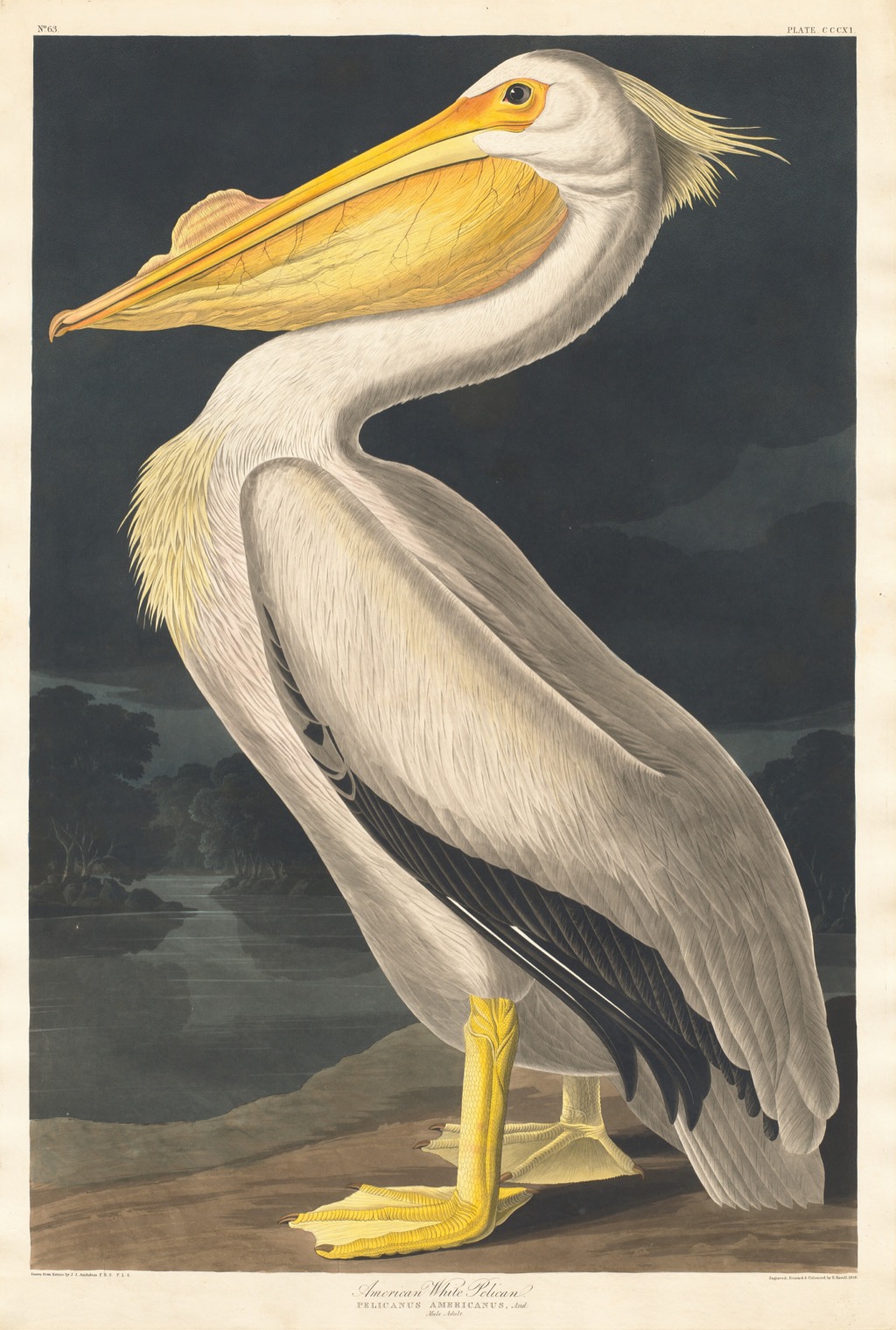
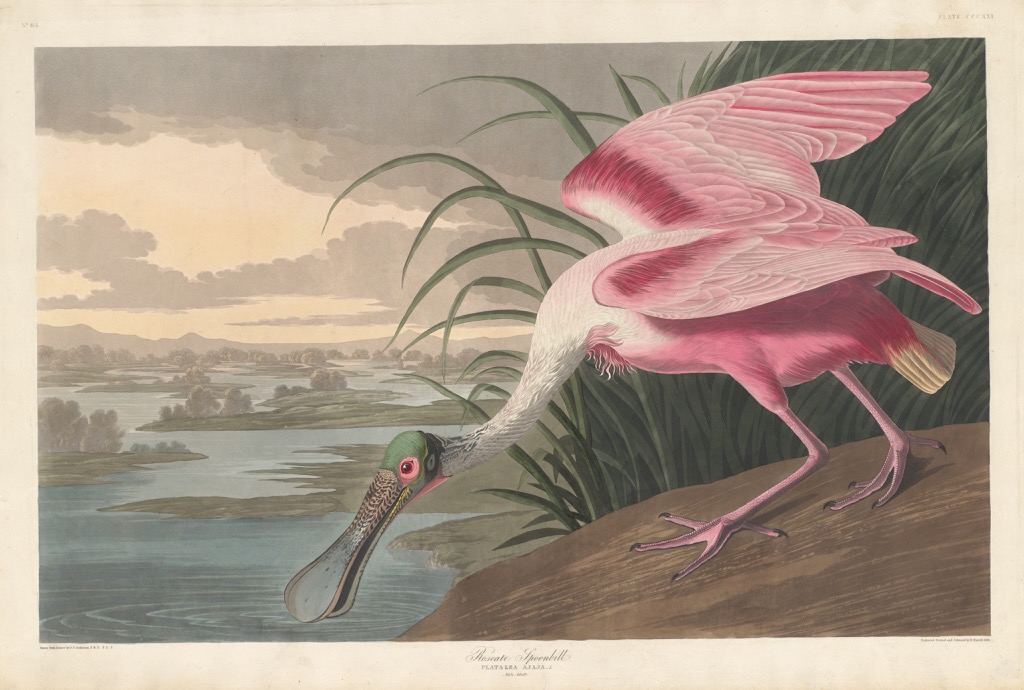
The comparison with other large-bird pages is useful. American White Pelican depends on mass, bill and pouch. Roseate Spoonbill depends on color, wetland posture and the flattened spoon-shaped bill. Great Blue Heron depends on vertical patience and long anatomy. The flamingo depends on compression. Its greatness lies in the way Audubon turns a practical problem into the most memorable feature of the plate.
Color, Bill and Body
Color gives the plate its immediate appeal. Modern sources explain that flamingo color comes from diet, including algae, shrimp and other aquatic foods rich in pigments. Audubon's bird is not evenly pink. The body is deep rose, the wing includes a darker accent, the legs and feet carry their own warmth, and the bill shifts through pale, orange and dark tones. This modulation keeps the figure from becoming a flat emblem.
The bill is just as important as the color. American Flamingos feed by lowering the head into shallow water and filtering small food items with specialized structures in the bill. Cornell describes birds striding slowly through shallow lagoons and estuaries, using the tongue to push water through comb-like structures in the bill. Audubon's anatomical studies make that feeding machinery visible.
The upside-down feeding posture is one reason the bird's bill looks so strange to human viewers. A flamingo's head and bill are not built for a conventional pecking or spearing action. They are built for filtering. Audubon's plate places the bill near the water and then isolates details above the image, allowing the viewer to connect beauty with biological use.
The body is also a study in tension. Long legs make the bird feel fragile and high. The heavy curved neck and bill bring the energy downward. The body sits between those forces, a bright oval of weight and color. The composition succeeds because it does not treat the flamingo's awkwardness as a defect. It lets awkwardness become elegance.
The Bird Behind the Image
The American Flamingo is a tropical flamingo of the Caribbean, nearby coasts and related shallow-water habitats. Cornell identifies the species as Phoenicopterus ruber, in the order Phoenicopteriformes and family Phoenicopteridae. It describes the habitat broadly as shorelines, with shallow saline lagoons and estuaries especially important. Smithsonian's National Zoo also identifies the species as Phoenicopterus ruber and places it in the flamingo family.
Modern sources emphasize social life. American Flamingos feed, travel and breed in groups, sometimes in very large colonies. Cornell notes that pairs build volcano-shaped mud nests and that chicks later gather in communal nurseries watched by adults. The distant flock in Audubon's plate quietly acknowledges this social identity. The main bird dominates the sheet, but it is not alone in the world.
The species feeds mainly on aquatic invertebrates, with algae and other plant material also part of the diet. This food is connected to color. The pink or red plumage that makes flamingos so visually recognizable comes from pigments in what they eat. In the plate, color is therefore not just decoration. It is a clue to the bird's life in shallow water.
Current status language should be kept measured. Cornell's overview marks the American Flamingo as Low Concern, and Smithsonian lists Least Concern. That does not mean habitat is irrelevant or that local populations never face pressure. It means this particular plate should not be framed like Audubon's extinct-bird images. It belongs more naturally with living wetland and coastal subjects, while still inviting attention to habitat, food, breeding colonies and changing environmental conditions.
Source Material and Observation
Audubon's flamingo has a special place in the story of The Birds of America because it was one of the last great large-bird solutions in the folio. It also raises questions about observation and source material. Accounts of Audubon's working process around the flamingo point to the difficulty of obtaining reliable source material for such a large tropical bird. That context fits the broader pattern of his practice: field memory, collected bodies, correspondence and studio construction all shaped the finished image.
The public plate should therefore not be read as a simple outdoor snapshot. Audubon did observe birds in the field during his career, but many finished works were made through a mixture of observation, specimen study and constructed arrangement. In the flamingo, that mixture is visible. The bird's pose is plausible for feeding, but it is also a brilliant answer to a design problem. The anatomical details show close physical study. The distant flock gives a sense of place and social life. The main figure carries the theatrical clarity of a studio-composed image.
This does not weaken the plate. It makes the image more interesting. Audubon's art often depends on the gap between living nature and constructed representation. He wanted viewers to feel the bird's presence, and he used every available method to create that feeling: memory, specimens, drawing, printmaking, scale and dramatic selection.
The flamingo is especially good at revealing that process. It looks immediate, but it is carefully built. It looks natural, but the pose is also strategic. It looks decorative, but the anatomy is studied. It looks solitary, but the background places it among other flamingos. The image succeeds because all of those layers remain active.
Place in The Birds of America
As plate 431, American Flamingo appears near the end of The Birds of America. That late position gives it a sense of culmination. By the time readers reached the flamingo, Audubon and Havell had already produced hundreds of images across a wide range of species, sizes, behaviors and habitats. The flamingo arrives as one of the last great demonstrations of the folio's ambition.
The Natural History Museum describes The Birds of America as a four-volume work with 435 color plates in double-elephant folio format, and notes that Audubon's birds were shown with drama and life rather than only as mounted specimens. Yale emphasizes the subscription and printing challenges created by the large sheets. The flamingo brings those larger facts into one image. It is a large bird fitted to a difficult page, made through technical print collaboration, and designed to feel alive while carrying anatomical information.
Within the cluster, the plate connects naturally to the publication hub for The Birds of America and the broader John James Audubon Works overview. It also belongs with the large wetland and water-bird group: American White Pelican, Roseate Spoonbill, Great Blue Heron and Louisiana Heron.
The plate also looks forward to modern image culture. Audubon's flamingo is among the works most easily recognized by viewers who may not know the full publication. Its pink body, extreme pose and tall vertical format make it memorable as art, science and design at once. That popularity should not be allowed to strip away the object facts. Plate number, date, maker line, medium and institutional source are what keep the famous image historically grounded.
Printmaking and Collaboration
The line Robert Havell after John James Audubon is central to understanding the plate. Audubon supplied the design and natural-history ambition. Havell engraved, printed and colored the work into a finished folio image. The result belongs to both drawing and print culture.
Engraving gives the flamingo's outline, bill details, feathers, legs and anatomical studies their structure. Aquatint supports softer tone. Hand coloring supplies the pink body, pale water, muted ground and bill tones that make the plate so striking. If the color were flat, the bird would feel like a sign. If the line were weak, the anatomy would lose authority. The plate works because line, tone and color support each other.
The anatomical studies above the main image also show the value of print. They allow multiple forms of attention to exist on one sheet: the dramatic bird below and the numbered physical details above. A viewer can admire the whole composition, then move into the mechanics of bill, tongue and foot. That layered reading is central to Audubon's best plates.
The folio size increased the burden on the print shop. Large sheets required technical skill, expensive materials and a subscription audience willing to fund the effort. The flamingo's grandeur is therefore inseparable from the economics of the project. It was not only drawn. It had to be sold, engraved, printed, colored, delivered, preserved and eventually digitized.
How to Look at American Flamingo
Begin with the curve. The flamingo's neck is the plate's main event, a sweeping line that lets the tall bird occupy the page. Then look at the bill. Its bend, color and dark tip are not decorative quirks but feeding tools. Next, compare the main figure with the distant birds. Audubon gives one flamingo the authority of a portrait while letting the background remind us that this is a social species.
Then look upward. The anatomical studies are easy to skip because the main bird is so strong, but they change the meaning of the plate. They tell the viewer that Audubon wanted more than visual impact. He wanted the bird's structures to be studied. Bill, tongue and foot are not accessories. They explain how the bird lives in shallow water.
Finally, notice how much white space remains. The plate could have been crowded with vegetation, sky or additional birds. Instead, Audubon allows the main form to breathe. The open upper sheet makes the anatomical studies feel suspended, while the pale lagoon gives the distant flock room. The composition is bold because it trusts the bird's body to carry the image.
This is a good habit for reading Audubon generally. Do not stop at the beautiful subject. Ask what problem the plate solves. With the flamingo, the problem is height. The solution is a bending body that becomes one of the most elegant shapes in nineteenth-century natural history art.
Why This Plate Matters
American Flamingo matters because it condenses Audubon's strengths into one unmistakable image: scale, color, animation, anatomical attention, print collaboration and theatrical design. It is visually seductive, but it is also structurally intelligent. The bird's famous pose is not a flourish added after the fact. It is the answer to the central challenge of picturing a tall flamingo at folio scale.
The plate also matters because it links Audubon's art to modern bird knowledge without being swallowed by it. Current sources identify the species, habitat, feeding behavior and conservation status. Those facts help the reader understand what the image shows. But the artwork remains a historical object from 1838, made through nineteenth-century collecting, printing and publication systems.
Within Audubon's work, the flamingo is one of the clearest bridges between science and spectacle. It can be admired for color and elegance, studied for anatomy, read as a print, and placed within the final sweep of The Birds of America. Few plates make the logic of the whole project so visible so quickly.
Frequently Asked Questions
Discussion
American Flamingo asks readers to look at scale, colour, anatomy and printmaking together.
Use the prompts below to think about how Audubon turned a tall wetland bird into one of the most memorable images in The Birds of America.
Reader Insights
How does the bent neck solve the problem of fitting a tall bird into the folio sheet?
What changes when you look from the pink body to the bill, tongue and foot studies above it?
How do the distant birds and pale lagoon change the main flamingo from portrait into species image?
Join the Conversation
Share your reading of Audubon's American Flamingo plate, its colour and its design below.
References
- National Gallery of Art, American Flamingo, accessed 26 July 2026.
- Biodiversity Heritage Library, The Birds of America, accessed 26 July 2026.
- Biodiversity Heritage Library, Ornithological Biography, accessed 26 July 2026.
- Natural History Museum, London, The Birds of America overview, accessed 26 July 2026.
- Yale Beinecke Library, The Double Elephant Folio, accessed 26 July 2026.
- Cornell Lab of Ornithology, All About Birds, American Flamingo overview, accessed 26 July 2026.
- Cornell Lab of Ornithology, All About Birds, American Flamingo life history, accessed 26 July 2026.
- Smithsonian's National Zoo and Conservation Biology Institute, American flamingo, accessed 26 July 2026.