

 by Tom Gurney
Tom Gurney BSc (Hons) is an art history expert with over 20 years experience
Published on July 26, 2026 / Updated on September 6, 2026
Email: tomgurney1@gmail.com / Phone: +44 7429 011000
Snowy Owl: Introduction
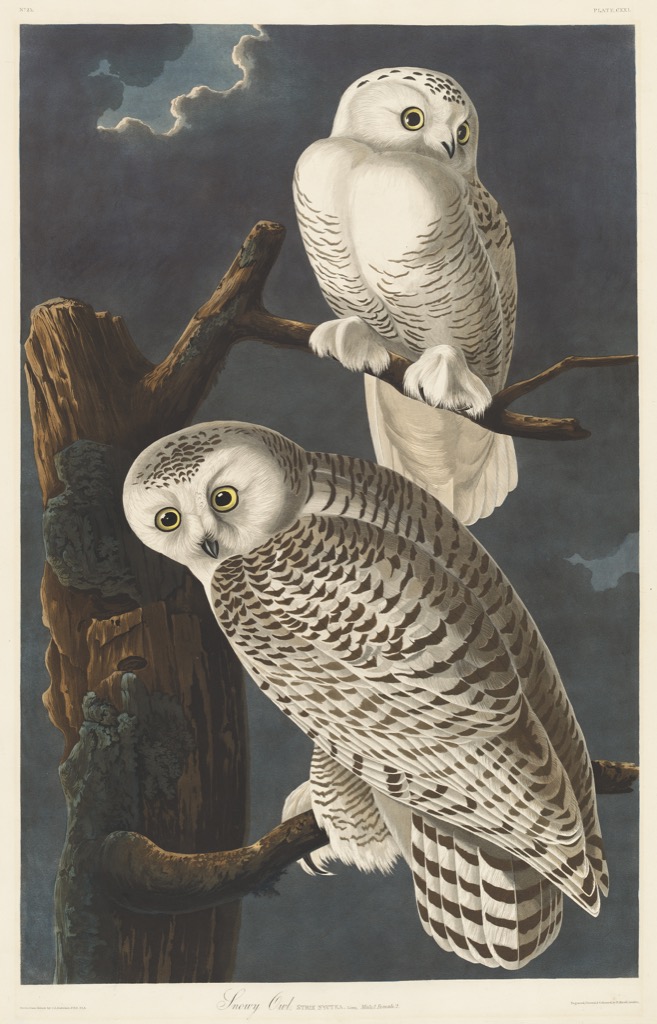
John James Audubon's Snowy Owl is one of the most atmospheric plates in The Birds of America. It shows two pale owls on the branches of a dead tree under a dark, clouded sky. One bird sits lower, facing left but turning its head outward; the other is perched above, more frontal, with its head turned to the side and its chest fluffed into a dense white mass. The scene feels cold, watchful and still. [1]
The National Gallery of Art records the work as Snowy Owl, dated 1831, by Robert Havell after John James Audubon. It is a hand-colored engraving and aquatint on Whatman wove paper, accession number 1945.8.121, and catalogued as Birds of America, no. 121. Those details matter because the image is easy to detach from its source and treat as a generic winter owl. In Audubon's work, it is a specific folio plate from a specific nineteenth-century publication. [1]
The modern Snowy Owl is Bubo scandiacus, an Arctic-breeding owl whose winter appearances farther south are irregular and food-driven. Cornell identifies the species in the order Strigiformes and family Strigidae. Its overview marks the bird as Low Concern, while Cornell's life-history account also notes steep decline, difficult population estimates and Yellow Watch List context. A careful reading should therefore avoid both alarmist simplification and false reassurance. [6], [7]
At a Glance
- Public titleSnowy Owl
- SeriesThe Birds of America, Plate CXXI [1]
- Catalogue referenceBirds of America, no. 121 [1]
- Date1831 [1]
- Maker lineRobert Havell after John James Audubon [1]
- Mediumhand-colored engraving and aquatint on Whatman wove paper [1]
- AccessionNational Gallery of Art, 1945.8.121 [1]
- Current species nameSnowy Owl, Bubo scandiacus [6]
- Image statusNGA public-domain media route [1]
Contents
- Introduction
- Annotated Details
- Object Facts
- What the Plate Shows
- White Plumage and Watchfulness
- The Bird Behind the Image
- Range, Winter Movement and Irruptions
- Place in The Birds of America
- Printmaking and Atmosphere
- Conservation and Modern Status
- How to Look at Snowy Owl
Annotated Details from Snowy Owl
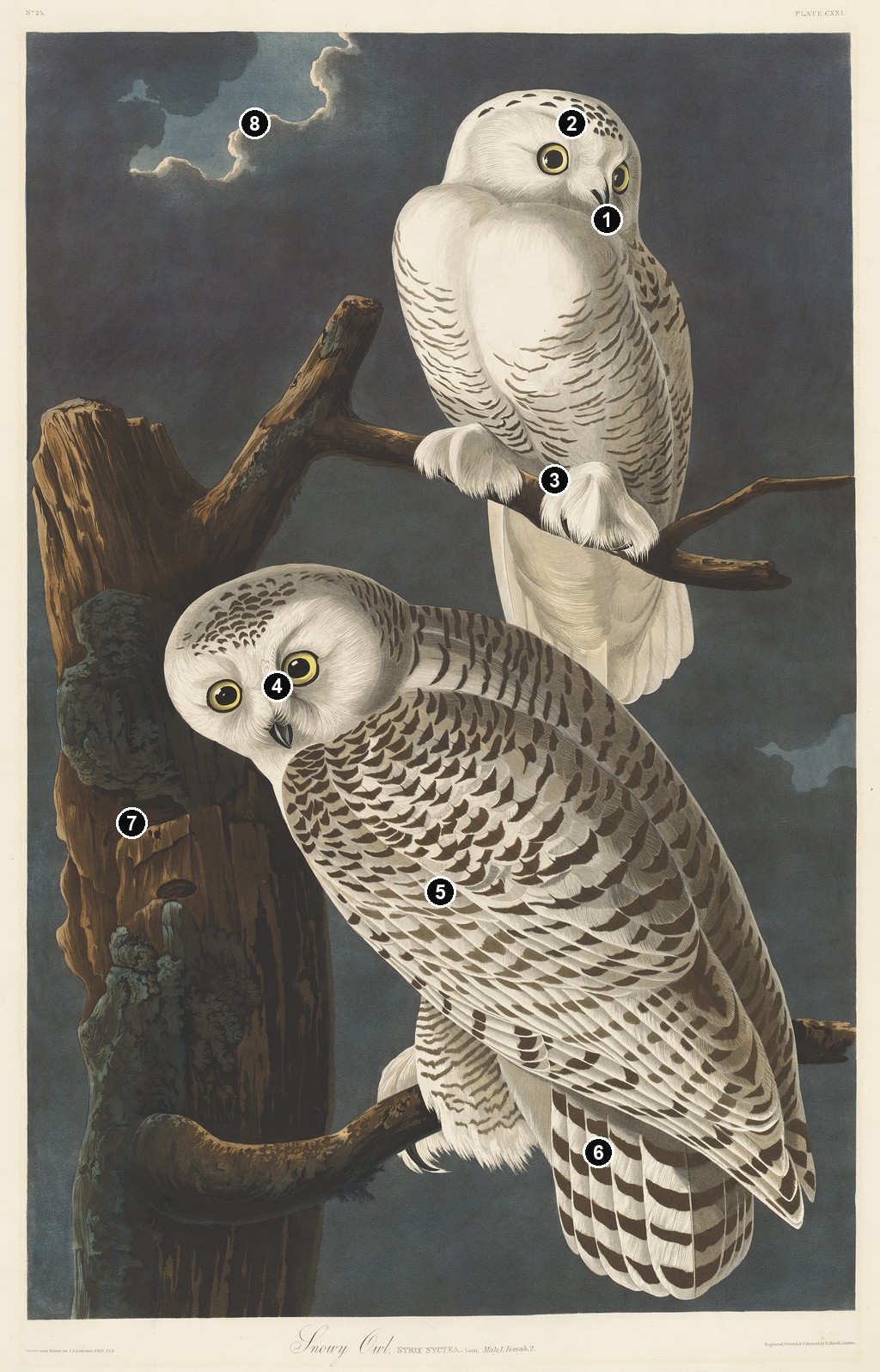
These annotated details follow Audubon's Snowy Owl through the paired birds, yellow eyes, black bill, barred plumage, feathered feet, broken stump and dark weathered sky.
Details from SNOWY OWL
Close looking shows how the plate balances the white mass of the owls against a dramatic dark setting, turning plumage pattern, perch and atmosphere into one large folio design.
Upper owl eyes and bill
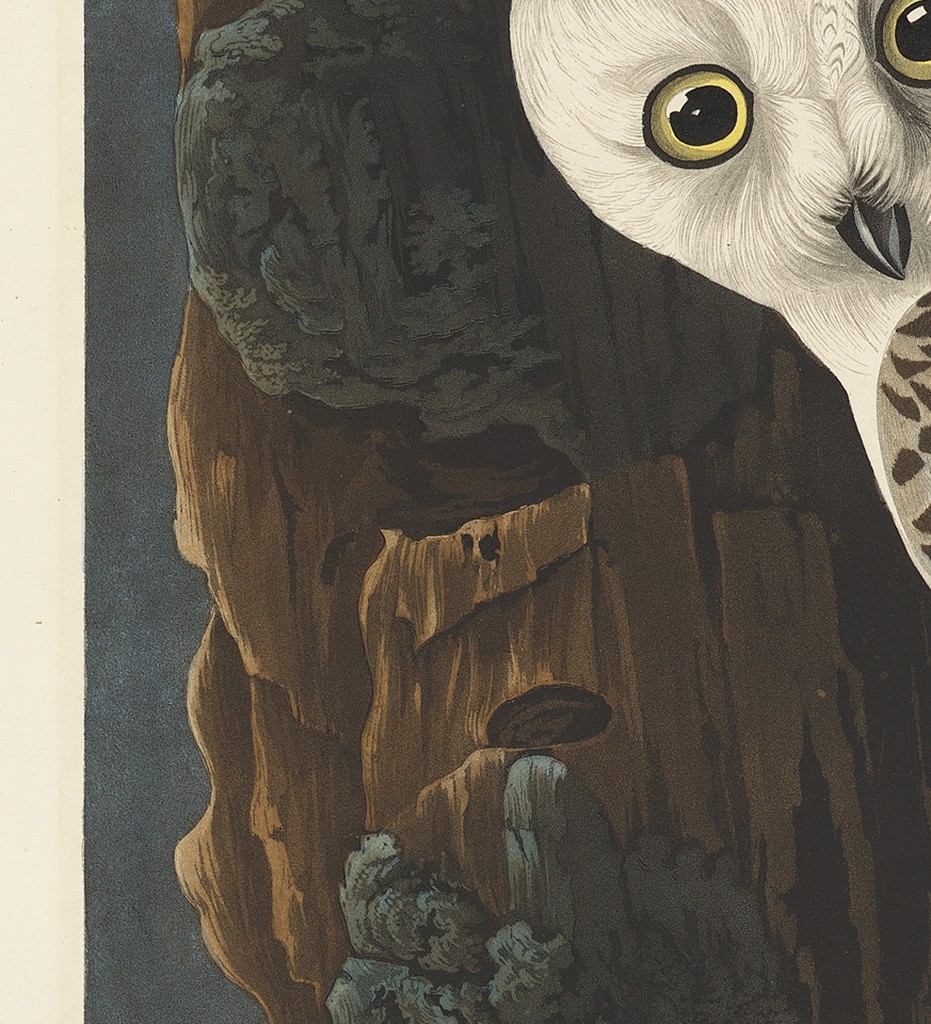
The upper owl's yellow eyes and small black bill create the plate's most direct stare. The head is rounded, alert and almost mask-like.
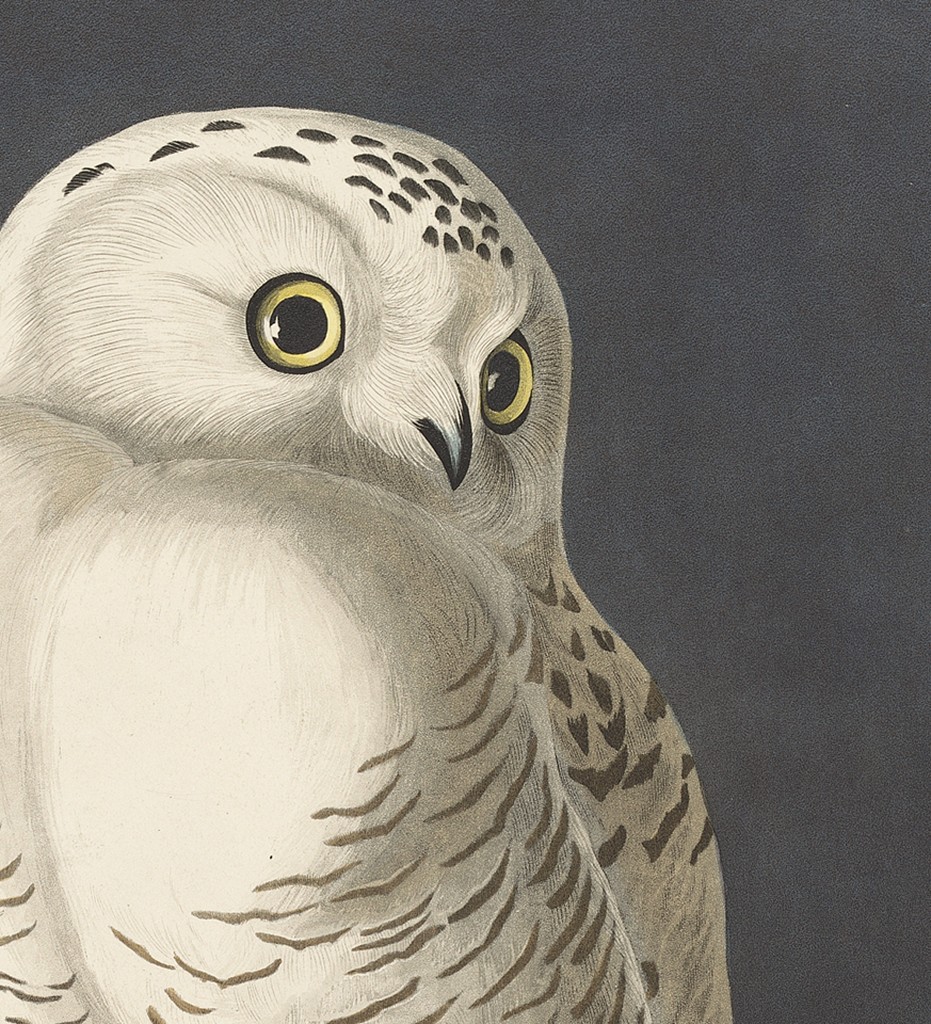
Spotted crown
Small dark marks across the crown break the white head into a pattern of soft feathers and sharp spots.
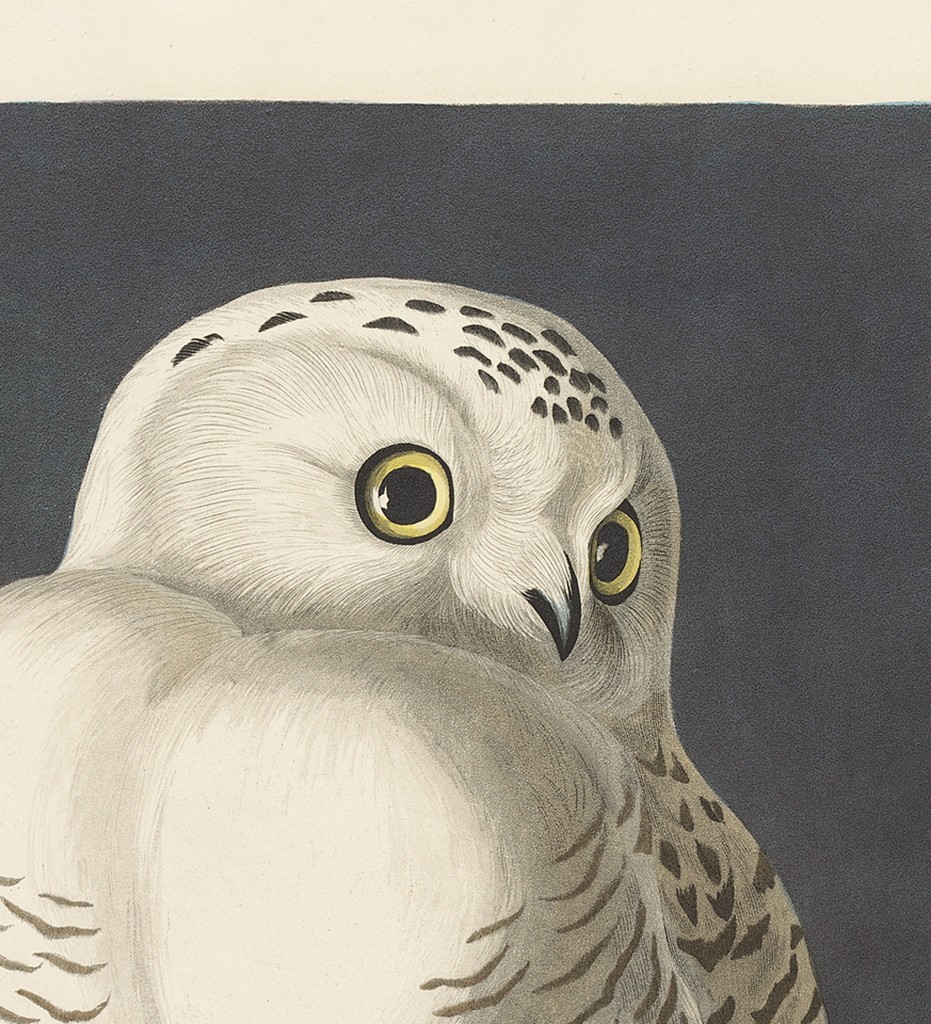
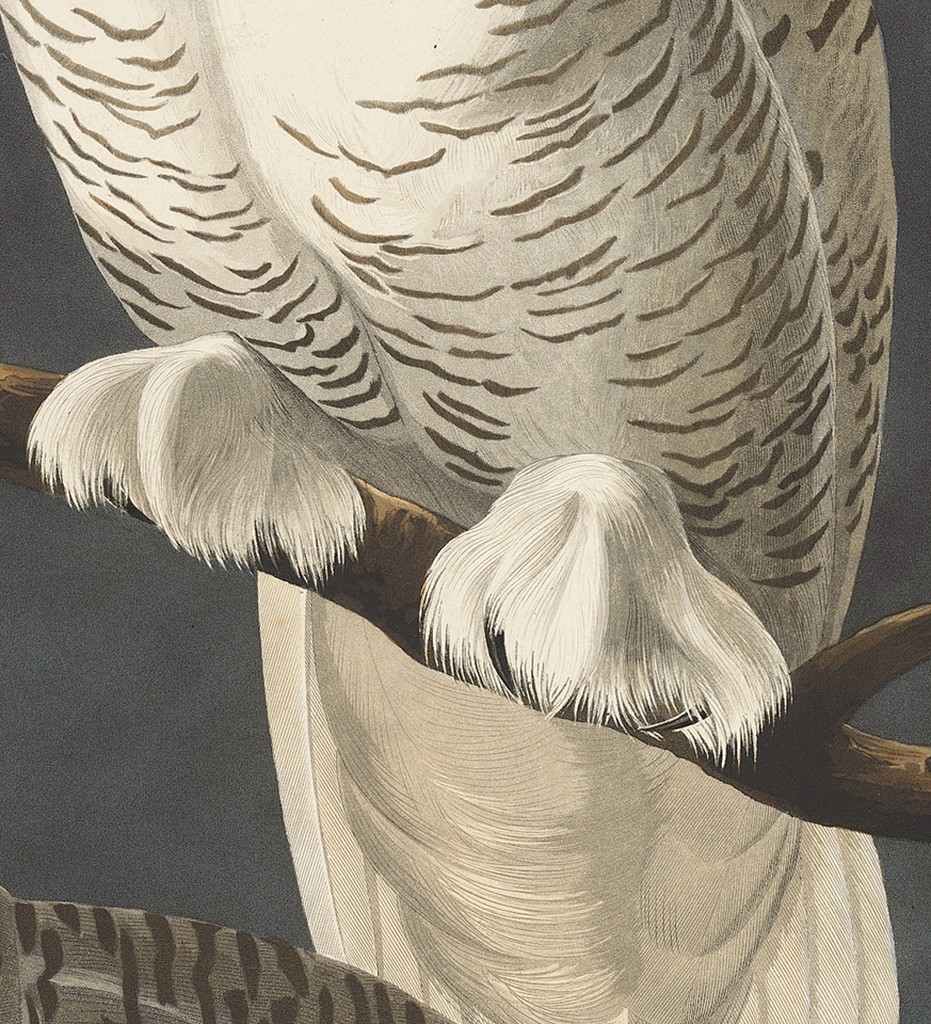
Feathered feet on branch
The heavy feathered feet rest on the branch like white tufts. Audubon uses them to show the owl's cold-adapted body without turning the plate into a diagram.
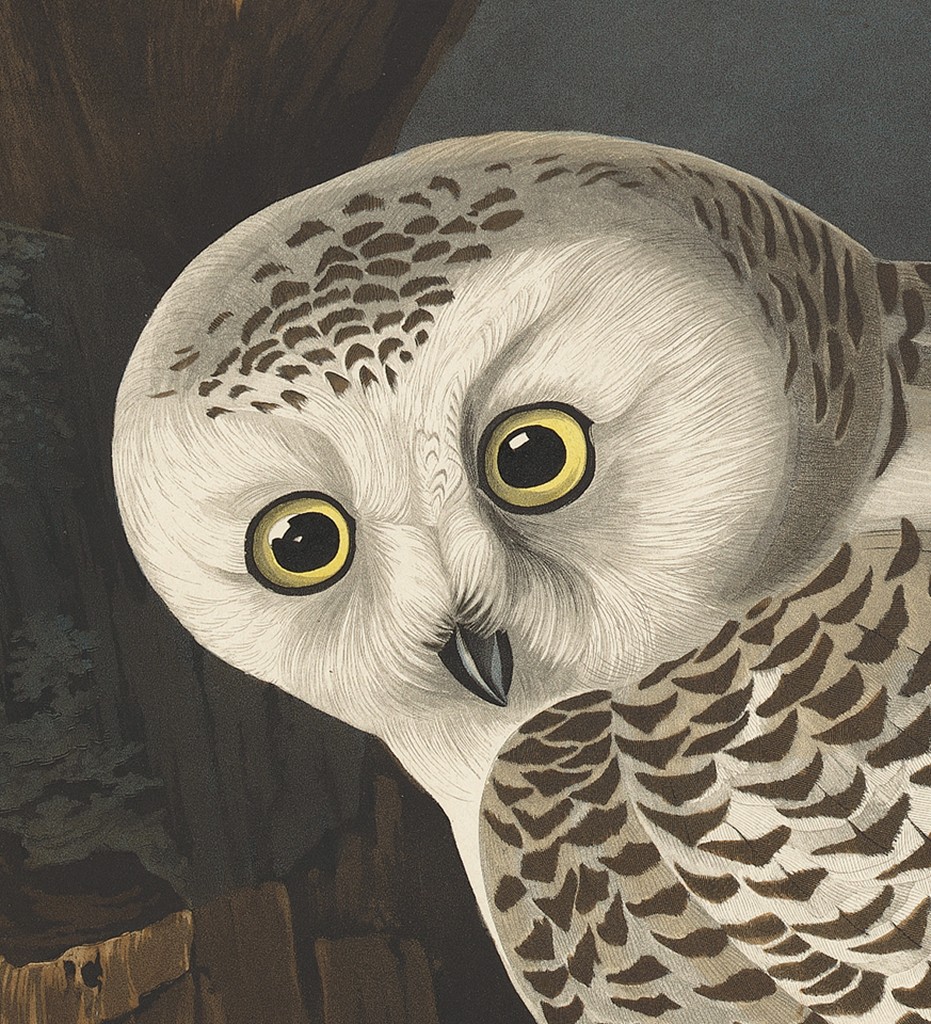
Lower owl face
The lower owl's tilted face brings a second look into the composition. Its eyes repeat the upper bird's yellow circles at a lower, closer scale.
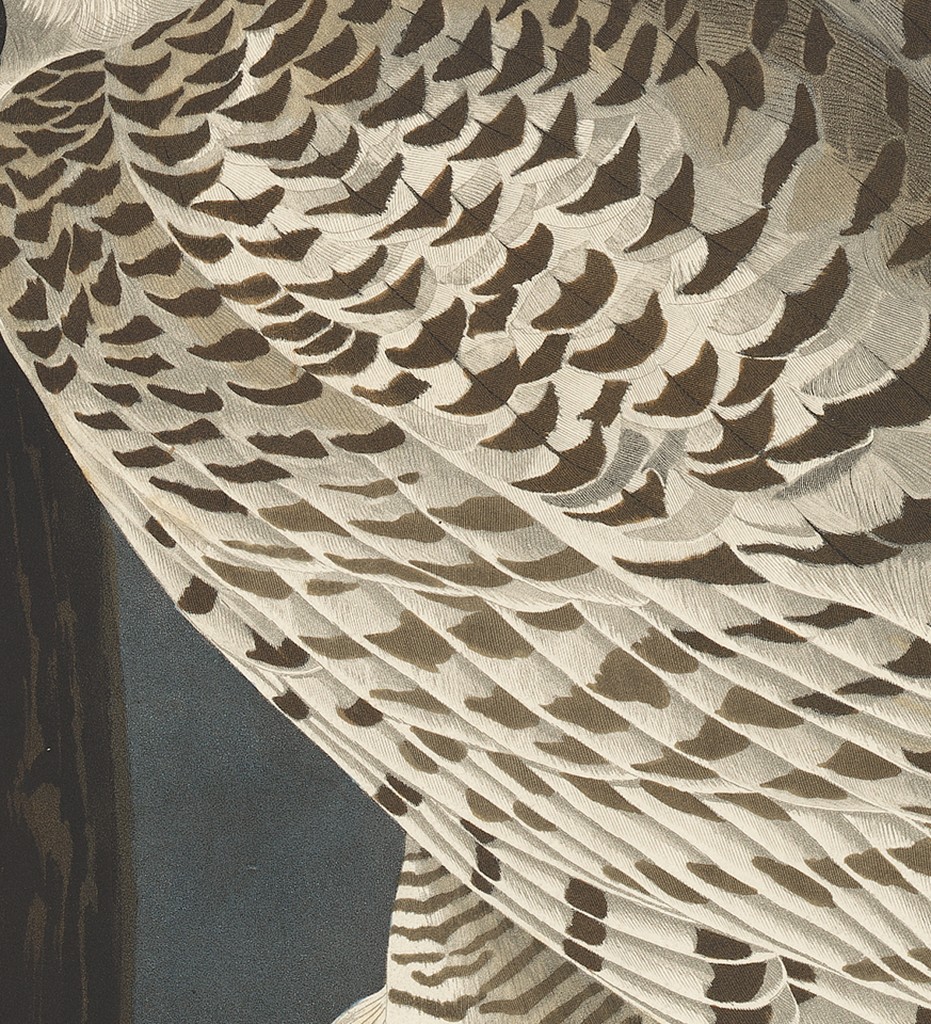
Barred body plumage
Dark bars travel across the body in layered curves. The pattern keeps the large pale bird from becoming a flat white shape.
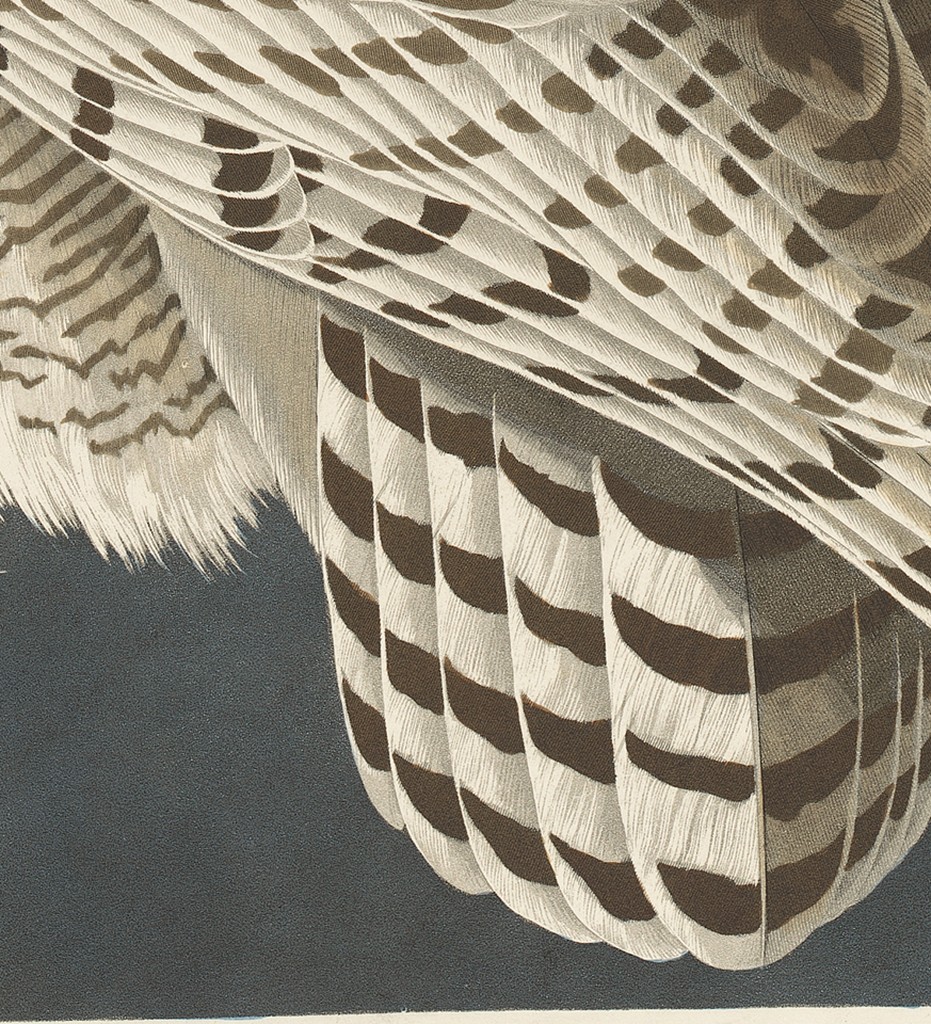
Long tail feathers
The long tail feathers finish the lower bird's diagonal sweep. Their pale bars echo the body pattern while pointing toward the bottom edge.
Broken stump and lichen
The broken stump, bark and lichen give the owls a rugged perch. This rough texture contrasts with the carefully feathered bodies.
Dark sky and cloud
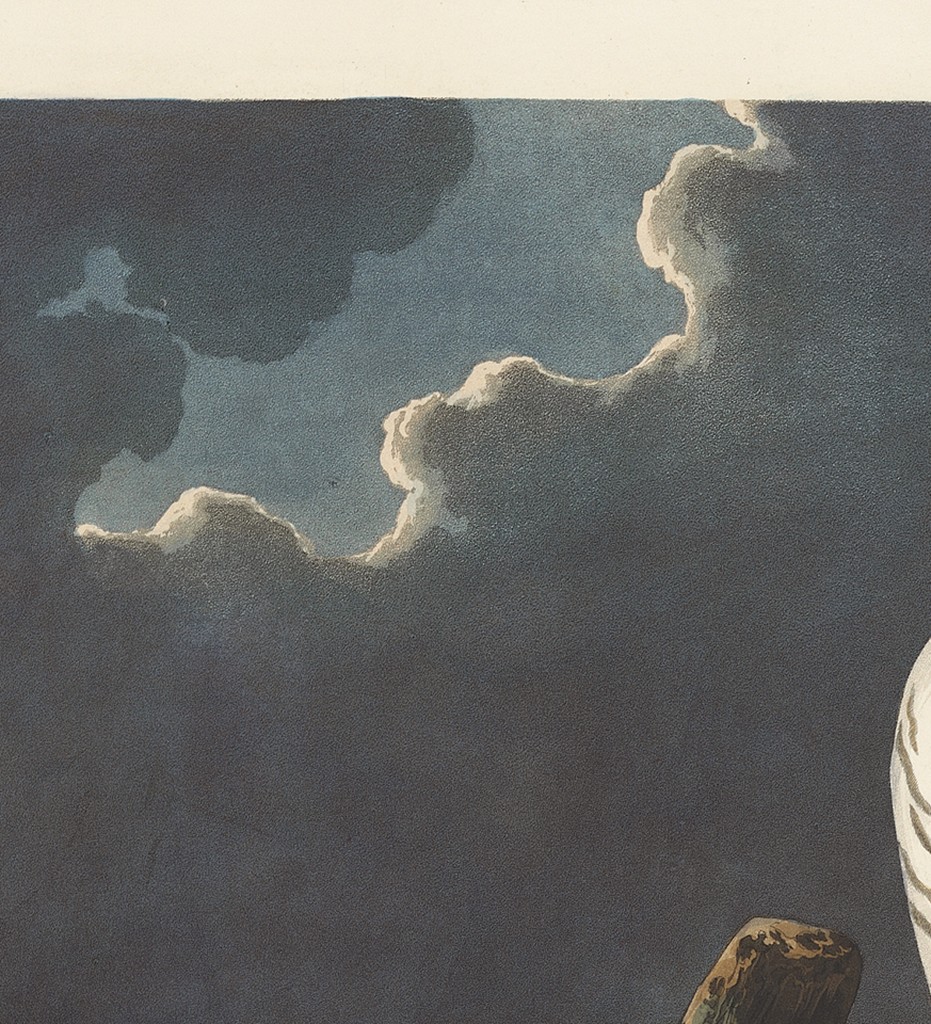
The dark sky and lit cloud set the owls in a theatrical night scene. The background makes their whiteness more forceful.
Object Facts
Snowy Owl belongs to The Birds of America, Audubon's double-elephant folio publication of North American birds. NGA gives the date as 1831 and the maker line as Robert Havell after John James Audubon. That maker line is essential. Audubon supplied the design and bird image; Havell translated the design into the printed object through engraving, aquatint, printing and hand coloring. [1], [2]
The NGA record gives the medium as hand-colored engraving and aquatint on Whatman wove paper. It records the plate size as 89.5 by 65.4 centimetres and the sheet size as 100.7 by 68 centimetres. This is a large vertical plate, suited to the rising dead tree and the stacked pair of owls. [1]
The plate's credit line is the Gift of Mrs. Walter B. James. NGA also notes that the object's media is free and in the public domain. That institutional record gives the article a strong image source, because title, maker line, dimensions, accession number, catalogue reference and public-domain media note can all be checked through the museum record. [1]
What the Plate Shows
The plate shows two Snowy Owls perched on a gnarled dead tree. The lower bird grips a branch and turns its head toward the viewer. The upper bird is more frontal, with its rounded body facing forward and its head turned to the right. The sky behind them is heavy with blue-gray cloud, and the dead branches create a stark vertical structure. [1]
Audubon and Havell make the birds look almost sculptural. Their white plumage stands against the dark sky and tree, but the bodies are not blank. Subtle markings, feather texture and yellow eyes break the whiteness. The lower bird feels alert and grounded. The upper bird feels more inflated, almost like a pale weight balanced in the branches.
The dead tree is central to the mood. It is not a leafy branch scene like Cardinal Grosbeak or a small-bird plate structured by plants. The tree is bare, rough and weathered. It gives the owls a dramatic perch and makes the plate feel wintry even without a detailed snow-covered ground.
The composition works through stillness. Many Audubon plates are built around feeding, movement or interaction. Snowy Owl is more watchful. The birds do not need to fly, strike or struggle. Their force comes from being motionless, insulated, heavy and alert.
White Plumage and Watchfulness
The Snowy Owl's white plumage is the plate's immediate attraction, but it should not be reduced to a simple symbol of winter. Cornell notes that males tend to become whiter with age, while females and young birds retain more dark markings. That modern information helps explain why visible patterning in a Snowy Owl is not merely decorative. [6]
Audubon's plate presents the owls as pale, but not empty. The whiteness holds texture and contour. The feathering around the body makes each bird look insulated against cold. The yellow eyes are small but intense, giving the plate its watchful character.
This combination of whiteness and attention is part of the owl's modern appeal. Snowy Owls are often seen in winter as pale forms on open ground, dunes, fields, airport edges or shoreline structures. They may sit for long periods, conserving energy while surveying the area. Audubon's tree perch is more elevated and theatrical than many modern winter sightings, but it captures the same sense of a bird that can turn stillness into presence. [6], [7]
The plate also avoids a common sentimental trap. The owls are beautiful, but they are not soft. Their bodies are dense, their feet and talons are powerful, and their posture suggests a predator that is patient rather than harmless.
The Bird Behind the Image
The Snowy Owl is an Arctic and subarctic owl of open country. Cornell identifies tundra as its breeding habitat and notes that wintering birds use open places such as fields, shorelines, dunes, airport fields and other treeless areas where they can watch for prey. [6], [7]
Food shapes the species' movements. Cornell emphasizes lemmings on the breeding grounds, while also noting ptarmigan, waterfowl and other prey. On both breeding and wintering grounds, the diet can widen to include rodents, hares, squirrels, weasels, wading birds, seabirds, ducks, grebes and geese. This range matters because the owl's public image is often simple: white bird, snow, Arctic. The living bird is more dynamic than that. [7]
Snowy Owls also differ from many owl stereotypes because they can hunt by day. Cornell describes them as strongly day-active in the continuous daylight of Arctic summer, able to hunt at all hours. That day-hunting habit matters for visual art. Audubon's owls are not hidden in deep nocturnal darkness. Their pale bodies and visible eyes belong to a predator that can be seen in open light as well as imagined in cold gloom. [6]
The nest is also unusual for readers who think of owls in trees. Cornell describes Snowy Owls as ground nesters on tundra, with the female scraping a shallow hollow on a slight rise. Audubon's plate shows perched birds rather than nesting birds, but modern nesting information keeps the species tied to open northern landscapes rather than forest interiors. [7]
Range, Winter Movement and Irruptions
Snowy Owl range language needs care. It is not accurate to say that all Snowy Owls simply migrate south every winter in the same way. Cornell explains that some North American Snowy Owls remain on their breeding grounds year-round, while others move in winter into southern Canada and the northern half of the contiguous United States. In some regions they appear regularly in winter; elsewhere they are irruptive, showing up only in certain winters. [6]
That irregularity is part of the bird's fascination. Snowy Owls can appear suddenly in wide-open places far from the high Arctic, drawing attention from birders and non-birders alike. Cornell's Bird Academy describes these movements as part of nomadic, food-driven lives in which individuals may travel vast distances from year to year. [8]
The word irruption is useful, but it should not become a mystery label. Large winter movements are connected to food conditions, breeding success and competition, especially around lemming cycles in the Arctic. In some years, many young birds may move south after productive breeding seasons. In other years, fewer appear. The pattern is not a simple sign of starvation, nor a guaranteed annual spectacle. [6], [8]
Audubon's plate predates modern tracking and population study, but it still captures something that later viewers recognize: the shock of a large pale owl in a stark landscape. The dead tree and dark sky create a stage for that shock. The modern range story gives the image a second life, especially for readers who have seen Snowy Owls in open winter settings.
Place in The Birds of America
As plate number 121, Snowy Owl belongs to The Birds of America, Audubon's vast publication of 435 hand-colored plates issued between 1827 and 1838. Natural History Museum and Yale Beinecke sources both emphasize the double-elephant folio format and the life-size ambition behind Audubon's project. NGA anchors this particular plate through its object record. [1], [4], [5]
The Snowy Owl plate shows how the folio could serve a large predator without needing action. A plate such as Ivory-billed Woodpecker depends on tree-trunk activity and conservation uncertainty. Great Blue Heron depends on long wetland posture. Snowy Owl depends on perch, weather, whiteness and stare.
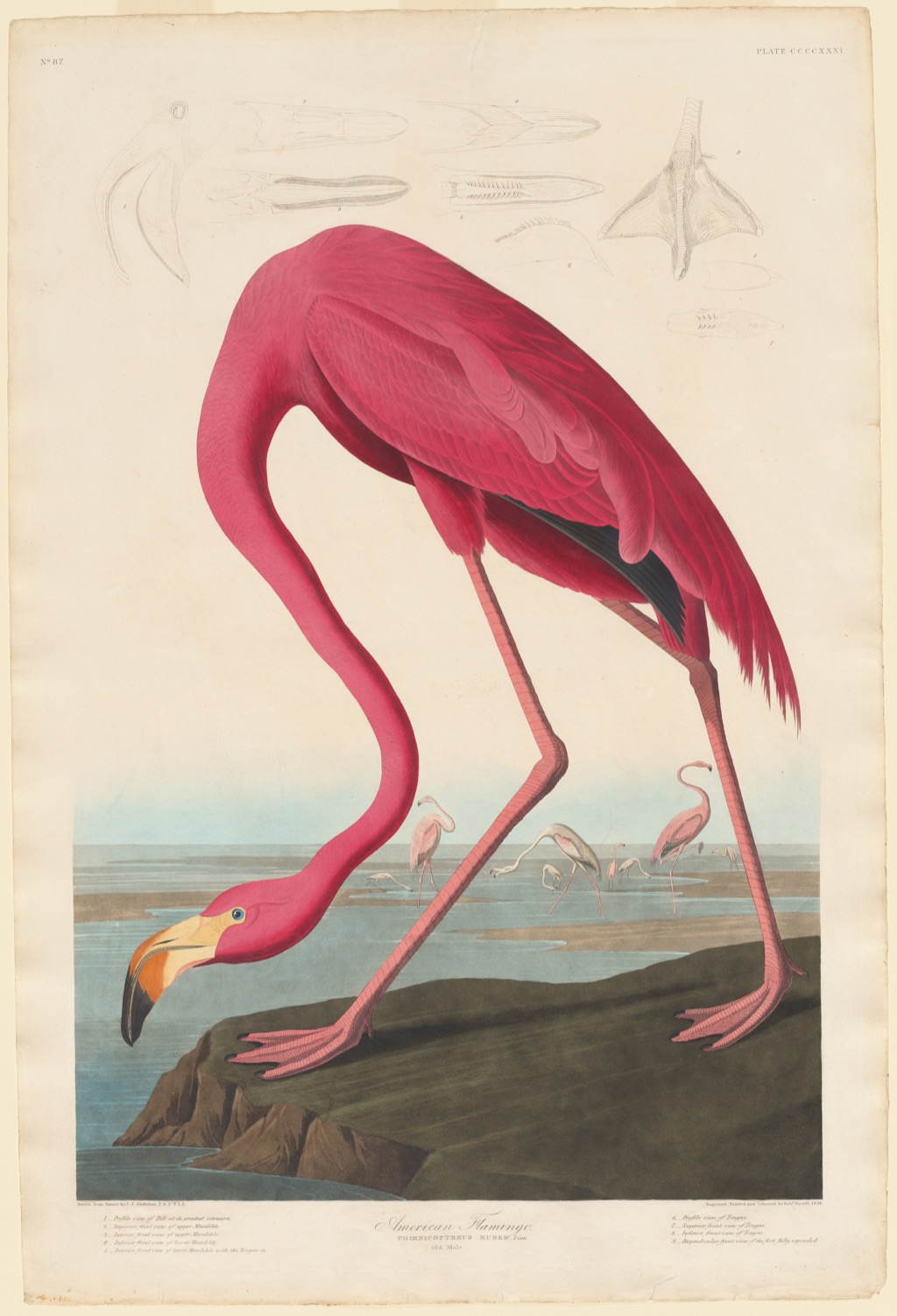
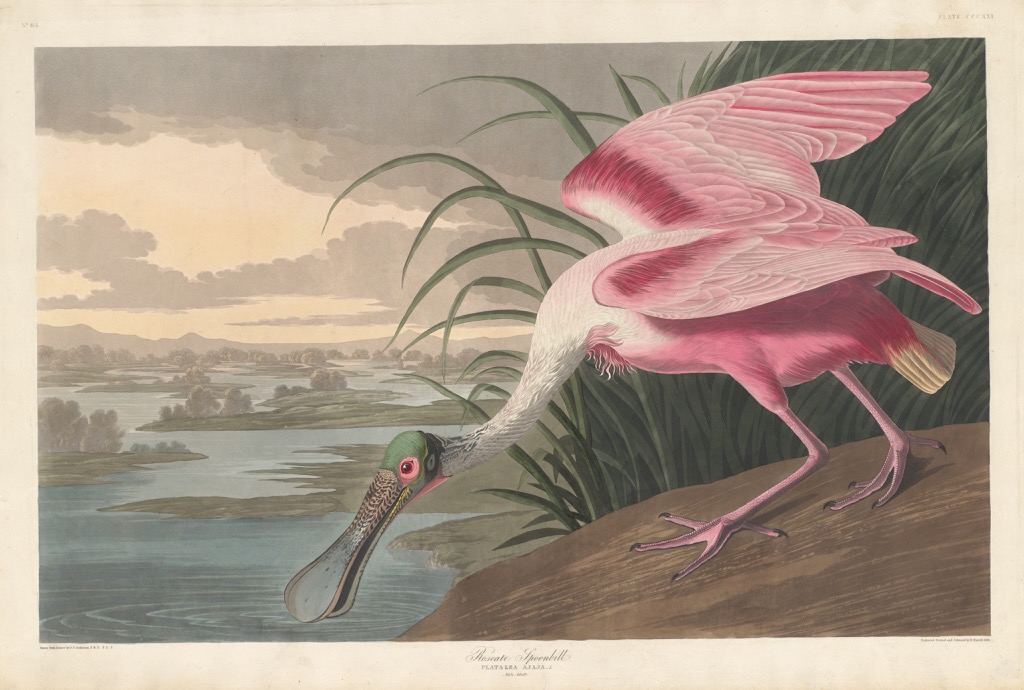
It also sits naturally beside Audubon's other image-led pathways. American Flamingo and Roseate Spoonbill bring colour and wetland form. Snowy Owl brings northern severity, winter recognition and raptor presence.
For the larger publication context, readers should continue to The Birds of America. For Audubon's broader work across drawing, print, book-making and painting, John James Audubon Works gives the wider frame.
Printmaking and Atmosphere
Snowy Owl depends heavily on printmaking atmosphere. The owls are pale, the tree is dark, and the sky carries dense cloud. Engraving gives branch, feather and eye their structure. Aquatint helps create the tonal sky. Hand coloring gives the image its cold blue-gray mood and the yellow intensity of the owls' eyes. [1]
The challenge is subtle. A white bird on pale paper can easily lose force. Havell's printed tones and Audubon's design solve that problem by placing the owls against darker branches and weather. The birds remain clear because the background is strong enough to make whiteness visible.
The dead tree also has graphic power. Its branches cut into the page like dark lines, holding the birds in place and lifting the composition upward. The tree is not lush or comforting. It is skeletal, which makes the owls seem even more self-contained.
This is one reason the plate feels different from a modern wildlife photograph. A photograph might show a Snowy Owl on a beach, fencepost or frozen field. Audubon's plate stages the bird as an image of cold endurance: perched, framed, watched by clouds and made monumental through the double-elephant folio.
Conservation and Modern Status
Modern status language for Snowy Owl needs balance. Cornell's overview marks the species as Low Concern, but its life-history page gives a more complicated conservation summary. It notes that Snowy Owls are hard to count because they nest remotely, hold large territories and move unpredictably in winter. It also reports a Partners in Flight estimate of 29,000 breeding birds, steep decline from 1976 to 2016 and Yellow Watch List placement for a species needing constant care and long-term assessment. [6], [7]
Those facts should not be stretched into a claim that every winter sighting indicates collapse. They should also not be ignored. The Snowy Owl is still a living species with broad public recognition, but its conservation story is difficult because of remote breeding grounds, changing prey cycles, uncertain climate effects and unpredictable movements.
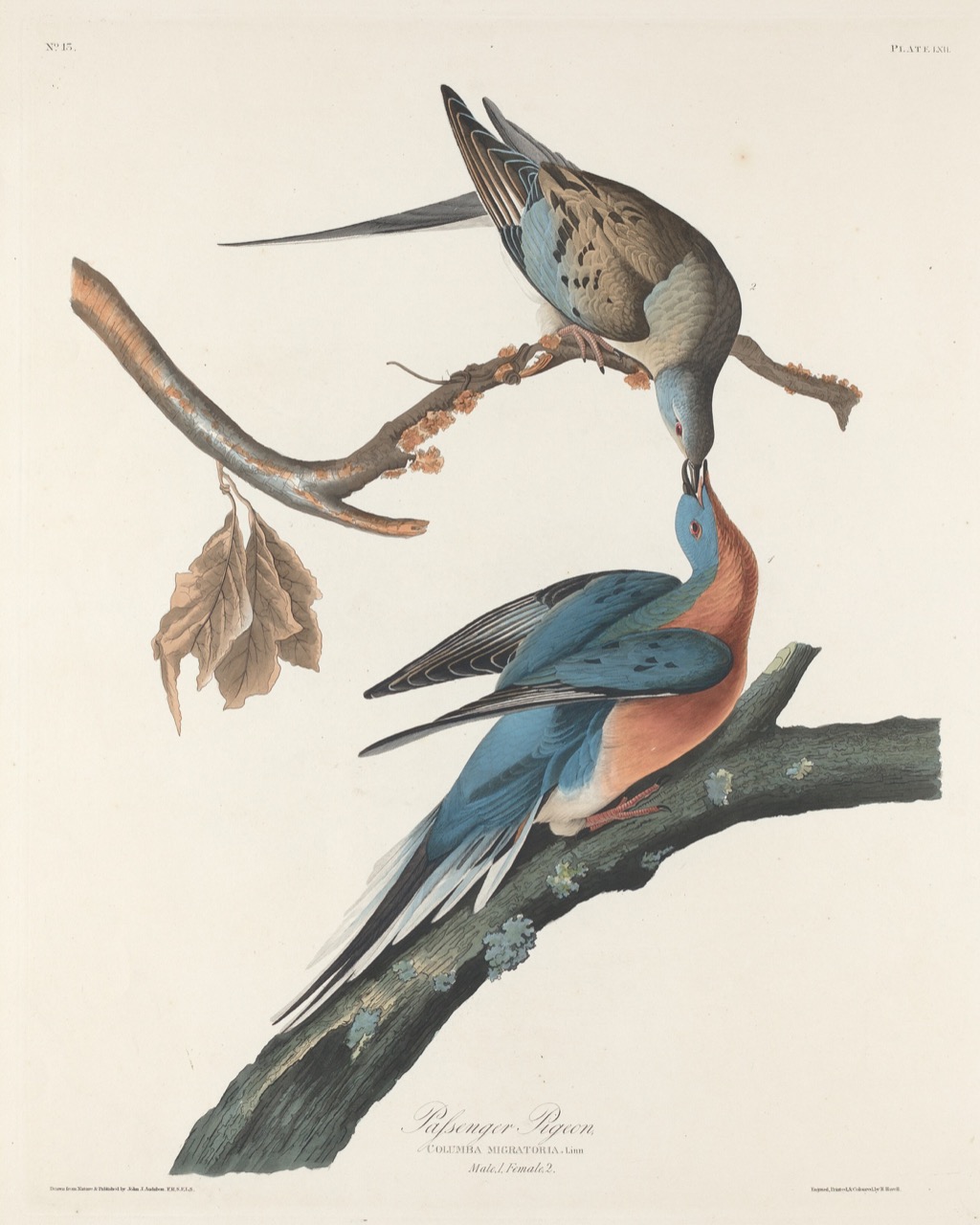
For a plate page, the right tone is careful attention. Audubon's image is not an extinction memorial like Passenger Pigeon or Carolina Parakeet. It is a living-species image whose modern sources ask readers to understand vulnerability, uncertainty and long-term monitoring.
How to Look at Snowy Owl
Begin with the eyes. The yellow eyes give the plate its alertness and keep the pale bodies from becoming merely decorative. Then look at the difference between the two owls. One turns outward from below; the other sits higher and more frontal, head turned in another direction. The pair creates a sense of watchfulness in multiple directions.
Next, look at the tree. Its dead branches are not background clutter. They hold the composition together and create the starkness that makes the white birds powerful. The tree also distinguishes this plate from the tundra-ground and open-field settings modern readers may associate with the species.
Then look at the sky. The dark clouds make the plate feel cold and dramatic, but they also solve a visual problem: they let the white plumage be seen. Without that atmosphere, the birds would lose much of their weight.
Finally, bring in the modern bird. Snowy Owls are open-country predators tied to Arctic breeding grounds, lemming cycles and irregular winter appearances. Audubon's plate does not explain all of that, but it gives a memorable visual form to the bird's public identity: pale, northern, watchful and hard to forget.
Why This Plate Matters
Snowy Owl matters because it gives Audubon's cluster a powerful winter and raptor image. It is not built on bright colour, extinction memory or spectacular feeding action. It is built on stillness. The plate asks viewers to look at posture, whiteness, weather, tree structure and the quiet force of two predators waiting.
It also matters because Snowy Owls continue to occupy a special place in public bird culture. Their irregular winter appearances can draw crowds, and their pale bodies make them visually dramatic even for people who do not usually follow birds. Audubon's plate belongs to that longer fascination, while remaining firmly a nineteenth-century print object.
The best reading holds the artwork and the living bird together. Snowy Owl is a hand-colored folio plate made through Audubon's design and Havell's printmaking. It is also an image of a real Arctic owl whose modern status, movements and habitat are more complicated than a simple winter symbol. For wider context in bird art, the site's bird drawings section offers another route into the tradition.
Frequently Asked Questions
Discussion
Snowy Owl turns a pale Arctic predator into a dramatic folio image of stillness, weather and watchfulness.
Use the prompts below to think about atmosphere, winter movement and the difference between a familiar owl image and a carefully built natural-history plate.
Reader Insights
How do the two turned heads change the mood of the plate?
What does the dark sky do for the owls' white plumage?
How should a page balance Low Concern status with steep-decline and watch-list context?
Join the Conversation
Share your reading of Audubon's Snowy Owl and its balance of winter beauty, predator force and conservation nuance below.
References
- National Gallery of Art, Snowy Owl, accession 1945.8.121, accessed 26 July 2026.
- Biodiversity Heritage Library, The Birds of America, accessed 26 July 2026.
- Biodiversity Heritage Library, Ornithological Biography, accessed 26 July 2026.
- Natural History Museum, London, The Birds of American Animals, accessed 26 July 2026.
- Yale Beinecke Library, The Double Elephant Folio, accessed 26 July 2026.
- Cornell Lab of Ornithology, All About Birds, Snowy Owl overview, accessed 26 July 2026.
- Cornell Lab of Ornithology, All About Birds, Snowy Owl life history, accessed 26 July 2026.
- Cornell Bird Academy, Snowy Owl Invasion, accessed 26 July 2026.