

 Buy Art Prints Now
from Amazon
* As an Amazon Associate I earn from qualifying purchases.
Image reference [image]
 by Tom Gurney
Tom Gurney BSc (Hons) is an art history expert with over 20 years experience
Published on August 14, 2026 / Updated on August 14, 2026
Email: tomgurney1@gmail.com / Phone: +44 7429 011000
The Awakening of Adonis: Introduction
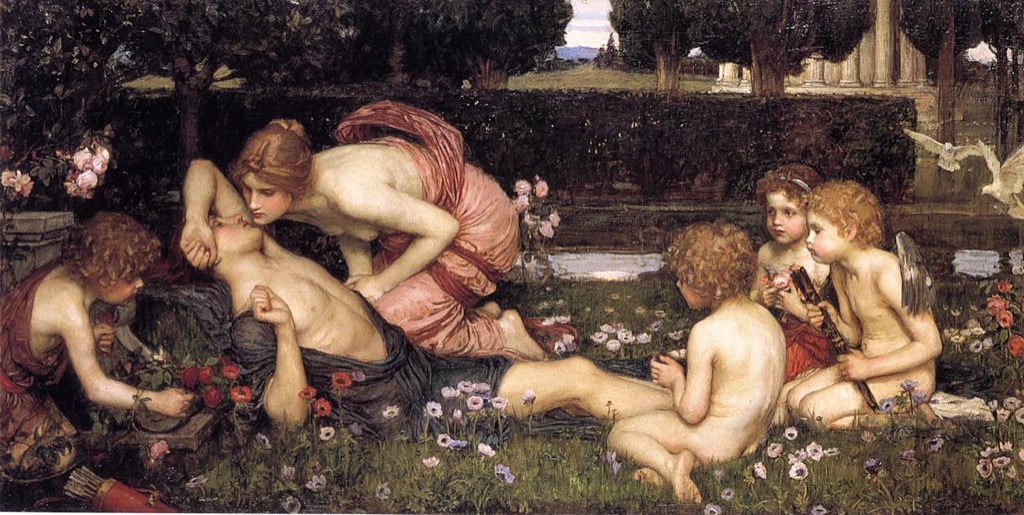
Venus bends to kiss a beautiful young man awake while winged children gather flowers and rekindle a torch. John William Waterhouse's The Awakening of Adonis was begun in 1899 and exhibited at the Royal Academy in 1900. Its flowering garden turns the violent myth of Adonis's death into a suspended vision of desire and seasonal renewal. [1] [2]
The title seems reassuring, but red anemones and the sleeping body's stillness keep death close. Waterhouse paints neither the fatal boar hunt nor an unambiguous resurrection. He creates an awakening whose meaning depends on several ancient traditions and on the viewer's willingness to distinguish catalogue interpretation from what the canvas actually proves.
At a Glance
- ArtistJohn William Waterhouse (1849–1917)
- TitleThe Awakening of Adonis [1]
- DateBegun in 1899; first exhibited in 1900 [1] [2]
- MediumOil on canvas [2]
- Dimensions95.9 × 188 cm [2]
- CollectionPrivate collection; associated with the Andrew Lloyd Webber Collection [1] [2]
- First exhibitedRoyal Academy, London, Summer Exhibition, 1900 [1]
- SubjectVenus awakening Adonis with a kiss in a garden, accompanied by Cupid or putti, flowers, doves and a rekindled torch
- Primary mythic controlsAccounts of Adonis in Ovid and other ancient mythographers, with no single surviving text describing every painted detail [1] [3]
- Essential distinctionWaterhouse's awakening is not a literal illustration of Ovid's boar-hunt episode
Contents
- Introduction
- A Kiss between Sleep and Return
- Adonis before the Fatal Hunt
- What the Ancient Sources Do and Do Not Say
- Venus, Cupid and the Flowering Garden
- Anemones, Roses, Doves and the Torch
- Beauty, Looking and the Horizontal Body
- From 1899 Studio Work to the 1900 Academy
- Preparatory Studies and Alternative Readings
A Kiss between Sleep and Return
Adonis lies almost horizontally across a wide foreground. His pale body is relaxed, his head turned upward and his eyes closed or only beginning to open. Venus leans down from behind him until their faces nearly meet.
Small winged figures fill the garden around the pair. One tends a torch, others carry or scatter flowers and the air is active with birds. Their movement contrasts with Adonis's stillness.
The format is unusually broad. Rather than isolate two lovers in a vertical embrace, Waterhouse distributes narrative signs across a long meadow. The viewer reads from quiver and child to reclining youth, bending goddess, garlands and further attendants.
No wound or boar appears. The body can therefore be read as sleeping, seasonally returning or deathlike. The title directs us towards waking, but visual ambiguity prevents an effortless answer.
Venus's kiss is both affectionate and causative. It does not merely greet an alert lover; it appears to summon consciousness. Her leaning body supplies the active diagonal against his horizontal repose.
This reverses the gender arrangement found in many sleeping-beauty stories. The beautiful unconscious body is male and exposed to a woman's gaze and touch. Waterhouse had already made sleeping men objects of supernatural female attention in A Naiad.
Adonis is not shown as a hunter. Weapons are displaced to the side, and the garden protects him temporarily from the boar that will define his end. Sensual repose replaces heroic action.
The scene is therefore a beginning haunted by conclusion. Even if spring has returned and desire has revived, viewers who know the myth understand that Adonis will not remain permanently safe.
Adonis before the Fatal Hunt
Adonis's birth is itself a metamorphosis story. In Ovid's Metamorphoses, his mother Myrrha has conceived him through an incestuous union with her father. After she is transformed into the myrrh tree, the tree opens and the child is born. [3]
The infant rapidly becomes a beautiful boy and then a young man loved by Venus. Ovid makes the goddess accidentally vulnerable to her son Cupid's power when an arrow grazes her, and her attachment to Adonis draws her away from her usual haunts. [3]
She accompanies him in the hunt but warns him against dangerous beasts. Adonis ignores or fails to survive that warning. A wild boar, wounded by his weapon, charges and gores him. [3]
Venus hears his groans while travelling through the air, returns and laments over his body. She promises an enduring memorial and transforms his blood into a short-lived flower, commonly identified as the anemone. [3]
Other ancient accounts add the dispute between Aphrodite and Persephone. Aphrodite entrusts the beautiful child to the underworld goddess, who refuses to give him back. A divine judgement divides Adonis's time between them. [1]
That division encouraged seasonal readings. Time below and time with the goddess of love could correspond to disappearance and return, barrenness and growth. Ancient ritual lamented Adonis, although the relationship between varied myths, cult practices and later “dying and rising” summaries is not perfectly uniform.
Waterhouse gathers these traditions into an event that is more visual than textual. Venus welcomes or awakens Adonis in a fertile garden. Flowers associate his return with renewed life, while underworld absence and future death remain implied.
The title does not say The Resurrection of Adonis. “Awakening” preserves analogy between sleep and death without requiring a doctrinal claim that this is the instant after the boar has killed him.
What the Ancient Sources Do and Do Not Say
Ovid supplies Myrrha's tree-birth, Venus's love, warning, Adonis's death and the flower made from his blood. [3] He does not describe the exact garden tableau Waterhouse paints: a kiss awakening the youth, several putti, rekindled torch and doves rising together.
The dispute with Persephone appears in mythographic traditions outside Ovid's main narrative and is summarised in the Sotheby's catalogue. [1] It provides a plausible basis for return from a divided year, but it should not be misquoted as though every version ends in annual bodily resurrection.
Waterhouse's composition is therefore synthetic. He can combine a seasonal interpretation of Adonis with Ovidian flower metamorphosis and familiar attributes of Venus and Cupid.
The white doves belong to Venus's visual tradition. The torch belongs to Cupid or to love rekindled. Roses belong to Venus, while anemones belong to Adonis's blood and brief life. [1] The canvas makes these associations simultaneous.
Ancient myth did not exist as one authorised script. Apollodorus, Hyginus, Ovid and later poets transmit different emphases. A Victorian artist and audience could encounter them through translations, dictionaries, paintings, sculpture and retellings.
This plurality helps explain the work's emotional openness. If the youth has merely slept, the flowers foreshadow death. If he returns from Persephone, they announce spring. If he lies deathlike, Venus's kiss becomes lament or impossible wish.
The most responsible reading begins with the title and catalogue tradition but marks uncertainty. It should not claim that the picture definitely shows the moment after the fatal hunt, because no wound establishes that chronology.
Nor should it call Adonis a god without qualification. In most familiar accounts he is a beautiful mortal or hero loved by goddesses, later honoured through cult. Waterhouse emphasises bodily vulnerability rather than divine invulnerability.
Venus, Cupid and the Flowering Garden
Venus occupies the composition's centre not by sitting frontally but by bending. Her movement bridges the upper garden and the low body. Desire descends into touch.
The small winged figure near the torch is most securely identified as Cupid because quiver, arrows and torch are his conventional attributes. Other winged children can be described as putti or attendant loves rather than assigned individual names. [1] [4]
Their number turns a private kiss into a ceremony of revival. Flowers are gathered, flame receives breath and birds rise. The whole garden seems to participate in awakening.
At the same time, the attendants risk becoming decorative. Anthony Hobson considered the putti charming but superfluous to the action, as noted by the Victorian Web. [4] That criticism usefully asks whether multiplication clarifies myth or disperses emotional concentration.
Without them, Venus and Adonis would form an intense two-body encounter. With them, awakening becomes a collective season rather than solely erotic intimacy.
The garden is sometimes described as Elysian. [1] Nothing in the visible architecture conclusively maps it onto a specific underworld geography. It is safest to call it an ideal, fertile pleasure garden shaped for mythic return.
Roses, meadow flowers, water and distant growth turn fertility into environment. Adonis is not awakening in a bedroom or tomb. His body belongs to a landscape in bloom.
Venus is also not a remote Olympian apparition. She kneels or stoops close enough for breath and lips to matter. Waterhouse humanises divine action through the tenderness of posture.
The figures' nudity is restrained by drapery, vegetation and pose. Sensuality is central, but it operates through proximity and looking as much as exposed flesh.
Anemones, Roses, Doves and the Torch
Red flowers in the foreground are often identified as anemones. Ovid says that Venus transforms Adonis's blood into a fragile flower whose petals do not cling firmly and are soon shaken away by wind. [3]
If anemones appear before the painted youth's death, they function as foreshadowing rather than chronological products of his blood. If the scene follows a deathlike absence, they can function as memorials. Waterhouse allows pictorial symbolism to disregard linear sequence.
Roses are attached to Venus in later classical and artistic tradition. Their abundance broadens the garden from one flower of mourning to the whole domain of love. [1]
White doves rise into the air. They lighten the upper composition and identify Venus through her sacred birds without requiring a chariot. Their flight makes awakening contagious.
The torch offers the clearest allegory. A winged child blows upon it to bring the flame back. Love and life are rekindled together. [1]
Yet fire is also temporary and consumptive. Like petals, flame requires sustaining. The picture's symbols of renewal carry fragility within them.
A quiver near the edge recalls Cupid's arrows and the hunt. Arrow and spear belong to different narrative systems—erotic wounding and physical hunting—but Adonis is endangered by both desire and sport.
The flowers should not be read as a botanical inventory with one fixed meaning assigned to every species. Reproductions make identification uncertain, and decorative colour is part of their work. The secure pattern is a garden where love, blood, season and mortality overlap.
Beauty, Looking and the Horizontal Body
Adonis is famous because goddesses desire his beauty. Waterhouse makes that beauty visible through a body presented for inspection while consciousness is suspended.
Venus looks closely. The putti attend. The gallery viewer joins them. Adonis is the visual object around which active gazes organise themselves.
This gender reversal does not remove unequal power. Venus is divine and awake; Adonis is mortal and recumbent. Her kiss may restore him, claim him or express grief. His consent cannot be read from closed eyes.
The horizontal body recalls dead heroes, sleeping lovers and academic studies of the nude. Waterhouse keeps all three possibilities active. The title insists on transition rather than final state.
His pale flesh contrasts with saturated grass and flowers. The body seems both part of fertile nature and unnaturally still within it.
Venus's drapery creates a curved shelter above his head. Their faces nearly touch, concentrating intimacy amid the wide bustle of attendants.
The long canvas delays the kiss. Viewers traverse secondary figures before reaching the central exchange. Horizontal breadth creates narrative time.
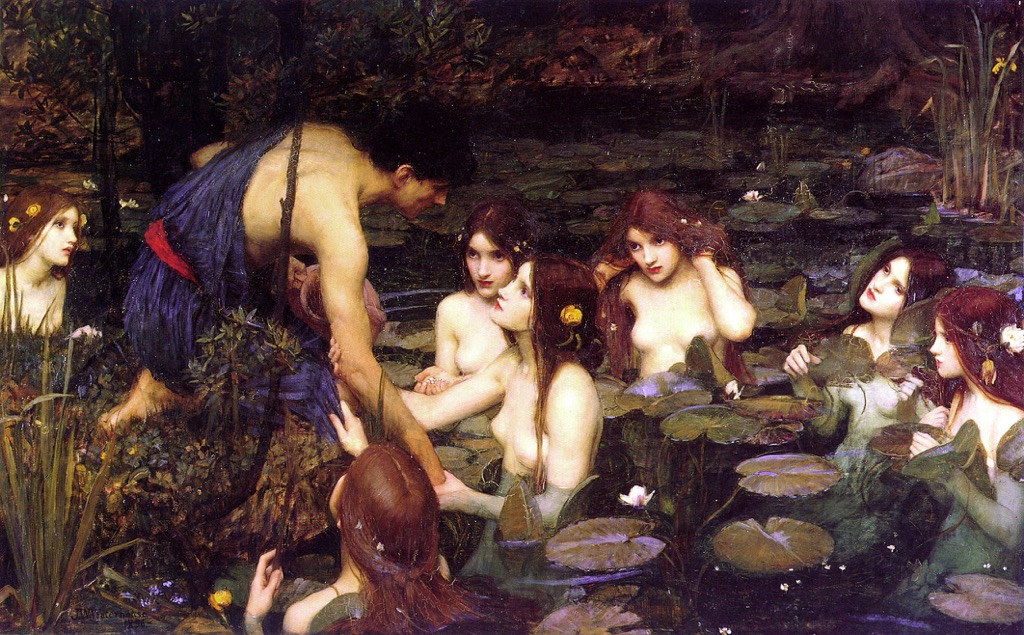
Waterhouse had painted Hylas kneeling before seven nymphs and a sleeping youth watched by a naiad. Adonis continues his interest in male beauty made vulnerable to supernatural female desire. Unlike Hylas, however, Adonis is not being pulled into water; he is being called back into life or love.
The body's display also connects painting with contemporary sculpture. Late-Victorian galleries regularly presented ideal male nudes whose mythological titles made close study of the body culturally acceptable. Waterhouse translates that sculptural stillness into flesh surrounded by soft, temporary growth. Adonis can resemble a beautiful statue until Venus's approach promises warmth and response.
His passivity is not his complete mythic identity. The future hunter will choose dangerous action despite Venus's warning. [3] By showing him before that assertion, Waterhouse lets vulnerability dominate the figure ordinarily remembered for reckless pursuit of a boar.
The result complicates heroism. Physical perfection neither grants control over divine desire nor guarantees survival. Adonis is powerful as an image and powerless as a sleeping mortal. Everyone around him acts upon the scene while he remains the reason for their action.
From 1899 Studio Work to the 1900 Academy
Waterhouse began the painting in 1899 but did not complete it in time for that year's Royal Academy. It was held over and exhibited in the summer of 1900. [1]
This date control explains why modern sources alternate between 1899 and 1900. Both can be meaningful if labelled: 1899 for origin or execution, 1900 for completion and first public exhibition.
At the Academy, a reviewer in the Athenaeum described the work as attempting to represent passionate emotions and historic tragedy dramatically. [1] The response recognises that the canvas's flowers and children do not make it emotionally light.
The picture belongs with Waterhouse's large mythological confrontations of the late 1890s, including Hylas and the Nymphs and Flora and the Zephyrs. Each brings a beautiful mortal or nymph into decisive contact with supernatural desire. [1]
It also anticipates Nymphs Finding the Head of Orpheus, exhibited in 1901. The sequence moves among threatened youth, abduction, awakening and the aftermath of violent death.
The painting is privately owned and has been associated with Lord Lloyd-Webber's collection. [1] [2] Its scale—nearly 1.9 metres wide—makes direct viewing different from the cropped or reduced images through which it is often known.
Private status increases the importance of exhibition catalogues, contemporary reviews and studies. These records preserve chronology and working evidence even when the finished surface is not regularly available.
The year's exhibition context adds a productive comparison with Waterhouse's A Mermaid, the work later accepted as his Diploma picture. Both place an idealised body at the boundary between human and supernatural existence, but the mermaid is conscious and self-contained while Adonis is surrounded by agents of awakening. One draws beauty out of her own hair and song; the other receives life or desire from outside.
The Athenaeum review's language of “historic tragedy” may sound odd for a flower-filled garden. [1] It indicates that informed viewers did not forget the fatal structure behind the decorative surface. In mythological painting, anemones could make future blood present without requiring violence to be shown.
Waterhouse thus offered the Academy two experiences at once. From a distance, the picture reads as a broad spring idyll with pale figures, greenery and flowers. At narrative range, every renewal becomes temporary because Adonis's beauty is inseparable from his early death.
This double address helps explain why the subject belongs to a sequence of “fateful confrontations.” [1] The action is tender, but fate has not been cancelled. Venus can wake, claim or mourn the youth; she cannot make the myth end before the boar.
Preparatory Studies and Alternative Readings
Several studies survive, suggesting that Waterhouse worked hard to settle the large multi-figure design. A 49 × 36 centimetre oil head study for Venus descended from his widow and was sold from the studio collection in 1926. [1]
The reverse carries a study for one of the putti, showing that Waterhouse reused support and developed figures individually. [1]
Another oil study measures 35.6 × 68.3 centimetres and belonged to the artist at his death. It passed through the 1926 studio sale and later collections. [5]
Studies do not simply prove a predetermined final plan. Differences among them can show uncertainty over pose, number and placement. Waterhouse's preparatory abundance matches the challenge of coordinating a reclining body, bending woman and scattered attendants.
The usual catalogue reading interprets Venus as awakening Adonis in her garden, with Cupid rekindling love and spring returning. [1] That remains the best-supported starting point because it connects title, attributes and exhibition tradition.
A modern scholarly alternative has linked the image to lament traditions in which Venus begs the dead Adonis to wake long enough for a final kiss. [6] On this reading, apparent sleep might be death and “awakening” a wish rather than accomplished return.
The canvas cannot finally adjudicate between these emotional registers. It contains no obvious wound, but it includes flowers of blood and a body still enough for mourning. The kiss can be welcome and farewell at once.
Rather than choose by certainty, viewers can recognise Waterhouse's achievement: he makes spring renewal poignant because death is remembered, and makes death bearable because the garden imagines return.
The alternative readings also demonstrate a general rule for interpreting Waterhouse. A title, flower and pose can guide meaning without functioning as incontrovertible proof of chronology. Catalogue tradition is evidence; close visual description is evidence; ancient poems are evidence. Quality depends on allowing them to meet without pretending that they say exactly the same thing.
Here the title points towards waking, Ovid points towards fatal hunting and floral memorial, broader myth points towards divided time, and the canvas points towards sleep-like stillness. [1] [3] Their partial mismatch is the source of the picture's emotional richness rather than a problem to be solved away.
Related Pages
- Hylas and the Nymphs: Compare another large mythological Waterhouse composition.
- Literary and Mythological Sources: Follow the Ovidian and classical source framework behind Waterhouse's myth paintings.
- Paintings: Return to the protected Waterhouse paintings hub.
Frequently Asked Questions
Adonis is a beautiful mortal loved by Venus or Aphrodite. In Ovid, he dies after being gored by a boar, and Venus turns his blood into a flower. [3]
Venus bends to awaken or greet Adonis with a kiss while winged attendants gather flowers and tend a torch. [1]
It can support that seasonal interpretation, but no wound or explicit underworld setting proves it. The image may also present sleep or a lamenting wish for awakening.
It was begun in 1899 and exhibited at the Royal Academy in 1900. [1]
The canvas measures approximately 95.9 × 188 centimetres. [2]
They are generally identified as anemones, recalling the flower Venus creates from Adonis's blood in Ovid. [3] [4]
The rekindled flame makes renewed love and life visible within the awakening scene. [1]
Discussion
1. Does Adonis appear asleep, dead or in transition between states? 2. How does the title direct interpretation beyond what the body alone reveals? 3. Do the putti deepen the idea of seasonal renewal or distract from the lovers? 4. Why place flowers associated with Adonis's death in a scene of awakening? 5. How does Waterhouse reverse the usual gender of the sleeping beauty? 6. What is the relationship between the rekindled torch and Venus's kiss? 7. Compare Adonis with Hylas as an object of supernatural female attention. 8. Can the painting function simultaneously as welcome and lament?
Reader Insights
Which visible detail most changes the way you read this page?
Which source or comparison helps the work feel less familiar and more specific?
What question would you bring back to the painting after reading?
Join the Conversation
Share your reading of this page below.
References
- Image reference
- Sotheby's, “John William Waterhouse, Study for the head of Venus in The Awakening of Adonis,” catalogue essay documenting the finished painting's chronology, 1900 reception, mythic interpretation, imagery and study provenance, View source.
- Wikimedia Commons, “John William Waterhouse, The Awakening of Adonis,” object metadata and public-domain image, including dimensions and private collection, View source.
- Ovid, Metamorphoses, Book 10, Perseus Digital Library, Myrrha, Venus and Adonis narrative, View source.
- Victorian Web, “Waterhouse's The Awakening of Adonis,” visual details, anemone interpretation, contemporary reproduction and Hobson commentary, View source.
- Sotheby's, “John William Waterhouse, Study for the Awakening of Adonis,” object record for the 35.6 × 68.3 cm oil study and its provenance, View source.
- Jennifer Bates Ehlert, Pretty Boys on Display: New Sculpture, Visual Culture, and the Role of the Female Gaze, Harvard University thesis, discussion of The Awakening of Adonis and the alternative lament reading, View source.