

 Buy Art Prints Now
from Amazon
* As an Amazon Associate I earn from qualifying purchases.
Image reference [image]
 by Tom Gurney
Tom Gurney BSc (Hons) is an art history expert with over 20 years experience
Published on August 14, 2026 / Updated on August 14, 2026
Email: tomgurney1@gmail.com / Phone: +44 7429 011000
Apollo and Daphne: Introduction
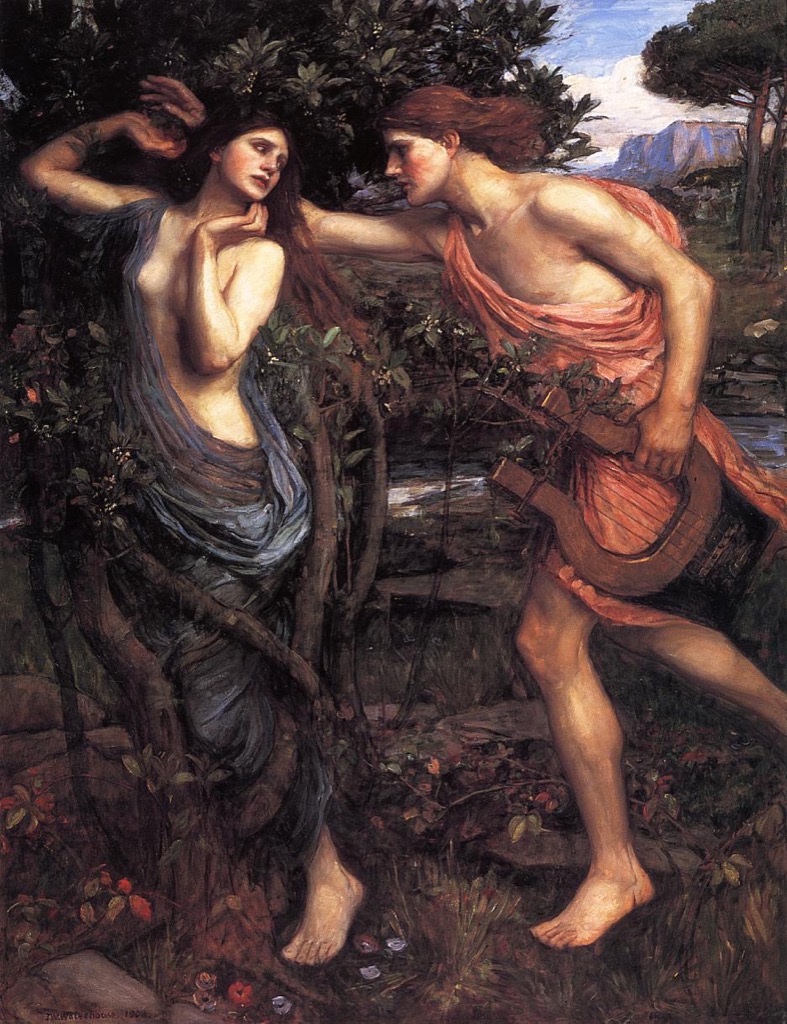
Daphne's body has begun to become a laurel tree. Leaves rise from her arms while Apollo reaches towards a woman he has pursued but cannot possess. John William Waterhouse's Apollo and Daphne of 1908 concentrates Ovid's story at the point where escape, violation and metamorphosis become inseparable. [1] [2] [3]
The scene is sometimes softened into a tale of unrequited love. Ovid is harsher: Cupid imposes desire and aversion, Daphne repeatedly refuses marriage, Apollo chases her, and she must lose her human form to stop him. Waterhouse's beauty does not erase that structure.
At a Glance
- ArtistJohn William Waterhouse (1849–1917)
- TitleApollo and Daphne [1]
- Date1908 [1] [2]
- MediumOil on canvas [1]
- DimensionsApproximately 142.8 × 111.4 cm [1]
- CollectionPrivate collection [1]
- First exhibitedRoyal Academy, London, 1908 [2]
- Primary literary sourceOvid, Metamorphoses, Book 1 [3]
- SubjectDaphne transforming into laurel as Apollo reaches her at the end of his pursuit
- Preparatory evidenceA pencil study for Apollo's head survives on a sketchbook sheet [2]
- Essential distinctionDaphne's transformation is an escape from pursuit, not a freely chosen romantic union with Apollo
Contents
- Introduction
- The Moment the Chase Cannot Continue
- Cupid's Two Arrows
- Daphne's Refusal and Apollo's Pursuit
- From Woman to Laurel
- Gesture, Gaze and Unequal Power
- Body, Leaves and Landscape
- Waterhouse's Changes to Ovid
- The Royal Academy Picture and Its Study
The Moment the Chase Cannot Continue
Waterhouse places Apollo and Daphne close together in a vertical woodland composition. The god advances from the left while Daphne occupies the right, where body and tree begin to merge.
Leaves and branches emerge around her raised arms. Her lower body stands near the tree's rooted base, and the boundary between flesh, drapery, trunk and surrounding growth is deliberately difficult to separate.
Apollo has nearly reached her. His forward inclination and extended hand carry the momentum of pursuit into the stopped image. Daphne's higher position and altered body prevent ordinary contact.
The scene is not the beginning of attraction. It is the final instant of a chase. Everything that explains why Daphne transforms lies outside the frame and must be restored from Ovid. [3]
Waterhouse avoids showing a long running path or distant figures. Compression makes the encounter intimate but also claustrophobic. The space between the two bodies is narrow enough for Apollo's desire to feel immediate.
Daphne does not embrace the god. Her movement rises and withdraws into foliage. Transformation gives her a new vertical power but costs mobility, speech and human life.
Apollo's surprise can be read in his lifted face and interrupted approach. The object of pursuit is becoming something he can touch only as a tree.
The painting's beauty produces an ethical challenge. Flowers, leaves, pale flesh and lyrical colour may invite admiration, yet the narrative is about a woman's refusal overridden until self-erasure becomes escape.
The chosen instant also refuses an ordinary resolution of figure against ground. Daphne begins as one of two protagonists but ends as part of the setting. Waterhouse asks the viewer to watch a person cross the category that normally separates subject from landscape.
Apollo remains entirely legible. His face, limbs and drapery preserve a coherent outline even as he moves. Daphne's outline breaks into leaves. The difference makes their unequal futures visible before the metamorphosis is complete.
This is why the work is more than a decorative woodland encounter. Composition enacts the myth's loss of personhood. One character will leave carrying a new emblem; the other will become the grove through which future characters move.
Cupid's Two Arrows
Ovid begins the episode with conflict between Apollo and Cupid. Apollo has just killed the monstrous Python and mocks the smaller god for carrying a bow. Weapons, he suggests, belong to heroic power rather than a child. [3]
Cupid answers that his own bow will conquer Apollo. He shoots two arrows with opposite effects: a golden, sharp-tipped shaft that creates love and a blunt leaden arrow that repels it. [3]
Apollo receives desire. Daphne receives aversion. Their emotional inequality is supernatural before they meet.
This origin prevents the story from being a simple mismatch between an eager lover and a shy woman who might be persuaded. Ovid constructs incompatible compulsions. Apollo cannot moderate his passion, and Daphne's rejection is intensified beyond ordinary preference.
Cupid is not visible in Waterhouse's painting. His absence makes Apollo appear responsible for his pursuit rather than a puppet whose behaviour can be excused by an arrow.
The god nevertheless carries the effects of Cupid's punishment. Apollo, master of archery, prophecy, music and healing, discovers that none of his arts can cure his own desire. [3]
The irony is central. The divine hunter who ridiculed love's weapon becomes its victim. Yet Daphne bears the greater cost. Apollo suffers longing; she loses human form.
Waterhouse does not include the two arrows as explanatory props. Viewers encounter consequence rather than cause. This economy strengthens the visual confrontation but can obscure Cupid's role unless the source is read.
The unseen arrows also parallel the unseen chase. Painting selects the instant at which invisible desire produces visible metamorphosis.
Daphne's Refusal and Apollo's Pursuit
Daphne is the daughter of the river god Peneus in Ovid's account. She delights in woodland freedom and hunting and asks her father to let her remain unmarried like Diana. [3]
Peneus wants a son-in-law and grandchildren, but he grants or accepts her wish. Daphne's refusal of marriage therefore precedes Apollo's arrival and is not merely a reaction to his individual appearance. [3]
Apollo sees her and imagines how her unarranged hair and unseen body might look. His description turns her into a series of features available to visual and erotic improvement. [3]
She runs. He calls after her, insisting that he is not an enemy and comparing the pursuit to animals fleeing predators. The comparisons undermine his reassurance: lamb flees wolf, deer flees lion and dove flees eagle because danger is real. [3]
Apollo lists his divine territories, his father Jupiter and his powers of prophecy, music, archery, medicine and herbs. Status becomes persuasion. Daphne continues to flee. [3]
Ovid compares them to a hound pursuing a hare. The hunter is close enough to expect possession, while the prey remains uncertain whether she has escaped. [3]
When Daphne's strength fails, she calls upon her father and asks the river or earth to destroy the beauty that has caused her danger. Transformation answers the request. [3]
This sequence makes consent unmistakable. She has declared a wish for virginity, fled, ignored persuasion and prayed for another form. Apollo's desire does not create mutual love.
Waterhouse's painting begins where verbal pursuit ends. Daphne no longer needs to run because the body Apollo wanted is disappearing.
From Woman to Laurel
Ovid describes heaviness entering Daphne's limbs. Bark encloses her breast, hair becomes leaves, arms become branches and feet take root. Only her beauty remains within the tree. [3]
Apollo embraces the trunk and feels a heart still beating beneath the bark. The branches shrink from his kisses. Even after transformation, the tree's response continues Daphne's refusal. [3]
The god then declares the laurel his. Since she cannot be his wife, she will be his tree. Laurel will crown his hair, lyre, quiver, Roman generals and imperial doors; it will remain evergreen. [3]
The ending transforms Daphne's escape into Apollo's emblem. He honours the tree, but he also appropriates the form she took to avoid him.
Waterhouse stops before a complete tree and before the declaration of ownership. Daphne remains visibly human enough for viewers to register personal cost.
Partial metamorphosis is especially suited to painting. Flesh and leaf can coexist in one instant even though narrative prose describes successive bodily changes.
The upward spread of branches gives Daphne an expanded silhouette. She gains scale as she loses agency. Rootedness protects her from pursuit while fixing her permanently in place.
Laurel carries later associations with artistic and military achievement, prophecy and Apollo himself. In the immediate myth, however, those honours arise from a chase. The prestigious wreath retains a history of refusal.
Waterhouse's leaves should therefore not be treated as mere decorative frame. They are the subject's irreversible event.
Gesture, Gaze and Unequal Power
Apollo's body moves towards Daphne. His hand extends, head lifts and attention fixes upon her. The god's desire is spatially directional.
Daphne's movement is harder to classify. She rises, turns or is drawn upward by the tree. Her gaze may meet Apollo's or pass beyond him, but her transformation prevents bodily reciprocity.
The gap between hand and body is crucial. Waterhouse paints imminence without permitting possession. Apollo can touch bark and branches, not the woman as she was.
Their vertical relation may make Daphne appear elevated or enthroned by nature. That visual power should not be confused with a happy apotheosis. Ovid's heroine asks to lose the form that has made her desirable. [3]
Apollo is a god; Daphne is a nymph. His claims to authority, skill and ancestry accompany physical pursuit. The picture's near equality of scale does not remove mythic inequality.
At the same time, metamorphosis defeats his immediate aim. Nature answers Daphne where argument has failed. The pursued figure becomes untouchable on human terms.
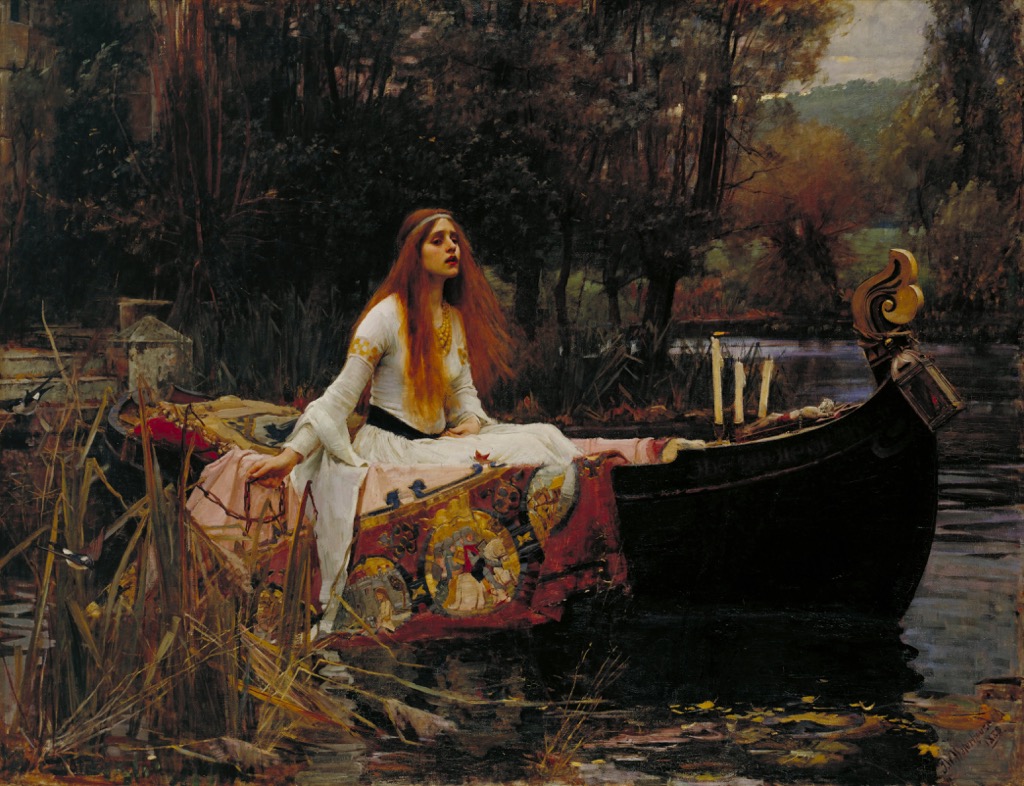
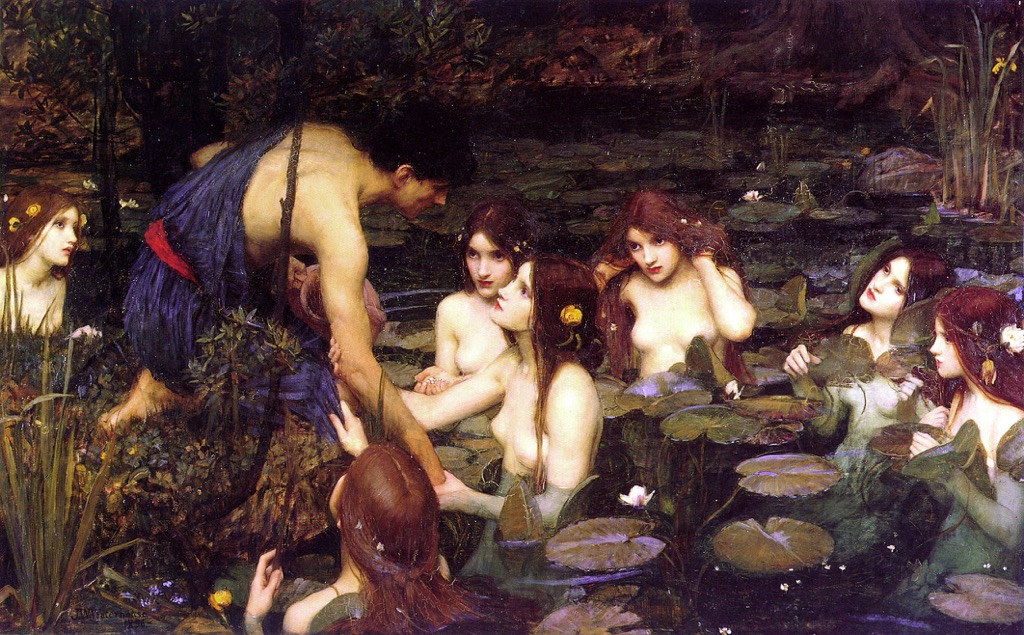
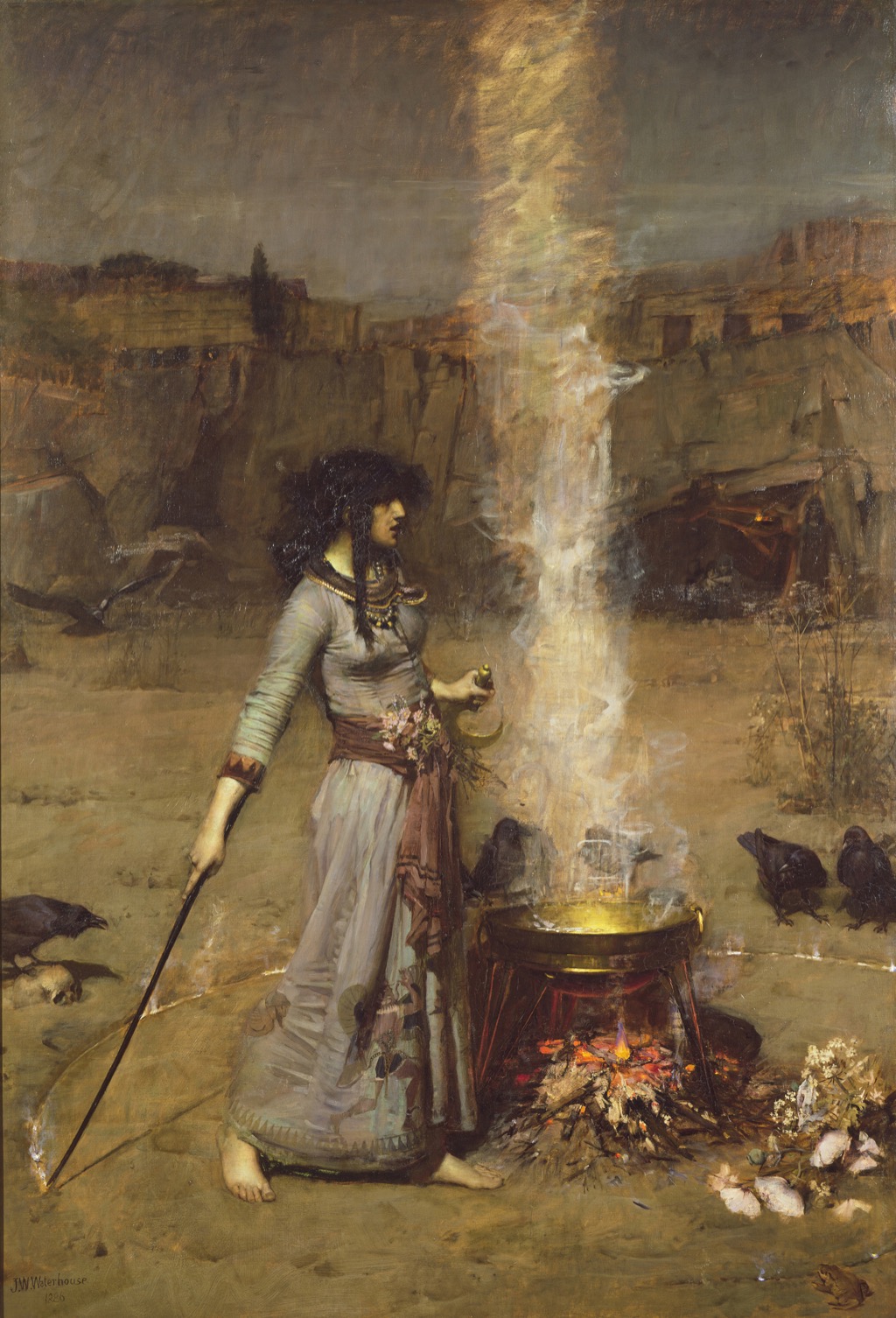
Waterhouse often organised drama through exchanged looks: Hylas faces the foremost nymph, Phyllis faces Demophoon and Medea looks towards Jason. Here gaze cannot solve the conflict because desire itself is the danger.
The viewer is placed close enough to inspect Daphne's body at the moment she escapes inspection. That paradox implicates looking. Painting preserves the beauty the heroine asks to destroy.
Body, Leaves and Landscape
The woodland is not neutral background. Daphne's preferred life belongs to groves, hunting and Diana. Becoming a tree intensifies her relation to the environment until figure and landscape become one. [3]
Branches create a network around the upper body. Their irregular lines contrast with the smoother curves of flesh and drapery, making metamorphosis visible as a change in material language.
Flowers at ground level and green growth can make the scene appear fertile, but the central transformation is not seasonal abundance like Flora's. It is emergency refuge.
Waterhouse uses a tall format to accommodate upward change. Roots, human torso, raised arms and canopy can be read along one vertical axis.
Apollo's coloured drapery distinguishes his moving body from the tree. He remains a discrete figure capable of leaving; Daphne becomes the place.
This asymmetry is one of the myth's severest features. The pursuer will carry laurel as an attribute across future stories. The pursued person remains rooted in the consequence.
The painting does not present a botanically exact sequence. Human arms do not transform according to natural tree growth, and the precise point where skin becomes bark may be concealed. Mythic legibility matters more than scientific process.
Colour reproductions vary, especially in the red, blue and green passages. Stable analysis should rest on posture, placement and transformation rather than assuming every digital hue matches the private original.
The laurel itself is evergreen. Ovid uses this lasting foliage when Apollo promises that the tree will remain perpetually honoured. [3] Evergreen endurance contrasts with Daphne's lost human changeability: she will not age, move or choose another future.
Waterhouse makes foliage visually abundant, but abundance is not freedom. Branches give her body greater reach while roots remove travel. Leaves permit continuing life while bark prevents speech.
This tension distinguishes Daphne from Waterhouse's flower gatherers. Those women touch, select and carry vegetation. Daphne can no longer stand apart from the plant world to use it. She has become what another person might gather or wear.
The comparison with Flora and the Zephyrs is especially revealing. Flora's myth also begins with a wind god pursuing a nymph and converts sexual violence into flowers and spring. Daphne receives no marriage, garden or office as compensation. Her tree is honoured by the pursuer who caused the transformation.
Waterhouse's late career repeatedly returned to women becoming vegetation. Phyllis emerges from almond branches, while Daphne disappears into laurel. One metamorphosis permits reunion and forgiveness; the other prevents contact. Their similar beauty should not blur their different moral structures.
Waterhouse's Changes to Ovid
Waterhouse omits Cupid, Peneus, Python, the full race and Apollo's speech. The painting reduces a long episode to two figures and one transformation. [2] [3]
This omission removes satire. Ovid's boastful Apollo is verbally self-important and repeatedly misunderstands the fear he causes. The painted god is quieter, perhaps startled or regretful.
The reduction can make him more sympathetic than the source. Without chase and speech, a viewer might see a lover losing a woman to magic. Restoring Ovid corrects that sentimental drift.
Waterhouse also gives Daphne a composed beauty during metamorphosis. Ovid emphasises exhaustion, prayer and bodily seizure by bark. The canvas transforms panic into a stable, idealised figure.
That aestheticisation is characteristic of late mythological painting, but it is not ethically neutral. Suffering becomes beautiful enough to contemplate at leisure.
Yet beauty can intensify loss. Because Daphne remains visibly human, viewers see what is disappearing. Complete bark would hide the personal cost.
The scene ends before Apollo claims laurel as his sacred tree. This is an important choice. It keeps emphasis on Daphne's escape rather than on the honours Apollo grants after appropriating her form.
Waterhouse therefore softens the violence of pursuit while preserving the visual boundary that defeats it. The result must be read with and against Ovid.
That double reading also corrects a misleading category often applied to Waterhouse's women. Daphne is not a femme fatale. She does not lure Apollo, use supernatural power to entrap him or turn into a tree as punishment for threatening a man. She flees power directed at her.
Nor is Apollo simply a knight disappointed by unattainable beauty. He is a god who names his prestige while chasing someone who has not consented. [3] The classical identities matter because they establish the imbalance behind the graceful poses.
Waterhouse's restraint can create space for sympathy if viewers supply the poem, but it can also neutralise urgency for viewers who do not. The canvas's interpretive responsibility is therefore shared with title, catalogue and literary education.
The Royal Academy Picture and Its Study
Apollo and Daphne was exhibited at the Royal Academy in 1908. [2] Waterhouse also showed The Soul of the Rose and Gather Ye Rosebuds While Ye May that year, bringing classical pursuit, medievalised sensual memory and carpe-diem reflection into one exhibition season. [2]
The canvas is privately owned. Published dimensions vary slightly, with a Commons object record giving approximately 142.8 by 111.4 centimetres and other catalogues rounding to 145 by 112. [1] [4]
A pencil sketchbook sheet survives with a study for Apollo's head in profile. Christie's identifies it securely with the finished picture and documents descent through Waterhouse's great-nephew. [2]
On the same side is another small composition, possibly connected to a romance subject; the reverse carries a study for the 1908 Gather Ye Rosebuds. [2] The sheet shows Waterhouse testing multiple projects within one working object.
Apollo's head mattered because its angle establishes pursuit. Too frontal a face would address the viewer; too lowered a face would weaken Daphne's elevation. The profile directs every line of attention towards her.
The preparatory record is limited compared with the surviving studies for Phyllis and Demophoon. It does not justify reconstructing every stage of Waterhouse's process.
Private ownership also limits technical claims. Without published conservation analysis, statements about exact pigments, underdrawing or changes beneath the paint should remain cautious.
The secure evidence is nevertheless enough to place the work: a large, mature Royal Academy canvas, developed through drawing and based on one of Ovid's most influential metamorphoses.
The 1908 exhibition group shows how deliberately Waterhouse varied the meaning of flowers. Gather Ye Rosebuds While Ye May uses them to measure youth and passing time. The Soul of the Rose makes fragrance a route into memory and desire. Apollo and Daphne turns leaves into the material of bodily escape. [2]
These are not interchangeable pictures of beautiful women in gardens. In one, a figure gathers; in another, she smells; in the third, she becomes. The verb controlling each relationship changes the ethical and temporal meaning of nature.
At nearly a metre and a half high, Apollo and Daphne would have confronted Academy viewers at bodily scale. [1] The transformation was not a small book illustration but an encounter whose branches could extend above the viewer's centre of vision.
Related Pages
- Hylas and the Nymphs: Compare another large mythological Waterhouse composition.
- Literary and Mythological Sources: Follow the Ovidian and classical source framework behind Waterhouse's myth paintings.
- Paintings: Return to the protected Waterhouse paintings hub.
Frequently Asked Questions
Apollo is the god of prophecy, music, medicine and archery. Daphne is a nymph who wishes to remain unmarried and is pursued by him after Cupid strikes them with opposing arrows. [3]
Exhausted by the chase, she asks her father or the earth to destroy the beauty causing her danger. She is transformed into a laurel. [3]
No. Ovid repeatedly establishes her refusal and flight. Cupid's leaden arrow intensifies her aversion. [3]
He embraces the tree and declares that laurel will become his sacred emblem and crown. [3]
It is in a private collection. [1]
Published measurements are approximately 143 × 111 centimetres, with some sources rounding to 145 × 112. [1] [4]
Yes. A small pencil study for Apollo's profile survives on a sketchbook sheet. [2]
It depicts desire, but not mutual love. The narrative context is pursuit without consent and transformation as escape.
Discussion
1. Does Daphne's elevated position make the transformation look empowering or tragic? 2. How would the picture change if Cupid and his arrows were visible? 3. Why might Waterhouse omit the chase and show only its last instant? 4. Does the painting make Apollo more sympathetic than Ovid does? 5. How does partial transformation preserve Daphne's identity? 6. What is the difference between honouring the laurel and claiming it? 7. How does the viewer's inspection complicate a story about escape from being desired? 8. Compare Daphne's metamorphosis with Phyllis's emergence from an almond tree.
Reader Insights
Which visible detail most changes the way you read this page?
Which source or comparison helps the work feel less familiar and more specific?
What question would you bring back to the painting after reading?
Join the Conversation
Share your reading of this page below.
References
- Image reference
- Wikimedia Commons, “John William Waterhouse, Apollo and Daphne,” object metadata for date, dimensions and private ownership, View source.
- Christie's, “John William Waterhouse, Studies for Apollo and Daphne and another composition; Study for Gather Ye Rosebuds while Ye May,” drawing record confirming the 1908 Royal Academy exhibition and Apollo study, View source.
- Ovid, Metamorphoses, Book 1, Perseus Digital Library, Apollo and Daphne episode, View source.
- Art Renewal Center, “John William Waterhouse, Apollo and Daphne,” catalogue record with rounded dimensions and medium, View source.