

 Buy Art Prints Now
from Amazon
* As an Amazon Associate I earn from qualifying purchases.
Image reference [image]
 by Tom Gurney
Tom Gurney BSc (Hons) is an art history expert with over 20 years experience
Published on August 14, 2026 / Updated on August 14, 2026
Email: tomgurney1@gmail.com / Phone: +44 7429 011000
Thisbe: Introduction
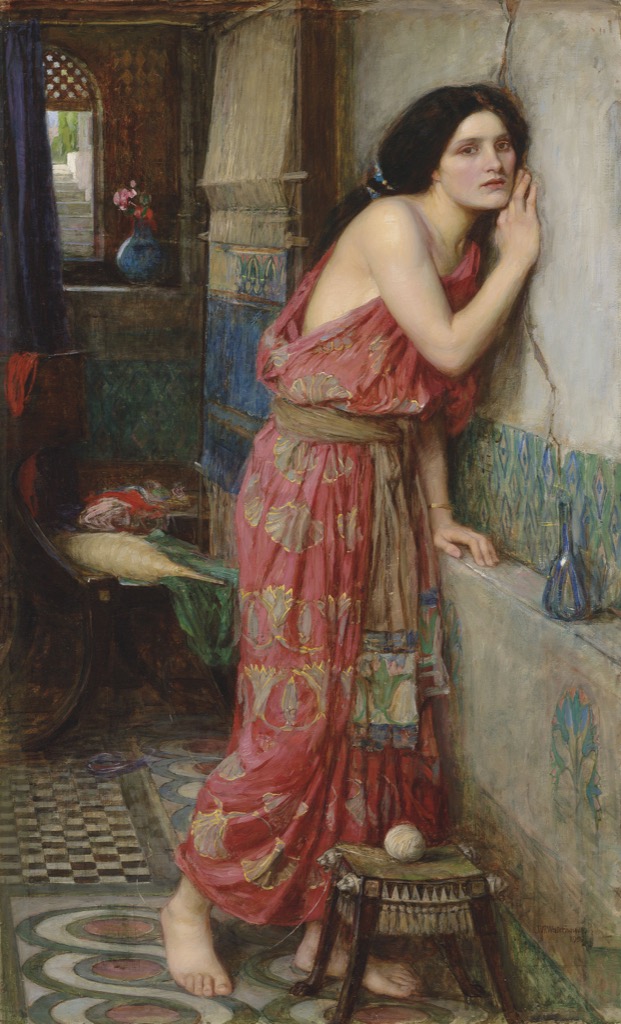
Thisbe has risen from her loom because a voice is travelling through stone. She presses her ear and cheek towards the wall, listening to Pyramus in the adjoining house. The barrier prevents the lovers from touching, yet its smallest crack permits the promises that will lead them beyond the city and towards death.
John William Waterhouse painted Thisbe in 1909 and exhibited it at the Royal Academy with Lamia. Rather than show the bloodied veil, Pyramus's suicide or the darkening mulberries at the story's end, he selects the private beginning: a woman, a wall and the transformation of sound into action. [1]
At a Glance
- ArtistJohn William Waterhouse (1849–1917)
- TitleThisbe; later sold at times as The Listener or Thisbe or The Listener [1]
- Date1909; signed and dated lower right [1]
- MediumOil on canvas [1]
- Dimensions38¾ × 23¾ inches; 98.5 × 60.3 cm [1]
- CollectionPrivate collection [1]
- ExhibitedRoyal Academy, London, 1909, no. 43 [1]
- Principal sourceOvid, Metamorphoses, Book IV, lines 55–166 [2] [3]
- SubjectThisbe listening to Pyramus through the wall separating their neighbouring houses
- Essential distinctionWaterhouse paints communication through the wall, not the later meeting at Ninus's tomb or either lover's death
Contents
- Introduction
- A Body Turned into Listening
- Pyramus and Thisbe in Ovid
- Why Waterhouse Stops at the Wall
- Loom, Chamber and Divided Space
- An Imagined Babylon
- Thisbe, Lamia and Waterhouse's Recurring Heroines
- Exhibition, Reception and Provenance
A Body Turned into Listening
Thisbe stands in profile, leaning so closely towards the wall that distance seems almost eliminated. One hand rises to the surface; her face turns with intense concentration; the long line of her body follows the direction of hearing.
Waterhouse makes listening physical. Sound cannot be painted as an object moving through air, so he shows its effect upon posture. Shoulder, arm, neck and cheek align towards an invisible source. The figure's alert stillness implies that even a small movement might lose the words.
Her clothing provides the strongest colour. A rose-red robe falls over a pale underdress or sash, and patterned decoration catches the eye before leading it upward to her flushed face. Christie's notes the triangular design created by arm and head and the way the gown's colouring intensifies her pallor. [1]
The lover is absent from view. Pyramus occupies the neighbouring house and the viewer's imagination. This arrangement gives Thisbe complete visual prominence without making her emotionally solitary: every part of her pose acknowledges another person.
The wall is at once plain obstacle and active medium. It separates the families' homes, frustrates touch and sight, and permits whispered speech through a flaw. Waterhouse does not treat architecture as dead background. Stone governs the lovers' relation.
Behind Thisbe, a sunlit opening reveals steps and garden. The external route appears available, but she ignores it in order to hear the wall. Christie's observes that the garden and stair create depth while the chamber remains comparatively dark. [1]
The contrast is temporal as well as spatial. The present belongs to secret speech indoors. The later story will send Thisbe outside to the tomb and mulberry tree. Waterhouse places open landscape in sight while holding her at the boundary from which escape is planned.
Nothing violent has happened yet. The tragedy exists as knowledge brought by the title and source. The painting's pressure comes from seeing tenderness before its consequences.
Pyramus and Thisbe in Ovid
The best-known ancient version appears in Book IV of Ovid's Metamorphoses. One of the daughters of Minyas tells the story while the sisters remain indoors working with wool and rejecting the festival of Bacchus. [2] That narrative setting already connects storytelling, women's textile labour and a tale about a hidden voice.
Pyramus and Thisbe are young neighbours in Babylon. Ovid calls them exceptionally beautiful and says that proximity allowed acquaintance to grow into love. Their parents forbid marriage, but cannot extinguish their mutual desire. [2] [3]
The houses share a wall. A narrow crack, formed when the wall was built, has gone unnoticed by everyone except the lovers. Through it they exchange whispers and declarations. They reproach the barrier for preventing embrace, then thank it for allowing words to pass. [2] [3]
They decide to deceive their guards and leave separately at night. The meeting place will be the tomb of Ninus outside the city, beneath a mulberry tree whose fruit is white. Thisbe arrives first. [2]
A lioness comes from a recent kill to drink. Thisbe flees into a cave, dropping her veil. The animal mouths and bloodies the abandoned cloth. When Pyramus arrives, he finds the lioness's tracks and the stained veil, concludes that Thisbe has been killed, and blames himself for arranging the meeting. [2] [3]
He stabs himself beneath the mulberry. His blood stains its fruit. Thisbe returns, initially fails to recognise the changed tree, then discovers Pyramus. She takes his sword, asks that their ashes be placed in one urn and that the tree retain its dark fruit as a memorial, then kills herself. [2] [3]
The gods and parents grant the final requests. The mulberry's colour preserves the lovers' story, giving the episode its place in a poem about transformations.
Waterhouse includes none of the lioness, tomb, veil, sword, blood or fruit. Yet the wall is not a marginal prelude. It creates the only form of relationship available to the lovers and prompts the decision to meet outside. The whole catastrophe grows from the desire to convert heard presence into bodily presence.
Why Waterhouse Stops at the Wall
Artists illustrating Pyramus and Thisbe often choose the climactic deaths because they offer action, pathos and recognisable objects. Waterhouse chooses a moment that is almost motionless and visually one-sided.
The decision concentrates anticipation. A death scene tells viewers that possibility has ended. The listening scene keeps the future open inside the figure's hope, even though an informed viewer knows the outcome.
It also allows Thisbe to be active before victimhood defines her. She listens, communicates and participates in the plan. Her attention is not decorative melancholy imposed after Pyramus's death.
The wall externalises the story's social prohibition. Parents who forbid the union do not appear; their power is built into the house. Thisbe confronts architecture rather than a father, guard or crowd.
The small crack complicates the barrier. It is inadequate for touch but sufficient for speech. The lovers' frustration arises not from complete isolation but from partial access: enough intimacy to intensify desire, not enough to fulfil it.
Waterhouse can therefore build drama without showing Pyramus. Viewers become like Thisbe in one respect: we must infer a presence through its effect. We see her hearing but cannot hear what she hears.
Christie's connects the pose with two earlier Waterhouse compositions: Psyche Entering Cupid's Garden and The Soul of the Rose. In each, a woman approaches a hard surface or boundary. [1] The comparison is formally useful, but the surfaces do different narrative work.
Psyche's door can open and gives access to a garden. The woman in The Soul of the Rose leans into flowers growing against a wall, seeking scent and touch. Thisbe's wall stays closed while transmitting another person's voice. Entry, sensation and communication produce different kinds of intimacy.
The choice of listening also resonates with the alternate auction title The Listener. That title makes the action legible without identifying the myth, but it removes the future tragedy and transformation encoded by “Thisbe.” The history of the two names demonstrates how much narrative a title supplies.
Loom, Chamber and Divided Space
Behind Thisbe stands a loom with woven fabric. Christie's emphasises that she has just risen from it and relates the detail to the importance of textile work in Waterhouse's paintings. [1]
The loom is especially apt because Ovid frames the tale as a story told by a woman engaged in wool work with her sisters. [2] It also situates Thisbe in a domestic chamber governed by expected activity. She has interrupted making in order to listen.
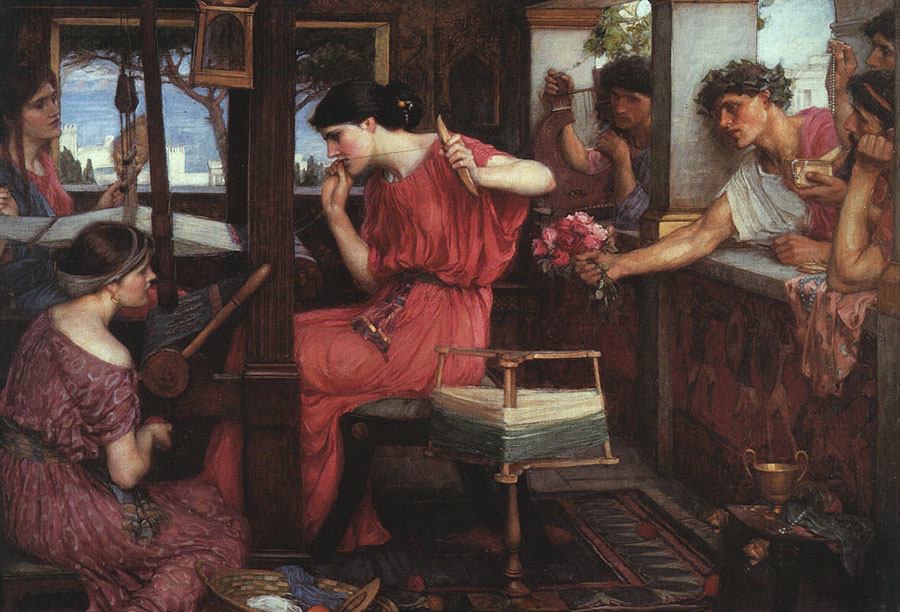
Waterhouse does not prove that Ovid's Thisbe was weaving at the wall. The loom is his visual addition or emphasis. It connects her to a wider sequence of textile women—Penelope, Circe and the Lady of Shalott—whose making structures time and enclosure.
Here textile and speech are competing threads. The loom draws ordered material across a frame; whispers pass through an accidental crack. One practice belongs visibly within the household, the other privately exceeds its rules.
The red robe itself demonstrates woven beauty. Thisbe wears the kind of coloured surface her environment can produce, while turning away from production towards desire. Cloth is not only an emblem of confinement; it is skill, material and visual agency.
The chamber's floor, stool, tiles and window surround her with designed surfaces. Hard planes repeat the wall's authority, while textiles introduce folds and softness. Her body mediates between the two.
The small stool in the foreground opens space at her feet and makes the room feel inhabited. It also acts as a low horizontal counterweight to the ascending figure. Christie's identifies its style as Egyptian rather than Babylonian and notes other deliberately mixed historical elements in the room. [1]
The garden beyond offers sunlight and depth, but its steps lead away from the point of contact. Composition makes the wall feel emotionally nearer than open air.
This enclosure distinguishes Thisbe from Waterhouse's outdoor women beside streams, flowers or windswept coasts. She is not simply indoors; she is pressed against the exact line dividing one interior from another.
The painting's vertical format strengthens that pressure. A wider canvas might have shown both houses or both lovers. The narrow field keeps Pyramus excluded and turns Thisbe's body into the principal measure of the wall.
The arrangement also reverses a familiar convention of romantic painting. Instead of placing two lovers together and asking the setting to explain their separation, Waterhouse shows one lover and makes the absent body the setting's secret. The viewer cannot inspect Pyramus's expression or judge whether his desire matches Thisbe's. Her act of listening becomes the only available evidence of reciprocity, just as the crack is the lovers' only channel.
An Imagined Babylon
Ovid sets the story in Babylon, the city traditionally associated with great walls. Waterhouse does not reconstruct Babylon from archaeological evidence with strict historical consistency. [1] [2]
Christie's identifies several sources combined in the interior: an Egyptian stool, Egyptian lotus decoration on the gown, Islamic forms in the window transom, Ottoman tiles and a late Roman type of patterned flooring. [1] These elements create a generalized distant past rather than one documented place and date.
That mixture should not be defended as accurate archaeology. Nor need it be dismissed as carelessness without considering its visual purpose. Waterhouse constructs an imaginative antiquity legible to an Edwardian gallery audience through accumulated signs of eastern, ancient and luxurious design.
The result also prevents the wall from becoming visually empty. Patterned surfaces, textiles and openings differentiate the chamber while leaving the main barrier firm enough for Thisbe's action to read immediately.
Historical hybridity was common in Victorian and Edwardian classical painting. Artists studied museum objects, photographs, travel, stage design and earlier art, then selected across cultures to build poetic settings. Modern cataloguing can identify the sources more precisely than the picture itself announces them.
The mixed room affects meaning. Thisbe is surrounded by beauty created from many times and places, while the story insists upon a simple human problem: two neighbours cannot meet. Exotic distance and emotional immediacy coexist.
The lotus pattern on the gown should not be assigned a secret symbolic meaning merely because lotus imagery carries associations in different cultures. Christie's uses it as evidence of Egyptianising design. [1] Without a statement from Waterhouse, its secure role is decorative and historicalising.
Similarly, the bright garden should not be labelled a specific Babylonian site. It provides openness, sun and recession. The ancient city exists through atmosphere, not topographical proof.
This is one reason the painting remains emotionally accessible despite archaeological inconsistency. Waterhouse asks the room to support the story rather than to become a scholarly reconstruction that overwhelms it.
Thisbe, Lamia and Waterhouse's Recurring Heroines
Waterhouse exhibited Thisbe at the 1909 Royal Academy as no. 43. The same exhibition included the one-figure Lamia, a woman seated beside a woodland pool. [1]
The two works were discussed together by The Studio, which praised their poetic expression, individuality and colour. [1] Their pairing shows how Waterhouse could vary the solitary literary heroine within one exhibition.
Thisbe strains towards a lover who is physically near but hidden. Lamia sits alone in landscape while knowledge of her dangerous nature and absent human lover comes from Keats's poem. One scene makes communication immediate; the other concentrates ambiguity and self-containment.
Both paintings depend upon a viewer who knows more narrative than the canvas displays. We anticipate Thisbe's fatal meeting and Lamia's exposure without seeing either event. Waterhouse uses literary titles as compressed futures.
Rose Sketchley's 1909 essay on Waterhouse, discussed at length in the Christie's catalogue, placed figures such as Psyche, Pandora, Isabella, Lamia and the Lady of Shalott within an art of lives turned inward by suffering. [1] Her near-contemporary account is valuable because it shows that Waterhouse's women were not perceived only as decorative beauties.
Sketchley's language reflects its period and should not be treated as the artist's direct confession. Yet it helps recover an Edwardian interpretation in which myth and legend could reveal contemporary psychological experience.
Thisbe's concentration is a strong example. Nothing in the pose is inert. Listening is work performed under restriction. Her flush and forward pressure make inwardness bodily intense.
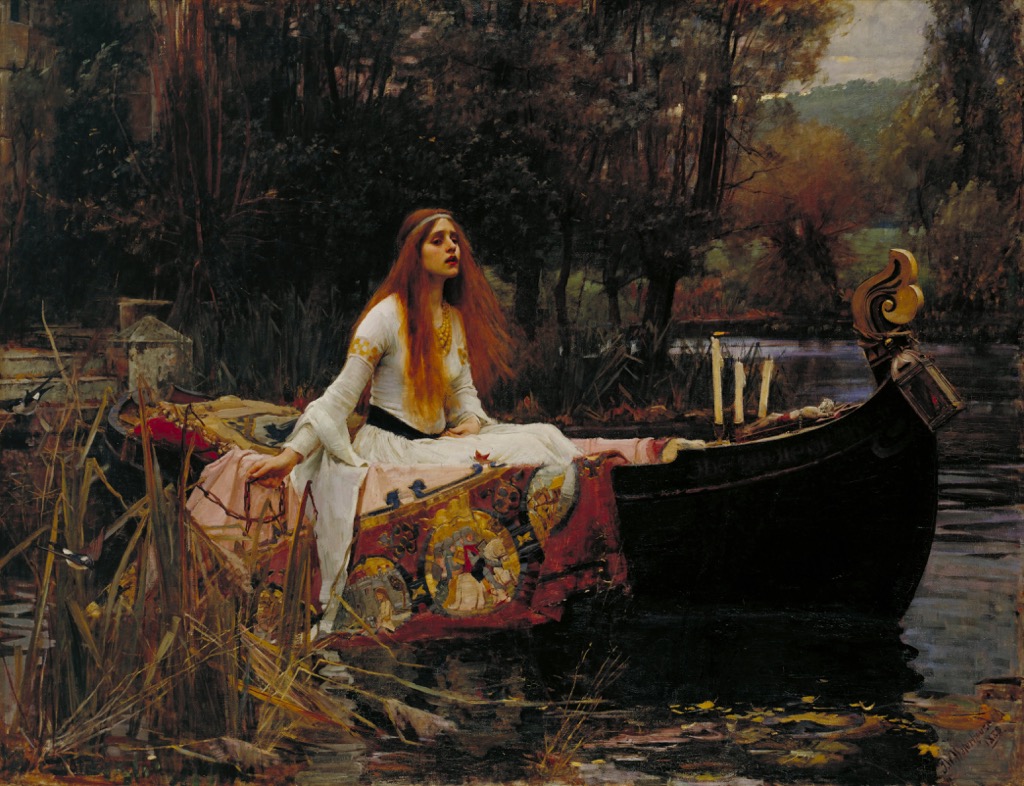
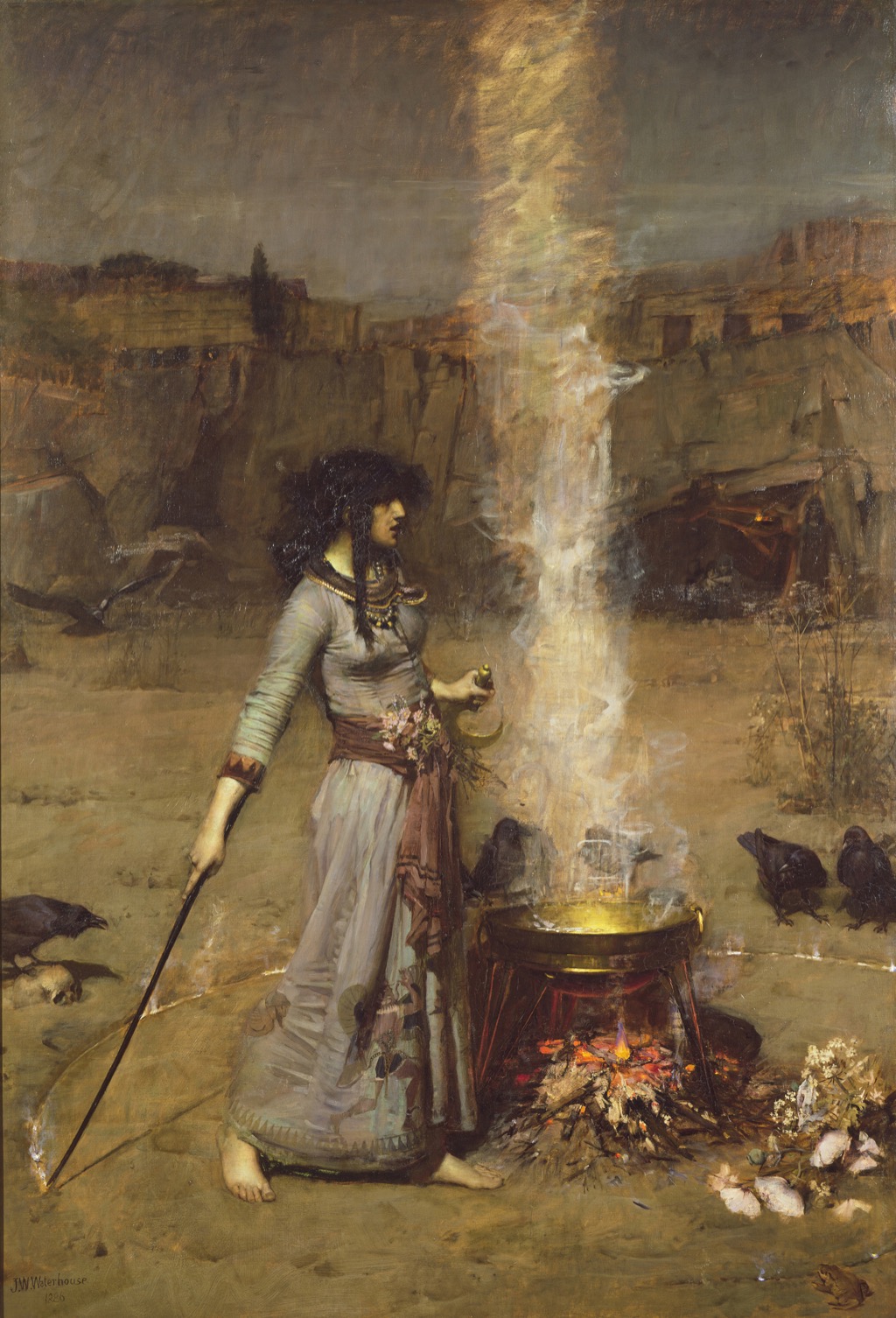
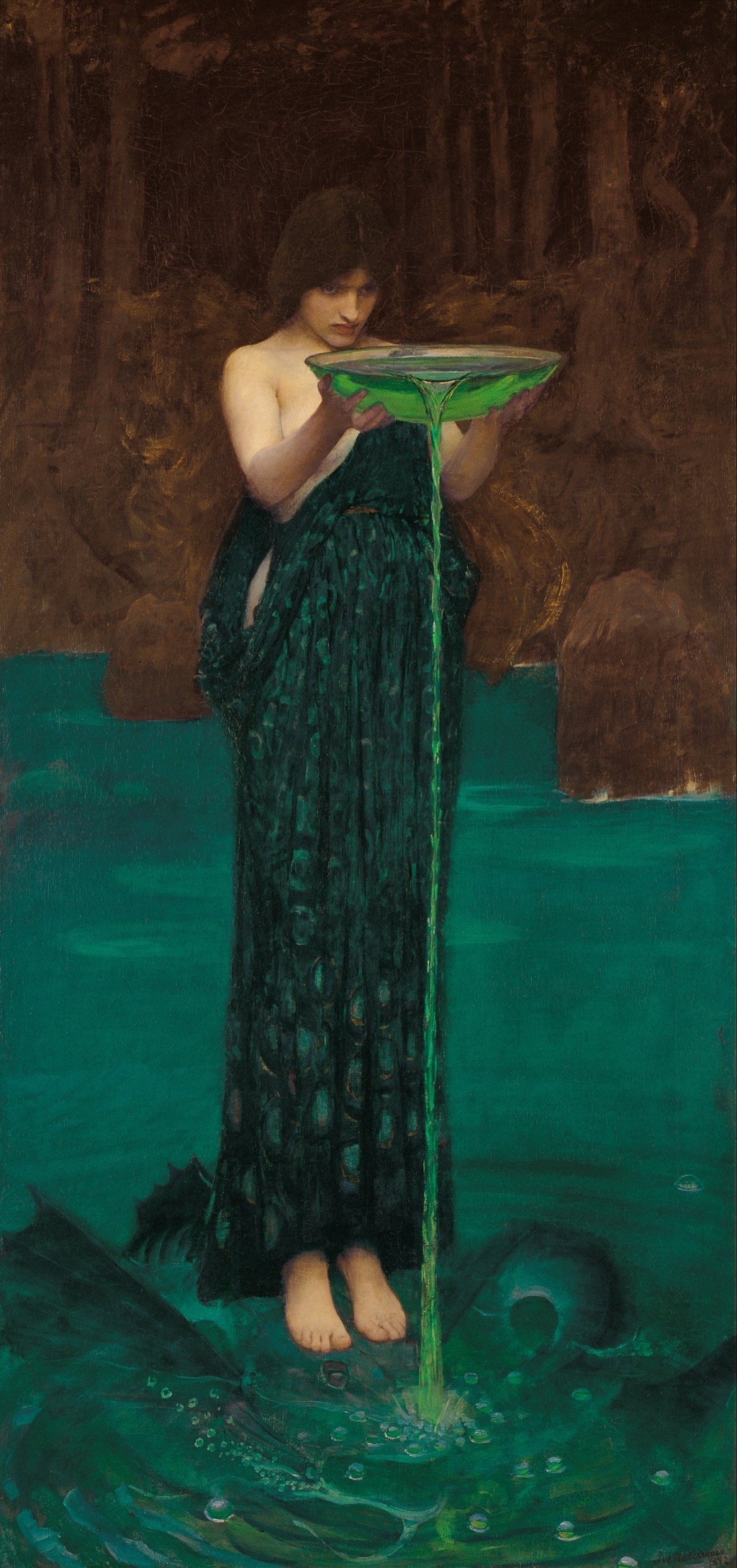
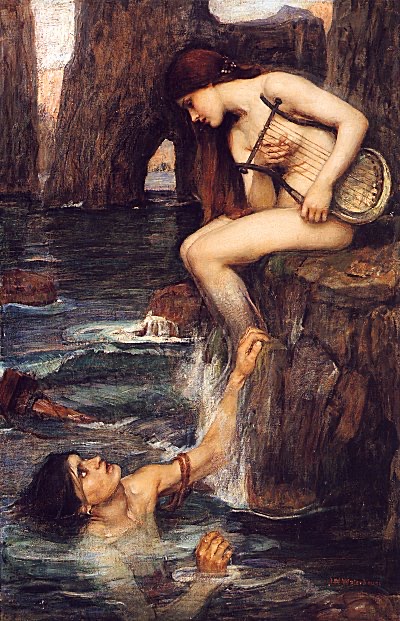
She also differs from Waterhouse's destructive enchantresses. Circe confronts or transforms men; the Siren draws a sailor towards danger; Lamia's identity complicates love. Thisbe has no supernatural power. Transformation belongs to the mulberry after human catastrophe.
The painting's empathy therefore rests with a mortal woman using the smallest architectural failure to sustain a relationship.
Exhibition, Reception and Provenance
Waterhouse signed and dated Thisbe in 1909 and exhibited it at the Royal Academy that spring. Christie's records its medium, dimensions and exhibition number and reproduces contemporary and later bibliography. [1]
Lieutenant-Colonel Fairfax Rhodes owned the picture by December 1909. He was a barrister, collector and bibliophile whose collection also included Waterhouse's 1910 Ophelia. [1]
At Rhodes's 1934 sale, Sotheby's catalogued the work as The Listener. It was acquired by the dealer Permain and later belonged to the American newspaper proprietor William Randolph Hearst at St Donat's Castle in Wales. A mid-century photograph documented it in the castle's private dining room. [1]
The picture subsequently entered a private collection in Hove. Sotheby's sold it again in 1985 as Thisbe or The Listener; Whitford & Hughes acquired it, and it passed into another British private collection. Christie's offered it in 2018 after more than thirty years away from auction. [1]
This name history is more than administrative. “The Listener” records that the pose remained intelligible when the mythological identity was weakened or omitted. “Thisbe” restores the invisible Pyramus, the planned meeting and the metamorphosis of the mulberry.
The privately owned canvas is widely reproduced, but its physical scale matters. At nearly a metre tall, Thisbe's figure has bodily presence; the room surrounds rather than miniaturises her. Digital images can sharpen decorative objects while flattening the distinction between thin, dark chamber and bright distance.
The narrow dimensions also matter at this scale. The canvas is less than two-thirds as wide as it is high, so the wall and standing body read as parallel vertical forces. Thisbe does not merely occupy the chamber; she seems measured against the construction that confines her.
No public source used here securely names the model. Christie's describes her as Waterhouse's favourite model of the period but says she remains unidentified. [1] Repeated appearances can establish a working type without establishing a biographical identity.
The provenance also cautions against assuming that a familiar online image belongs to a public museum. Thisbe has been visible through Royal Academy display, private interiors, auction catalogues and reproductions, while remaining in private ownership.
Related Pages
- Paintings: Return to the protected Waterhouse paintings hub.
- Literary and Mythological Sources: Read the classical source frame for Waterhouse's Thisbe.
- Technique and Style: Connect Thisbe with Waterhouse's late colour, surface and figure handling.
Frequently Asked Questions
She is listening to her lover Pyramus through a crack in the wall between their neighbouring houses. [1] [2]
He is on the other side of the wall and cannot be seen. Waterhouse shows his presence through Thisbe's listening posture.
Ovid says their parents forbid them to marry. They communicate secretly through a flaw in the shared wall. [2] [3]
They arrange to meet at Ninus's tomb. A lioness bloodies Thisbe's dropped veil; Pyramus mistakenly believes her dead and kills himself. Thisbe returns and takes her own life. Their blood changes the mulberry fruit from white to dark. [2] [3]
It establishes Thisbe's domestic textile work and links the scene to Waterhouse's other weaving women. Ovid also embeds the story within storytelling by women engaged in wool work, though he does not specify that Thisbe herself left a loom at this moment. [1] [2]
No. It combines Egyptian, Islamic, Ottoman and Romanising elements to evoke a distant ancient setting. [1]
Yes. It appeared under that title at a 1934 sale and as Thisbe or The Listener in 1985. [1]
It is privately owned. Christie's documented its modern provenance when it returned to auction in 2018. [1]
Shakespeare stages a comic version of Pyramus and Thisbe in Act V of A Midsummer Night's Dream, including the wall between the lovers. [4] That later adaptation demonstrates the story's familiarity but is not Waterhouse's ancient source.
Discussion
1. How does Waterhouse make sound imaginable without showing or writing the words? 2. Is the wall principally an obstacle, a medium of communication or both? 3. What changes when the story's hopeful beginning is painted instead of its violent end? 4. How does the loom connect recognised domestic work with forbidden speech? 5. Why might the alternate title The Listener have remained convincing without the mythological name? 6. Compare Thisbe's wall with the surfaces in The Soul of the Rose and Psyche Entering Cupid's Garden. What passes through each boundary? 7. Does the historically mixed interior weaken the image or clarify Waterhouse's poetic rather than archaeological aim? 8. How does private ownership shape the difference between an artwork's fame and its public accessibility?
Reader Insights
Which visible detail most changes the way you read this page?
Which source or comparison helps the work feel less familiar and more specific?
What question would you bring back to the painting after reading?
Join the Conversation
Share your reading of this page below.
References
- Main image: John William Waterhouse, Thisbe, 1909, public-domain faithful reproduction via Wikimedia Commons.
- Christie's, “John William Waterhouse, R.A., Thisbe,” lot record and catalogue essay by Peter Trippi, including object facts, Royal Academy exhibition, reception, visual analysis and provenance, View source.
- Ovid, Metamorphoses, Book IV, translated by A. S. Kline, University of Virginia Ovid Collection, sections 55–166, View source.
- Ovid, Metamorphoses, Book IV, Latin text and English translation, Perseus Digital Library, Tufts University, View source.
- William Shakespeare, A Midsummer Night's Dream, Act 5, Scene 1, Folger Shakespeare Library, the mechanicals' performance of Pyramus and Thisbe, View source.