

 by Tom Gurney
Tom Gurney BSc (Hons) is an art history expert with over 20 years experience
Published on August 14, 2026 / Updated on August 14, 2026
Email: tomgurney1@gmail.com / Phone: +44 7429 011000
The Danaïdes: Introduction
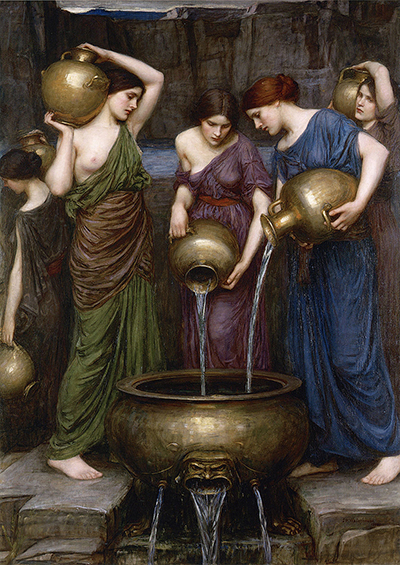
Seven women carry shining vessels towards a basin that can never be filled. Water pours in bright, repeated streams, but the labour has no result and no end. John William Waterhouse's 1906 Danaïdes gives monumental form to an ancient punishment whose horror lies not in sudden violence but in permanent repetition.
The painting in Aberdeen is the later and larger of Waterhouse's two known treatments of the subject. It should not be confused with the five-figure version of 1904 in private ownership. Painted on a canvas more than 1.6 metres high, the Aberdeen work expands a single futile action into a procession. [1] [5]
At a Glance
- ArtistJohn William Waterhouse (1849–1917)
- TitleThe Danaïdes, also written The Danaides [1]
- Date1906 [1]
- MediumOil on canvas [1]
- Dimensions162.5 × 127.4 cm; framed, 191.1 × 155.5 × 11 cm [1]
- CollectionAberdeen Art Gallery & Museums [1]
- AcquisitionPurchased in 1927 with income from the Macdonald Bequest [1]
- Object numberABDAG003402 [1]
- SubjectThe daughters of Danaus performing an endless water-carrying punishment in the underworld [1] [4]
- First exhibitionRoyal Academy, London, 1906 [5] [6]
- Version warningThis is the seven-figure 1906 Aberdeen painting, not Waterhouse's smaller five-figure version of 1904 [5]
Contents
- Introduction
- An Image of Labour without Completion
- The Danaids, Forced Marriage and Murder
- Hypermnestra and the Exception within the Group
- How the Water Punishment Entered the Myth
- Seven Figures, Vessels and Descending Movement
- The 1904 and 1906 Versions
- Exhibition, Acquisition and Late Style
An Image of Labour without Completion
Waterhouse begins after crime, judgement and death. The Danaids have reached the underworld, and punishment has become their entire environment.
The women descend and gather around a large metal basin. Each carries a vessel. Some hold the weight close to the body; others tilt a jar so that water falls in a narrow stream. Further figures continue the task behind them.
No supervising god, judge or demon appears. External force has become unnecessary because the sentence is built into the work itself. However much water the women pour, the container cannot retain it.
That failure is not represented as a single accident. The women do not recoil from a newly discovered crack or search for a repair. Their controlled actions imply that they have performed the sequence before and will repeat it again.
The composition converts time into pattern. Bent necks, rounded shoulders, jar handles and falling streams recur with variations. Each figure advances a fraction of the cycle: approach, lift, pour, empty and return.
Water is the painting's most active material. It catches light, connects vessel to basin and then escapes. The substance that should complete the task instead makes its impossibility visible.
The Danaids are often placed beside Sisyphus as emblems of futile labour. Waterhouse makes the comparison understandable without showing a single dramatic collapse. Sisyphus's stone returns down a slope; the Danaids' achievement drains away as it is made.
Yet the women are not anonymous machinery. Differences of dress, pose and attention preserve individual bodies within collective punishment. The sentence treats them as a group; the painting asks viewers to look at separate experiences of exhaustion, concentration and resignation.
The Danaids, Forced Marriage and Murder
The Danaids are the fifty daughters of Danaus. In the mythographic account attributed to Apollodorus, Danaus and his brother Aegyptus descend from the line of Io. Aegyptus has fifty sons, and conflict between the brothers drives Danaus and his daughters from Egypt towards Argos. [2]
The sons of Aegyptus follow and seek marriages with their cousins. Danaus distrusts their reconciliation and still resents the exile. He agrees to assign the marriages but secretly gives his daughters daggers and instructs them to kill their husbands while they sleep. [2]
Forty-nine obey. They cut off the men's heads and bury them at Lerna, according to this account. The mass killing produces the guilt for which later tradition condemns them. [2]
The story cannot responsibly be reduced to a simple warning against murderous wives. The marriages arise from dynastic pursuit, coercion and a father's command. Aeschylus's surviving Suppliants, the first part of a lost trilogy, centres the daughters' flight from the sons of Aegyptus and their appeal for protection at Argos before any wedding-night killings occur. [3]
That dramatic context keeps fear and compulsion in view. The women are first suppliants resisting unwanted union; they later become killers under paternal authority. Ancient versions do not offer a single psychologically complete narrative that settles every degree of responsibility.
Waterhouse paints the punishment rather than the marriages, and his title identifies the women collectively. No husband, father or pursuing cousin appears. Viewers encounter the consequences without seeing the network of male power that precedes them.
This omission is visually effective but ethically important. The endless labour can be understood as punishment for murder while still recognising that the path to murder begins in forced marriage and command.
The myth also participates in stories about migration, the foundation of Argive rule and rivalry within a royal family. The Danaids are not merely residents of an abstract hell. They belong to a larger legendary genealogy whose descendants include rulers and heroes. [2]
Waterhouse removes those dynastic continuities. In the underworld, royal birth no longer distinguishes them from workers condemned to carry water forever.
Hypermnestra and the Exception within the Group
One daughter refuses Danaus's order. Apollodorus calls her Hypermnestra; spellings such as Hypermestra also appear in English. [2]
Her assigned husband, Lynceus, respects her wish to remain a virgin. Hypermnestra therefore spares him. Danaus imprisons her for disobedience, but she is later reunited with Lynceus and becomes part of the continuing royal line. [2]
Horace develops her moral exception in Ode 3.11. Against the crime and afterlife punishment of her sisters, he praises the one bride willing to deceive her father rather than kill her husband. [4]
The exception matters because the familiar number “fifty Danaids” can obscure the fact that forty-nine commit the murders. Museum summaries often simplify the group, but the ancient story preserves a dissenter.
Waterhouse does not mark one of the seven painted women as Hypermnestra. Because she avoided the crime, the logic of the punishment normally excludes her. It would be misleading to search the composition for a secretly innocent Danaid unless evidence tied a particular figure to her.
The seven figures stand for the punished sisters rather than provide a literal census. Waterhouse reduces forty-nine into a number that can fill the canvas while still suggesting a stream of bodies extending beyond it.
Hypermnestra's absence sharpens the collective design. The painting concerns those trapped in the repeating action. The woman who broke the command also broke the pattern and therefore belongs to a different narrative future.
Her story complicates obedience. The forty-nine obey their father and become guilty; Hypermnestra disobeys him and is celebrated. The myth is not simply about failure to follow authority. It asks which obligations deserve loyalty when kinship, marriage and violence conflict.
In Waterhouse's picture, that moral choice is already past. Every visible action is now compelled by a judgement from which no further disobedience appears possible.
How the Water Punishment Entered the Myth
The most familiar Danaid punishment is to carry water endlessly into a pierced, leaking or bottomless container. Aberdeen's collection record uses this established account to explain the painting. [1]
The tradition developed over time. A Cambridge study of Aeschylus's Suppliants notes that futile water-carrying was associated in classical sources with the uninitiated or the impious before it was explicitly attached to the daughters of Danaus. The Danaid connection appears clearly in later ancient literature and becomes especially familiar through Roman poets. [6]
Plato's Gorgias describes uninitiated souls carrying water with a sieve into a leaking jar as an image of desires that can never be satisfied. Those workers are not identified there as the Danaids. The resemblance helps explain how an existing underworld task could migrate into their legend. [6]
By the time of Horace, the association is explicit. Ode 3.11 asks its addressee to hear of the Danaids' crime, the water streaming through the bottom of their cask and the punishment continuing beyond death. [4]
This history cautions against describing the image as if one fixed Greek scripture had always contained every detail. Ancient myth was transmitted through drama, poetry, local tradition, visual art and mythography. Motifs combined and acquired new moral meanings.
Waterhouse inherits the mature, proverbial form. His audience could recognise the Danaids as figures of lost labour even without remembering Apollodorus's genealogy or the development of the underworld motif.
The leaking basin externalises futility with unusual clarity. Many punishments injure the body. This one attacks purpose. Effort survives, but consequence is removed.
The task also blurs punishment and purification. Carrying water could imply washing away guilt, yet a vessel that never fills ensures that cleansing can never be declared complete. The women remain permanently between crime and release.
Waterhouse does not explain which theological system administers this underworld. Rock, shadow and water create a mythic environment rather than a mapped account of Hades. The physical cycle is enough.
Seven Figures, Vessels and Descending Movement
The 1906 composition is built around seven women. Their bodies form a descending rhythm from the upper part of the canvas towards the great basin below. [1] [5]
This diagonal movement prevents the group from reading as a static row. The eye follows the labour downwards, from filled vessels to tipped jars and escaping water.
Circular forms repeat: the mouths and bellies of jars, loops of handles, the rim of the basin and the curves of shoulders. These repetitions bind separate figures into one mechanism.
The vessels catch warm metallic light against cooler and darker surroundings. Gold and bronze tones make the equipment beautiful, which increases rather than relieves the punishment. Objects worthy of ceremony have been reduced to instruments of unending work.
Draperies in blue, green, mauve and muted red distinguish the women. Waterhouse avoids a uniform costume, allowing colour to interrupt the collective sentence with traces of identity.
Several bodies bend. Their poses communicate weight without requiring exaggerated strain. The labour appears exhausting because it is sustained and inevitable, not because one jar is impossibly heavy.
The basin's projecting ornament suggests an outlet through which the water escapes. The painting does not need to expose a cracked bottom in diagrammatic detail. Visible outflow is enough to contradict the streams entering above.
The women's positions also distribute knowledge. Those closest to the basin can see the failure directly; the figures descending from above may be carrying the next loads towards an outcome already known. That arrangement makes punishment communal but not simultaneous. At any moment, one sister pours while another waits and another approaches.
The water creates brief vertical lines that are continually renewed. Paint fixes them permanently even though actual falling water would vanish at once. Waterhouse exploits this paradox: the most transient element in the scene becomes the visual sign of eternity.
Empty space is scarce. Drapery overlaps bodies, bodies overlap vessels and rock presses around the procession. The crowding prevents viewers from imagining an easy route past the basin. Movement exists, but only within the prescribed circuit.
The lower edge brings the apparatus close while the upper figures remain partly absorbed by shadow and distance. The group can therefore suggest more sisters outside the frame without pretending to depict all forty-nine. Representation becomes numerical pressure rather than census.
Each completed pour consequently enlarges the image of the task while leaving the task itself exactly where it began.
Faces are quiet and largely absorbed. No figure turns towards the viewer with a theatrical appeal. This restraint makes spectators witnesses to a system rather than recipients of one heroine's story.
The surrounding rock and stone narrow the space. There is no horizon, domestic room or public architecture to imply another kind of life nearby. Water, vessel and body dominate the confined world.
Waterhouse's women remain sensuously painted, but beauty is not rescue. Their skin, hair and drapery hold attention while the composition denies narrative change. The contradiction is central to the picture's unease: what the viewer can continue enjoying, the figures must continue enduring.
The 1904 and 1906 Versions
Waterhouse painted an earlier Danaïdes in 1904. That version is privately held and uses five principal figures. The Aberdeen canvas of 1906 enlarges the group to seven and increases the sense of a procession. [5]
The dates and figure counts provide the safest way to separate them. Reproductions on commercial and secondary websites are frequently labelled inconsistently, and some pages assign the Aberdeen image to 1902, 1903 or 1904 despite the museum's 1906 record.
For the present manuscript, the collection that owns the painting is authoritative: Aberdeen identifies its canvas as the 1906 oil measuring 162.5 × 127.4 cm. [1]
The Victorian Web summarises Anthony Hobson's judgement that the later work is a major, imposing group while the earlier composition is more harmonious. [5] That is an attributed critical comparison, not a fact inherent in the paintings.
The distinction nevertheless identifies a real artistic choice. Increasing the number of figures makes the punishment more collective and the descent more emphatic. The 1906 version sacrifices some compactness in exchange for scale, repetition and weight.
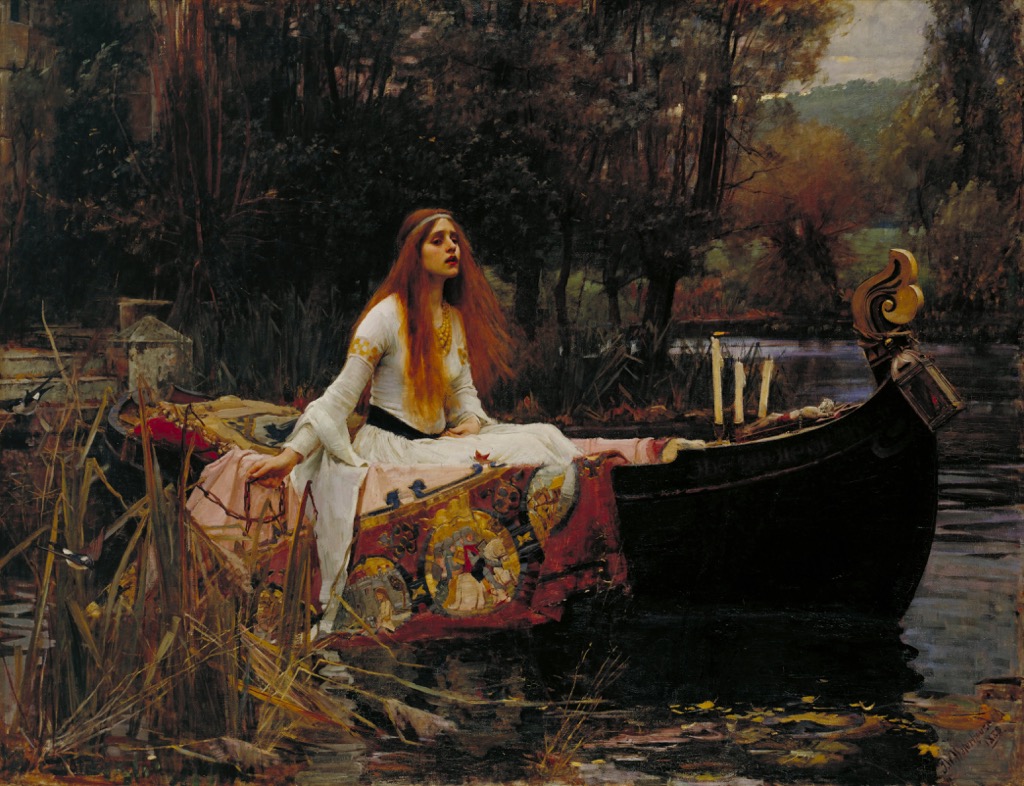
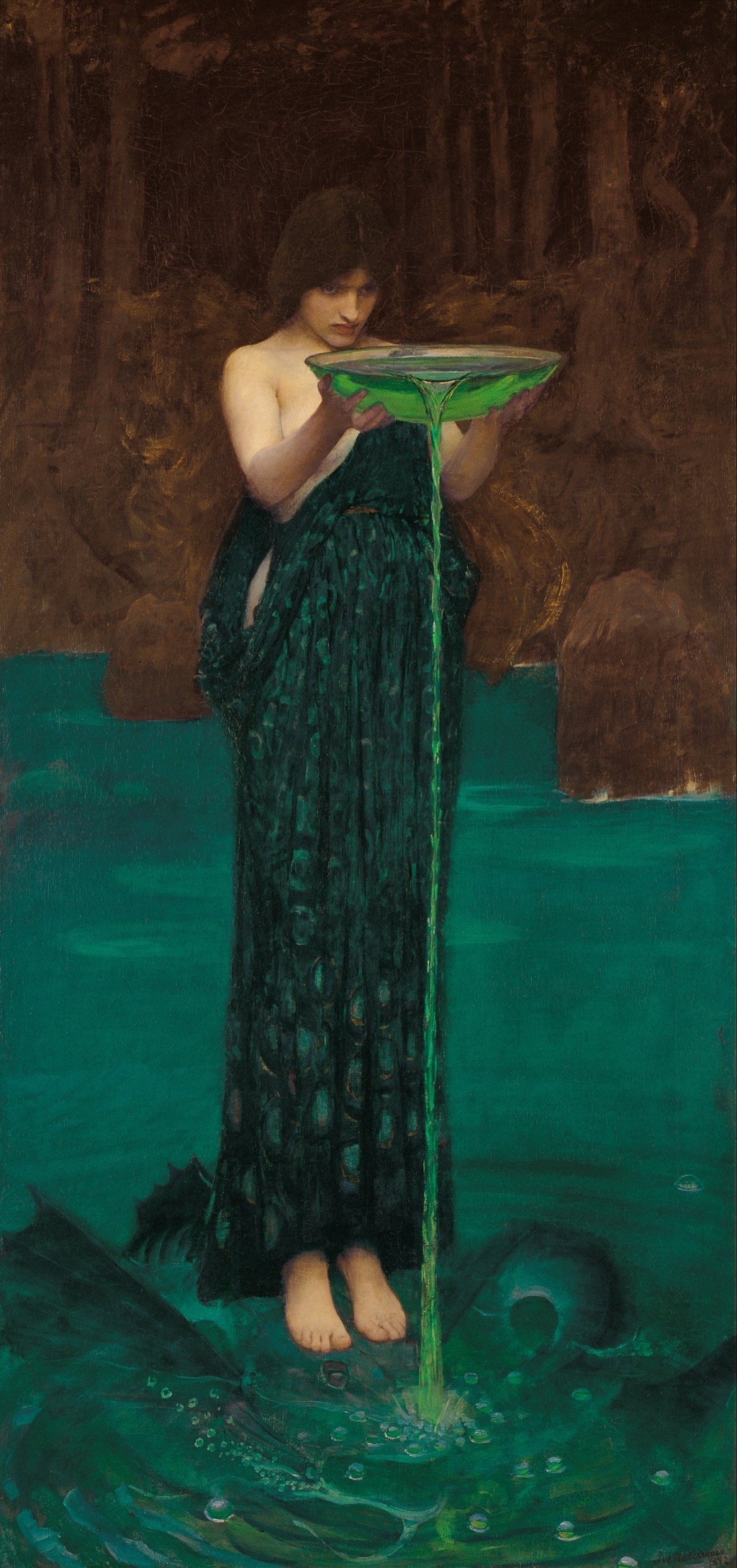
Waterhouse often returned to subjects rather than treating a first composition as final. His multiple Shalott, Ophelia, Circe and Lamia paintings similarly change moment, arrangement or emotional emphasis. A second version should not be assumed to be a replica.
Nor should the 1904 canvas be called a preparatory study without evidence. It is an independent finished painting. Studies on paper or smaller painted works may relate to the project, but the existence of an earlier version does not reduce it to rehearsal.
The two Danaïdes compositions offer a particularly clear example of revision by multiplication. Waterhouse does not change the mythic action. He changes how many bodies are required to make endlessness visible.
Exhibition, Acquisition and Late Style
The 1906 Danaïdes was exhibited at the Royal Academy in that year. [5] [6] By then Waterhouse was a full Royal Academician with more than three decades of Academy exhibiting behind him.
The subject belongs to the same mature mythological phase as Echo and Narcissus, Lamia, Jason and Medea and Circe Invidiosa. Women from ancient narratives carry much of the psychological and compositional weight, but the paintings do not all tell the same story about feminine danger or victimhood.
Here the women have committed violence, suffered coercion and entered punishment. Their moral position is less stable than that of a simply innocent captive and less powerful than that of an enchantress controlling the scene.
The Aberdeen painting combines broad handling with a highly organised group. From a distance, the repeated bodies and vessels form a clear decorative rhythm. At closer range, water, cloth and rock allow the painted surface to remain mobile.
The gallery acquired the work in 1927 with income from the Macdonald Bequest, more than a decade after Waterhouse's death. [1] The museum record does not state that it was commissioned for Aberdeen, and that claim should not be inferred from its present location.
Its size makes physical viewing important. At more than 1.6 metres high and nearly 1.3 metres wide, the painting brings the descending women close to human scale. [1] Reproductions convey the pattern but reduce the relation between viewer and labouring body.
Aberdeen currently records the painting as viewable by appointment at its Treasure Hub rather than continuously displayed. [1] Because access arrangements can change, visitors should consult the museum before travelling.
The work's continuing power comes from an unusually economical invention. Waterhouse does not illustrate the wedding night, severed heads, a divine trial or a crowded hell. He selects one action whose repetition can carry the entire moral weight of the story.
Nothing in the scene ends, but the painting's formal beauty repeatedly persuades the eye to begin again.
Related Pages
- The Lady of Shalott: Compare Waterhouse's best-known literary composition.
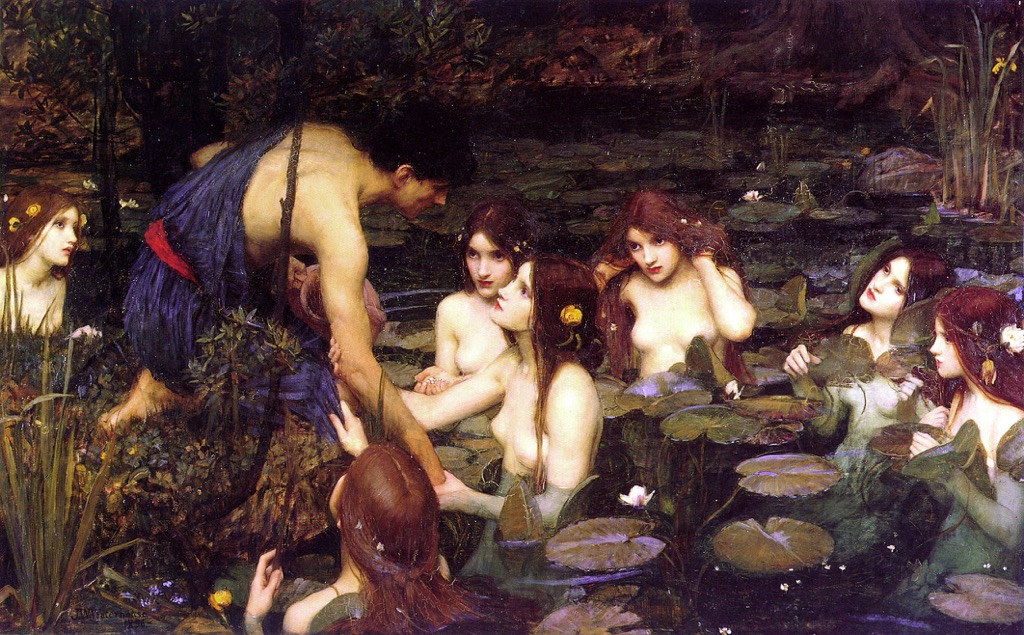
- Hylas and the Nymphs: Compare another major mythological scene.
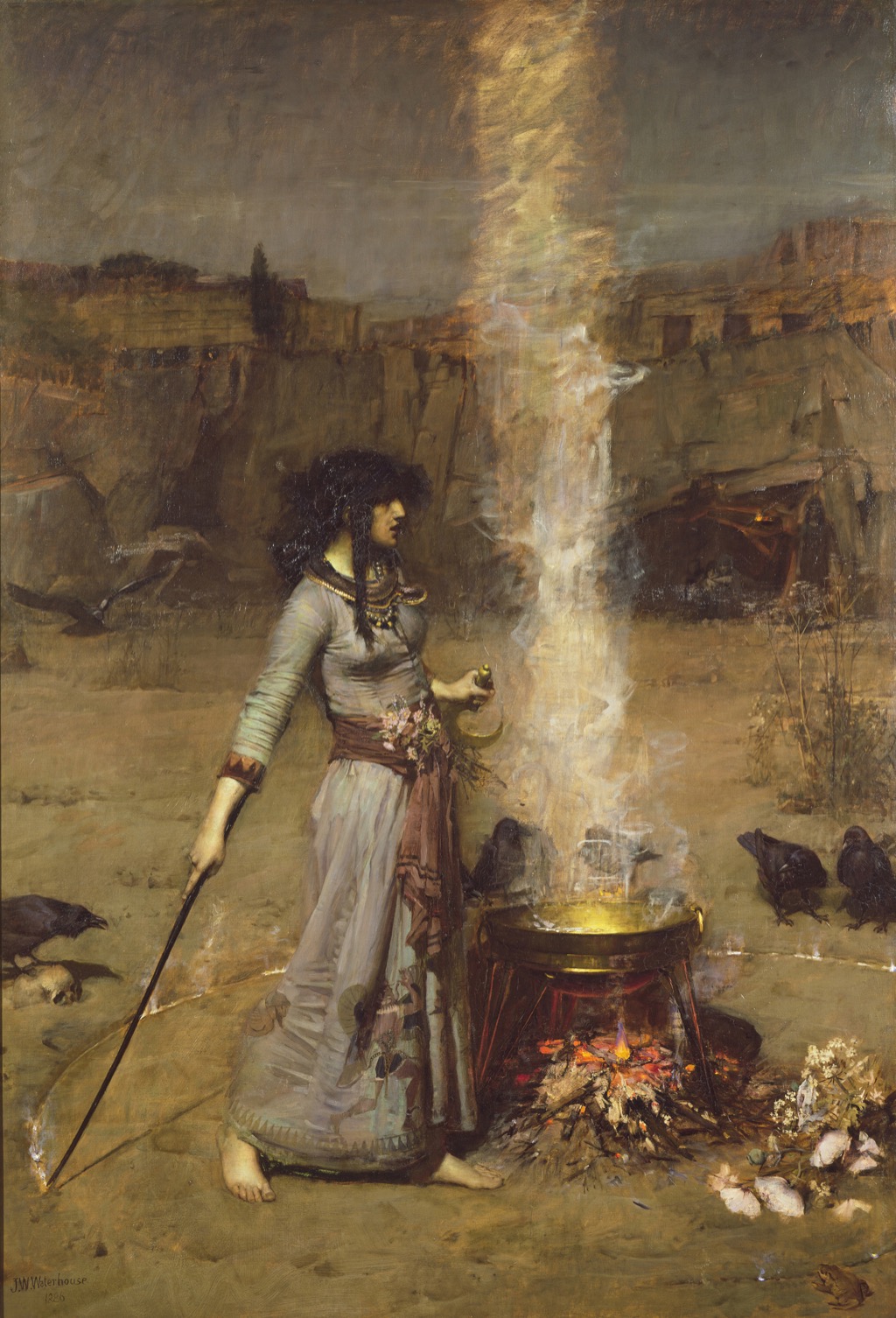
- The Magic Circle: Compare Waterhouse's treatment of ritual and symbolism.
Frequently Asked Questions
They were the fifty daughters of Danaus. In the best-known account, Danaus ordered them to kill the fifty sons of Aegyptus after forced marriages; forty-nine obeyed. [2]
Hypermnestra spared Lynceus because he respected her wish to remain a virgin. She was imprisoned by Danaus but ultimately continued the royal line with Lynceus. [2] [4]
Later ancient tradition condemned them to carry and pour water endlessly into a leaking or bottomless vessel. [4] [6]
Its inability to retain water is the mechanism of the punishment. It removes completion from labour and turns every effort into another beginning.
Seven figures are visible, representing the much larger group of punished sisters. [5]
Yes. A five-figure version dated 1904 is in private ownership. The larger seven-figure canvas in Aberdeen dates from 1906. [5]
No. It is treated as a separate finished composition. The later canvas revises and enlarges the group rather than simply copying it.
It belongs to Aberdeen Art Gallery & Museums, object ABDAG003402. The collection currently lists it as viewable by appointment at the Aberdeen Treasure Hub. [1]
In 1927, using income from the Macdonald Bequest. [1]
Discussion
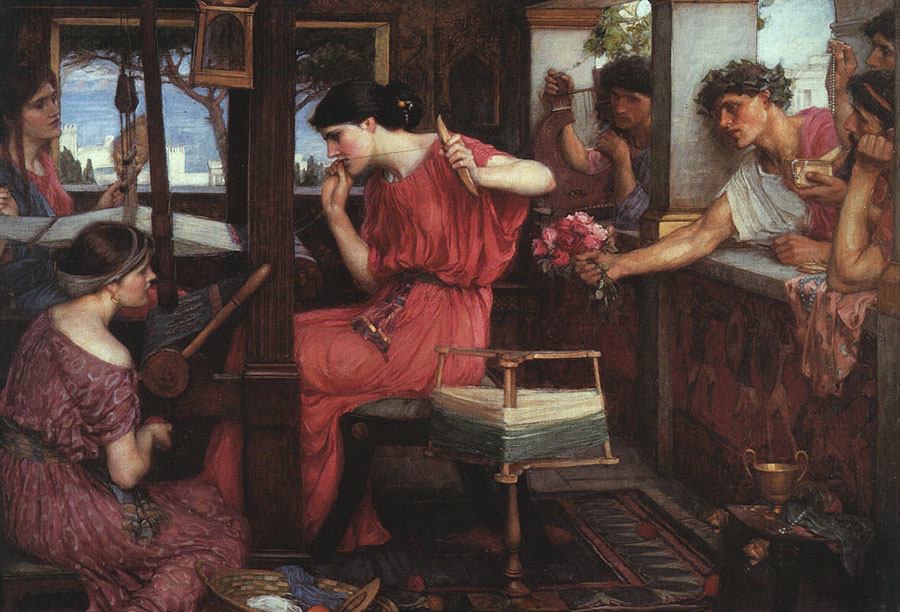
1. How does Waterhouse make repetition visible in a still image? 2. What is the effect of removing judges and guards from the punishment scene? 3. How should forced marriage and Danaus's command affect judgement of the sisters' crime? 4. Why is Hypermnestra important even though she does not appear in the painting? 5. Does the beauty of the vessels and draperies soften the punishment or make it more disturbing? 6. What is gained by expanding the five-figure 1904 composition into seven figures in 1906? 7. Compare the Danaids' endless labour with Penelope's repeated weaving and unweaving. How does purpose transform similar actions? 8. Why might a punishment based on futility remain more memorable than one based on physical pain?
Reader Insights
Which visible detail most changes the way you read this page?
Which source or comparison helps the work feel less familiar and more specific?
What question would you bring back to the painting after reading?
Join the Conversation
Share your reading of this page below.
References
- Aberdeen Art Gallery & Museums, “The Danaides,” collection record, object ABDAG003402, accessed 6 August 2026, View source.
- Apollodorus, Library, Book 2, chapter 1, section 5, translated by James George Frazer, Perseus Digital Library, Tufts University, accessed 6 August 2026, View source.
- Aeschylus, Suppliant Women, translated by Herbert Weir Smyth, Perseus Digital Library, Tufts University, accessed 6 August 2026, View source.
- Horace, Odes, Book 3, Ode 11, translated by C. Smart, Wikisource, accessed 6 August 2026, View source.
- Jacqueline Banerjee, “The Danaïdes,” The Victorian Web, 15 March 2021, View source.
- Alan H. Sommerstein, ed., Aeschylus: Suppliants, Cambridge Greek and Latin Classics (Cambridge: Cambridge University Press, 2019), introduction, pp. 9–11, excerpt accessed 6 August 2026, View source.