

 by Tom Gurney
Tom Gurney BSc (Hons) is an art history expert with over 20 years experience
Published on August 14, 2026 / Updated on August 14, 2026
Email: tomgurney1@gmail.com / Phone: +44 7429 011000
Study for Dante and Matilda: Introduction
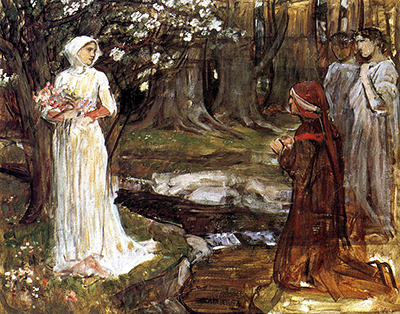
John William Waterhouse's Study for Dante and Matilda imagines the poet's first encounter with a woman gathering flowers in the Earthly Paradise. Matilda stands in white among blossoms on one bank of a stream; Dante kneels opposite in dark red, with Virgil and Statius behind him. Flowing water keeps the figures close but separate.
Made about 1914–17 and left unfinished, the oil study belongs to the Dahesh Museum of Art. [1] [2] It was formerly called Dante and Beatrice, but the scene comes from Canto 28 of Purgatorio, before Beatrice's later arrival. Correct identification transforms the work: this is Matilda beside Lethe, explaining Eden and preparing Dante for purification. [1] [3]
At a Glance
- ArtistJohn William Waterhouse
- TitleStudy for Dante and Matilda [1] [2]
- Former titleDante and Beatrice [1]
- DateAbout 1914–17 [1] [2]
- MediumOil on canvas mounted on wood [1] [2]
- Dimensions49.5 × 61.9 cm [1] [2]
- CollectionDahesh Museum of Art, New York [1] [2]
- Accession number1997.44 [1] [2]
- StatusUnfinished study [2]
- Literary sourceDante Alighieri, Purgatorio, Canto 28 [2] [3]
Contents
- Introduction
- What the study shows
- The scene in Purgatorio
- Why the woman is Matilda, not Beatrice
- The river Lethe
- Flowers, forest and Earthly Paradise
- Dante, Virgil and Statius
- Colour and spatial division
- What the unfinished surface reveals
- Active and contemplative life
What the study shows
Matilda stands at left in a long white garment and hood, holding a mixed armful of flowers. Her pale form rises against a flowering tree and darker woodland.
Dante kneels at right in a red hood and brown-red robe. His hands lift before him, fingers close together, as he looks across the stream.
Two men stand behind. They are appropriately understood as Virgil and Statius, Dante's guides at this stage of the journey, though their features remain only broadly indicated.
Water moves diagonally through the centre. Pale highlights catch its surface and a small cascade, making the dividing current visually active.
The banks differ. Matilda's side is bright with small flowers and white blossom; Dante's side is darker, with exposed earth and great trunks.
No figure crosses. The encounter depends on looking, speaking and listening across water.
The brushwork is open and unevenly resolved. Faces and garments are established, but passages of wood, river and background retain the character of active planning.
This is not a damaged finished painting masquerading as a sketch. The Dahesh Museum catalogues it as an unfinished study. [2]
The scene in Purgatorio
At the summit of Mount Purgatory, Dante enters a living forest whose air, fragrance, birds and perpetual vegetation mark the Earthly Paradise. [3] [4]
A stream stops his progress. Across it he sees a solitary woman singing and gathering flower after flower. [3]
Dante asks her to come nearer so that he can hear. She turns as gracefully as a dancer, approaches the opposite bank and raises her eyes towards him. [3]
The woman explains the unusual wind and water of the garden. The place is above ordinary weather, yet a constant divine order moves its air and maintains its streams.
This explanation makes her more than a decorative personification of spring. She answers Dante's confusion about how vegetation can move in a place beyond the disturbances he has known below. Her speech teaches him to read the garden correctly.
She then connects the landscape with humanity's memory of an earthly Golden Age. In Dante's Christian design, classical poets dimly imagined a happiness whose true location and cause are disclosed here. Matilda mediates between sensory beauty, inherited poetry and revealed order. [3] [5]
She later names the two waters: Lethe removes the memory of sin, while Eunoe restores the memory of good deeds. They must be experienced in sequence. [3] [4]
Waterhouse compresses this long exchange into first encounter. Flowers identify her action, the stream supplies the boundary, and Dante's kneeling attention registers wonder.
The study contains no procession or chariot. Those belong to the cantos that follow, when Beatrice appears.
Its source is therefore precise even though the painting remains visibly unfinished.
Waterhouse selects a moment before the poem's greater pageantry begins. That choice keeps the composition intimate: four human figures, a river and a flowering wood. The theological scale is carried by ordinary acts of seeing, asking and gathering.
It also permits viewers unfamiliar with Dante to understand the basic relationship. The woman belongs to the luminous garden, the travellers have arrived from a darker region, and the stream is a boundary they have not yet mastered. Literary knowledge deepens these facts rather than rescuing an otherwise illegible image.
Why the woman is Matilda, not Beatrice
The work circulated under the title Dante and Beatrice. That identification is understandable because Beatrice is the best-known woman in Dante's poetry and a major Pre-Raphaelite subject.
It is nevertheless incorrect for this scene. The Dahesh Museum identifies the flower-gatherer as Matilda and locates the meeting in Canto 28. [2]
Beatrice arrives later in Purgatorio within an elaborate sacred procession. She is not first encountered alone picking flowers across Lethe.
Matilda's name is itself delayed in Dante's poem; she remains “the lady” through the initial encounter and is named explicitly only much later. That textual delay may have encouraged later visual confusion.
Correct title work is not pedantry. It changes the woman's role from Dante's beloved and future guide to a distinct guardian or minister of the Earthly Paradise.
It also clarifies the two male companions. Virgil has not yet vanished at Canto 28, and Statius has joined the ascent.
The old title should be retained in metadata as a former identification so that historical catalogues and searches remain connected.
Public copy should lead with Study for Dante and Matilda and explain the correction immediately.
Matilda's own identity beyond the poem remains debated. Commentators have proposed historical, scriptural and symbolic associations, but Dante gives no simple biographical introduction in Canto 28. [5] The painting does not resolve those scholarly arguments.
That uncertainty differs from the Beatrice error. We may not know which traditions stand behind Matilda's name, yet we can know that the flower-gatherer at Lethe before the procession is not Beatrice. Responsible interpretation should keep the secure narrative distinction while acknowledging the wider debate.
The corrected title also improves visual attention. Once Matilda is recognised, her bouquet ceases to be a generic romantic attribute and becomes evidence of the exact action Dante describes. The stream similarly changes from poetic scenery into one of Eden's named waters.
The river Lethe
The visible stream is Lethe. Matilda explains that its water removes the memory of sin; Eunoe, flowing in the other direction from the same divine source, restores recollection of good. [3] [4]
In Canto 28 Dante has not yet crossed or drunk. The water is first an obstacle that stops his physical advance.
Waterhouse emphasises this condition. Dante and Matilda occupy opposite banks, separated by only a short distance that feels psychologically charged.
The current runs across the scene rather than receding quietly into depth. It becomes a luminous band between red and white figures.
Lethe is not merely a picturesque brook. Its future function is moral and mnemonic, preparing the purged soul for ascent.
At the same time, Dante's first response is sensory. He hears the woman's song, sees flowers and water, and wants to draw closer.
The study balances those registers. A real-looking stream divides bodies; readers of the poem know it will transform memory.
Waterhouse frequently used water as a dangerous threshold. Here it is not fatal seduction but divinely ordered purification, giving a familiar motif a different ethical direction.
The direction of movement is also unusual for him. Many Waterhouse protagonists approach water without understanding the danger it contains. Dante understands too little at first, but instruction will make passage possible. Knowledge does not break the spell; it prepares the traveller to advance.
Lethe's purpose can sound like simple forgetting, yet the poem embeds it in moral restoration. Sin has already been acknowledged and purged on the mountain. Removal of its painful memory is not evasion of responsibility but part of readiness for Paradise, paired with Eunoe's renewal of remembered good.
The two-bank composition therefore represents a precise “not yet.” Dante has reached Eden but has not completed the final rites; Virgil still stands behind him; Matilda has appeared but Beatrice has not. Waterhouse's suspended encounter is structurally faithful to this interval.
Flowers, forest and Earthly Paradise
Matilda's armful of flowers anchors the scene in Dante's text. She moves through yellow and red blossoms, gathering them as she sings. [3]
Waterhouse gives her a mixed bouquet and surrounds her feet with scattered colour. White blossom fills the branches above, extending her pale garment into the living world.
The Earthly Paradise is not simply pleasant landscape. It is Eden at the summit of the purgatorial mountain, a place of original innocence and transition towards heaven. [4]
The forest contrasts with the dark wood in which Dante's journey began. Here density shelters light, music and ordered abundance.
Waterhouse differentiates the banks rather than painting uniform spring. Matilda's side blooms; Dante's side contains darker soil and heavier trunks.
The Dahesh Museum interprets this contrast as passage from ordinary sinful existence towards spiritual purity. [2]
That reading is persuasive but should not turn every bare branch into a fixed code. The unfinished state also contributes to differences in density and colour.
Flowers carry action before allegory: Matilda is doing what the poem says. Symbolic abundance grows from faithful narrative detail.
Dante, Virgil and Statius
Dante is recognisable through the red hood and robe conventional in later representations of the poet. He kneels closest to the water.
His posture condenses wonder, petition and concentrated listening. The raised hands do not need to be assigned to one exact line.
Behind him stand Virgil and Statius. Virgil has guided Dante through Hell and Purgatory but cannot enter Paradise; Statius, a Roman poet imagined as a converted Christian, joins them in the later ascent.
Their faces are lightly worked, reinforcing their secondary role at this first encounter.
Dante's red creates the strongest warm accent. It separates him from the grey-white companions and dark trees.
The three men occupy a compressed vertical group, whereas Matilda stands alone with space around her. This asymmetry grants her authority over the place.
She does not cross to greet them. Knowledge travels through voice while the river remains in place.
The composition therefore visualises a change in guidance. Virgil and Statius witness as a new figure begins to explain the realm Dante has entered.
Colour and spatial division
White and red establish the primary opposition. Matilda's garment catches the strongest light; Dante's robe forms the deepest chromatic mass.
The river occupies the middle in broken white, grey and brown. Its highlights connect Matilda's dress with Dante's pale-faced companions while still keeping the banks apart.
Vertical trunks fill the right background. Flowering branches spread horizontally at left, softening the division.
The diagonal banks create a shallow stage rather than a deep panoramic landscape. Figures remain close enough for conversation.
Waterhouse avoids perfect symmetry. Matilda is upright; Dante kneels. She holds flowers; he holds empty hands. She knows the place; he asks.
The two men's pale robes form an echo of Matilda, but their shadowed faces keep them on Dante's side of incomplete understanding.
Because the study is unfinished, dark ground and exposed underlayers contribute strongly to the palette. Interpretation should distinguish purposeful contrast from areas not carried to final resolution.
Even so, the central scheme is clear. Purity and knowledge are not conveyed by white alone; they emerge through Matilda's relation to flowers, water and Dante's attention.
What the unfinished surface reveals
The Dahesh object is oil on canvas mounted on wood. [1] [2] Mounting stabilises the textile support but may reflect later conservation rather than Waterhouse's first working format.
Loose brushwork is visible in tree trunks, water and the standing companions. Outlines shift, and some forms remain transparent.
At points the warm ground participates in the visible image, especially across the right bank and wooded background. Such passages let the eye reconstruct forms from abbreviated strokes rather than continuous finish.
The flowering area at left is handled differently. Small light and coloured touches accumulate around Matilda, providing enough specificity to establish blossom without describing every species. Narrative necessity determines detail: flowers must be recognisable as what she gathers, but botanical taxonomy is irrelevant.
Matilda and Dante receive greater definition because their relationship carries the composition. This hierarchy lets viewers see how Waterhouse established narrative before finishing detail.
The surface should not be treated as a literal step-by-step technical manual. Artists can revise different zones at different times, and later condition affects appearance.
“Study” may mean preparation for a larger intended composition, but no completed final version matching this exact arrangement is established here.
Waterhouse died in February 1917, within the broad date range assigned to the work. Illness or death may explain incompletion, but the object record does not document the precise cause. [1] [2]
Its open state has independent value. It reveals the balance between broad tonal masses and the selective detail needed for identity.
The work is therefore both literary image and evidence of late studio thought.
It also cautions against treating “unfinished” as aesthetically deficient. The principal relation is already established with unusual clarity. Later refinement might have altered faces, branches and water, but the red-white opposition and separation of banks were sufficiently strong to carry the story.
What remains unknown is equally important. The study cannot tell us the intended final scale, every planned colour adjustment or whether Waterhouse would have altered the group. Its value lies in what survives, not in a speculative reconstruction of a lost masterpiece.
Active and contemplative life
The Dahesh Museum describes Matilda as personifying active life, contrasted with the contemplative life associated with Beatrice. [2]
This interpretation has a long history in Dante commentary. Matilda acts: she gathers flowers, sings, explains the garden and later assists Dante with the purifying waters.
Beatrice's role is different, though not inactive. She represents sacred knowledge and guides Dante beyond the limits of Virgilian reason.
Waterhouse's study makes Matilda's activity visible through hands and bouquet. Her white dress does not turn her into a motionless apparition.
Dante kneels as recipient, yet his questioning drives the exchange. Active and contemplative should not become simplistic gendered opposites.
The painting also contains three kinds of action: Matilda's gathering, the stream's flow and Dante's intellectual approach.
Commentary traditions do not reduce Matilda to a single universally agreed equation. [5] “Active life” is a productive guide because it matches her deeds, but it should remain an interpretation rather than a substitute name.
The distinction is visible in Waterhouse's design. Matilda is momentarily still enough to converse, yet flowers in her arms record recent movement and imply that it will continue. Her activity is purposeful care within the garden, not hurried labour imposed from outside.
Dante's kneeling is similarly active in another register. His body pauses, but attention, desire and questioning propel the canto. The picture avoids presenting spiritual receptivity as passivity.
The former title erased some of this specificity by replacing the working guardian with the more famous beloved. Restoration of Matilda returns labour and explanation to the scene.
Her authority is local and transitional. She belongs to the threshold where memory is prepared for ascent.
Waterhouse's late Dantean project
Dante was a foundational figure for the Pre-Raphaelite imagination, especially through Dante Gabriel Rossetti's name, poetry and images of Beatrice.
Waterhouse's choice of Purgatorio connects him to that legacy while avoiding its most familiar romantic scene.
His Matilda belongs to a late group of women in flowered or wooded settings, but the literary source gives every major element a clear function.
The study returns to themes present throughout his career: a woman gathering flowers, a stream as boundary, watchers on an opposite bank and a suspended approach.
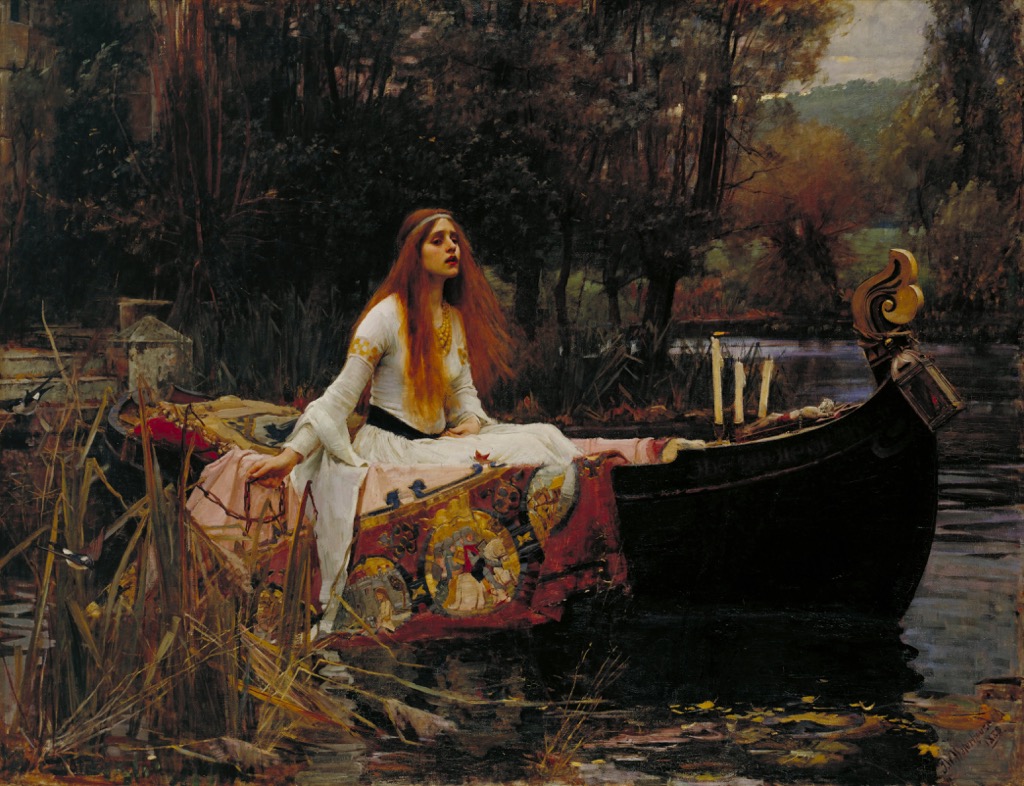
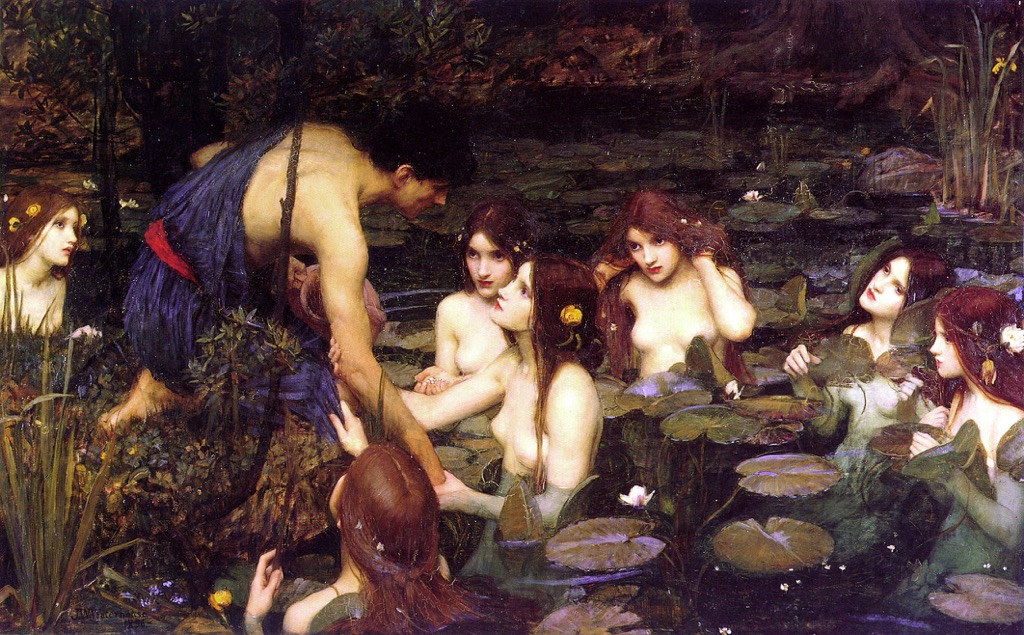
Unlike Hylas and the Nymphs, crossing the water promises purification rather than death. Unlike The Lady of Shalott, the threshold leads upward rather than towards doom.
The unfinished surface suits the subject accidentally but powerfully. Dante has reached a realm of transition, and Waterhouse's forms remain between conception and completion.
The Dahesh acquisition preserves this late experiment as a museum object rather than allowing its old misidentification to remain uncorrected.
Museum ownership also makes its unfinished state available for sustained comparison with Waterhouse's completed canvases. Instead of judging only the polished surface for which he is famous, viewers can see how figure placement, tonal division and narrative recognition precede final elaboration.
The work's late date gives that evidence particular poignancy, but biography should not overwhelm it. It is more than a final fragment: it is an intelligent rereading of a literary threshold by an artist who had spent decades painting thresholds of his own.
Related Pages
- The Lady of Shalott: Compare Waterhouse's best-known literary composition.
- Hylas and the Nymphs: Compare another major mythological scene.
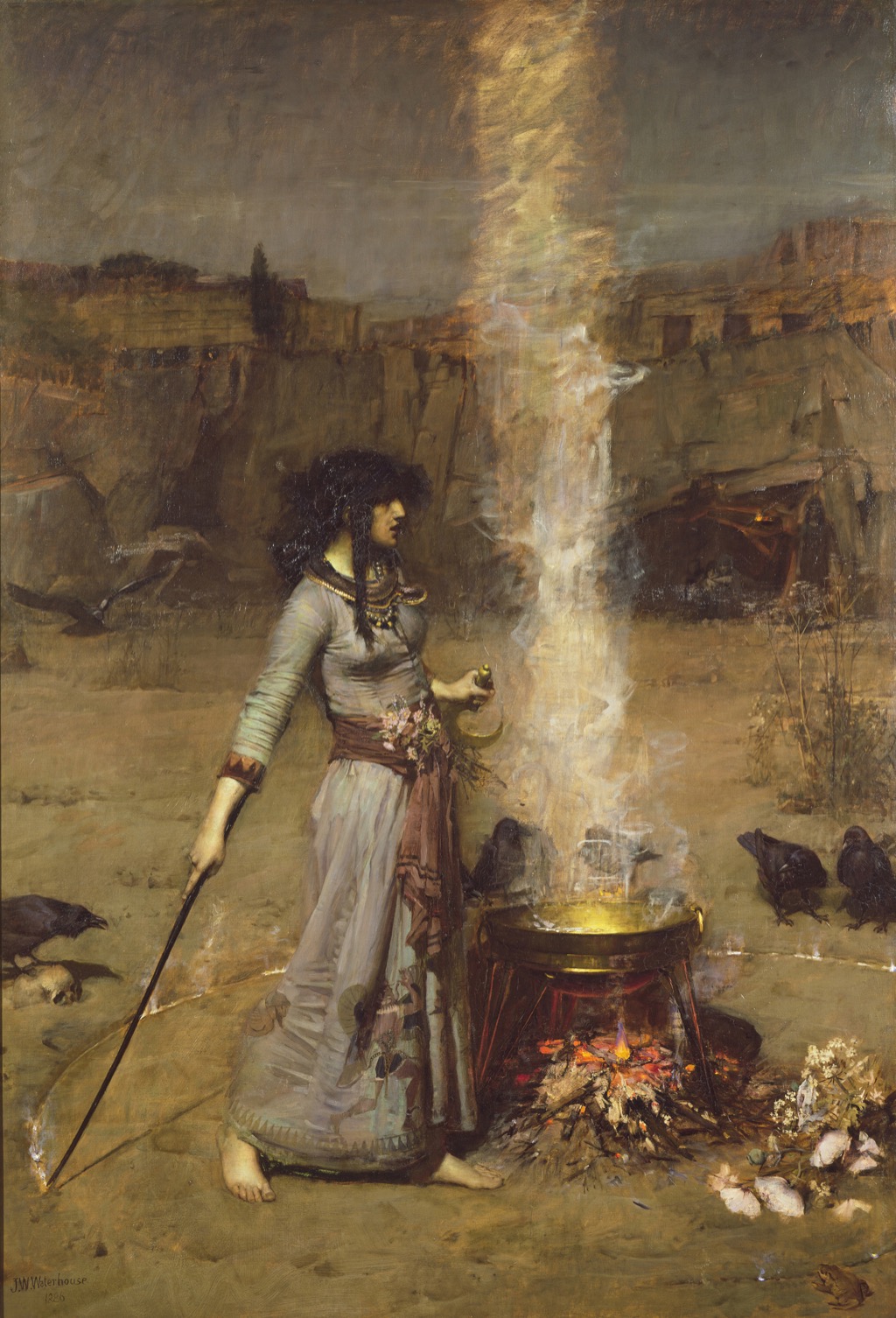
- The Magic Circle: Compare Waterhouse's treatment of ritual and symbolism.
Frequently Asked Questions
Beatrice is Dante's most famous female figure, but the flower gathering and stream identify Canto 28, where he meets Matilda before Beatrice arrives. [1] [2]
They are understood as his guides Virgil and Statius.
No. The Dahesh Museum catalogues it as an unfinished study. [2]
Discussion
Study for Dante and Matilda is a painting about nearness that cannot yet become contact. A narrow stream divides the figures, but voice, gaze and flowers already cross the interval.
Correct naming restores the picture's full intelligence. Matilda is not a substitute Beatrice. She is the active interpreter of Eden, keeper of its waters and necessary guide between purgation and ascent.
Reader Insights
Which visible detail most changes the way you read this page?
Which source or comparison helps the work feel less familiar and more specific?
What question would you bring back to the painting after reading?
Join the Conversation
Share your reading of this page below.
References
- Wikimedia Commons / Dahesh object data, John William Waterhouse, Study for Dante and Matilda, former title, date, medium, dimensions, collection and accession. View source
- Dahesh Museum of Art, “John William Waterhouse, Study for Dante and Matilda,” collection record and interpretation. View source
- *Dante Alighieri, Purgatorio, Canto 28*, English translation of the flower gathering, encounter and explanation of Lethe and Eunoe. View source
- University of Leeds, Discover Dante, “The Earthly Paradise, Cantos XXVIII–XXXIII,” setting, rivers and narrative sequence. View source
- Dante Lab, Dartmouth College, Purgatorio 28, Italian text and commentary tradition. View source