

 Buy Art Prints Now
from Amazon
* As an Amazon Associate I earn from qualifying purchases.
Image reference [image]
 by Tom Gurney
Tom Gurney BSc (Hons) is an art history expert with over 20 years experience
Published on August 14, 2026 / Updated on August 14, 2026
Email: tomgurney1@gmail.com / Phone: +44 7429 011000
The Enchanted Garden: Introduction
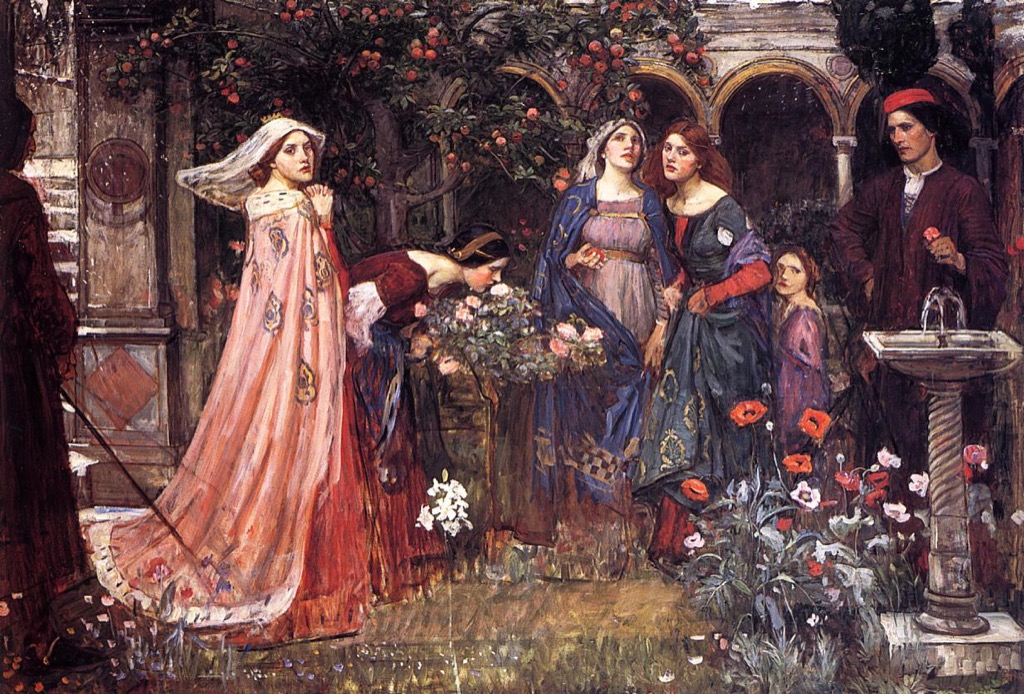
A winter garden has burst into the colours of May, yet the woman at its centre cannot share the delight around her. John William Waterhouse's The Enchanted Garden is a painting about a marvel that creates a moral crisis. Flowers answer an apparently impossible demand; the human figures must decide what honour requires now that the impossible has happened.
Begun in 1916 and left unfinished when Waterhouse died in February 1917, the large canvas draws upon the fifth story of the tenth day of Giovanni Boccaccio's Decameron. It was exhibited posthumously at the Royal Academy and later acquired from the artist's widow by William Hesketh Lever. Today it hangs at the Lady Lever Art Gallery beside Waterhouse's A Tale from the Decameron. [1] [2]
At a Glance
- ArtistJohn William Waterhouse (1849–1917)
- TitleThe Enchanted Garden [1]
- Date1916–17 [1] [2]
- MediumOil on canvas [1]
- DimensionsApproximately 115.5 × 160 cm [1]
- CollectionLady Lever Art Gallery, National Museums Liverpool [1] [2]
- StatusUnfinished at Waterhouse's death; exhibited posthumously at the Royal Academy in 1917 [2]
- AcquisitionSold by Esther Waterhouse to William Hesketh Lever in 1922 [2]
- Literary sourceGiovanni Boccaccio, Decameron, Day 10, Story 5 [3]
- Principal charactersMadonna Dianora, Messer Ansaldo and figures associated with the magically flowering winter garden
- Essential cautionThe unfinished passages reveal a work in progress, but they do not prove exactly how Waterhouse intended every figure or surface to look when complete
Contents
- Introduction
- A Miracle with an Anxious Centre
- Dianora's Impossible Condition
- Generosity after Enchantment
- How Waterhouse Organises the Garden
- What the Unfinished Surface Can Tell Us
- Waterhouse's Final Years and Companion Painting
- Provenance and Public Afterlife
A Miracle with an Anxious Centre
The first impression is abundance. The wide canvas is filled with flowering plants, graceful bodies and cultivated space. Women bend towards blossoms, gather near one another and move through a garden that seems to offer every pleasure of colour, scent and touch.
The emotional centre is different. A tall woman in a pale rose and gold dress stands near the middle, her head inclined and her expression withdrawn. Her drapery and scale give her prominence, but her stillness separates her from the surrounding enjoyment. Christie's identifies a surviving 1916 head study as preparation for this central figure. [2] The link secures her importance in Waterhouse's design even though the painting itself does not carry written labels naming the characters.
At the left, a man in deep red enters or watches from the edge of the enchanted space. At the right, another male figure is associated with the fountain or garden architecture. Women between them attend to flowers rather than to the crisis that the literary story makes legible. Their delight establishes the garden's success; the central woman's unease establishes its cost.
The contrast is the painting's narrative engine. If every figure were astonished, the scene would be only a spectacle of magic. If every figure were distressed, the garden would lose its seductive force. Waterhouse lets beauty and obligation arrive together.
The miracle is visible, but its cause is not dramatised as a theatrical spell. There is no bolt of supernatural light and no securely identifiable magic tool dominating the canvas. The season has simply become impossible. Flowers appear where winter should have prevented them.
This reticence suits Waterhouse's narrative method. He frequently selects a pause after an action has begun to matter but before its consequences are settled. The viewer arrives when the marvel can no longer be dismissed and the moral response has not yet been completed.
The garden is therefore not an escape from decision. It is the place in which an evasive promise becomes real.
Dianora's Impossible Condition
Boccaccio's story is told by Emilia on the tenth day of the Decameron. That day's tales concern acts of generosity or magnificence, and the winter garden becomes the test that allows several characters to exceed what strict self-interest would demand. [3]
Madonna Dianora is married to Gilberto in Friuli. Messer Ansaldo loves her and presses his suit. Hoping to end the pursuit by asking for something no one could provide, Dianora says that she will satisfy his desire if he can make a garden near Udine as green and flowering in January as it would be in May. [3]
The demand is meant as refusal by impossibility. Its danger lies in its form: Dianora has attached words of consent to a condition, however fantastical. Ansaldo finds a magician who, for a large payment, produces the garden. Boccaccio describes grass, flowers, flowering trees and fruit appearing amid winter cold. People come to see the wonder. [3]
Waterhouse paints the proof rather than the request. The garden is already full. The women touching and examining its growth act almost like witnesses, confirming that the condition has been met.
Dianora's distress follows because the device intended to protect her has failed. She had not expected to choose between fidelity to her husband and fidelity to her word. The painting's central figure can reasonably be read as Dianora because her troubled prominence matches this point in the tale, but the identification should rest on the literary structure and preparatory evidence rather than on a supposed portrait likeness.
The story does not make the situation a simple romance between Dianora and Ansaldo. His pursuit is unwanted, and her condition is an attempt to stop it. The garden's beauty should not erase that imbalance.
Nor does magic immediately resolve the problem. It intensifies it. Once the flowers exist, Dianora becomes ill with anxiety and tells Gilberto what she promised. He is initially angry, then decides that her word should not be broken. He tells her to go to Ansaldo while asking her, if possible, to preserve her honour. [3]
That decision can trouble modern readers. Gilberto treats the promise as binding even though it arose under persistent pressure, and Dianora's wishes remain constrained by male codes of honour. Boccaccio's story nevertheless uses this uncomfortable situation to begin a chain of renunciation.
Waterhouse does not paint the later conversations. He concentrates the whole ethical knot in a woman who stands amid the material fulfilment of words she never expected anyone to satisfy.
Generosity after Enchantment
When Dianora reaches Ansaldo and explains that her husband has sent her to keep the promise, Ansaldo is moved by Gilberto's generosity. He refuses to take advantage of her and releases her from the obligation. The magician, hearing what Ansaldo has done, then refuses his own fee. [3]
The tale ends by asking which of the three men has acted most generously: Gilberto, Ansaldo or the magician. That question belongs to the tenth day's larger concern with magnificence. It also shows that the enchanted garden is only the first of several extraordinary acts.
Waterhouse chooses the moment before this chain is complete. If the central woman is Dianora confronting the garden, she cannot yet know that Ansaldo will release her. Her distress is not mistaken merely because the tale eventually turns towards generosity.
This temporal choice protects the image from becoming a moral diagram. Viewers who know Boccaccio can anticipate the outcome; viewers who do not can still recognise that one person experiences the beautiful scene as a burden.
The man in red at the left is often understood as Ansaldo, the lover responsible for commissioning the marvel. A figure at the fountain has been associated with the magician. These readings fit the story and composition, but Waterhouse left no surviving key that proves every identification. The painting is strongest when the narrative functions are recognised without claiming documentary certainty beyond the evidence.
The women enjoying the flowers are not prominent named characters in Boccaccio's compact tale. Waterhouse expands the public wonder of the garden into a chorus of physical responses. One bends close to blossoms; another turns within the group; their bodies make scent and softness imaginable.
They also isolate Dianora. Everyone sees the same garden, but only she carries the promise that produced it. Visual abundance becomes psychological solitude.
Generosity in Boccaccio finally means giving up a right or payment that could technically be claimed. Waterhouse's suspended moment asks what happens before such relinquishment, when claims still appear enforceable. The garden has met the letter of Dianora's condition while violating its intended purpose.
That distinction between literal fulfilment and moral understanding is central. Magic can make January resemble May. It cannot by itself decide what one person owes another.
How Waterhouse Organises the Garden
The canvas is broad and processional. Figures form a loose route across the cultivated space rather than a rigid frieze. Darker colours at the edges lead towards the paler central woman, while clusters of heads and bending bodies create smaller rhythms within the horizontal design.
The garden is neither wilderness nor a botanically labelled specimen ground. Architectural boundaries, paths, a fountain and arranged growth suggest human control. Yet the profusion exceeds ordinary cultivation because the source makes season itself the object of manipulation.
Flowers carry the proof of enchantment. Their importance is not reducible to a single symbolic dictionary. In this story, blossoms are evidence: they establish that Ansaldo has met Dianora's condition. They also create pleasure for bystanders and anxiety for the person who set the test.
Waterhouse had long used gardens to organise thresholds and desires. In Psyche Opening the Door into Cupid's Garden, cultivated nature lies beyond a door towards which the heroine moves. In The Soul of the Rose, a woman presses close to a flower at a wall, concentrating a private sensory experience. The Enchanted Garden opens the setting to a crowd and turns floral abundance into a publicly verified marvel.
The central figure's dress rises in a long, nearly vertical shape against the wider flow. Her posture arrests the eye. Around her, gestures lean outwards and down towards the flowers; her attention appears to fold inward.
Waterhouse does not need to paint snow beside roses to explain the winter contradiction. The title and literary source supply the seasonal fact, while the full garden provides the result. An explicit split between winter and spring might have made the magic more obvious but the emotional situation less unified.
The fountain introduces another kind of controlled nature: water gathered, directed and displayed by art. It can be read as an apt companion to a garden produced by technical or magical skill. Still, the figure beside it should not be declared the magician solely because fountains suggest transformation.
The composition also depends upon sightlines that do not resolve into one communal reaction. Figures look at flowers, across the space or towards one another. No single gesture tells every viewer how to feel. The marvel disperses attention while Dianora concentrates consequence.
This is a late Waterhouse crowd, but not an anonymous mass. Differences of pose allow the garden's effects to register body by body. Wonder is social; responsibility remains personal.
What the Unfinished Surface Can Tell Us
Waterhouse was still working on The Enchanted Garden near the end of his life. It remained incomplete when he died on 10 February 1917, yet the Royal Academy exhibited it later that year. [2] Its unfinished status is not a minor biographical detail. It affects how the image must be read.
Some passages are more fully resolved than others. Faces, garments, plants and spatial transitions do not all carry the same degree of finish. Preparatory structure remains nearer the surface, allowing modern viewers to perceive something of the sequence by which Waterhouse established a large composition.
That visibility is valuable but easy to misuse. An unfinished area is not automatically an expressive decision. Thin paint may indicate that another layer was planned; a simplified face may have awaited revision; an unresolved boundary may have been temporary. Because Waterhouse did not complete the work, no one can reconstruct the exact final balance with certainty.
The surviving head study shows that he prepared the central female figure independently in oil on canvasboard. Christie's records that it remained in the artist's family and identifies it with the woman at the centre of the large painting. [2] The study confirms sustained attention rather than a casually improvised head.
Its date of 1916 also supports the understanding that The Enchanted Garden developed across Waterhouse's final working period. The canvas should not be described as a sudden picture begun only at the moment of death.
The Royal Academy's decision to show an unfinished work posthumously indicates the esteem attached to Waterhouse and to the project. [2] It does not transform the painting into a completed statement, nor prove that the Academy knew how he would have finished it.
The incompletion has an unavoidable emotional resonance: a garden made to conquer winter remained unfinished by an artist approaching death. That parallel is moving, but it is retrospective. There is no documentary basis for claiming that Waterhouse selected the subject as a coded farewell or allegory of his illness.
Responsible interpretation can hold both truths. The circumstance changes our encounter with the canvas, while the literary story remains the demonstrable source of its winter garden.
Waterhouse's Final Years and Companion Painting
In 1916 Waterhouse exhibited A Tale from the Decameron at the Royal Academy. That painting shows the young Florentine company of Boccaccio's frame narrative gathered in a garden around a storyteller. The Enchanted Garden moves from the frame to one particular tale. [2] [4]
The two works now share a gallery and a broad, multi-figure format. Both oppose the popular idea that late Waterhouse painted only solitary women in narrow vertical canvases. They engage with listening, storytelling and garden society on a substantial scale.
Their narrative positions differ. A Tale from the Decameron shows stories being exchanged as communal recreation. The Enchanted Garden enters a story in which speech has material consequences. A condition spoken to deter a lover becomes a place others can walk through.
Boccaccio's frame makes the comparison richer. Seven women and three men leave plague-stricken Florence and organise days of storytelling in the countryside. Their gardens support order, conversation and temporary safety. [4] Within the tenth-day tale, the garden is instead a magical intervention that destabilises a marriage and tests competing claims.
It is tempting to interpret Waterhouse's return to the Decameron during the First World War as direct escapism from contemporary violence. The contrast between cultivated peace and wartime Europe would have been available to viewers, but evidence for a single intended political message is lacking. The works also continue his much older engagement with Italian settings, literary women and moments of suspended choice.
Late style appears here as breadth rather than decline. The garden demands orchestration of numerous figures, extensive vegetation and architecture. Even in its incomplete state, the project is ambitious.
The companion relationship also changes the final work's mood. Seen beside the 1916 canvas, The Enchanted Garden does not look like an isolated fantasy. It becomes the second movement of a sustained engagement with Boccaccio: first the act of telling, then a tale about the unforeseen power of words.
Provenance and Public Afterlife
After Waterhouse's death, The Enchanted Garden remained with his widow, Esther Waterhouse. In 1922 she sold it to William Hesketh Lever, the soap manufacturer, collector and first Viscount Leverhulme. [2]
Lever had assembled a major collection of British art and founded the Lady Lever Art Gallery at Port Sunlight. The acquisition placed an unfinished studio work within a public museum context and preserved its relationship with A Tale from the Decameron.
Christie's describes it as one of Leverhulme's last important purchases of a contemporary painting. [2] That history matters because incomplete works can easily be dispersed, altered or known only through documentation. Public ownership allows the uneven surface and large scale to remain part of interpretation.
The painting's dimensions—roughly 115.5 by 160 centimetres—make reproduction misleading if scale is ignored. [1] The human group occupies a field wide enough for bodily spacing and multiple episodes of attention. At gallery distance, the design coheres; closer viewing exposes variations in finish.
Its afterlife also demonstrates how an unfinished picture can be both an artwork and evidence of working practice. Viewers may respond to Dianora's crisis while also studying underlayers, transitions and prepared figures. Neither mode cancels the other.
The work is sometimes dated simply 1917 because that is the year of Waterhouse's death and posthumous exhibition. A date range of 1916–17 better reflects the 1916 head study and its development over the final period. [1] [2]
It should likewise be called unfinished rather than abandoned. “Abandoned” can imply a deliberate decision to stop. The evidence instead says that work ceased because the artist died.
The painting now closes Waterhouse's long Royal Academy story in an unexpectedly open form. His first Academy exhibit, Sleep and His Half-Brother Death of 1874, was carefully finished and compact. The final posthumous appearance was a large garden whose human dilemma is intelligible while its material resolution remains incomplete.
Related Pages
- Paintings: Return to the protected Waterhouse paintings hub.
- Literary and Mythological Sources: Read the literary frame for Waterhouse's Decameron subjects.
- Technique and Style: Connect the unfinished late garden composition with Waterhouse's mature colour, texture and figure handling.
Frequently Asked Questions
It draws upon Day 10, Story 5 of Boccaccio's Decameron. Dianora promises to yield to Ansaldo if he can produce a garden flowering in January as though it were May. He succeeds with a magician's help, leaving her anguished by the promise. [3]
She is generally understood as Dianora. A surviving head study is identified with the central female figure, and her distress fits Dianora's position in the tale. [2] The identification is compelling, although the canvas itself carries no written name.
Ansaldo commissions a magician to make an apparently impossible winter garden. Its supernatural flowering satisfies the literal condition Dianora thought could never be met. [3]
Dianora's husband tells her to keep her word. When Ansaldo learns this, he releases her; the magician then refuses payment. Boccaccio turns the situation into a debate about generosity. [3]
No. It was incomplete when Waterhouse died in 1917. The Royal Academy nevertheless exhibited it posthumously that year. [2]
There is no evidence that incompletion was the intended final form. Waterhouse was working on the project during his last years, and death interrupted it.
They allow viewers to see differences between established design, preparatory passages and more resolved paint. They cannot tell us with certainty every change Waterhouse would have made.
It belongs to the Lady Lever Art Gallery at Port Sunlight, part of National Museums Liverpool. [1] [2] Display arrangements can change, so visitors should check before travelling.
Discussion
1. Why does Waterhouse make the garden delightful to most figures while keeping Dianora visibly troubled? 2. Does the fulfilment of an impossible condition create a legitimate claim, or expose the unfairness of the original pursuit? 3. How does knowing the story's later acts of generosity change the suspended moment Waterhouse selects? 4. What is gained by showing the miracle's result rather than the magician performing it? 5. How should an unfinished surface affect interpretation without being mistaken for deliberate final style? 6. Compare the garden here with the social garden in A Tale from the Decameron. How does speech function in each? 7. Can the painting's connection with Waterhouse's death be acknowledged without turning the subject into an unsupported personal allegory? 8. Which details establish collective wonder, and which concentrate individual responsibility?
Reader Insights
Which visible detail most changes the way you read this page?
Which source or comparison helps the work feel less familiar and more specific?
What question would you bring back to the painting after reading?
Join the Conversation
Share your reading of this page below.
References
- Main image: John William Waterhouse, The Enchanted Garden, c. 1916–17, public-domain faithful reproduction via Wikimedia Commons.
- Wikimedia Commons, “The Enchanted Garden by John William Waterhouse,” object metadata citing the Lady Lever Art Gallery, including date, medium, dimensions and collection, accessed 6 August 2026, View source.
- Christie's, “John William Waterhouse, R.A., Head Study for ‘The Enchanted Garden’, 1916,” catalogue entry and essay prepared with assistance from Peter Trippi, including the painting's unfinished status, 1917 Royal Academy display, 1922 sale and present collection, View source.
- Giovanni Boccaccio, The Decameron, Tenth Day, Fifth Tale, translated by J. M. Rigg, Geoffrey Chaucer Website, Harvard University, View source.
- Giovanni Boccaccio, The Decameron, translated by John Payne, Project Gutenberg, including the frame narrative of seven women and three men and the garden settings, View source.