

 by Tom Gurney
Tom Gurney BSc (Hons) is an art history expert with over 20 years experience
Published on August 14, 2026 / Updated on August 14, 2026
Email: tomgurney1@gmail.com / Phone: +44 7429 011000
Gossip (Good Neighbours): Introduction
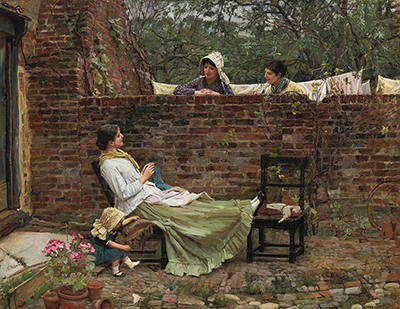
Three young women exchange news across a low, weathered wall while a small child remains beside the seated worker. Laundry hangs behind them, moss softens the yard and every inclined head turns conversation into visible action. John William Waterhouse’s 1885 Gossip is an unusually direct scene of contemporary social life from an artist now better known for legendary heroines. [1]
The painting has circulated as Gossip, The Gossips, Good Neighbours and Washing Day. Christie's records a signed oil on canvas measuring 72.1 × 92.7 cm, exhibited at the Institute of Oil Painters in 1885 and at St Jude’s, Whitechapel, the following year. [1] Its everyday subject, natural light and closely observed stone place Waterhouse beside British naturalism rather than inside a simple story of late Pre-Raphaelite revival.
At a Glance
- ArtistJohn William Waterhouse (1849–1917)
- Primary public titleGossip [1]
- Alternative titlesThe Gossips, Good Neighbours and Washing Day
- Date1885 [1]
- MediumOil on canvas [1]
- Dimensions72.1 × 92.7 cm [1]
- Signature“J. W. Waterhouse,” lower left [1]
- CollectionPrivate collection [1]
- First documented exhibitionInstitute of Oil Painters, 1885, no. 319 [1]
- Later exhibitionSt Jude’s, Whitechapel, 1886, no. 188 [1]
- Early provenanceIsaac Smith; Gooden and Fox sale, 15 May 1911, 80 guineas to Dalby [1]
Contents
- Introduction
- Conversation across a Wall
- What Each Title Changes
- Women’s Work and Social Knowledge
- The Child Inside and Outside the Exchange
- Wall, Laundry, Yard and Landscape
- Naturalism, Bastien-Lepage and Newlyn
- Waterhouse in 1885
- Looking without Condescension
- The Visible Choreography of Speech
Conversation across a Wall
The composition depends upon a barrier that enables contact. A low brick or stone wall divides spaces but brings heads and bodies into one conversational group. [1]
On one side, a young woman sits with cloth in her hands. She may be knitting, sewing, mending or handling laundry; the exact task should be described cautiously from the image.
A small child stays close to her. On the far side, two other young women lean towards the exchange.
Their faces and gestures create a circuit. One person speaks or has just spoken, another receives the information, and the third measures her response.
Waterhouse does not supply speech. The viewer infers content from posture and title.
That missing speech is the painting’s engine. “Gossip” invites us to imagine excitement, secrecy or judgement without giving evidence for any particular story.
The wall lets conversation appear both ordinary and slightly illicit. Nobody has crossed into another yard; information has.
Physical labour pauses but does not disappear. Cloth remains in the seated woman’s hands, and washing fills the background.
The painting therefore catches social life inside work rather than opposing one to the other. Talk is part of the day’s activity.
Bodies arrange the sound we cannot hear. Tilted heads shorten distance, elbows or arms find support, and faces orient towards a shared centre above the wall.
The child’s lower position breaks this adult triangle. Conversation happens over, around and beyond the smallest figure.
Landscape participates too. Trees and worn masonry enclose the group without making the yard claustrophobic.
Unlike a staged literary climax, the moment has no known before and after. It could end when a task resumes or continue until another neighbour joins.
What Each Title Changes
Gossip makes speech the subject and gives it a morally loaded tone. The word can mean informal conversation, but it often implies information about absent people and questions the speakers’ discretion.
The Gossips shifts emphasis from the act to the women. Their identity becomes defined by a behaviour.
Good Neighbours is warmer. It treats the wall as a shared boundary and conversation as community rather than fault.
Washing Day places labour and setting first. Hanging white linen explains the domestic occasion and turns talk into an incidental pause.
The titles demonstrate that naming is interpretation. The same gestures can represent intimacy, idleness, mutual support or small-scale surveillance.
No accessible record establishes that Waterhouse authorised every alternative. The documented exhibition catalogues and sale histories should be consulted where titles matter, while later names can be preserved as reception evidence. [1]
The painting itself refuses to decide whether the news is kind or malicious. No absent victim appears, and no facial expression proves scandal.
Modern viewers should be careful with gendered assumptions. Western art and literature have repeatedly treated women’s conversation as trivial or dangerous while presenting male discussion as public reason.
Calling the picture Gossip can reproduce that hierarchy unless the social function of talk is also recognised.
Neighbourhood information may organise childcare, work, safety, courtship, illness and reputation. Informal speech has consequences precisely because it circulates knowledge unavailable through official channels.
At the same time, gossip can exclude and wound. The painting’s lack of content preserves both possibilities.
Using Gossip (Good Neighbours) in the page title keeps the familiar route while preventing one moral judgement from controlling the work.
Women’s Work and Social Knowledge
The scene contains at least two kinds of work. Laundry or sewing is visible; maintaining relationships is not easily measured but equally present.
The seated woman’s hands remain occupied. This detail resists the idea that conversation equals idleness.
Laundry itself was demanding domestic labour, involving water, lifting, rubbing, boiling, drying and weather. The white cloth behind the group should not function as picturesque decoration alone.
Waterhouse does not turn the scene into a documentary account of every task. The garments are already hung, and the women appear attractively composed.
That aesthetic ordering can dignify the everyday while also softening its physical burden.
The wall distinguishes households, properties or work areas. Neighbourliness allows information to pass without erasing those boundaries.
Social knowledge is carried through face and voice. Because Waterhouse cannot paint sound, he makes attention visible.
The recipient’s body tells us that information matters before we know what it is. The painting is therefore less about a specific rumour than about the force of being told.
This force can be communal. A young caregiver may receive advice or news from slightly older companions.
It can also be disciplinary. A neighbourhood watches conduct, and reputation travels quickly across walls.
The child’s presence makes such circulation intergenerational. Adults speak in front of children even when assuming they do not understand.
Waterhouse neither caricatures the women nor turns them into anonymous labour types. Their gestures are individually studied, and the natural setting is rendered with serious attention. [1]
This respect distinguishes Gossip from comic images that exaggerate female chatter through open mouths and grotesque faces.
The humour, if present, is gentle and observational. We recognise a familiar pattern of leaning closer when information becomes interesting.
The Child Inside and Outside the Exchange
The image shows the smallest figure beside the seated young woman.
The child belongs physically to the group but not fully to the adult conversation.
Height makes that exclusion visible. Adult faces meet around the wall, while the child occupies a lower plane near the work.
The youngster may look, play, wait or simply remain attached to the caregiver. None of those states should be over-narrated from a reproduction.
Childcare and domestic labour coincide. The seated figure’s attention is divided among cloth, child and neighbours.
That divided attention reveals skill rather than distraction. Everyday life rarely offers the isolated focus granted to Waterhouse’s mythological heroines.
The child can also change how we judge gossip. Conversation occurring beside care feels less like leisure stolen from duty and more like social life sustaining duty.
At the same time, children are conduits of neighbourhood information. They hear, repeat and misunderstand.
Waterhouse does not show that later circulation, but the composition makes it imaginable. Speech cannot be contained as neatly as laundry within one yard.
The toddler’s lack of access mirrors the spectator’s. We too are close enough to observe posture but too far away to hear words.
This parallel prevents superiority. Viewers may think they recognise “gossip,” yet they know no more of the content than the child.
The title supplies a category, not a transcript.
The child therefore anchors the painting’s epistemology: presence does not guarantee understanding.
Wall, Laundry, Yard and Landscape
Christie's praises Waterhouse’s meticulous observation of wall, foliage and moss-covered yard. [1]
These surfaces are not neutral background. The wall organises the people, and its worn material makes the meeting plausible.
Moss suggests damp, time and limited maintenance. Brick and stone carry histories of repair.
White laundry catches light and punctuates greens and earth colours. Its hanging planes echo the horizontal spread of the composition.
Trees form a soft screen beyond the harder boundary. Their foliage is observed but not finished with the archaeological precision of Waterhouse’s earlier classical interiors.
Natural light unifies figures and place. No theatrical spotlight separates a heroine from darkness.
This equality of illumination is part of the painting’s democratic effect. Cloth, moss, child and face all belong to one ordinary atmosphere.
The yard is carefully arranged. Naturalism does not mean an uncomposed snapshot.
Waterhouse places the wall at the correct height to support bodies and connect faces. Laundry fills potential emptiness; tree trunks stabilise the distance.
The setting can be rural, village or suburban without a securely identified address. It should not be assigned to Cornwall solely because Waterhouse knew artists connected with Newlyn. [1]
Nor should the people be named as specific neighbours. The object record offers no sitter identities.
The quality of the wall matters art historically. Christie's compares its crumbling masonry and trees with Jules Bastien-Lepage’s Joan of Arc. [1] [2]
In both cases, extraordinary intensity emerges within a closely observed outdoor setting, though Waterhouse’s subject has no supernatural voices.
The resemblance lies in handling and spatial relation, not shared narrative.
Naturalism, Bastien-Lepage and Newlyn
Christie's places Gossip within Waterhouse’s strongest mid-1880s engagement with landscape, outdoor genre and natural light. [1]
He was close to landscape specialists including William Logsdail, his neighbour at Primrose Hill Studios, and Frank Bramley, whom he may have visited in Cornwall. [1]
Through this circle, Waterhouse could encounter the influence of Jules Bastien-Lepage, the French painter whose rural figures combined precise bodies with freer, atmospheric surroundings.
The Metropolitan Museum describes Bastien-Lepage’s Joan of Arc as a scene set in the artist’s native Lorraine, where a village garden supports the visionary subject. [2]
Waterhouse borrows no voices or saint. He adapts a way of making wall, tree and figure feel observed in one place.
The painting also bears comparison with the Newlyn School, especially Stanhope Forbes and Walter Langley. [1]
Artists working around Newlyn represented fishing communities, work and village life with seriousness shaped by French naturalism.
Waterhouse was never simply a member of that colony. “Connected to the ideals” is safer than assigning institutional membership. [1]
This context revises the familiar label “Pre-Raphaelite.” In 1885, Waterhouse was exploring contemporary realism and modern paint handling as well as historic and poetic subjects.
The original Brotherhood had formed nearly four decades earlier. Calling every detailed surface “Pre-Raphaelite technique” erases the French and British naturalist currents visible here.
Naturalism itself should not be treated as photographic neutrality. Waterhouse selects attractive figures, harmonious colour and a pleasing arrangement. [1]
He observes and idealises at once. The tension makes the work commercial without making it empty.
The painting’s progressive quality lies in that hybrid: serious ordinary subject, outdoor light and carefully controlled decoration.
Waterhouse in 1885
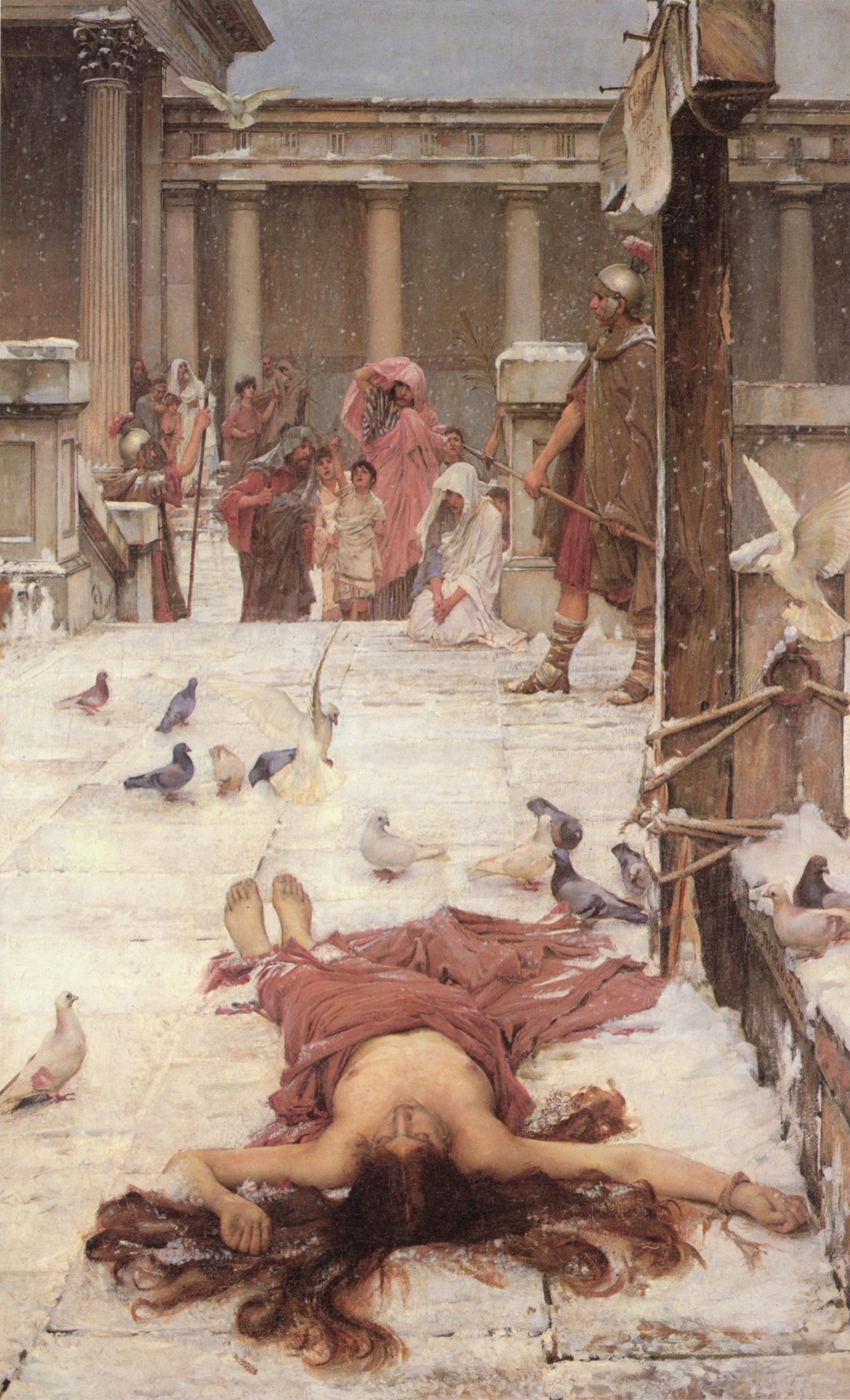
The year places Gossip at a decisive point. Waterhouse had recently completed Saint Eulalia (1885 in exhibition chronology, painted 1884), a large martyrdom subject now at Tate. [1] [3]
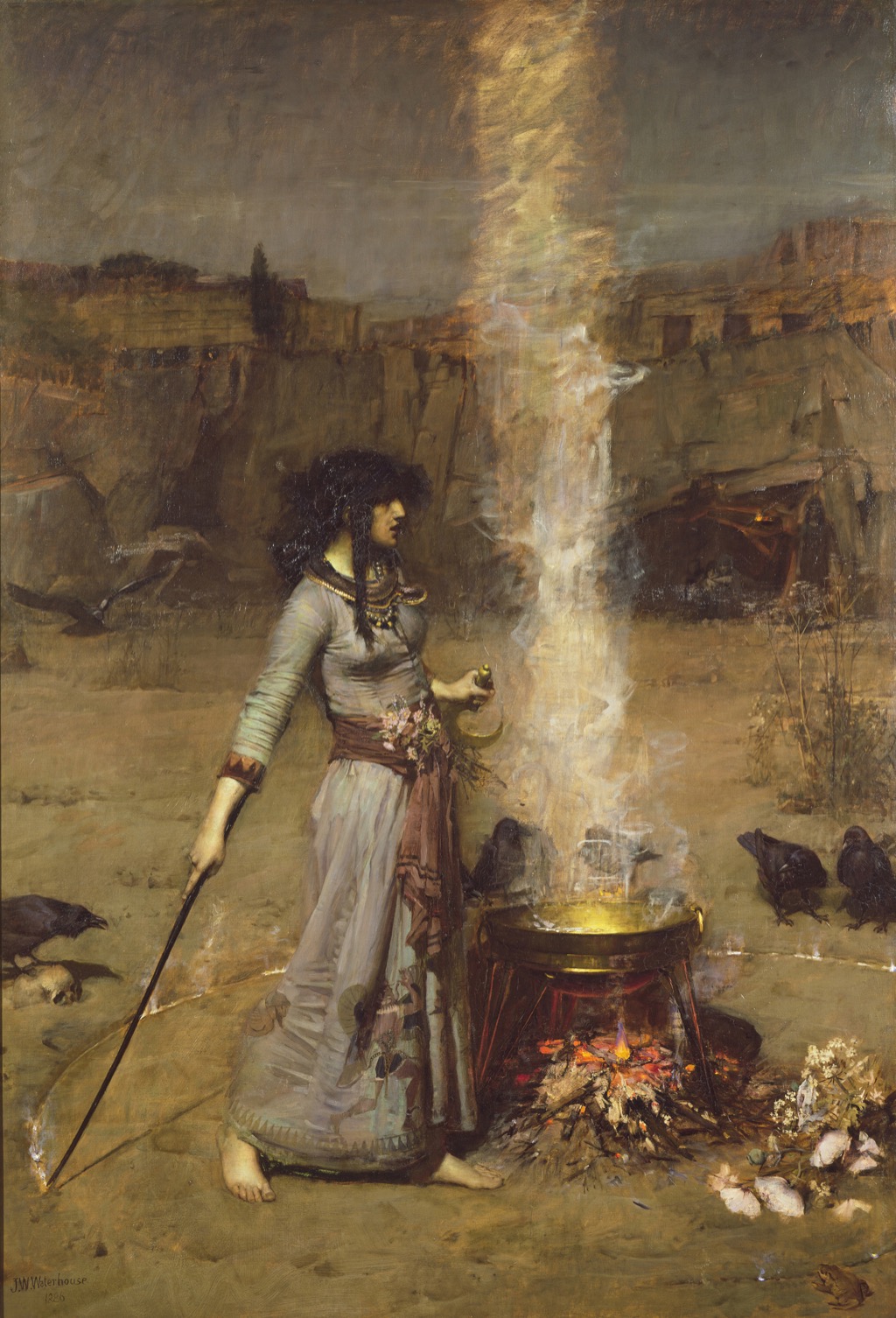
He would soon create The Magic Circle, Mariamne, The Lady of Shalott and his first Ophelia.
Those famous works make it tempting to treat Gossip as a minor pause before his “real” career. The chronology suggests the opposite.
Waterhouse was testing how modern observation could support future poetic painting. Moss, flesh and cloth trained the same eye that would later make legendary scenes physically persuasive.
He also exhibited Gossip at the Institute of Oil Painters rather than the Royal Academy. [1]
That venue suited a work whose interest lay in medium and contemporary genre rather than monumental literary ambition.
The Whitechapel display at St Jude’s in 1886 gave it a different urban audience. [1]
Exhibition history shows the painting was not a private exercise discovered only after his death. It entered public view under contemporary conditions.
Its early owner Isaac Smith and 1911 Gooden and Fox sale connect it to the market for modern British painting. [1]
The price of eighty guineas records one transaction, not an eternal measure of quality.
Most important, the picture challenges a linear career narrative. Waterhouse did not move neatly from classical archaeology to Pre-Raphaelite myth.
In the mid-1880s he could paint martyrdom, magic, landscape and neighbourhood conversation with overlapping techniques.
This range helps explain his later art. The unreal survives because it rests upon knowledge gained from the real.
Looking without Condescension
Genre painting invites viewers to inspect people whose names and circumstances remain unknown. That privilege requires care.
The figures should not be described as foolish because a title calls their talk gossip. Their expressions are animated, not grotesque.
Nor should clothes and yard be used to assign an exact class without evidence. The scene suggests modest domestic life but does not provide an income ledger.
The artist’s careful arrangement can conceal labour. White washing looks beautiful because he has turned it into a light-bearing shape.
Close looking restores material reality: cloth had to be cleaned and hung; a child had to be watched; walls weathered and required repair.
Conversation may offer pleasure inside that work. The painting records sociability as a resource.
It also positions the audience as another gossip. We infer a story about people we do not know from fragments of gesture.
This reflexive structure is one of the work’s deepest pleasures. The title tempts judgement, then the silence withholds grounds for it.
What viewers can know is visual: bodies lean, attention converges, tasks pause, light crosses the yard.
Everything beyond that should remain hypothesis.
Waterhouse’s respect is not documentary transparency. The composition is attractive and may idealise its subjects for collectors.
Yet idealisation does not erase individuality. Each participant occupies a distinct role within the exchange.
The painting asks us to recognise ordinary intelligence in gesture—the ability to speak, listen, assess and remain connected across a boundary.
The Visible Choreography of Speech
Painting cannot reproduce the pace, volume or exact sequence of a conversation. Waterhouse solves that limitation by distributing possible speech among bodies.
A speaker leans or turns differently from a listener. Someone receiving surprising news may hold still while another anticipates the response.
The composition does not identify these roles permanently. A group conversation changes speaker from moment to moment, and the image may capture the brief transfer between one voice and the next.
This uncertainty makes gestures active. A tilted head can mean listening, confidence or the beginning of reply.
Hands are equally important. The seated figure’s occupied hands tie language to labour, while arms resting on the wall turn masonry into social furniture.
The low wall is therefore almost a fourth participant. It sets the distance at which private talk becomes possible without formal visiting.
The neighbouring figures do not need to enter the yard. Their leaning posture temporarily converts division into meeting place.
The broad horizontal canvas suits this choreography. A narrow upright format would stack bodies or privilege one portrait; the landscape shape lets attention travel laterally from person to person. [1]
Laundry repeats that horizontal movement in pale intervals. Tree trunks then provide upright counterweights, preventing conversation from visually spilling out of the scene.
Waterhouse controls the spectator’s eye in the same way that a good storyteller controls attention. We follow glance, wall, cloth and face, searching for a centre that remains mobile.
This movement makes “gossip” more than an anecdotal title. Information has no material body, yet the composition shows circulation through linked directions.
The lack of a clear speaker also protects the women from fixed roles. Nobody is securely established as liar, victim, judge or innocent recipient.
Viewers may assign such positions because narrative appetite dislikes an empty centre. The painting quietly exposes that appetite.
If we imagine a “juicy story,” as popular descriptions often do, we are inventing the absent object of discussion.
The same figures could be sharing household news, warning of illness, planning work or commenting on something just outside the frame.
Close looking therefore moves in two opposite directions. It makes posture increasingly precise while making story increasingly uncertain.
That is not a failure of interpretation. It is the work’s formal truth: Waterhouse paints communication, not content.
The result belongs to a long tradition of genre scenes in which small gestures make social relations legible. What distinguishes Gossip is its refusal of caricature and the seriousness with which natural environment supports fleeting talk.
Related Pages
- The Lady of Shalott: Compare Waterhouse's best-known literary composition.
- Hylas and the Nymphs: Compare another major mythological scene.
- The Magic Circle: Compare Waterhouse's treatment of ritual and symbolism.
Frequently Asked Questions
Christie's catalogues it as Gossip. The Gossips, Good Neighbours and Washing Day are established alternatives. [1]
It was painted and first exhibited in 1885. [1]
The canvas measures 72.1 × 92.7 cm. [1]
It is privately owned. [1]
The painting does not support that judgement. Cloth remains in hand, laundry hangs nearby and childcare continues during conversation.
Waterhouse later became a major inheritor of Pre-Raphaelite imagery, but this work is more precisely understood through contemporary outdoor genre, French-related naturalism and Newlyn affinities. [1]
Discussion
Gossip makes invisible exchange into a structured image. A wall divides property but supports bodies; laundry marks labour but catches beautiful light; a child shares the space but not necessarily the information.
Its alternative titles expose the viewer’s power. The scene becomes morally suspect as Gossip, affectionate as Good Neighbours and industrious as Washing Day. Waterhouse supplies gestures rich enough to survive all three.
Reader Insights
Which visible detail most changes the way you read this page?
Which source or comparison helps the work feel less familiar and more specific?
What question would you bring back to the painting after reading?
Join the Conversation
Share your reading of this page below.
References
- Christie's, “John William Waterhouse: Gossip,” object record and catalogue essay, 15 December 2011. View source.
- Metropolitan Museum of Art, Jules Bastien-Lepage, Joan of Arc, collection record. View source.
- Tate, “John William Waterhouse: Saint Eulalia,” collection record, N01542. View source.