

 by Tom Gurney
Tom Gurney BSc (Hons) is an art history expert with over 20 years experience
Published on August 14, 2026 / Updated on August 14, 2026
Email: tomgurney1@gmail.com / Phone: +44 7429 011000
A Grecian Flower Market: Introduction
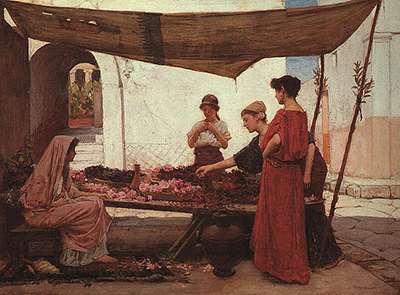
John William Waterhouse's A Grecian Flower Market, also known as A Flower Stall, presents four women around a shaded display of cut flowers. Painted about 1880, it belongs to the young artist's group of small classical genre scenes, in which imagined ancient life is made accessible through familiar activities such as shopping, arranging and selling. [1] [2]
The painting is held by the Laing Art Gallery in Newcastle upon Tyne. [1] Its market is neither an archaeological reconstruction nor a mythological episode. Waterhouse uses antique architecture, dress and vessels to transform a recognisably nineteenth-century encounter between customer and vendors into a decorative vision of Greece.
At a Glance
- ArtistJohn William Waterhouse
- TitleA Grecian Flower Market [1]
- Alternative titleA Flower Stall [3]
- DateAbout 1880 [1]
- MediumOil on canvas [1]
- DimensionsApproximately 57.8 × 79.3 cm [4]
- CollectionLaing Art Gallery, Newcastle upon Tyne [1]
- ExhibitedRecorded as exhibited in 1880 in the Laing collection catalogue [5]
- SubjectWomen buying, selling or arranging flowers in an imagined Greek setting
- ContextOne of Waterhouse's early Alma-Tadema-influenced scenes of everyday classical life [2]
Contents
- Introduction
- What the painting shows
- Customer, sellers and social exchange
- Flowers as goods and decoration
- What makes the market “Grecian”
- Alma-Tadema and classical genre painting
- Architecture, textiles and colour
- Looking at work and leisure
- Exhibition and collection history
- The painting within Waterhouse's development
What the painting shows
The scene is arranged horizontally beneath a striped awning or canopy. Four women occupy a shallow architectural space around a low display of flowers.
One woman sits at the left or centre-left, turned towards the stall. Her rose-pink drapery spreads across the bench and gives the composition its largest warm colour.
Three standing figures attend the flowers or the seated visitor. White, red and muted garments separate their bodies while keeping them within a coordinated palette.
Cut blooms are spread on a stone counter, table or carpeted platform. Pink and pale flowers form irregular clusters between hands and drapery.
An amphora or tall vessel stands near the foreground, helping to mark the scene as antique. Steps, wall surfaces and a glimpse through an opening create limited depth.
The women's gestures are small rather than dramatic. One may arrange or offer flowers; another waits; the seated figure appears to inspect the display.
No money is visibly exchanged in the surviving reproduction, and the title supplies more certainty about commerce than any single gesture.
The market feels quiet. Waterhouse does not paint a crowded street with shouting traders, porters and competing customers.
Instead, he isolates a graceful encounter and converts buying into a carefully balanced figure composition.
This selectivity is important. The painting describes an idealised flower stall, not the full labour and congestion of an ancient urban market.
The visual pleasure begins with arrangement: bodies alternate standing and seated, flowers mediate between them, and the awning contains the group beneath a decorative ceiling.
Customer, sellers and social exchange
The title implies roles. At least one woman is likely a customer, while the others tend or sell the flowers.
Waterhouse makes those roles readable through position rather than caricature. The seated figure faces the goods; standing women control access to the display.
This creates a gentle social asymmetry. One person can choose and purchase, while others wait, arrange and serve.
Dress does not provide a fully reliable guide to class because all four figures are idealised for exhibition painting.
Their faces and gestures invite observation but do not disclose individual biographies. They are types within a market interaction, not documented portraits of ancient Greeks.
The seated customer's pink drapery may signal leisure and visibility. The vendors' upright postures connect them with work.
Yet the scene makes labour appear unhurried and elegant. Flowers are already abundant, the stall orderly, and no heavy carrying is shown.
Waterhouse therefore offers commerce purified of strain. The market becomes a socially acceptable occasion for looking at women, textiles and flowers.
The exchange also structures the spectator's role. Like the customer, we inspect the available beauty, but we remain outside price and transaction.
That parallel can be read critically. The painting places flowers and idealised female bodies within the same aesthetic field of selection and display.
Waterhouse does not explicitly equate the women with merchandise. Nevertheless, stall, gaze and ornamental arrangement make questions of consumption relevant.
The quiet interaction is central to classical genre painting: ancient people are made familiar by performing recognisable everyday actions.
Flowers as goods and decoration
Flowers serve three functions at once. They are the market's product, the figures' activity and the painting's most concentrated decorative detail.
As goods, they imply cultivation, cutting, transport and sale. None of that prior labour is visible.
As activity, they give the women's hands a reason to meet over the stall. Small gestures become socially meaningful through offering and choosing.
As decoration, the blooms echo warm drapery and break the stone setting with irregular colour.
The title does not identify a particular flower species. Online descriptions commonly call the pink blooms roses, but a cautious page should avoid botanical precision where reproduction is insufficient.
Ancient Greek culture used flowers in festivals, worship, funerals, adornment and domestic life. The painting does not select one ritual context.
Its flowers are market commodities before they become garlands or offerings. This commercial stage gives the subject unusual ordinariness.
Cut flowers also carry a familiar implication of brevity. Their beauty is intensified by the knowledge that it will fade.
Waterhouse does not turn that transience into a vanitas lesson. No withered bloom or skull interrupts the pleasant exchange.
Instead, impermanence may explain why the act of selection matters: these goods offer temporary colour, scent and pleasure.
The flower display connects the painting with Offerings of 1879 and the later A Flower Market, Old Rome of 1886. [2]
Across those works, flowers move between devotion, commerce and ornament, allowing Waterhouse to revisit the motif in changing settings.
What makes the market “Grecian”
Waterhouse signals antiquity through draped dress, stone architecture, vessels and the absence of modern commercial signage.
The alternate title A Flower Stall is more descriptive; “Grecian” supplies the imaginative location. [3]
The distinction matters because the picture is not documentary evidence for a specific excavated Greek market.
Its awning, amphora, paving and garments are plausible antique cues assembled for a Victorian audience.
Waterhouse had been born in Rome to artist parents and returned to Italy in the 1870s. Sotheby's notes that his 1876 visit to Pompeii, with studies of frescoes and architecture, had a significant effect on his small domestic classical subjects. [2]
Pompeii is Roman rather than Greek, which shows how broadly visual sources could be combined. A picture titled “Grecian” might use an ancient Mediterranean vocabulary shaped by Roman sites and contemporary studio props.
This was normal within Victorian classicism. Artists sought credibility through observed materials while arranging them in invented scenes.
The setting should therefore be called imagined Greece, not a reconstruction of Athens, Corinth or another named city.
No inscription, landmark or cult object establishes a precise date within antiquity.
The women's clothing is similarly classicising rather than ethnographically exact. It removes corsets and modern hats while preserving elegant folds attractive to contemporary viewers.
“Grecian” functions as a licence for distance. It makes a familiar shopping scene seem timeless, sunlit and culturally elevated.
Alma-Tadema and classical genre painting
Sotheby's identifies A Grecian Flower Market within a sequence in which the influence of Lawrence Alma-Tadema replaced the earlier impact of Jean-Léon Gérôme. [2]
Alma-Tadema specialised in scenes of daily life set among highly finished marble, ancient objects and Mediterranean light.
His example showed that classical art did not require heroic battle or famous myth. A conversation, purchase or idle pause could sustain an exhibition picture.
Waterhouse adopted that possibility while developing a less archaeological and increasingly psychological art of his own.
Offerings of 1879 marks the transition in Sotheby's account. It is followed by the 1880 Dolce Far Niente in Kirkcaldy and A Grecian Flower Market, then by A Flower Market, Old Rome in 1886. [2]
These links are thematic rather than evidence of a commissioned series.
The flower market borrows Alma-Tadema's interest in antique luxury and ordinary action, but its loose floral abundance and grouping already point towards Waterhouse's later women among flowers.
The comparison also reveals a tension. Archaeological props lend historical authority, yet the interaction remains shaped by nineteenth-century ideas of femininity, beauty and consumption.
Waterhouse's women are graceful and available to view; the market has none of the dirt, bargaining or conflict likely in actual commerce.
That idealisation is not a failure of realism so much as the chosen aim of classical genre painting.
The ancient world becomes a decorative mirror for contemporary desires: ordered leisure, cultivated beauty and social exchange without industrial modernity.
Architecture, textiles and colour
The striped awning is one of the painting's strongest devices. It shelters the figures and introduces a repeated pattern above their irregular poses.
Its shade creates an intermediate world between interior and street. The women are visible but protected from open sunlight.
Stone steps and wall planes supply pale neutrals against which drapery becomes saturated.
The seated woman's pink garment spreads laterally, linking her body with the flower display.
Red on a standing figure creates a stronger vertical accent. White cloth catches light and separates overlapping bodies.
The amphora adds a curving silhouette near more angular architecture. It also provides scale and reinforces the classical setting.
Waterhouse keeps the spatial depth relatively shallow. The stall reads almost like a stage, with figures arrayed across a narrow band.
An opening in the background prevents complete flatness and hints at a wider city beyond the transaction.
This balance between depth and pattern supports the painting's decorative appeal. Viewers can enter the setting while still reading it as an arrangement of coloured shapes.
Flowers mediate hard and soft materials. Their petals sit against stone, pottery, fabric and skin.
Because the work is around 79 centimetres wide, it offers a substantial group scene without the monumentality of Waterhouse's later Academy narratives. [4]
The scale suits close viewing, where small hands, vessels and blooms reward attention.
Looking at work and leisure
A market is a workplace, but Waterhouse makes it resemble leisure. The distinction is distributed among the figures.
The seated woman can pause, inspect and choose. The standing women remain responsible for arrangement and service.
Their labour appears aesthetically pleasing because it handles flowers rather than heavy goods.
The scene thereby participates in a long artistic tendency to romanticise feminised work: selling, arranging, weaving or serving becomes graceful gesture.
The title keeps commerce visible enough to resist pure pastoral fantasy. These flowers are not freely gathered in a meadow.
That fact adds social meaning. Beauty has a price, and access is structured by roles.
Victorian viewers would have known flower sellers in modern streets as well as fashionable shops and domestic floral decoration.
Ancient Greece lets Waterhouse distance those contemporary associations while retaining their readability.
Modern interpretation can recover the tension between aesthetic surface and economic relation without claiming the painting was intended as social criticism.
Nothing in the scene exposes exploitation or poverty. Its silence about such conditions is itself part of the ideal.
The vendors' dignity matters. They are not caricatured or visually degraded; they occupy most of the canvas and control the central goods.
At the same time, all are arranged for the external spectator. The market enables a visual consumption beyond the depicted sale.
Exhibition and collection history
The Laing Art Gallery catalogue records the work as exhibited in 1880 and identifies it within the Newcastle collection. [5]
Art UK dates it about 1880, uses the title A Grecian Flower Market and credits the Laing as owner. [1]
Google Arts & Culture similarly records the 1880 painting at the Laing Art Gallery. [6]
The collection catalogue indicates acquisition in 1972 through the National Art Collections Fund, Pilgrim Trust and Friends of the Laing Art Gallery. [5]
That public ownership distinguishes the work from many of Waterhouse's early classical scenes, whose locations are private or unknown.
The alternate title A Flower Stall remains valuable because it describes the visible activity without overemphasising geographical certainty. [3]
Titles can change through exhibitions, catalogues and market records. Both should be retained, with the museum's current title given priority.
The public collection also provides a stable institutional basis for images and future conservation research.
Display status can change, so visitors should check the Laing's current listings rather than assume permanent hanging.
The 1972 acquisition placed an accessible early Waterhouse within a collection strong in nineteenth-century British art.
The painting within Waterhouse's development
In 1880, Waterhouse was still defining the visual identity that would make his later mythological heroines famous.
The flower market shows his facility with multi-figure composition before the monumental narratives of Diogenes, The Favourites of the Emperor Honorius and Consulting the Oracle.
It also shows a lighter alternative to the melancholy of A Sick Child Brought into the Temple of Aesculapius and The Remorse of Nero.
Sotheby's describes the late-1870s shift towards brighter tones and everyday Roman life under Alma-Tadema's influence. [2]
The subject anticipates later Waterhouse concerns even though its style is early. Women attend to flowers; attention is inward; beauty circulates through touch and selection.
What is missing is equally instructive. There is no fatal myth, supernatural event or named literary heroine.
The market is social rather than solitary. Meaning arises among several figures instead of concentrating in one face.
Waterhouse would soon enlarge his canvases and heighten drama. He never entirely abandoned the quieter grammar of women, objects and enclosed space.
The painting therefore should not be treated merely as apprenticeship imitation. It is a coherent experiment in making antiquity familiar.
Its strongest contribution is the connection between classical genre and the artist's later floral symbolism.
How to interpret the scene today
The first task is to see both antiquity and Victorian invention. Waterhouse depicts neither modern Newcastle nor an excavated Greek market.
He constructs an ancient setting through selected cues and uses it to organise contemporary ideals of femininity, consumption and beauty.
The flowers invite pleasure. Their status as goods invites reflection on who grows, sells, buys and looks.
The women appear dignified and self-contained, yet their graceful work is shaped for the spectator's enjoyment.
An archaeological reading can ask which objects are plausible without treating plausibility as proof of accuracy.
An Aesthetic reading can attend to colour, line and decorative harmony rather than search for a missing plot.
A social reading can distinguish the leisure of choosing from the work of selling.
These approaches coexist. The painting succeeds because a simple stall supports formal, historical and social attention.
What should be avoided is inventing named heroines or a mythological episode. The current evidence supports genre, not legend.
It is equally misleading to label Waterhouse a Pre-Raphaelite Brotherhood member in 1880. The original Brotherhood had formed before his birth; his later affinities developed through a different generation and institutional path.
A Grecian Flower Market is best understood as an early classical genre work moving between Academy training, Alma-Tadema's example and Waterhouse's emerging interests.
A close-looking route through the market
A useful first view begins at the canopy. Its regular stripes announce human order before the eye descends to the irregular petals below. Between them stand the women, whose vertical and seated forms translate architecture into social relation. The stall is therefore composed from top down as shelter, people and goods.
Next, follow the colour rather than the story. Pink moves from the customer's garment into the flowers; red strengthens one vendor; white catches the greatest light. This circulation prevents any figure from becoming isolated and makes commerce appear harmonious. Only after noticing that harmony should the viewer ask whose work sustains it.
Finally, look beyond the stall. The small architectural opening implies an ancient city without describing it. Waterhouse gives enough distance to make the market believable but withholds the crowd that would complicate its elegance. The omission is as meaningful as the amphora and steps: antiquity is selected for quiet visibility.
The alternate title A Flower Stall is especially helpful during close looking because it returns attention to the concrete encounter. [3] “Grecian” supplies atmosphere; “flower stall” identifies the organised place where cut nature becomes property. Holding both titles together prevents the setting from floating free of the depicted economic exchange.
These observations also explain why the public collection matters. Direct viewing at the Laing can reveal scale, surface and colour relations flattened by reproduction. Until current display is confirmed, however, a reader should consult the gallery rather than assume the canvas is continuously available.
Related Pages
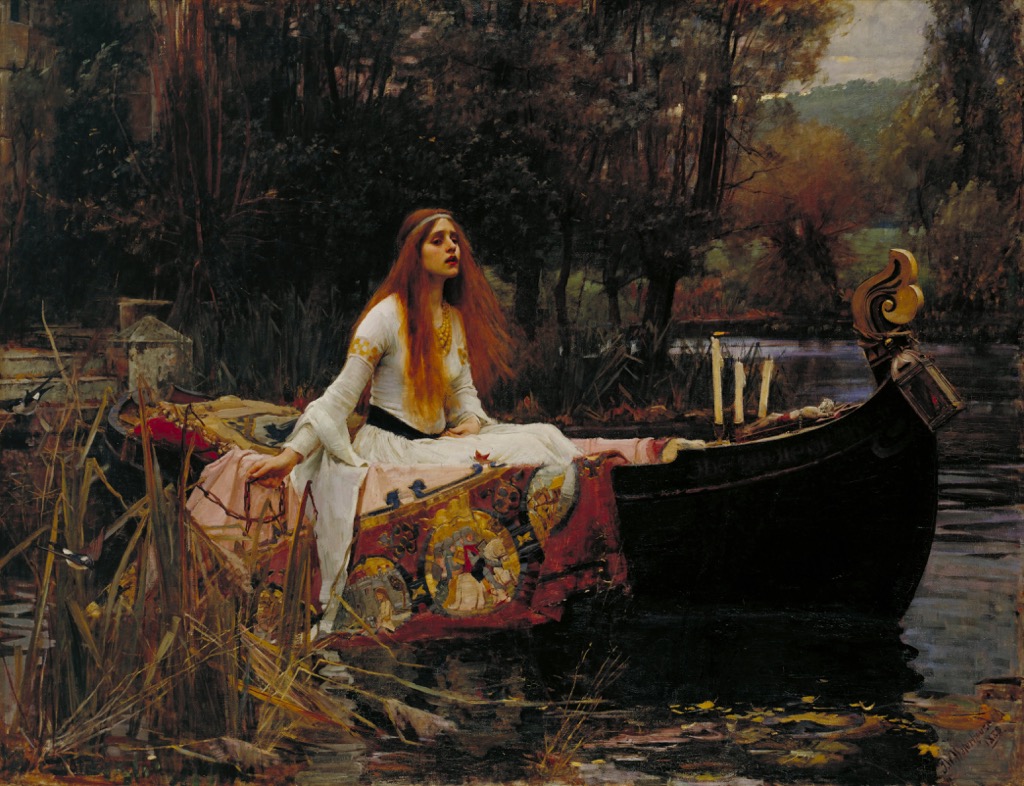
- The Lady of Shalott: Compare Waterhouse's best-known literary composition.
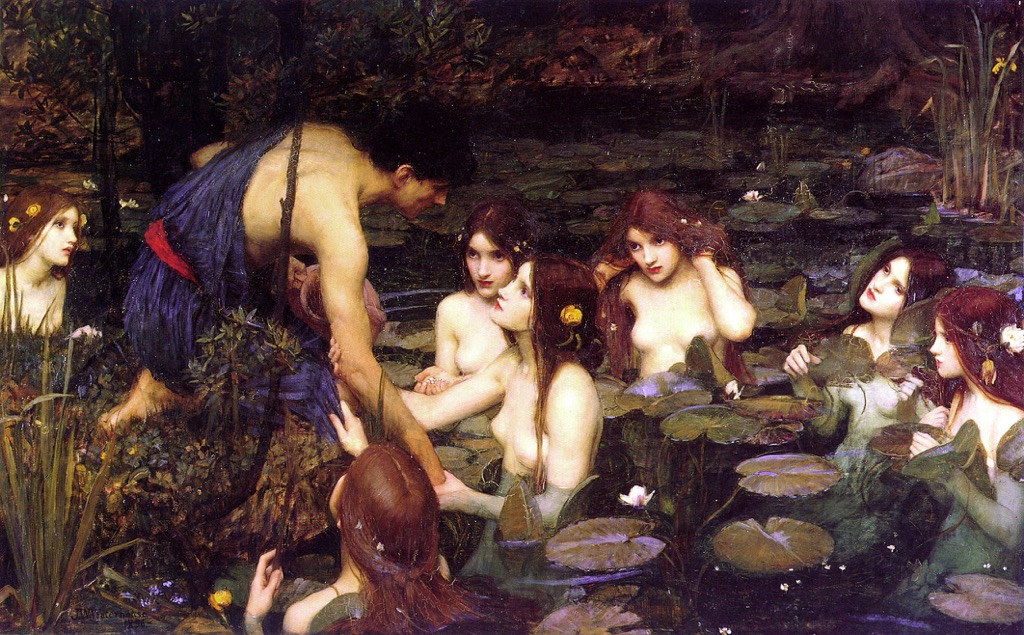
- Hylas and the Nymphs: Compare another major mythological scene.
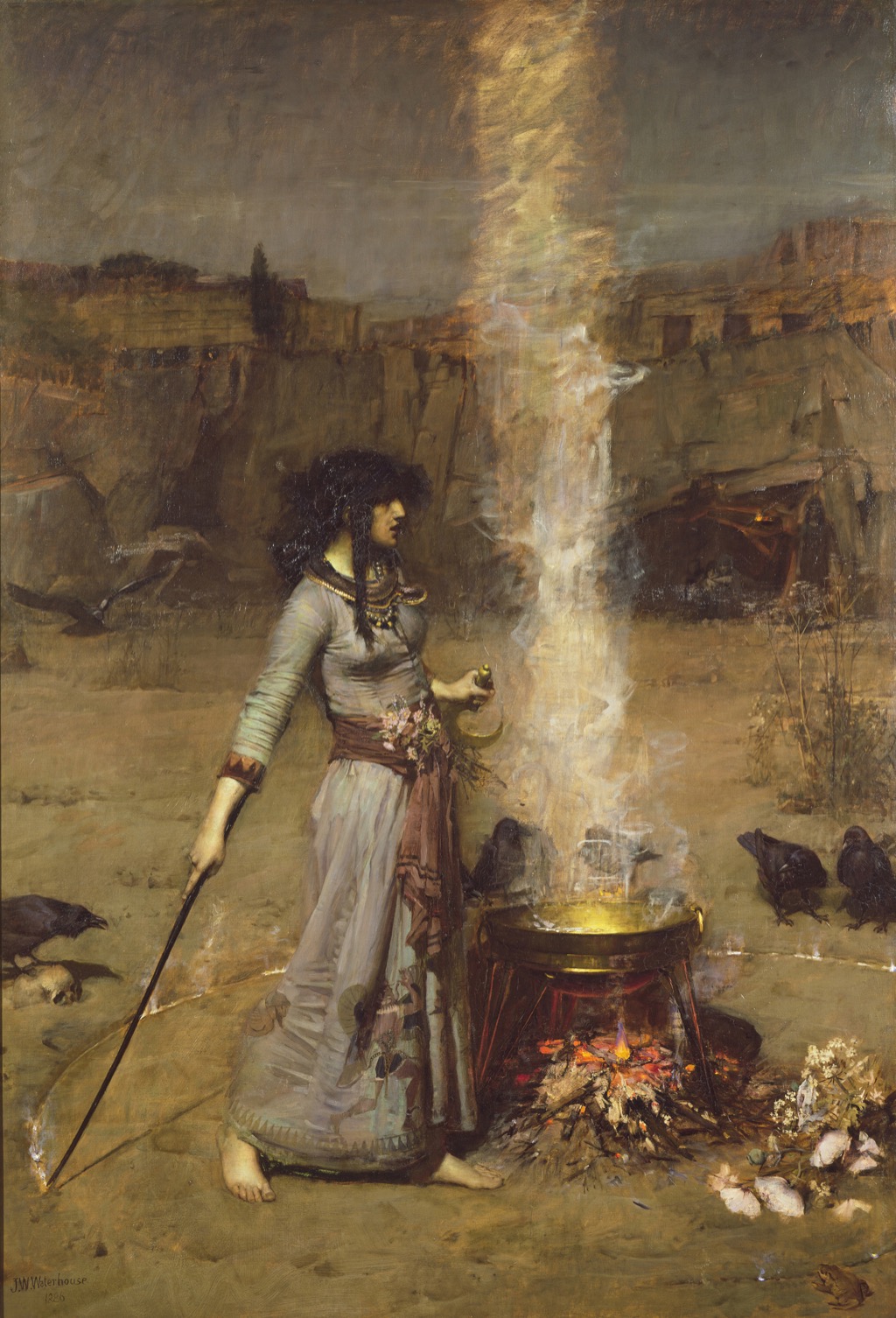
- The Magic Circle: Compare Waterhouse's treatment of ritual and symbolism.
Frequently Asked Questions
It belongs to the Laing Art Gallery in Newcastle upon Tyne. [1]
No. A Flower Stall is an alternate title for this work. [3] It should not be confused with A Flower Market, Old Rome of 1886.
No exact site is identified. Waterhouse created an imagined ancient setting from architecture, dress and objects familiar within Victorian classicism.
Yes. Sotheby's specifically places the painting within a group of domestic classical scenes shaped by Lawrence Alma-Tadema's influence. [2]
Women attend a flower stall: one appears to inspect or buy while others arrange, present or sell cut blooms.
Discussion
The flower market is an effective subject because it joins value and beauty. The flowers are cultivated, displayed and exchanged, while Waterhouse's painting performs a parallel act by arranging colour for exhibition and eventual collection.
Its imagined Greece gives ordinary commerce the distance of antiquity. Yet the seated customer, working vendors and pleasure of choosing would have remained fully legible to Victorian viewers.
Reader Insights
Which visible detail most changes the way you read this page?
Which source or comparison helps the work feel less familiar and more specific?
What question would you bring back to the painting after reading?
Join the Conversation
Share your reading of this page below.
References
- Art UK, “A Grecian Flower Market,” collection and image record, Laing Art Gallery. View source.
- Sotheby's, “John William Waterhouse: Offerings,” catalogue note discussing Waterhouse's Pompeian studies, Alma-Tadema's influence and the domestic classical sequence including A Grecian Flower Market. View source.
- Wikimedia Commons, “John William Waterhouse: A Grecian Flower Market,” recording the alternate title A Flower Stall. View source.
- FeelTheArt object record, “A Grecian Flower Market,” recording dimensions of 57.8 × 79.3 cm and the Laing location; artist name on the page is erroneous and not relied upon. View source.
- Laing Art Gallery, Paintings from the Laing Collection, collection catalogue, updated May 2019. View source.
- Google Arts & Culture, “John William Waterhouse: A Grecian Flower Market,” Laing Art Gallery object presentation. View source.