

 by Tom Gurney
Tom Gurney BSc (Hons) is an art history expert with over 20 years experience
Published on August 14, 2026 / Updated on August 14, 2026
Email: tomgurney1@gmail.com / Phone: +44 7429 011000
Head of a Girl I: Introduction
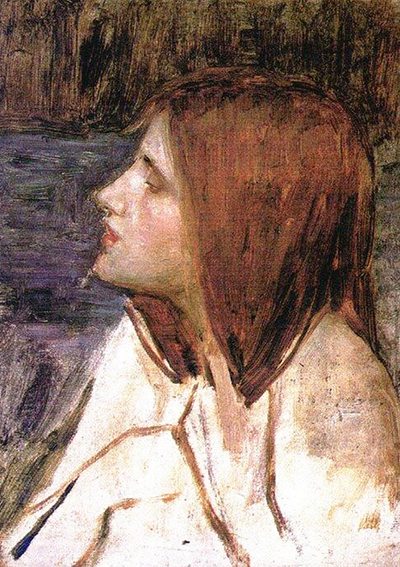
A red-haired young woman lifts a hand to her hair beside water, rocks and dense growth. John William Waterhouse’s Head of a Girl is a small oil study rather than a named portrait: the face is carefully established, while clothing, hand and setting remain freer. The contrast reveals how the artist built an expressive figure from concentrated observation and economical suggestion. [1]
The work is usually dated to about 1892–95 within a broader c.1892–1900 range. It has been connected with the development of A Mermaid and with Waterhouse’s recurrent red-haired model type, but the sitter has not been securely identified. [1] Calling the page Head of a Girl I distinguishes this study within the website’s group of similarly titled works; the qualifying numeral is an editorial identifier, not necessarily Waterhouse’s own title.
At a Glance
- ArtistJohn William Waterhouse (1849–1917)
- Recorded titleHead of a Girl [1]
- Website titleHead of a Girl I
- DateProbably c.1892–95; Christie’s gives an overall c.1892–1900 discussion [1]
- MediumOil on canvas board [1]
- Dimensions35.5 × 25.4 cm (14 × 10 in) [1]
- CollectionPrivate collection [1]
- SubjectUnnamed red-haired model holding or arranging her hair
- Related workConnected by scholarship with studies towards A Mermaid [1]
- StatusIndependent oil study, not a documented portrait of a named sitter
Contents
- Introduction
- A Study, Not a Portrait
- The Gesture of Holding Hair
- Face First: Hierarchy of Finish
- Water, Rocks and Shrubbery
- Relationship to A Mermaid
- The “Waterhouse Girl” and Model Identity
- Studio Labour and Artistic Evidence
- Provenance, Exhibitions and Changing Status
- From Observation to Ideal Type
A Study, Not a Portrait
Christie’s catalogues the work simply as Head of a Girl and describes its oil-on-canvas-board support and compact dimensions. [1] The title names neither sitter nor fictional character.
That absence is decisive. The image should not be converted into a portrait of Muriel Foster, Esther Waterhouse or another named woman merely because facial features resemble other works.
Portraiture aims to preserve an identified individual’s likeness. A studio head study can pursue expression, colour, pose and a reusable motif without recording the model’s public identity.
The two functions can overlap, but their historical records differ. Here provenance begins with Waterhouse’s estate, not the model’s family. [1]
The title’s “girl” belongs to period cataloguing language and gives only a broad age category. Modern prose can use “young woman” where appropriate without silently changing the artwork record.
The website’s numeral “I” is useful because Waterhouse produced more than one study circulating under similar titles. It must not be treated as an inscription or a documented sequence established by the artist.
The support reinforces the working character. Canvas board is portable and suited to a small, direct study, though support alone cannot prove whether the painting was made in one sitting.
Its scale draws the viewer close. At fourteen by ten inches, the work encourages attention to touch and transition rather than the distant spectacle of a Royal Academy canvas. [1]
Calling it a study does not make it unfinished in a dismissive sense. The painting may be complete for its purpose: to secure a head, gesture and atmosphere without resolving every secondary passage.
That purposeful inequality of finish is the work’s central subject.
The Gesture of Holding Hair
The model raises a hand towards her long red hair, gathering, separating or playing with it. [1] The action is small but visually productive.
Hair forms a line between head and hand. It makes the lifted arm necessary and turns an otherwise static bust into a moment of activity.
The exact purpose remains open. She may be arranging wet hair, lifting it from her shoulder or simply sustaining a pose invented by Waterhouse.
Because water appears nearby, viewers may imagine bathing or mermaid narrative. That association is supported by comparison with A Mermaid, but no independent story is named in this study. [1]
The gesture should therefore be described before it is decoded. Fingers approach strands; head and hand are linked; attention seems turned inward or aside.
Waterhouse repeatedly used hair as material and sign. Heroines comb it, let it fall, bind another person with it or display it as part of sensuous presence.
Here hair is also a compositional tool. Its warm colour stands against the cooler and darker environment.
The hand introduces vulnerability because fingers and joints are difficult to paint convincingly. In a study, Waterhouse can leave them less resolved while securing the overall relation.
This looser hand does not necessarily mean the picture was abandoned. It shows priority: face and neck carry identity and expression, while gesture can remain summarized.
The model’s absorption also limits narrative access. She does not obviously perform for the viewer, even though the pose was made for an artist.
The tension between private gesture and professional sitting gives the study much of its intimacy.
Face First: Hierarchy of Finish
Christie’s catalogue essay argues that Waterhouse established the face and neck first, then worked outward. [1] The visible hierarchy supports that reading.
Eyes, mouth, nose and flesh transitions receive concentrated attention because small errors would alter the entire effect.
Hair can remain broader, clothing still broader and landscape more suggestive. Each zone requires only the finish necessary to support the head.
This movement from centre to periphery resembles looking. Viewers focus on the face, register gesture and then absorb environment.
Waterhouse turns that natural hierarchy into a painterly one.
The white blouse provides a light base beneath the head. It separates neck and hair from the darker lower field without requiring elaborate costume.
Its relative simplicity also prevents historical period from becoming fixed. The study need not declare whether the final character will be ancient, medieval or contemporary.
Such flexibility made head studies useful across Waterhouse’s practice. A face observed in the studio could later enter a literary composition under transformed clothing and setting.
That possibility should not lead to the claim that this exact head was mechanically copied into every similar heroine. Waterhouse adjusted angle, expression, scale and colour.
The study preserves thought rather than a stencil.
Its unfinished-looking passages also reveal the artist’s confidence. A few placed marks can imply cloth or foliage because the central modelling establishes enough reality for the eye to complete the rest.
The result is both an image of a woman and an image of allocation: Waterhouse shows where attention was spent.
Water, Rocks and Shrubbery
The background includes the suggestion of water, rocks and vegetation. These elements place the head within an outdoor, watery environment rather than a neutral studio.
They may have been developed from separate observation or invented around the posed model. The public record does not establish a specific location.
Water introduces association without explicit narrative. It can suggest bathing, riverbank, pool, nymph or mermaid while remaining simply landscape.
Rocks create a firmer counterform. Their irregular mass can support the figure and divide water from shrubbery.
Vegetation softens the remaining field. Loose green and brown marks provide atmosphere rather than botanical identification.
This setting is more than filler. It changes the way the model’s hair is seen: warm strands appear organic within natural colour rather than decorative against a plain wall.
At the same time, the unfinished environment keeps attention concentrated. A fully described landscape might compete with the head.
The study therefore sits between studio exercise and narrative fragment. It contains enough world to provoke imagination but not enough to determine a story.
That open quality explains why it can be related to A Mermaid without being renamed as a definite mermaid study.
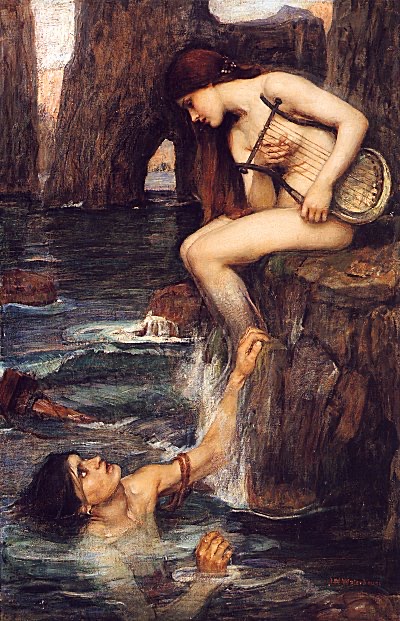
Waterhouse’s later large canvas creates a rock pool, long-haired nude figure, shell and distant sea. The small head offers only some of that vocabulary.
Difference is as important as resemblance. The blouse, compact crop and ambiguous water keep this work independent.
Relationship to A Mermaid
The Christie’s essay places the study within Waterhouse’s development of the red-haired woman holding her hair and connects it particularly with A Mermaid, his Royal Academy Diploma Work completed in 1900 after years of preparation. [1] [2]
The relationship is persuasive at the level of motif. Both works explore long red hair, inward concentration and a watery setting.
Chronology also supports development. A probable date around 1892–95 places the head during the long gestation of the larger mermaid subject. [1]
Yet “related to” is safer than “the definitive study for.” Waterhouse made several oil studies and varied his compositions.
Christie’s mentions a similar-sized companion sketch in which hands are more cursory. [1] This suggests repeated investigation rather than a single linear preparation.
The final A Mermaid differs in scale, nudity, full seated body, shell and developed coastal environment. Its meaning also depends upon the mythic identity established by title.
The head study retains contemporary clothing and no securely documented title beyond its descriptive one.
Viewers can therefore use the small work to understand process: Waterhouse rehearsed a relation between face, hair and hand before or alongside larger compositional decisions.
Process is rarely a straight staircase from rough idea to perfected final image. Motifs can migrate, be abandoned, return or generate independent saleable works.
The study’s later exhibition as an autonomous object confirms that modern audiences value it beyond preparatory function. [1]
Its intimacy may even make the act of hair handling more immediate than in the completed Diploma Work.
The “Waterhouse Girl” and Model Identity
Waterhouse’s recurring female type has often been called the “Waterhouse girl”: pale skin, abundant reddish hair, strong brows and an introspective or direct gaze. [1]
The phrase identifies stylistic continuity, but it can also erase the professional women whose bodies and faces made that continuity possible.
Models were not imaginary raw material. They travelled to studios, held poses and contributed physical endurance to the production of art.
Christie’s notes that attempts to identify this sitter through Muriel Foster have reached an impasse. [1] The responsible conclusion is not to choose another name by resemblance.
Waterhouse’s surviving sketchbooks contain some model names, but a name beside one drawing does not automatically identify every similar face across decades.
Artists can idealise different sitters towards a preferred type. They can also represent one sitter differently from work to work.
Facial matching from reproductions is especially weak evidence because angle, lighting, age and artistic adjustment alter appearance.
The model here should remain unnamed. That does not make her unimportant.
Anonymity is a condition of the surviving archive, not a statement that she lacked identity in life.
The manuscript can acknowledge her labour and distinguish it from Claire Kenworthy, Betty Pollock and Margaret Schreiber, whose portrait identities are independently documented.
That distinction is central to collection quality. Similar appearance cannot override provenance and title.
Studio Labour and Artistic Evidence
The study makes studio labour visible in several directions. The model sustains an awkward arm position; the painter makes rapid decisions; the small support allows experiment.
Holding hair may feel casual in life, but maintaining the gesture across a sitting would produce strain. Waterhouse may have asked for pauses or reconstructed the hand from shorter observations.
No studio record proves the exact sequence. The bodily demand is an inference from the pose, not a diary of the session.
The painter’s labour appears in varied finish. Concentrated facial modelling requires repeated comparison, while broader marks in foliage can be placed more swiftly.
Canvas board also responds differently from stretched canvas. Its firm support can encourage direct touch, though technical examination would be needed to describe ground and layering precisely.
The work’s edges preserve decisions that a large finished painting might smooth away. Changes in pressure and opacity become part of its appeal.
Study and model are therefore parallel forms of evidence. The surface records Waterhouse’s priorities; the pose records another person’s participation.
Neither offers full biography. Paint cannot tell us the model’s name, wages or thoughts.
This limitation should sharpen rather than end inquiry. It encourages questions about why some sitters were named in account books or portraits and others survived only under generic titles.
Victorian modelling occupied an unstable social position, increasingly professional yet still exposed to moral suspicion. [1]
Acknowledging that history prevents the intimate image from appearing effortlessly available.
Provenance, Exhibitions and Changing Status
The work remained in Waterhouse’s estate and appeared in his studio sale at Christie’s in 1926 as lot 67. It sold for two guineas to the dealer and critic David Croal Thomson. [1]
That first recorded market event occurred nine years after the artist’s death. The study entered circulation as part of the material left in his studio rather than through a public exhibition in his lifetime.
It later belonged to the Pre-Raphaelite Trust and appeared at Sotheby’s in 1977 and 1999 before passing through Kelley Gallery. [1]
These transfers reflect growing interest in Waterhouse and associated Victorian art. A small study once sold inexpensively could become a researched and internationally exhibited object.
Exhibitions included Sheffield and Wolverhampton in 1978–79, the major Waterhouse retrospective beginning at the Groninger Museum in 2008, the Royal Academy in 2009 and Montreal in 2009–10. [1]
That history changes the work’s public status. It moved from studio remnant to evidence within a scholarly reconstruction of Waterhouse’s practice.
The Royal Academy display is particularly resonant because Waterhouse had been a Royal Academician, yet the study’s Academy visibility came long after his lifetime.
Modern cataloguing supplies the approximate date and relationship to other works that the generic title alone cannot convey.
Provenance also guards against confusion. Similar heads may share titles, but measurements, support and sale history identify this physical object.
The page’s “I” must always remain subordinate to those concrete facts. It is a navigation device, not provenance.
Private ownership continues to limit routine access, making the well-documented Christie’s record especially important. [1]
From Observation to Ideal Type
The face feels individual because Waterhouse observed a living model. It also resembles a recurring ideal because he selected features and colouring that suited his art.
These truths are not contradictory. Academic figure painting often moved between particular body and general type.
If idealisation becomes too dominant in interpretation, the model disappears. If likeness is assumed to be photographic, the artist’s transformations disappear.
The study holds both in productive tension.
Its title refuses literary specificity, allowing viewers to watch the mechanism before a character name settles over it.
Hair can become mermaid hair in one canvas, enchanted binding in another or simply hair being arranged here.
The same gesture changes according to title and context. That mobility was one source of Waterhouse’s creative economy.
It was also dependent upon studio collaboration. A model supplied the physical possibilities from which he built repeated visual language.
The painting thus belongs in both a technique narrative and a models-and-sitters narrative.
It should not be used as proof that one woman posed for all related works. Its value lies precisely in showing how type can emerge without secure identity.
The anonymous title is not a puzzle that must be solved at any cost. It is an honest record of what the archive currently permits us to know.
Why the Small Scale Matters
The study’s physical size changes the encounter. [1] A head close to life size on a monumental canvas can command a gallery wall; this one asks the viewer to approach.
At close range, abbreviated passages become legible as decisions rather than deficiencies. A mark can be simultaneously a streak of paint and a leaf, fold or reflected edge.
The compact board also compresses the relationship between figure and landscape. Water, stone and vegetation do not extend into a broad world; they gather tightly around the head.
That compression creates psychological intensity without supplying a definite emotion. The model seems enclosed in an environment made from the same quick material touch as her clothing and hair.
Scale may also have supported experimentation. Waterhouse could investigate colour and pose without the time and expense of committing immediately to a large exhibition canvas.
Yet small studies were not necessarily private in perpetuity. This work entered sale, collection and major retrospective display, where audiences learned to value process alongside finished spectacle. [1]
Its modern prominence reflects a broader shift in taste. Visible handling and incomplete resolution can now seem more immediate than polished academic surfaces once preferred.
That response should still be historical. We cannot assume Waterhouse intended the board to make a modernist statement or believed every passage ready for exhibition.
The safest conclusion is functional and visual: small scale enabled concentration. Face and gesture occupy nearly the entire imaginative field, while landscape survives as the minimum world they require.
Related Pages
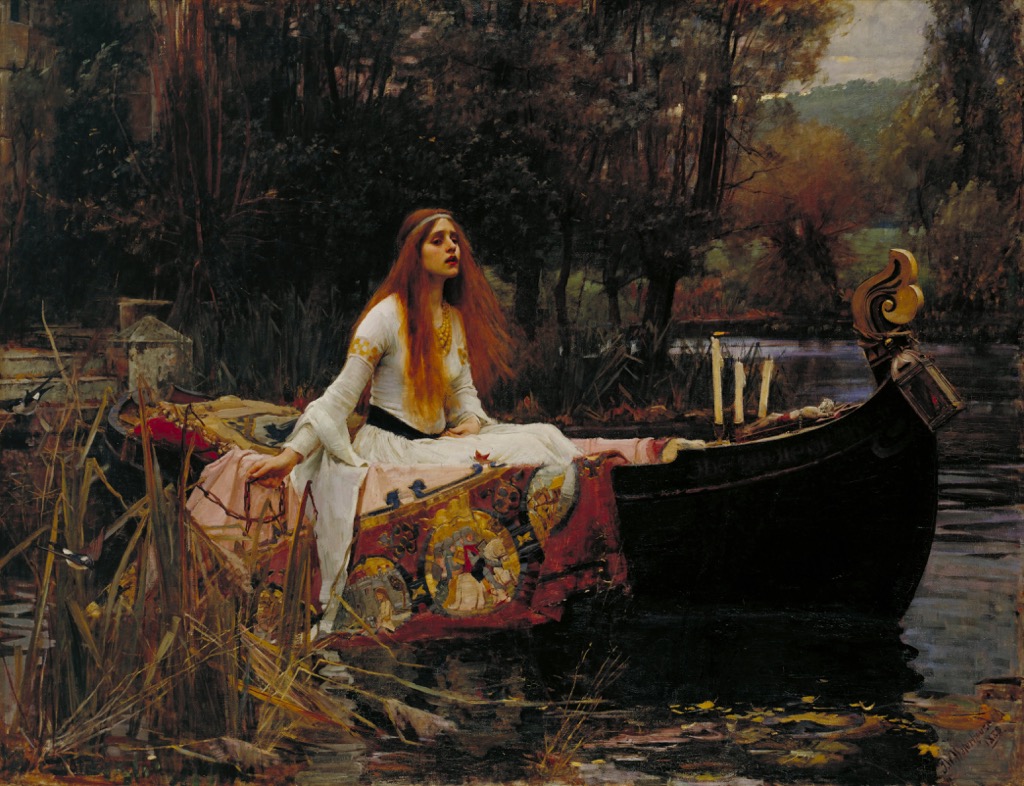
- The Lady of Shalott: Compare Waterhouse's best-known literary composition.
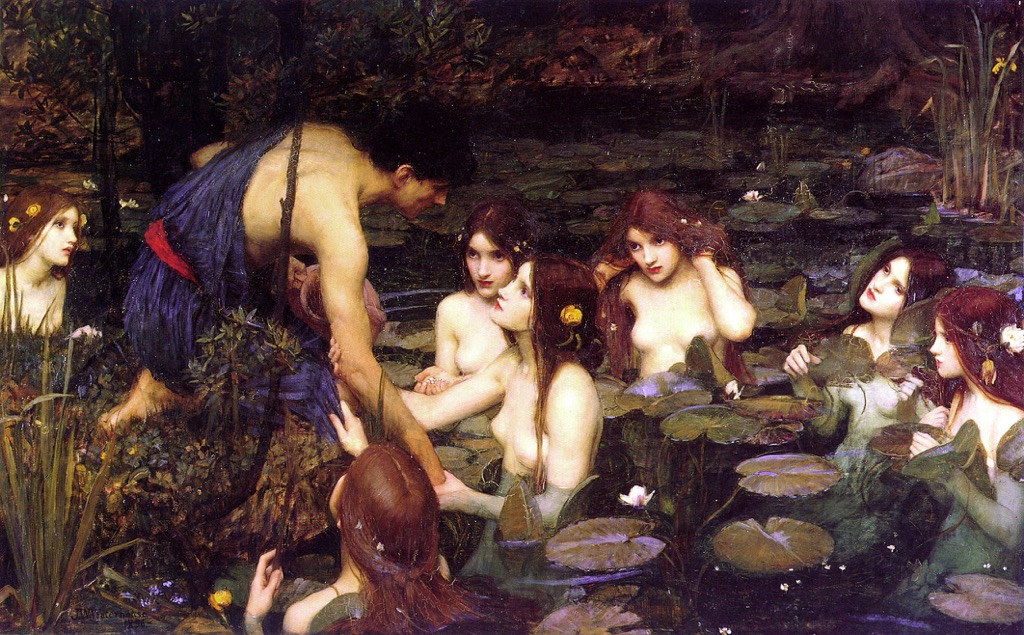
- Hylas and the Nymphs: Compare another major mythological scene.
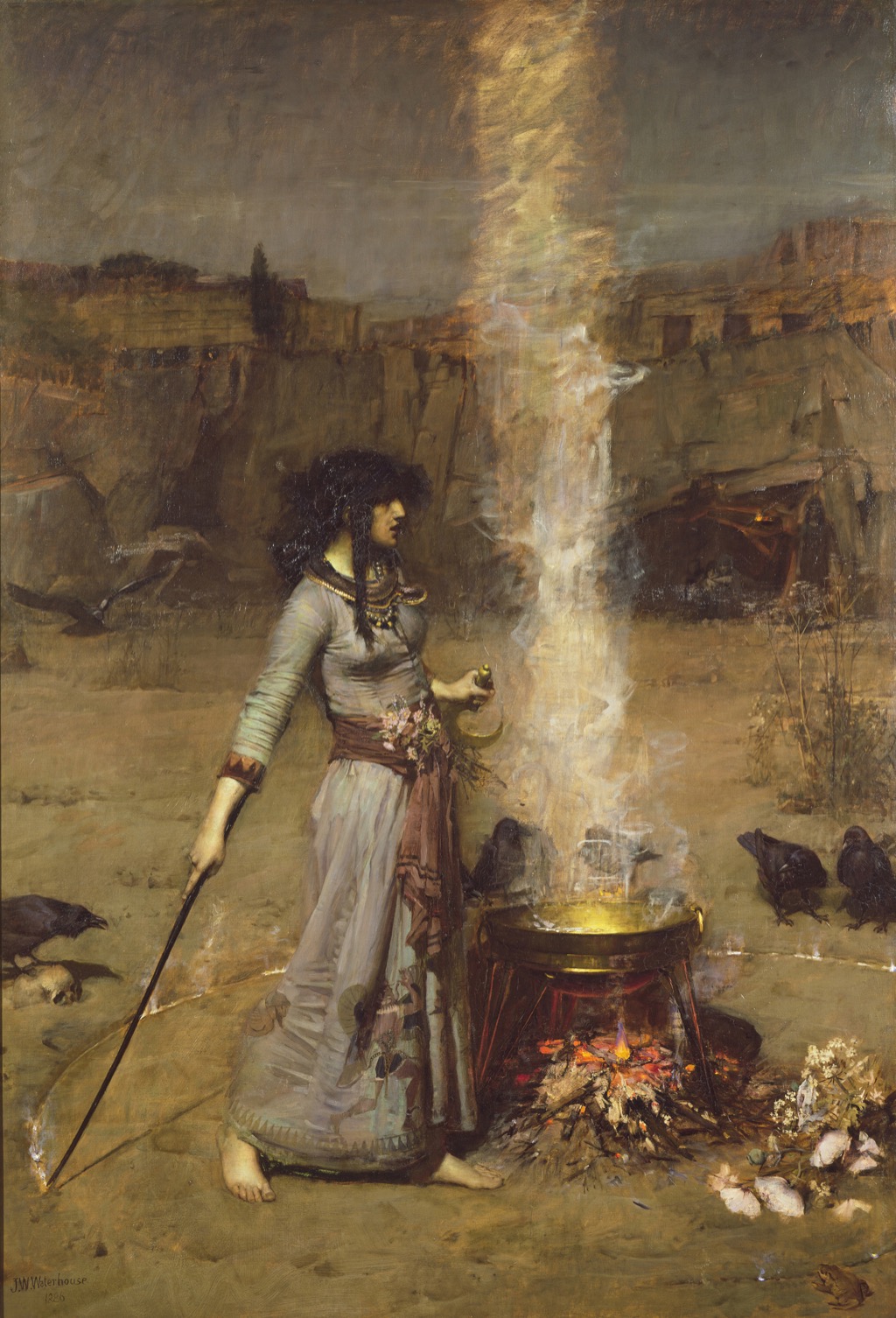
- The Magic Circle: Compare Waterhouse's treatment of ritual and symbolism.
Frequently Asked Questions
It is best described as an oil head study of an unnamed model, not a documented commissioned portrait. [1]
Probably around 1892–95, within a broader proposed range extending to about 1900. [1]
35.5 × 25.4 cm, painted in oil on canvas board. [1]
The motif relates to studies for A Mermaid, but this work’s documented title does not identify the clothed model as a mermaid. [1] [2]
No secure identification has been established. Muriel Foster has been investigated but not proven. [1]
The numeral distinguishes it from another similarly titled work. It is an editorial label rather than a known Waterhouse title.
Discussion
Head of a Girl I is strongest when neither promoted into a finished narrative nor dismissed as preliminary debris. Waterhouse resolves what matters most—the face, neck and relation between hair and hand—while allowing blouse and landscape to remain open.
Its connection with A Mermaid reveals a motif under development, but its independence matters equally. The clothed young woman occupies her own ambiguous watery setting, free from a definitive literary identity.
Reader Insights
Which visible detail most changes the way you read this page?
Which source or comparison helps the work feel less familiar and more specific?
What question would you bring back to the painting after reading?
Join the Conversation
Share your reading of this page below.
References
- Christie’s, “John William Waterhouse, R.A., R.I. (1849–1917), Head of a Girl,” lot record and catalogue essay, including support, dimensions, dating, model discussion, provenance and exhibitions. View source.
- Royal Academy of Arts, “A Mermaid,” collection record for Waterhouse’s Diploma Work. View source.