

 by Tom Gurney
Tom Gurney BSc (Hons) is an art history expert with over 20 years experience
Published on August 14, 2026 / Updated on August 14, 2026
Email: tomgurney1@gmail.com / Phone: +44 7429 011000
Miss Betty Pollock: Introduction
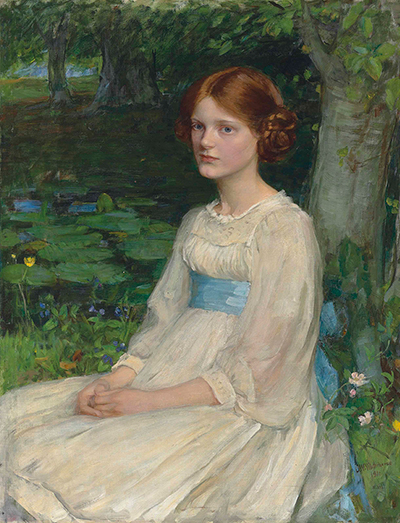
John William Waterhouse painted Elizabeth “Betty” Pollock in 1911, when she was fourteen. Seated in a white dress with a pale blue sash before water and lilies, she occupies the meeting point between commissioned portraiture and the poetic natural settings of Waterhouse’s late subject paintings. The work was exhibited at the Royal Academy in 1912 under her own name. [1]
Betty did not remain only the adolescent preserved on the canvas. She became a successful stage mimic and actress, admired in the interwar theatre. [1] That later history makes the portrait especially revealing: Waterhouse records a young sitter before a public performing identity had fully emerged, while the controlled pose already demonstrates how every portrait is itself a form of presentation.
At a Glance
- ArtistJohn William Waterhouse (1849–1917)
- TitleMiss Betty Pollock [1]
- Date1911, signed and dated lower right [1]
- MediumOil on canvas [1]
- Dimensions91.5 × 72 cm (36 × 28¼ in) [1]
- CollectionPrivate collection [1]
- SitterElizabeth “Betty” Pollock (1898–1970) [1]
- Age of sitterFourteen when painted [1]
- Royal AcademyExhibited 1912, no. 185 [1] [2]
- Later careerStage mimic and actress [1]
Contents
- Introduction
- Betty Pollock at Fourteen
- A Commissioned Portrait
- White Dress and Blue Sash
- Lily Pond: Setting or Invention?
- Pose, Gaze and Performance
- Royal Academy Exhibition in 1912
- Betty Pollock’s Later Stage Career
- Provenance and Family Memory
- Portrait and Character Study
Betty Pollock at Fourteen
Elizabeth Pollock was born in 1898, the daughter of Sir Adrian Pollock. Waterhouse painted her at the age of fourteen, and the canvas bears his signature and the date 1911. [1]
Age matters because reproductions can make the sitter appear older. Formal dress, scale and composed expression belong to portrait convention; they should not be used to turn an adolescent into an adult romantic heroine.
Christie’s records the familiar name “Betty,” the form under which her later stage career became known. [1] The title’s “Miss” marks contemporary social usage, but the personal name keeps the image from anonymity.
Betty’s father owned the portrait and lent it to exhibitions. This family connection provides a strong chain between sitter, title and object. [1]
The painting therefore differs from Waterhouse’s many unnamed head studies. We know who sat, approximately how old she was and what she later did.
That knowledge changes interpretation, but it should not make the portrait a prophecy. Waterhouse was not knowingly painting all of Betty’s future stage performances into her face.
He was representing a fourteen-year-old within the expectations of her family, his studio practice and Royal Academy portraiture.
The later actress and the adolescent sitter are one person at different moments. Good biography connects them without collapsing time.
It is also useful to retain her complete lifespan, 1898–1970. [1] The portrait captures one year within a life of more than seven decades.
The fixed youthful appearance can otherwise dominate memory, making the painted Betty seem more “real” than the adult professional woman who followed.
A Commissioned Portrait
The Pollock canvas was a portrait commission rather than an independently invented literary subject. Sir Adrian Pollock’s ownership and loans confirm its family function. [1]
Commission does not mean that every choice was dictated by the patron. Waterhouse selected pose, light, background, handling and the relation between sitter and setting.
The family required likeness; the artist also produced a work capable of public exhibition.
That dual purpose helps explain the painting’s balance. Betty is recognisable and socially presented, yet lilies and water connect her to Waterhouse’s distinctive imaginative world.
Christie’s suggests that Waterhouse may have met the Pollock family through the actor-manager Gerald du Maurier. [1] The proposal is plausible within Betty’s theatrical connections, though “may have” should remain visible.
Networks mattered to portrait practice. Introductions built confidence before a family entrusted an artist with the representation of a child.
The commission also gave Waterhouse an opportunity to work at a substantial size. At more than ninety centimetres high, the canvas carries bodily presence while remaining short of a full-length society portrait. [1]
Its vertical format allows seated figure, dress and landscape-like background to coexist. Betty fills much of the field without becoming detached from her surroundings.
Unlike a family snapshot, the portrait would have required sustained sittings and later studio work. Its apparent moment is carefully assembled.
Betty contributes to that assembly. Sitting still, wearing selected clothes and sustaining an expression are forms of labour, even when performed within privilege.
The finished picture is therefore both commissioned object and collaboration, though Waterhouse retained formal control.
White Dress and Blue Sash
Betty’s white dress creates the portrait’s largest light area. A pale blue sash crosses or gathers it, introducing colour without overwhelming the youthful ensemble. [1]
The combination can suggest freshness and formality, but no specific ceremony is documented. It should not be called a bridal or confirmation costume.
White oil paint requires modelling. Cool shadows, warmer reflected light and varied edges allow cloth to describe the seated body.
The sash performs several compositional tasks. Its blue interrupts the white mass, marks the waist and forms a chromatic bridge towards water and foliage.
Fabric also establishes social presentation. The dress is not working clothing; it belongs to the controlled appearance expected in a commissioned portrait.
At fourteen, Betty stands at a difficult boundary for representation. Clothing may emphasise youth while the formal scale gives her seriousness.
Waterhouse avoids turning the portrait into a childish genre scene. No toy, schoolbook or pet is needed to state her age.
Nor does he present her as an adult society hostess. The pale ensemble preserves an age-appropriate lightness within the established portrait format.
Exact shades can vary in reproductions. The important relation is tonal and structural: bright dress against darker natural surroundings, with the sash mediating between them.
The dress attracts the eye first, but the face must retain attention. Waterhouse controls that competition through flesh tone, modelling and the direction of Betty’s gaze.
Costume therefore supports identity without replacing it. We remember the white and blue, but the work remains Miss Betty Pollock.
Lily Pond: Setting or Invention?
Behind Betty appears a garden or water setting with lily pads. Christie’s notes that the landscape may have been real or imagined; the available record does not settle the question. [1]
That uncertainty is productive. Waterhouse could study natural forms, use an existing garden and reorganise it, or create a studio synthesis from remembered motifs.
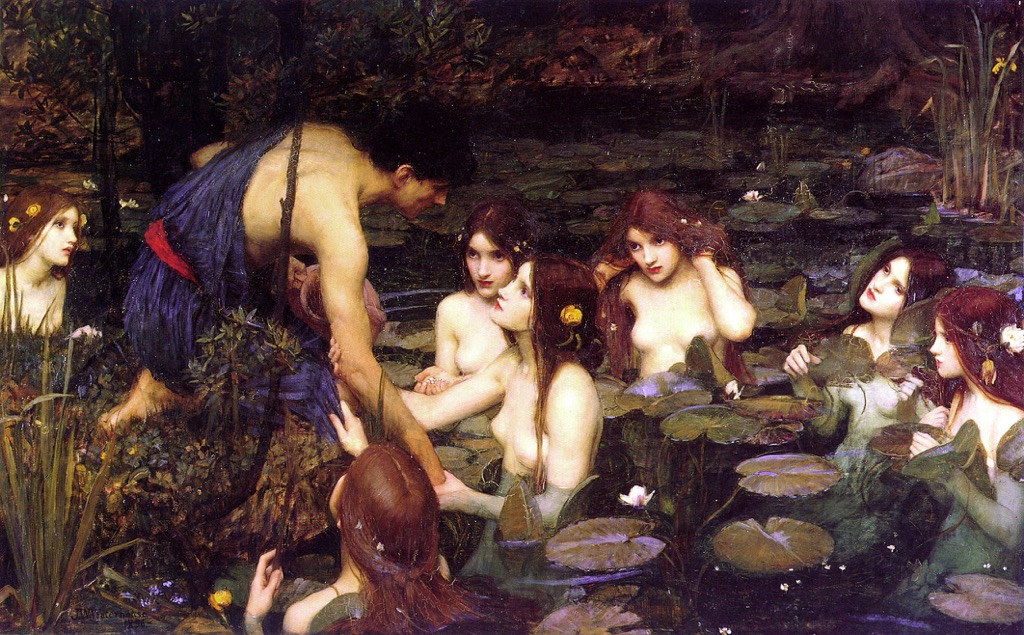
The background links the portrait to some of his best-known paintings. Water lilies are central to Hylas and the Nymphs, and a watery edge appears in several Ophelia compositions. [1]
Those echoes do not turn Betty into a nymph or Shakespearean heroine. Visual vocabulary can travel between genres without importing narrative identity.
The pond softens the formal commission. Instead of sitting before curtain, column or plain studio darkness, Betty occupies a natural enclosure.
Water introduces horizontal calm and reflected light. Lily pads break its surface into small organic shapes.
The setting can also communicate cultivated leisure. A lily pond belongs more readily to a managed garden than untouched wilderness.
If it represents a real property, the location has not been securely named in the public catalogue. If imagined, it still derives credibility from Waterhouse’s close study of plants and water.
The distinction between real and invented should remain open rather than resolved through confidence of tone.
What matters visually is that the setting surrounds Betty without becoming an independent landscape. Its greens and darks increase the luminosity of her dress.
The pond makes the portrait distinctly Waterhouse while leaving the sitter historically herself.
Pose, Gaze and Performance
Betty sits rather than acts. Her body is arranged for stillness, and her expression meets the demands of a formal likeness.
Yet every portrait involves performance. A sitter offers a version of self for the painter, and the painter selects what the image will repeat.
This fact becomes especially resonant because Betty later worked on stage. She became known as a mimic, a performer whose art depended upon observing and transforming voice, gesture and manner. [1]
It would be tempting to discover that talent already visible in the portrait. Such hindsight should be resisted.
A composed gaze does not prove theatrical ambition, and Waterhouse’s pose was part of his design.
Still, the later career helps modern viewers notice presentation as an active skill. Betty was not a mute piece of studio material.
At fourteen she could respond to direction, adjust posture and participate in the social exchange of sitting.
The gaze also regulates the viewer’s access. If direct, it asserts presence; if slightly averted, it creates distance. Either effect is constructed rather than a transparent measure of personality.
Waterhouse often painted fictional women absorbed by an object or threatened from outside the frame. Betty’s portrait contains no comparable event.
Her attention is enough. The image’s tension arises from the meeting between adolescent subject and formal public form.
Later audiences know more about her future than the 1912 Royal Academy visitor did. That asymmetry makes the portrait a remarkable temporal object: a beginning viewed from beyond the completed life.
Royal Academy Exhibition in 1912
The portrait appeared in the 1912 Royal Academy exhibition as catalogue number 185. [1] [2] Public display moved it temporarily beyond the Pollock household.
Royal Academy visitors encountered the work among hundreds of paintings, not within today’s focused Waterhouse catalogue.
Its title offered an individual identity but assumed that many viewers would not know the sitter personally. The picture therefore had to communicate as painting as well as likeness.
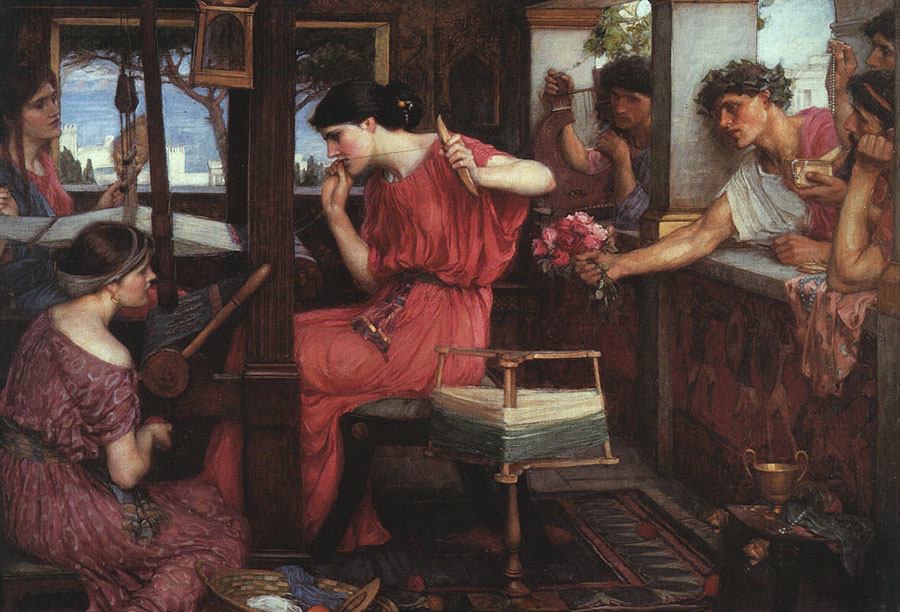
That year Waterhouse also showed Penelope and the Suitors, a major literary composition. [1] [2] The pairing demonstrates the breadth of his active practice.
Penelope is surrounded by narrative objects and unwanted men. Betty is a contemporary adolescent, isolated within a portrait setting.
Placed in the same exhibition, the works may have encouraged comparison between Waterhouse’s fictional and living women.
They also challenge the idea that portraiture was peripheral. Waterhouse selected or accepted the Pollock work for the most visible annual exhibition in British art.
Later in 1912 it appeared at the Liverpool Academy Autumn Exhibition as number 956, lent by Sir Adrian Pollock. [1]
The loan record confirms continued family ownership and extends the portrait’s public life beyond London.
Exhibition does not tell us how critics or viewers responded unless reviews are located. The manuscript should not invent acclaim.
What the catalogue history proves is that Betty’s likeness functioned publicly in two cities during the year after it was painted.
Betty Pollock’s Later Stage Career
Betty Pollock became a successful stage mimic and actress. Christie’s records praise from Noël Coward and Ivor Novello and cites an obituary describing her as one of the most subtly gifted mimics on the London stage during the 1930s. [1]
Mimicry was more than simple impersonation. It required acute observation of rhythm, gesture, voice and social manner, then the ability to condense those traits for an audience.
That professional skill offers an intriguing counterpoint to portraiture. Waterhouse observed Betty; Betty later built a career through observing others.
Both practices turn a living person into a repeatable representation, but their means differ. Oil fixes appearance on canvas; performance recreates manner in time.
The portrait cannot tell us how her voice sounded or how she moved before an audience. Her stage work could not preserve itself as continuously as paint.
As a result, the adolescent image may now be more readily accessible than many mature performances. This imbalance is common in theatre history.
Betty lived until 1970. [1] Her career unfolded through a century transformed by war, broadcasting and changing entertainment.
The 1911 canvas predates all of that. It belongs to Edwardian culture while its sitter would participate in modern mass performance.
Her later success should therefore be included not as decorative celebrity anecdote but as restoration of agency and duration.
She was not only “Waterhouse’s model.” She became a professional interpreter of character in her own right.
The portrait’s title preserves her name; biography allows that name to continue beyond the frame.
Provenance and Family Memory
The portrait passed from Betty’s father, Sir Adrian Pollock, by descent through the family. [1] This history supports both identification and original ownership.
Sir Adrian also lent it to the Royal Academy and Liverpool Academy exhibitions in 1912. [1] The lender information places the picture securely within the family immediately after completion.
By-descent provenance can compress several generations, but it indicates continuity that anonymous studio works often lack.
Family possession may preserve a sitter’s name even when detailed commission correspondence disappears. It can also keep a major painting out of public view for long periods.
The Christie’s record brings together signature, size, exhibitions, provenance and biography. [1] Auction catalogues are commercial documents, yet well-researched entries can preserve crucial evidence.
Their claims still require evaluation. The documented signature and catalogue numbers are stronger than a speculative account of how Waterhouse met the family.
Current private ownership means that public access remains intermittent. Reproductions become important, but they cannot replace examination of scale, surface and colour.
No museum accession should be attached to the painting. Its 1912 exhibition history is public; its present domestic or private location is not.
Price history is not needed to explain its art-historical value. The sitter’s identity, Waterhouse’s handling and the bridge between portrait and natural setting are more durable subjects.
Provenance here is not merely a chain of possession. It is the reason Betty remains Betty rather than another unnamed girl beside water lilies.
Portrait and Character Study
The painting can be approached as a likeness and as a study in controlled character. Those categories overlap but should not be confused.
Likeness refers to Betty’s individual features. Character emerges through pose, dress, setting and the associations Waterhouse builds around her.
The lily pond may make the image feel poetic, yet it does not supply a fictional role. White dress and blue sash may communicate youth and refinement, yet they are still clothes selected for an actual sitter.
This balance separates the work from a “fancy picture,” in which a model appears under a suggestive title without personal identification.
It also separates Betty from Waterhouse’s portraits of adult women. Age changes the responsibilities of description. Adolescent composure should not be sexualised through the language routinely applied to mythological enchantresses.
Waterhouse’s famous beauty type can obscure this difference. Similarities in colouring or face shape do not make all his subjects interchangeable.
Betty’s documented age, name and later profession provide checks against generic interpretation.
The picture’s poetic qualities remain real. Natural setting, restrained colour and the still surface of water create mood.
But mood belongs to the painting, not automatically to Betty’s psychology. The distinction allows viewers to enjoy atmosphere without claiming to know how she felt.
This is the portrait’s finest tension: it is recognisably Waterhouse and unmistakably devoted to a person who continued beyond his image.
Looking Across the 1912 Exhibition
The Royal Academy pairing with Penelope and the Suitors deserves one further distinction. Both canvases centre a woman and make textiles visually important, but the cloth performs opposite functions. [1] [2]
Penelope’s loom belongs to strategy. In Homer’s story she prolongs weaving and secretly undoes it to delay remarriage. The textile is an instrument of resistance within an unwanted courtship.
Betty’s white dress and blue sash belong to presentation. They frame the sitter’s youthful appearance and help integrate her body with the portrait’s colour scheme.
Treating both simply as examples of Waterhouse’s decorative femininity would lose those differences. One woman is a fictional adult acting under pressure; the other is a documented fourteen-year-old participating in a family commission.
Their settings differ as well. Penelope’s architectural interior is crowded by suitors and gifts. Betty’s pond offers space and removes other figures.
The comparison reveals how Waterhouse could use beauty without assigning it one meaning. Pale fabric can participate in narrative conflict or formal likeness; flowers can suggest Homeric courtship or remain garden forms around a contemporary sitter.
Royal Academy visitors might have encountered the paintings far apart on crowded walls, and no evidence proves that Waterhouse intended a dialogue. The common exhibition year nevertheless provides a historically grounded comparison.
It also protects Betty’s portrait from being treated as a minor diversion. In the studio season that produced one of his most elaborate late narratives, Waterhouse gave equal professional attention to the exacting problem of a living adolescent’s likeness.
Age, Memory and Reproduction
Portraits of young people can acquire a special cultural power because the depicted age never changes. Viewers meet Betty at fourteen even when reading an obituary written after a long career.
Family members would have experienced the painting differently as she grew older. It became a record of resemblance across time, not only a current likeness.
Digital circulation extends that effect. The painted adolescent may be encountered more often than photographs of the adult performer, making Waterhouse’s selection disproportionately influential.
Biographical writing can correct the imbalance. Dates, stage career and professional reputation remind readers that the canvas is an early chapter rather than a complete identity. [1]
This temporal awareness also moderates description. The portrait can be admired for grace, colour and atmosphere without turning youth into permanent essence.
Betty’s life moved; the paint did not. The lasting value of the work lies partly in the tension between those facts.
Related Pages
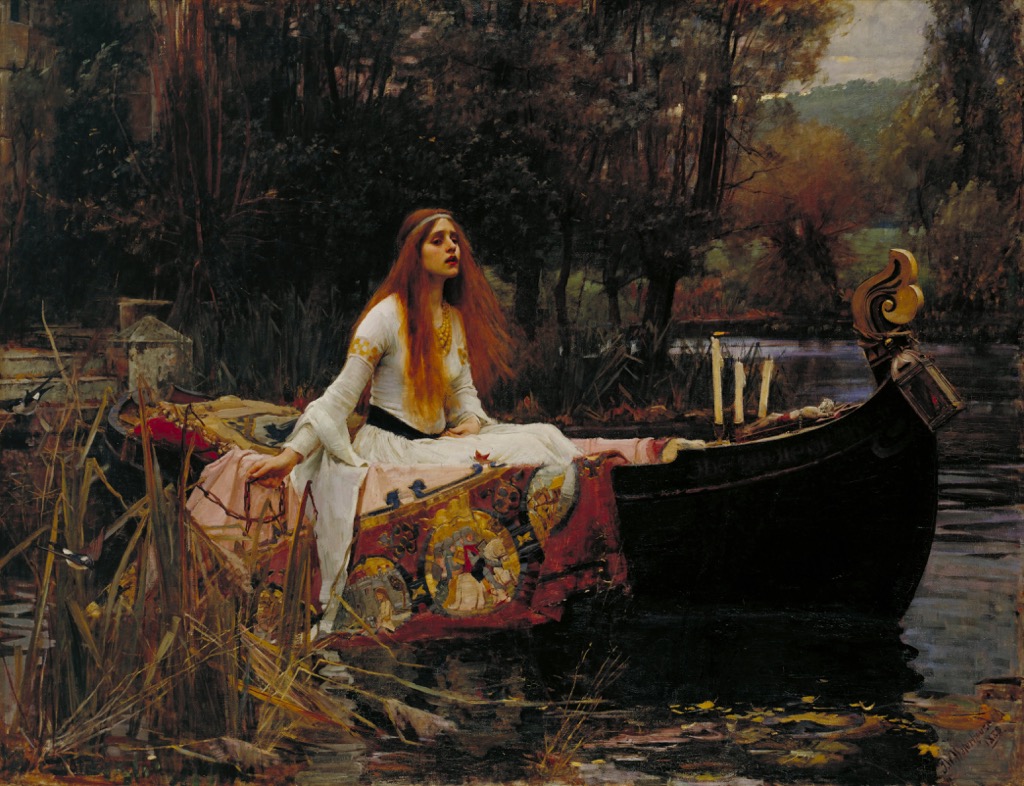
- The Lady of Shalott: Compare Waterhouse's best-known literary composition.
- Hylas and the Nymphs: Compare another major mythological scene.
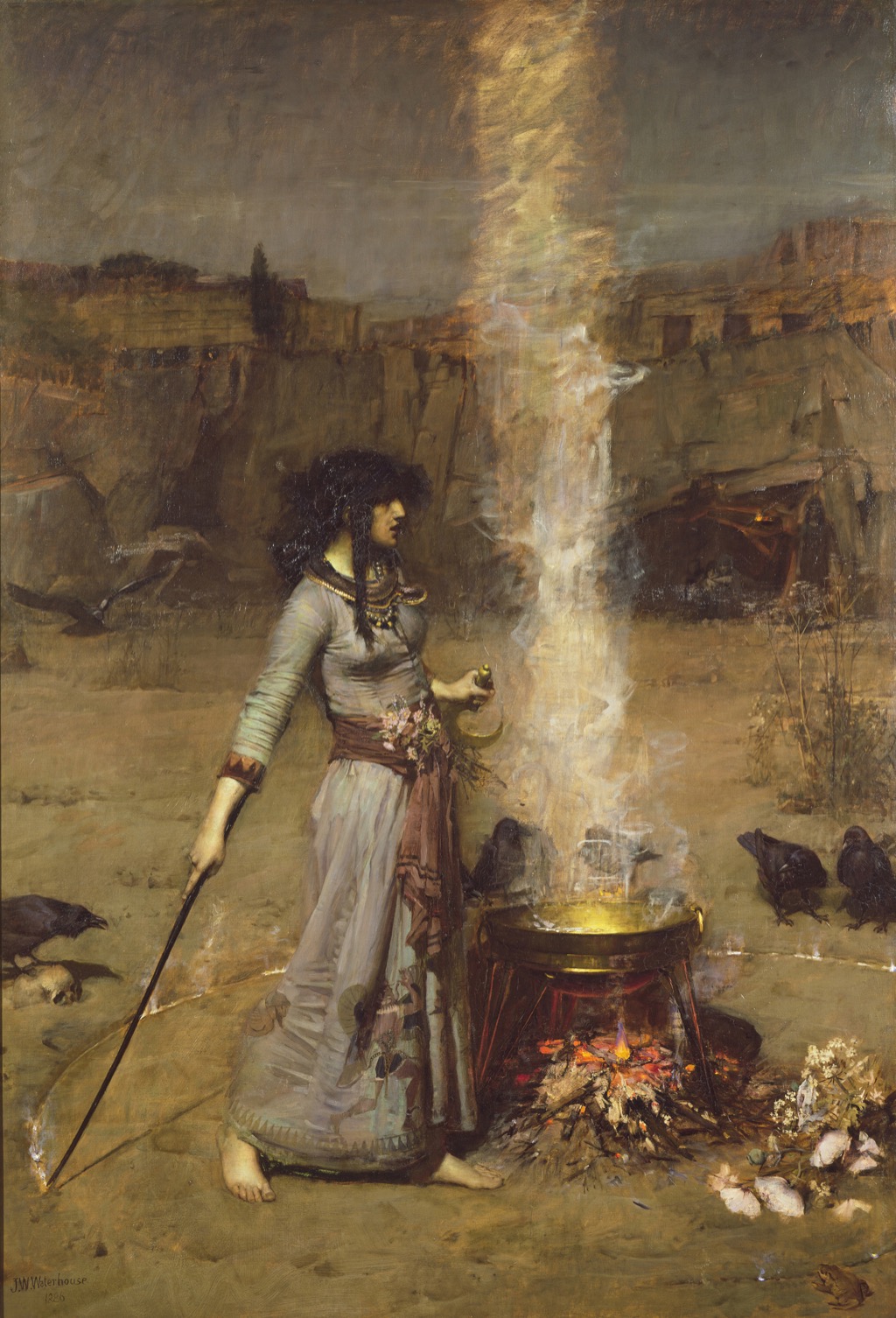
- The Magic Circle: Compare Waterhouse's treatment of ritual and symbolism.
Frequently Asked Questions
Elizabeth “Betty” Pollock (1898–1970) was the daughter of Sir Adrian Pollock. She later became a successful stage mimic and actress. [1]
She was fourteen when Waterhouse painted her in 1911. [1]
Oil on canvas, 91.5 × 72 cm. [1]
It may have been real or imagined; the published record does not establish a specific location. [1]
At the Royal Academy in 1912, catalogue number 185; it also appeared at the Liverpool Academy that autumn. [1] [2]
The painting is in a private collection. [1]
Discussion
Miss Betty Pollock is unusually rich in documented intersections. It is a family commission and a Royal Academy exhibit, an adolescent portrait and an image of a future performer, a recognisable likeness and a distinctly Waterhouse arrangement of pale figure, water and lilies.
The strongest interpretation keeps those identities in balance. Betty should not become Ophelia merely because she sits by water, nor should her later theatrical fame be read prophetically into her fourteen-year-old expression. The natural background belongs to Waterhouse’s poetic vocabulary; the name, age and subsequent career belong to Betty’s history.
Reader Insights
Which visible detail most changes the way you read this page?
Which source or comparison helps the work feel less familiar and more specific?
What question would you bring back to the painting after reading?
Join the Conversation
Share your reading of this page below.
References
- Christie’s, “John William Waterhouse, R.A., R.I. (1849–1917), Miss Betty Pollock,” lot record and catalogue essay, including signature, dimensions, sitter biography, exhibitions and provenance. View source.
- Royal Academy of Arts, Exhibition of the Royal Academy of Arts (1912), catalogue entry no. 185. View source.