


 by Tom Gurney
Tom Gurney BSc (Hons) is an art history expert with over 20 years experience
Published on June 19, 2020 / Updated on November 29, 2026
Email: tomgurney1@gmail.com / Phone: +44 7429 011000
Overview
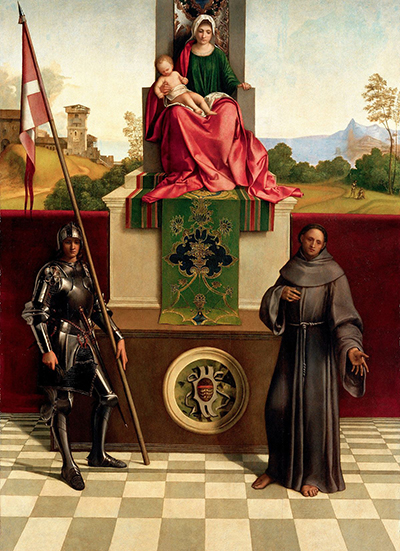
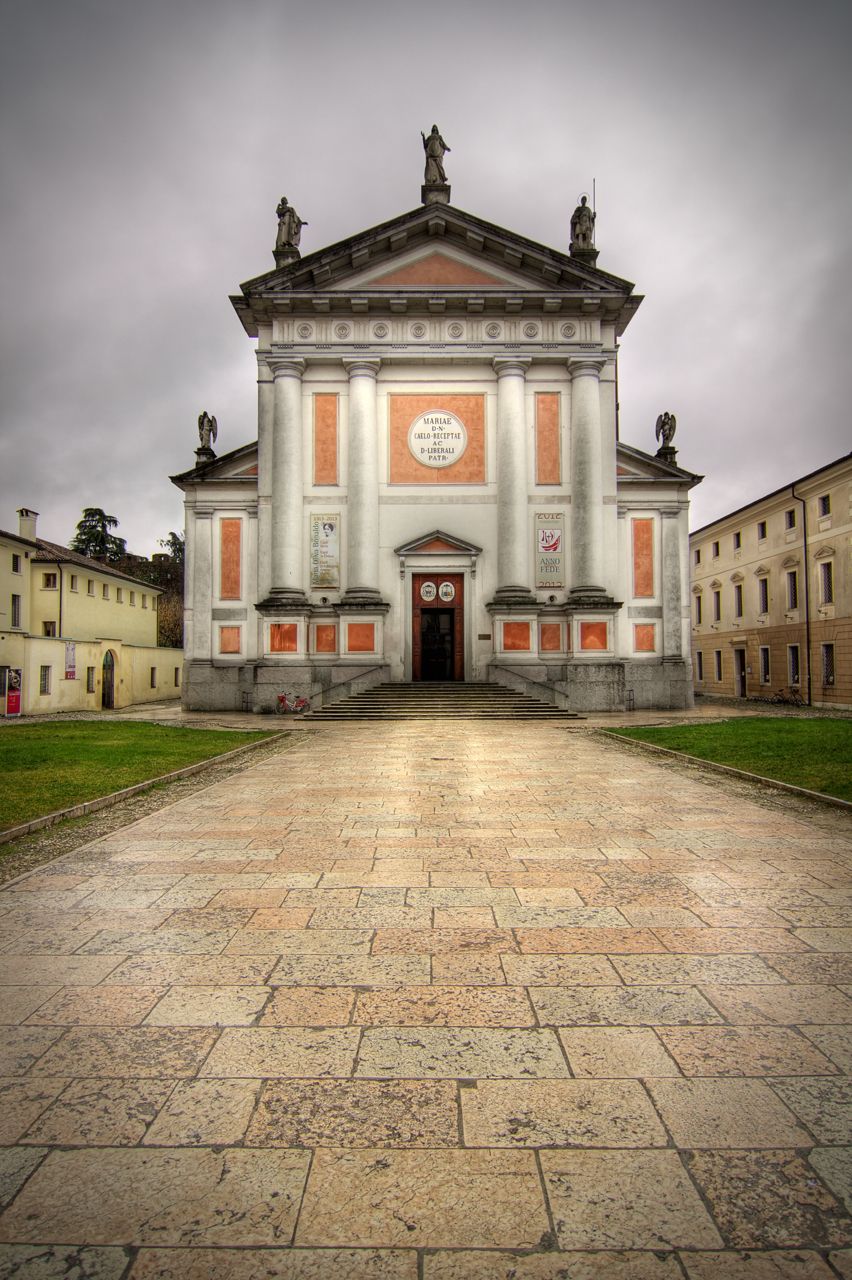
The first thing a viewer notices about Giorgione’s Castelfranco Madonna may be how high the Virgin sits. The throne rises beyond two standing saints and almost into the sky. One saint brings armour and a long banner to the painted floor. The other wears a simple habit. The Child looks down. At the centre, well below the figures’ heads, a coat of arms ties the high drama of colour and perspective to a family who lived, died and worshipped in this town. The altarpiece is still in Castelfranco Veneto, in the cathedral setting for which it became famous. [1] [2]
It is a painting on joined poplar boards, about two metres high and just over one and a half metres wide. The town dates it around 1503–04 while acknowledging proposals closer to 1500. The Royal Academy exhibition catalogue selected the earlier date. Those few years matter for tracing the beginnings of a painter whose surviving working life is poorly documented. They have less effect on the first encounter in the chapel, where the altarpiece initially asks us to follow its sharply different levels and the gazes they make possible. [1] [3]
At a Glance
- Datec.1502–04
- CollectionDuomo, Castelfranco Veneto
- AttributionGiorgione
From the floor to the throne
The painted floor is a grid of squares seen from below and at a receding angle. Most of its diagonal lines belong to the foreground, below the edge of a warm red barrier. The saints stand on it with their bodies roughly at a viewer’s level. Their shared space gives the tall painting a broad, open base. Further up, the throne appears as a narrow succession of surfaces and edges. A patch of red under the Virgin and the green on the other side of her blue wrap bring large, plainly coloured forms into close proximity. The elevated group feels both accessible by sight and set apart. [1] [3]
The barrier behind the saints cuts across the scene at a decisive level. On the spectator’s side of it there is hard pavement, cast shadow and a limited strip of room. Beyond it there is an open place with vegetation, small buildings and distant changes of colour. The painted sky surrounds the Virgin and makes the upper body of the composition seem almost unsupported. Yet the landscape rests on an engineered field of vertical stones and perspective below. The design allows the eye to imagine a room, a country beyond it and an opening towards the holy figures in one view. [1] [3]
Follow the two saints at ground level. The armoured figure’s upright pole repeats one edge of the throne and nearly reaches the top. The line is fine enough to guide the gaze without closing off the air on the left. On the right Saint Francis bends an arm and keeps the other closer to his body. The dark cloth of his habit absorbs more light than the armour does. The different materials give each man a different presence even where their feet occupy roughly corresponding positions. The painter has used a familiar religious grouping to make a viewer move between two ways of standing and looking. [1] [3]
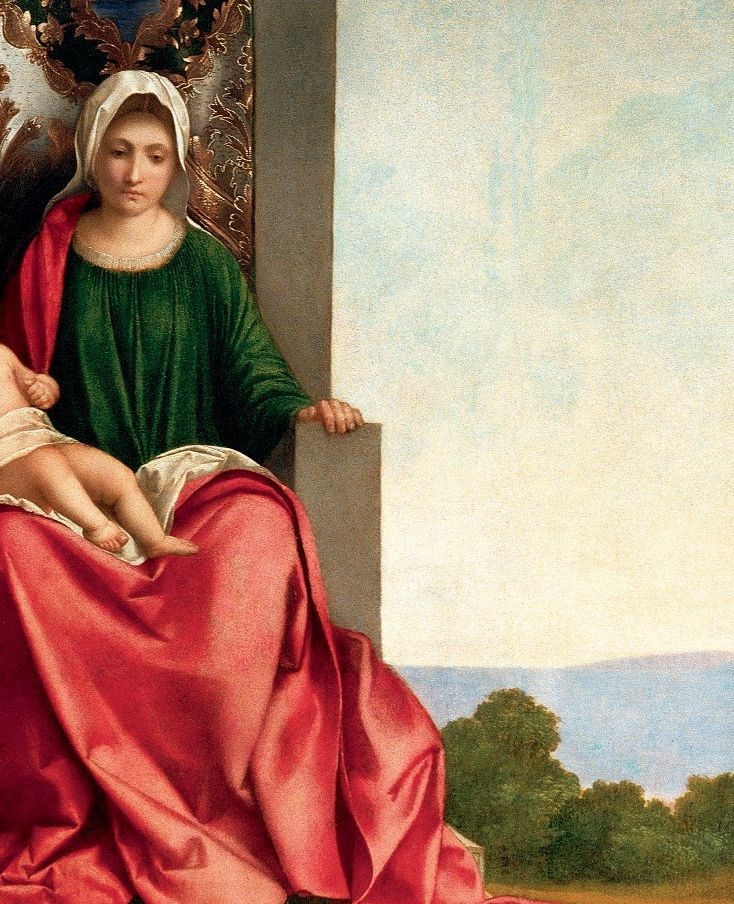
The raised group above them is much quieter than the strong architecture might suggest. The Virgin inclines her head. The Child’s body sits across her lap and his downward gaze makes the height of the throne part of their relationship to the people below. The landscape continues around them. Small lateral openings lead the eye past the throne, while the figures keep their measured place on the central axis. The effect is conspicuous in a full-scale view. Changing the distance from which the painting is seen changes whether the eye first registers the central body, the bands of colour or the geometry of the base. [1] [3]
Two saints and the armoured figure’s disputed name
Francis of Assisi is recognisable by his habit and is generally named on the right. The saint on the left is harder to settle. The Comune identifies him as Saint Nicasius, placing weight on a banner associated with the Hospitallers. Earlier accounts have called him Saint George, a plausible name from the armour and a later dedication of the chapel, or Saint Liberale, a saint with long associations with Castelfranco and Treviso. The Museo Casa Giorgione also names Nicasius. The persistence of other names in old records and reproductions explains why the shorter title Castelfranco Madonna is useful. [1] [2] [4]
The difficulty is partly a matter of evidence. Armour identifies a type of saint more readily than a particular person. The banner and the Costanzo connection support a narrower proposal if their relationship is established. Dedications, meanwhile, can change after an artwork is made. Finocchi Ghersi’s archival work traces an early dedication to Saint Catherine and a later association with Saint George from 1584. That sequence makes the local history richer. It also gives a reason to distinguish the date of the earliest painted image from later ways in which people in the chapel identified its saints. [1] [4]
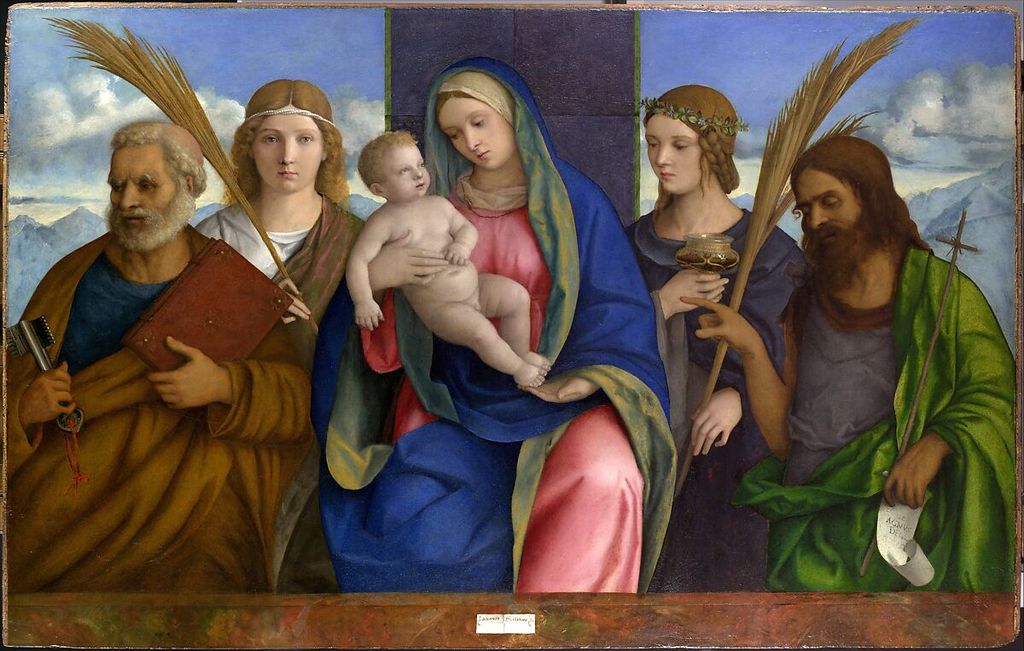
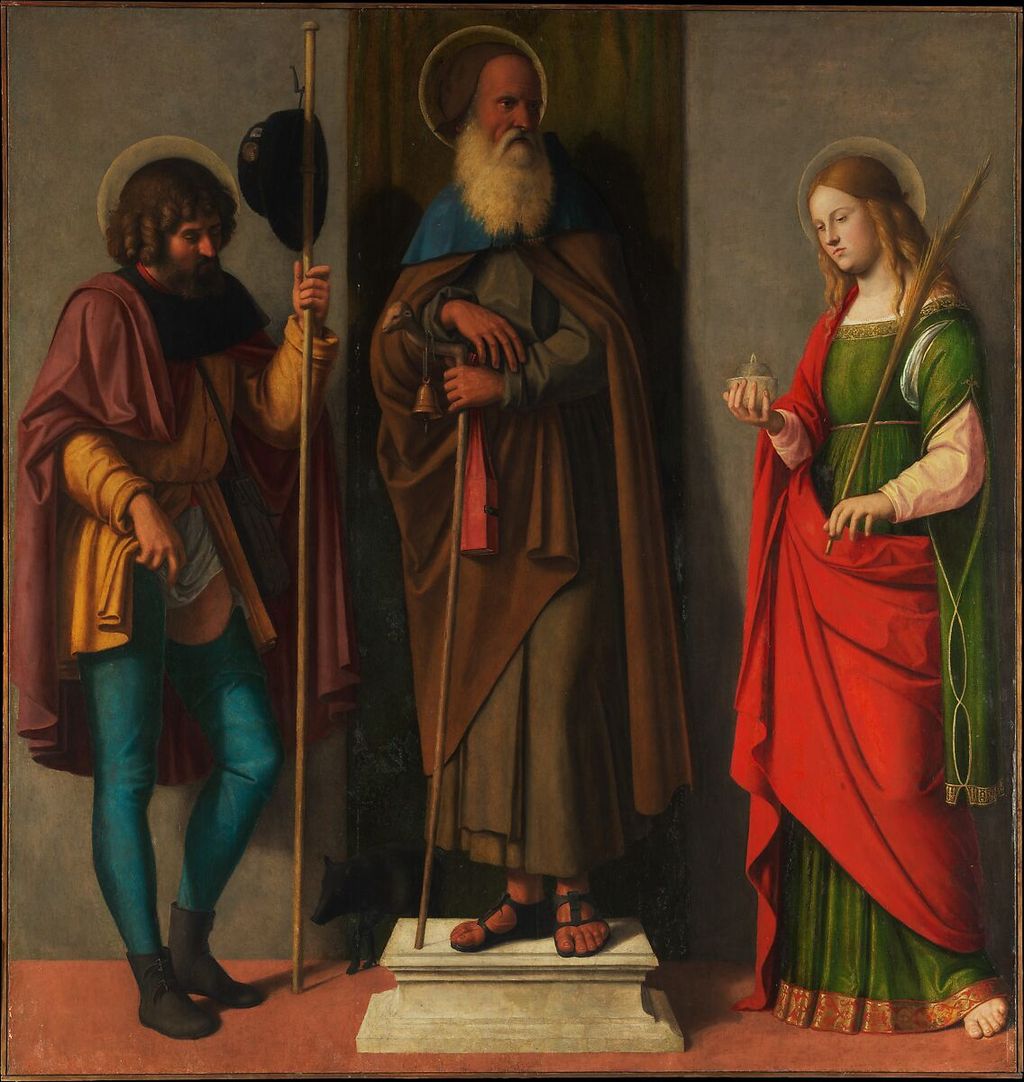
The pair is worth examining even while the name remains open. The Franciscan’s unadorned dress and the armoured man’s reflective equipment occupy opposite places near the altar, with the Virgin high in their common field of vision. In the Met’s Madonna and Child with Saints by Giovanni Bellini and his workshop, the sacred group comes much closer to the scale and position of one another’s heads. Cima da Conegliano’s Three Saints gives a different kind of standing presence to a group of saints across a landscape. Giorgione’s vertical separation is easy to feel when these pictures are set nearby. The comparisons place the work within a Venetian language of devotional figures while leaving decisions about a particular model open. [3] [5] [6]
Two particulars of those comparisons bring out what the form made possible. In the Bellini workshop panel, the parapet runs at the bottom of a shallow gathering. It carries a small piece of paper with the painter’s name, and the four flanking saints occupy nearly the same pictorial depth. In Cima’s altarpiece the centre does rise a little, with Anthony above the protectors Roch and Lucy. Their objects advertise protections that worshippers could recognise. The difference at Castelfranco lies in how extensively the central rise is engineered and how far up the structure the composition takes the two main figures. The family emblem occupies an unusually legible field because so much of the middle remains open. [1] [5] [6]
A painted memorial and a real grave
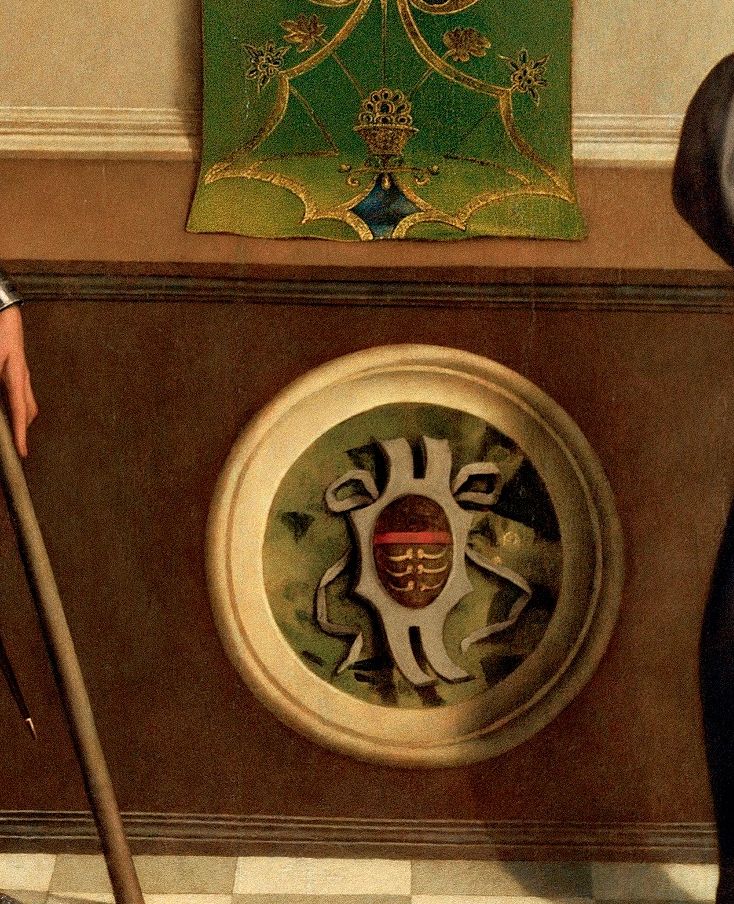
The coat of arms in the foreground belongs to the Costanzo family. It is set on the large stone-coloured form below the throne. The painted structure has encouraged a reading in which the Virgin and Child preside over a memorial. The real object that makes this interpretation compelling is outside the frame. At the base of the altar is the burial slab bearing the relief of Matteo Costanzo. The town associates the painting with his father, the soldier Tuzio Costanzo. The arms, the image and the tomb belong to the same chapel history, but each piece of evidence speaks from a different place. [1] [2]
Seen in the chapel, the stone and the painting are related by upward movement. The real relief lies low in the physical field of view. The picture takes the eye past a painted architectural body carrying the family device. Above it the two saints share a floor, and farther up the Virgin and Child sit apart. The resemblance between the materials in the lower section of the painting and the physical stone helps give this imagined space continuity with the chapel. A reproduction of the panel preserves the geometry and the arms, while the local installation makes the relation with the lower monument easier to grasp. [1] [3]
One of the most interesting technical findings gives the idea of a memorial another dimension. Radiographic work found that the Child had been directed differently in an earlier state. The municipal account interprets the finished downward gaze as a turn towards the emblem and tomb-like form. The observation separates something physically detectable, a change in the process of painting, from a reading of its purpose. Whether the painter moved the gaze because of a changed commission or for another reason is a historical question. The altered look certainly changes how a viewer can connect the sacred group with the centre of the lower painting. [1] [7] [8]
Was it first conceived for the Costanzo family?
The visible arms provide good evidence for the importance of the Costanzo family in the work’s finished form. The earlier stages that technical examination has revealed invite a question about when that association entered the design. Finocchi Ghersi examined documents in the state archive at Venice and the diocesan archive at Treviso. Their evidence involves a dispute before the altarpiece took shape, with parties including the Venetian patrician Cristoforo Moro, the bishop Bernardo de’ Rossi, the priest and printer Bonino Bonini and a German religious figure called Francesco di Guglielmo da Colonia. Finocchi Ghersi proposes that Francesco might have commissioned the earliest form of the work. [4]
This proposal makes the technical and documentary evidence useful together. An archival account can describe the change of circumstances around the altar. The image under the surface preserves a different configuration. Each requires careful interpretation before it can say exactly who ordered which stage. The proposal also allows for a subsequent Costanzo intervention, which accords with the armour, family device and burial arrangement visible in the completed setting. A patron’s identity in one stage and a family’s association with a finished object can both matter to its history. [1] [4] [7]
The work’s date has similar layers. An early date can reflect one interpretation of the hidden design or the available period for work on the chapel. A later date can give more weight to the surviving memorial arrangement. In a Courtauld discussion of the altarpiece’s documented life, a payment to a stonemason and his son for two chapels in June 1503 provides a date for work on the church fabric. The payment concerns their work. Its date gives valuable context without attaching the same day or year to every act of painting. The same account, by Georgios E. Markou, puts the burial of Matteo in one of the chapels in August 1504 and calls attention to the Costanzo family’s Cypriot connections. That historical setting enlarges the meaning of the coat of arms. It marks a family whose military and devotional ties reached beyond this particular town, with a tomb and family altar grounding part of that history in Castelfranco. The child painted above the arms and the young man commemorated below belong to the public form of a family’s prayer. [9] Period evidence becomes most precise when the transaction it describes is kept in view. [3] [4] [9]
The painting through repairs, theft and return
The appearance of the panel has also been shaped over centuries by movement, repairs and exposure. The Comune notes interventions from the seventeenth century onwards and identifies the theft of December 1972 as a traumatic episode. A poplar support made from several boards has a physical history as important to a conservator as the thin coloured surface a viewer sees. Joins, losses, changed varnishes and repairs can affect how light passes across the panel today. Close looking benefits from attention to these processes even where the composition can still be read readily. [1] [7] [8]
Following its recovery, the painting continued to require care. The substantial 2002–03 intervention formed part of the preparations for the exhibition devoted to Giorgione. X-radiography and infrared reflectography have been discussed in the conservation literature. Monica Molteni reproduces a diagnostic image when considering the work’s treatment and historical description. Such an image lets a reader consider parts of the preparation and the changes made before the surface arrived at its visible configuration. Its tonal differences arise from the recording process and need to be interpreted with the conservation history. The vivid green, red and blue of the altarpiece belong to a viewing experience with a quite different purpose. [1] [7] [8]
The current church setting and the nearby museum offer complementary encounters. The museum’s presentation explains the town, the Casa Marta-Pellizzari frieze and the altarpiece through documentary objects and a projection. The original is in the chapel at the cathedral. Looking at the representation before or after a visit can help separate the stages people have identified, while the chapel makes the height and bodily presence of the picture unusually clear. The space around the painting also helps distinguish an object such as the tomb from the image of architecture inside the frame. [1] [2]
On a second look, the strongest connections are often the smallest. The Child’s inclined head, the coat of arms, the feet of the saints and the slight openings beside the throne belong to different kinds of space. Giorgione’s design lets those elements form a continuous route upwards and back down. Conservation and the archive have sharpened our sense of how that structure took shape. The identities that remain in debate are worth attending to because the relief and the figure in armour were meaningful to people in this room long before the modern categories of patronage and attribution had been assembled. [1] [4] [7]
Annotated Details from Castelfranco Madonna
Select a point to see its detail.
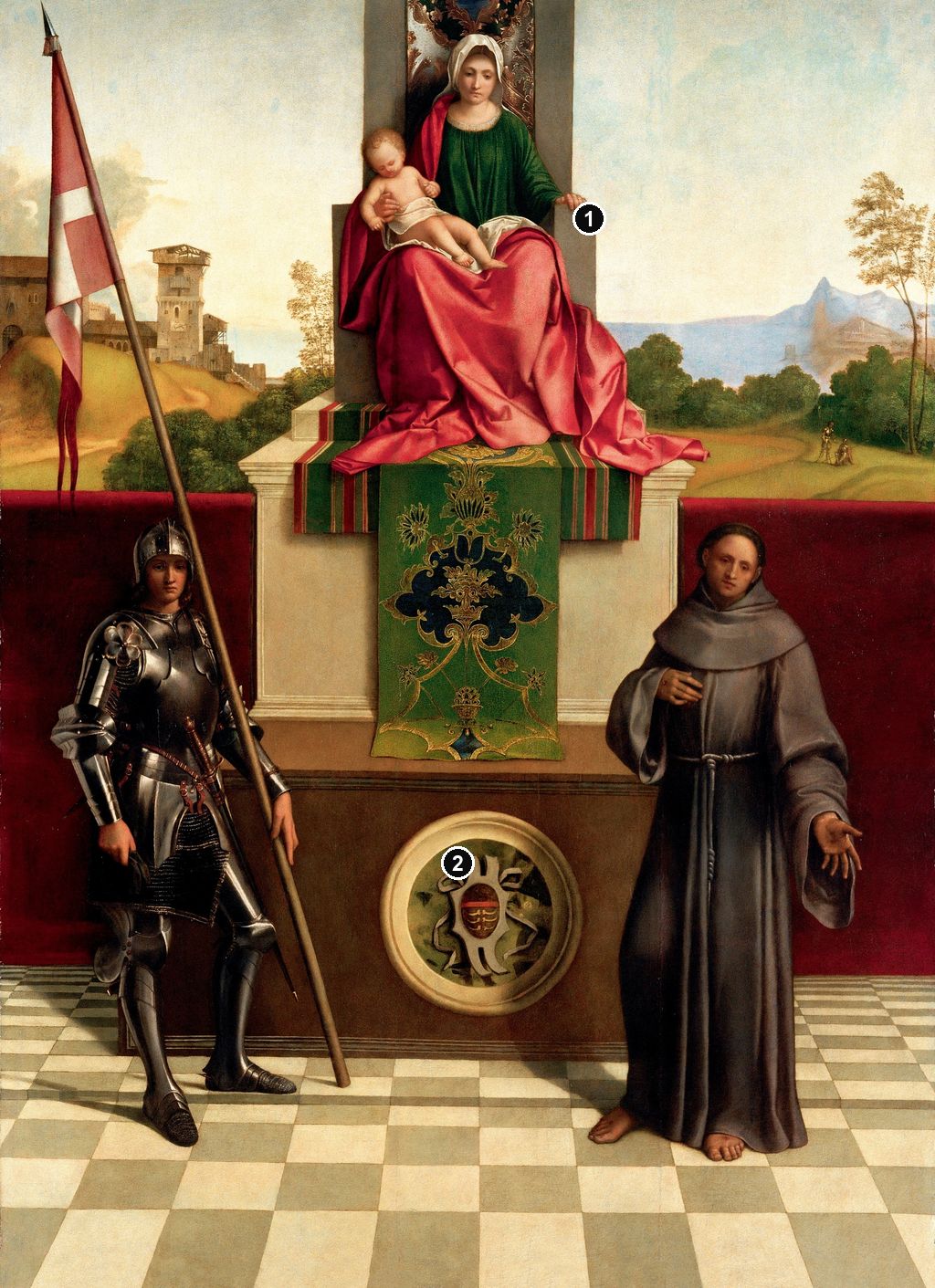
1. Virgin and Child · 2. Costanzo arms
Details from CASTELFRANCO MADONNA
Detail crops from the same image.
Virgin and Child
The mother and child are raised above the landscape and the two standing saints.
Costanzo arms
The lower structure retains the heraldic mark associated with the chapel family.
Giorgione’s career
Castelfranco Madonna
Early 1500sFondaco dei Tedeschi
1507–08Three Philosophers
1508–09Death in Venice
1510Discussion
Share what you noticed and how you arrived at your reading.
Reader Insights
Which detail would you point out to somebody seeing Castelfranco Madonna by Giorgione for the first time?
How does the painting through repairs, theft and return change how you read the work?
Join the Conversation
Share a detail, comparison or question about Castelfranco Madonna by Giorgione below.
References
- Comune di Castelfranco Veneto, La Pala di Giorgione. View source.
- Museo Casa Giorgione, Il progetto museale, the Pala and its original setting. View source.
- Simone Facchinetti and Arturo Galansino, eds., In the Age of Giorgione, catalogue entry 17, Royal Academy of Arts, 2016. View source.
- Lorenzo Finocchi Ghersi, La “via Lattea” di Giorgione a Castelfranco e un’ipotesi per la committenza della Pala in San Liberale, Bollettino d’Arte 14, 2012. View source.
- Metropolitan Museum of Art, Giovanni Bellini, Madonna and Child with Saints. View source.
- Metropolitan Museum of Art, Cima da Conegliano, Three Saints. View source.
- Monica Molteni, Study of the Pala di Castelfranco, diagnostic radiograph at fig. 91. View source.
- Università di Verona research repository, Untersuchungen mit Röntgenstrahlen und Infrarotreflektographie und die Restaurierung der Altartafel von Castelfranco, technical examination and restoration study. View source.
- The Courtauld, Giorgione’s Castelfranco Altarpiece, archival discussion. View source.