


 by Tom Gurney
Tom Gurney BSc (Hons) is an art history expert with over 20 years experience
Published on June 19, 2020 / Updated on November 29, 2026
Email: tomgurney1@gmail.com / Phone: +44 7429 011000
Overview
Giorgione’s paintings have an unusually complicated history of names. Some are documented in the collections of people who lived close to the painter’s time. One portrait carries an inscription dated during his career. Others were finished by another painter, damaged, altered or taken up under his name by later collectors. A useful survey starts with those different kinds of evidence. It then turns to things the pictures make available to anyone who looks at them, such as the surface of a shoulder in half-light, the working height of a fresco or the way distance is made from changing greens. [1] [2]
At a Glance
- Datesc.1500–1510
- PlaceMuseums and collections
- SubjectGiorgione and associated works
Where the strongest evidence begins
The Tempest is a good starting point because an early viewer names its maker and describes several visible features. In his notes on Gabriele Vendramin’s collection, Marcantonio Michiel singles out the storm and the two figures. The painting at the Gallerie dell’Accademia still contains the combination he described. The description also demonstrates the limits of an excellent record. It helps secure the identity and attribution of the picture while leaving room for disagreement about the subject. A recognizable woman, man and storm were enough in the context of the owner’s collection. They have proved much harder to turn into a single agreed story. [3]
A different sort of evidence belongs to Laura. Its inscription refers to Zorzi of Castelfranco and supplies a date in 1506. The inscription is on the back and need not be in Giorgione’s hand to matter. It is evidence of a name and date associated with a particular object. On the front, a branch has encouraged the traditional title Laura. The portrait thereby carries both a relatively strong statement about its making and a much weaker one about the person depicted. Keeping the two questions separate makes the work more interesting. The sitter elicited a highly particular treatment of fabric, flesh and light, even though her historical identity escapes us. [1] [4]
The surviving La Nuda fragment offers yet another point of reference. The record of valuation for the Fondaco frescoes identifies a historical commission, and the Accademia relates the fragment to its distinctive position on the façade. Much of the surrounding work has disappeared. The evidence here includes the architecture, descriptions of the project, the surviving surface and later images of the decoration. These materials can tell us a great deal about what belonged where. They give an incomplete account of a spectator’s experience of the whole finished building. [5]
Wood, cloth and a wall
The museum labels become more useful when read with the scale and support in mind. The National Gallery’s Adoration of the Kings is a long, low composition on wood. The painted company can be followed sideways, from the ruins and the Holy Family to the visitors and their attendants. Its proportions have encouraged the gallery’s proposal that it belonged to a predella. In the Adoration of the Shepherds in Washington, the oil-painted panel is larger and closer to a broad rectangle. The dark cavern stands beside an open region of distant country. The same biblical family can be pictured through the rhythm of a procession or gathered at the edge of a shadowed shelter. That difference is an invitation to compare the pictures as made objects as well as represented events. [6] [7]
The Castelfranco Madonna has a much more vertical obligation. Its throne towers above the saints and the painted setting has a strong middle line below the Virgin. The figures beside the throne extend the design towards the level of a visitor. The family arms and position in a chapel add another kind of significance to the image. A small privately owned canvas could give a landscape or a figure room for suggestion, while the altar image still had to assert its setting and make its sacred grouping immediately legible. The family connection can be understood even while research on an earlier configuration and earliest plans for the chapel continues. [8] [9]
At the Fondaco, the support was plaster on a building. At Castelfranco, the Frieze of the Liberal and Mechanical Arts is an interior ensemble traditionally assigned to the artist and a different kind of encounter altogether. Instruments, trophies and inscriptions occupy a continuous strip close to a ceiling. The surface invites the eye to travel around a room. Four reproduced details of diagrams, armour, celestial forms and musical objects reach their full effect when they can be seen in that sequence. Seeing both sites as one category of mural painting can obscure the difference between a mercantile façade seen from the canal and a quiet band of related things painted inside a house. [5] [10]
Framing the human figure
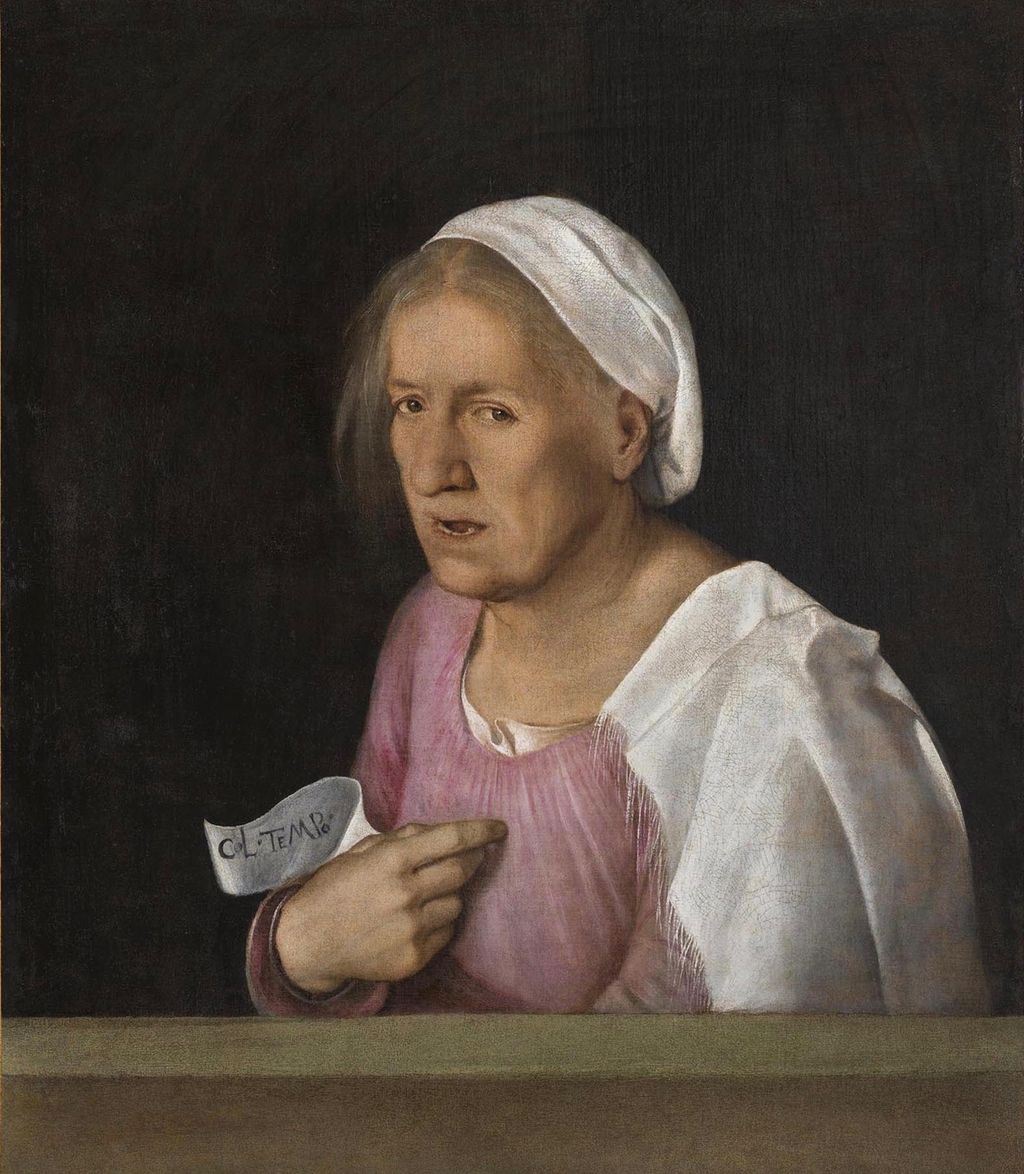
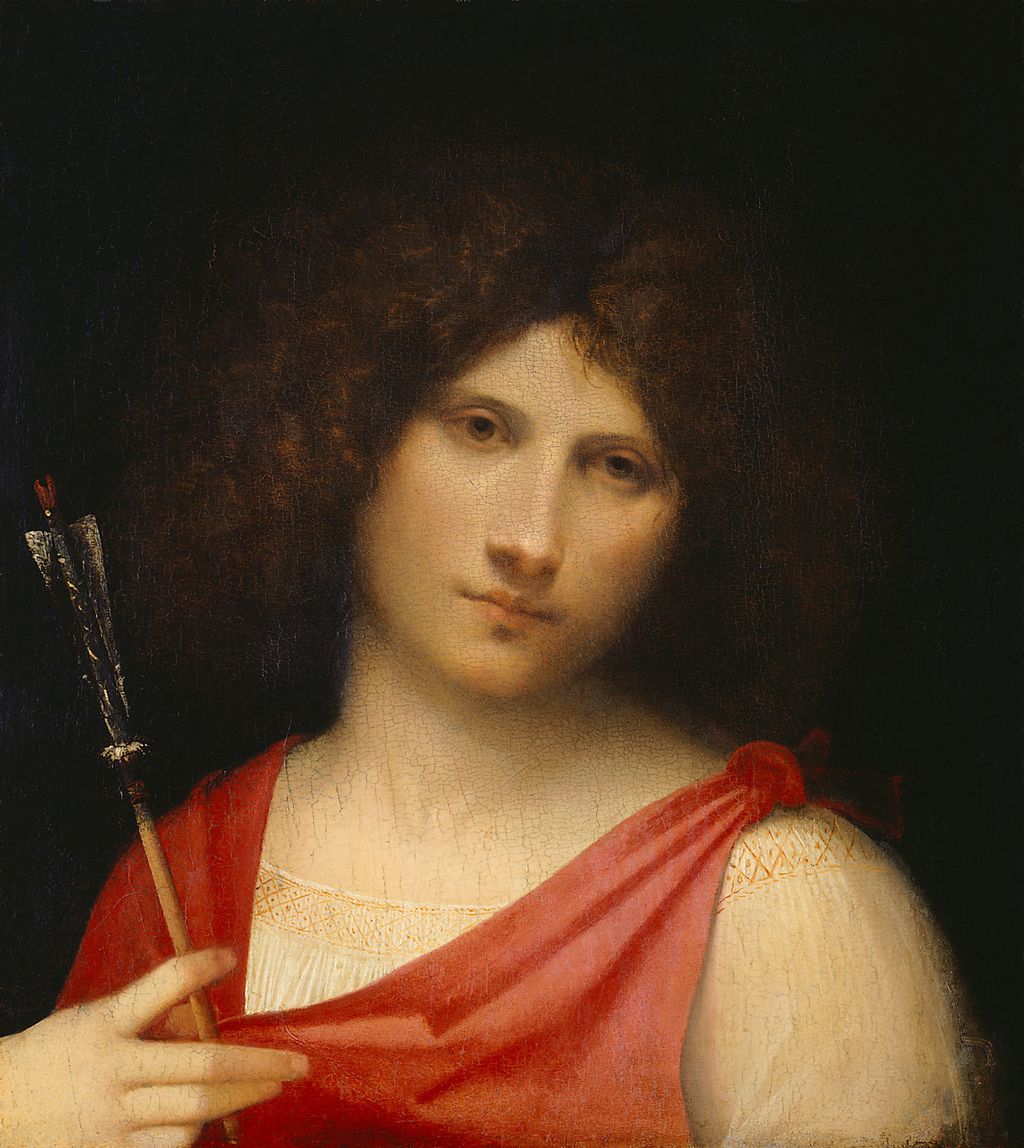
In La Vecchia, a low ledge and the slip of paper held near the woman’s body concentrate attention on face and hand. The Accademia describes several possible ways of approaching the reference to time on the paper. The physical relation of writing and person is unusually active. We encounter the look of an older face, then see that the woman carries words with her. In the KHM’s Youth Holding an Arrow, the hand introduces another object, an arrow whose possible meanings range from Eros to a saint’s identity. Neither portrait uses the device quite like an identifying badge. The object prompts a thought that can continue after the first encounter with the face. [11] [12]
The comparison becomes more precise when there are two related objects to consider. The Royal Collection’s Boy with a Pipe has a similar inclination of the head and a prop associated with a particular kind of life. Its catalogue attributes the painting to Titian while acknowledging the history of its Giorgione attribution and the idea’s association with Giorgione. The Vienna youth and the Royal Collection boy show how close a visual relation can be even when the labels must be written differently. The Borghese Singer with a Flute and Passionate Singer make further comparisons possible. Their qualified labels and distinct bodies, habits of looking and musical gestures deserve close attention before they can be discussed as a pair. [12] [13] [14] [15]
Two-figure portraits give Giorgione’s circle several different reasons for placing bodies close together. The Palazzo Venezia Double Portrait brings two men into the same intimate half-length composition. Washington’s Giovanni Borgherini and His Tutor introduces objects associated with education and measurement. In the Uffizi Warrior with Groom, an attendant stands behind a figure in armour. The setting and clothes lead viewers towards questions of rank and role. These pictures reward comparison across posture and attention. They also show potential pitfalls in turning a convenient short title into proof of sitter identity. Seeing two men helps one recognize a picture across catalogues. It gives very little basis for assuming its maker by itself. [16] [17] [18]
Companion panels and names that repeat
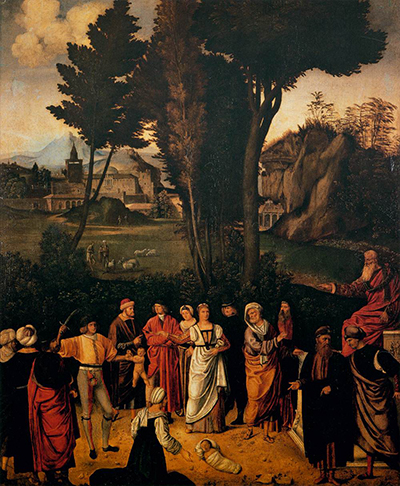
The Uffizi histories of The Test of Fire of Moses and The Judgement of Solomon make a useful pairing. The same history of attribution runs through them, and the Italian national catalogue explicitly connects them as pendants. Each retains its own inventory and narrative. Moses’ trial centres on the child and objects used to test him. Solomon’s judgement is built around competing claims to a child and the possibility of violence. Both allow a story to spread across landscape and architecture rather than sealing the protagonists into a small interior. Their documented association gives the compositions a reason to be studied together beyond their shared biblical subject. [19] [20]
Other similarities of title are more misleading. The unfinished Judgement of Solomon by Sebastiano del Piombo is a separate composition and belongs to a different material history. In portraiture, the former title of a prince may be attached to several works made at different dates. The young Francesco Maria della Rovere in Vienna carries an oak-leaf helmet, while Titian’s adult portrait in the Uffizi presents the grown duke equipped for public command. The visual evidence of age, scale, posture and costume matters even when the name in the heading is identical. The KHM remains careful about its identification of the youth. [21] [22] [23]
One productive way to compare the portrait groups is to follow their hands. The boy in Washington holds several tools close to the front of the picture, making them especially prominent. The armour at Florence complicates touch. A hand can look different over plate than it does next to a softer sleeve, and the arrangements of hands, instruments and weapons direct attention to different social roles. In the Palazzo Venezia picture the two men differ in bearing and position even though their heads are very close together. Set the compositions side by side and it becomes possible to discuss the two-figure format as an artistic choice, while setting aside an assumed uniform purpose or attribution. [16] [17] [18]
The precise status of a comparison matters especially when a work is cited to explain another. The current Washington record describes the Borgherini painting as attributed to Giorgione. It can give evidence for the use of instruments and expressions in his circle, while the named Vienna portrait remains a different kind of reference. The comparison yields most when it preserves the grounds on which each object is connected to the painter. [4] [17]
What a completion or an old label can mean
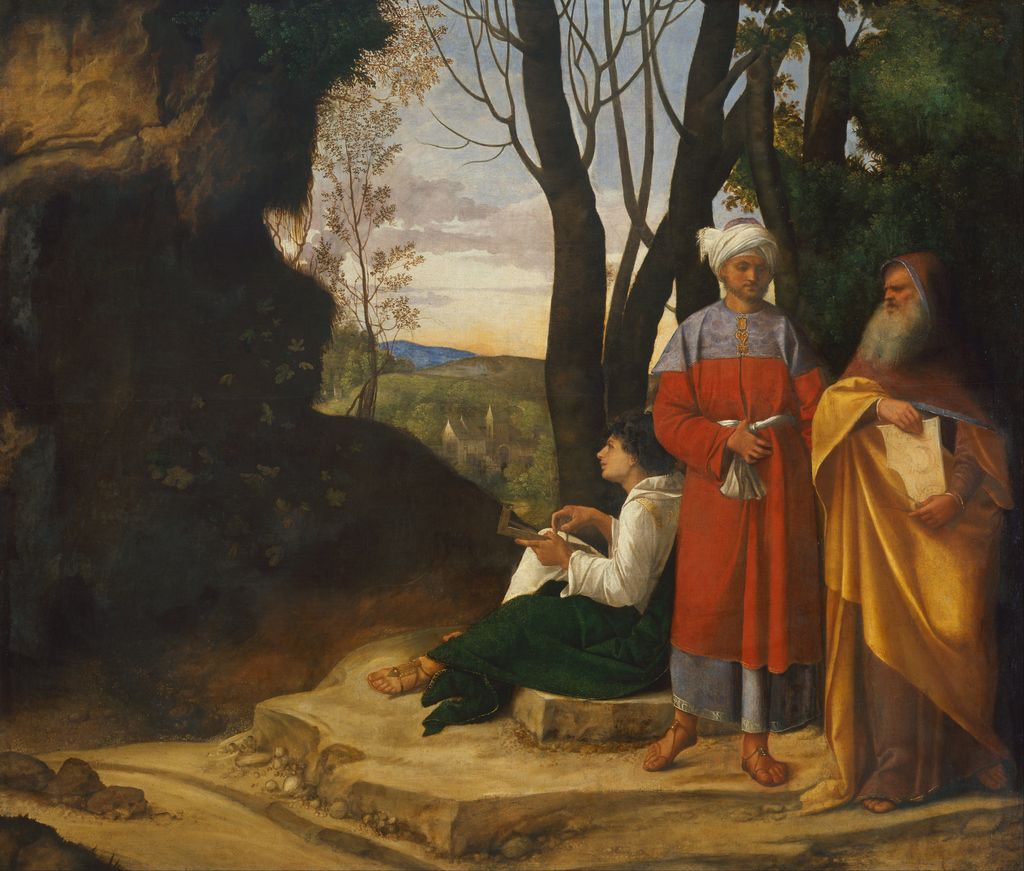
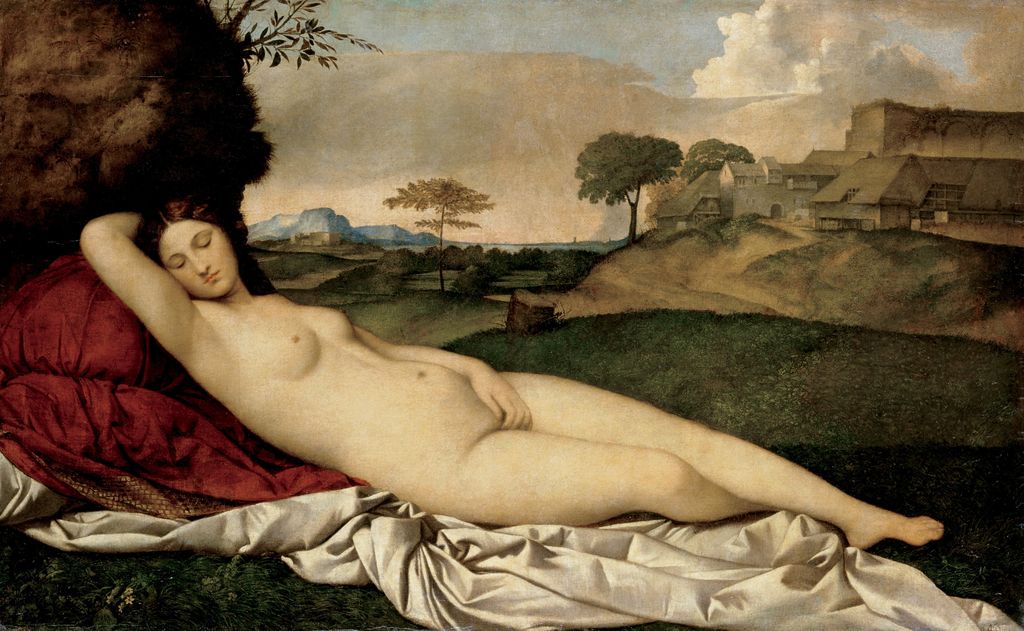
Both the Sleeping Venus and the Three Philosophers come with early evidence for more than one painter’s contribution. The Dresden picture is associated with Giorgione and Titian. Michiel’s description of the philosophers mentions that Sebastiano completed it. There are legitimate questions about what completion meant in each case. One artist might bring areas already laid in to the desired finish, paint a substantial part of a composition or make changes to a first idea. An early statement establishes the history of a work and the presence of a second hand more securely than an exact division of its brushwork. That is a particularly important caution when the paintings are being used as models for identifying unrecorded works from the same period. [1] [24] [25]
The Louvre’s Pastoral Concert belongs to the history of the painter’s reputation through a different route. Early inventories held it under Giorgione’s name, and an older photograph catalogued by the Musée d’Orsay records that label. The Louvre now credits Titian. The two men occupied such close territory in early Venetian pastoral painting that the repeated Giorgione attribution remains worth knowing. It helps explain older reproductions and the comparisons that shaped the painting’s critical reception. A present-day guide should distinguish the historical label clearly so that viewers can recognize an old reference and understand why a modern caption differs. [26] [27]
The Uffizi warrior documents another kind of disagreement. The museum gives the painting to Giorgione. An Italian national catalogue entry associates it with Cavazzola, or Paolo Morando. The comparison matters for the handling of armour and reflected light, and for when and where a particular solution to showing two armoured figures was available. A gallery’s choice of one name and a catalogue’s choice of another are meaningful parts of the evidence. The image is the same canvas. Its stability as an object makes the disagreement over authorship easier to see. [18] [28]
Surfaces that record two histories
Il Tramonto in London allows us to see some of these problems in a single few inches of canvas. The National Gallery’s technical study distinguishes original passages from later additions and damaged areas. Two foreground figures remain central to the possibilities for the subject, although more conspicuous details elsewhere may be later. The bright horizon and fine changes of light in the land can still speak to the history of Venetian painting. An argument based on the picture’s narrative has to attend to the physical history of the passage it uses. Comparing the old photograph of a painting with the current work can be as useful as comparing the work with another landscape. [29]
Technical results can also reveal choices made before a picture took its present form. Conservation research at Castelfranco helped investigators distinguish stages below the surface. In a public altarpiece, a change in the address of the Child or the composition of the throne can affect the relation between its figures and a viewer at the altar. At the Tempest, evidence of an earlier arrangement changes the weight that theories can put on the two figures’ final positions. Earlier paint gives information about the act of making. Later paint gives information about conservation, ownership or intervention. Similar-looking disruptions on a modern display can have fundamentally different causes. [3] [9] [29]
The Hermitage’s Virgin and Child in a Landscape offers a related lesson in the meaning of a support line on a label. The museum describes oil on canvas transferred from panel. The current cloth backing therefore belongs to the later life of the object, rather than throwing light directly on the painter’s choice at the start. This is an especially important distinction when comparing the small Hermitage picture with the Dresden Venus or the Tempest, where the use of canvas forms a different part of the object’s history. Even a well reproduced photograph offers limited help with a question like this. The edge, back and conservation description carry information that a frontal view can scarcely reveal. [30]
The Washington Holy Family puts questions of format and identification inside a single collection. The picture is easy to confuse in abbreviated lists with the same museum’s Adoration of the Shepherds. It helps to look at the number of people gathered around the child and at how the foreground relates to the open setting behind them. The two paintings have distinct histories and the gallery keeps separate object records. Collection name, format and accession number matter as much as the familiar names of the holy figures. Reading the catalogue in this way also makes it possible to compare the small Hermitage Madonna and Washington Holy Family without supposing that every recurring devotional group was designed for the same purpose. [7] [30] [31]
Reading a collection label against the picture
A practical way to approach the corpus is to choose three records with different strengths. Start with the Tempest, where an early collection description and the surviving picture can be matched in unusual detail. Then try the Vienna Laura, where an inscription made in the period contributes dating and a name without identifying the sitter. Finish with either the Royal Collection shepherd or the Louvre concert. The modern maker’s name and the traditional one come into view together. Their precise relationship is worth reading before treating the image as characteristic of Giorgione. [3] [4] [13] [26]
The procedure applies equally well to works of smaller reputation. Ask whether the title is modern or old, whether the visual match is based on a particular inventory, and whether a proposal concerns the person painted, the original commissioning context or the painter. Then return to the image. The longer attention in front of it is where these distinctions begin to pay off. Paintings first met through a printed title can become recognizable as particular arrangements of light, fabric, landscape and gesture. After that, learning how the name changed becomes part of seeing the work more clearly. [1] [2]
Artworks directory
| Name | Date | Collection and attribution |
|---|---|---|
| Castelfranco Madonna by Giorgione | c.1502–04 | Duomo, Castelfranco Veneto · Giorgione Catalogue. |
| Ceres | Unverified | Exact work unidentified |
| Christ Carrying the Cross | c.1508–10 | Scuola Grande di San Rocco, Venice · Giorgione at San Rocco; also attributed to Titian Catalogue. |
| David with the Head of Goliath | Unverified | Relation to the Brunswick fragment under review |
| Double Portrait | c.1502 | Palazzo Venezia, Rome · Giorgione at VIVE; attribution debated Catalogue. |
| Frieze of the Liberal and Mechanical Arts | c.1502–03 proposed | Museo Casa Giorgione, Castelfranco Veneto · East wall associated with Giorgione; west wall later Catalogue. |
| Giovanni Borgherini and His Tutor | Early 1500s | National Gallery of Art, Washington · Giorgione; identity disputed Catalogue. |
| Giovanni Borgherini and Trifone Gabriele (Munich portrait) | Early 16th century | Alte Pinakothek, Munich · attributed to Giorgione Catalogue. |
| Judith by Giorgione | c.1504 | State Hermitage Museum, St Petersburg · Giorgione Catalogue. |
| La Nuda | c.1508 | Gallerie dell’Accademia, Venice · Giorgione Catalogue. |
| La Vecchia by Giorgione | c.1506–08 | Gallerie dell’Accademia, Venice · Giorgione Catalogue. |
| Laura by Giorgione | 1506 | Kunsthistorisches Museum, Vienna · Giorgione Catalogue. |
| Passionate Singer | c.1507 | Galleria Borghese, Rome · Venetian school, attributed to Giorgione Catalogue. |
| Pastoral Concert | c.1509 | Musée du Louvre, Paris · Titian; formerly attributed to Giorgione Catalogue. |
| Portrait of a Man | Unverified | Exact sitter and collection under review |
| Portrait of a Venetian Gentleman | Unverified | Object and former attributions under review |
| Portrait of a Youth | c.1503 | Museum of Fine Arts, Budapest · Giorgione; named identity uncertain Catalogue. |
| Portrait of Francesco Maria della Rovere | Early 1500s | Kunsthistorisches Museum, Vienna · Giorgione at KHM; also attributed to Sebastiano Catalogue. |
| Sacred Conversation | Unverified | Exact composition under review |
| Samson Captured by the Philistines | Unverified | Attribution and location unresolved |
| Self-Portrait | Unverified | Historical title; identity under review |
| Shepherd with a Flute | c.1510–15 | Royal Collection · Attributed to Titian, possible Giorgione design Catalogue. |
| Singer with a Flute | c.1507 | Galleria Borghese, Rome · Venetian school, attributed to Giorgione Catalogue. |
| Sleeping Venus by Giorgione and Titian | c.1508–10 | Gemäldegalerie Alte Meister, Dresden · Giorgione, with Titian associated with completion Catalogue. |
| The Adoration of the Kings | 1506–07 | National Gallery, London · Giorgione Catalogue. |
| The Adoration of the Shepherds | c.1505–10 | National Gallery of Art, Washington · Giorgione Catalogue. |
| The Holy Family | c.1500 | National Gallery of Art, Washington · Giorgione Catalogue. |
| The Judgement of Solomon | c.1505–08; earlier dates proposed | Uffizi Galleries, Florence · Giorgione; collaboration debated Catalogue. |
| The Sunset | 1506–10 | National Gallery, London · Giorgione, with substantial later additions Catalogue. |
| The Tempest by Giorgione | c.1505–08 | Gallerie dell’Accademia, Venice · Giorgione Catalogue. |
| The Test of Fire of Moses | Early 1500s; dates debated | Uffizi Galleries, Florence · Giorgione; collaboration debated Catalogue. |
| The Three Ages of Man | c.1505–10 | Galleria Palatina, Florence · Giorgione Catalogue. |
| The Three Philosophers by Giorgione | c.1508–09 | Kunsthistorisches Museum, Vienna · Giorgione, with Sebastiano named as finisher by Michiel Catalogue. |
| Triple Portrait | Unverified | Exact object under review |
| Virgin and Child in a Landscape | c.1503 | State Hermitage Museum, St Petersburg · Giorgione, attribution debated historically Catalogue. |
| Virgin and Child with a View of Venice | Unverified | Tallard association to verify |
| Warrior with Groom | 1501–02 | Uffizi Galleries, Florence · Attributed to Giorgione by the Uffizi Catalogue. |
| Woman with a Unicorn | Unverified | Former attribution under review |
| Youth Holding an Arrow | c.1505 | Kunsthistorisches Museum, Vienna · Giorgione Catalogue. |
Giorgione’s career
Castelfranco Madonna
Early 1500sFondaco dei Tedeschi
1507–08Three Philosophers
1508–09Death in Venice
1510Discussion
Share what you noticed and how you arrived at your reading.
Reader Insights
Which detail would you point out to somebody seeing Giorgione Paintings for the first time?
How does reading a collection label against the picture change how you read the work?
Join the Conversation
Share a detail, comparison or question about Giorgione Paintings below.
References
- Städel Museum, Giorgione, Digital Collection. View source.
- National Gallery of Art, Washington, Bellini, Giorgione, Titian, and the Renaissance of Venetian Painting. View source.
- Gallerie dell’Accademia di Venezia, La tempesta, inv. 915. View source.
- Kunsthistorisches Museum Wien, Titian’s Vision of Women exhibition catalogue, Bildnis einer jungen Frau (Laura). View source.
- Gallerie dell’Accademia di Venezia, La Nuda, inv. 1034. View source.
- National Gallery, London, The Adoration of the Kings, NG1160. View source.
- National Gallery of Art, Washington, The Adoration of the Shepherds, 1939.1.289. View source.
- Comune di Castelfranco Veneto, La Pala di Giorgione. View source.
- Lorenzo Finocchi Ghersi, La “via Lattea” di Giorgione a Castelfranco e un’ipotesi per la committenza della Pala in San Liberale, Bollettino d’Arte. View source.
- Museo Casa Giorgione, Il Fregio. View source.
- Gallerie dell’Accademia di Venezia, La vecchia, inv. 272. View source.
- Kunsthistorisches Museum Wien, Knabe mit Pfeil, GG 323. View source.
- Royal Collection Trust, A Boy with a Pipe, RCIN 405767. View source.
- Galleria Borghese, Cantore con flauto. View source.
- Galleria Borghese, Passionate Singer. View source.
- VIVE, Palazzo Venezia, Doppio ritratto. View source.
- National Gallery of Art, Washington, Giovanni Borgherini and His Tutor. View source.
- Gallerie degli Uffizi, The “Gattamelata”. Man in armour with a squire. View source.
- Catalogo generale dei Beni Culturali, Mosè sottoposto alla prova del fuoco, 0900286684. View source.
- Catalogo generale dei Beni Culturali, Giudizio di Salomone, 0900286722. View source.
- National Gallery, London, Sebastiano del Piombo, The Judgement of Solomon. View source.
- Kunsthistorisches Museum Wien, Bildnis des Francesco Maria I. della Rovere, GG 10. View source.
- Gallerie degli Uffizi, Titian, Portrait of Francesco Maria della Rovere. View source.
- Staatliche Kunstsammlungen Dresden, Schlummernde Venus, Gal.-Nr. 185. View source.
- Kunsthistorisches Museum Wien, Die drei Philosophen, GG 111. View source.
- Musée du Louvre, Le Concert champêtre, INV 71. View source.
- Musée d’Orsay, Adolphe Braun photograph of Concert champêtre with its historical attribution. View source.
- Catalogo generale dei Beni Culturali, The Uffizi warrior with attendant, former Giorgione attribution. View source.
- Jill Dunkerton, Giorgione and not Giorgione: The Conservation History and Technical Examination of Il Tramonto, National Gallery Technical Bulletin 31, 2010. View source.
- State Hermitage Museum, Madonna and Child in a Landscape, inv. 785, Western European paintings catalogue. View source.
- National Gallery of Art, Washington, The Holy Family. View source.