


 by Tom Gurney
Tom Gurney BSc (Hons) is an art history expert with over 20 years experience
Published on June 19, 2020 / Updated on November 29, 2026
Email: tomgurney1@gmail.com / Phone: +44 7429 011000
Overview
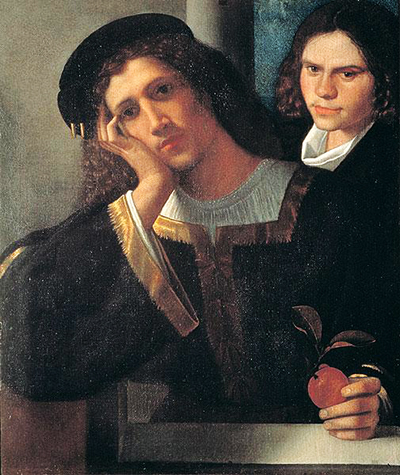
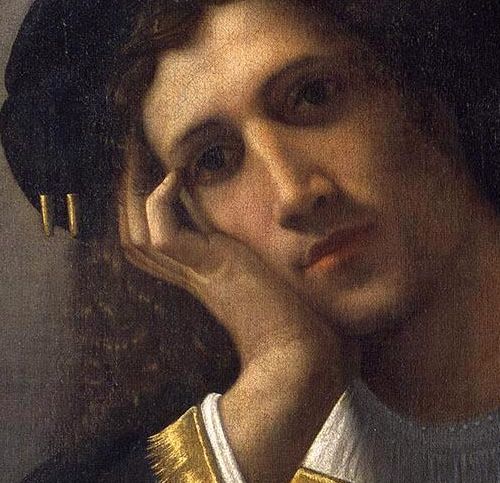
A young man holds a bitter orange in one hand and rests his cheek against the other. Somebody his own age looks out from behind him, close enough that their shoulders almost meet. The first man has the light and the more conspicuous role, but the second is sufficiently alert to unsettle the apparent solitude of the pose. This Double Portrait, often called the Ludovisi Double Portrait, belongs to Palazzo Venezia in Rome. Its catalogue dates it to about 1502 and gives its dimensions as 76.3 by 63.4 centimetres. The institution attributes the oil on canvas to Giorgione and sets out the arguments for and against the attribution in its catalogue. [1] [2]
At a Glance
- Datec.1502
- CollectionPalazzo Venezia, Rome
- AttributionGiorgione at VIVE; attribution debated
- Inventory902
What happens between the two figures
The front man's elbow is low enough to disappear, leaving the hand against his cheek as the most visible sign of support. The pressure changes the shape of the pose, making the head seem to settle down and inward. The person behind him, nearly in his shadow, holds his head more independently. He could simply have been included by positioning his face above the seated figure's shoulder. Instead the small gap and the density of the shade around it make his place in the painting an event. We see the two men at roughly the same time, but the second head becomes fully apparent only after the first has established a mood for the picture. [1] [2] [3]
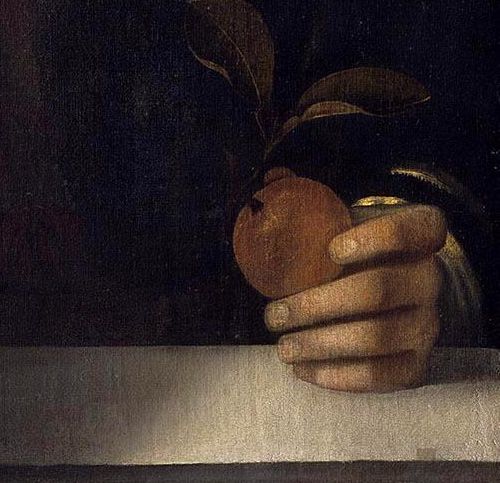
The least ambiguous object is the fruit, a melangolo or bitter orange. It appears as such in a seventeenth-century inventory of Cardinal Carlo Emmanuele Pio di Savoia. VIVE sets that identification alongside the familiar association of a propped head with melancholy. The fruit may bring to mind the bitterness of a love that also gives pleasure. The gesture and the taste therefore have a possible relation. The original patron has left no description telling us which experience the orange was meant to convey. We can still feel the role of the hand that holds it. The open fingers support an object available to be offered or withdrawn, while the hand at the cheek supports a weight that stays where it is. [1] [2] [3]
What the second face contributes depends partly on where we stand. Follow the front man's eyes downward and the man behind him can feel like a witness to his absorbed mood. Move your attention to the more open gaze and it is the observer who has suddenly entered the picture's space. Two young men have accomplished what a formal portrait of one person can do only successively. They can offer an outward point of contact and a suggestion of private thought at the same time. In the narrow upper field above the bright fabric at the front, there is little else to distract us from how differently their features respond to light. [1] [3]
How much does the title tell us?
The names of the two young men remain unknown. The museum also uses the title The Two Friends, which is an evocative way of approaching the companionship suggested by their close placement. It supplies no historical relationship by itself. Alessandro Ballarin proposed that the painting might have arisen in the circle of Venetian young men associated with Pietro Bembo and known as the Compagnia degli Amici. Their literary interests, including the pleasures and pains of love, give a plausible setting for experiments with a portrait that brings emotional conduct so close to the surface. None of the proposed associations identifies a sitter or turns that circle into a documented patron. [1] [2] [3] [4]
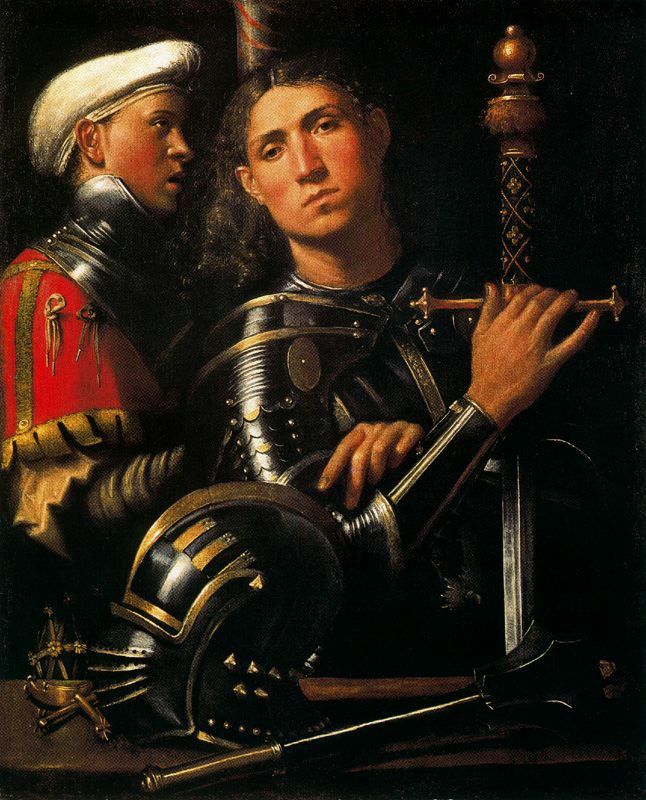
In the same early Venetian culture, a work such as Warrior with Groom makes two people share a narrow field with a conspicuous difference of role. The armoured man and his companion are separated by equipment and dress as well as by the way they enter the picture. In the Rome canvas no armour or household duty explains why one man stands behind the other. The front figure's fruit and posture set their own terms. Placing the pictures side by side can illuminate a particularly Venetian experiment with two people near the same edge of the picture while leaving the two attributions to be argued from their own evidence. [1] [3] [5]
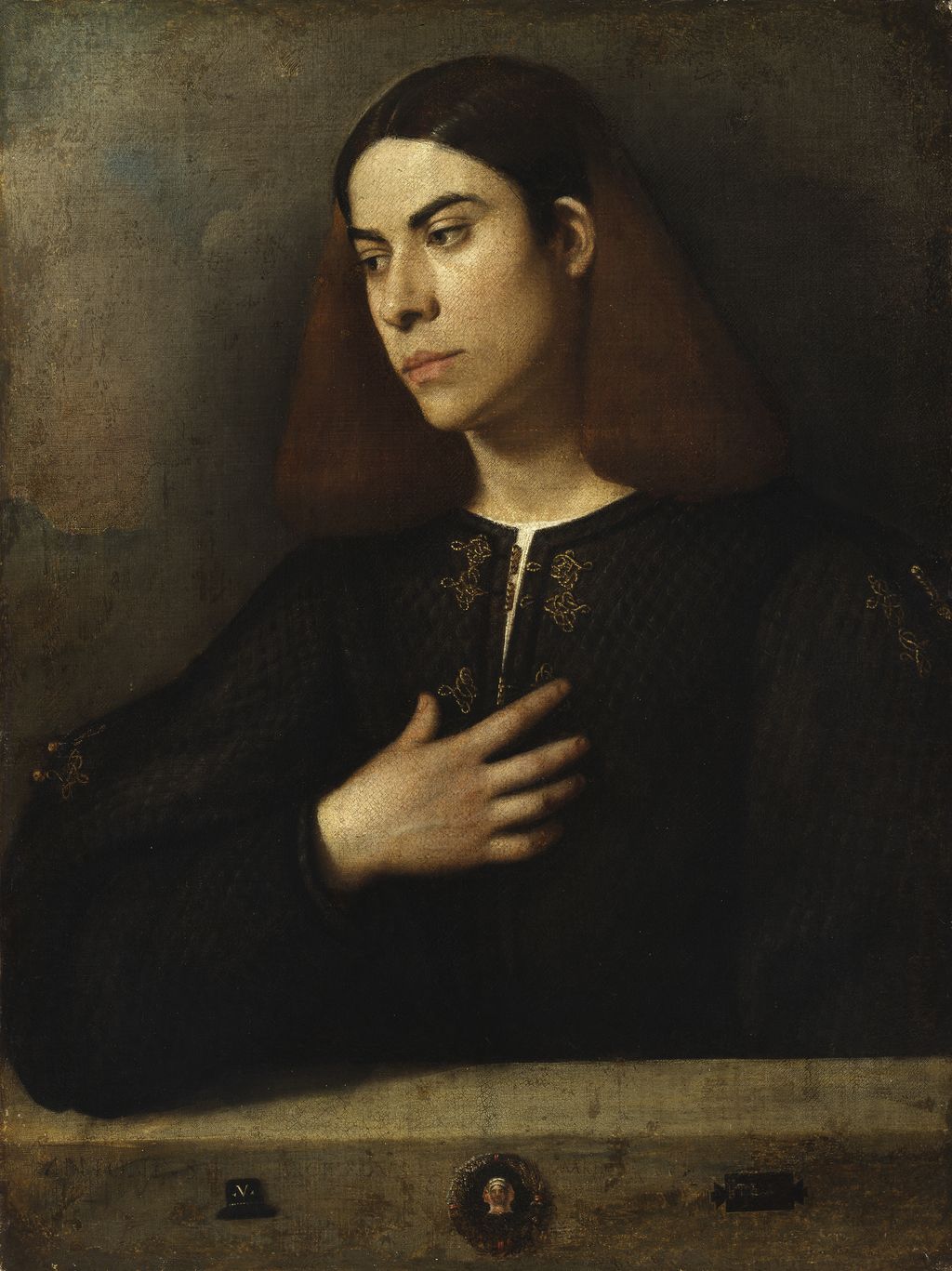
A 2025 exhibition brought the Rome picture into comparison with the Portrait of a Youth from Budapest. The distinction between the works matters. The Budapest painting occupies its space with one face with the gaze directed to one side. In Rome, the second face makes the act of looking almost part of the subject. The paired display gave viewers a chance to test those different forms of address at first hand. Its importance lies in the comparison between two original objects with complicated attribution histories, each visible in its own frame. [1] [6]
Giorgione, Dosso and the Ludovisi record
The museum links the canvas with inventories of the Pio di Savoia and Ludovisi collections, both associating it with Giorgione. It was recorded in the Ludovisi collection in 1633. In the collection of Cardinal Tommaso Ruffo in Ferrara in the early eighteenth century it appeared under the name Dosso Dossi. Later it remained with the Ruffo family, and in 1919 it entered Palazzo Venezia through Fabrizio Ruffo. The chain of custody is especially helpful in identifying the work once the specific description of a man holding his cheek with one hand and the fruit with the other is taken into account. It gives a distinct history to images that might otherwise blur together under the title Double Portrait. [1] [2] [3]
The case for Giorgione remains substantial, and VIVE's fuller entry also notes the judgement of scholars who assign it to a Venetian painter in his orbit. Date and attribution are partly linked. A date early in the first decade of the sixteenth century makes this canvas important for arguments about the emergence of an emotionally suggestive Venetian half-length portrait. An association with a painter adopting Giorgione's inventions helps explain the same qualities in a different way. The pose and the lighting are available to both sides of the debate. It is their combination with the structure and handling of the original paint and with comparisons to other objects that matters. [1] [3] [4]
There is another picture called a double portrait in Munich, and it has been the subject of its own technical study. Scientific images of successive designs beneath that surface cannot be transferred to the canvas in Rome. Readers looking for the Roman object should use Palazzo Venezia inventory 902, its two young men and its bitter orange. For this particular painting, the most memorable evidence is still visible without a catalogue. The fruit confirms that the front man is doing something specific with his free hand. As his attention recedes into a thought we cannot recover, the man behind him offers us a disconcertingly direct glance. [1] [7]
Annotated Details from Double Portrait
Select a point to see its detail.
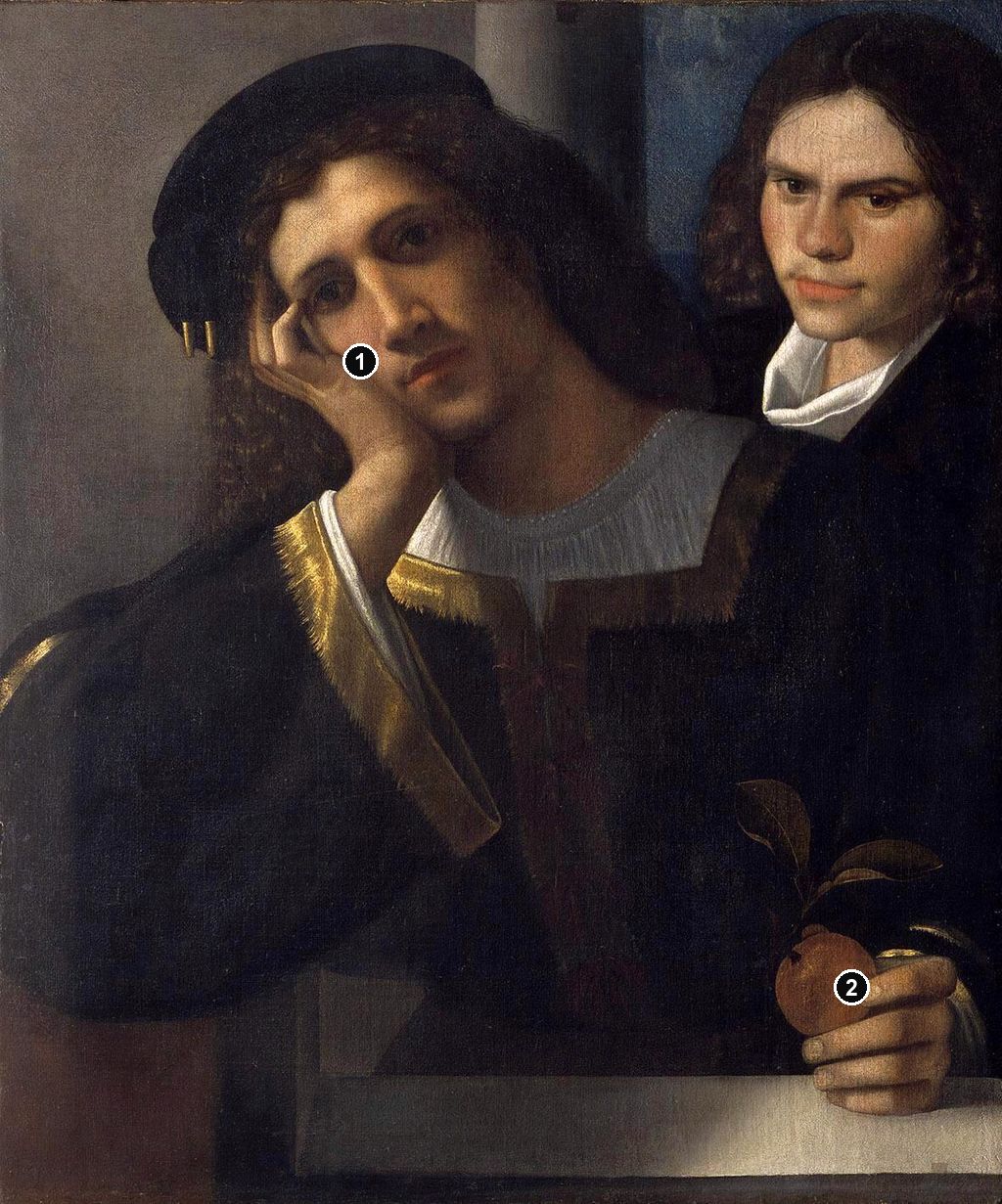
1. The foreground face · 2. The bitter orange
Details from DOUBLE PORTRAIT
Detail crops from the same image.
The foreground face
The foreground man rests his cheek on one hand and faces the viewer from near the parapet.
The bitter orange
The fruit rises above the lower edge and has prompted readings about the contrasting moods of the figures.
Giorgione’s career
Castelfranco Madonna
Early 1500sFondaco dei Tedeschi
1507–08Three Philosophers
1508–09Death in Venice
1510Discussion
Share what you noticed and how you arrived at your reading.
Reader Insights
Which detail would you point out to somebody seeing Double Portrait for the first time?
How does giorgione, Dosso and the Ludovisi record change how you read the work?
Join the Conversation
Share a detail, comparison or question about Double Portrait below.
References
- VIVE, Palazzo Venezia, Double portrait, inventory 902. View source.
- VIVE, Palazzo Venezia, The two friends by Giorgione. View source.
- Enrico Maria Dal Pozzolo and contributors, Savoldo e Giorgione: Ritratto amoroso, exhibition catalogue. View source.
- Simone Facchinetti and Arturo Galansino, eds., In the Age of Giorgione. View source.
- Gallerie degli Uffizi, The Gattamelata, Man in Armour with a Squire. View source.
- VIVE, Giorgione. Da Budapest a Roma. View source.
- Anneliese Földes et al., One Canvas, Four Ideas: A Double Portrait Attributed to Giorgione. View source.