


 by Tom Gurney
Tom Gurney BSc (Hons) is an art history expert with over 20 years experience
Published on June 19, 2020 / Updated on November 29, 2026
Email: tomgurney1@gmail.com / Phone: +44 7429 011000
Overview
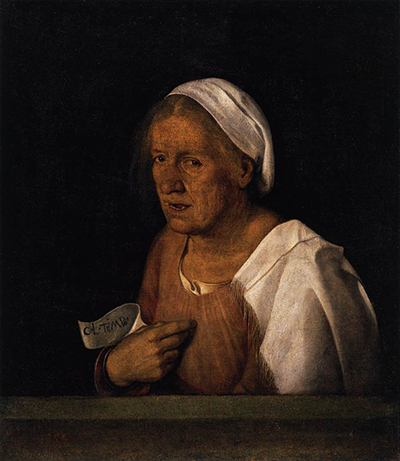
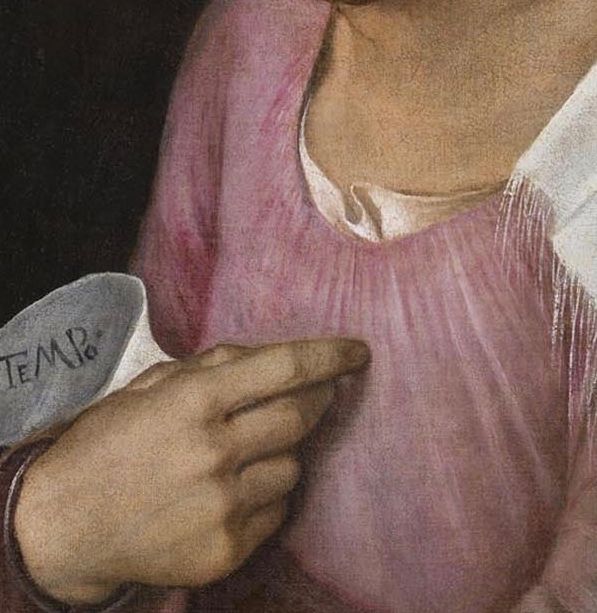
An older woman stands behind a low ledge and looks out. Her mouth is open just enough to suggest that she might speak. One hand rises towards her chest and carries a piece of paper with two words on it, col tempo, meaning “with time”. The head covering and fabric below it catch the light. Her face comes forward from a dark ground, made distinct by the lines of skin around her eyes and against her cheek. Much of the picture is available in that first encounter. What the words and the woman are asking of us takes longer to decide. [1] [2]
The painting, called La Vecchia or The Old Woman, is in the Gallerie dell’Accademia, Venice, catalogue number 272. It measures 68 × 59 cm and is painted on canvas. Cincinnati Art Museum, which exhibited it in 2019, gave a broad date of about 1502–08. The modest dimensions put pressure on individual details. A hand close to the chest and the small white surface of the paper take up very little of the space. In combination with the gaze, they let the picture establish a more direct relation with viewers than some larger scenes full of people can achieve. [1] [2]
At a Glance
- Datec.1506–08
- CollectionGallerie dell’Accademia, Venice
- AttributionGiorgione
A face and a hand on either side of the ledge
The ledge is a narrow horizontal near the bottom of the painting. Without it we might imagine the body continuing towards us in the same dark space. With it there is a clear threshold between her and a viewer. Above that threshold the bright surfaces of hand, cloth and face make separate demands on our attention. The arm lifts from lower in the painting and gives weight to the words on the paper. The woman’s head leans slightly into the light. Whatever the space beyond the panel, she seems close enough for us to respond. [1] [2]
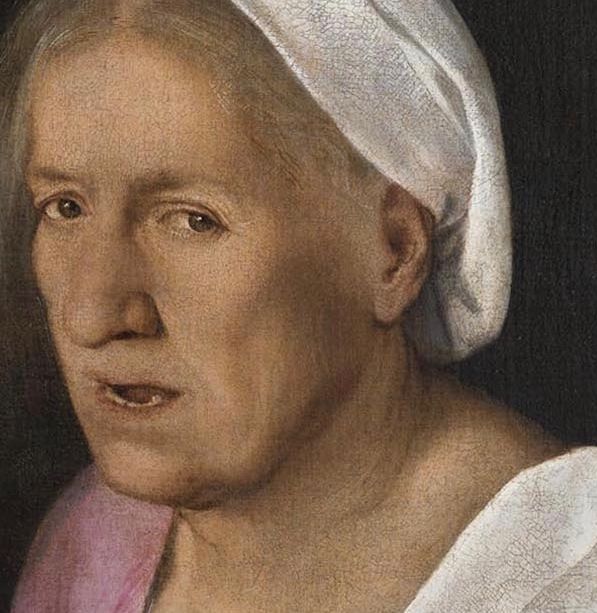
The ageing of the face is conveyed through the way the light meets it. Creases around the eyes are fine and numerous. Elsewhere the darkening around the mouth and the farther cheek has more breadth. The head covering brings close areas of pale colour against the more complex tones of the skin. This is one reason the face looks inhabited by a person before it asks to be interpreted as a statement about age. The test of close looking here is how long the woman herself remains present while the separate materials and effects of brushwork come into focus. [1]
The figure seems to point to herself as she presents the paper. Her shoulder rises and the grouping gives the gesture a shape between invitation and self-identification. The slightly open mouth is as important as the written words. It makes what could have been an impersonal motto look as though it might belong to someone’s lived speech. The ledge keeps a literal distance between herself and her audience. The gaze and the paper cross it. [1] [2]
What does “with time” ask us to think about?
The words are brief enough to invite a sentence completed by the viewer. With time, the face changes. With time, visible beauty gives way to experience. With time, things that seemed central at a younger age come to matter less. The Accademia presents the motto in relation to at least two plausible directions. It can be read as a reminder of death and the transience of earthly things, or as a way of praising the insight that comes with age. The woman’s hand near her heart has also invited a spiritual reading. The grammar of the two words leaves these questions open. [1] [3]
A reading that emphasises decay draws upon the portrait’s candour. Giorgione has given close attention to the face, and the text invites somebody younger to see in that face the result of time’s passage. A reading that emphasises experience begins with the same details. The woman looks steadily and the portrait gives her an opportunity to address viewers directly. Familiar visual devices of portraiture give her that position in front of us. The strength of the image lies partly in the possibility of taking both readings seriously without needing to reduce her expression to a single emotion. [1] [2] [3]
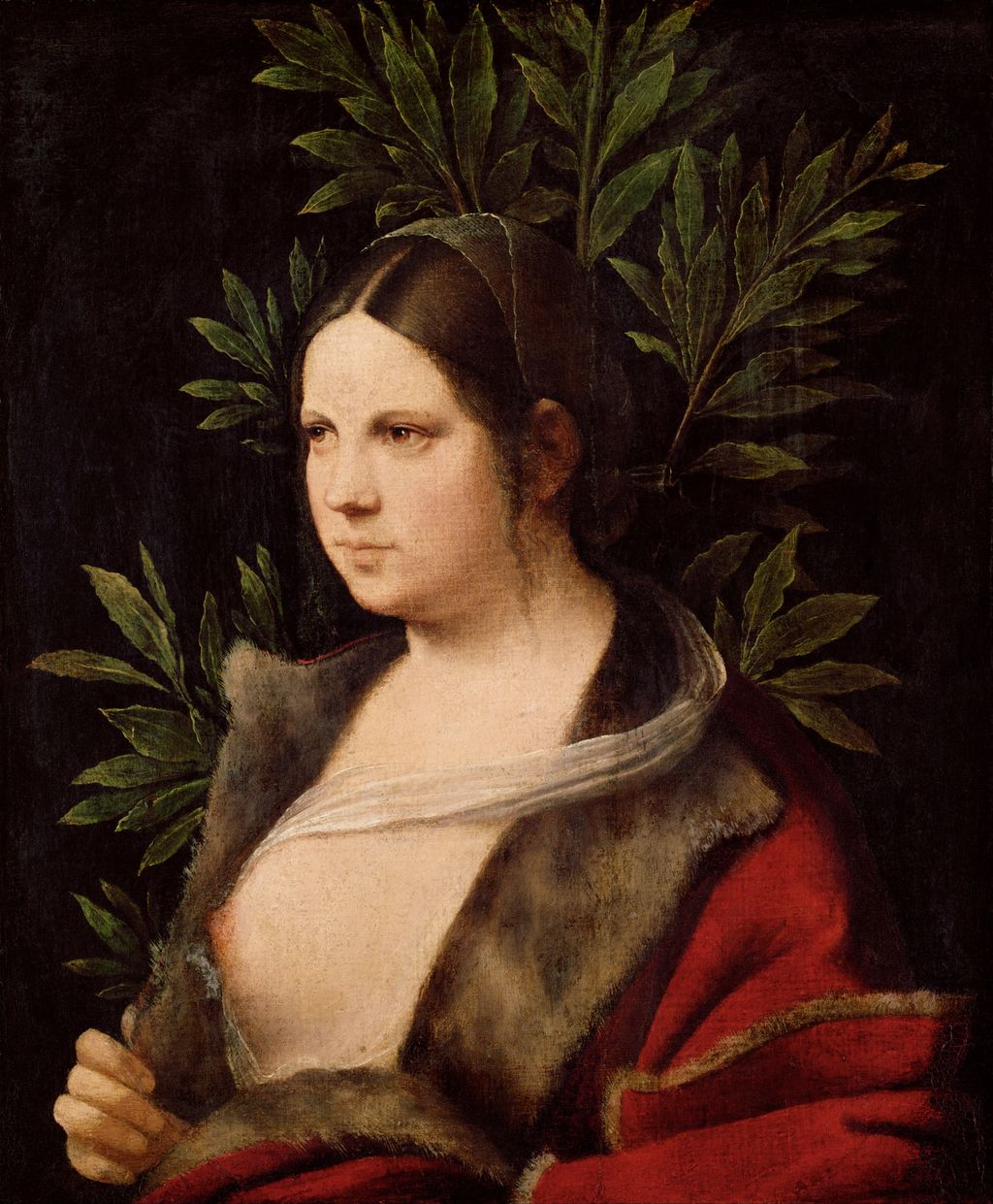
The subjects of Laura and the Vecchia make an instructive pair in the modern viewer’s imagination. In the Vienna picture face and clothing are again composed close to the surface, but the branch behind the head gives the sitter’s name its chief visible associations. The older woman is accompanied by writing that could be read in front of the picture. The Vienna woman's dated inscription is behind the painting. Two images remembered under apparently secure titles thus ask us to read them in quite different ways. The visual comparison is useful even though nothing establishes that the two were painted as companions. [1] [4]
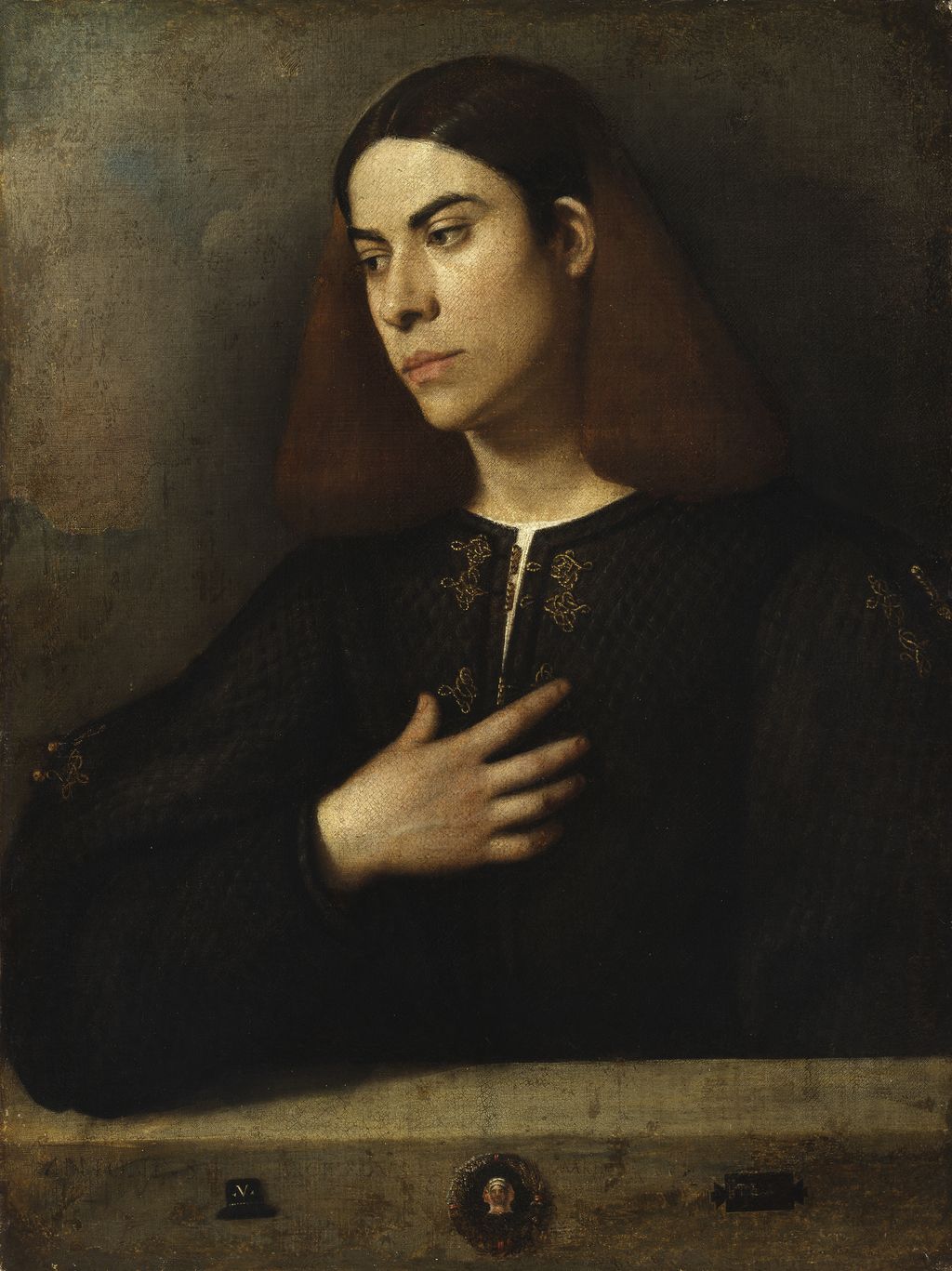
The reverse of Albrecht Dürer’s portrait of a young man gives a comparison with a different kind of explicit moral figure. There an older woman grips a money bag. The KHM links the bag and her appearance to the transience of riches and to avarice. The dated object has a portrait on one side and a moral image on the other. The older woman in Giorgione’s picture brings an inscription together with the force and scale of portraiture in one view. The change in format matters. A viewer of the Dürer has to turn the young man’s picture over to reach the second figure. When looking at the Giorgione, the face and its further appeal to the passage of time meet the eye together. [1] [5]
The Dürer also gives a useful way of testing the old frame record. Painted portraits in the period could have a reverse, cover or related object that introduced another meaning. A frame with the name or arms of a family could have helped situate an image in a collection and made the personal sense of the words clearer to early viewers. What survives of Giorgione’s canvas is enough to feel the power of its face and gesture. A related portrait by Dürer can show what kinds of encounter a painted reverse created while leaving the facts of the Vendramin display to the inventory. [1] [6] [7] [5]
The problem with calling her Giorgione’s mother
Documents made in the second half of the sixteenth century describe a picture associated with Gabriele Vendramin’s collection as the painter’s mother. The portrait now called La Vecchia has long been read in connection with that entry. Later inventory descriptions emphasise an old woman. Such a difference could reflect uncertainty about a woman’s identity, a tendency to record only the appearance a work presents, or a familiar name passing through a family’s account of its possessions. In this case we are faced with neither a name recorded on the front nor a portrait securely documented as the likeness of a particular person. [1] [6] [7]
The Accademia also discusses the suggestion that she portrays a nurse. The apparent domestic character of the clothing can support that kind of recognition. It is a way of understanding the role the woman might have had and the associations that came with it, from prudence to knowledge gained through long experience. An identification of a social type requires different evidence from naming a particular woman. The large, specific, near face and the inscription can sustain their interplay whichever kind of person originally stood before the painter. [1]
The description of the work in the 1601 inventory contains other useful evidence. The painted walnut frame with the Vendramin arms connected the object to its owner’s family. The entry also names a painted cover depicting a man in dark clothing. A covering image can change the order in which another paid-for object is encountered. If the recorded cover was used with the Vecchia, it would have made this face something revealed by an action, with one image set in relation to another. The evidence belongs to the object’s known history of keeping and display. It does not allow us to reconstruct the original ensemble or the lost man's portrait, and it leaves open whether this arrangement goes back to Giorgione. [3] [6] [7]
From a Venetian house to a public collection
The painting remained with the Vendramin collection at least to 1601. The Accademia traces it subsequently to Cristoforo Orsetti, the merchant who mentions it in his will in 1664, and then to his son Giovanni Battista. It later entered the Manfrin collection, from which the state acquired it in 1856. The early company it kept included The Tempest. Giorgione’s two pictures could be encountered as part of the same family collection, even though their seventeenth-century and modern routes to the public collection followed different courses. Early co-ownership supports a historical comparison. It gives no reason by itself to treat the paintings as a commissioned pair. [1] [7] [8]
The restoration presented before the 2019 American loans reopened questions about what generations of viewers had seen in the picture. The Ministry of Culture names Giulio Bono and Silvia Bonifacio as conservators, with Giulio Manieri Elia and Maria Chiara Maida directing the work and Ornella Salvadori directing scientific investigation. The Ministry records that the treatment lasted seven months and that the results were unveiled in Venice in February before the painting travelled to Ohio and Connecticut. The loan history is useful documentary context for photographs from the period. A photograph of the picture alongside other exhibits could show changes in the placement, lighting and distance from viewers. That version of an encounter should be read alongside the more direct treatment record when deciding what changes actually happened to the surface. The conservation and the subsequent exhibition in Cincinnati and Hartford supplied a new occasion for looking closely at the inscription, hand and face. The painting is often said to show the traces of time in its sitter. The surface showing those traces has aged too. The intervention history matters when comparing current museum views with older photographs or printed plates. [9] [10] [11]
The restored canvas makes it possible to return to the word tempo with a fresh eye. It is presented through the body of a woman who looks out, seems to speak and can acknowledge herself with a small movement of the hand. Her relation to us is the part of the picture that a viewer can still examine directly. Its title and history of ownership help place that encounter in time. Its composition allows the encounter to be immediate even today. [1] [2]
Annotated Details from Old Woman
Select a point to see its detail.
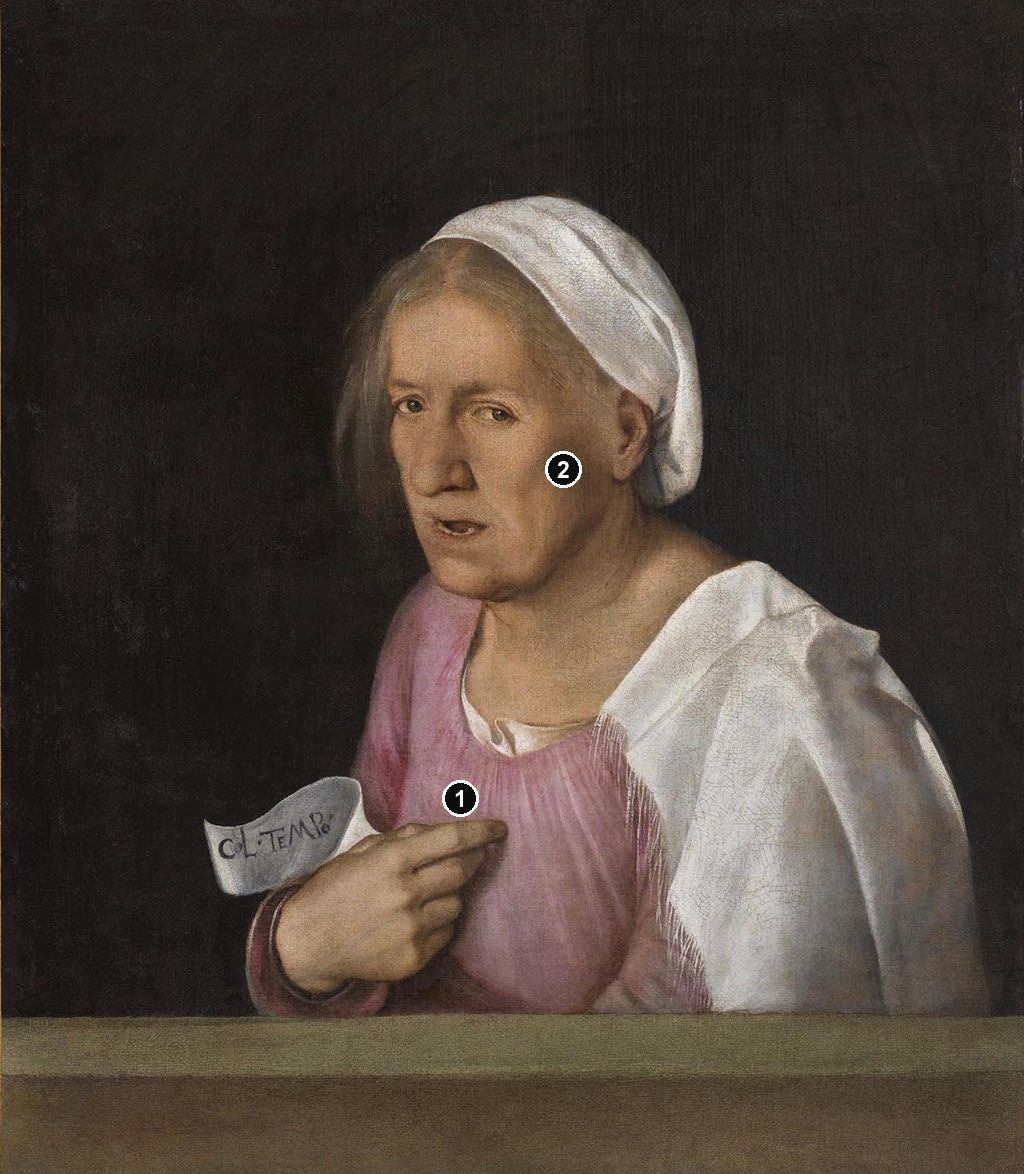
1. Col tempo · 2. Face and cap
Details from OLD WOMAN
Detail crops from the same image.
Col tempo
The small scroll concentrates the larger meditation on time into words.
Face and cap
The strongest contrasts near the brow and folded cap draw attention to changes in texture.
Giorgione’s career
Castelfranco Madonna
Early 1500sFondaco dei Tedeschi
1507–08Three Philosophers
1508–09Death in Venice
1510Discussion
Share what you noticed and how you arrived at your reading.
Reader Insights
Which detail would you point out to somebody seeing La Vecchia by Giorgione for the first time?
How does from a Venetian house to a public collection change how you read the work?
Join the Conversation
Share a detail, comparison or question about La Vecchia by Giorgione below.
References
- Gallerie dell’Accademia di Venezia, La vecchia, inv. 272. View source.
- Cincinnati Art Museum, Giorgione’s La Vecchia, exhibition record. View source.
- Ministero della Cultura, L’opera del giorno: La Vecchia. View source.
- Kunsthistorisches Museum Wien, Young Woman (“Laura”), GG 31. View source.
- Kunsthistorisches Museum Wien, Albrecht Dürer, Brustbild eines jungen Mannes and Allegorie des Geizes, GG 849. View source.
- Royal Academy of Arts, In the Age of Giorgione, exhibition portraits section. View source.
- Istituto Centrale per il Catalogo e la Documentazione, La Vecchia, national catalogue record 0500401731. View source.
- Gallerie dell’Accademia di Venezia, La tempesta, inv. 915. View source.
- Ministero della Cultura, La Vecchia di Giorgione restaurata. View source.
- Cincinnati Art Museum, Rare presentation of Giorgione’s La Vecchia, 2019. View source.
- Wadsworth Atheneum Museum of Art, Giorgione’s La Vecchia, 2019. View source.