


 by Tom Gurney
Tom Gurney BSc (Hons) is an art history expert with over 20 years experience
Published on June 19, 2020 / Updated on November 29, 2026
Email: tomgurney1@gmail.com / Phone: +44 7429 011000
Overview
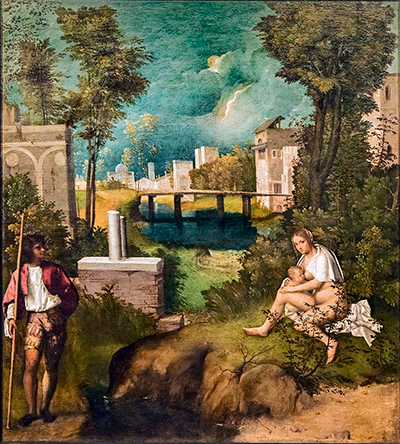
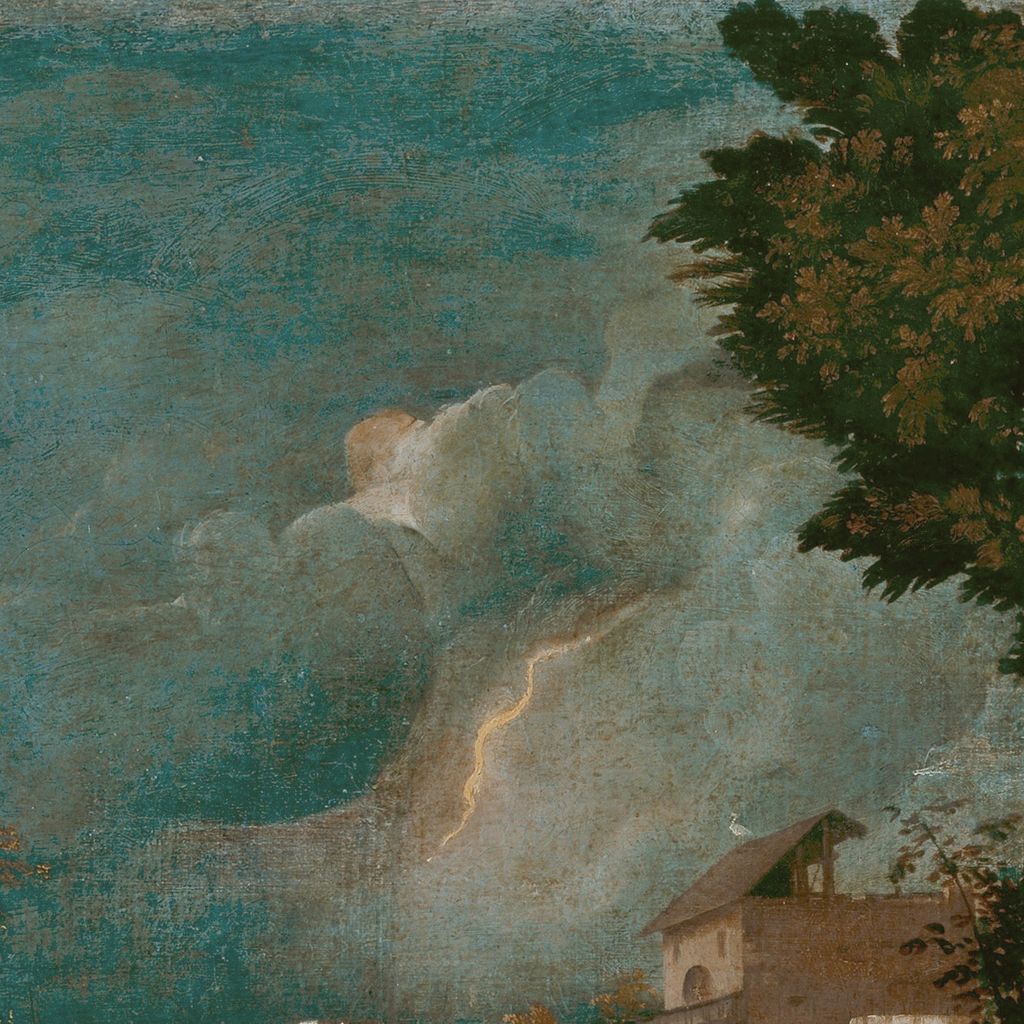
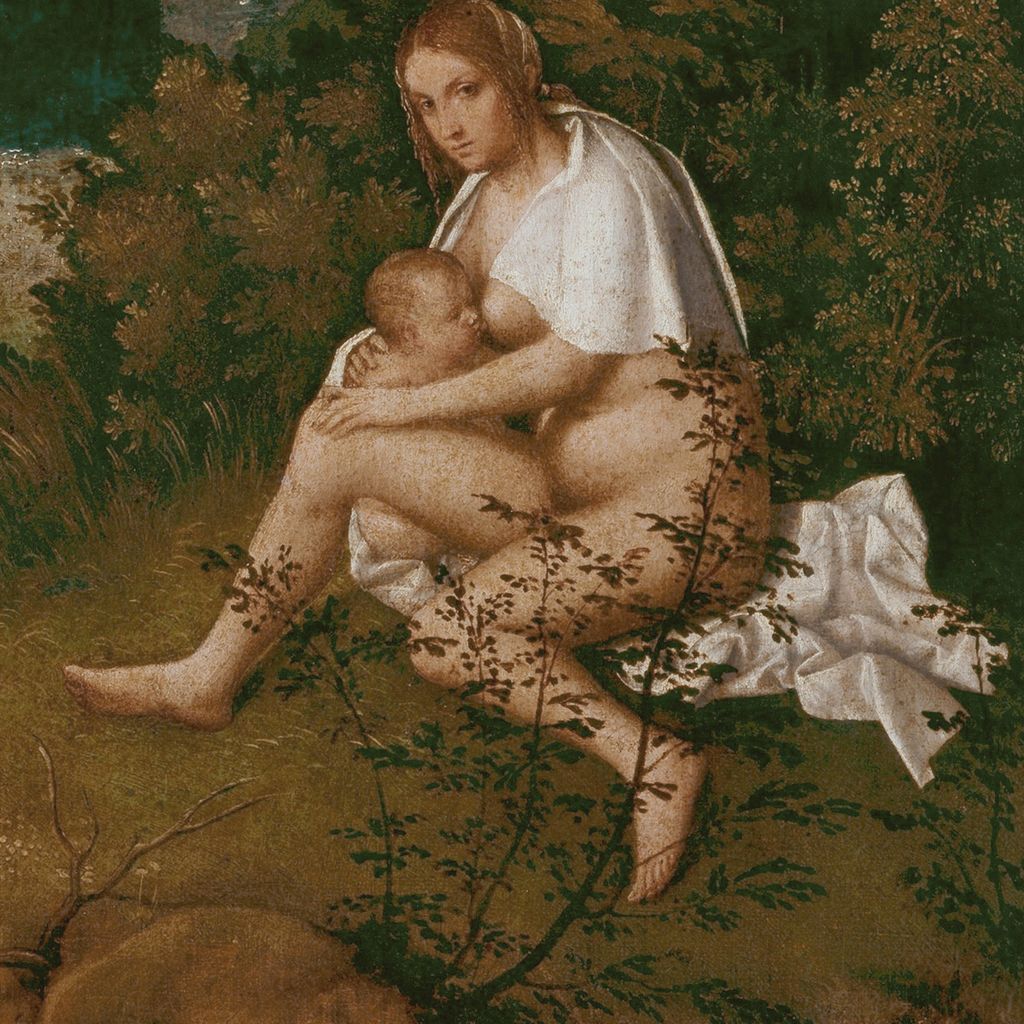
A lightning bolt makes a jagged opening in the sky. Beneath it a pale town sits above a stretch of water, with a narrow bridge just visible ahead of the buildings. In the foreground a clothed man on one bank looks across towards a woman nursing a child. She turns her gaze towards us. The people are close enough to seem part of a single encounter, but their poses and the water between them keep the relation unresolved. In 1530, the Venetian collector and writer Marcantonio Michiel found a practical way to describe the picture. He put the storm first. [1] [2]
Today The Tempest is held by the Gallerie dell’Accademia in Venice, whose catalogue lists the canvas at 82 × 73 centimetres. Its scale matters. Much of what gives it interest, from the little white marks around the buildings to the ground beside the standing figure, rewards a close approach. Seen from farther away, it is the distribution of the darks and the thin band of light in the distance that direct attention. Giorgione makes an outdoor scene feel full of a change that is still taking place. [1]
At a Glance
- Datec.1505–08
- CollectionGallerie dell’Accademia, Venice
- AttributionGiorgione
Across the banks and into the town
The man at the left holds a long staff. His near side is edged by white cloth and a warmer red. Behind him the broken stonework and fragments of columns are set close to the eye. They make it possible to judge how far away the town must be. On the other bank the woman and child sit lower amid foliage. Pale flesh and a drape emerge from the greens and browns, and the woman’s raised head gives a very small face unusual force. The staff encourages the eye to rise. Her body and the shallow bank spread out low across the right. These horizontal and vertical tendencies are part of the balance between two unequal groups. [1]
The landscape immediately behind them brings both sides together. Water reflects shapes brighter than the vegetation above them. The little bridge runs across a narrowing plane. It interrupts the recession into the town just enough for the buildings behind it to seem separate from the nearer ground. The houses, varying in height, carry fine changes of colour that distinguish lit faces from darker recesses. The city remains recognisable even with a patch of almost solid shadow on either side. Then the cloud bank above it pulls the eye back towards the lightning. Such a route through the picture can be traced without attributing a story to any of its parts. [1]
The weather seems momentary. It is also a device that holds together large areas of the design. Look at the relation between the sharp turn of the bolt and the long paler passage of the horizon. The marks have different edges and carry different kinds of light. One briefly illuminates the sky, while the other gives distance to the buildings and water. You can also see the sky through several gaps among the trees, a way of allowing the storm to move beyond the main opening in the distance. The painting draws on the Venetian cultivation of colour to make objects share an atmosphere. It lets the effect of that atmosphere shift with the order of looking. [1] [3]
The landscape also has a specific emotional direction. On the near bank the woman meets a viewer. The man remains in profile or near-profile to that encounter, and his glance appears to head towards her side of the painting. The people’s physical separation is easy to see and the purpose of their meeting is elusive. The bridge farther away offers the most obvious connection between two banks, yet the figures do not stand on it. The human action and the passage through the land are related without proceeding at the same pace. Giorgione can tell an unmistakable sacred story elsewhere. In The Tempest, the landscape gives room to a much less determinate meeting. [1] [3]
What Michiel recorded in 1530
Michiel saw the work in the house of Gabriele Vendramin. The Morelli edition prints an entry beginning el paesetto in tela con la tempesta, which can be rendered as the little landscape on canvas with the storm. Michiel then names the woman and man using the vocabulary of his own century, describing the man as a soldier and applying a period term for a Romani woman to the nursing figure. He says that the canvas was by Zorzi of Castelfranco. His description tells us what one visitor thought he saw well enough to identify the entry, even if it leaves open whom the people were meant to represent. [1] [2]
Its position among other records in the same collection also matters. Michiel was writing brief observations about objects in a particular house. Authorship, subject and memorable details could make a painting recognisable to someone with similar interests. He had less reason to set down a continuous explanation of every pictorial motif. The unusual emphasis on a paesetto makes the setting part of the work’s earliest known reception. It leaves a later scholar to ask whether the word describes its size, small scale of subject or character as a landscape. The practical power of the entry is that there are very few objects to which its combination of weather, figures, owner and maker could plausibly apply. [1] [2] [4]
Vendramin was the owner at the time of the visit. The Gallerie dell’Accademia considers a hypothesis in which he also commissioned the work and it bears on the fortunes of his family. This is plausible because ownership, interest and an intelligible family context can align. It remains a proposal about a moment before the record we have. The picture was already in the collection when Michiel came through. Other details needed to prove the first commission, such as a dated agreement or instructions for the subject, are absent from his account. The distinction matters whenever an interpretation depends on identifying a particular patron’s desired story. [1] [2] [5]
The modern museum record follows the picture from the Vendramin inheritance through later Venetian collections and places its entry into the Accademia in 1932, bought from Prince Giovannelli. Its proximity to Giorgione’s La Vecchia in museum display has a historical resonance because the two pictures were associated with the Vendramin. Their later routes into the public collection differ. The arrival date attached to the portrait, which entered the museum holdings in connection with the Manfrin collection, belongs to that object's history. One reason to consult the individual records is that ownership links can survive as accurate general recollections while dates and paths of acquisition become confused. [1] [5] [6]
The other woman beneath the paint
The difficulty of reading the subject increased when researchers discovered that the visible man is in an area that once included a very different figure. Antonio Morassi published radiographic results in 1939. They revealed traces read as a second nude woman, seated on the left beneath the present standing figure. This pentimento was a major change in the composition. It is hard to read the visible man as an unvarying element of the painter’s initial design once we know that he occupies an area previously organised around a different body. [7] [8]
An X-radiograph records differences in the materials through which the rays pass. It can preserve information about two stages at once. A readily legible published reconstruction needs decisions about where shapes begin and end and which marks belong together. It has historiographic value, especially when it shows what the first investigators believed they saw. It remains a reconstruction. A separate regional photographic catalogue records an archival item associated with the technical documentation. That record helps locate the object studied, while the article and later examinations bear more directly on what investigators made of the image. [7] [8] [9]
Later documentation has examined changes in more of the composition than the area of the left figure. Revisions were reported in discussion of the underlying layout and its landscape and architecture. It is worth keeping the methods distinct. A loss or shadow visible on a photograph, a feature in radiography and a mark revealed by infrared imaging can have different material explanations. It is also worth keeping the scope of those observations in proportion. The clearest result for a general viewer is that the foreground went through a considerable revision while the painting was being worked on. The technical history does not spell out a fixed story about why a woman was replaced by a man. Giorgione may have revised a subject, found a stronger spatial relation for his figures, or altered the image for reasons we can no longer recover. [7] [8] [10]
The change alters how we test a proposed interpretation. If the man’s presence is indispensable to a particular reading, the scholar must show why the final arrangement supports that argument. If all the meaning supposedly lay outside the relationship between the foreground figures, it remains worth asking why the change was so consequential to the final composition. Technical evidence puts a sharper edge on both questions. The two different arrangements are also a reminder that the picture's effect depends on acts of painting, revision and looking, even when the literary possibilities attract most attention. [7] [8]
Stories of exile, poetry and a threatened child
A straightforward explanation could begin by treating the picture as a narrative, with the visible figures standing for people in a prior text. Salvatore Settis’s influential proposal reads the group in relation to Adam and Eve after their expulsion. On that reading, family, landscape and the distance from the city participate in a story about human life outside paradise. The value of approaching the painting through a particular narrative is that details can be tested together. The difficulty lies in distinguishing a pattern that fits parts of the image from the evidence that would establish why Giorgione painted that pattern. Michiel’s own brief record does not identify an expelled couple. [2] [4] [11]
Rudolf Schier’s Virgilian reading makes a different use of a text. He sees the first Eclogue as a model for a pastoral world poised between the attractions of the countryside and threats from both the city and less sheltered nature. The fourth Eclogue, with its concern for the birth of a child and a future age, has a more particular relation to his account of the picture. The proposal depends on the way poetry could give a scene an organising mood and civic resonance as well as a particular literary idea. It does not require that every visible tree or wall illustrate a single line of verse. [12]
The Kirkendales have proposed a reading from Hesiod’s Theogony, associating the infant with Zeus and the attendant figures and objects with the myth’s framework. The availability of Hesiod in humanist Venice makes the proposal historically intelligible. It then has to be tested against the visual evidence, including individual identifications. Luigi Agus’s review asks whether some of the details have independent pictorial explanations. An architectural fragment may make sense as contemporary building design without also being a disguised face of a god. His argument helps to distinguish the broad plausibility of a classical source from the much narrower claim that a particular detail demonstrates that source. [11]
The museum’s proposed tie to Vendramin changes the question again. It treats the social and family setting of an early owner as part of the picture’s possible meaning. The most productive way to explore these theories is to ask what each one explains with the fewest assumptions. An exile reading gives the woman and child a named place in a story. A pastoral reading illuminates the coexistence of countryside, city and threatening weather. A Vendramin reading draws attention to an ownership link that is securely documented for 1530 and potentially older. Each account has a different kind of supporting evidence. The record of a contemporary commission or an unambiguous period title could change their relative strength. [1] [2] [5] [11] [12]
The painting’s place in Venetian landscape
The storm has a compelling role in all these readings. The painting makes light darken and flare in places far apart. In the middle distance there is a surprising brightness close to the base of the storm. The foreground remains green and comparatively dim. If the figures were removed, the uneven illumination would still lead the eye from the banks to the sky and suggest the arrival of weather. With the figures present, the same changes in light give a sense of what it might feel like to be outdoors in that interval. Their clothes, skin and surroundings make the unsettled light a shared condition, even though they make different claims on our attention. [1] [3]
A comparison with The Three Philosophers shows how varied the use of distance can be in Giorgione’s pictures. The Vienna painting holds three standing or seated figures close to a rough rock face. They dominate a much larger portion of the canvas. The landscape is an opening beside the attentive figures, and the difference between its softer distances and the dark rock is palpable. In the Tempest, the open space is between the figures and the distance comes forward through it. The arrangement contributes to the feeling that the scene might continue either across the ground or beyond the city we can see. [1] [13]
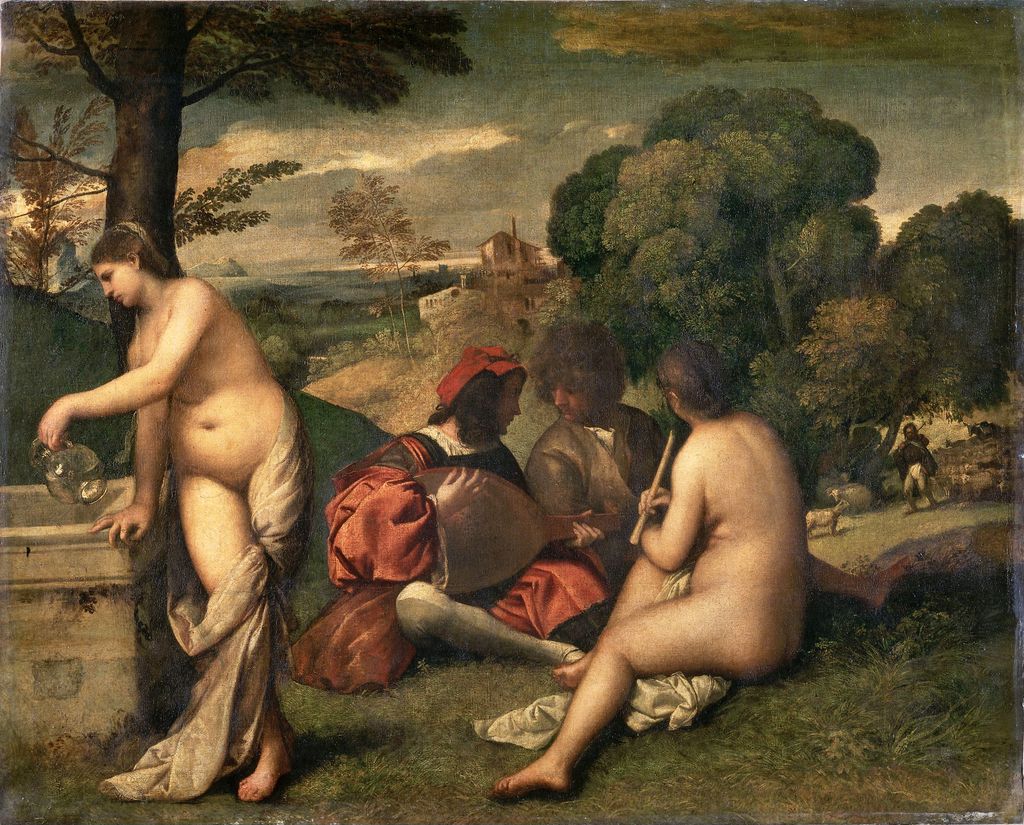
The Pastoral Concert in the Louvre is also a useful comparison, especially at the meeting of water, music and the bodies grouped in a landscape. It is currently credited to Titian. Its ownership history under Giorgione’s name makes it a record of an affinity repeatedly noticed by viewers. That affinity does not need to establish common authorship in order to reveal anything. Figures can look as if they belong to an invented country, even when the weather and surrounding features have the specificity of a witnessed view. This is one reason the Tempest’s effect survives the rise and fall of particular solutions to its subject. [1] [14]
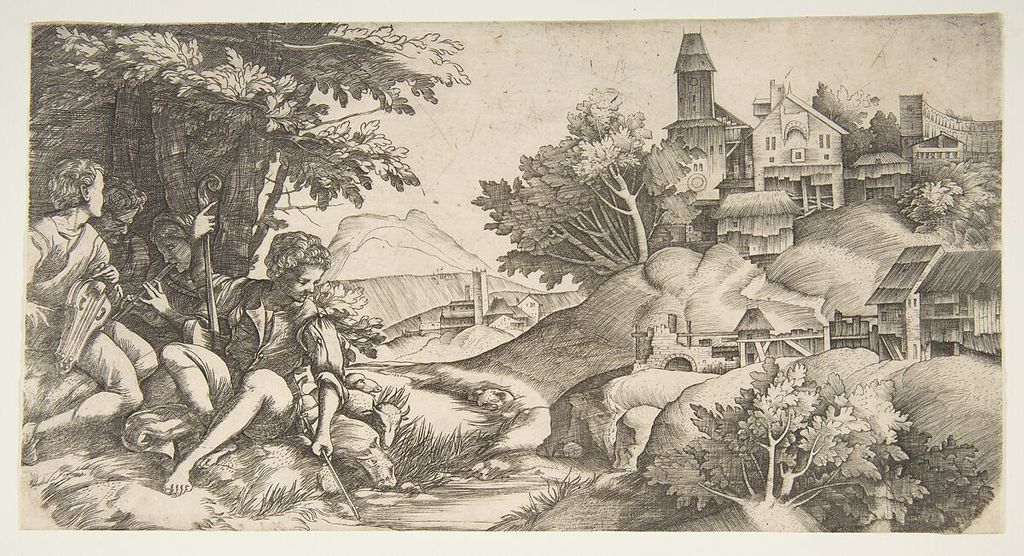
The Campagnola engraving of shepherds playing music beneath trees offers a useful comparison in a different medium. The print pairs a shaded gathering on the left with a much more open terrain on the right. Far up the slope the houses are small enough to read as a distant world of people and work. The people under the tree establish a place for looking out towards it. Fine strokes take the place of the changes in colour that carry a viewer through Giorgione’s canvas. The distribution of masses, from dark wood to a pale and open margin, still does much of the work. Cleveland’s impression is catalogued as a composition begun by Giulio Campagnola and finished by Domenico. The close comparison rests on related interests in an inhabited landscape. It gives no reason to treat the print as an exact model for the Tempest. [15]
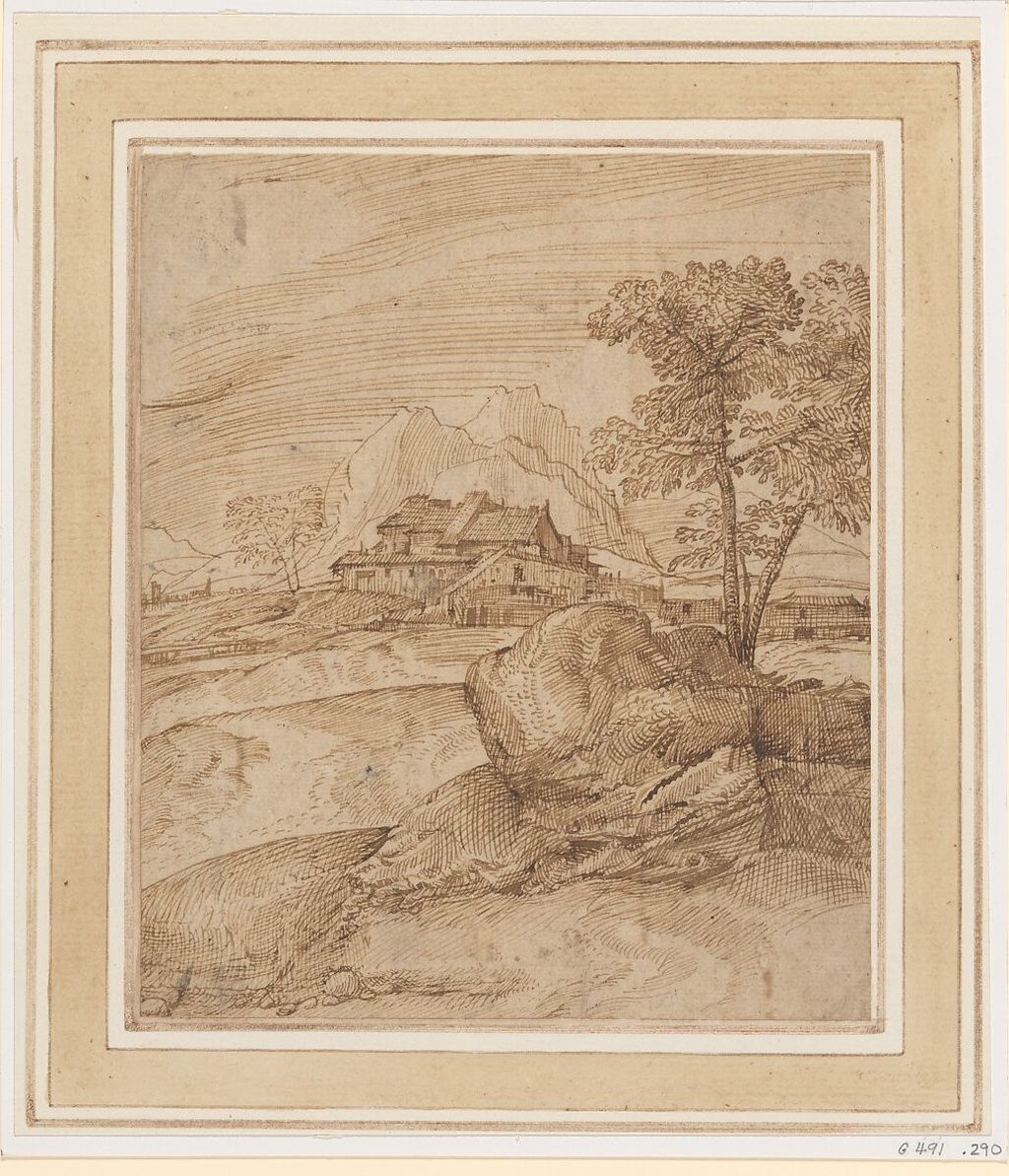
Domenico’s drawing of a mountainous landscape in the Met centres on a combination of built and natural forms. Small marks around buildings and foliage settle into a whole terrain as the eye moves away from the paper. That visual economy helps explain why the bridge and towers in the Tempest can have such presence at so small a size. Giorgione’s buildings are recognisably made for people. Their weight against the sky and the fact that they stand at a remove from the foreground encounter give them another function. They set the proportions of a world in which a short-lived storm can seem to bear down on an entire settlement. [1] [16]
A return to the museum canvas can begin with the smallest parts. Start at the edge of the white around the child and follow the water under the bridge. Look for the thin breaks in the dark ground where another colour comes through. Then look again at the lightning and the buildings it almost touches. The figures have their own distances from us and from one another. The space between them keeps the encounter open. The old inventory phrase has held its place because the effect it identifies is so precisely made. The painting preserves the bare instant of a flash in a landscape where the eye feels it already has a history. [1] [2]
Annotated Details from Tempest
Select a point to see its detail.
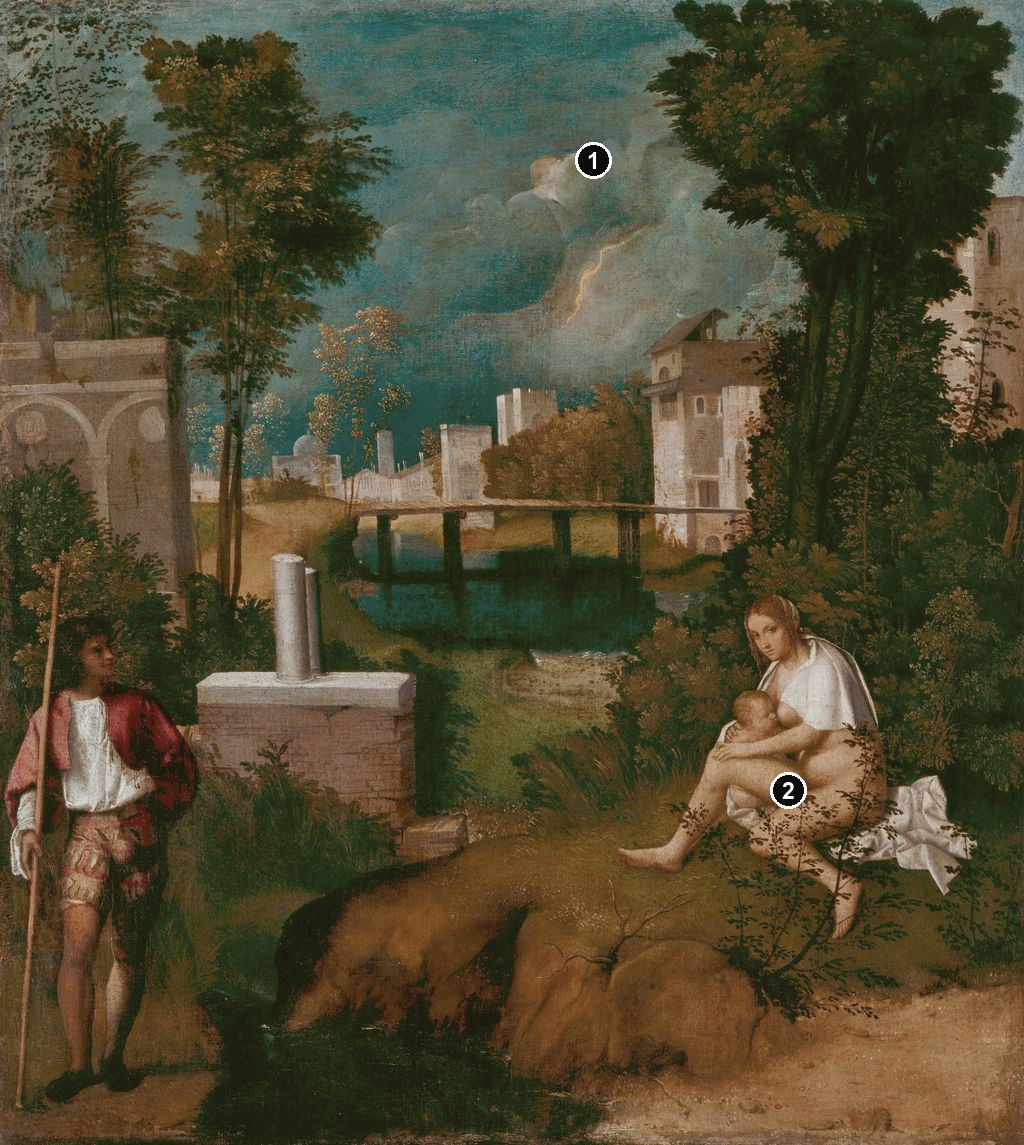
1. Lightning · 2. Mother and child
Details from TEMPEST
Detail crops from the same image.
Lightning
The zigzag divides the clouds above the roofs and trees.
Mother and child
The nursing group occupies the opposite bank from the solitary standing man.
Giorgione’s career
Castelfranco Madonna
Early 1500sFondaco dei Tedeschi
1507–08Three Philosophers
1508–09Death in Venice
1510Discussion
Share what you noticed and how you arrived at your reading.
Reader Insights
Which detail would you point out to somebody seeing The Tempest by Giorgione for the first time?
How does the painting’s place in Venetian landscape change how you read the work?
Join the Conversation
Share a detail, comparison or question about The Tempest by Giorgione below.
References
- Gallerie dell’Accademia di Venezia, La tempesta, inv. 915. View source.
- Marcantonio Michiel, Notizia d’opere di disegno, Opere in Venezia, Vendramin entry, Morelli edition, 1800, p. 80. View source.
- National Gallery, London, Giorgione. View source.
- Simone Facchinetti and Arturo Galansino, eds., In the Age of Giorgione, Royal Academy of Arts, 2016. View source.
- Ministero della Cultura, Gallerie dell’Accademia di Venezia, La Tempesta di Giorgione, discussion of patronage. View source.
- Gallerie dell’Accademia di Venezia, La vecchia, inv. 272. View source.
- Antonio Morassi, Esame radiografico della “Tempesta” di Giorgione, Le Arti 1, no. 6, 1939, pp. 567–570. View source.
- Jaynie Anderson, Giorgione, Oxford Bibliographies in Art History, conservation and attribution section. View source.
- Catalogo generale dei Beni Culturali, Photographic heritage record CRV-F_0031668, technical documentation of the Tempest. View source.
- Università Ca’ Foscari Venezia, Conservation thesis discussing technical reports on the Tempest, pp. 147–149 and cited Accademia exhibition documentation. View source.
- Luigi Agus, La Tempesta di Giorgione e la Teogonia di Esiodo nel volume di Ursula e Warren Kirkendale riedito in forma aggiornata, Papireto 2, 2023, pp. 249–253. View source.
- Rudolf Schier, Giorgione’s Tempesta: a Virgilian pastoral, Renaissance Studies 22, no. 4, 2008, DOI 10.1111/j.1477-4658.2008.00494.x. View source.
- Kunsthistorisches Museum Wien, Die drei Philosophen, GG 111. View source.
- Musée du Louvre, Titien, Le Concert champêtre, INV 71. View source.
- Cleveland Museum of Art, Giulio and Domenico Campagnola, Shepherds in a Landscape. View source.
- Metropolitan Museum of Art, Domenico Campagnola, Mountainous Landscape with a Rock, Trees, and Buildings. View source.