


 by Tom Gurney
Tom Gurney BSc (Hons) is an art history expert with over 20 years experience
Published on June 19, 2020 / Updated on November 29, 2026
Email: tomgurney1@gmail.com / Phone: +44 7429 011000
Overview
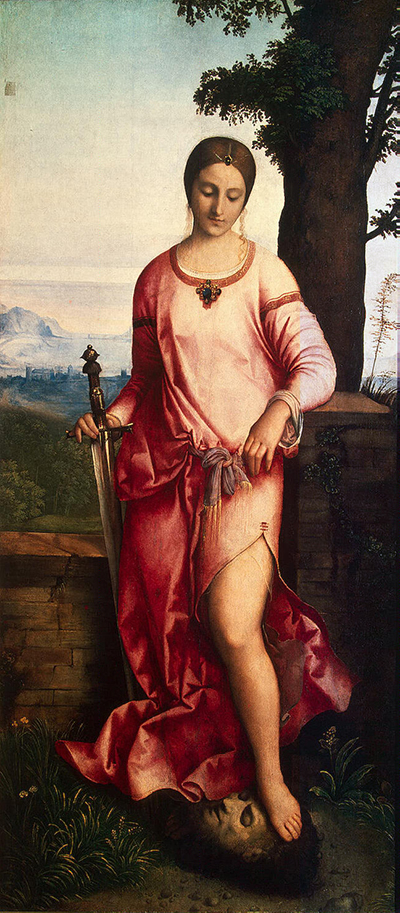
Judith stands in the open air with a sword hanging from her hand. One foot rests on the head of Holofernes. Behind her the land opens towards a quiet distance, with trees and buildings in light that has scarcely any of the violence suggested by the object at her feet. Giorgione chose the stillness after the deed. The entire scene is built around the relation between a slender upright figure, an instrument of action that is no longer in motion and the land into which a viewer can look beyond them. [1] [2]
The painting is now in the State Hermitage Museum in Saint Petersburg, inventory number 95. The collection catalogue gives its dimensions as 144 × 68 cm. The painted layers were transferred from a wooden panel to canvas. Dates proposed for the work tend to place it around or shortly after 1504. The approximate date and the original support are useful when comparing the picture with other early Venetian work. The current shape, the exposed paint and the certainty of modern museum attribution each have separate histories. [1] [2] [3]
At a Glance
- Datec.1504
- CollectionState Hermitage Museum, St Petersburg
- AttributionGiorgione
The figure after the action
In the Book of Judith the danger is to a city. The Jewish heroine goes into the Assyrian camp, gains access to Holofernes and returns after killing him. The act turns the fortunes of Bethulia. Giorgione offers little of the crowded and unstable scene that can be made from that part of the story. There is no visible companion or soldier. Judith has space on either side of her figure and her weight settles over one leg. The head at her foot names the terrible success of her act, while the tall enclosure and open background give the rest of the painting quite a different speed. [1] [2] [4]
The sword helps determine how that stillness feels. It has a surprising length, with a pale edge that can be followed down. The hand holds it rather than flourishes it, and its direction runs close to the longer axis of the canvas. An act that needs movement has already happened. Now the weapon forms a line that draws attention down through the body and back to the head. At the same time, the gown has numerous more complex edges that spread around her bent knee. The single long edge of the sword and the many softer lines of the clothing carry the action and the remaining quiet in different ways. [1] [2]
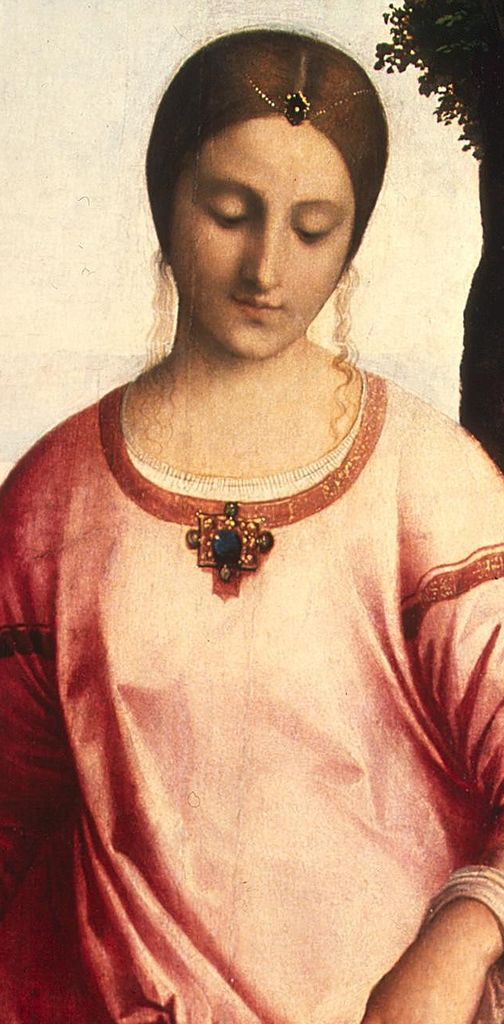
Judith's face tilts and her eyes lower. It is possible to read concentration or inwardness into this expression, but the painting does not give us the kind of accompanying rhetoric that would decide what emotion she is meant to convey. The scene’s distance from the action is sharper because of her proximity to us. The head of the general is near enough to register as a face. The woman occupies her place on the ground with a calmness that is severe as well as graceful. The Russian Hermitage account finds a poetic and reflective tone in the landscape and figure. The leafy line of the wall and the more open, light-toned distance are active parts of that tone. [1]
A narrow picture with a broader history
The proportions are unusually tall and slender. Even if the exact width of the first painting remains uncertain, the format changes how the episode is represented. It makes the distance between Judith’s head and Holofernes’ the strongest measure of the image. There is room for the background to wrap around the standing figure, especially in the visible openings by the wall, but it never develops into a continuous lateral spectacle. A more horizontal arrangement could have offered a bed, tent and other participants. Here the figure has enough space to feel erect and alone. [1] [2] [3]
The Hermitage catalogue describes marks for hinges and traces of a square fitting for a lock visible before transfer. It proposes that the painting may have been used as the door of a cupboard or aumbry. This is evidence of physical use, with limits. A fitting could have been put onto a panel at the time of painting, or it could record a later adaptation. The evidence does not identify a specific church, household or cabinet or prove that the present dimensions are exactly those of a door that someone first commissioned. It opens a valuable question about what happened to pictures before they reached the kind of collection in which a viewer could encounter them in a fixed frame. [2] [3]
Ivan Sablin’s study of the narrowing of the work follows traces of earlier widths and changes to the edges. Reproductive prints and drawings matter to such a question, since they can preserve details no longer visible or suggest a different relative width. They need careful handling too. A printmaker may trim an edge, reverse a composition or leave out an area of vegetation. The engraver’s dimensions, the outline of a drawing and the current support can therefore differ for several reasons. Putting their evidence together offers more information than treating the most extensive known reproduction as a precise plan of every lost margin. [3] [5] [6]
Sablin compares the current proportions with the larger painting implied by Larcher’s engraved image. He calculates a difference of about seventeen centimetres in width and offers a nineteenth-century window for the change on the evidence of successive catalogues. He also discusses a proposal by curator Franz Labensky to remove what Labensky believed were later additions. Those proposals tell us something specific about the motivations of past custodians, who could consider an apparent enlargement a thing to correct. The document does not record when the cutting was done or definitively settle which edges the original painter supplied. Moving the paint from the original board to canvas complicated that physical question because the original wooden support could no longer be inspected intact. [2] [3]
The colour history makes a second difference. Sablin reports on the conservation of 1968–71 and cites T. D. Fomichova’s account of removing discoloured varnish. The treatment exposed cooler relations and stronger differences between colours than earlier viewers had described. This matters for critical language about the picture’s warm “Venetian” glow and for contemporary photographs made from different reproductions. In the current painting the garment, stone, distant air and skin ask for close comparison in their own right. Some early critics saw a much warmer common cast across those parts of the picture. The timing of their observations is part of interpreting them. [3]
The older name of Raphael
In the early eighteenth century the painting was associated with the French collector Pierre Crozat and classed as Raphael. One way to see how such an attribution travelled is to look at Antoinette Larcher’s engraving, catalogued as part of the Recueil Crozat. The Royal Collection identifies the reversed print as an image after the painting now in the Hermitage. Other institutions preserve impressions with the old Raphael attribution. The print does two things at once. It records a recognisable composition as it entered circulation among viewers and gives access to a name under which some of those viewers would have known it. [5] [7]
A drawing catalogued at Christie’s under Jan de Bisschop is another witness to the circulation of the subject and attribution in northern Europe. Its Raphael inscription belongs to the history of recognition. The auction catalogue points to differences between the drawing, the engraving and the canvas, including ivy in the drawing that does not appear in the same way in Larcher’s plate. This comparison illustrates what physical evidence and careful photography can add to the history of one work. When adjacent witnesses preserve different details, they can help us ask which belong to changes in the original and which are choices of media or individual copyists. [5] [6]
The picture passed to Catherine the Great’s collection in 1772 from the Crozat holdings. The museum’s current record and its published catalogue attribute it to Giorgione. The latter credits Karl von Liphart with the nineteenth-century suggestion, an assessment that shows how the painting came to sit within a different history of Venetian landscape and figure painting. The earlier name remains part of the story of the object. A visitor today may first see the work as a Giorgione, while readers of the eighteenth-century prints or inventories could have brought very different pictures to mind when looking at the woman and her surroundings. [1] [2] [5] [8]
Other ways to show Judith
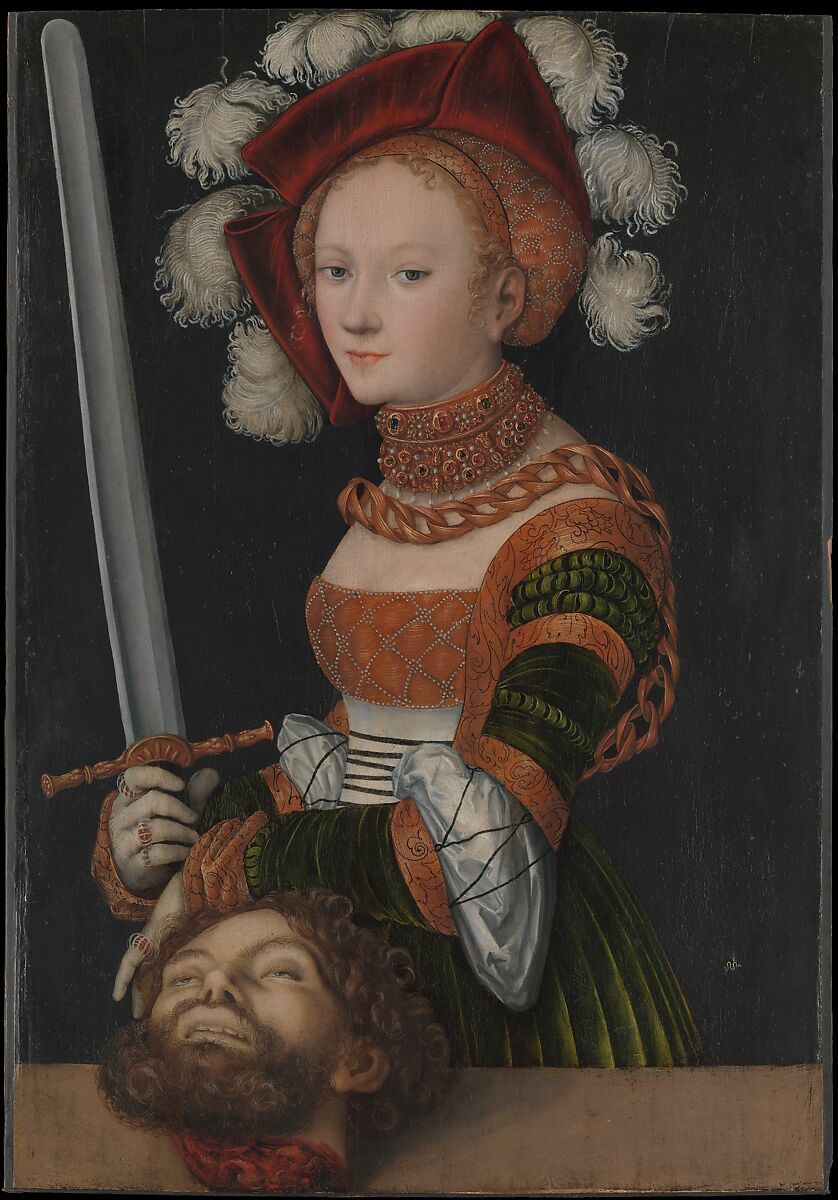
A comparison with Lucas Cranach the Elder’s Judith with the Head of Holofernes makes the equipment of this Judith’s role especially clear. The Metropolitan Museum’s Cranach uses an elaborately dressed half-length figure with the sword and head visible close to the same plane, amounting to a quite different relation between body, weapon and viewer. In Giorgione’s work a full figure stands at a greater remove. The extended height lets the head of the general remain far below the heroine and allows one’s gaze to travel round them through the scene. The role of costume changes too. The sharper display of textiles and adornment in Cranach places more emphasis on the visible appearance and social authority of the woman. [1] [9]
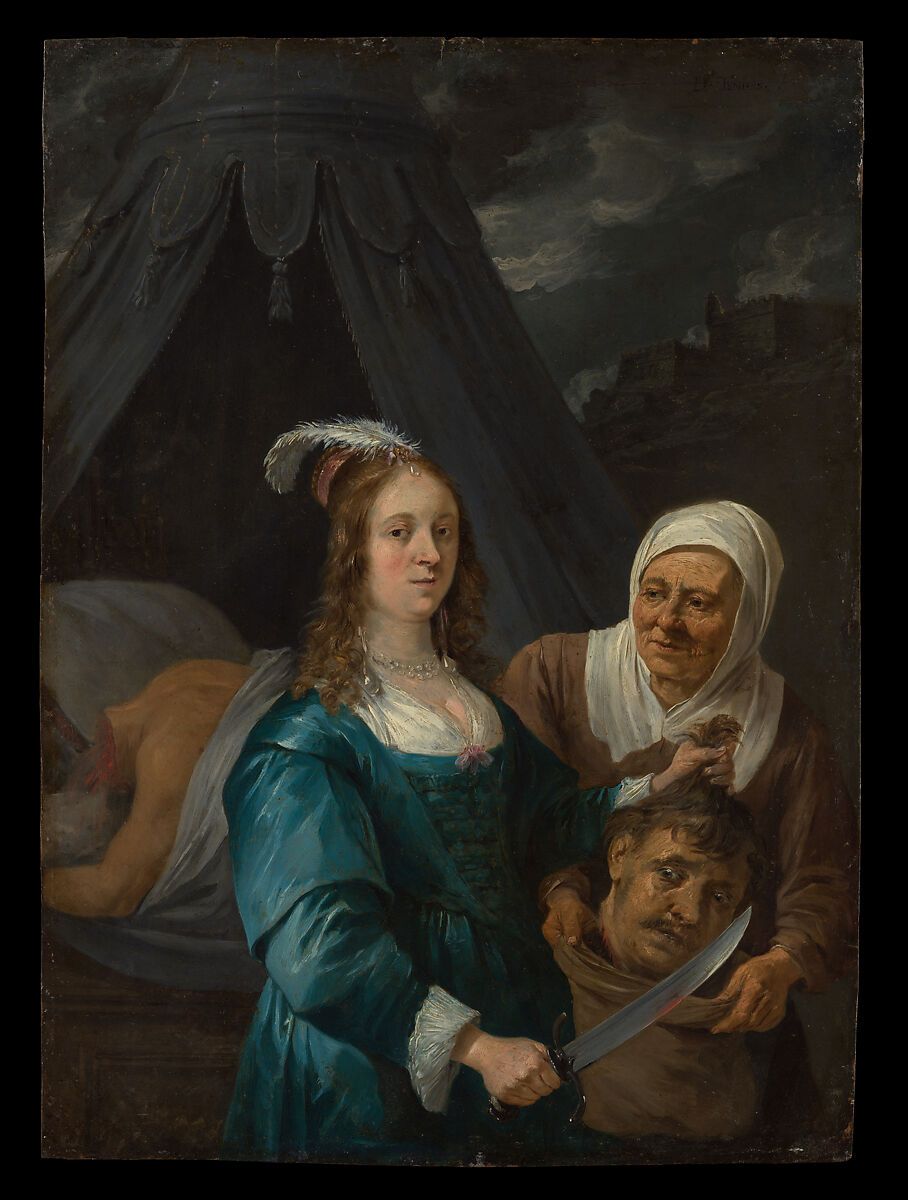
David Teniers the Younger’s oil on copper in the Met puts Judith with her maid and lets her display the head as a trophy. The differences of scale and surface make this an especially useful comparison. Copper makes a small and smooth support on which the painter can show several people and detailed actions. Giorgione had a narrow panel and a much longer bodily line to organise. These are separate compositions of the same story. The head, gesture and use of a secondary figure can do a different job in each case, even when the subject announced by the title is identical. [1] [4]
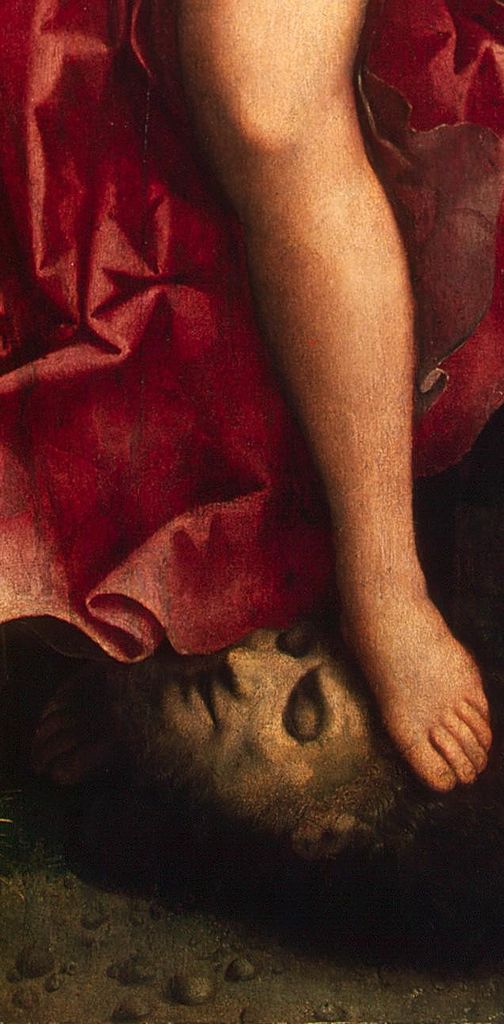
The Hermitage catalogue has also remarked on a resemblance between its Holofernes and images associated with Giorgione's own likeness. Some self-portrait traditions themselves depend on fragmentary objects and later reproductions. A resemblance can therefore raise a question without demonstrating the historical identity of the face that Judith stands above. The visibility of the general’s features, and the way they seem within reach of the heroine’s foot, are firmer grounds for understanding the role he plays after his defeat. [2] [10]
The singularity of Giorgione’s treatment comes into focus when the physical distance between the two heads is taken seriously. The woman passes something like the length of her whole body above the object that tells us what story we have entered. The landscape broadens while the subject settles. The silhouette, sword and step from ledge to distance still make a complete experience of the moment when action falls quiet. [1] [2]
Annotated Details from Judith
Select a point to see its detail.
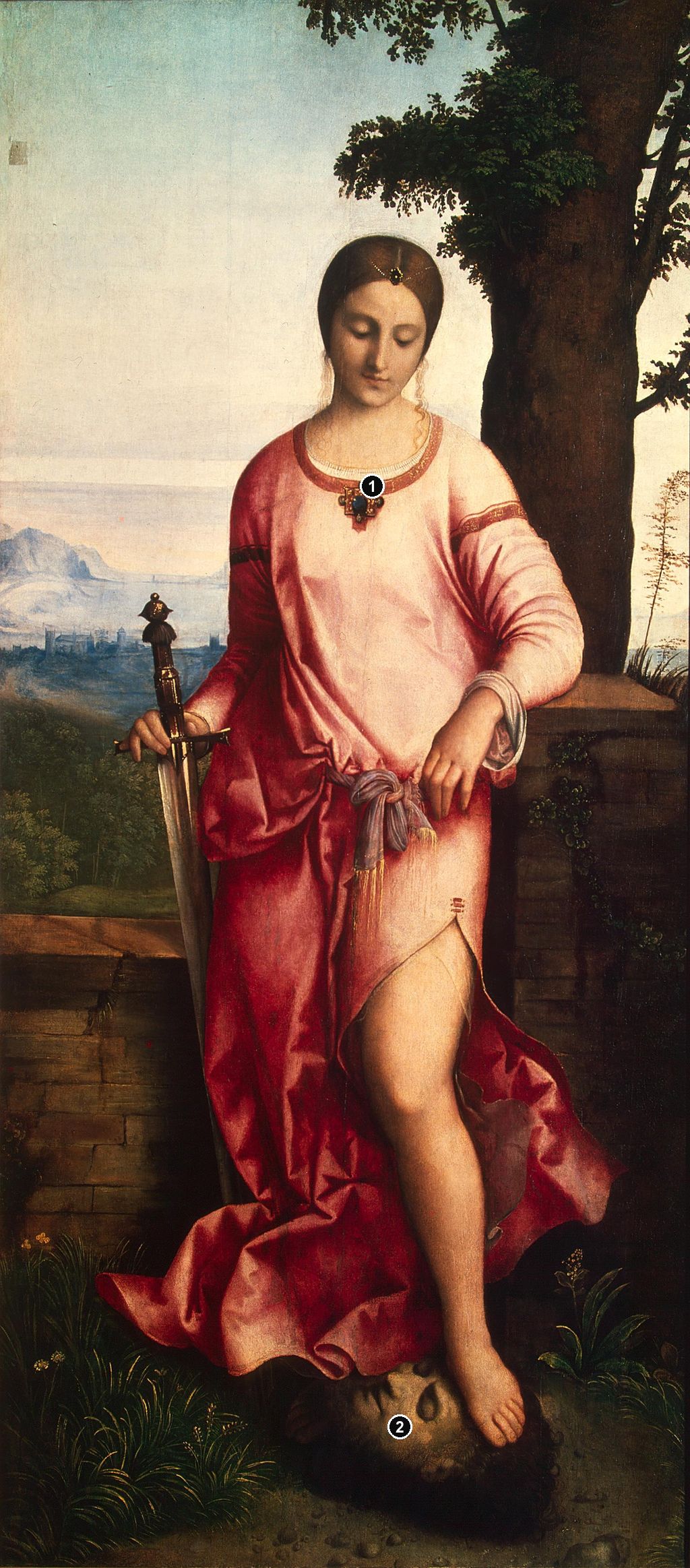
1. Judith’s lowered gaze · 2. Holofernes
Details from JUDITH
Detail crops from the same image.
Judith’s lowered gaze
The woman’s quiet expression holds the violence of the story at a distance.
Holofernes
The severed head lies at her foot within an area affected by the picture’s changing format.
Giorgione’s career
Castelfranco Madonna
Early 1500sFondaco dei Tedeschi
1507–08Three Philosophers
1508–09Death in Venice
1510Discussion
Share what you noticed and how you arrived at your reading.
Reader Insights
Which detail would you point out to somebody seeing Judith by Giorgione for the first time?
How does other ways to show Judith change how you read the work?
Join the Conversation
Share a detail, comparison or question about Judith by Giorgione below.
References
- State Hermitage Museum, Юдифь, digital collection record 32196. View source.
- State Hermitage Museum, Western European Art, Judith, inv. 95, collection catalogue, no. 9. View source.
- Ivan D. Sablin, The Narrowing of Giorgione’s Masterpiece: To the Problem of the Hermitage Judith’s Original Measurements, International Journal of Art and Art History 5, no. 2, 2017, pp. 13–18. View source.
- Metropolitan Museum of Art, David Teniers the Younger, Judith with the Head of Holofernes. View source.
- Royal Collection Trust, Antoinette Larcher, Judith, RCIN 850172. View source.
- Christie’s, Jan de Bisschop, Judith with the Head of Holofernes, after Giorgione, lot catalogue. View source.
- Hessen Kassel Heritage, Antoinette Larcher, Judith, engraved inscription. View source.
- Hermitage Foundation UK, Judith by Giorgione and the history of Catherine’s acquisition. View source.
- Metropolitan Museum of Art, Lucas Cranach the Elder, Judith with the Head of Holofernes. View source.
- Herzog Anton Ulrich-Museum, Braunschweig, Giorgione, Selbstbildnis als David. View source.